RMK College of Engineering and Technology
EC6014
Cognitive Radios
Department
of
Electronics and Communication Engineering
Unit 1
SDR Architecture
Syllabus
• Essential functions of the software radio,
• Basic SDR,
• Hardware Architecture,
• Computational Processing Resources,
• Software Architecture,
• Top Level Component Interfaces,
• Interface Topologies Among Plug and Play Modules,.
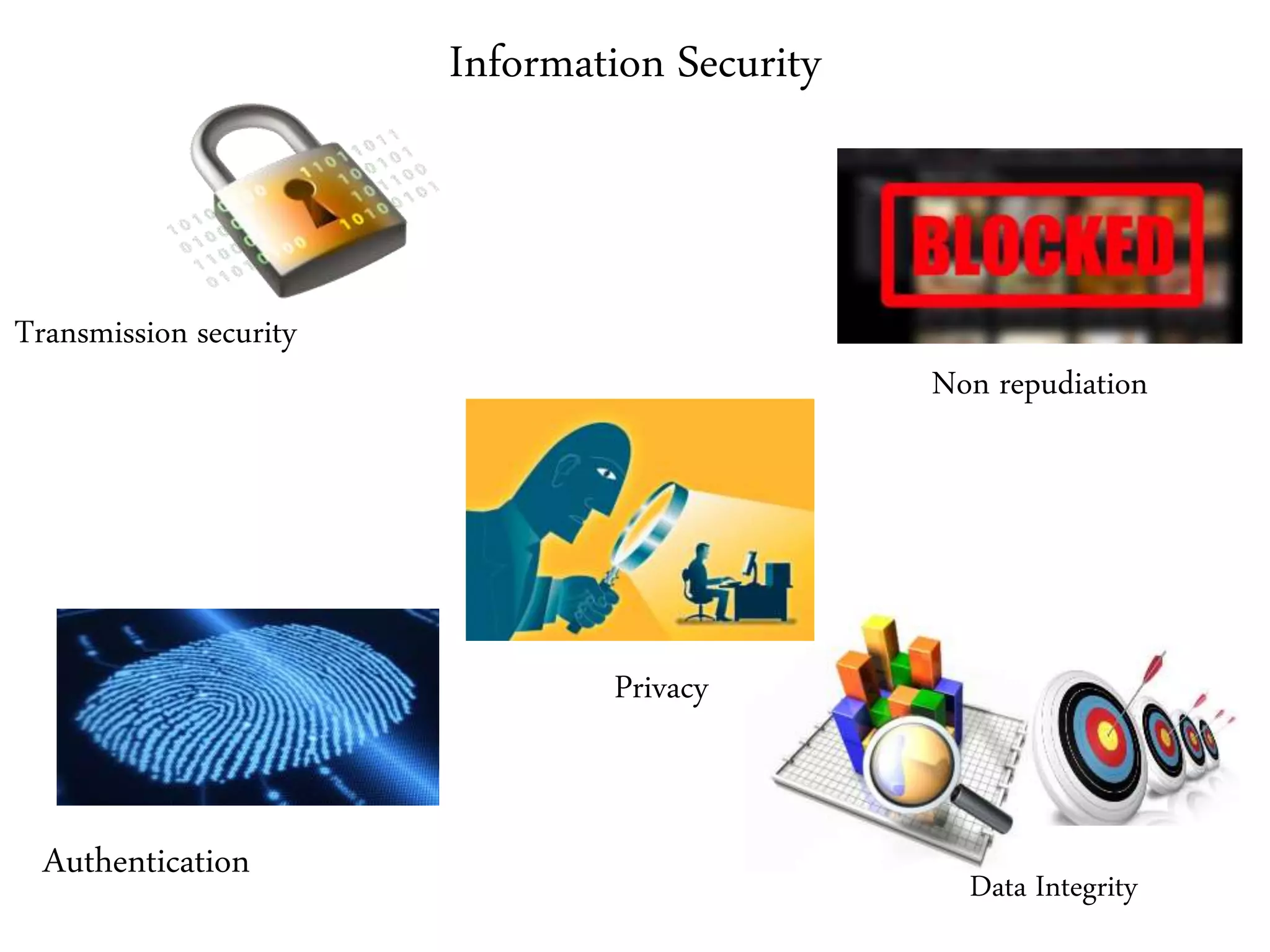
Information Security
Transmission security
Authentication
Non repudiation
Data Integrity
Privacy
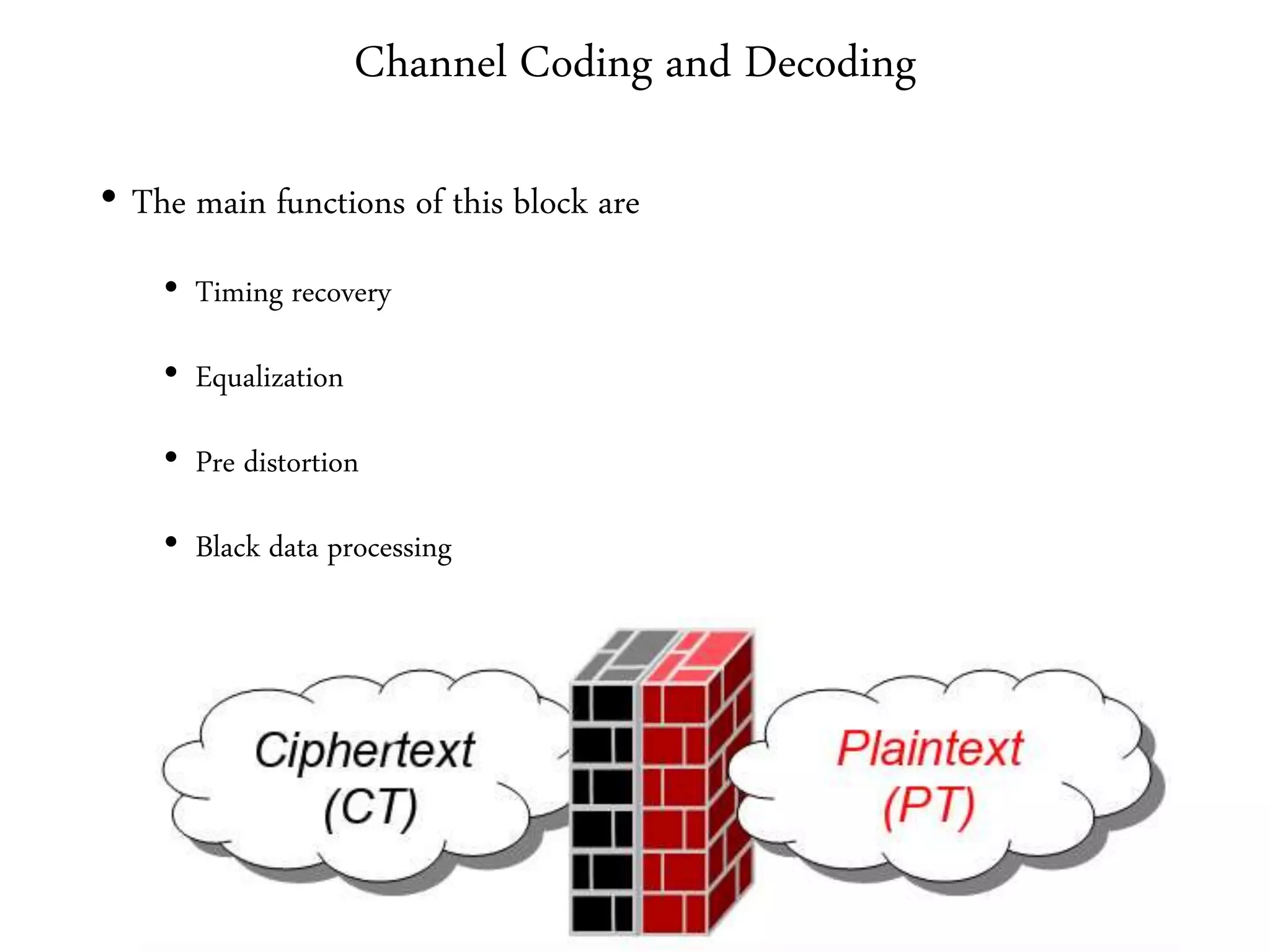
Channel Coding and Decoding
• The main functions of this block are
• Timing recovery
• Equalization
• Pre distortion
• Black data processing
RF Access
Diversity
Antenna Selection
RF to IF Conversion
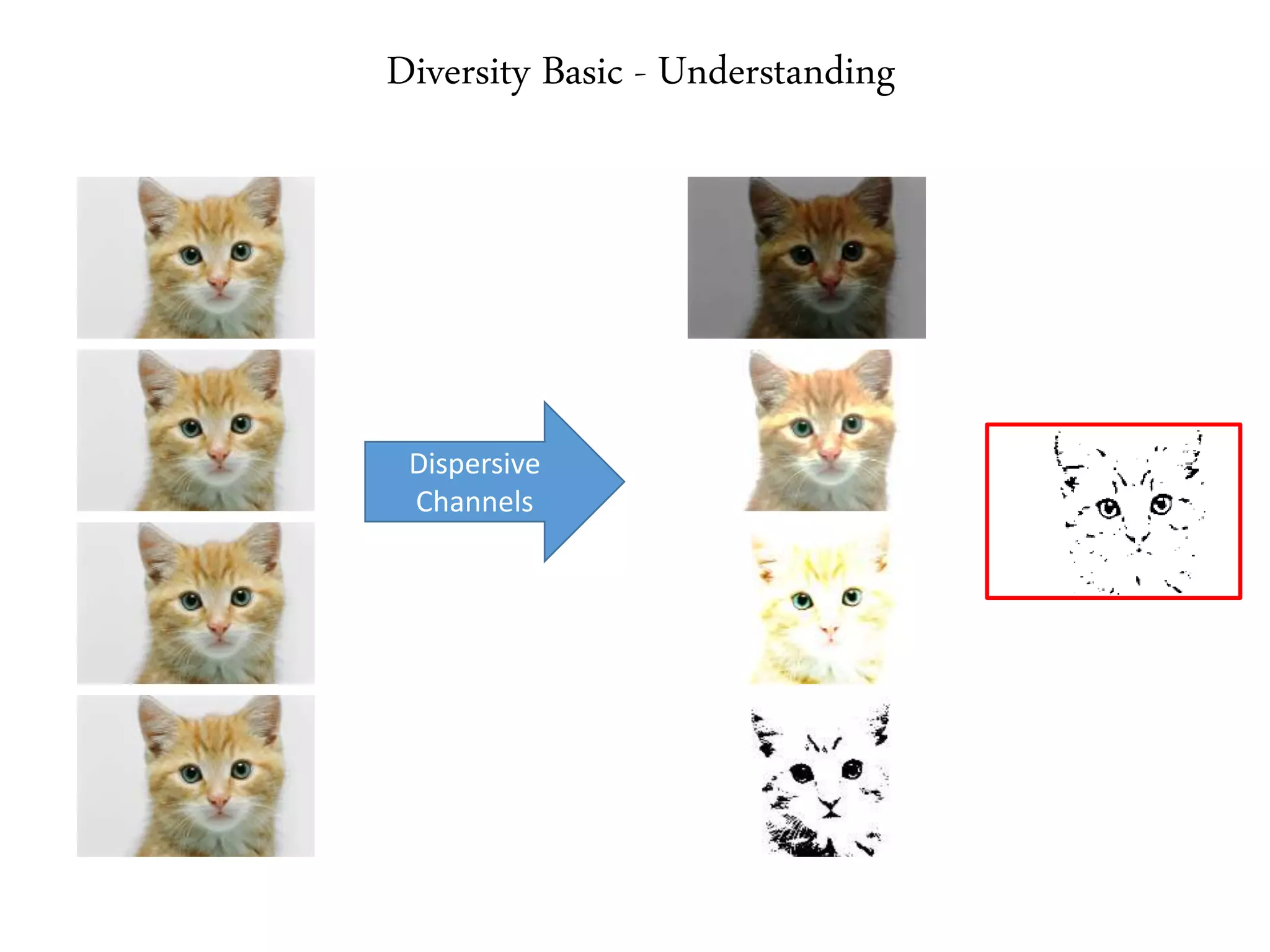
Diversity Basic - Understanding
Dispersive
Channels
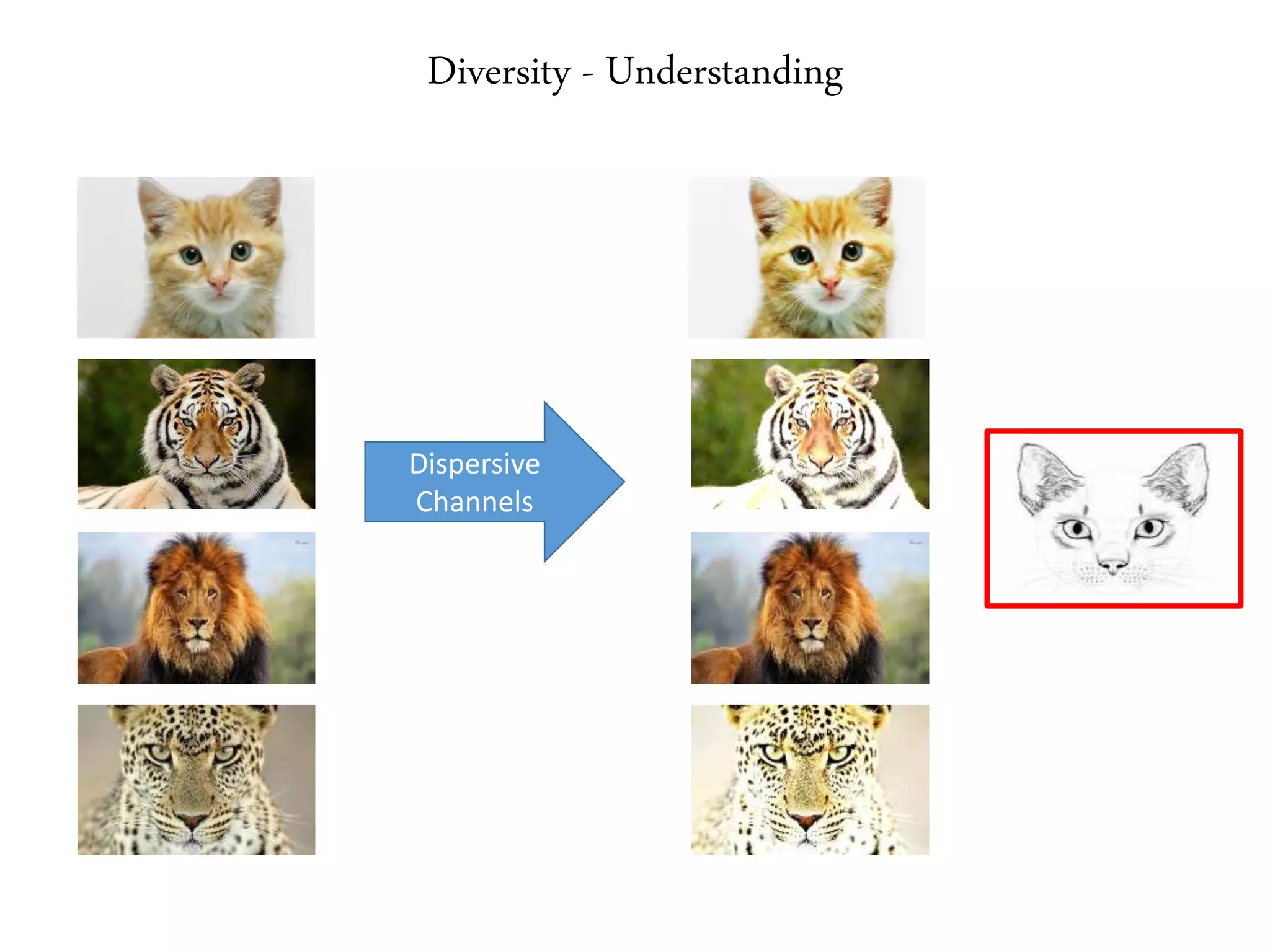
Diversity - Understanding
Dispersive
Channels
Diversity - Principle
• The principle of diversity is to ensure that the same information reaches the receiver on a
statistically independent channels.
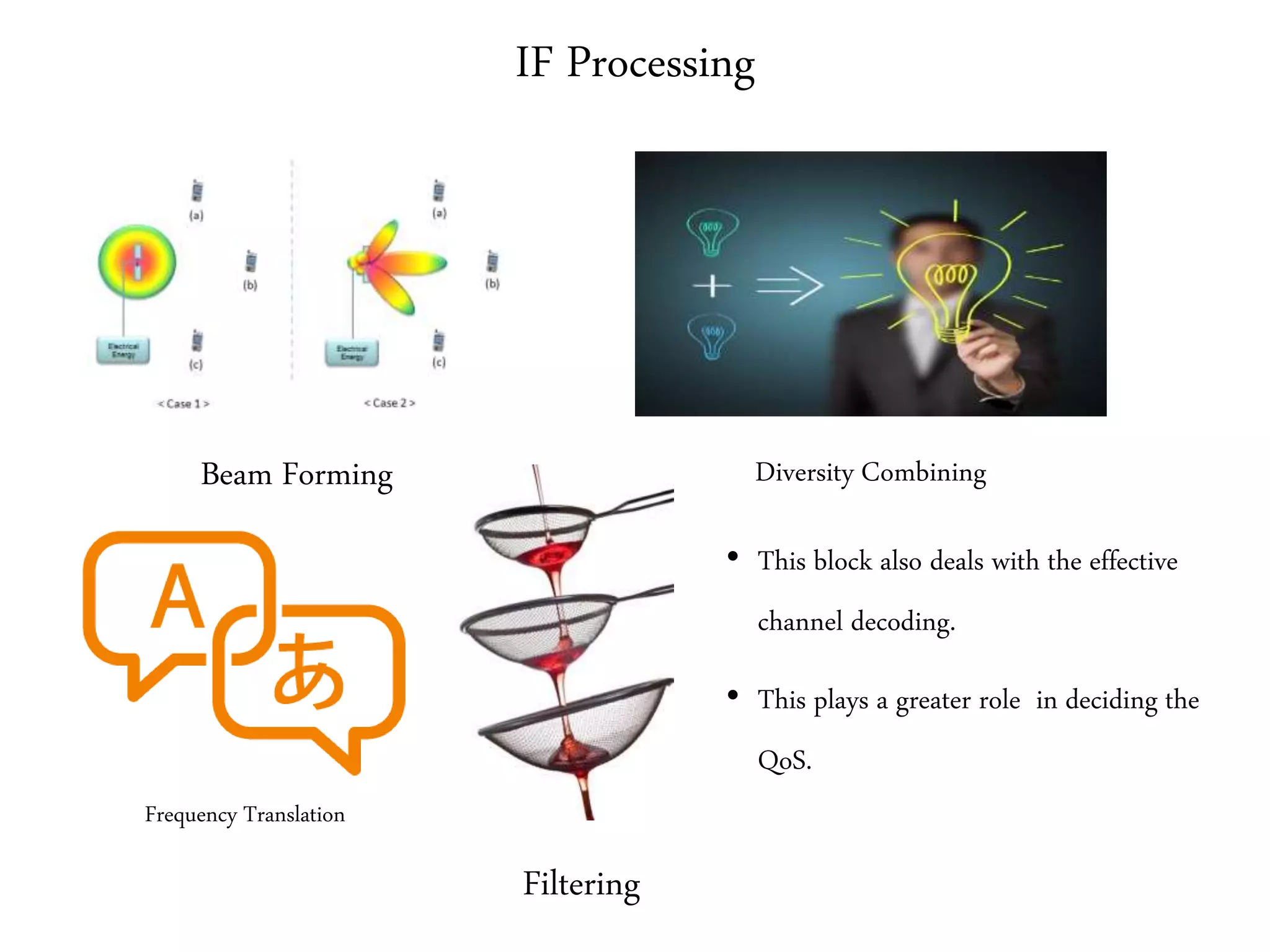
IF Processing
Beam Forming
• This block also deals with the effective
channel decoding.
• This plays a greater role in deciding the
QoS.
Diversity Combining
Frequency Translation
Filtering
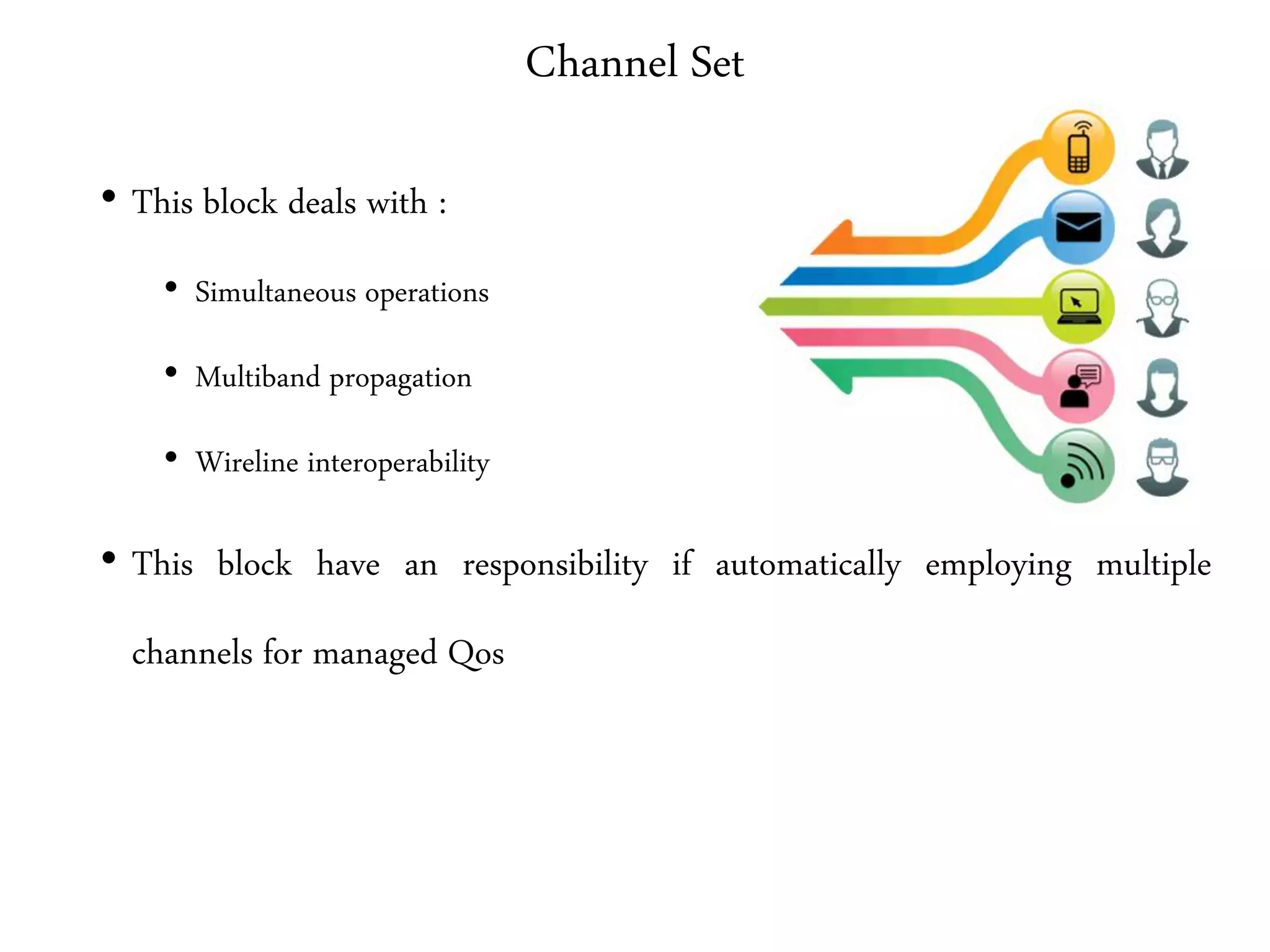
Channel Set
• This block deals with :
• Simultaneous operations
• Multiband propagation
• Wireline interoperability
• This block have an responsibility if automatically employing multiple
channels for managed Qos
Multiple personalities
• Multi mode agile services
• Interoperability
• Multiple personalities may lead to RFI
(Radio Frequency interference)
Evolution Support
• Software part that supports the future enhancements as updates.
Joint Control
• joint control function. Joint control ensures system stability, error recovery,
timely data flow, and isochronous streaming of voice and video.
• As radios become more advanced, joint control becomes more complex, evolving
toward autonomous selection of band, mode, and data format.
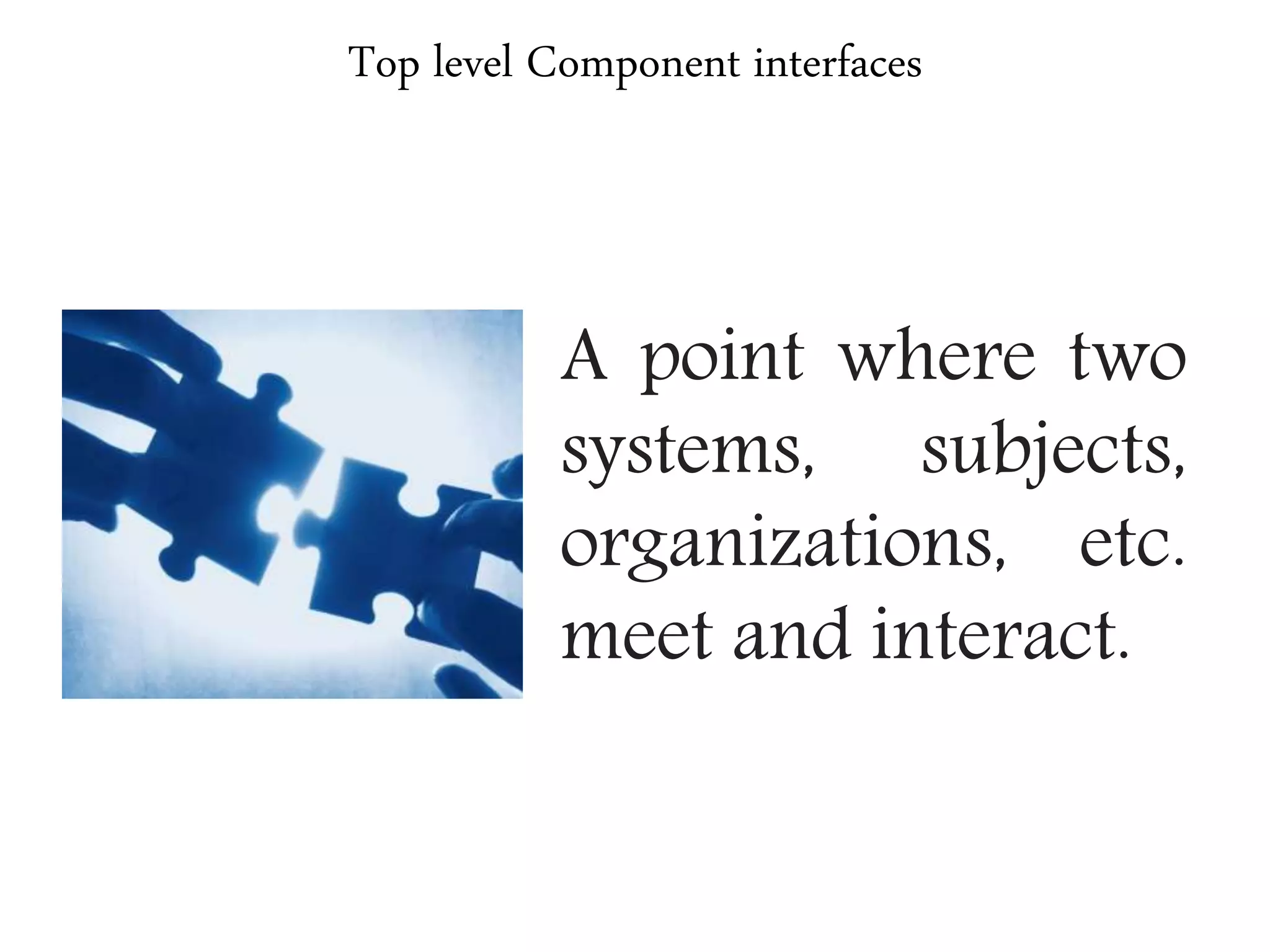
Top level Component interfaces
A point where two
systems, subjects,
organizations, etc.
meet and interact.
What is an Interface ?..
• In computing, an interface is a shared boundary across which two separate components of computer system
exchange information.
• Software Radio must support the RF and intermediate frequency (IF) hardware that is necessary to interface
the computing hardware with radio signals. This support is largely a tuning structure coupled with a
standardized interface.
• In software radio to make the waveform and application interfaces standardized, it is necessary to make the
hardware platform present a set of highly standardized interfaces.
Top Level Interfaces in SDR
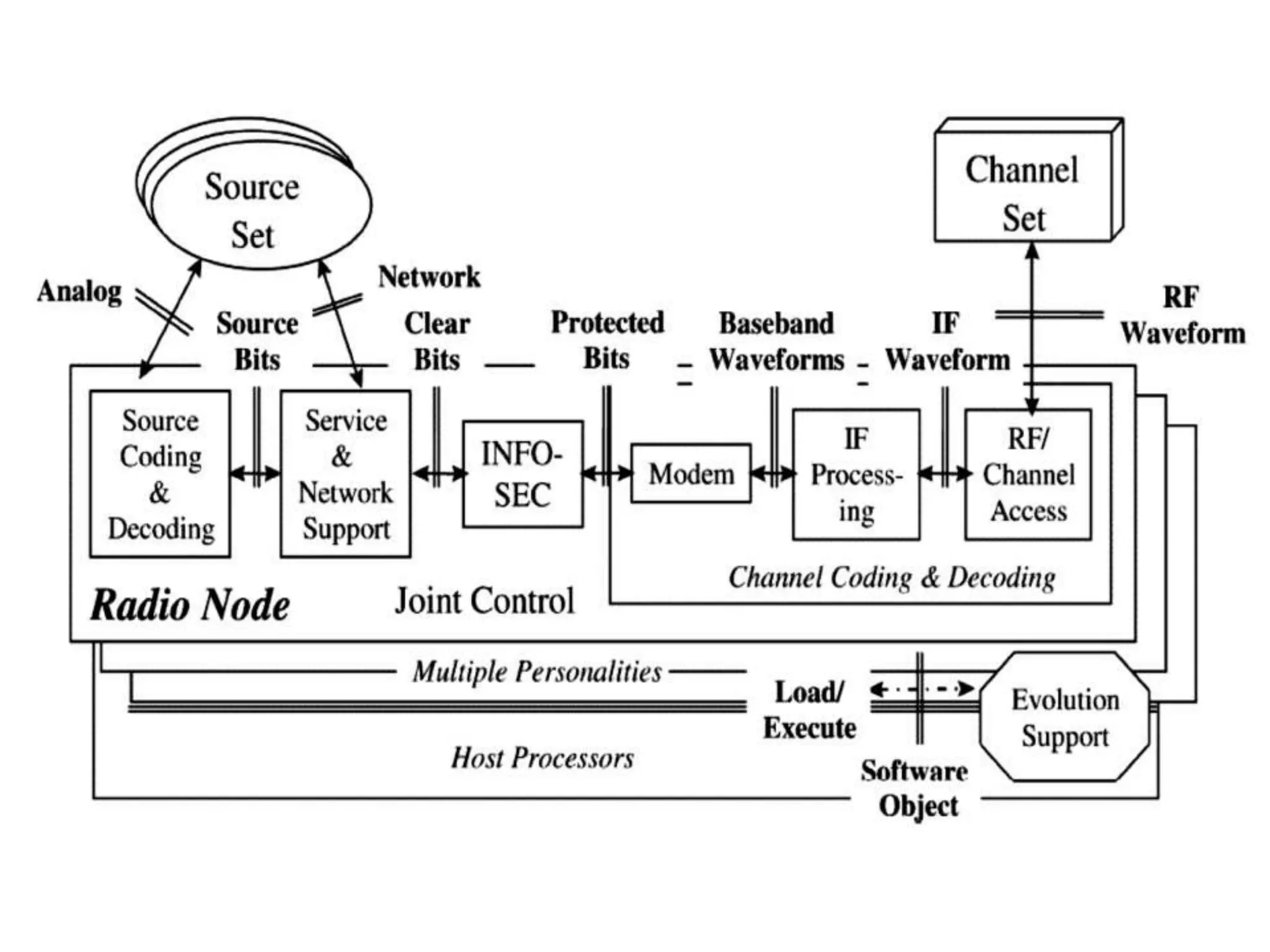
• After identifying the functions to be accomplished in a software radio, one
must define the interface points among the functional components.
Analog Stream
• Used to interface the external audio, video and facsimile devices with the
SDR.
• These interfaces may carry continuous streams
Source Bit Stream
• This interface carries the coded bit streams and packets.
• It also carries the signals from ADC, Vocoders, and compressed Text.
• Sampling theorem is used for ADC and finite arithmetic precision for coded
sequences.
Clear Bit Streams
• These streams are framed, multiplexed and FEC performed packets
Protected Bit stream
• They carry the authentication responses, public key and private key.
• It also carries the enciphered bit streams.
IF Wave form
• It carries digitally pre emphasized waveform ready for up conversion
RF Waveform
• This interface deals with the control of power level, adjacent channel
interference etc.,
Network interface
• These interface are used to carry the information form the remotely located sources.
• This interface uses asynchronous Transfer Mode (ATM) and its associated protocols.
• ATM is a telecommunication concept to transfer the user traffic including Voice, data
and video signals.
• They are widely used for the integrated services digital networks.
Joint Control
• This controls all the interfaces between the hardware and software.
• This interface is also used for initialization and fault recovery.
Standardizing an Interface
• This way, vendors can develop their waveforms independent of the knowledge of the
underlying hardware.
• Similarly, hardware developers can develop a radio with standardized interfaces, which
can subsequently be expected to run a wide variety of waveforms from standardized
libraries.
Application Programming Interfaces - API
• This way, the waveform development proceeds by assuming a standardized set of interfaces Application-
Programming Interfaces(APIs) for the radio hardware, and the radio hardware translates commands and
status messages crossing those interfaces to the unique underlying hardware through a set of common
drivers.
• In addition, the method by which a waveform is installed into a radio, activated, deactivated, and de-
installed, and the way in which radios use the standard interfaces must be standardized so that
waveforms are reasonably portable to more than one hardware platform implementation
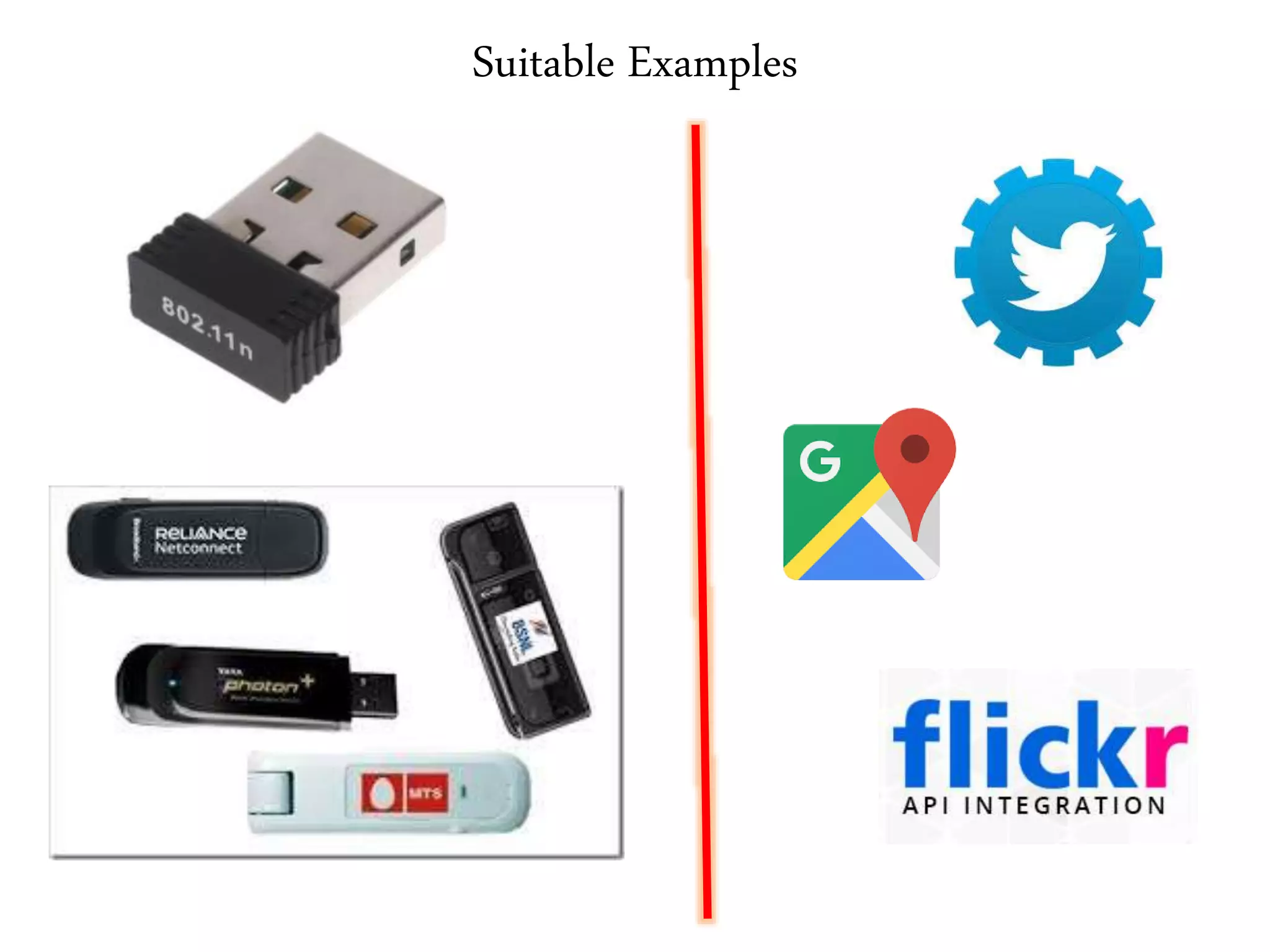
Suitable Examples
SDR - Hardware Architecture
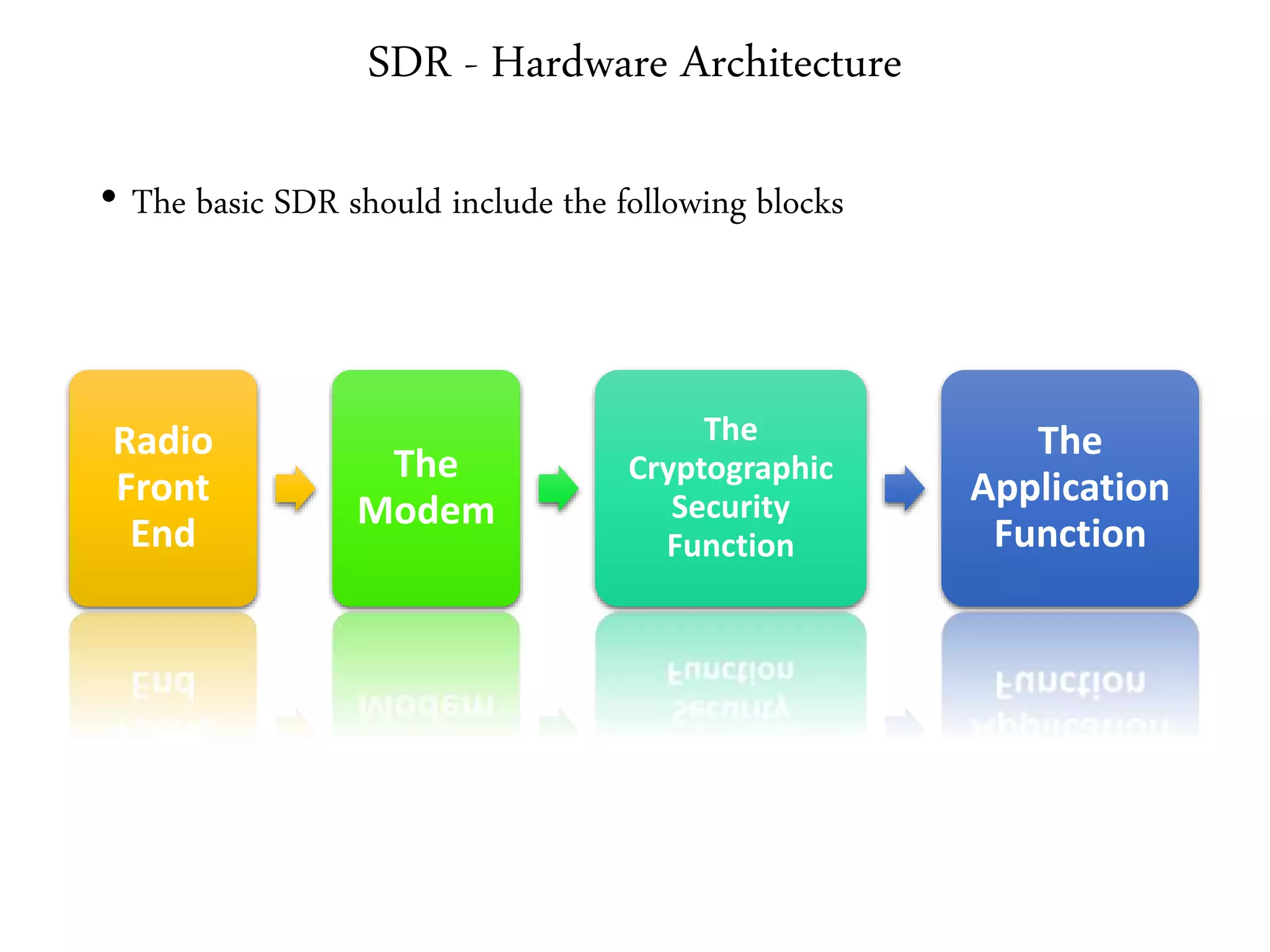
• The basic SDR should include the following blocks
Radio
Front
End
The
Modem
The
Cryptographic
Security
Function
The
Application
Function
In Addition to these blocks….
• Some Radios may include Support for network devices, allowing the radio
to provide network services and to be remotely controlled over the local
Ethernet.
In Addition to these blocks….
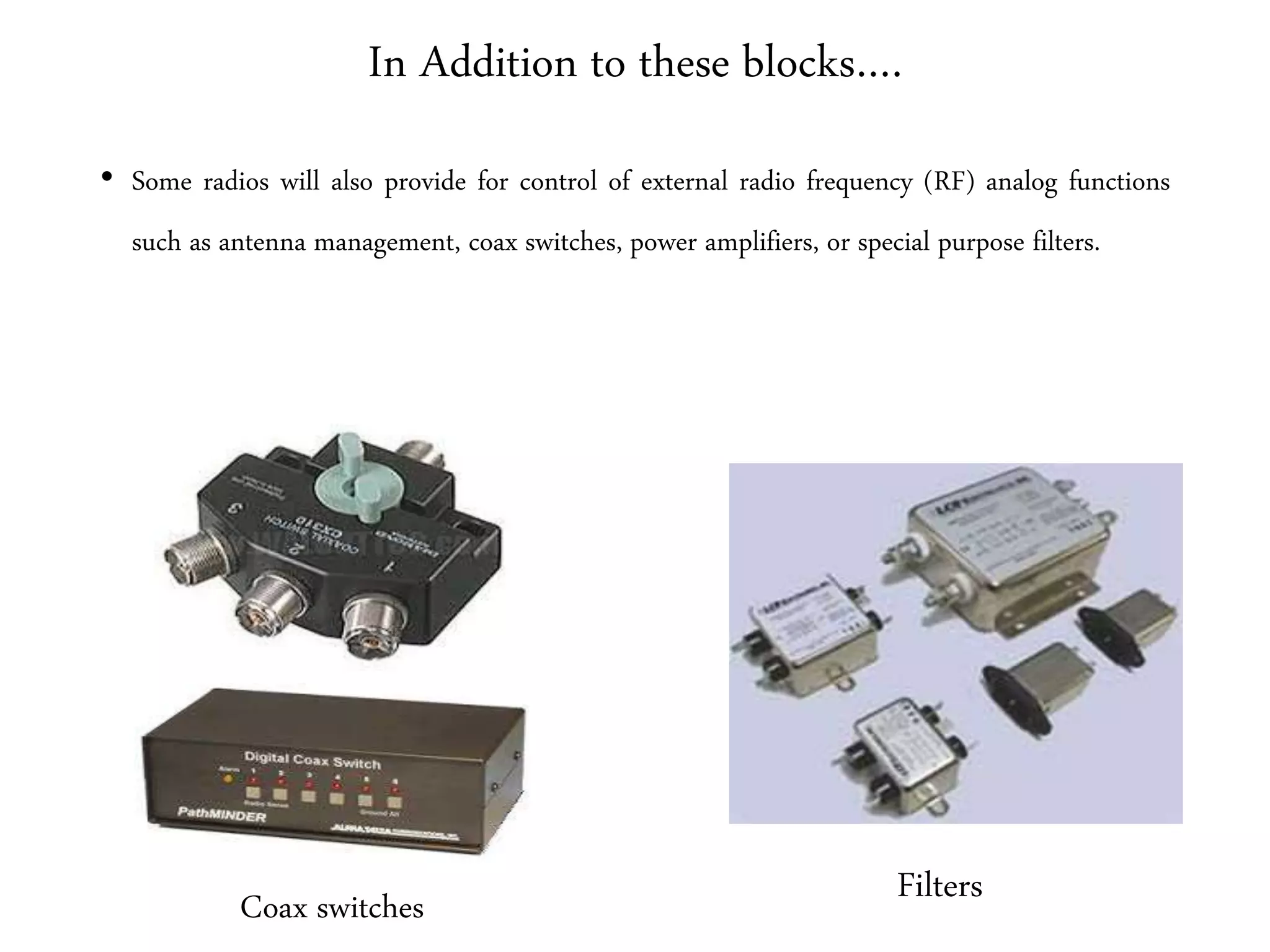
• Some radios will also provide for control of external radio frequency (RF) analog functions
such as antenna management, coax switches, power amplifiers, or special purpose filters.
Coax switches Filters
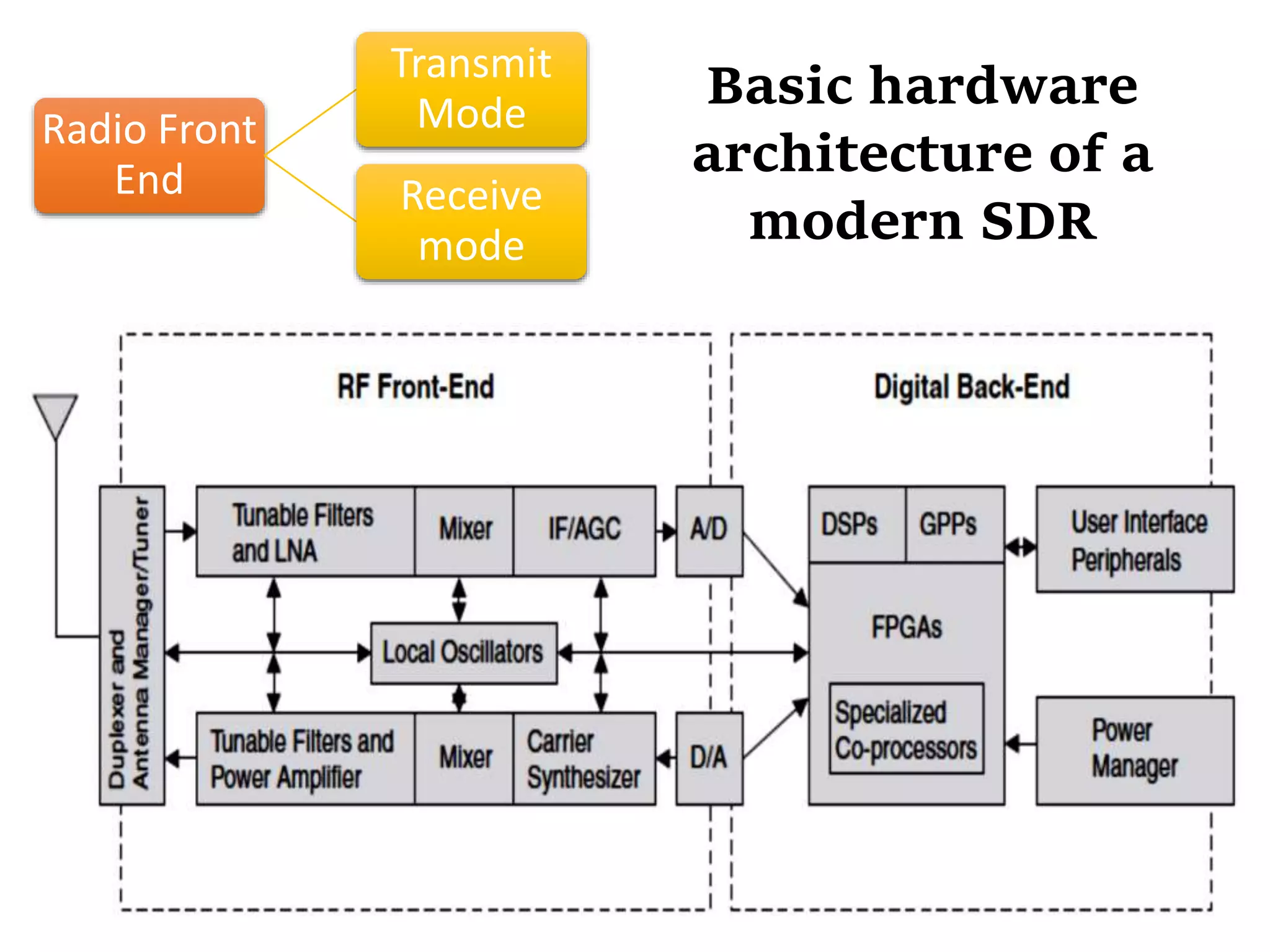
Radio Front
End
Transmit
Mode
Receive
mode
Basic hardware
architecture of a
modern SDR
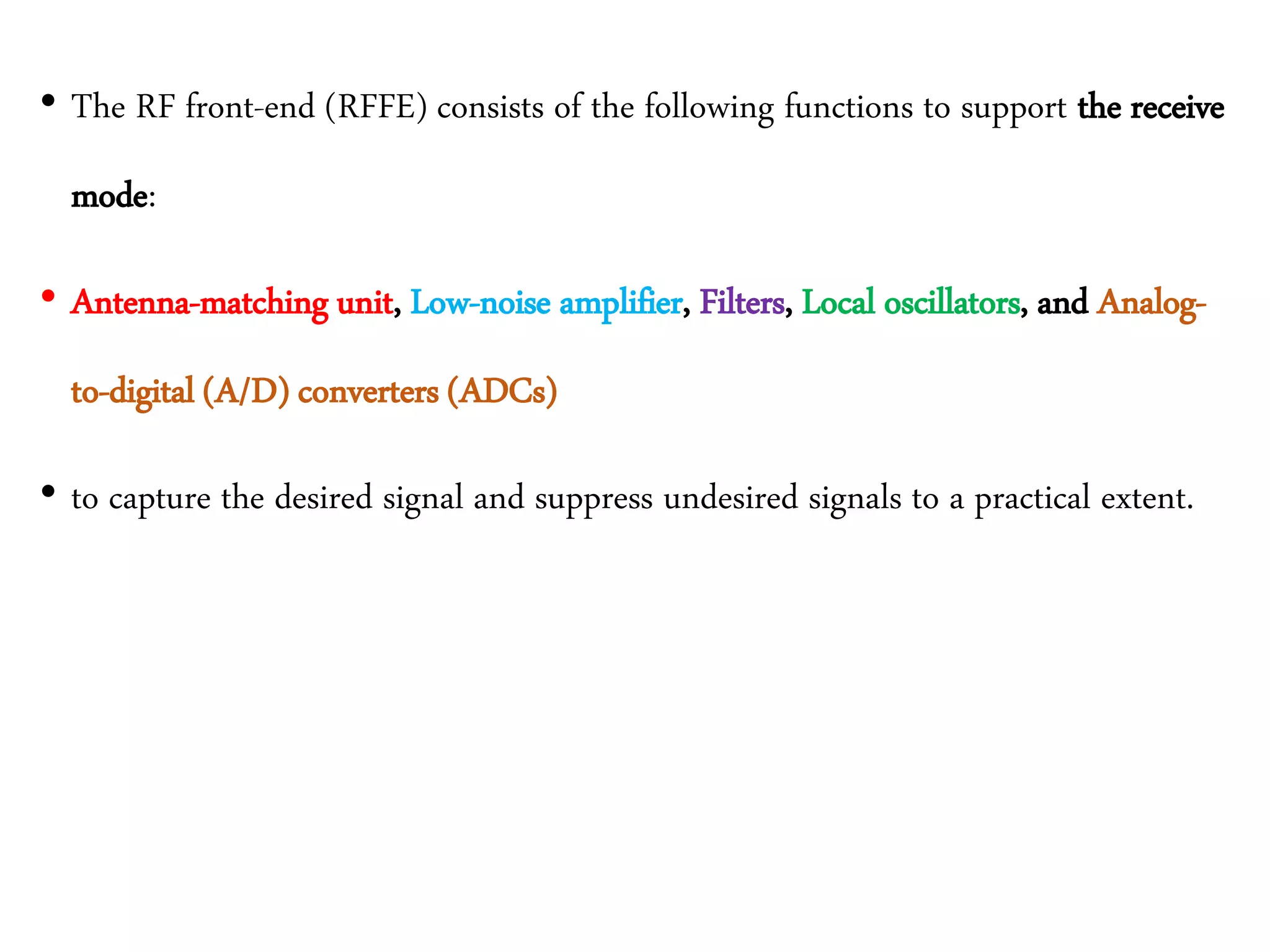
• The RF front-end (RFFE) consists of the following functions to support the receive
mode:
• Antenna-matching unit, Low-noise amplifier, Filters, Local oscillators, and Analog-
to-digital (A/D) converters (ADCs)
• to capture the desired signal and suppress undesired signals to a practical extent.
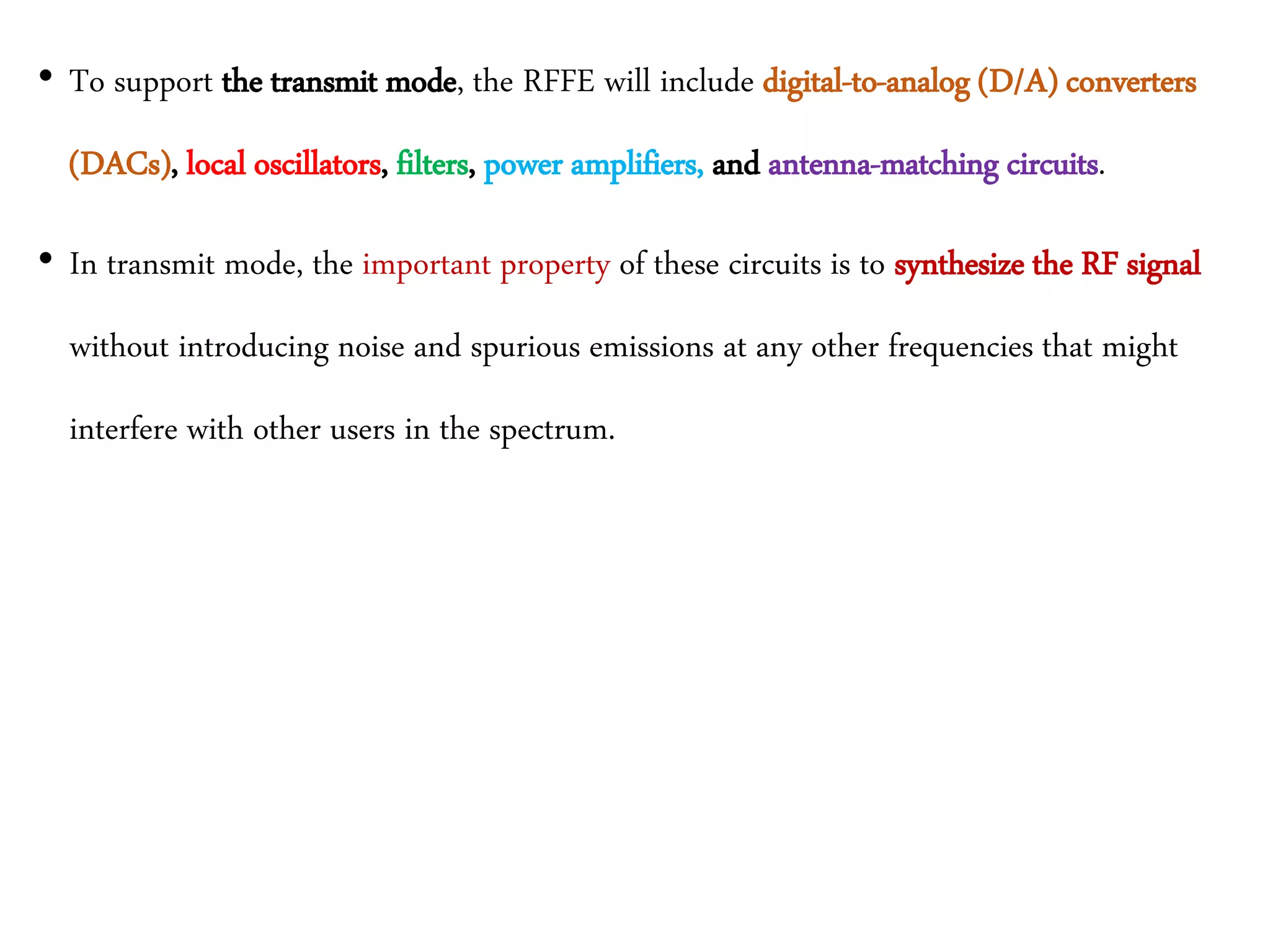
• To support the transmit mode, the RFFE will include digital-to-analog (D/A) converters
(DACs), local oscillators, filters, power amplifiers, and antenna-matching circuits.
• In transmit mode, the important property of these circuits is to synthesize the RF signal
without introducing noise and spurious emissions at any other frequencies that might
interfere with other users in the spectrum.
• The modem processes the received signal or synthesizes the transmitted signal, or
both for a full duplex radio.
• The transmit process and the receive process are discussed in detail.
The Modem
Transmit Process
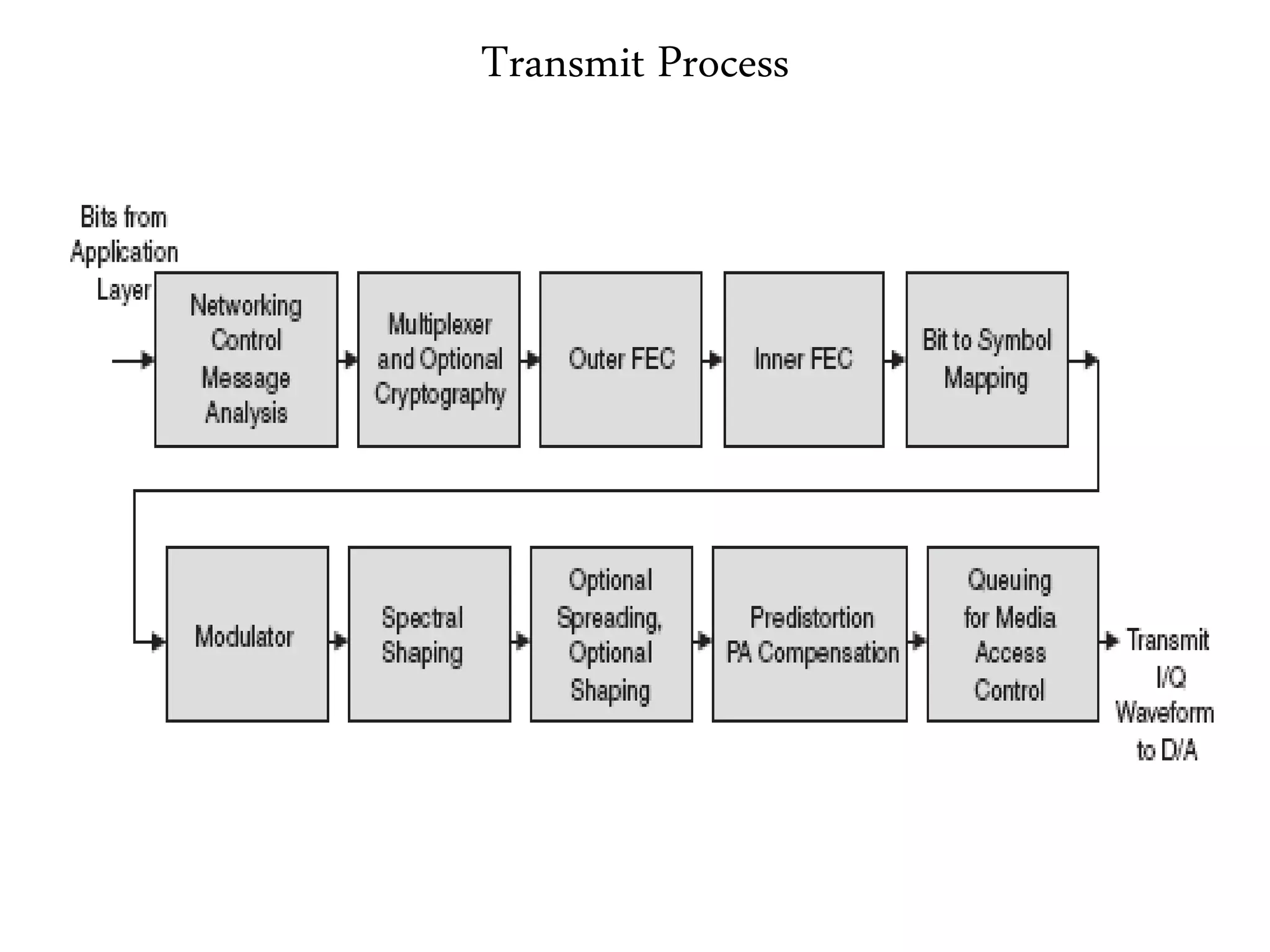
• The modem takes bits of information to be transmitted, groups the information into packets, adds a structured redundancy to provide for error
correction at the receiver, groups bits to be formed into symbols, selects a wave shape to represent each symbol,
• synthesizes each wave shape, and filters each wave shape to keep it within its desired bandwidth.
• It may spread the signal to a much wider bandwidth by multiplying the symbol by a wideband waveform which is also generated by similar
methods.
• The final waveform is filtered to match the desired transmit signal bandwidth.
• The modem must also control the power amplifier and the local oscillators to produce the desired carrier frequency, and must control the
antenna-matching unit to minimize voltage standing wave radio (VSWR).
• The modem may also control the external RF elements, including transmit versus receive mode, carrier frequency, and smart antenna control.
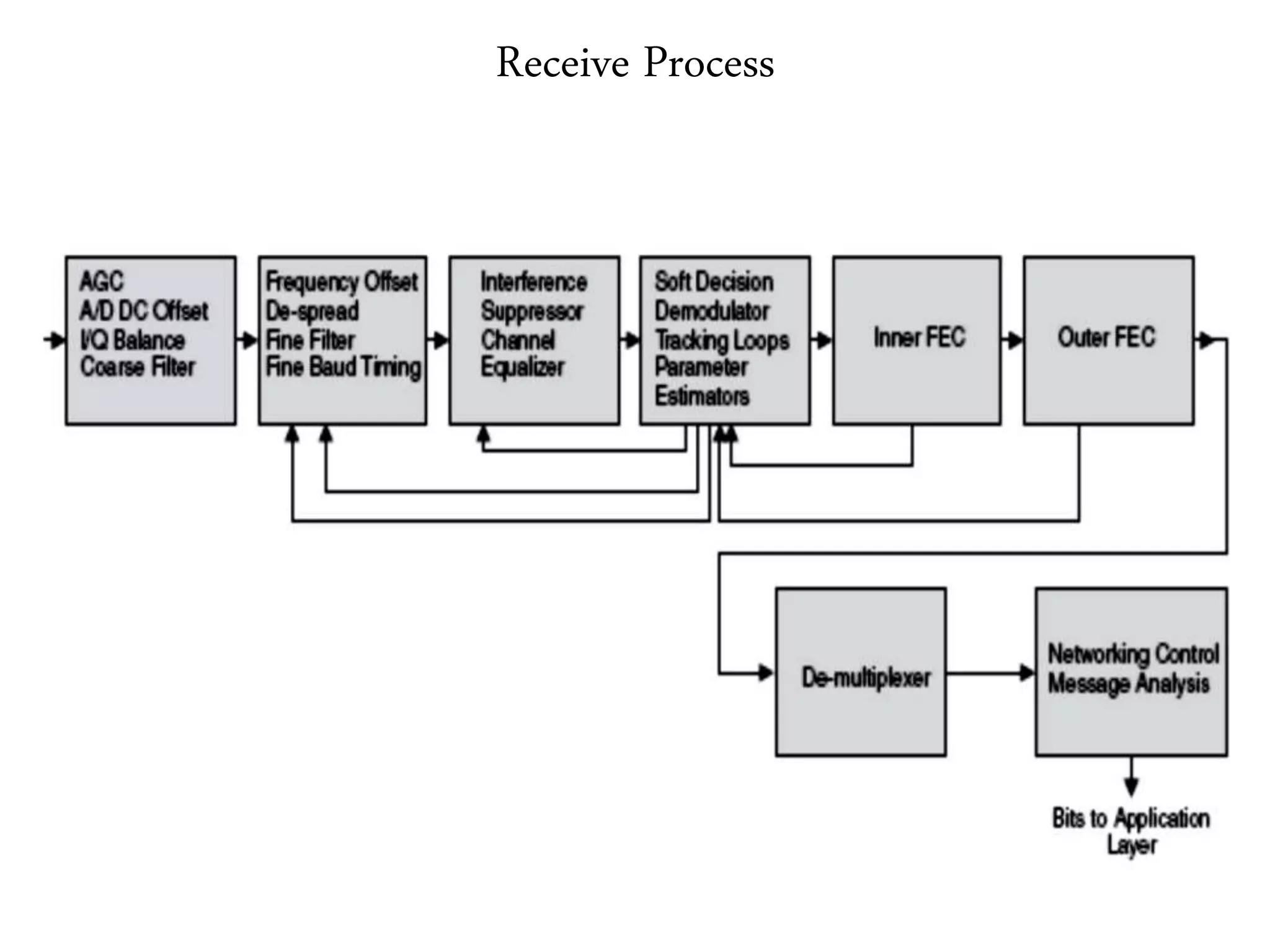
Receive Process
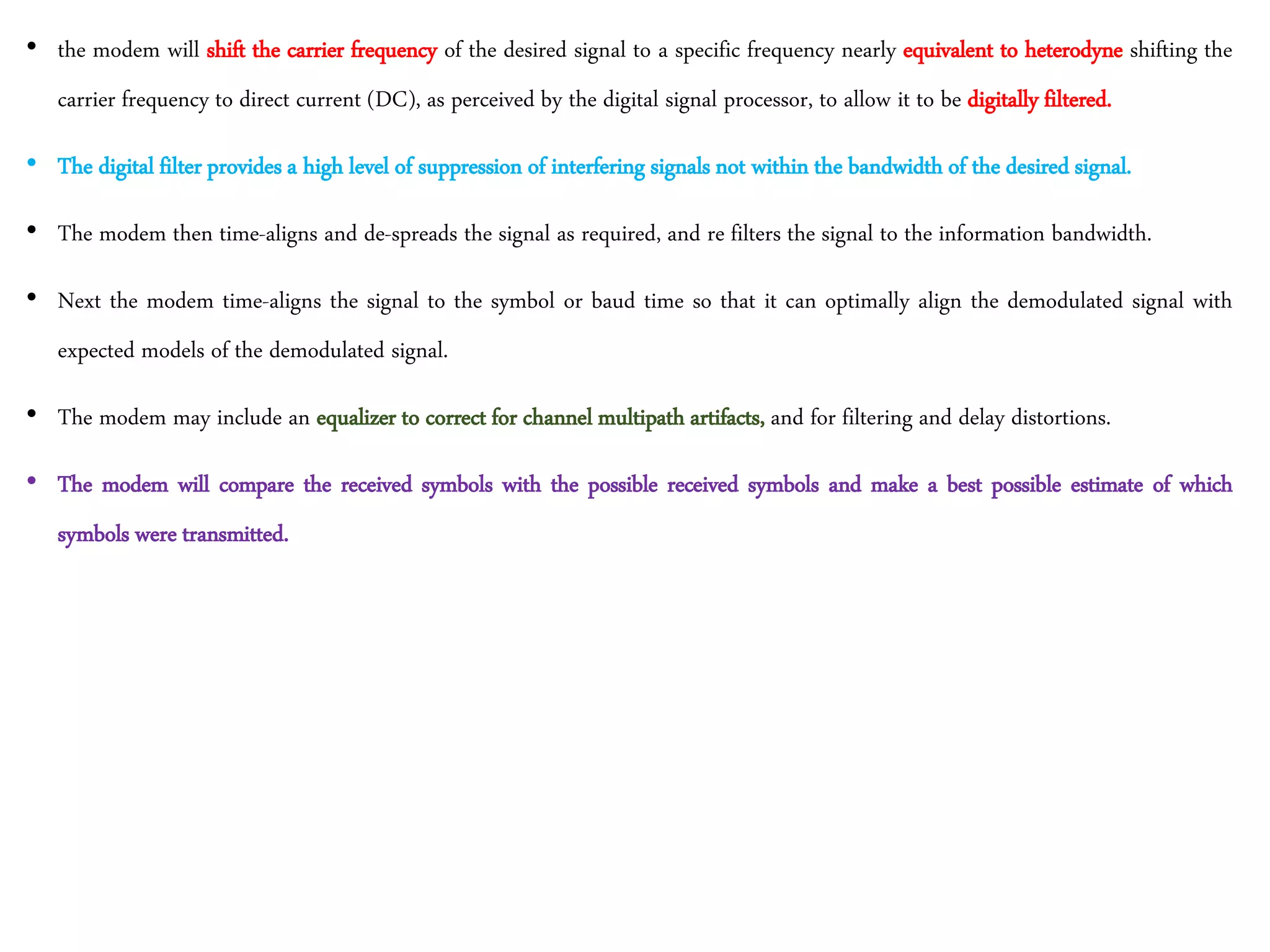
• the modem will shift the carrier frequency of the desired signal to a specific frequency nearly equivalent to heterodyne shifting the
carrier frequency to direct current (DC), as perceived by the digital signal processor, to allow it to be digitally filtered.
• The digital filter provides a high level of suppression of interfering signals not within the bandwidth of the desired signal.
• The modem then time-aligns and de-spreads the signal as required, and re filters the signal to the information bandwidth.
• Next the modem time-aligns the signal to the symbol or baud time so that it can optimally align the demodulated signal with
expected models of the demodulated signal.
• The modem may include an equalizer to correct for channel multipath artifacts, and for filtering and delay distortions.
• The modem will compare the received symbols with the possible received symbols and make a best possible estimate of which
symbols were transmitted.
• The cryptographic security function must encrypt any information to be transmitted. Because the encryption processes are
unique to each application, these cannot be generalized.
• The Digital Encryption Standard (DES) and the Advanced Encryption Standard (AES) from the US National Institute of
Standards and Technology (NIST) provide example cryptographic processes.
• In addition to providing the user with privacy for voice communication, cryptography also plays a major role in assuring that
the billing is to an authenticated user terminal.
The Cryptographic
Security Function
• The user‟s application may range from voice telephony, to data networking, to text messaging, to graphic display, to live video.
Each application has its own unique set of requirements, which, in turn, translate into different implications on the performance
requirements of the SDR.
• The application processor will typically implement a vocoder, a video coder, and/or a data coder, as well as selected web browser
functions.
• Compression factors typically in excess of 10:1 are achieved in voice coding, and up to 100:1 in video coding. Data compression
ranges from 10 to 50 percent, depending on how much redundancycan be identified in the original information data stream.
The Application
Function
Software Architecture
• The objective of the software architecture in an SDR is to place waveforms and applications
onto a software-based radio platform in a standardized way.
• These waveforms and applications are installed, used, and replaced by other applications as
required to achieve the user’s objectives.
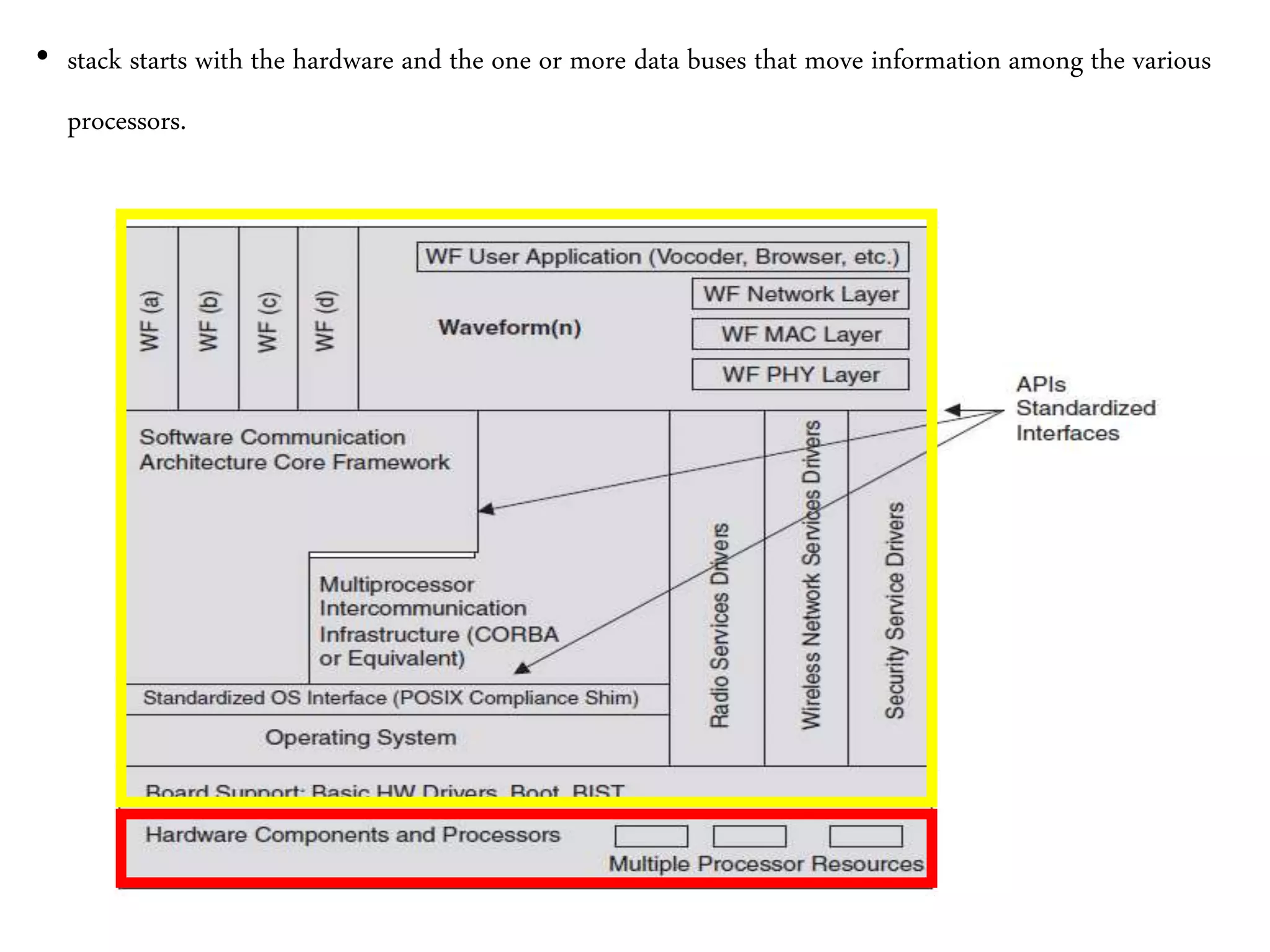
• The Software radio is decomposed into a stack of hardware and software functions, with open
standard interfaces. As shown in Figure
• stack starts with the hardware and the one or more data buses that move information among the various
processors.
The software Frame work includes..
• The Software Framework includes several layers, they are:
• Board Support
• Operating systems
• Standardised OS Interface
• Multiprocessor intercommunication infrastructure
• Software communication Architecture core frame work
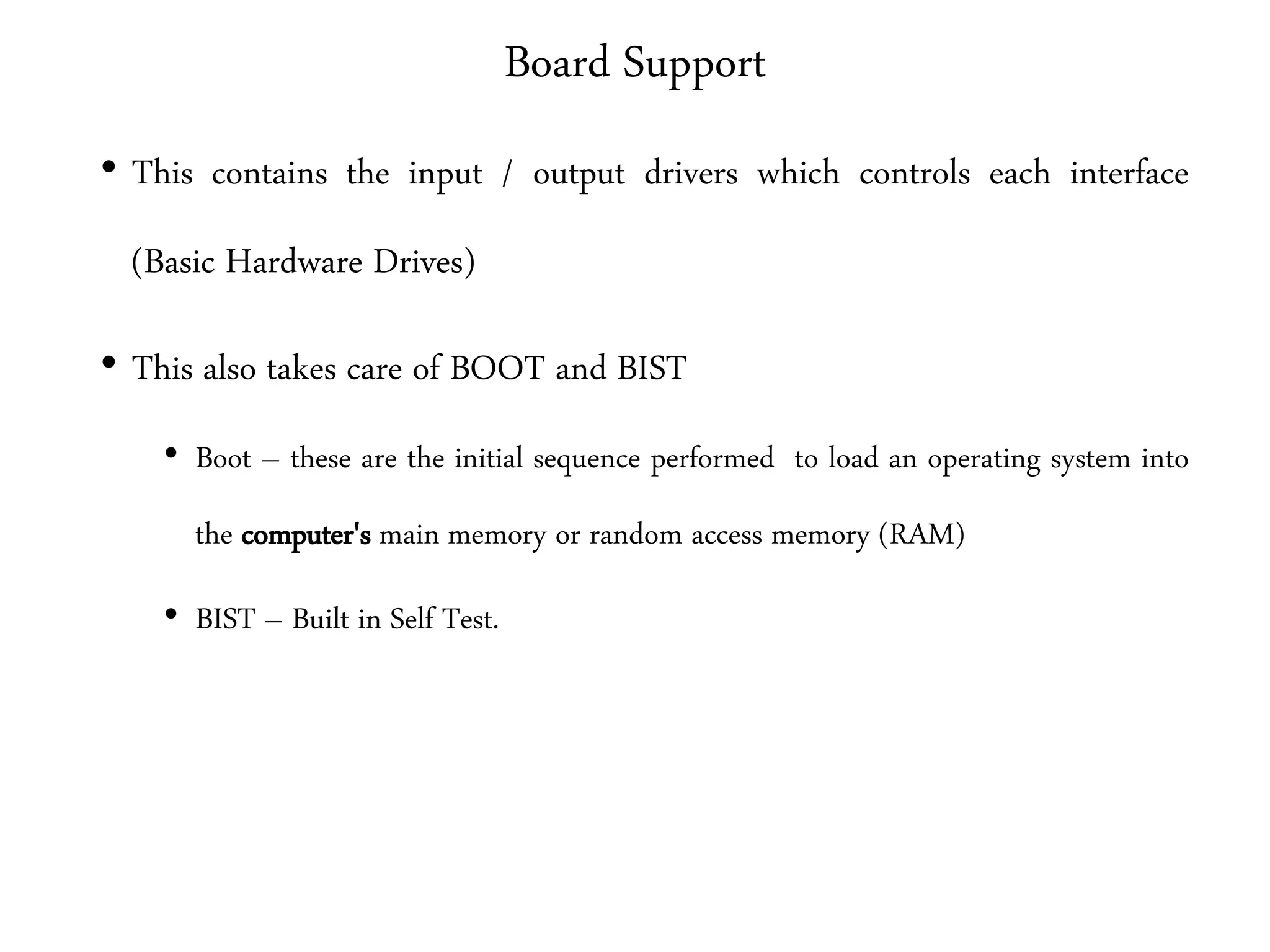
Board Support
• This contains the input / output drivers which controls each interface
(Basic Hardware Drives)
• This also takes care of BOOT and BIST
• Boot – these are the initial sequence performed to load an operating system into
the computer's main memory or random access memory (RAM)
• BIST – Built in Self Test.
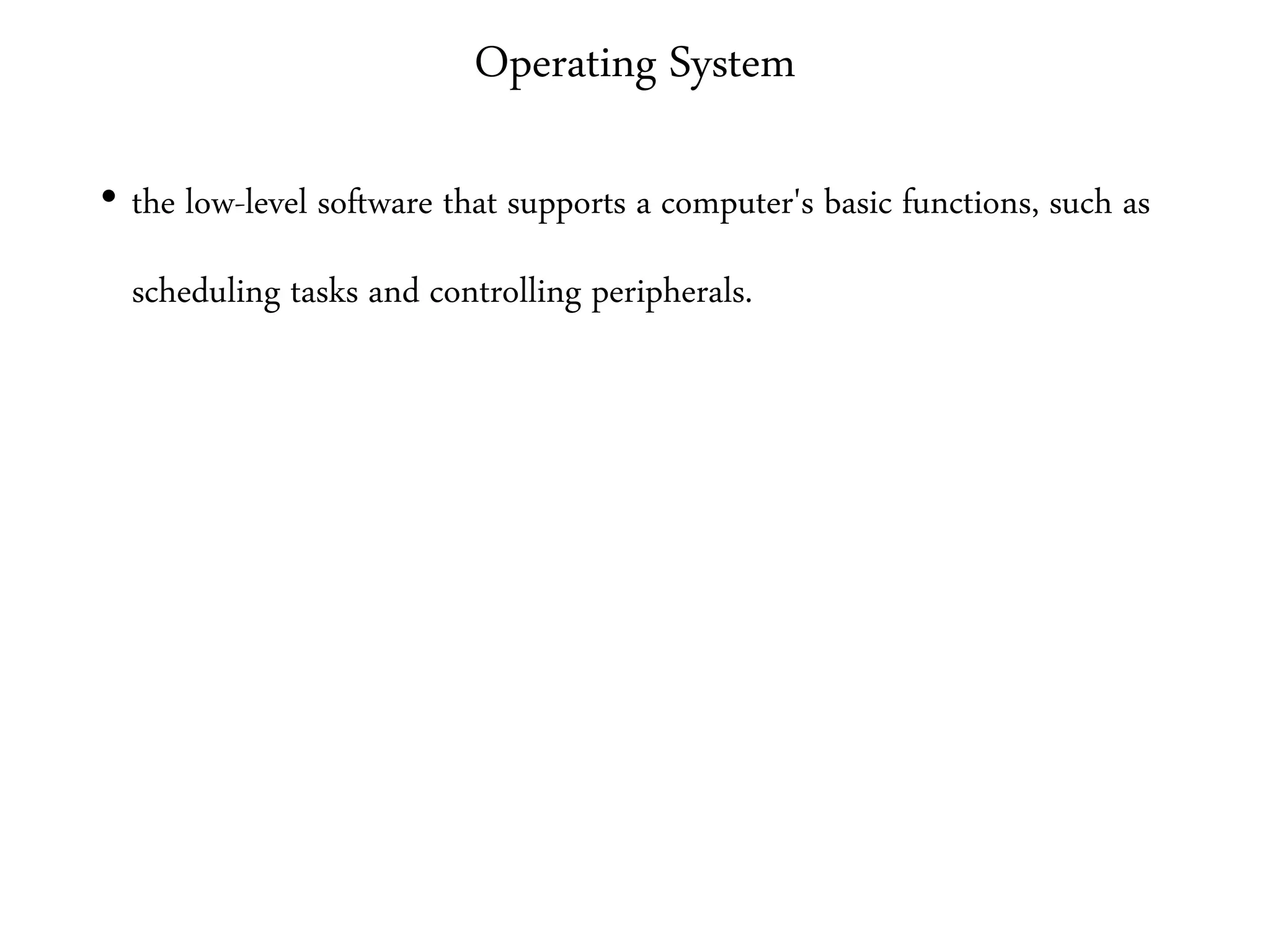
Operating System
• the low-level software that supports a computer's basic functions, such as
scheduling tasks and controlling peripherals.
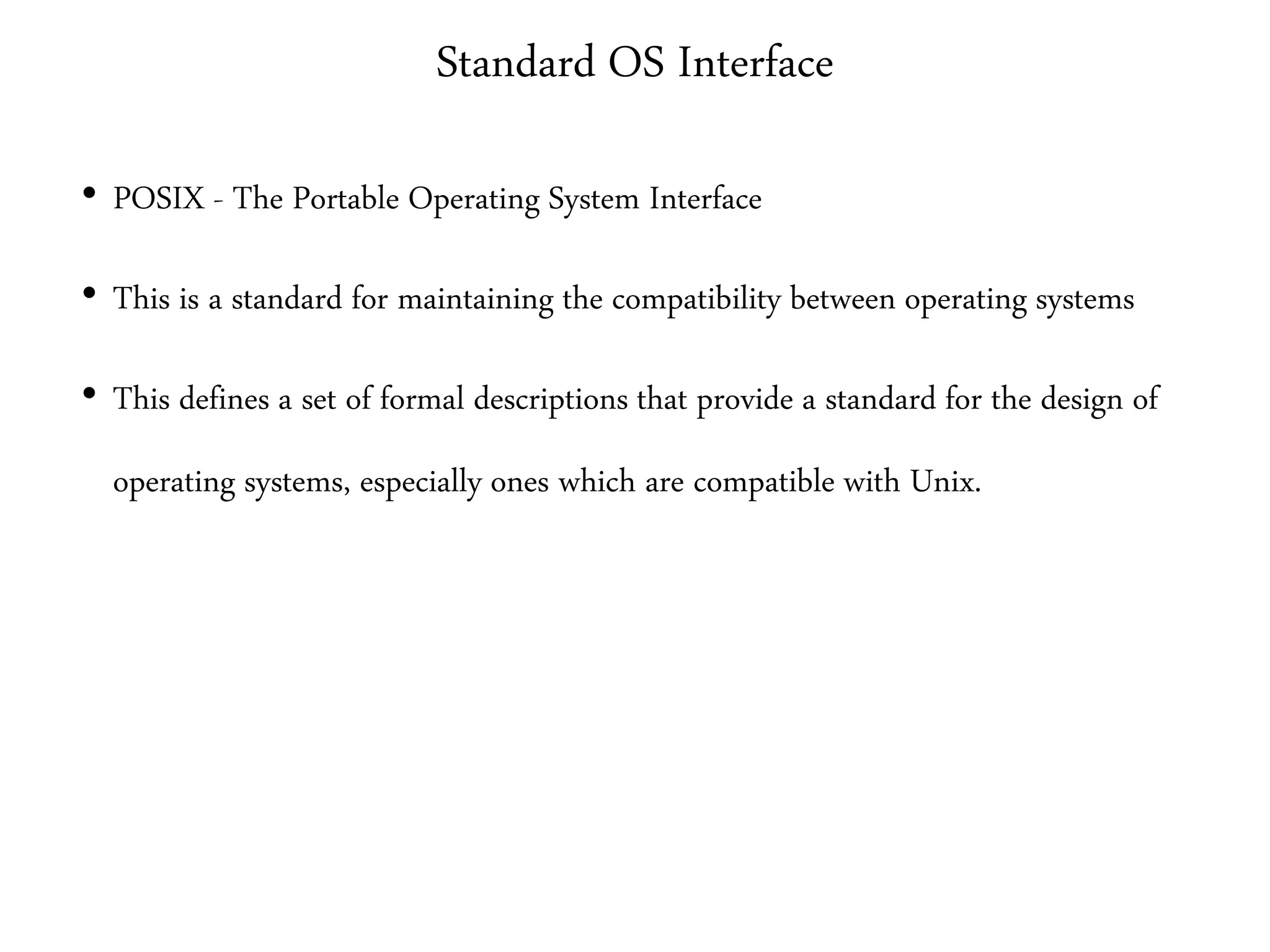
Standard OS Interface
• POSIX - The Portable Operating System Interface
• This is a standard for maintaining the compatibility between operating systems
• This defines a set of formal descriptions that provide a standard for the design of
operating systems, especially ones which are compatible with Unix.
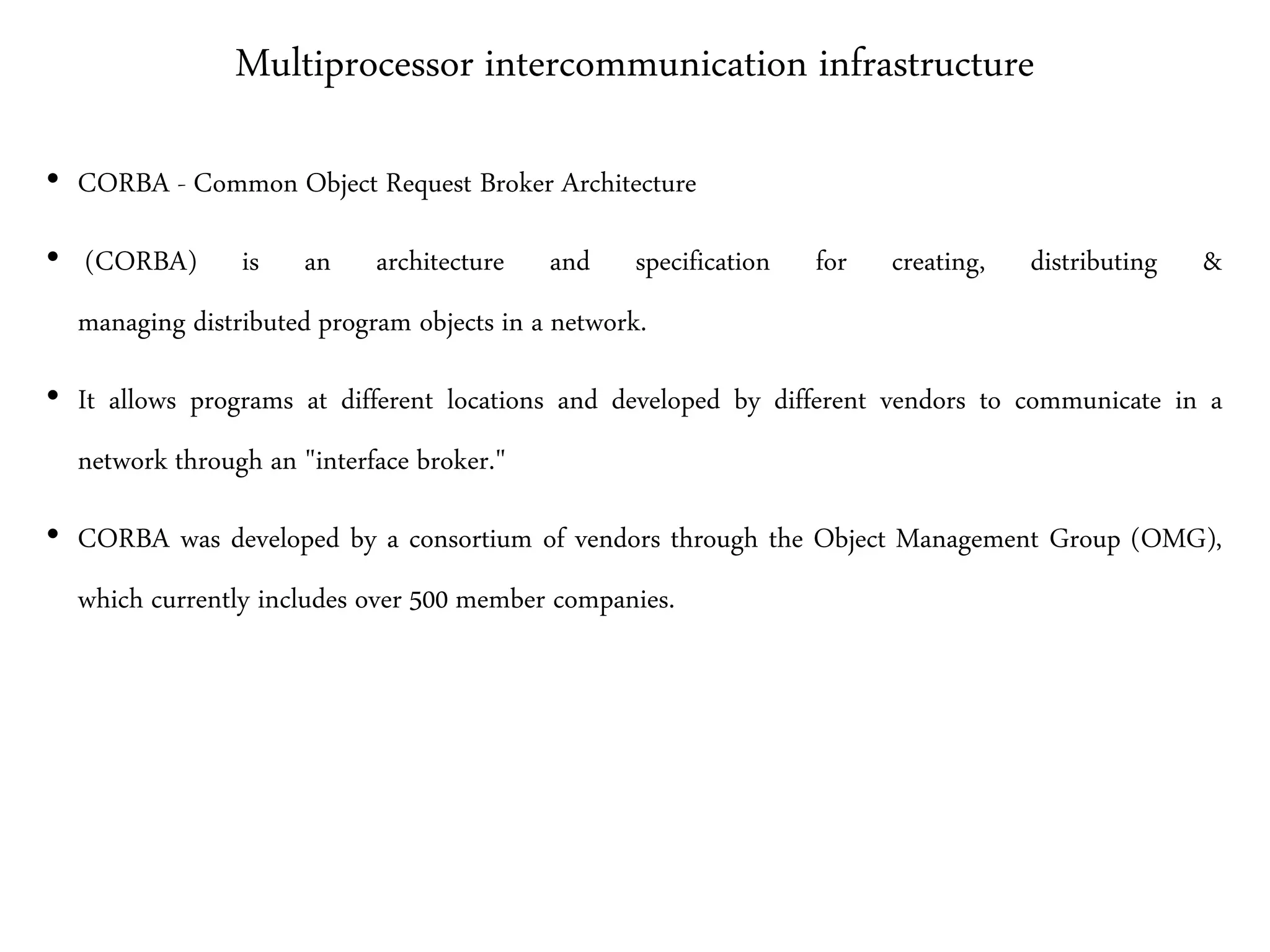
Multiprocessor intercommunication infrastructure
• CORBA - Common Object Request Broker Architecture
• (CORBA) is an architecture and specification for creating, distributing &
managing distributed program objects in a network.
• It allows programs at different locations and developed by different vendors to communicate in a
network through an "interface broker."
• CORBA was developed by a consortium of vendors through the Object Management Group (OMG),
which currently includes over 500 member companies.
Software Communication Architecture – Core Frame work
• The SCA is a core framework to provide a standardized process for identifying the available
computational resources of the radio, matching those resources to the required resources for
an application.
• The SCA also provides a standardized method of defining the requirements for each
application, performed in eXtensible Markup Language (XML).
Radio Service, Network Service and Security Service Drivers
• In software radio, the applications will have many reasons to interact with the
Internet as well as many local networks; therefore, it is also common to provide a
collection of standardized radio services, network services, and security services, so
that each application does not need to have its own copy of Internet Protocol, and
other commonly used functions.
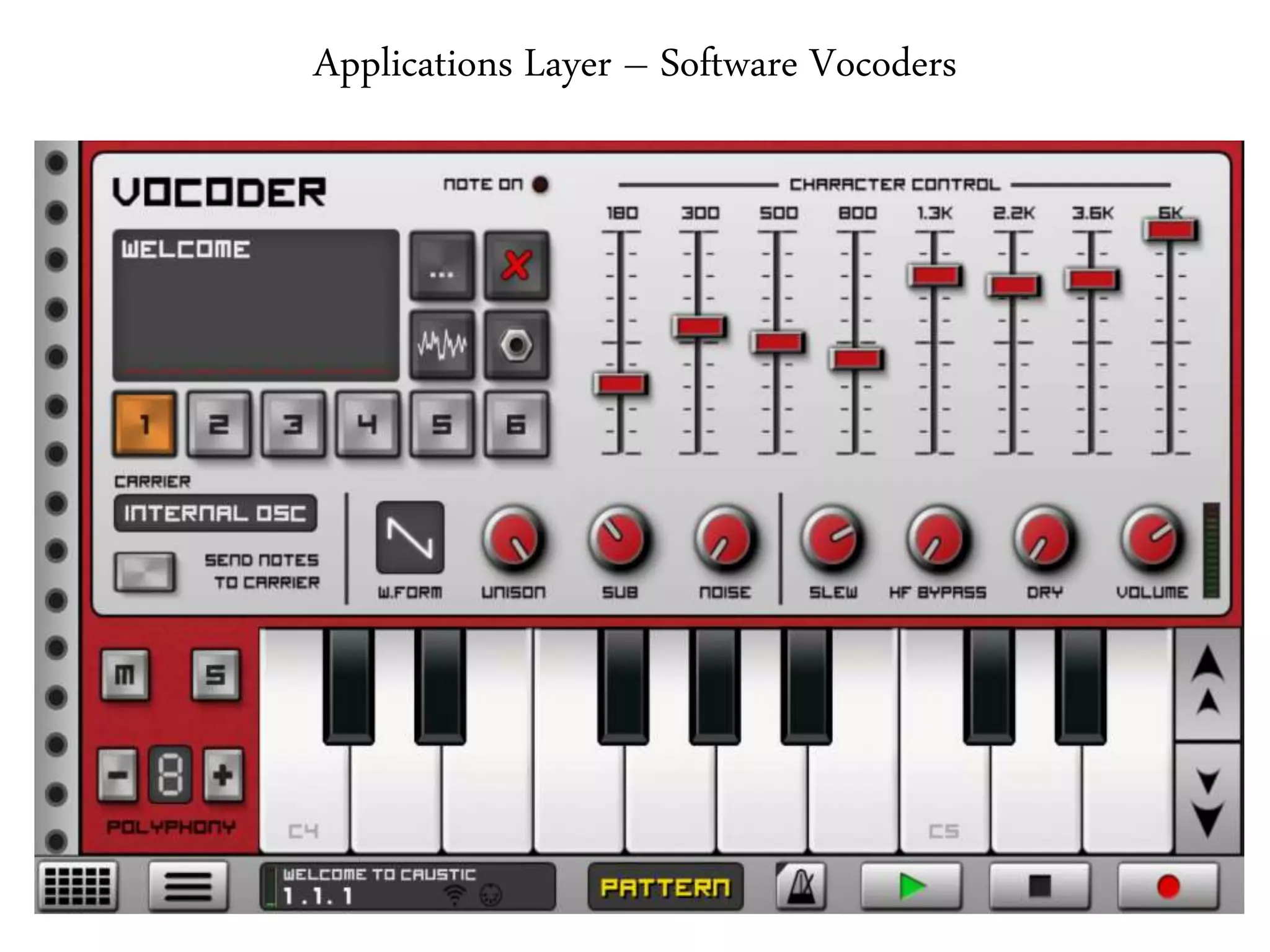
Applications Layer – Software Vocoders
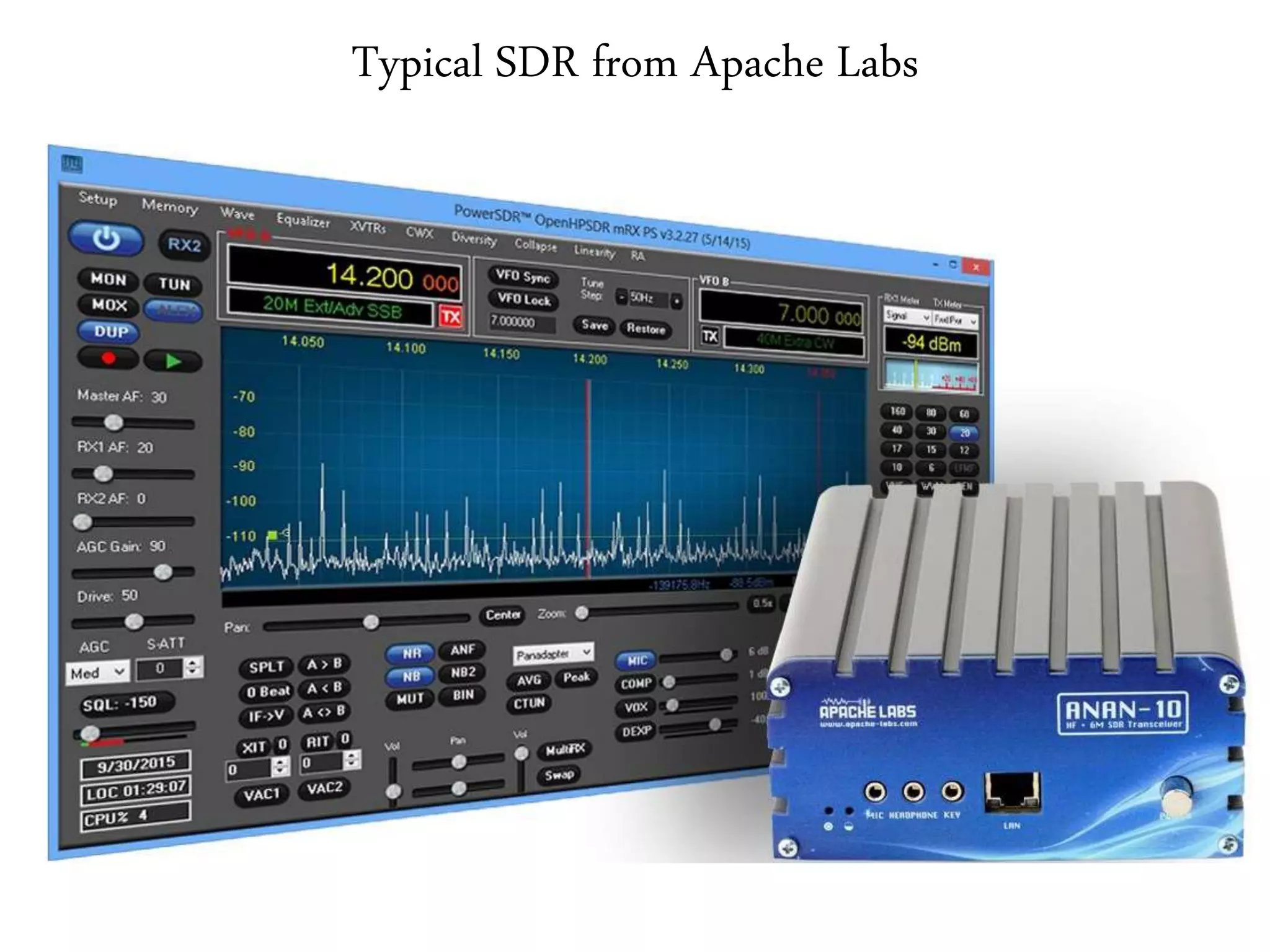
Typical SDR from Apache Labs
Computational Processing
Resources
Computational Processing Resources
• The design of an SDR must anticipate the computational resources needed to
implement its most complex application. The computational resources may
consist of GPPs, DSPs, FPGAs, and occasionally will include other chips that
extend the computational capacity.
Generally, the SDR vendor will avoid
• Inclusion of dedicated-purpose non-
programmable chips as it reduces the
flexibility of the SDR
GPP’s Used are…
• GPP selected by many SDR developers is the PowerPC.
• PowerPC (a backronym for Performance Optimization With
Enhanced RISC – Performance Computing, sometimes
abbreviated as PPC) is a RISC instruction set architecture
created by the 1991 Apple–IBM–Motorola alliance, known as
AIM.
GPP’s Contd…
• This class of processor is readily programmed in standard C or C language, supports a
very wide variety of addressing modes, floating point and integer computation, and a
large memory space
• These processors currently perform more than 1 billion mathematical operations per
second (mops).
• They also frequently execute many instructions in parallel.
Need for DSP’s
• The processes like signal Modulation and
demodulation accumulates in multiplying process
which in turn increases the computational
demands.
• This cannot be performed by the GPP’s style of
processing Informations
DSP’s
• DSPs are somewhat different than GPPs.
• The DSP internal architecture is optimized to be able to perform multiply accumulates very fast.
• This means they have one or more multipliers and one or more accumulators in hardware.
• DSPs are available that can perform fractional mathematics (integer) multiply accumulate instructions
at rates of 1 GHz, and floating point multiply accumulates at 600 MHz.
• The other major feature of the DSP is that it has far fewer and less sophisticated addressing modes.
Verdict
• As a result, the DSP is much more efficient at signal processing but less
capable to accommodate the software associated with the network
protocols.
FPGA’s
• FPGAs have recently become capable of providing tremendous amounts of multiply accumulate
operations on a single chip, surpassing DSPs
• In addition to the DSP, FPGAs can also provide the timing logic to synthesize clocks, baud rate, chip
rate, time slot, and frame timing, thus leading to a reasonably compact waveform implementation.
• complex signal processes that are not efficiently implemented on a DSP, such as Cordic operations, log
magnitude operations, and difference magnitude operations, can all have the specialized hardware
implementations required for a waveform when implemented in FPGAs.
Drawbacks of FPGA’s
• The drawback of using FPGA’s are the codes are not written C or C ++,
instead written in VHDL which may conflict with the under laying
software Architecture
Final Verdict of computational Resources
• Today’s SDRs provide a reasonable mix of these computational alternatives to assure that a
wide variety of desirable applications can in fact be implemented at an acceptable resource
level.
• In today’s SDRs, dedicated-purpose application-specific integrated circuit (ASIC) chips are
avoided because the signal processing resources cannot be reprogrammed to implement
new waveform functionality.
Interface topology among Plug and Play Devices.
End
of
UNIT 2

Unit 2 sdr architecture

  • 1.
    RMK College ofEngineering and Technology EC6014 Cognitive Radios Department of Electronics and Communication Engineering
  • 2.
  • 3.
    Syllabus • Essential functionsof the software radio, • Basic SDR, • Hardware Architecture, • Computational Processing Resources, • Software Architecture, • Top Level Component Interfaces, • Interface Topologies Among Plug and Play Modules,.
  • 4.
  • 5.
    Channel Coding andDecoding • The main functions of this block are • Timing recovery • Equalization • Pre distortion • Black data processing
  • 6.
  • 7.
    Diversity Basic -Understanding Dispersive Channels
  • 8.
  • 9.
    Diversity - Principle •The principle of diversity is to ensure that the same information reaches the receiver on a statistically independent channels.
  • 10.
    IF Processing Beam Forming •This block also deals with the effective channel decoding. • This plays a greater role in deciding the QoS. Diversity Combining Frequency Translation Filtering
  • 11.
    Channel Set • Thisblock deals with : • Simultaneous operations • Multiband propagation • Wireline interoperability • This block have an responsibility if automatically employing multiple channels for managed Qos
  • 12.
    Multiple personalities • Multimode agile services • Interoperability • Multiple personalities may lead to RFI (Radio Frequency interference)
  • 13.
    Evolution Support • Softwarepart that supports the future enhancements as updates.
  • 14.
    Joint Control • jointcontrol function. Joint control ensures system stability, error recovery, timely data flow, and isochronous streaming of voice and video. • As radios become more advanced, joint control becomes more complex, evolving toward autonomous selection of band, mode, and data format.
  • 15.
    Top level Componentinterfaces A point where two systems, subjects, organizations, etc. meet and interact.
  • 16.
    What is anInterface ?.. • In computing, an interface is a shared boundary across which two separate components of computer system exchange information. • Software Radio must support the RF and intermediate frequency (IF) hardware that is necessary to interface the computing hardware with radio signals. This support is largely a tuning structure coupled with a standardized interface. • In software radio to make the waveform and application interfaces standardized, it is necessary to make the hardware platform present a set of highly standardized interfaces.
  • 17.
    Top Level Interfacesin SDR • After identifying the functions to be accomplished in a software radio, one must define the interface points among the functional components.
  • 19.
    Analog Stream • Usedto interface the external audio, video and facsimile devices with the SDR. • These interfaces may carry continuous streams
  • 20.
    Source Bit Stream •This interface carries the coded bit streams and packets. • It also carries the signals from ADC, Vocoders, and compressed Text. • Sampling theorem is used for ADC and finite arithmetic precision for coded sequences.
  • 21.
    Clear Bit Streams •These streams are framed, multiplexed and FEC performed packets
  • 22.
    Protected Bit stream •They carry the authentication responses, public key and private key. • It also carries the enciphered bit streams.
  • 23.
    IF Wave form •It carries digitally pre emphasized waveform ready for up conversion
  • 24.
    RF Waveform • Thisinterface deals with the control of power level, adjacent channel interference etc.,
  • 25.
    Network interface • Theseinterface are used to carry the information form the remotely located sources. • This interface uses asynchronous Transfer Mode (ATM) and its associated protocols. • ATM is a telecommunication concept to transfer the user traffic including Voice, data and video signals. • They are widely used for the integrated services digital networks.
  • 26.
    Joint Control • Thiscontrols all the interfaces between the hardware and software. • This interface is also used for initialization and fault recovery.
  • 27.
    Standardizing an Interface •This way, vendors can develop their waveforms independent of the knowledge of the underlying hardware. • Similarly, hardware developers can develop a radio with standardized interfaces, which can subsequently be expected to run a wide variety of waveforms from standardized libraries.
  • 28.
    Application Programming Interfaces- API • This way, the waveform development proceeds by assuming a standardized set of interfaces Application- Programming Interfaces(APIs) for the radio hardware, and the radio hardware translates commands and status messages crossing those interfaces to the unique underlying hardware through a set of common drivers. • In addition, the method by which a waveform is installed into a radio, activated, deactivated, and de- installed, and the way in which radios use the standard interfaces must be standardized so that waveforms are reasonably portable to more than one hardware platform implementation
  • 29.
  • 30.
    SDR - HardwareArchitecture
  • 31.
    SDR - HardwareArchitecture • The basic SDR should include the following blocks Radio Front End The Modem The Cryptographic Security Function The Application Function
  • 32.
    In Addition tothese blocks…. • Some Radios may include Support for network devices, allowing the radio to provide network services and to be remotely controlled over the local Ethernet.
  • 33.
    In Addition tothese blocks…. • Some radios will also provide for control of external radio frequency (RF) analog functions such as antenna management, coax switches, power amplifiers, or special purpose filters. Coax switches Filters
  • 34.
  • 35.
    • The RFfront-end (RFFE) consists of the following functions to support the receive mode: • Antenna-matching unit, Low-noise amplifier, Filters, Local oscillators, and Analog- to-digital (A/D) converters (ADCs) • to capture the desired signal and suppress undesired signals to a practical extent.
  • 37.
    • To supportthe transmit mode, the RFFE will include digital-to-analog (D/A) converters (DACs), local oscillators, filters, power amplifiers, and antenna-matching circuits. • In transmit mode, the important property of these circuits is to synthesize the RF signal without introducing noise and spurious emissions at any other frequencies that might interfere with other users in the spectrum.
  • 38.
    • The modemprocesses the received signal or synthesizes the transmitted signal, or both for a full duplex radio. • The transmit process and the receive process are discussed in detail. The Modem
  • 39.
  • 40.
    • The modemtakes bits of information to be transmitted, groups the information into packets, adds a structured redundancy to provide for error correction at the receiver, groups bits to be formed into symbols, selects a wave shape to represent each symbol, • synthesizes each wave shape, and filters each wave shape to keep it within its desired bandwidth. • It may spread the signal to a much wider bandwidth by multiplying the symbol by a wideband waveform which is also generated by similar methods. • The final waveform is filtered to match the desired transmit signal bandwidth. • The modem must also control the power amplifier and the local oscillators to produce the desired carrier frequency, and must control the antenna-matching unit to minimize voltage standing wave radio (VSWR). • The modem may also control the external RF elements, including transmit versus receive mode, carrier frequency, and smart antenna control.
  • 41.
  • 42.
    • the modemwill shift the carrier frequency of the desired signal to a specific frequency nearly equivalent to heterodyne shifting the carrier frequency to direct current (DC), as perceived by the digital signal processor, to allow it to be digitally filtered. • The digital filter provides a high level of suppression of interfering signals not within the bandwidth of the desired signal. • The modem then time-aligns and de-spreads the signal as required, and re filters the signal to the information bandwidth. • Next the modem time-aligns the signal to the symbol or baud time so that it can optimally align the demodulated signal with expected models of the demodulated signal. • The modem may include an equalizer to correct for channel multipath artifacts, and for filtering and delay distortions. • The modem will compare the received symbols with the possible received symbols and make a best possible estimate of which symbols were transmitted.
  • 43.
    • The cryptographicsecurity function must encrypt any information to be transmitted. Because the encryption processes are unique to each application, these cannot be generalized. • The Digital Encryption Standard (DES) and the Advanced Encryption Standard (AES) from the US National Institute of Standards and Technology (NIST) provide example cryptographic processes. • In addition to providing the user with privacy for voice communication, cryptography also plays a major role in assuring that the billing is to an authenticated user terminal. The Cryptographic Security Function
  • 44.
    • The user‟sapplication may range from voice telephony, to data networking, to text messaging, to graphic display, to live video. Each application has its own unique set of requirements, which, in turn, translate into different implications on the performance requirements of the SDR. • The application processor will typically implement a vocoder, a video coder, and/or a data coder, as well as selected web browser functions. • Compression factors typically in excess of 10:1 are achieved in voice coding, and up to 100:1 in video coding. Data compression ranges from 10 to 50 percent, depending on how much redundancycan be identified in the original information data stream. The Application Function
  • 45.
  • 46.
    Software Architecture • Theobjective of the software architecture in an SDR is to place waveforms and applications onto a software-based radio platform in a standardized way. • These waveforms and applications are installed, used, and replaced by other applications as required to achieve the user’s objectives. • The Software radio is decomposed into a stack of hardware and software functions, with open standard interfaces. As shown in Figure
  • 47.
    • stack startswith the hardware and the one or more data buses that move information among the various processors.
  • 48.
    The software Framework includes.. • The Software Framework includes several layers, they are: • Board Support • Operating systems • Standardised OS Interface • Multiprocessor intercommunication infrastructure • Software communication Architecture core frame work
  • 49.
    Board Support • Thiscontains the input / output drivers which controls each interface (Basic Hardware Drives) • This also takes care of BOOT and BIST • Boot – these are the initial sequence performed to load an operating system into the computer's main memory or random access memory (RAM) • BIST – Built in Self Test.
  • 50.
    Operating System • thelow-level software that supports a computer's basic functions, such as scheduling tasks and controlling peripherals.
  • 51.
    Standard OS Interface •POSIX - The Portable Operating System Interface • This is a standard for maintaining the compatibility between operating systems • This defines a set of formal descriptions that provide a standard for the design of operating systems, especially ones which are compatible with Unix.
  • 52.
    Multiprocessor intercommunication infrastructure •CORBA - Common Object Request Broker Architecture • (CORBA) is an architecture and specification for creating, distributing & managing distributed program objects in a network. • It allows programs at different locations and developed by different vendors to communicate in a network through an "interface broker." • CORBA was developed by a consortium of vendors through the Object Management Group (OMG), which currently includes over 500 member companies.
  • 53.
    Software Communication Architecture– Core Frame work • The SCA is a core framework to provide a standardized process for identifying the available computational resources of the radio, matching those resources to the required resources for an application. • The SCA also provides a standardized method of defining the requirements for each application, performed in eXtensible Markup Language (XML).
  • 54.
    Radio Service, NetworkService and Security Service Drivers • In software radio, the applications will have many reasons to interact with the Internet as well as many local networks; therefore, it is also common to provide a collection of standardized radio services, network services, and security services, so that each application does not need to have its own copy of Internet Protocol, and other commonly used functions.
  • 55.
    Applications Layer –Software Vocoders
  • 56.
    Typical SDR fromApache Labs
  • 57.
  • 58.
    Computational Processing Resources •The design of an SDR must anticipate the computational resources needed to implement its most complex application. The computational resources may consist of GPPs, DSPs, FPGAs, and occasionally will include other chips that extend the computational capacity.
  • 59.
    Generally, the SDRvendor will avoid • Inclusion of dedicated-purpose non- programmable chips as it reduces the flexibility of the SDR
  • 60.
    GPP’s Used are… •GPP selected by many SDR developers is the PowerPC. • PowerPC (a backronym for Performance Optimization With Enhanced RISC – Performance Computing, sometimes abbreviated as PPC) is a RISC instruction set architecture created by the 1991 Apple–IBM–Motorola alliance, known as AIM.
  • 61.
    GPP’s Contd… • Thisclass of processor is readily programmed in standard C or C language, supports a very wide variety of addressing modes, floating point and integer computation, and a large memory space • These processors currently perform more than 1 billion mathematical operations per second (mops). • They also frequently execute many instructions in parallel.
  • 62.
    Need for DSP’s •The processes like signal Modulation and demodulation accumulates in multiplying process which in turn increases the computational demands. • This cannot be performed by the GPP’s style of processing Informations
  • 63.
    DSP’s • DSPs aresomewhat different than GPPs. • The DSP internal architecture is optimized to be able to perform multiply accumulates very fast. • This means they have one or more multipliers and one or more accumulators in hardware. • DSPs are available that can perform fractional mathematics (integer) multiply accumulate instructions at rates of 1 GHz, and floating point multiply accumulates at 600 MHz. • The other major feature of the DSP is that it has far fewer and less sophisticated addressing modes.
  • 64.
    Verdict • As aresult, the DSP is much more efficient at signal processing but less capable to accommodate the software associated with the network protocols.
  • 65.
    FPGA’s • FPGAs haverecently become capable of providing tremendous amounts of multiply accumulate operations on a single chip, surpassing DSPs • In addition to the DSP, FPGAs can also provide the timing logic to synthesize clocks, baud rate, chip rate, time slot, and frame timing, thus leading to a reasonably compact waveform implementation. • complex signal processes that are not efficiently implemented on a DSP, such as Cordic operations, log magnitude operations, and difference magnitude operations, can all have the specialized hardware implementations required for a waveform when implemented in FPGAs.
  • 66.
    Drawbacks of FPGA’s •The drawback of using FPGA’s are the codes are not written C or C ++, instead written in VHDL which may conflict with the under laying software Architecture
  • 67.
    Final Verdict ofcomputational Resources • Today’s SDRs provide a reasonable mix of these computational alternatives to assure that a wide variety of desirable applications can in fact be implemented at an acceptable resource level. • In today’s SDRs, dedicated-purpose application-specific integrated circuit (ASIC) chips are avoided because the signal processing resources cannot be reprogrammed to implement new waveform functionality.
  • 68.
    Interface topology amongPlug and Play Devices.
  • 69.