DYSPHAGIA
Dr (PROF.) A B SINGH UNIT
Department of general surgery
Patna medical college & Hospital
CONTENTs
• Definition
• Swallowing mechanism
• Clinical presentation
• Grading of dysphagia
• Etiology
• Investigations
• Management
DYSPHAGIA
• The word dysphagia is derived from the Greek
phagia (to eat) and dys (with difficulty).
• Eating becomes unenjoyful.
• It refers to the sensation of food being
obstructed in the food passage anywhere
from the mouth to the stomach.
• The basic impairment behind dysphagia are
1)neurological
2)mechanical / obstructive
SWALLOW MECHANISM
• The act of swallowing requires the passage for food and drink from the
mouth into the stomach.
• From mouth to hypopharynx covers 1/3rd of passage (distance) while
2/3rd is covered by the esophagus .
• The swallowing center in brain stem is located in the floor of fourth
ventricle and adjacent regions of medulla. From here it is connected
to cerebral cortex, vomiting and respiratory centre.
• All these areas works in coordinated manner to provides voluntary as
well the involuantary control of swallowing.
• An adult swallow approximately 580 times daily and the act goes on
unconsciously .
• Swallowing phase
– Oro-Pharyngeal phase( voluntary phase)
– Esophageal phase( involuntary phase)
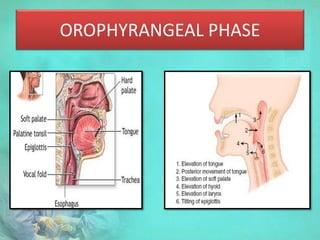
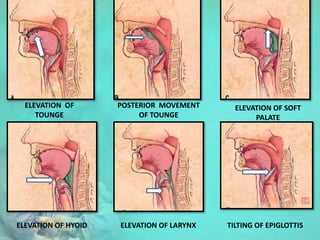
OROPHYRANGEAL PHASE
ELEVATION OF
TOUNGE
POSTERIOR MOVEMENT
OF TOUNGE
ELEVATION OF SOFT
PALATE
ELEVATION OF HYOID ELEVATION OF LARYNX TILTING OF EPIGLOTTIS
Esophageal Phase
• Food bolus is propelled through the esophagus
by an involuntary wave of contraction mediated
by the enteric nervous system.
• Pressure gradient speeds the movement of food
from the hypopharynx into the esophagus when
the cricopharyngeus muscle relaxes.
• The primary peristaltic contraction which is
initiated by a swallowing , moves down the
esophagus at the rate of 2 to 4 cm/s and reaches
the distal esophagus about 9 seconds .
• This duration varies from 8 to 20 seconds
Clinical presentation
• Pain and difficulty in swallowing.
• Sensation of food being stuck into throat or chest.
• Coughing or gagging while swallowing.
• Nasal regurgitation
• Dysarthria
• Nasal speech because of associated muscle
weaknesses
• Frequent burning sensation in chest.
• Having food or stomach acid back up into the throat.
• Unexpectedly losing weight.
FUNCTIONAL GRADES OF DYSPHAGIA
There are 6 grades of dysphagia
• GRADE 1 : Complains of dysphagia but still
eating normally
• GRADE 2 : Requires liquid with Meals
• GRADE 3 : able to take semisolid ,but unable
to take any solids
• GRADE 4 : able to swallow liquids only
• GRADE 5 : unable to swallow liquid, but able
to swallow saliva
• GRADE 6 : unable to swallow saliva also
Etiology
Dyspahgia has been classified broadly into
two types on the basis of site.
Oropharyngeal Esophageal
Abnormalities Causing
Oropharyngeal Dysphagia
• Inability to initiate the act of swallowing.
Etiology
(1) Neuromuscular Diseases
• Central nervous system (CNS)
• Cerebral vascular accident involving the brain stem.
• Parkinson disease
• Wilson disease
• Multiple sclerosis
• Brain stem tumor
• Peripheral nervous system
• poliomyelitis
• Peripheral neuropathies (e.g. diphtheria, tetanus rabies, diabetes mellitus)
• Motor end plate
• Myasthenia gravis
CONTINUED ........................
• Muscle
• Oculopharyngeal muscular dystrophy
• Primary myositis
• Metabolic myopathy (e.g., glycogen storage disease, lipid storage
disease)
(2) mechanical or obstructive Lesions
1) Inflammatory
• Pharyngitis
• Abscess ( peri-tonsillar , paraphryngeal/retrophryngeal )
• Tuberculosis
• Syphilis
2) Neoplastic
3) Plummer-Vinson syndrome
4)Extrinsic compression
• Thyromegaly( hashimoto’s thyroiditis)
• cervical osteophytes
• Lymphadenopathy
CONTINUED.........................
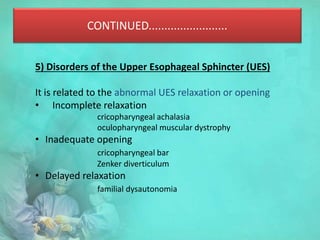
5) Disorders of the Upper Esophageal Sphincter (UES)
It is related to the abnormal UES relaxation or opening
• Incomplete relaxation
cricopharyngeal achalasia
oculopharyngeal muscular dystrophy
• Inadequate opening
cricopharyngeal bar
Zenker diverticulum
• Delayed relaxation
familial dysautonomia
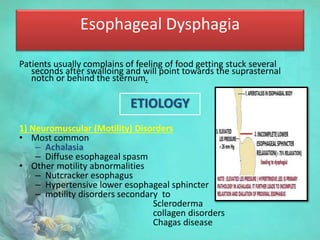
Esophageal Dysphagia
Patients usually complains of feeling of food getting stuck several
seconds after swalloing and will point towards the suprasternal
notch or behind the sternum.
ETIOLOGY
1) Neuromuscular (Motility) Disorders
• Most common
– Achalasia
– Diffuse esophageal spasm
• Other motility abnormalities
– Nutcracker esophagus
– Hypertensive lower esophageal sphincter
– motility disorders secondary to
Scleroderma
collagen disorders
Chagas disease
CONTINUED ........
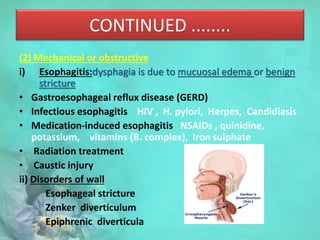
(2) Mechanical or obstructive
i) Esophagitis:dysphagia is due to mucuosal edema or benign
stricture
• Gastroesophageal reflux disease (GERD)
• Infectious esophagitis HIV , H. pylori, Herpes, Candidiasis
• Medication-induced esophagitis NSAIDs , quinidine,
potassium, vitamins (B. complex), Iron sulphate
• Radiation treatment
• Caustic injury
ii) Disorders of wall
Esophageal stricture
Zenker diverticulum
Epiphrenic diverticula
CONTINUED............
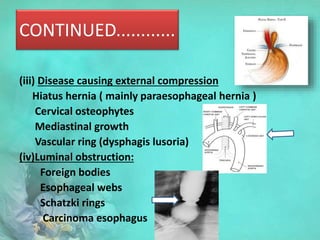
(iii) Disease causing external compression
Hiatus hernia ( mainly paraesophageal hernia )
Cervical osteophytes
Mediastinal growth
Vascular ring (dysphagis lusoria)
(iv)Luminal obstruction:
Foreign bodies
Esophageal webs
Schatzki rings
Carcinoma esophagus
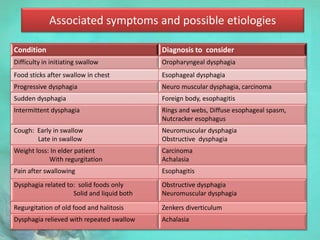
Associated symptoms and possible etiologies
Condition Diagnosis to consider
Difficulty in initiating swallow Oropharyngeal dysphagia
Food sticks after swallow in chest Esophageal dysphagia
Progressive dysphagia Neuro muscular dysphagia, carcinoma
Sudden dysphagia Foreign body, esophagitis
Intermittent dysphagia Rings and webs, Diffuse esophageal spasm,
Nutcracker esophagus
Cough: Early in swallow
Late in swallow
Neuromuscular dysphagia
Obstructive dysphagia
Weight loss: In elder patient
With regurgitation
Carcinoma
Achalasia
Pain after swallowing Esophagitis
Dysphagia related to: solid foods only
Solid and liquid both
Obstructive dysphagia
Neuromuscular dysphagia
Regurgitation of old food and halitosis Zenkers diverticulum
Dysphagia relieved with repeated swallow Achalasia
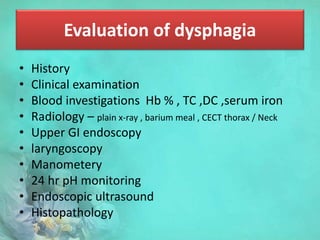
Evaluation of dysphagia
• History
• Clinical examination
• Blood investigations Hb % , TC ,DC ,serum iron
• Radiology – plain x-ray , barium meal , CECT thorax / Neck
• Upper GI endoscopy
• laryngoscopy
• Manometery
• 24 hr pH monitoring
• Endoscopic ultrasound
• Histopathology
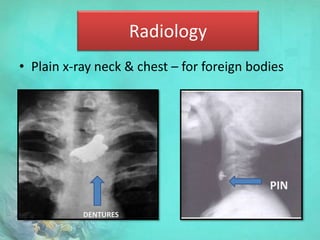
Radiology
• Plain x-ray neck & chest – for foreign bodies
DENTURES
PIN
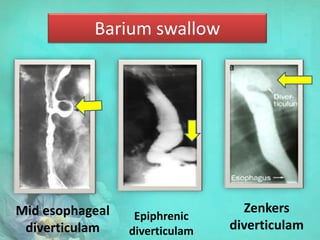
Barium swallow
Mid esophageal
diverticulam
Epiphrenic
diverticulam
Zenkers
diverticulam
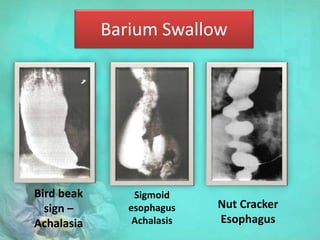
Barium Swallow
Bird beak
sign –
Achalasia
Sigmoid
esophagus
Achalasis
Nut Cracker
Esophagus
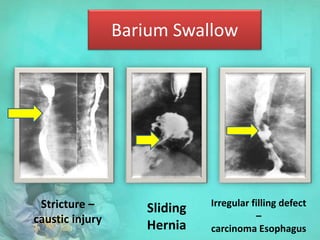
Barium Swallow
Stricture –
caustic injury
Sliding
Hernia
Irregular filling defect
–
carcinoma Esophagus
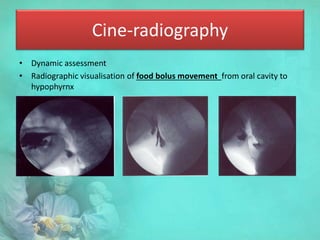
Cine-radiography
• Dynamic assessment
• Radiographic visualisation of food bolus movement from oral cavity to
hypophyrnx
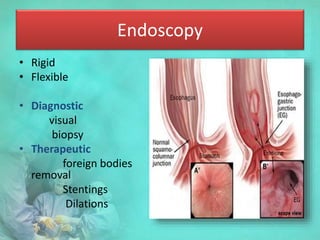
Endoscopy
• Rigid
• Flexible
• Diagnostic
visual
biopsy
• Therapeutic
foreign bodies
removal
Stentings
Dilations
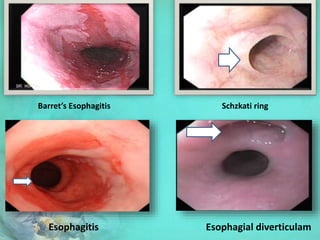
Barret’s Esophagitis Schzkati ring
Esophagitis Esophagial diverticulam
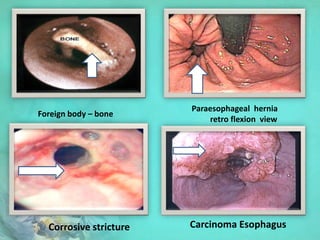
Corrosive stricture Carcinoma Esophagus
Foreign body – bone
Paraesophageal hernia
retro flexion view
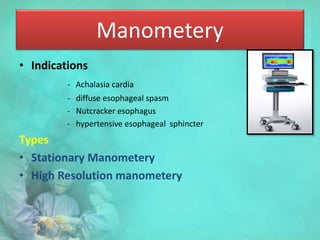
Manometery
• Indications
- Achalasia cardia
- diffuse esophageal spasm
- Nutcracker esophagus
- hypertensive esophageal sphincter
Types
• Stationary Manometery
• High Resolution manometery
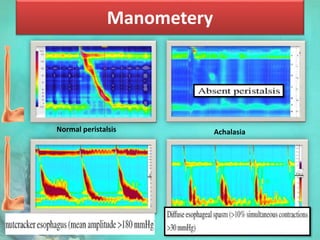
Manometery
Normal peristalsis Achalasia
Nutcracker esophagus Diffuse esophageal spasm
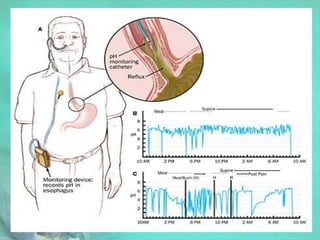
24-Hour Ambulatory pH Monitoring
• The most direct method of measuring
increased REFLUX (esophageal exposure
to gastric juice ) is by an indwelling pH
electrode, or more recently via a radio-
telemetric pH monitoring capsule that
can be clipped to the esophageal mucosa.
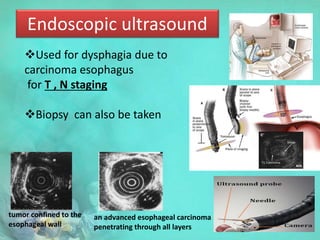
Endoscopic ultrasound
tumor confined to the
esophageal wall
an advanced esophageal carcinoma
penetrating through all layers
Used for dysphagia due to
carcinoma esophagus
for T , N staging
Biopsy can also be taken
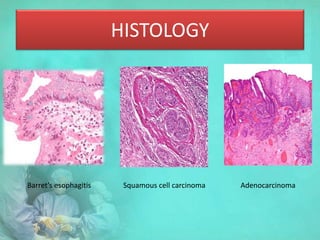
HISTOLOGY
Barret’s esophagitis Squamous cell carcinoma Adenocarcinoma
TREATMENT
• Life style modification
• Drug therapy
• Therapeutic endoscopy
• Dilation
• Stentings
• Chemo-radiation
• Surgery
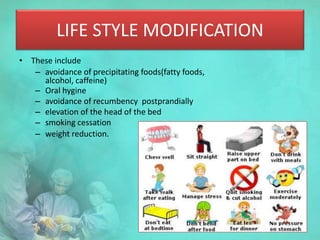
LIFE STYLE MODIFICATION
• These include
– avoidance of precipitating foods(fatty foods,
alcohol, caffeine)
– Oral hygine
– avoidance of recumbency postprandially
– elevation of the head of the bed
– smoking cessation
– weight reduction.
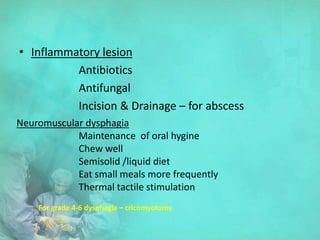
• Inflammatory lesion
Antibiotics
Antifungal
Incision & Drainage – for abscess
Neuromuscular dysphagia
Maintenance of oral hygine
Chew well
Semisolid /liquid diet
Eat small meals more frequently
Thermal tactile stimulation
For grade 4-6 dysphagia – cricomyotomy
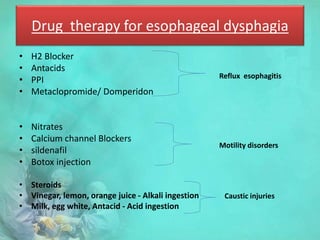
Drug therapy for esophageal dysphagia
• H2 Blocker
• Antacids
• PPI
• Metaclopromide/ Domperidon
• Nitrates
• Calcium channel Blockers
• sildenafil
• Botox injection
• Steroids
• Vinegar, lemon, orange juice - Alkali ingestion
• Milk, egg white, Antacid - Acid ingestion
Reflux esophagitis
Motility disorders
Caustic injuries
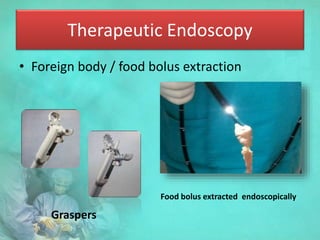
Therapeutic Endoscopy
• Foreign body / food bolus extraction
Graspers
Food bolus extracted endoscopically
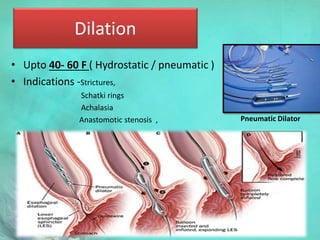
Dilation
• Upto 40- 60 F ( Hydrostatic / pneumatic )
• Indications -Strictures,
Schatki rings
Achalasia
Anastomotic stenosis , Pneumatic Dilator
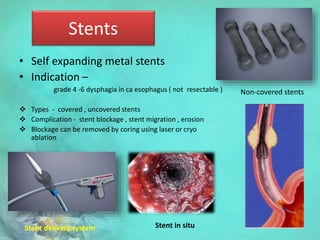
Stents
• Self expanding metal stents
• Indication –
grade 4 -6 dysphagia in ca esophagus ( not resectable )
 Types - covered , uncovered stents
 Complication - stent blockage , stent migration , erosion
 Blockage can be removed by coring using laser or cryo
ablation
Non-covered stents
Stent in situStent delivery system
Chemo-radiation
• Indications
Grade 1-3 dysphagia in case of ca
esophagus ( neo adjuvent )
Grade 4-6 dysphagia in case of ca
esophagus ( palliative )
Cisplatin+5FU + 60Gy radiation over 8 weeks
Surgery
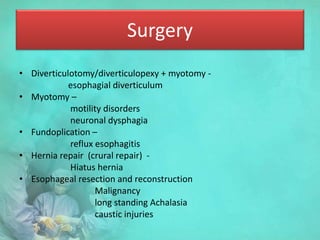
• Diverticulotomy/diverticulopexy + myotomy -
esophagial diverticulum
• Myotomy –
motility disorders
neuronal dysphagia
• Fundoplication –
reflux esophagitis
• Hernia repair (crural repair) -
Hiatus hernia
• Esophageal resection and reconstruction
Malignancy
long standing Achalasia
caustic injuries
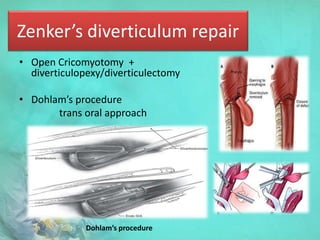
Zenker’s diverticulum repair
• Open Cricomyotomy +
diverticulopexy/diverticulectomy
• Dohlam’s procedure
trans oral approach
Dohlam’s procedure
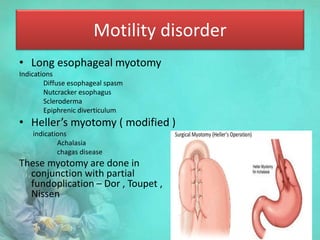
Motility disorder
• Long esophageal myotomy
Indications
Diffuse esophageal spasm
Nutcracker esophagus
Scleroderma
Epiphrenic diverticulum
• Heller’s myotomy ( modified )
indications
Achalasia
chagas disease
These myotomy are done in
conjunction with partial
fundoplication – Dor , Toupet ,
Nissen
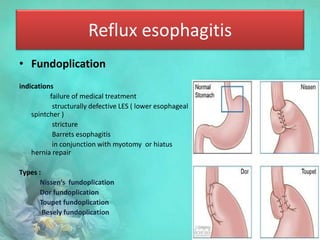
Reflux esophagitis
• Fundoplication
indications
failure of medical treatment
structurally defective LES ( lower esophageal
spintcher )
stricture
Barrets esophagitis
in conjunction with myotomy or hiatus
hernia repair
Types :
Nissen’s fundoplication
Dor fundoplication
Toupet fundoplication
Besely fundoplication
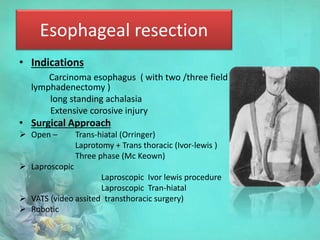
Esophageal resection
• Indications
Carcinoma esophagus ( with two /three field
lymphadenectomy )
long standing achalasia
Extensive corosive injury
• Surgical Approach
 Open – Trans-hiatal (Orringer)
Laprotomy + Trans thoracic (Ivor-lewis )
Three phase (Mc Keown)
 Laproscopic
Laproscopic Ivor lewis procedure
Laproscopic Tran-hiatal
 VATS (video assited transthoracic surgery)
 Robotic
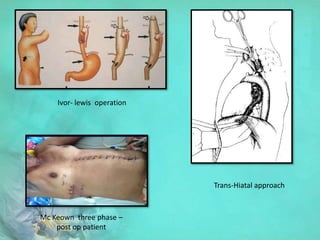
Ivor- lewis operation
Trans-Hiatal approach
Mc Keown three phase –
post op patient
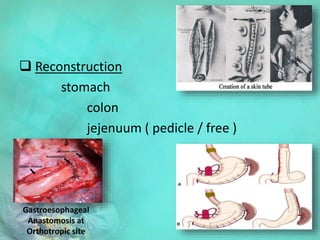
 Reconstruction
stomach
colon
jejenuum ( pedicle / free )
Gastroesophageal
Anastomosis at
Orthotropic site
Dysphagia

Dysphagia

  • 1.
    DYSPHAGIA Dr (PROF.) AB SINGH UNIT Department of general surgery Patna medical college & Hospital
  • 2.
    CONTENTs • Definition • Swallowingmechanism • Clinical presentation • Grading of dysphagia • Etiology • Investigations • Management
  • 3.
    DYSPHAGIA • The worddysphagia is derived from the Greek phagia (to eat) and dys (with difficulty). • Eating becomes unenjoyful. • It refers to the sensation of food being obstructed in the food passage anywhere from the mouth to the stomach. • The basic impairment behind dysphagia are 1)neurological 2)mechanical / obstructive
  • 4.
    SWALLOW MECHANISM • Theact of swallowing requires the passage for food and drink from the mouth into the stomach. • From mouth to hypopharynx covers 1/3rd of passage (distance) while 2/3rd is covered by the esophagus . • The swallowing center in brain stem is located in the floor of fourth ventricle and adjacent regions of medulla. From here it is connected to cerebral cortex, vomiting and respiratory centre. • All these areas works in coordinated manner to provides voluntary as well the involuantary control of swallowing. • An adult swallow approximately 580 times daily and the act goes on unconsciously . • Swallowing phase – Oro-Pharyngeal phase( voluntary phase) – Esophageal phase( involuntary phase)
  • 5.
  • 6.
    ELEVATION OF TOUNGE POSTERIOR MOVEMENT OFTOUNGE ELEVATION OF SOFT PALATE ELEVATION OF HYOID ELEVATION OF LARYNX TILTING OF EPIGLOTTIS
  • 7.
    Esophageal Phase • Foodbolus is propelled through the esophagus by an involuntary wave of contraction mediated by the enteric nervous system. • Pressure gradient speeds the movement of food from the hypopharynx into the esophagus when the cricopharyngeus muscle relaxes. • The primary peristaltic contraction which is initiated by a swallowing , moves down the esophagus at the rate of 2 to 4 cm/s and reaches the distal esophagus about 9 seconds . • This duration varies from 8 to 20 seconds
  • 8.
    Clinical presentation • Painand difficulty in swallowing. • Sensation of food being stuck into throat or chest. • Coughing or gagging while swallowing. • Nasal regurgitation • Dysarthria • Nasal speech because of associated muscle weaknesses • Frequent burning sensation in chest. • Having food or stomach acid back up into the throat. • Unexpectedly losing weight.
  • 9.
    FUNCTIONAL GRADES OFDYSPHAGIA There are 6 grades of dysphagia • GRADE 1 : Complains of dysphagia but still eating normally • GRADE 2 : Requires liquid with Meals • GRADE 3 : able to take semisolid ,but unable to take any solids • GRADE 4 : able to swallow liquids only • GRADE 5 : unable to swallow liquid, but able to swallow saliva • GRADE 6 : unable to swallow saliva also
  • 10.
    Etiology Dyspahgia has beenclassified broadly into two types on the basis of site. Oropharyngeal Esophageal
  • 11.
    Abnormalities Causing Oropharyngeal Dysphagia •Inability to initiate the act of swallowing. Etiology (1) Neuromuscular Diseases • Central nervous system (CNS) • Cerebral vascular accident involving the brain stem. • Parkinson disease • Wilson disease • Multiple sclerosis • Brain stem tumor • Peripheral nervous system • poliomyelitis • Peripheral neuropathies (e.g. diphtheria, tetanus rabies, diabetes mellitus) • Motor end plate • Myasthenia gravis
  • 12.
    CONTINUED ........................ • Muscle •Oculopharyngeal muscular dystrophy • Primary myositis • Metabolic myopathy (e.g., glycogen storage disease, lipid storage disease) (2) mechanical or obstructive Lesions 1) Inflammatory • Pharyngitis • Abscess ( peri-tonsillar , paraphryngeal/retrophryngeal ) • Tuberculosis • Syphilis 2) Neoplastic 3) Plummer-Vinson syndrome 4)Extrinsic compression • Thyromegaly( hashimoto’s thyroiditis) • cervical osteophytes • Lymphadenopathy
  • 13.
    CONTINUED......................... 5) Disorders ofthe Upper Esophageal Sphincter (UES) It is related to the abnormal UES relaxation or opening • Incomplete relaxation cricopharyngeal achalasia oculopharyngeal muscular dystrophy • Inadequate opening cricopharyngeal bar Zenker diverticulum • Delayed relaxation familial dysautonomia
  • 14.
    Esophageal Dysphagia Patients usuallycomplains of feeling of food getting stuck several seconds after swalloing and will point towards the suprasternal notch or behind the sternum. ETIOLOGY 1) Neuromuscular (Motility) Disorders • Most common – Achalasia – Diffuse esophageal spasm • Other motility abnormalities – Nutcracker esophagus – Hypertensive lower esophageal sphincter – motility disorders secondary to Scleroderma collagen disorders Chagas disease
  • 15.
    CONTINUED ........ (2) Mechanicalor obstructive i) Esophagitis:dysphagia is due to mucuosal edema or benign stricture • Gastroesophageal reflux disease (GERD) • Infectious esophagitis HIV , H. pylori, Herpes, Candidiasis • Medication-induced esophagitis NSAIDs , quinidine, potassium, vitamins (B. complex), Iron sulphate • Radiation treatment • Caustic injury ii) Disorders of wall Esophageal stricture Zenker diverticulum Epiphrenic diverticula
  • 16.
    CONTINUED............ (iii) Disease causingexternal compression Hiatus hernia ( mainly paraesophageal hernia ) Cervical osteophytes Mediastinal growth Vascular ring (dysphagis lusoria) (iv)Luminal obstruction: Foreign bodies Esophageal webs Schatzki rings Carcinoma esophagus
  • 17.
    Associated symptoms andpossible etiologies Condition Diagnosis to consider Difficulty in initiating swallow Oropharyngeal dysphagia Food sticks after swallow in chest Esophageal dysphagia Progressive dysphagia Neuro muscular dysphagia, carcinoma Sudden dysphagia Foreign body, esophagitis Intermittent dysphagia Rings and webs, Diffuse esophageal spasm, Nutcracker esophagus Cough: Early in swallow Late in swallow Neuromuscular dysphagia Obstructive dysphagia Weight loss: In elder patient With regurgitation Carcinoma Achalasia Pain after swallowing Esophagitis Dysphagia related to: solid foods only Solid and liquid both Obstructive dysphagia Neuromuscular dysphagia Regurgitation of old food and halitosis Zenkers diverticulum Dysphagia relieved with repeated swallow Achalasia
  • 18.
    Evaluation of dysphagia •History • Clinical examination • Blood investigations Hb % , TC ,DC ,serum iron • Radiology – plain x-ray , barium meal , CECT thorax / Neck • Upper GI endoscopy • laryngoscopy • Manometery • 24 hr pH monitoring • Endoscopic ultrasound • Histopathology
  • 19.
    Radiology • Plain x-rayneck & chest – for foreign bodies DENTURES PIN
  • 20.
  • 21.
    Barium Swallow Bird beak sign– Achalasia Sigmoid esophagus Achalasis Nut Cracker Esophagus
  • 22.
    Barium Swallow Stricture – causticinjury Sliding Hernia Irregular filling defect – carcinoma Esophagus
  • 23.
    Cine-radiography • Dynamic assessment •Radiographic visualisation of food bolus movement from oral cavity to hypophyrnx
  • 24.
    Endoscopy • Rigid • Flexible •Diagnostic visual biopsy • Therapeutic foreign bodies removal Stentings Dilations
  • 25.
    Barret’s Esophagitis Schzkatiring Esophagitis Esophagial diverticulam
  • 26.
    Corrosive stricture CarcinomaEsophagus Foreign body – bone Paraesophageal hernia retro flexion view
  • 27.
    Manometery • Indications - Achalasiacardia - diffuse esophageal spasm - Nutcracker esophagus - hypertensive esophageal sphincter Types • Stationary Manometery • High Resolution manometery
  • 28.
    Manometery Normal peristalsis Achalasia Nutcrackeresophagus Diffuse esophageal spasm
  • 29.
    24-Hour Ambulatory pHMonitoring • The most direct method of measuring increased REFLUX (esophageal exposure to gastric juice ) is by an indwelling pH electrode, or more recently via a radio- telemetric pH monitoring capsule that can be clipped to the esophageal mucosa.
  • 31.
    Endoscopic ultrasound tumor confinedto the esophageal wall an advanced esophageal carcinoma penetrating through all layers Used for dysphagia due to carcinoma esophagus for T , N staging Biopsy can also be taken
  • 32.
    HISTOLOGY Barret’s esophagitis Squamouscell carcinoma Adenocarcinoma
  • 33.
    TREATMENT • Life stylemodification • Drug therapy • Therapeutic endoscopy • Dilation • Stentings • Chemo-radiation • Surgery
  • 34.
    LIFE STYLE MODIFICATION •These include – avoidance of precipitating foods(fatty foods, alcohol, caffeine) – Oral hygine – avoidance of recumbency postprandially – elevation of the head of the bed – smoking cessation – weight reduction.
  • 35.
    • Inflammatory lesion Antibiotics Antifungal Incision& Drainage – for abscess Neuromuscular dysphagia Maintenance of oral hygine Chew well Semisolid /liquid diet Eat small meals more frequently Thermal tactile stimulation For grade 4-6 dysphagia – cricomyotomy
  • 36.
    Drug therapy foresophageal dysphagia • H2 Blocker • Antacids • PPI • Metaclopromide/ Domperidon • Nitrates • Calcium channel Blockers • sildenafil • Botox injection • Steroids • Vinegar, lemon, orange juice - Alkali ingestion • Milk, egg white, Antacid - Acid ingestion Reflux esophagitis Motility disorders Caustic injuries
  • 37.
    Therapeutic Endoscopy • Foreignbody / food bolus extraction Graspers Food bolus extracted endoscopically
  • 38.
    Dilation • Upto 40-60 F ( Hydrostatic / pneumatic ) • Indications -Strictures, Schatki rings Achalasia Anastomotic stenosis , Pneumatic Dilator
  • 39.
    Stents • Self expandingmetal stents • Indication – grade 4 -6 dysphagia in ca esophagus ( not resectable )  Types - covered , uncovered stents  Complication - stent blockage , stent migration , erosion  Blockage can be removed by coring using laser or cryo ablation Non-covered stents Stent in situStent delivery system
  • 40.
    Chemo-radiation • Indications Grade 1-3dysphagia in case of ca esophagus ( neo adjuvent ) Grade 4-6 dysphagia in case of ca esophagus ( palliative ) Cisplatin+5FU + 60Gy radiation over 8 weeks
  • 41.
    Surgery • Diverticulotomy/diverticulopexy +myotomy - esophagial diverticulum • Myotomy – motility disorders neuronal dysphagia • Fundoplication – reflux esophagitis • Hernia repair (crural repair) - Hiatus hernia • Esophageal resection and reconstruction Malignancy long standing Achalasia caustic injuries
  • 42.
    Zenker’s diverticulum repair •Open Cricomyotomy + diverticulopexy/diverticulectomy • Dohlam’s procedure trans oral approach Dohlam’s procedure
  • 43.
    Motility disorder • Longesophageal myotomy Indications Diffuse esophageal spasm Nutcracker esophagus Scleroderma Epiphrenic diverticulum • Heller’s myotomy ( modified ) indications Achalasia chagas disease These myotomy are done in conjunction with partial fundoplication – Dor , Toupet , Nissen
  • 44.
    Reflux esophagitis • Fundoplication indications failureof medical treatment structurally defective LES ( lower esophageal spintcher ) stricture Barrets esophagitis in conjunction with myotomy or hiatus hernia repair Types : Nissen’s fundoplication Dor fundoplication Toupet fundoplication Besely fundoplication
  • 45.
    Esophageal resection • Indications Carcinomaesophagus ( with two /three field lymphadenectomy ) long standing achalasia Extensive corosive injury • Surgical Approach  Open – Trans-hiatal (Orringer) Laprotomy + Trans thoracic (Ivor-lewis ) Three phase (Mc Keown)  Laproscopic Laproscopic Ivor lewis procedure Laproscopic Tran-hiatal  VATS (video assited transthoracic surgery)  Robotic
  • 46.
    Ivor- lewis operation Trans-Hiatalapproach Mc Keown three phase – post op patient
  • 47.
     Reconstruction stomach colon jejenuum (pedicle / free ) Gastroesophageal Anastomosis at Orthotropic site