UPPER
GASTROINTESTINAL
BLEEDING(UGIB)
           BY
     DR. OFOEGBU J.I.
OUTLINE

•   Definition
•   Epidemiology
•   Aetiology
•   Clinical presentation
•   Management
•   Prognosis
•   Conclusion
Definition

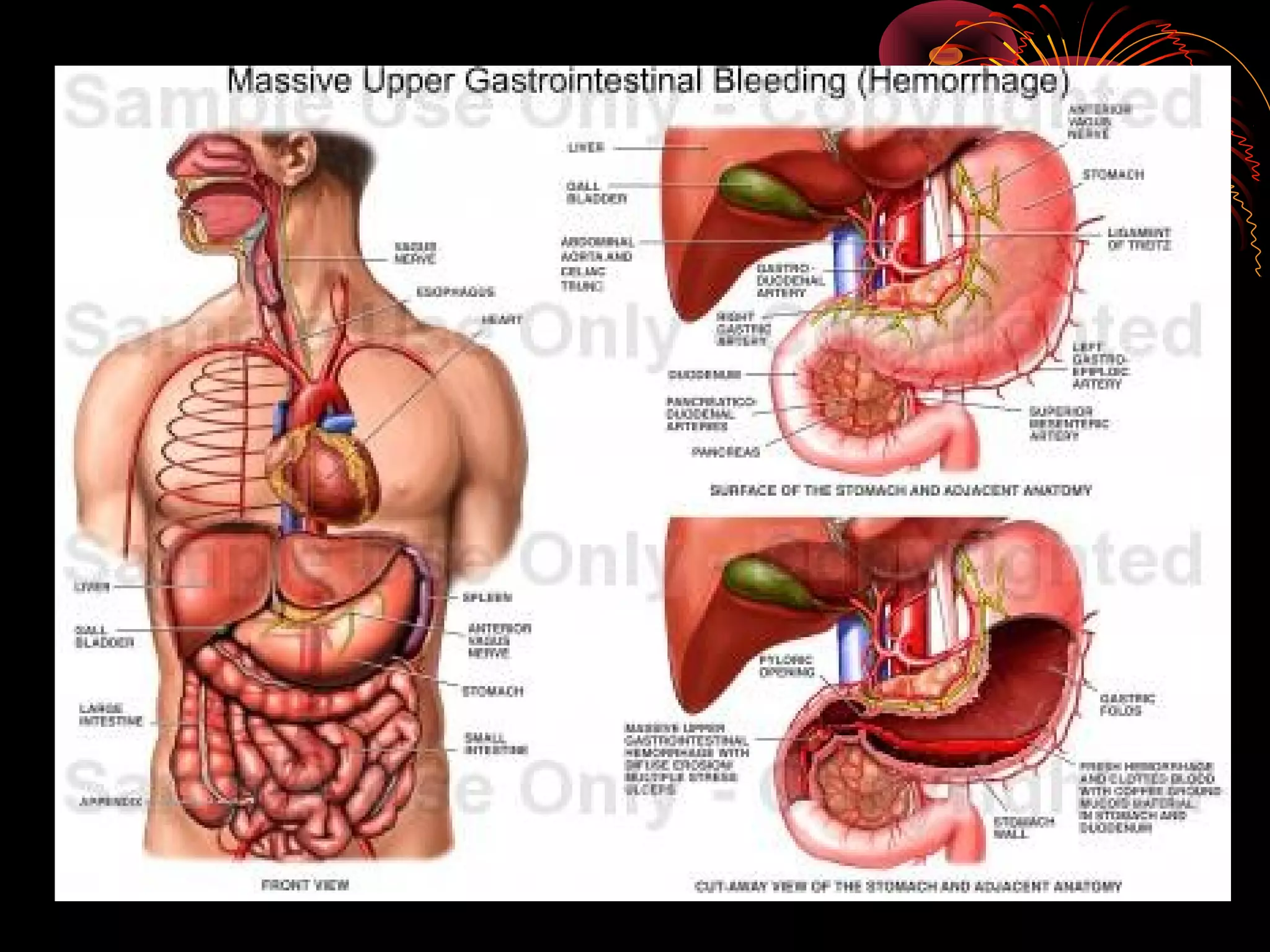
• UGIB can be defined as
  bleeding from any site along the
  gastrointestinal tract (GIT) that
  is above the ligament of treitz.
Epidemiology
• The annual incidence of hospital
  admissions for UGIB in the United States
  and Europe is approximately 0.1%, with a
  mortality rate of about 5-10%.
• The mortality rate of patients under 60
  years of age in the absence of malignancy
  or organ failure is < 1%.
• The three independent clinical predictions
  of death in patients hospitalized with UGIB
  are increasing age, co morbidities and
  haemodynamic compromise (tachycardia &
  hypotension)
Aetiology
• Common causes
 1) Peptic ulcers – most common
  cause of UGIB – 35-62% of cases
 2) Varices (oesophageal & gastric) –
  5-30%
 3) Mallory-Weiss syndrome – 5-15%
 4) Haemorrhagic gastropathy &
  erosions – 3-11%
 5) Erosive oesophagitis – 2-8%
Aetiology (contd)
• Uncommon causes; they include Erosive
  duodenitis, neoplasms, aortoenteric
  fistulas, vascular lesions[ including
  hereditary haemorrhagic
  telengectasias(Osler- Weber-Rendu) and
  gastric antral vascular ectasia (‘Water-
  melon stomach’)], Dieulafoy’s lesion (in
  which an aberrant vessel in the mucosa
  bleeds from a pinpoint mucosal defect),
  prolapse gastropathy, haemobilia and
  hemosuccus pancreaticus.
Clinical Presentation
• This bleeding from the GIT can present in 5 ways;
  a) Haematemesis:- Vomitus of red blood or ‘coffee-
   grounds’ material.
  b) Melaena:- Black, tarry foul smelling stool.
  c) Haematochezia:- Is the passage of bright red or
   maroon blood from the rectum.
  d) Occult GIB:- This is identified in the absence of
   overt bleeding by special examination of the stool
   (e.g. Guaiac testing)
  e) Symptoms of blood loss/anaemia:- Light-
   headedness, syncope, angina or dyspnoea.
Management

•   Quick history
•   Examination
•   Investigations
•   Treatment
Management (contd)
• This depends on the following;
 1) Age of patient
 2) The amount of blood lost
 3) Continuing visible blood loss
 4) Signs of chronic liver disease on
  examination
 5) Evidence of co morbidity e.g. cardiac
  failure, ischaemic heart disease and
  malignant disease.
 6) Presence of the classical features of
  shock.
Quick history

• Any of the already mentioned
  C/P, shock and unconscious.
• Hx of epigastric pain or a known
  PUD patient
• Intake of NSAIDS e.g. Asprin
• Alcohol binge
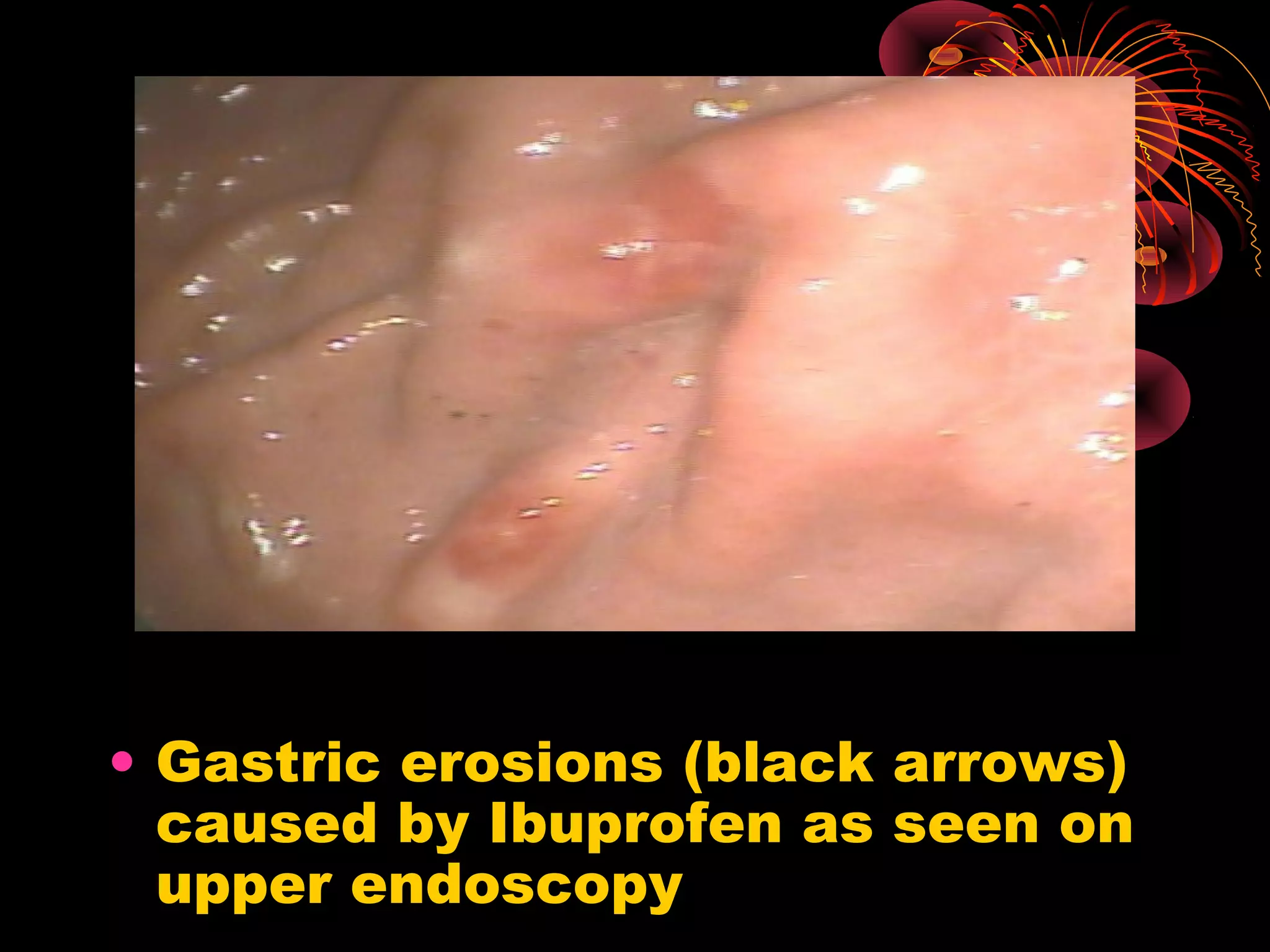
• Gastric erosions (black arrows)
  caused by Ibuprofen as seen on
  upper endoscopy
Examination
• Obvious continuing blood loss
• Pallour
• Cold and clammy extremities (shock)
• CVS – tachycardia >100b/m,
  hypotension
• Signs of chronic liver disease
• Abd- epigastric tenderness&
  hyperactive bowel sounds
  Ascitic tap- bloody
Investigations

•    FBC – especially Hb
•    S E/U/C – access renal status
•    Liver function test
•    Endoscopy (diagnostic) – performed
     within 24hrs in most patients.
    - Bleeding site is seen in >80% of
     cases. i.e. Varices, Mallory-Weiss
     tear or PUD.
Treatment

• Medical
• Surgical
Medical
• ABC Resuscitation- for emergency cases,
  when patient presents with an ongoing blood
  loss, in shock or unconscious.
 A- Clear airway    Suctioning in cases of
                      haematemesis
                      Left lateral position to
                      avoid aspiration.
 B- Ensure breathing    Oxygen therapy for
                         shocked patients.
Medical (ABC
resuscitation contd)
C- Circulation      Establish one or more
  intravenous accesses with wide bore
  cannulae, if bleeding is brisk and massive.
  - Blood transfusion with fresh whole blood
  - Colloid (dextran) or crystalloid (N/S) until
  blood becomes ready.
  -continue monitoring pulse and BP
  -avoid circulatory overload
For continued bleeding - reendoscope
Medical contd
(Therapeutic Endoscopy)
• This depends on cause;
• VARICES: (i) can be injected with a sclerosing
  agent that produces vessel thrombosis e.g. 5%
  phenol in almond or arachis oil
           (ii) Banding
  Both are said to arrest bleeding in 80% of cases
• BLEEDING PUD: (i) Bipolar electrocoagulation
                    (ii) Heater probe
                    (iii) Injection therapy with
  absolute alcohol, 1:10,000 epinephrine.
Medical contd (Drug
Therapy)
• In about 20% of cases of bleeding
  PUD, following use of heater probe,
  epinephrine or laser therapy they
  rebleed within 72hrs.
• Such cases will require intravenous
  Omeprazole 80mg bolus followed by
  infusion 8mg/hr for 72hrs.
• This reduces rebleeding rates and
  need for surgery.
Medical contd (Drug
Therapy)
• FOR VARICES: Vasoconstrictor
  therapy with Terlipressin(2mg
  6hrly x48hrs then 1mg 4hrly)
  and Somatostatin infusion (250-
  500ug/hr) is helpful.
  Also Octreotide 50ug bolus and
  50ug/hr intravenous infusion x2-
  5/7 can control acute bleeding.
Mgt of Varices contd.

• Balloon tamponade: with Sengstaken
  - Blakemore tube is successful in
  90% of cases & very useful in first
  few hrs of bleeding.
• Some drawbacks include aspiration
  pneumonia, oesophageal rupture &
  mucosal ulceration, which leads to a
  5% mortality.
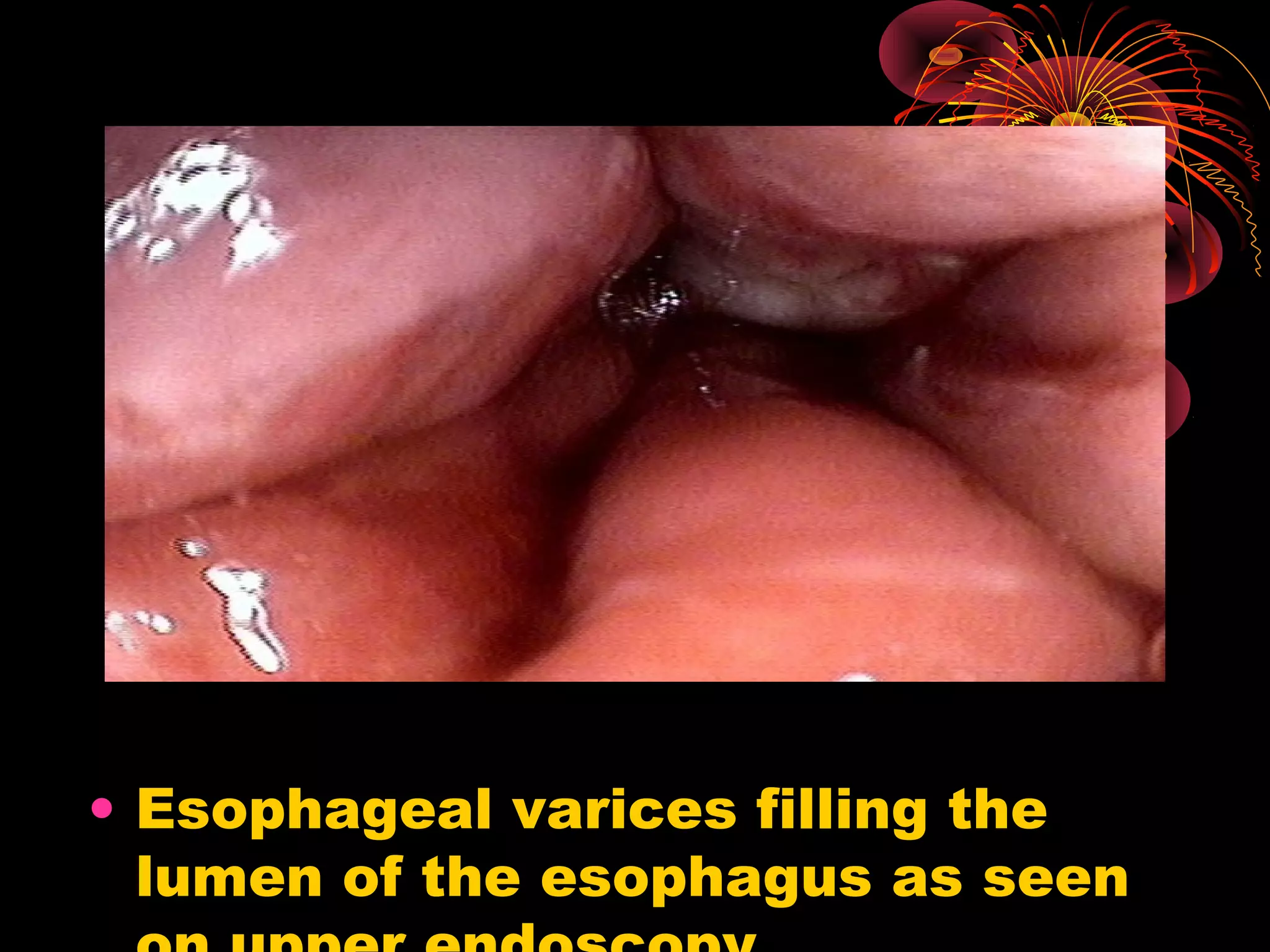
• Esophageal varices filling the
  lumen of the esophagus as seen
Additional mgt of acute
bleeding
• Prophylactic antibiotics: e.g.
  oral or i.v. quinolones –
  Ciprofloxacin
• Nursing – Intensive care nursing
  & NPO until bleeding stops.
• Sucralfate: 1g 6hrly – this
  reduces oesophageal ulceration
  following endoscopic therapy.
• Further bleed from a varice will
  require TIPS (Transjugular
  intrahepatic portosystemic
  shunt)- a minimal invasive
  procedure – done if endoscopic
  & medical therapy fail.
Surgery
• This is indicated when other measures fail
  or if TIPS is not available.
              TYPES
• a) Oesophageal transection & ligation of
  the feeding vessels to the bleeding
  Varices.
• b) Portosystemic shunting – but this
  causes significant encephalopathy
  Rebleed following treatment can be
  reduced by giving a non-selective B-
  blocker e.g. Propranolol
Mgt of Mallory – Weiss
tears
• Bleeding stops spontaneously in 80-
  90% of cases & recur in only 0-5% of
  patients.
• Endoscopy therapy is indicated in
  actively bleeding cases.
• Angiographic therapy with intra-
  arterial infusion of vasopressin or
  embolization and operative therapy
  with oversewing of the tear are
  rarely required.
Prognosis
• This depends on;
 1) Age: Mortality is < 0.1% for patients
  < 60yrs but >20% for patients >80yrs.
 2) Recurrent haemorrhage increases
  mortality.
 3) Co morbidities increase mortality
 4) Melaena is a better prognostic
  factor than haematemesis
 5) Shock increases mortality.
Conclusion

• Upper gastrointestinal bleeding
  can be life threatening seeking
  immediate medical care for
  aggressive resuscitation.
• Both medical and endoscopic
  therapy have been shown to
  significantly improve patient
  outcomes.
Upper gastrointestinal tract bleeding(ugib)

Upper gastrointestinal tract bleeding(ugib)

  • 1.
  • 2.
    OUTLINE • Definition • Epidemiology • Aetiology • Clinical presentation • Management • Prognosis • Conclusion
  • 4.
    Definition • UGIB canbe defined as bleeding from any site along the gastrointestinal tract (GIT) that is above the ligament of treitz.
  • 5.
    Epidemiology • The annualincidence of hospital admissions for UGIB in the United States and Europe is approximately 0.1%, with a mortality rate of about 5-10%. • The mortality rate of patients under 60 years of age in the absence of malignancy or organ failure is < 1%. • The three independent clinical predictions of death in patients hospitalized with UGIB are increasing age, co morbidities and haemodynamic compromise (tachycardia & hypotension)
  • 6.
    Aetiology • Common causes 1) Peptic ulcers – most common cause of UGIB – 35-62% of cases 2) Varices (oesophageal & gastric) – 5-30% 3) Mallory-Weiss syndrome – 5-15% 4) Haemorrhagic gastropathy & erosions – 3-11% 5) Erosive oesophagitis – 2-8%
  • 7.
    Aetiology (contd) • Uncommoncauses; they include Erosive duodenitis, neoplasms, aortoenteric fistulas, vascular lesions[ including hereditary haemorrhagic telengectasias(Osler- Weber-Rendu) and gastric antral vascular ectasia (‘Water- melon stomach’)], Dieulafoy’s lesion (in which an aberrant vessel in the mucosa bleeds from a pinpoint mucosal defect), prolapse gastropathy, haemobilia and hemosuccus pancreaticus.
  • 8.
    Clinical Presentation • Thisbleeding from the GIT can present in 5 ways; a) Haematemesis:- Vomitus of red blood or ‘coffee- grounds’ material. b) Melaena:- Black, tarry foul smelling stool. c) Haematochezia:- Is the passage of bright red or maroon blood from the rectum. d) Occult GIB:- This is identified in the absence of overt bleeding by special examination of the stool (e.g. Guaiac testing) e) Symptoms of blood loss/anaemia:- Light- headedness, syncope, angina or dyspnoea.
  • 9.
    Management • Quick history • Examination • Investigations • Treatment
  • 10.
    Management (contd) • Thisdepends on the following; 1) Age of patient 2) The amount of blood lost 3) Continuing visible blood loss 4) Signs of chronic liver disease on examination 5) Evidence of co morbidity e.g. cardiac failure, ischaemic heart disease and malignant disease. 6) Presence of the classical features of shock.
  • 11.
    Quick history • Anyof the already mentioned C/P, shock and unconscious. • Hx of epigastric pain or a known PUD patient • Intake of NSAIDS e.g. Asprin • Alcohol binge
  • 12.
    • Gastric erosions(black arrows) caused by Ibuprofen as seen on upper endoscopy
  • 13.
    Examination • Obvious continuingblood loss • Pallour • Cold and clammy extremities (shock) • CVS – tachycardia >100b/m, hypotension • Signs of chronic liver disease • Abd- epigastric tenderness& hyperactive bowel sounds Ascitic tap- bloody
  • 14.
    Investigations • FBC – especially Hb • S E/U/C – access renal status • Liver function test • Endoscopy (diagnostic) – performed within 24hrs in most patients. - Bleeding site is seen in >80% of cases. i.e. Varices, Mallory-Weiss tear or PUD.
  • 15.
  • 16.
    Medical • ABC Resuscitation-for emergency cases, when patient presents with an ongoing blood loss, in shock or unconscious. A- Clear airway Suctioning in cases of haematemesis Left lateral position to avoid aspiration. B- Ensure breathing Oxygen therapy for shocked patients.
  • 17.
    Medical (ABC resuscitation contd) C-Circulation Establish one or more intravenous accesses with wide bore cannulae, if bleeding is brisk and massive. - Blood transfusion with fresh whole blood - Colloid (dextran) or crystalloid (N/S) until blood becomes ready. -continue monitoring pulse and BP -avoid circulatory overload For continued bleeding - reendoscope
  • 18.
    Medical contd (Therapeutic Endoscopy) •This depends on cause; • VARICES: (i) can be injected with a sclerosing agent that produces vessel thrombosis e.g. 5% phenol in almond or arachis oil (ii) Banding Both are said to arrest bleeding in 80% of cases • BLEEDING PUD: (i) Bipolar electrocoagulation (ii) Heater probe (iii) Injection therapy with absolute alcohol, 1:10,000 epinephrine.
  • 19.
    Medical contd (Drug Therapy) •In about 20% of cases of bleeding PUD, following use of heater probe, epinephrine or laser therapy they rebleed within 72hrs. • Such cases will require intravenous Omeprazole 80mg bolus followed by infusion 8mg/hr for 72hrs. • This reduces rebleeding rates and need for surgery.
  • 20.
    Medical contd (Drug Therapy) •FOR VARICES: Vasoconstrictor therapy with Terlipressin(2mg 6hrly x48hrs then 1mg 4hrly) and Somatostatin infusion (250- 500ug/hr) is helpful. Also Octreotide 50ug bolus and 50ug/hr intravenous infusion x2- 5/7 can control acute bleeding.
  • 21.
    Mgt of Varicescontd. • Balloon tamponade: with Sengstaken - Blakemore tube is successful in 90% of cases & very useful in first few hrs of bleeding. • Some drawbacks include aspiration pneumonia, oesophageal rupture & mucosal ulceration, which leads to a 5% mortality.
  • 22.
    • Esophageal varicesfilling the lumen of the esophagus as seen
  • 23.
    Additional mgt ofacute bleeding • Prophylactic antibiotics: e.g. oral or i.v. quinolones – Ciprofloxacin • Nursing – Intensive care nursing & NPO until bleeding stops. • Sucralfate: 1g 6hrly – this reduces oesophageal ulceration following endoscopic therapy.
  • 24.
    • Further bleedfrom a varice will require TIPS (Transjugular intrahepatic portosystemic shunt)- a minimal invasive procedure – done if endoscopic & medical therapy fail.
  • 25.
    Surgery • This isindicated when other measures fail or if TIPS is not available. TYPES • a) Oesophageal transection & ligation of the feeding vessels to the bleeding Varices. • b) Portosystemic shunting – but this causes significant encephalopathy Rebleed following treatment can be reduced by giving a non-selective B- blocker e.g. Propranolol
  • 26.
    Mgt of Mallory– Weiss tears • Bleeding stops spontaneously in 80- 90% of cases & recur in only 0-5% of patients. • Endoscopy therapy is indicated in actively bleeding cases. • Angiographic therapy with intra- arterial infusion of vasopressin or embolization and operative therapy with oversewing of the tear are rarely required.
  • 27.
    Prognosis • This dependson; 1) Age: Mortality is < 0.1% for patients < 60yrs but >20% for patients >80yrs. 2) Recurrent haemorrhage increases mortality. 3) Co morbidities increase mortality 4) Melaena is a better prognostic factor than haematemesis 5) Shock increases mortality.
  • 28.
    Conclusion • Upper gastrointestinalbleeding can be life threatening seeking immediate medical care for aggressive resuscitation. • Both medical and endoscopic therapy have been shown to significantly improve patient outcomes.