



Presented By:
Mr. Abhay Rajpoot
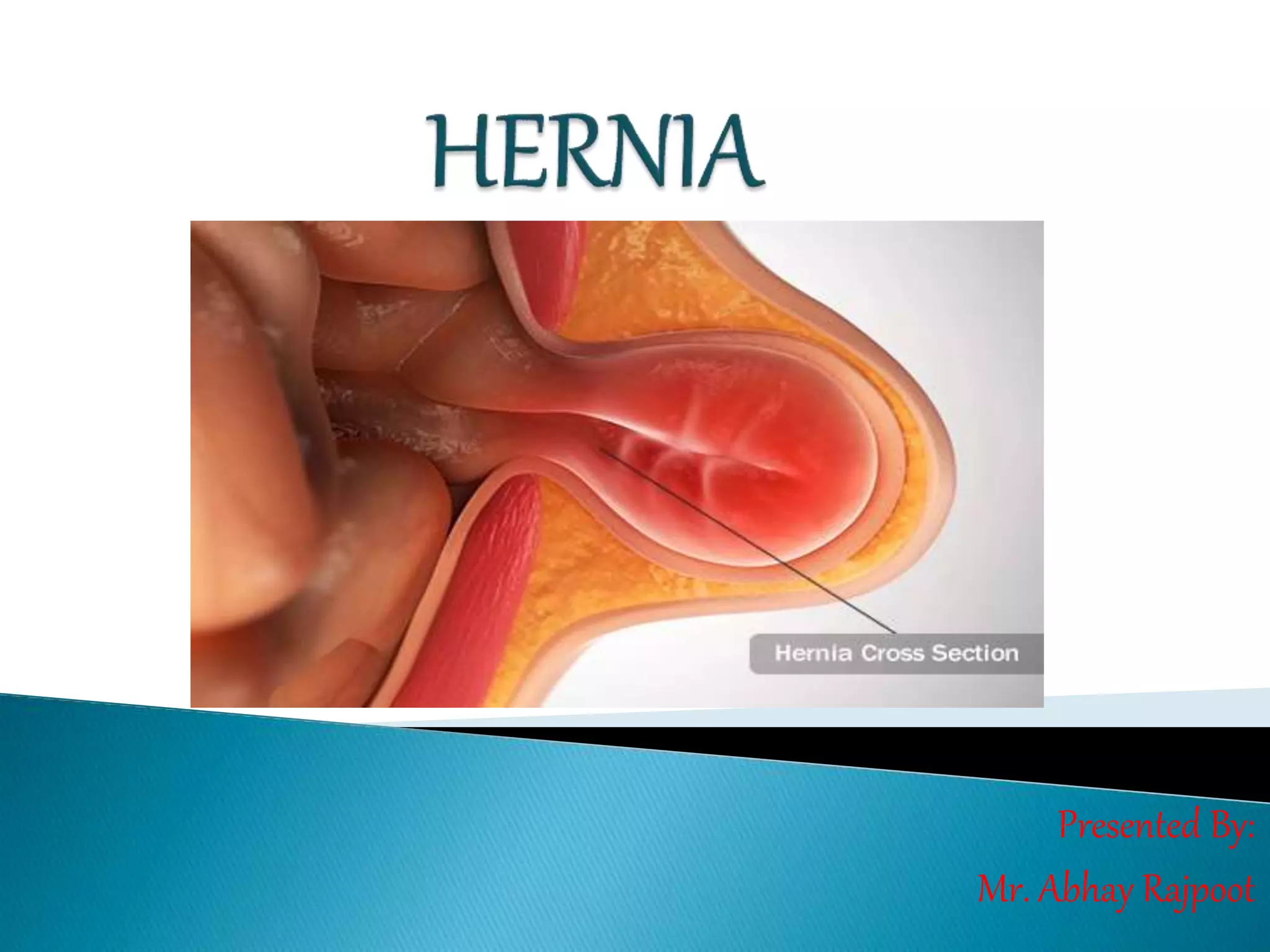
 A hernia is an abnormal protrusion of part of the body
out of its normal anatomical area of confinement. This
normally results in a swelling, pain and in some cases
loss of function.
 Abdominal wall hernias are common, with a
prevalence of 1.7% of all ages and 4% of those aged
over 45 years.
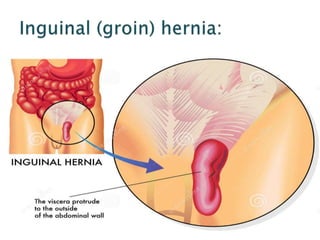
 Inguinal hernias account for 75% of abdominal wall
hernias, with a lifetime risk of 27% in men and 3% in
women.
 Repair of inguinal hernia is most common operation
in general surgery, with rates ranging from 10 per
100000 of the population in United Kingdom to 28
per 100000 in United States.
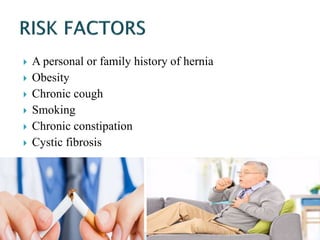
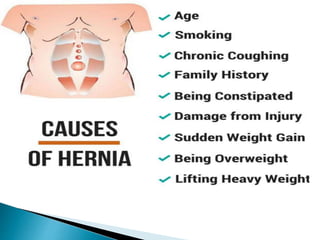
 A personal or family history of hernia
 Obesity
 Chronic cough
 Smoking
 Chronic constipation
 Cystic fibrosis
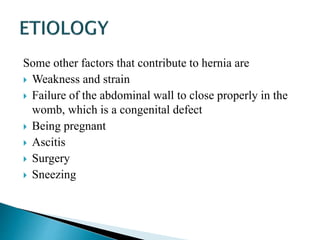
Some other factors that contribute to hernia are
 Weakness and strain
 Failure of the abdominal wall to close properly in the
womb, which is a congenital defect
 Being pregnant
 Ascitis
 Surgery
 Sneezing
 .
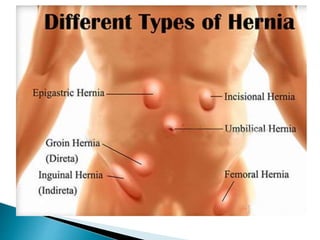
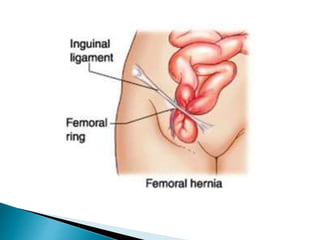
 The femoral canal is the path through which the femoral
artery, vein, and nerve leave the abdominal cavity to enter the
thigh
 A femoral hernia causes a bulge just below the inguinal
crease in roughly the middle of the upper leg. Usually
occurring in women, femoral hernias are particularly at risk of
becoming irreducible (not able to be pushed back into place)
and strangulated (cutting off blood supply).
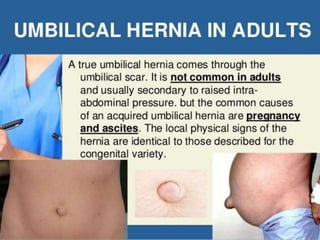
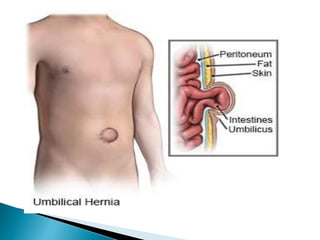
 These common hernias (10%-30%) are often noted in a
child at birth as a protrusion at the belly button (the
umbilicus). An umbilical hernia is caused when an
opening in the child's abdominal wall, which normally
closes before birth, doesn't close completely. If small
(less than half an inch), this type of hernia usually
closes gradually by age 2. Larger hernias and those
that do not close by themselves usually require surgery
when a child is 2 to 4 years of age. Even if the area is
closed at birth, umbilical hernias can appear later in
life because this spot may remain a weaker place in the
abdominal wall. Umbilical hernias can appear later in
life or in women who are pregnantor who have given
birth (due to the added stress on the area). They
usually do not cause abdominal pain.
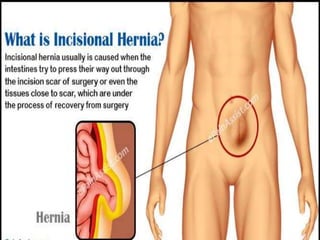
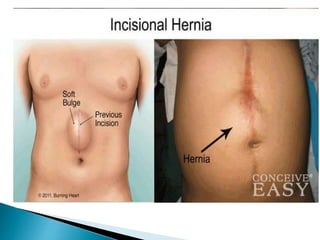
 Abdominal surgery causes a flaw in the
abdominal wall. This flaw can create an area
of weakness through which a hernia may
develop. This occurs after 2%-10% of all
abdominal surgeries, although some people
are more at risk. Even after surgical repair,
incisional hernias may return
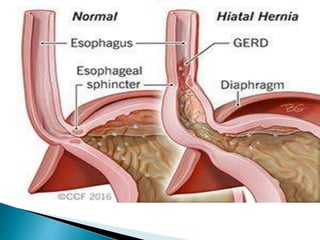
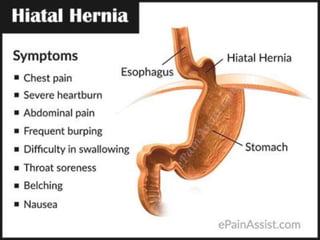
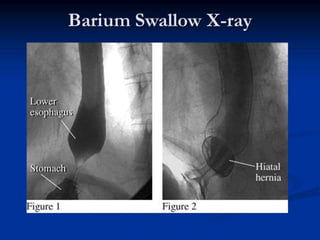
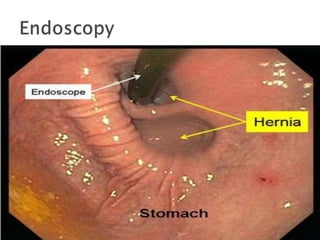
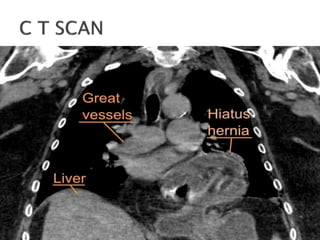
 This type of hernia occurs when part of the stomach
pushes through the diaphragm. The diaphragm
normally has a small opening for the esophagus. This
opening can become the place where part of the
stomach pushes through. Small hiatal hernias can be
asymptomatic (cause no symptoms), while larger ones
can cause pain and heartburn.
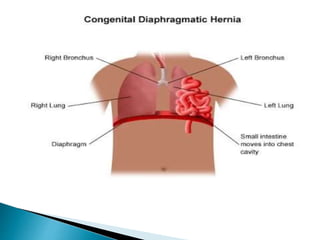
 This is usually a birth defect causing an opening in the
diaphragm, which allows abdominal content to push
through into the chest cavity
 History
 Physical examination
Physical examination of patients with hernia is usually
remarkable for bulge in the groin, painless scrotal
mass and palpable abdominal mass may be present.
Abdomen
 A palpable abdominal mass in the flank may be present
 Abdominal distention
Genitourinary
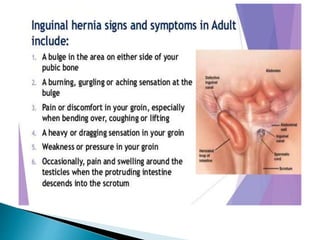
 Painless scrotal mass may be present
 Bulge in the groin
 Obstruction resulting in pain, nausea or constipation
 Swelling and pain in surrounding area
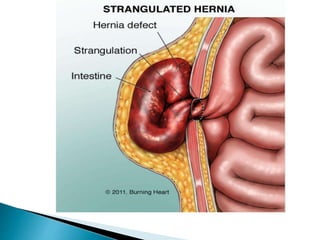
 Intestinal obstruction
 Sepsis
 Death
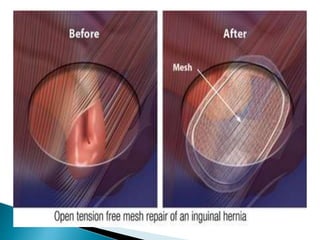
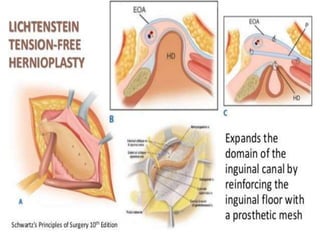
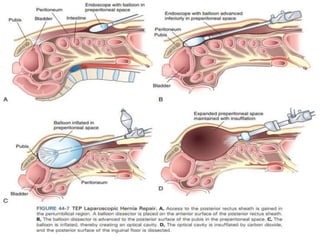
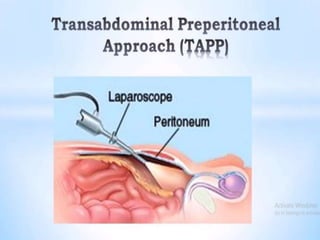
 Hernia repairs can be performed via open
repair (Lichtenstein technique most
commonly used) or laparoscopic
repair (either total extraperitoneal (TEP) or
transabdominal pre-peritoneal (TAPP)).
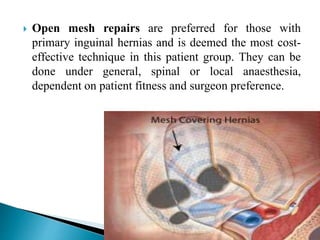
 Open mesh repairs are preferred for those with
primary inguinal hernias and is deemed the most cost-
effective technique in this patient group. They can be
done under general, spinal or local anaesthesia,
dependent on patient fitness and surgeon preference.
 Symptomatic management
 Perioperative nursing care
 Acute pain related to traumatized tissue as evidenced
by verbalization.
 Risk for fluid volume deficit related to the bleeding.
 Risk for infection related to inadequate primary
defences.
 Risk for imbalanced nutrition : less than body
requirement related to inability to digest food.
 Avoid smoking
 Avoid developing persistent cough and constipation
 Maintain body weight
 Avoid straining during bowel movement or urination
 Lifting objects with knees and not back
 Avoid lifting heavy weights
 A study was conducted on the factors associated with
inguinal hernia in children. Out of 960 children
admitted in surgical ward 50 had inguinal hernia, the
reveal that inguinal hernia was common in 1-5 year age
group. 90% were males,70% with term deliveries
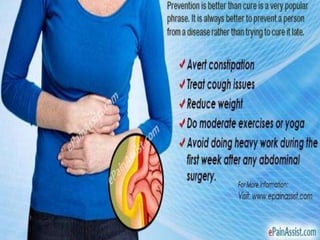
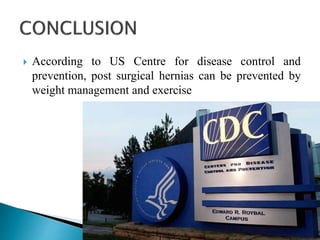
 According to US Centre for disease control and
prevention, post surgical hernias can be prevented by
weight management and exercise
Hernia
Hernia

Hernia

  • 1.
  • 2.
     A herniais an abnormal protrusion of part of the body out of its normal anatomical area of confinement. This normally results in a swelling, pain and in some cases loss of function.
  • 3.
     Abdominal wallhernias are common, with a prevalence of 1.7% of all ages and 4% of those aged over 45 years.  Inguinal hernias account for 75% of abdominal wall hernias, with a lifetime risk of 27% in men and 3% in women.  Repair of inguinal hernia is most common operation in general surgery, with rates ranging from 10 per 100000 of the population in United Kingdom to 28 per 100000 in United States.
  • 4.
     A personalor family history of hernia  Obesity  Chronic cough  Smoking  Chronic constipation  Cystic fibrosis
  • 6.
    Some other factorsthat contribute to hernia are  Weakness and strain  Failure of the abdominal wall to close properly in the womb, which is a congenital defect  Being pregnant  Ascitis  Surgery  Sneezing
  • 8.
  • 11.
     The femoralcanal is the path through which the femoral artery, vein, and nerve leave the abdominal cavity to enter the thigh  A femoral hernia causes a bulge just below the inguinal crease in roughly the middle of the upper leg. Usually occurring in women, femoral hernias are particularly at risk of becoming irreducible (not able to be pushed back into place) and strangulated (cutting off blood supply).
  • 13.
     These commonhernias (10%-30%) are often noted in a child at birth as a protrusion at the belly button (the umbilicus). An umbilical hernia is caused when an opening in the child's abdominal wall, which normally closes before birth, doesn't close completely. If small (less than half an inch), this type of hernia usually closes gradually by age 2. Larger hernias and those that do not close by themselves usually require surgery when a child is 2 to 4 years of age. Even if the area is closed at birth, umbilical hernias can appear later in life because this spot may remain a weaker place in the abdominal wall. Umbilical hernias can appear later in life or in women who are pregnantor who have given birth (due to the added stress on the area). They usually do not cause abdominal pain.
  • 15.
     Abdominal surgerycauses a flaw in the abdominal wall. This flaw can create an area of weakness through which a hernia may develop. This occurs after 2%-10% of all abdominal surgeries, although some people are more at risk. Even after surgical repair, incisional hernias may return
  • 19.
     This typeof hernia occurs when part of the stomach pushes through the diaphragm. The diaphragm normally has a small opening for the esophagus. This opening can become the place where part of the stomach pushes through. Small hiatal hernias can be asymptomatic (cause no symptoms), while larger ones can cause pain and heartburn.
  • 22.
     This isusually a birth defect causing an opening in the diaphragm, which allows abdominal content to push through into the chest cavity
  • 24.
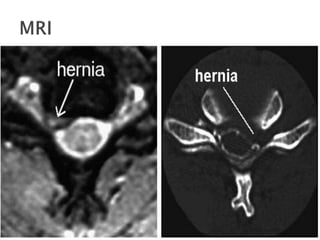
     History  Physicalexamination Physical examination of patients with hernia is usually remarkable for bulge in the groin, painless scrotal mass and palpable abdominal mass may be present. Abdomen  A palpable abdominal mass in the flank may be present  Abdominal distention Genitourinary  Painless scrotal mass may be present  Bulge in the groin
  • 30.
     Obstruction resultingin pain, nausea or constipation  Swelling and pain in surrounding area  Intestinal obstruction  Sepsis  Death
  • 32.
     Hernia repairscan be performed via open repair (Lichtenstein technique most commonly used) or laparoscopic repair (either total extraperitoneal (TEP) or transabdominal pre-peritoneal (TAPP)).
  • 33.
     Open meshrepairs are preferred for those with primary inguinal hernias and is deemed the most cost- effective technique in this patient group. They can be done under general, spinal or local anaesthesia, dependent on patient fitness and surgeon preference.
  • 38.
     Symptomatic management Perioperative nursing care
  • 39.
     Acute painrelated to traumatized tissue as evidenced by verbalization.  Risk for fluid volume deficit related to the bleeding.  Risk for infection related to inadequate primary defences.  Risk for imbalanced nutrition : less than body requirement related to inability to digest food.
  • 40.
     Avoid smoking Avoid developing persistent cough and constipation  Maintain body weight  Avoid straining during bowel movement or urination  Lifting objects with knees and not back  Avoid lifting heavy weights
  • 42.
     A studywas conducted on the factors associated with inguinal hernia in children. Out of 960 children admitted in surgical ward 50 had inguinal hernia, the reveal that inguinal hernia was common in 1-5 year age group. 90% were males,70% with term deliveries
  • 43.
     According toUS Centre for disease control and prevention, post surgical hernias can be prevented by weight management and exercise