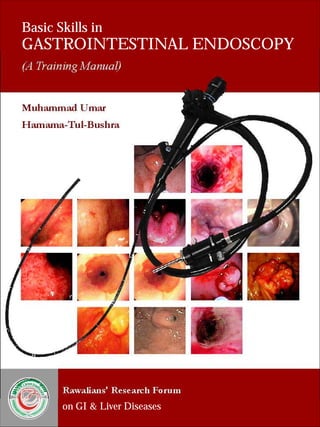
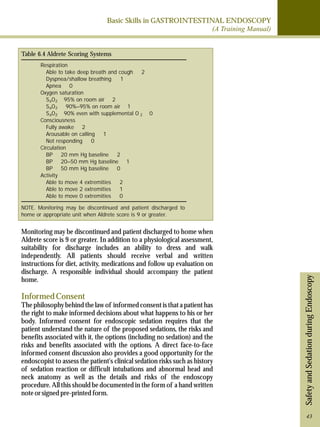
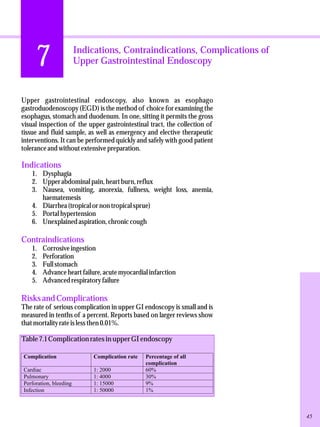
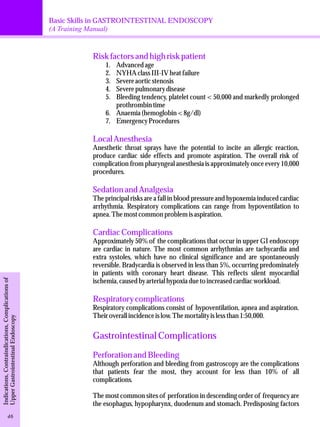
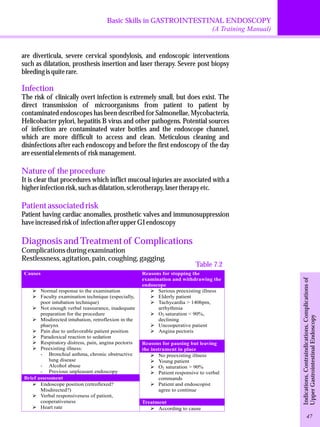
Basic Skills in 
GASTROINTESTINAL ENDOSCOPY 
(A Training Manual) 
Muhammad Umar 
Hamama-Tul-Bushra 
RAWALIANSRESEARCHFORUM 
ON G.I & LIVER DISEASES 
Rawalians' Research Forum 
on GI & Liver Diseases
Basic Skills in 
GASTROINTESTINAL ENDOSCOPY 
(A Training Manual) 
Muhammad Umar 
MBBS, MCPS, FCPS, FRCP (Glasg), FRCP (L), FACG, AGAF 
Chairman & Professor of Medicine 
Rawalpindi Medical College Rawalpindi 
Chief Gastroenterology & Hepatology Division 
Holy Family Hospital Rawalpindi 
Hamama-tul-Bushra 
BSc, MBBS, FCPS, FRCP (Glasg), FACG 
Professor of Medicine 
Rawalpindi Medical College Rawalpindi 
Consultant Gastroenterology & Hepatology Division 
Holy Family Hospital Rawalpindi
Basic Skills in GASTROINTESTINAL ENDOSCOPY 
(A Training Manual) 
Basic Skills in GASTROINTESTINAL ENDOSCOPY - A Training Manual 
© 2007 Rawalians' Research Forum on GI & Liver Diseases. Library of Rawalians' Research 
Forum on GI & Liver Diseases - RS/ICT/437 
All material in this manual is copyrighted by the author(s). No part of this publication may be 
reproduced, stored in a retrieval system, or transmitted, in any form or by means, electronic, 
mechanical, photocopying, recording or otherwise, without prior written permission of the 
author(s). Requests to reprint or reproduce material from this publication may be sent to 
Professor Muhammad Umar, Al-Shifa Clinic, 965-B Saidpur Road, Satellite Town, Rawalpindi, 
Pakistan. 
Although every effort has been made to ascertain the authenticity of the material provided by 
the contributors and to trace the copyright holders for borrowed material. If any omissions have 
occurred, the author(s), the editor and the publisher will be pleased to make the necessary 
arrangements at the first priority. 
ISBN: 978 969 9200 01 4 
Edited by: Amir Rizwan,MBBS, DCPS-HCSM 
Designed & Composed by Jahanzeb Khan 
Printed & Published in the Islamic Republic of Pakistan in 2007 
Rawalian’s Reasrch Forum 
Saidpur Road, Satellite Town, Rawalpindi - 46000 
Tel: +92 51 4414174 / 4427614 / 9290422 / 9290321-7 
Fax: +92 51 5591281 
Gastroenterology & Hepatology Division 
Department of Medicine 
Holy Family Hospital Rawalpindi 
Tel: +92 51 4414174 / 4427614 / 9290422 
Fax: +92 51 5591281 
Email: drumarpk@yahoo.com
Basic Skills in GASTROINTESTINAL ENDOSCOPY 
(A Training Manual) 
Foreword 
It is nature of a human being to discover the undiscovered that's why he started attempting to 
look into human body orifices and body cavities date back from antiquity. Most of these efforts 
were fruitless because of lack of light source. In 1806, Philip Bozzini presented the theoretical 
idea of Lichtleiter (Light Conductor). This basic idea of light conduction was exclusively used in 
future developments in gastrointestinal, urological, gynecological endoscopies and eventually 
the laparoscopy. 
While technological advances have made endoscopy one of the most common procedures for 
examining the gastrointestinal tract, learning how to maneuver the instruments and interpret the 
images can be frustrating for those without experience. This manual is specifically designed for 
beginners in endoscopy training. It has very illustrative and user friendly format, which 
comprehensively covers all aspects of basic skills in endoscopy. 
·Clear descriptions and images of the instruments and how and when they are used 
·Step-by-step instructions for handling the endoscope, such as insertion, air insufflation, 
irrigation, and more 
·Useful checklists and tables that lay out the procedures from beginning to end, including 
preparations, necessary medication and anesthesia, required staff and supplemental 
equipment, potential risks and complications, etc. 
The manual also encompasses a complete full-color atlas that illustrates the entire spectrum of 
both normal and pathological findings. In addition to detailed explanations of each finding, the 
authors provide 
·The endoscopic criteria and the most important differential diagnoses for each disorder 
·Series of images showing common variants, as well as comparison photographs of 
differential diagnoses 
·Useful guidelines for proper documentation 
Amir Rizwan, MBBS, DCPS-HCSM 
Research Coordinator 
Gastroenterology & Hepatology Division 
Holy Family Hospital Rawalpindi – Pakistan
Basic Skills in GASTROINTESTINAL ENDOSCOPY 
(A Training Manual) 
About the Authors 
Muhammad Umar 
MBBS, MCPS, FCPS, FRCP (L), FRCP (Glasg), FACG, AGAF 
Graduated in 1981, with presidential gold medal from President of Pakistan from Rawalpindi Medical College 
Rawalpindi Pakistan, started his professional career as physician after obtaining membership (MCPS) and then 
fellowship (FCPS) of College of Physicians & Surgeons Pakistan in 1984 and 1985. He was awarded fellowships 
from American College of Gastroenterology (FACG) in 2003, Royal College of Physicians London (FRCP), Royal 
College of Physicians Glasgow (FRCP) in 2006, and American Gastroenterological Association (AGAF) in 2007. 
He was appointed Assistant Professor, then Associate Professor and currently the Professor & Chair of Medicine and Chief 
of Gastroenterology & Hepatology Division. 
He had keen zest for gastroenterology and specifically hepatology so he started pursuing his career in it. He started 
practicing gastroenterology by performing upper and lower GI procedures in general medical setting after formal 
training in endoscopy from CMH Rawalpindi and basic skills courses in the United States and the United Kingdom. 
He established GI & Liver Clinic, GI & Liver Learning Resource Centre, and Liver Research Clinic at Holy Family 
Hospital Rawalpindi. 
He has contributed to gastroenterology by publishing more than 70 review and original research papers in various 
national and international journals, two books on hepatology; Evidenced Based Approach to Hepatitis C Management and 
Hepatitis C in Pakistan. Moreover, he published National Hepatitis Practice Guidelines. He was awarded SJZ Research 
Award from Pakistan Society of Gastroenterology & GI Endoscopy in 2004. 
Currently, he is the President of Pakistan Society of Gastroenterology & GI Endoscopy, General Secretary of Pakistan 
Society of Hepatology, and President of Rawalians' Research Forum on GI & Liver Diseases. 
Hamama-tul-Bushra 
BSc, MBBS, FCPS, FRCP (Glasg), FACG 
She graduated from Rawalpindi Medical College Pakistan with distinction in 1981. She obtained fellowship from 
College of Physicians & Surgeons Pakistan (FCPS) in 1985 and started her career. She was honored with 
fellowships from Royal College of Physicians Glasgow (FRCP) and American College of Gastroenterology 
(FACG) in 2007. She was appointed Assistant Professor, then Associate Professor and currently the Professor of Medicine 
at Rawalpindi Medical College and Holy Family Hospital Rawalpindi Pakistan. 
She had very strong interest in gastroenterology and specifically hepatology so she started pursuing her career in it. 
She started practicing gastroenterology and developed GI Wing and Endoscopy Suit at District Headquarters 
Hospital Rawalpindi. 
She has a long list of publications including original and review papers, books, guidelines, and manuals. She has 
published about 80 research papers, two books on hepatology; Evidenced Based Approach to Hepatitis C Management 
and Hepatitis C in Pakistan. Moreover, she published National Hepatitis Practice Guidelines.
Basic Skills in GASTROINTESTINAL ENDOSCOPY 
(A Training Manual) 
Contributors 
Masood Ahmed 
MBBS, FCPS 
Assistant Professor 
Holy Family Hospital 
Rawalpindi – Pakistan 
Muhammd Khurram 
MBBS, FCPS 
Assistant Professor 
Holy Family Hospital 
Rawalpindi – Pakistan 
Zahid M. Minhas 
MBBS, DCPS, PhD 
Senior Registrar Medicine 
Holy Family Hospital 
Rawalpindi – Pakistan 
Saima Ambreen 
MBBS, FCPS 
Senior Registrar 
Holy Family Hospital 
Rawalpindi – Pakistan 
Abdul Naeem 
MBBS 
Registrar 
Holy Family Hospital 
Rawalpindi – Pakistan 
Atif Nazir 
MBBS 
Registrar 
Holy Family Hospital 
Rawalpindi – Pakistan 
Omar Hayder 
MBBS 
House Physician 
Holy Family Hospital 
Rawalpindi – Pakistan 
Salman Abdul Qayyum 
MBBS 
Registrar 
Holy Family Hospital 
Rawalpindi - Pakistan
1 Endoscopic Equipment 
2 The Endoscopy Suite, Facilities and Staff 
3 Disinfection of Endoscopes 
4 Quality Assurance in Reprocessing 
5 Antibiotic Prophylaxis for Gastrointestinal Endoscopy 
6 Safety and Sedation during Endoscopy 
7 
Indications, Contraindications, Complications of 
Upper Gastrointestinal Endoscopy 
8 Upper Gastrointestinal Endoscopy 
9 Lower Gastrointestinal Endoscopy 
10 Colonoscopy / Sigmoidoscopy Technique 
Normal Endoscopic Findings 
11 
Basic Skills in GASTROINTESTINAL ENDOSCOPY 
(A Training Manual) 
Contents 
1 Introduction 1 
3 
9 
15 
23 
27 
35 
45 
53 
59 
63 
71 
12 79 
Lesion Recognition
Basic Skills in GASTROINTESTINAL ENDOSCOPY 
(A Training Manual) 
Introduction 
The word endoscopy is derived from the Greek word 'skopein' meaning 'to view' 
combining from prefix 'endo' meaning 'inside'. So Endoscopy means viewing inside the living 
body. 
th The endoscopes, which started as a simple, short, rigid, straight metallic tubes in 18 
century went through a lot of innovation in last two centuries and now we have the long flexible 
fiberscope to video endoscopes. As the science and art of endoscopy evolved its role as purely a 
diagnostic tool has changed to a therapeutic armament. 
Endoscopy has become an important investigation in the management of dyspepsia 
and upper duodenal pain; similarly it has an important diagnostic and therapeutic role in upper 
GI bleed. As the incidence and prevalence of liver disease and especially de-compensated liver 
disease increases day by day, the demand of endoscopy is proportionally increasing. 
Gastrointestinal Endoscopy is a complex skill, requiring a period of formal training and 
experience with close supervision. 
Only a skilled professional can provide the high standards of patient care, accuracy in 
diagnosis, and appropriate therapeutic interventions with avoidance of complications. It has 
been further recommended that doctors performing endoscopy should have a professional 
commitment to two or more endoscopy sessions weekly. So to acquire and maintain proficiency, 
close liaison with other experienced endoscopists ensures that training is a continuous process. 
Multidisciplinary interactions between endoscopists, radiologists, pathologists, physicians and 
surgeons contribute to effective training and skills. 
Endoscopy Nurses 
1. The main support to the endoscopist is given by nursing staff, although other 
properly trained health care workers can fit support roles. The specific role of 
the nurse in endoscopy is the care of patient before, during and after the 
procedure. 
2. Training in patient monitoring and resuscitation techniques is essential for the 
nurse to cope with the unforeseen reactions and cardiorespiratory 
complications that may occur. 
3. Endoscopes and their accessories are expensive and relatively delicate. Their 
incorrect maintenance and careless handling can damage them. Training in 
instrument handling and disinfection form an integral part of training of nurses 
and other endoscopy assistants and it is essential that all staff involved in 
endoscopy are kept up to date with ever-changing technology. 
1
1 Endoscopic Equipment 
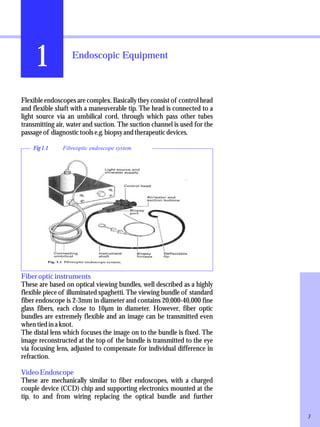
Flexible endoscopes are complex. Basically they consist of control head 
and flexible shaft with a maneuverable tip. The head is connected to a 
light source via an umbilical cord, through which pass other tubes 
transmitting air, water and suction. The suction channel is used for the 
passage of diagnostic tools e.g. biopsy and therapeutic devices. 
Fig 1.1 Fibreoptic endoscope system 
Fiber optic instruments 
These are based on optical viewing bundles, well described as a highly 
flexible piece of illuminated spaghetti. The viewing bundle of standard 
fiber endoscope is 2-3mm in diameter and contains 20,000-40,000 fine 
glass fibers, each close to 10μm in diameter. However, fiber optic 
bundles are extremely flexible and an image can be transmitted even 
when tied in a knot. 
The distal lens which focuses the image on to the bundle is fixed. The 
image reconstructed at the top of the bundle is transmitted to the eye 
via focusing lens, adjusted to compensate for individual difference in 
refraction. 
Video Endoscope 
These are mechanically similar to fiber endoscopes, with a charged 
couple device (CCD) chip and supporting electronics mounted at the 
tip, to and from wiring replacing the optical bundle and further 
3
Basic Skills in GASTROINTESTINAL ENDOSCOPY 
(A Training Manual) 
electronics and switches occupying the site of the ocular lens on the 
upper part of the control head. Removing any need to hold the 
instrument close to the endoscopist's eye has hygienic advantages. The 
CCD chip is an array of 33,000-100,000 individual photon cells known 
as pixels. The number of pixels determines the resolution of the image. 
The screen image quality of present video endoscopes equals that of 
present fiberscopes in both colour and resolution. 
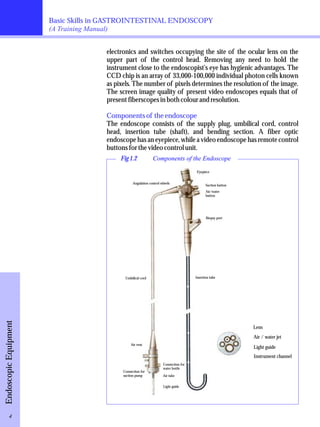
Components of the endoscope 
The endoscope consists of the supply plug, umbilical cord, control 
head, insertion tube (shaft), and bending section. A fiber optic 
endoscope has an eyepiece, while a video endoscope has remote control 
buttons for the video control unit. 
Endoscopic Equipment 
Fig 1.2 Components of the Endoscope 
Angulation control wheels 
Eyepiece 
Suction button 
Air/water 
button 
Biopsy port 
Umbilical cord Insertion tube 
Connection for 
water bottle 
Air vent 
Air tube 
Connection for 
suction pump 
Light guide 
Lens 
Air / water jet 
Light guide 
Instrument channel 
4
Basic Skills in GASTROINTESTINAL ENDOSCOPY 
Supply plug and umbilical cord 
(A Training Manual) 
The supply plug at the end of the umbilical cord has distal connectors 
for the light guide and air supply, side connectors for the water bottle 
and suction, and an air vent, which is not functional during endoscopy. 
The umbilical cord connects the supply plug to the control head. 
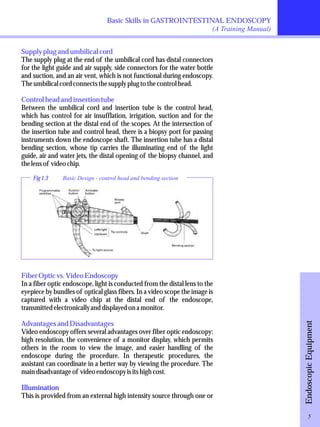
Control head and insertion tube 
Between the umbilical cord and insertion tube is the control head, 
which has control for air insufflation, irrigation, suction and for the 
bending section at the distal end of the scopes. At the intersection of 
the insertion tube and control head, there is a biopsy port for passing 
instruments down the endoscope shaft. The insertion tube has a distal 
bending section, whose tip carries the illuminating end of the light 
guide, air and water jets, the distal opening of the biopsy channel, and 
the lens of video chip. 
Fiber Optic vs. Video Endoscopy 
In a fiber optic endoscope, light is conducted from the distal lens to the 
eyepiece by bundles of optical glass fibers. In a video scope the image is 
captured with a video chip at the distal end of the endoscope, 
transmitted electronically and displayed on a monitor. 
Advantages and Disadvantages 
Video endoscopy offers several advantages over fiber optic endoscopy: 
high resolution, the convenience of a monitor display, which permits 
others in the room to view the image, and easier handling of the 
endoscope during the procedure. In therapeutic procedures, the 
assistant can coordinate in a better way by viewing the procedure. The 
main disadvantage of video endoscopy is its high cost. 
Illumination 
This is provided from an external high intensity source through one or 
Endoscopic Equipment 
Fig 1.3 Basic Design - control head and bending section 
5
Basic Skills in GASTROINTESTINAL ENDOSCOPY 
(A Training Manual) 
more light carrying bundles. Because the light intensity is reduced at any 
optical interface, light bundles run uninterrupted from the tip of the 
instrument through its connecting umbilical cord directly to the point 
of focus of the lamp. These may be Xenon arc (300 w) or halogen-filled 
tungsten filament lamps (150 w). 
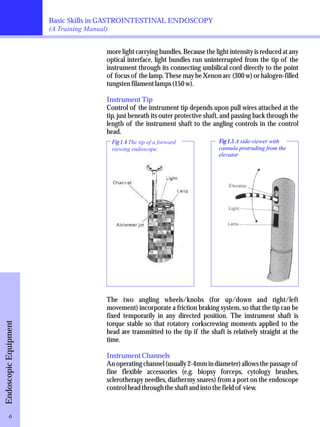
Instrument Tip 
Control of the instrument tip depends upon pull wires attached at the 
tip, just beneath its outer protective shaft, and passing back through the 
length of the instrument shaft to the angling controls in the control 
head. 
The two angling wheels/knobs (for up/down and right/left 
movement) incorporate a friction braking system, so that the tip can be 
fixed temporarily in any directed position. The instrument shaft is 
torque stable so that rotatory corkscrewing moments applied to the 
head are transmitted to the tip if the shaft is relatively straight at the 
time. 
Instrument Channels 
An operating channel (usually 2-4mm in diameter) allows the passage of 
fine flexible accessories (e.g. biopsy forceps, cytology brushes, 
sclerotherapy needles, diathermy snares) from a port on the endoscope 
control head through the shaft and into the field of view. 
Endoscopic Equipment 
Fig 1.4 The tip of a forward 
viewing endoscope. 
Fig 1.5 A side-viewer with 
cannula protruding from the 
elevator 
6
Basic Skills in GASTROINTESTINAL ENDOSCOPY 
(A Training Manual) 
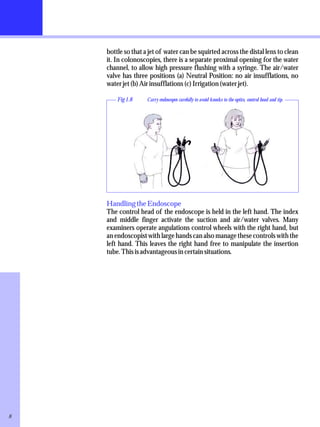
In some instruments (especially those with lateral viewing) the tip of the 
channel incorporates a small deflectable elevator or bridge which 
permits some directional control of the forceps and other accessories 
independent of the instrument tip, this elevator or bridge is controlled 
by a further thumb lever. The operating channel is also used for 
aspirations; an external suction pump is connected to the umbilical cord 
of the instrument near the light source and suction is diverted into the 
instrument channel by pressing the suction valve which has two 
positions, a neutral position and a suction position, the size varies with 
the instrument's purpose. 
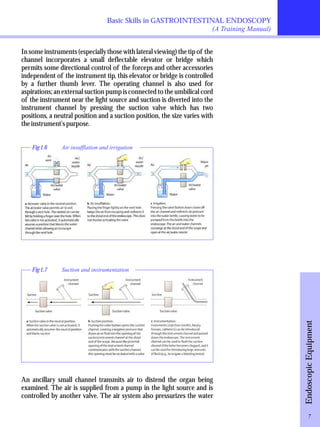
Fig 1.6 Air insufflation and irrigation 
An ancillary small channel transmits air to distend the organ being 
examined. The air is supplied from a pump in the light source and is 
controlled by another valve. The air system also pressurizes the water 
Endoscopic Equipment 
Fig 1.7 Suction and instrumentation 
7
bottle so that a jet of water can be squirted across the distal lens to clean 
it. In colonoscopies, there is a separate proximal opening for the water 
channel, to allow high pressure flushing with a syringe. The air/water 
valve has three positions (a) Neutral Position: no air insufflations, no 

water jet (b) Air insufflations (c) Irrigation (water jet). 
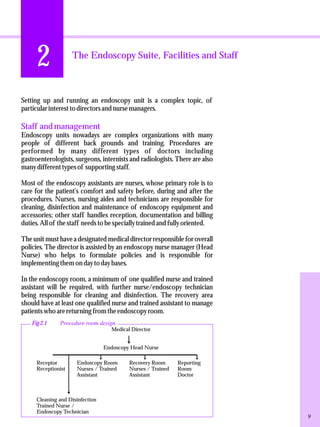
Fig 1.8 Carry endoscopes carefully to avoid knocks to the optics, control head and tip. 
Handling the Endoscope 
The control head of the endoscope is held in the left hand. The index 
and middle finger activate the suction and air/water valves. Many 
examiners operate angulations control wheels with the right hand, but 
an endoscopist with large hands can also manage these controls with the 
left hand. This leaves the right hand free to manipulate the insertion 
tube. This is advantageous in certain situations. 
8
2 
The Endoscopy Suite, Facilities and Staff 
Setting up and running an endoscopy unit is a complex topic, of 
particular interest to directors and nurse managers. 
Staff and management 
Endoscopy units nowadays are complex organizations with many 
people of different back grounds and training. Procedures are 
performed by many different types of doctors including 
gastroenterologists, surgeons, internists and radiologists. There are also 
many different types of supporting staff. 
Most of the endoscopy assistants are nurses, whose primary role is to 
care for the patient's comfort and safety before, during and after the 
procedures. Nurses, nursing aides and technicians are responsible for 
cleaning, disinfection and maintenance of endoscopy equipment and 
accessories; other staff handles reception, documentation and billing 
duties. All of the staff needs to be specially trained and fully oriented. 
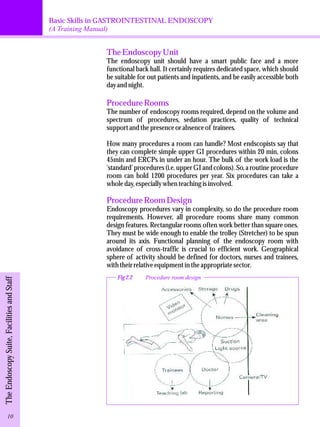
The unit must have a designated medical director responsible for overall 
policies. The director is assisted by an endoscopy nurse manager (Head 
Nurse) who helps to formulate policies and is responsible for 
implementing them on day to day bases. 
In the endoscopy room, a minimum of one qualified nurse and trained 
assistant will be required, with further nurse/endoscopy technician 
being responsible for cleaning and disinfection. The recovery area 
should have at least one qualified nurse and trained assistant to manage 
patients who are returning from the endoscopy room. 
Fig 2.1 Procedure room design 
Receptor 
Receptionist 
Endoscopy Room 
Nurses / Trained 
Assistant 
Recovery Room 
Nurses / Trained 
Assistant 
Reporting 
Room 
Doctor 
Cleaning and Disinfection 
Trained Nurse / 
Endoscopy Technician 
Medical Director 
Endoscopy Head Nurse 
9
Basic Skills in GASTROINTESTINAL ENDOSCOPY 
(A Training Manual) 
The Endoscopy Unit 
The endoscopy unit should have a smart public face and a more 
functional back hall. It certainly requires dedicated space, which should 
be suitable for out patients and inpatients, and be easily accessible both 
day and night. 
Procedure Rooms 
The number of endoscopy rooms required, depend on the volume and 
spectrum of procedures, sedation practices, quality of technical 
support and the presence or absence of trainees. 
How many procedures a room can handle? Most endscopists say that 
they can complete simple upper GI procedures within 20 min, colons 
45min and ERCPs in under an hour. The bulk of the work load is the 
'standard' procedures (i.e. upper GI and colons). So, a routine procedure 
room can hold 1200 procedures per year. Six procedures can take a 
whole day, especially when teaching is involved. 
Procedure Room Design 
Endoscopy procedures vary in complexity, so do the procedure room 
requirements. However, all procedure rooms share many common 
design features. Rectangular rooms often work better than square ones. 
They must be wide enough to enable the trolley (Stretcher) to be spun 
around its axis. Functional planning of the endoscopy room with 
avoidance of cross-traffic is crucial to efficient work. Geographical 
sphere of activity should be defined for doctors, nurses and trainees, 
with their relative equipment in the appropriate sector. 
Fig 2.2 Procedure room design 
The Endoscopy Suite, Facilities and Staff 10
Basic Skills in GASTROINTESTINAL ENDOSCOPY 
(A Training Manual) 
The room should contain large sinks to accommodate contaminated 
accessories, adequate work surfaces, storage cupboards and power 
points. The floor should be washable and smooth. Any windows should 
have blackout curtains and blinds. Central room light should be 
dimmable with spot light over the work tops. The endscopist and nurses 
should have an easy access to the alarm systems. Door opening should 
be 4ft wide to facilitate moving patients' stretchers and large pieces of 
equipment. 
Procedure room should have a continuous supply of piped oxygen, 
always available suction (two outlets) and an alarm system. Fixed 
examination tables are unnecessary. Patient trolleys (stretchers) are 
convenient for examination and recovery. It should be possible to tilt 
the top into a head down position and it is convenient if the height of 
the trolley can be adjusted. There must be arrangements for maintaining 
a reasonable temperature and for extracting odors, both clinical and 
chemical. 
Efficiency of utilization would be improved if all procedure rooms 
could be used for all types of procedures. There is no need to separate 
upper GI examinations from colonoscopies, since the room 
requirements are similar. However some procedures require 
sophisticated, heavy and expensive equipment which cannot be moved 
or duplicated (i.e. X-ray machines and lasers); thus it is usual to have 
several standard rooms and one high-tech room. A floor area of 15-20 
square meters (50-65 square feet) is adequate for a standard procedure 
room. 
Specialized procedure rooms 
Specialized rooms are usually large because of extra equipment for 
radiology, endoscopic ultrasound or laser. Fluoroscopic screenings 
must be available for many endoscopic procedures, especially 
dilatations. 
X-ray procedure rooms are larger than routine rooms. Correct siting of 
the table is essential. It is convenient for the radiologist and the 
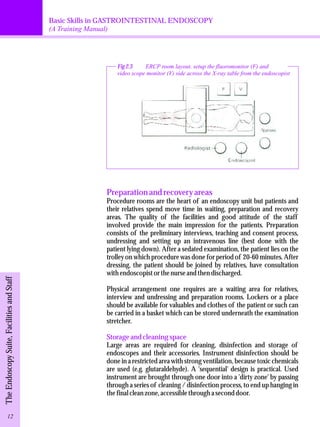
endscopist to work on the same side of the table. It is essential to mount 
the video and fluoroscopy monitors side by side, across from the 
endoscopist and radiology staff. 
Rooms containing X-ray equipment need to be lead-lined with standard 
safety features. Rooms in which lasers are used must meet appropriate 
local safety standards for eye protection. 
The Endoscopy Suite, Facilities and Staff 
11
Basic Skills in GASTROINTESTINAL ENDOSCOPY 
(A Training Manual) 
Fig 2.3 ERCP room layout. setup the fluoromonitor (F) and 
video scope monitor (V) side across the X-ray table from the endoscopist 
Preparation and recovery areas 
Procedure rooms are the heart of an endoscopy unit but patients and 
their relatives spend move time in waiting, preparation and recovery 
areas. The quality of the facilities and good attitude of the staff 
involved provide the main impression for the patients. Preparation 
consists of the preliminary interviews, teaching and consent process, 
undressing and setting up an intravenous line (best done with the 
patient lying down). After a sedated examination, the patient lies on the 
trolley on which procedure was done for period of 20-60 minutes. After 
dressing, the patient should be joined by relatives, have consultation 
with endoscopist or the nurse and then discharged. 
Physical arrangement one requires are a waiting area for relatives, 
interview and undressing and preparation rooms. Lockers or a place 
should be available for valuables and clothes of the patient or such can 
be carried in a basket which can be stored underneath the examination 
stretcher. 
Storage and cleaning space 
Large areas are required for cleaning, disinfection and storage of 
endoscopes and their accessories. Instrument disinfection should be 
done in a restricted area with strong ventilation, because toxic chemicals 
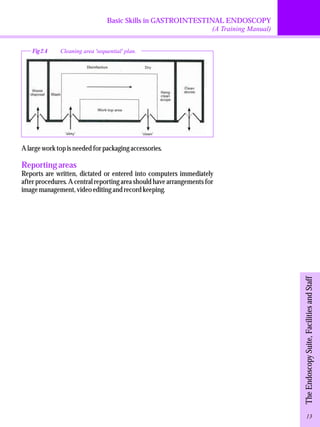
are used (e.g. glutaraldehyde). A 'sequential' design is practical. Used 
instrument are brought through one door into a 'dirty zone' by passing 
through a series of cleaning / disinfection process, to end up hanging in 
the final clean zone, accessible through a second door. 
The Endoscopy Suite, Facilities and Staff 12
Basic Skills in GASTROINTESTINAL ENDOSCOPY 
(A Training Manual) 
Fig 2.4 Cleaning area 'sequential' plan. 
A large work top is needed for packaging accessories. 
Reporting areas 
Reports are written, dictated or entered into computers immediately 
after procedures. A central reporting area should have arrangements for 
image management, video editing and record keeping. 
The Endoscopy Suite, Facilities and Staff 
13
3 Disinfection of Endoscopes 
·Flexible endoscopes are complex, versatile instruments that require 
proper and specialized decontamination and disinfections. In 
addition to the external surface of endoscopes their internal 
channels for air, water, aspiration and accessories are all exposed to 
body fluids. Flexible endoscopes are heat labile and cannot be 
autoclaved. 
·A guiding principle for decontamination is that of universal 
precautions. Any patient must be considered a potential infectious 
risk, and each endoscope and device must be reprocessed with the 
same rigor following every endoscopic procedure. 
·Endoscopy induced infection is usually due to procedural errors in 
decontamination. Other potential risk factors for transmission of 
infection include the use of older endoscopes with associated 
surface and working channel irregularities and the use of 
contaminated water bottles or irrigation solutions using 
substandard disinfectant or inadequate drying or storage of 
endoscope. 
Endoscopy related infections 
Infections can spread from patient to patient or patient to healthcare 
worker or staff members if equipment is reprocessed inadequately. 
Bacterial infections have been acquired during endoscopy, such as 
salmonella and pseudomonas, viral disease, such as hepatitis B, and 
Hepatitis C have all been transmitted during endoscopy. There is 
generally no risk of transmission of helminths, nematodes, 
platyhelminths, ascaris or liver flukes. However, concerns have been 
raised with respect to the risk of transmission of Giardia lambliasis, 
cryptosporydium species and amoebas. 
Patients with immune deficiency syndrome or severe neutropenia and 
those receiving immunosuppressive chemotherapy or those who have 
artificial cardiac valves have an increased risk of infection. 
Diseases may be transmitted from patient to endoscopic personnel. 
Studies have suggested that endoscopes are potential vectors for the 
transmission of Helicobacter pylori. Another example is acquisition of 
15
Basic Skills in GASTROINTESTINAL ENDOSCOPY 
(A Training Manual) 
herpes simplex ophthalmitis following esophageal biopsy. Healthcare 
workers are also at potential risk of infection with blood-borne viruses 
transmitted via sharps, such as spiked biopsy forceps. So, protection 
from direct contact with the endoscopes and accessories is essential. 
Gloves and aprons should be worn and protective masks and eye 
protection goggles should be available to avoid exposure to blood or 
body fluids. Traditionally, patients harboring potentially infectious 
microorganisms are scheduled for the end of endoscopy list in order to 
minimize cross infection. However, if universal endoscope 
decontamination regime is followed, which premises that all patients are 
potentially infectious, there is no need to place the patients with known 
infections last on the list. Nonetheless prevailing infection control 
policies often schedule patients with Methicillin Resistant 
Staphylococcus Aureus (MRSA) at the end of list. 
Staff known to be disease carriers should avoid duties that could 
transmit infection to patients. It is recommended that all staff be 
offered vaccination against hepatitis B. 
Decontaminant of Endoscopes 
Sterilization is defined as the complete destruction of all 
microorganism including bacterial spores. Sterilization is required for 
devices that are normally used in sterile areas of the body. Flexible 
endoscopes do not penetrate into the sterile areas of the body, but only 
have contact with mucosal membranes, so they only need a high level of 
disinfection rather than sterilization in order to kill bacteria, viruses, 
mycobacteria and some spores. 
Reprocessing of Endoscopes 
Before commencing with reprocessing of endoscopes and endoscopic 
accessories, protective clothing must be put on. 
Manual Cleaning 
a. As soon as the endoscope is removed from the patient, the 
air/water channel must be flushed for 10-15 seconds to eject 
refluxed blood and mucus. 
b. Detergent solution should be sucked/aspirated through the 
suction/biopsy channel to remove secretion and debris. 
c. The insertion tube should be wiped with discardable sponges or 
swabs to remove any blood, mucus or feces after conducting the 
leak testing. 
Disinfection of Endoscopes 16
Basic Skills in GASTROINTESTINAL ENDOSCOPY 
(A Training Manual) 
d. The endoscope should be immersed in water and detergent, and 
cleaned externally. The distal end is brushed with a soft 
toothbrush especially targeting the air/water outlet nozzle. All 
valves are removed and washed. The biopsy channel opening 
and the suction part should be cleaned with a cotton bud. 
e. Brushing through the suction/instrument channel and all 
accessible channels must be done using a cleaning brush. The 
brush must be passed through the channel several times until 
clean, and the brush itself must be cleaned with detergent using 
a soft toothbrush each time it emerges. 
Introduce the cleaning brush via the biopsy port through the 
shaft, until it emerges from the distal end at least three times. 
Pass the cleaning brush through the suction channel opening 
after removing the suction button and down the shaft until it 
emerges from the distal end at least three times. 
Pass the cleaning brush from the suction channel opening in the 
other direction through the umbilical cord, until it emerges 
from the suction connector at least three times. 
After the channels have been thoroughly brushed, either put the 
endoscope into the reprocessor to complete disinfection or 
follow the manual method. 
Rinsing 
Rinse the endoscope and valves under running tap water of drinking 
quality. Immerse the endoscope and irrigate all channels by flushing 
with water followed by air to expel as much air as possible prior to 
disinfection. 
Disinfection 
Manual disinfection:- Disinfection must be carried out in a separate 
room with proper ventilation. Protective gloves, eye protection and 
aprons must be used and splashing must be avoided. The instrument 
should be fully immersed in 2% glutaraldehyde or other chemical 
disinfectant of equally potency. All channels must be filled with 
disinfectant and soaked for not less than 10 minutes. 
Rinsing of the instruments with water must be undertaken after 
disinfection, internally and externally to remove all traces of 
disinfectant. The water must be of drinking quality or alternatively, 
filtered water may be used for rinsing. 
Disinfection of Endoscopes 
17
Basic Skills in GASTROINTESTINAL ENDOSCOPY 
(A Training Manual) 
Dry the endoscope externally and flush each channel with air, wipe the 
eyepiece and light guide connector as well as the plugs before 
connecting the endoscope to the light source. Fit the air/water and 
suction valves and activate the air/water and suction channels. The 
endoscope is now ready for use again. 
Washer Disinfector: After manual cleaning, the endoscope is placed in 
an automatic disinfector and all channel connectors attached. This 
ensures exposure of all internal and external surfaces to the 
disinfectant. If automatic reprocessing cycle is interrupted disinfection 
cannot be assumed and entire process should be repeated. 
The advantages of automatic reprocessing are as follows. 
a. The likelihood of an essential step being omitted is reduced. 
b. All channels are properly irrigated. 
c. Exposure of skin, eyes and respiratory tract to disinfectants is 
reduced. 
d. Atmospheric pollution by the disinfectant is reduced. 
Drying and Storage of Endoscope 
Drying of endoscope prior to prolonged storage decreases bacterial 
colonization. Forced air can be used for drying. 
a. Storage should be done by hanging the scopes in a vertical 
position to facilitate drying. Remove all caps, valves and other 
detachable components. 
b. Uncoil insertion tube and umbilical cord. 
c. Endoscopes should be placed in well-ventilated rooms or 
cabinets. 
d. Clearly mark which endoscopes have been reprocessed. 
e. It is important to avoid the contamination of disinfected 
endoscopes by contact with environment. 
Endoscopic Accessories 
The following steps are important for disinfection/sterilization of all 
reusable accessories. 
i. Immediate washing in detergent solution. 
ii. Dismantle as far as possible 
iii. Brush with cleaning brush or tooth brush hollow 
iv. Flushing of detergent through lumen of hollow components 
v. Use an ultrasonic cleaner for all accessories 
vi. Rinse thoroughly in water of drinking quality 
Disinfection of Endoscopes 18
Basic Skills in GASTROINTESTINAL ENDOSCOPY 
(A Training Manual) 
vii. Sterilization can be achieved by either auto claving where 
recommended by the manufacturer, ethylene oxide gas can be 
used, and though it is time-consuming and expensive. 
viii. Non-sterlizable accessories should be disinfected prior to use. 
ix. Avoid the use of defective or damaged accessories because such 
instrument may not operate properly and may also damage the 
endoscope instrument channel 
Disinfectants 
The ideal disinfection is effective against wider range of organisms 
including viruses and prion proteins. It should be compatible with 
endoscopes and accessories and be non-irritant and safe for users. 
Aldehyde based disinfectants 
Glutaraldehyde (GA) and its derivative kill most bacteria and viruses, 
like HIV and HBV in less than 5 minutes. Mycobacterium is more 
resistant to 2% glutaraldehyde. So the endoscopes are immersed for 
more than 20 minutes at room temperature. 
The standard method of disinfection is immersing for 20 minutes in a 
2% glutaraldehyde solution. The maximum shelf life is 14 days. 
The advantages of glutaraldehyde are that it is effective, relatively 
inexpensive and does not damage endoscopes and accessories. 
However it has irritant and sensitizing properties. So can lend to allergic 
problems and can cause dermatitis, conjunctivitis, nasal irritation and 
asthma in endoscopy staff. In patients residues of glutaraldehyde after 
insufficient rinsing can cause colitis, abdominal cramps and bloody 
diarrhea. 
Glutaraldehyde can fix proteins and allows for biofilm creation. 
Orthophthaldehyde (OPA) 
It is a high level disinfectant. OPA completely destroys all viable 
common bacteria is 5 minutes of exposure. It is non irritant. High level 
disinfection is achieved in 12 minutes life span is 2 weeks. 
Peracetic acid (PAA) 
When compared peracetic acid has similar or better biocidal activity. A 
contact time of 5 minutes is recommended for the destruction of 
vegetative bacteria and viruses. The sporicidal activity requires 
immersion for 10 minutes (0.35 PAA), a contact time at 10-15minutes 
and a concentrations >0.09%. 
Disinfection of Endoscopes 
19
Basic Skills in GASTROINTESTINAL ENDOSCOPY 
(A Training Manual) 
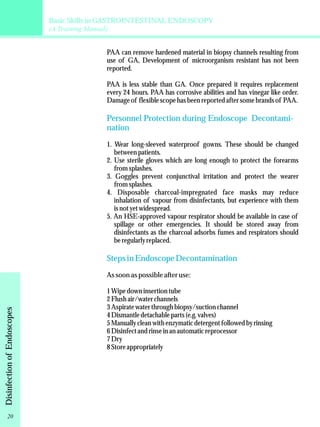
PAA can remove hardened material in biopsy channels resulting from 
use of GA, Development of microorganism resistant has not been 
reported. 
PAA is less stable than GA. Once prepared it requires replacement 
every 24 hours. PAA has corrosive abilities and has vinegar like order. 
Damage of flexible scope has been reported after some brands of PAA. 
Personnel Protection during Endoscope Decontami-nation 
1. Wear long-sleeved waterproof gowns. These should be changed 
between patients. 
2. Use sterile gloves which are long enough to protect the forearms 
from splashes. 
3. Goggles prevent conjunctival irritation and protect the wearer 
from splashes. 
4. Disposable charcoal-impregnated face masks may reduce 
inhalation of vapour from disinfectants, but experience with them 
is not yet widespread. 
5. An HSE-approved vapour respirator should be available in case of 
spillage or other emergencies. It should be stored away from 
disinfectants as the charcoal adsorbs fumes and respirators should 
be regularly replaced. 
Steps in Endoscope Decontamination 
As soon as possible after use: 
1 Wipe down insertion tube 
2 Flush air/water channels 
3 Aspirate water through biopsy/suction channel 
4 Dismantle detachable parts (e.g. valves) 
5 Manually clean with enzymatic detergent followed by rinsing 
6 Disinfect and rinse in an automatic reprocessor 
7 Dry 
8 Store appropriately 
Disinfection of Endoscopes 20
Basic Skills in GASTROINTESTINAL ENDOSCOPY 
(A Training Manual) 
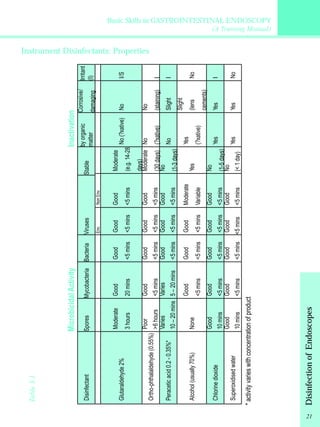
Microbicidal Activity Inactivation 
Disinfectant Spores Mycobacteria Bacteria Viruses Stable by organic 
Disinfection of Endoscopes 
matter 
Corrosive/ 
damaging 
Irritant 
(I) 
Env. Non Env. 
Glutaraldehyde 2% 
Moderate 
3 hours 
Good 
20 mins 
Good 
<5 mins 
Good 
<5 mins 
Good 
<5 mins 
Moderate 
(e.g. 14-28 
days) 
No (?xative) No I/S 
Ortho-phthalaldehyde (0.55%) 
Poor 
>6 hours 
Good 
<5 mins 
Good 
<5 mins 
Good 
<5 mins 
Good 
<5 mins 
Moderate 
(30 days) 
No 
(?xative) 
No 
(staining) I 
Peracetic acid 0.2 - 0.35%* 
Varies 
10 – 20 mins 
Varies 
5 – 20 mins 
Good 
<5 mins 
Good 
<5 mins 
Good 
<5 mins 
No 
(1-3 days) 
No Slight I 
Alcohol (usually 70%) None 
Good 
<5 mins 
Good 
<5 mins 
Good 
<5 mins 
Moderate 
Variable 
Yes 
Yes 
(?xative) 
Slight 
(lens 
cements) 
No 
Chlorine dioxide 
Good 
10 mins 
Good 
<5 mins 
Good 
<5 mins 
Good 
<5 mins 
Good 
<5 mins 
No 
(1-5 days) 
Yes Yes I 
Superoxidised water 
Good 
10 mins 
Good 
<5 mins 
Good 
<5 mins 
Good 
<5 mins 
Good 
<5 mins 
No 
(< 1 day) Yes Yes No 
* activity varies with concentration of product 
Instrument Disinfectants: Properties 
Table 3.1 
21
Basic Skills in GASTROINTESTINAL ENDOSCOPY 
(A Training Manual) 
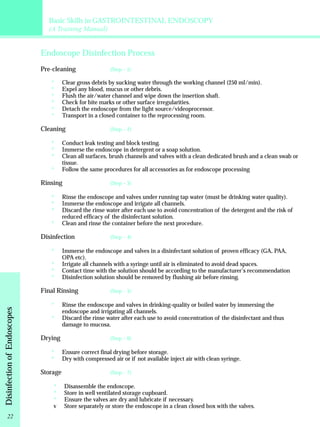
Endoscope Disinfection Process 
(Step – 1) 
Pre-cleaning 
****** 
(Step – 2) 
*** 
* 
(Step – 3) 
*** 
* 
(Step – 4) 
* 
*** 
(Step – 5) 
* 
* 
(Step – 6) 
** (Step – 7) 
*** 
Clear gross debris by sucking water through the working channel (250 ml/min). 
Expel any blood, mucus or other debris. 
Flush the air/water channel and wipe down the insertion shaft. 
Check for bite marks or other surface irregularities. 
Detach the endoscope from the light source/videoprocessor. 
Transport in a closed container to the reprocessing room. 
Cleaning 
Conduct leak testing and block testing. 
Immerse the endoscope in detergent or a soap solution. 
Clean all surfaces, brush channels and valves with a clean dedicated brush and a clean swab or 
tissue. 
Follow the same procedures for all accessories as for endoscope processing 
Rinsing 
Rinse the endoscope and valves under running tap water (must be drinking water quality). 
Immerse the endoscope and irrigate all channels. 
Discard the rinse water after each use to avoid concentration of the detergent and the risk of 
reduced efficacy of the disinfectant solution. 
Clean and rinse the container before the next procedure. 
Disinfection 
Immerse the endoscope and valves in a disinfectant solution of proven efficacy (GA, PAA, 
OPA etc). 
Irrigate all channels with a syringe until air is eliminated to avoid dead spaces. 
Contact time with the solution should be according to the manufacturer's recommendation 
Disinfection solution should be removed by flushing air before rinsing. 
Final Rinsing 
Rinse the endoscope and valves in drinking-quality or boiled water by immersing the 
endoscope and irrigating all channels. 
Discard the rinse water after each use to avoid concentration of the disinfectant and thus 
damage to mucosa. 
Drying 
Ensure correct final drying before storage. 
Dry with compressed air or if not available inject air with clean syringe. 
Storage 
Disassemble the endoscope. 
Store in well ventilated storage cupboard. 
Ensure the valves are dry and lubricate if necessary. 
v Store separately or store the endoscope in a clean closed box with the valves. 
Disinfection of Endoscopes 22
4 Quality Assurance in Reprocessing 
Microbiological surveillance is an important means of evaluating the 
outcome quality of reprocessing procedures and is an instrument of 
regular quality control in gastrointestinal endoscopy, whether 
endoscopic procedures are performed in hospital, in private clinics or 
doctors offices. It is an instrument for detecting and redressing 
procedure, and for preventing the transmission of infections agents 
through endoscopy. 
Table. 4.1 Weaknesses and deficiencies in endoscope reprocessing (modified 
from reference[12]) 
a. Inadequate reprocessing of endoscopes and accessories 
- Inadequate cleaning (e. g. inadequate manual cleaning and brushing of 
endoscope channels) 
- Contaminated cleaning accessories (e. g. cleaning brushes) 
- Use of unsuitable or incompatible detergents and disinfectants 
- Inadequate concentrations and contact time of agents 
- Contaminated or time-expired solutions 
- Contaminated rinsing water 
- Fixed organic material (biofilm) in endoscopes, water pipes , containers, or 
washer-disinfectors 
- Use of nonsterile accessories in invasive diagnosis and treatment (e. g. nonsterile 
biopsy forceps, polypectomy snares) 
- Inadequate reprocessing of water bottles (e. g. no sterilization) 
- Use of tap water in water bottles 
b. Inadequate transport and storage of endoscopes 
- Insufficient drying before storage (e. g. Pseudomonas spp.) 
- Inappropriate storage conditions 
c. Contaminated or defective washer-disinfector 
- Contaminated pipes, containers, etc. 
- Contaminated final rinsing water 
- Mechanical/electronic defects of washer-disinfector 
- Incorrect use of washer-disinfector (e. g. wrong connections) 
- Lack of regular maintenance of washer-disinfector according to manufacturer’s 
recommendations 
d. Design limitations and damaged endoscopes 
- Small lumina, branched channels, not accessible to cleaning brushes 
- Damage to the surfaces (internal and external) of the endoscope, providing 
potential for contamination 
e. Contaminated water in the endoscopy unit 
- Contaminated main water pipes/supply 
- Contaminated or inadequate water supply systems (filtration etc.) 
23
Basic Skills in GASTROINTESTINAL ENDOSCOPY 
(A Training Manual) 
Quality Assurance in Reprocessing 
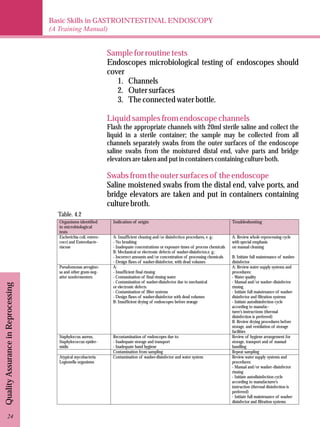
Sample for routine tests 
Endoscopes microbiological testing of endoscopes should 
cover 
1. Channels 
2. Outer surfaces 
3. The connected water bottle. 
Liquid samples from endoscope channels 
Flash the appropriate channels with 20ml sterile saline and collect the 
liquid in a sterile container; the sample may be collected from all 
channels separately swabs from the outer surfaces of the endoscope 
saline swabs from the moistured distal end, valve parts and bridge 
elevators are taken and put in containers containing culture both. 
Swabs from the outer surfaces of the endoscope 
Saline moistened swabs from the distal end, valve ports, and 
bridge elevators are taken and put in containers containing 
culture broth. 
Organisms identified 
in microbiological 
tests 
Indication of origin Troubleshooting 
Escherichia coli, entero-cocci 
and Enterobacte-riaceae 
A: Insufficient cleaning and/or disinfection procedures, e. g.: 
- No brushing 
- Inadequate concentrations or exposure times of process chemicals 
B: Mechanical or electronic defects of washer-disinfector,e. g.: 
- Incorrect amounts and/or concentration of processing chemicals 
- Design flaws of washer-disinfector, with dead volumes 
A: Review whole reprocessing cycle 
with special emphasis 
on manual cleaning 
B: Initiate full maintenance of washer-disinfector 
Pseudomonas aerugino-sa 
and other gram-neg-ative 
nonfermenters 
A: 
- Insufficient final rinsing 
- Contamination of final rinsing water 
- Contamination of washer-disinfector due to mechanical 
or electronic defects 
- Contamination of filter systems 
- Design flaws of washer-disinfector with dead volumes 
B: Insufficient drying of endoscopes before storage 
A: Review water supply systems and 
procedures: 
- Water quality 
- Manual and/or washer-disinfector 
rinsing 
- Initiate full maintenance of washer-disinfector 
and filtration systems 
- Initiate autodisinfection cycle 
according to manufac-turer’s 
instructions (thermal 
disinfection is preferred) 
B: Review drying procedures before 
storage, and ventilation of storage 
facilities 
Staphyloccus aureus, 
Staphylococcus epider-midis 
Recontamination of endoscopes due to: 
- Inadequate storage and transport 
- Inadequate hand hygiene 
Review of hygiene arrangement for 
storage, transport and of manual 
handling 
Contamination from sampling Repeat sampling 
Atypical mycobacteria 
Legionella organisms 
Contamination of washer-disinfector and water system Review water supply systems and 
procedures: 
- Manual and/or washer-disinfector 
rinsing 
- Initiate autodisinfection cycle 
according to manufacturer’s 
instruction (thermal disinfection is 
preferred) 
- Initiate full maintenance of washer-disinfector 
and filtration systems 
Table. 4.2 
24
Basic Skills in GASTROINTESTINAL ENDOSCOPY 
(A Training Manual) 
Quality Assurance in Reprocessing 
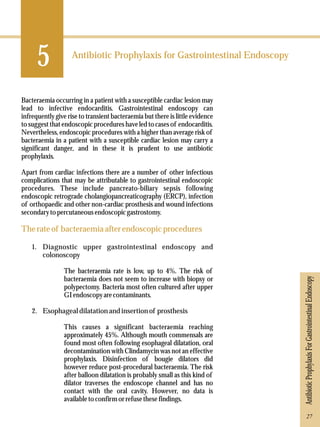
Liquid sample from water bottles 
Two samples of 100ml are taken from the water bottle; ready for use 
should be tested. Adequate connectors should be used in order to take 
liquid samples from water bottles via the connection tube of the water 
bottle. 
Final rinse water of washer-disinfectors 
Two sample of 100ml water collected using a sterile syringe in sterile 
containers. 
Water supply 
Water sample should be taken from the top water. The samples should 
be sent to microbiologists for culture. 
Interpretation of results and corrective measure in case 
of contamination 
Total microbiological count 
The maximum total count in liquid samples from endoscope channels 
should be < 20cful channel. Indicator organism should not be found at 
any time. Cultures taken from swabs should be focused on the growth 
of indicator organisms. The maximum count from water samples 
should be < 10/100 efu/ml. Indicator organism should not be found at 
any time. 
25
5 
Antibiotic Prophylaxis for Gastrointestinal Endoscopy 
Bacteraemia occurring in a patient with a susceptible cardiac lesion may 
lead to infective endocarditis. Gastrointestinal endoscopy can 
infrequently give rise to transient bacteraemia but there is little evidence 
to suggest that endoscopic procedures have led to cases of endocarditis. 
Nevertheless, endoscopic procedures with a higher than average risk of 
bacteraemia in a patient with a susceptible cardiac lesion may carry a 
significant danger, and in these it is prudent to use antibiotic 
prophylaxis. 
Apart from cardiac infections there are a number of other infectious 
complications that may be attributable to gastrointestinal endoscopic 
procedures. These include pancreato-biliary sepsis following 
endoscopic retrograde cholangiopancreaticography (ERCP), infection 
of orthopaedic and other non-cardiac prosthesis and wound infections 
secondary to percutaneous endoscopic gastrostomy. 
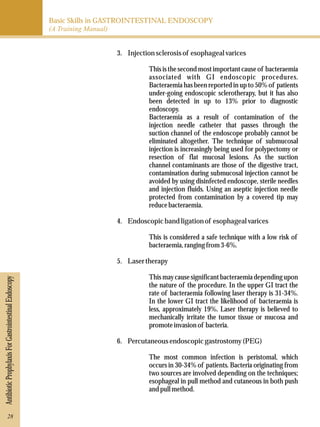
The rate of bacteraemia after endoscopic procedures 
1. Diagnostic upper gastrointestinal endoscopy and 
colonoscopy 
The bacteraemia rate is low, up to 4%. The risk of 
bacteraemia does not seem to increase with biopsy or 
polypectomy. Bacteria most often cultured after upper 
GI endoscopy are contaminants. 
2. Esophageal dilatation and insertion of prosthesis 
This causes a significant bacteraemia reaching 
approximately 45%. Although mouth commensals are 
found most often following esophageal dilatation, oral 
decontamination with Clindamycin was not an effective 
prophylaxis. Disinfection of bougie dilators did 
however reduce post-procedural bacteraemia. The risk 
after balloon dilatation is probably small as this kind of 
dilator traverses the endoscope channel and has no 
contact with the oral cavity. However, no data is 
available to confirm or refuse these findings. 
Antibiotic Prophylaxis For Gastrointestinal Endoscopy 
27
Basic Skills in GASTROINTESTINAL ENDOSCOPY 
(A Training Manual) 
Antibiotic Prophylaxis For Gastrointestinal Endoscopy 
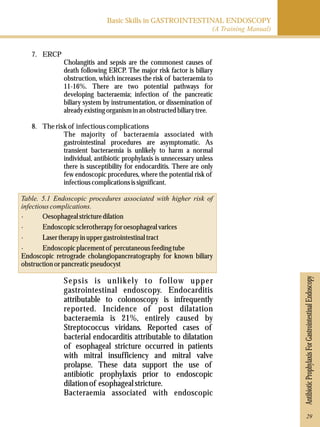
3. Injection sclerosis of esophageal varices 
This is the second most important cause of bacteraemia 
associated with GI endoscopic procedures. 
Bacteraemia has been reported in up to 50% of patients 
under-going endoscopic sclerotherapy, but it has also 
been detected in up to 13% prior to diagnostic 
endoscopy. 
Bacteraemia as a result of contamination of the 
injection needle catheter that passes through the 
suction channel of the endoscope probably cannot be 
eliminated altogether. The technique of submucosal 
injection is increasingly being used for polypectomy or 
resection of flat mucosal lesions. As the suction 
channel contaminants are those of the digestive tract, 
contamination during submucosal injection cannot be 
avoided by using disinfected endoscope, sterile needles 
and injection fluids. Using an aseptic injection needle 
protected from contamination by a covered tip may 
reduce bacteraemia. 
4. Endoscopic band ligation of esophageal varices 
This is considered a safe technique with a low risk of 
bacteraemia, ranging from 3-6%. 
5. Laser therapy 
This may cause significant bacteraemia depending upon 
the nature of the procedure. In the upper GI tract the 
rate of bacteraemia following laser therapy is 31-34%. 
In the lower GI tract the likelihood of bacteraemia is 
less, approximately 19%. Laser therapy is believed to 
mechanically irritate the tumor tissue or mucosa and 
promote invasion of bacteria. 
6. Percutaneous endoscopic gastrostomy (PEG) 
The most common infection is peristomal, which 
occurs in 30-34% of patients. Bacteria originating from 
two sources are involved depending on the techniques; 
esophageal in pull method and cutaneous in both push 
and pull method. 
28
7. ERCP 
Basic Skills in GASTROINTESTINAL ENDOSCOPY 
(A Training Manual) 
Cholangitis and sepsis are the commonest causes of 
death following ERCP. The major risk factor is biliary 
obstruction, which increases the risk of bacteraemia to 
11-16%. There are two potential pathways for 
developing bacteraemia; infection of the pancreatic 
biliary system by instrumentation, or dissemination of 
already existing organism in an obstructed biliary tree. 
8. The risk of infectious complications 
The majority of bacteraemia associated with 
gastrointestinal procedures are asymptomatic. As 
transient bacteraemia is unlikely to harm a normal 
individual, antibiotic prophylaxis is unnecessary unless 
there is susceptibility for endocarditis. There are only 
few endoscopic procedures, where the potential risk of 
infectious complications is significant. 
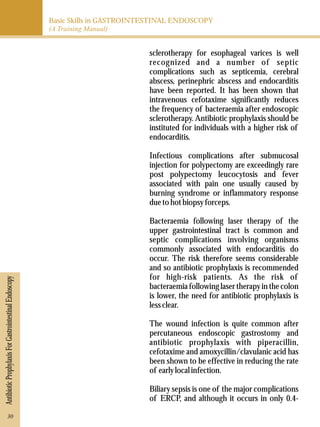
Table. 5.1 Endoscopic procedures associated with higher risk of 
infectious complications. 
· Oesophageal stricture dilation 
· Endoscopic sclerotherapy for oesophageal varices 
· Laser therapy in upper gastrointestinal tract 
· Endoscopic placement of percutaneous feeding tube 
Endoscopic retrograde cholangiopancreatography for known biliary 
obstruction or pancreatic pseudocyst 
Sepsis is unlikely to follow upper 
gastrointestinal endoscopy. Endocarditis 
attributable to colonoscopy is infrequently 
reported. Incidence of post dilatation 
bacteraemia is 21%, entirely caused by 
Streptococcus viridans. Reported cases of 
bacterial endocarditis attributable to dilatation 
of esophageal stricture occurred in patients 
with mitral insufficiency and mitral valve 
prolapse. These data support the use of 
antibiotic prophylaxis prior to endoscopic 
dilation of esophageal stricture. 
Bacteraemia associated with endoscopic 
Antibiotic Prophylaxis For Gastrointestinal Endoscopy 
29
Basic Skills in GASTROINTESTINAL ENDOSCOPY 
(A Training Manual) 
Antibiotic Prophylaxis For Gastrointestinal Endoscopy 
sclerotherapy for esophageal varices is well 
recognized and a number of septic 
complications such as septicemia, cerebral 
abscess, perinephric abscess and endocarditis 
have been reported. It has been shown that 
intravenous cefotaxime significantly reduces 
the frequency of bacteraemia after endoscopic 
sclerotherapy. Antibiotic prophylaxis should be 
instituted for individuals with a higher risk of 
endocarditis. 
Infectious complications after submucosal 
injection for polypectomy are exceedingly rare 
post polypectomy leucocytosis and fever 
associated with pain one usually caused by 
burning syndrome or inflammatory response 
due to hot biopsy forceps. 
Bacteraemia following laser therapy of the 
upper gastrointestinal tract is common and 
septic complications involving organisms 
commonly associated with endocarditis do 
occur. The risk therefore seems considerable 
and so antibiotic prophylaxis is recommended 
for high-risk patients. As the risk of 
bacteraemia following laser therapy in the colon 
is lower, the need for antibiotic prophylaxis is 
less clear. 
The wound infection is quite common after 
percutaneous endoscopic gastrostomy and 
antibiotic prophylaxis with piperacillin, 
cefotaxime and amoxycillin/clavulanic acid has 
been shown to be effective in reducing the rate 
of early local infection. 
Biliary sepsis is one of the major complications 
of ERCP, and although it occurs in only 0.4- 
30
Basic Skills in GASTROINTESTINAL ENDOSCOPY 
(A Training Manual) 
Antibiotic Prophylaxis For Gastrointestinal Endoscopy 
0.8%, it is associated with 8-20% mortality rate. 
Antibiotic prophylaxis is recommended for 
patients who are likely to undergo therapeutic 
ERCP if there has been previous biliary sepsis, 
bile duct obstruction or pancreatic pseudocyst. 
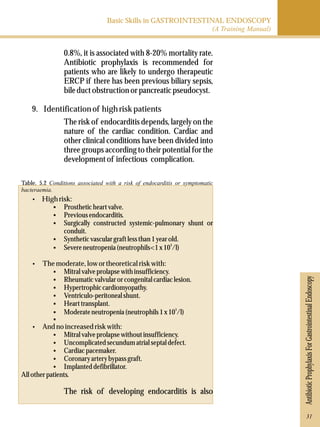
9. Identification of high risk patients 
The risk of endocarditis depends, largely on the 
nature of the cardiac condition. Cardiac and 
other clinical conditions have been divided into 
three groups according to their potential for the 
development of infectious complication. 
Table. 5.2 Conditions associated with a risk of endocarditis or symptomatic 
bacteraemia. 
·High risk: 
§Prosthetic heart valve. 
§Previous endocarditis. 
§Surgically constructed systemic-pulmonary shunt or 
conduit. 
§Synthetic vascular graft less than 1 year old. 
3 §Severe neutropenia (neutrophils<1 x 10 /l) 
·The moderate, low or theoretical risk with: 
§Mitral valve prolapse with insufficiency. 
§Rheumatic valvular or congenital cardiac lesion. 
§Hypertrophic cardiomyopathy. 
§Ventriculo-peritoneal shunt. 
§Heart transplant. 
3 §Moderate neutropenia (neutrophils 1 x 10 /l) 
§ 
·And no increased risk with: 
§Mitral valve prolapse without insufficiency. 
§Uncomplicated secundum atrial septal defect. 
§Cardiac pacemaker. 
§Coronary artery bypass graft. 
§Implanted defibrillator. 
All other patients. 
The risk of developing endocarditis is also 
31
Basic Skills in GASTROINTESTINAL ENDOSCOPY 
(A Training Manual) 
Antibiotic Prophylaxis For Gastrointestinal Endoscopy 
dependent upon bacteraemia. Although 
bacteraemia is common following many 
invasive endoscopic procedures, only certain 
bacteria commonly cause endocarditis. 
Haemolytic streptococci and staphylococci are 
the most likely, comprising respectively 55% 
and 25% cases associated with native valve and 
30% and 45% of vascular prosthesis infections. 
Streptococcus viridians is the commonest cause 
of endocarditis following esophageal high risk 
therapeutic procedures. 
Antibiotic prophylaxis for bacterial 
endocarditis should be specifically directed 
against these organisms. It should be stressed 
that endocarditis hardly ever develops as a 
consequence of an endoscopic procedure. 
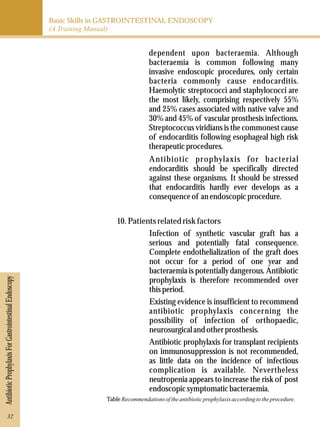
10. Patients related risk factors 
Infection of synthetic vascular graft has a 
serious and potentially fatal consequence. 
Complete endothelialization of the graft does 
not occur for a period of one year and 
bacteraemia is potentially dangerous. Antibiotic 
prophylaxis is therefore recommended over 
this period. 
Existing evidence is insufficient to recommend 
antibiotic prophylaxis concerning the 
possibility of infection of orthopaedic, 
neurosurgical and other prosthesis. 
Antibiotic prophylaxis for transplant recipients 
on immunosuppression is not recommended, 
as little data on the incidence of infectious 
complication is available. Nevertheless 
neutropenia appears to increase the risk of post 
endoscopic symptomatic bacteraemia. 
Table Recommendations of the antibiotic prophylaxis according to the procedure. 
32
Basic Skills in GASTROINTESTINAL ENDOSCOPY 
(A Training Manual) 
Antibiotic Prophylaxis For Gastrointestinal Endoscopy 
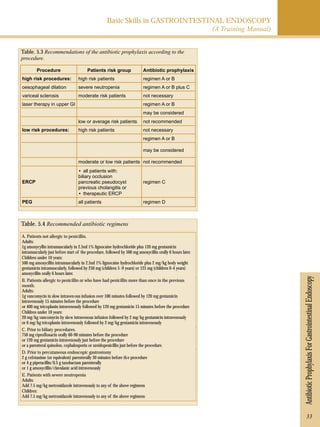
Table. 5.3 Recommendations of the antibiotic prophylaxis according to the 
procedure. 
Procedure Patients risk group Antibiotic prophylaxis 
high risk procedures: high risk patients regimen A or B 
oesophageal dilation severe neutropenia regimen A or B plus C 
variceal sclerosis moderate risk patients not necessary 
laser therapy in upper GI regimen A or B 
may be considered 
low or average risk patients not recommended 
low risk procedures: high risk patients not necessary 
regimen A or B 
may be considered 
moderate or low risk patients not recommended 
ERCP 
· all patients with: 
biliary occlusion 
pancreatic pseudocyst 
previous cholangitis or 
· therapeutic ERCP 
regimen C 
PEG all patients regimen D 
Table. 5.4 Recommended antibiotic regimens 
A. Patients not allergic to penicillin. 
Adults: 
1g amoxycyllin intramuscularly in 2.5ml 1% lignocaine hydrochloride plus 120 mg gentamicin 
intramuscularly just before start of the procedure, followed by 500 mg amoxycillin orally 6 hours later. 
Children under 10 years: 
500 mg amoxycillin intramuscularly in 2.5ml 1% lignocaine hydrochloride plus 2 mg/kg body weight 
gentamicin intramuscularly, followed by 250 mg (children 5 -9 years) or 125 mg (children 0-4 years) 
amoxycillin orally 6 hours later. 
B. Patients allergic to penicillin or who have had penicillin more than once in the previous 
month. 
Adults: 
1g vancomycin in slow intraven ous infusion over 100 minutes followed by 120 mg gentamicin 
intravenously 15 minutes before the procedure 
or 400 mg teicoplanin intravenously followed by 120 mg gentamicin 15 minutes before the procedure 
Children under 10 years: 
20 mg/kg vancomycin by slow intravenous infusion followed by 2 mg/kg gentamicin intravenously 
or 6 mg/kg teicoplanin intravenously followed by 2 mg/kg gentamicin intravenously 
C. Prior to biliary procedures. 
750 mg ciprofloxacin orally 60-90 minutes before the procedure 
or 120 mg gentamicin intravenously just before the procedure 
or a parenteral quinolon, cephalosporin or ureidopenicillin just before the procedure. 
D. Prior to percutaneous endoscopic gastrostomy 
2 g cefotaxime (or equivalent) parenterally 30 minutes before th e procedure 
or 4 g piperacillin/0.5 g tazobactam parenterally 
or 1 g amoxycillin/clavulanic acid intravenously 
E. Patients with severe neutropenia 
Adults: 
Add 7.5 mg/kg metronidazole intravenously to any of the above regimens 
Children: 
Add 7.5 mg/kg metronidazole intravenously to any of the above regimens 
33
6 
Safety and Sedation during Endoscopy 
Preprocedure Assessment 
Assessment of patients through a medical history and evaluation of 
their physical condition should be done before administration of 
intravenous sedation. Essential elements of medical history include the 
following: 
i. Significant cardiac or pulmonary disease 
ii. Neurological or seizure disorder 
iii. Strider, snoring or sleep apnea 
iv. History of adverse reaction to sedation or anesthesia 
v. Current medications, drugs and allergies 
vi. Alcohol or drug abuse 
vii. Time of last oral intake 
In addition to above assessments, a patient's overall disease risk should 
be classified according to the American Society for Anesthesiology 
(ASA) physical status classification. 
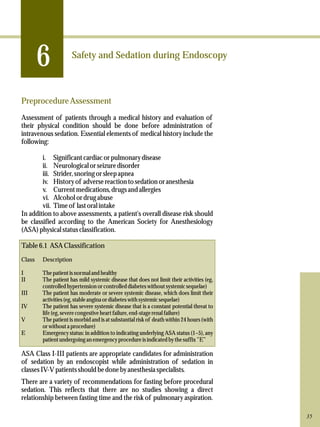
Table 6.1 ASA Classification 
Class Description 
I The patient is normal and healthy 
II The patient has mild systemic disease that does not limit their activities (eg, 
controlled hypertension or controlled diabetes without systemic sequelae) 
III The patient has moderate or severe systemic disease, which does limit their 
activities (eg, stable angina or diabetes with systemic sequelae) 
IV The patient has severe systemic disease that is a constant potential threat to 
life (eg, severe congestive heart failure, end-stage renal failure) 
V The patient is morbid and is at substantial risk of death within 24 hours (with 
or without a procedure) 
E Emergency status: in addition to indicating underlying ASA status (1–5), any 
patient undergoing an emergency procedure is indicated by the suffix ”E” 
ASA Class I-III patients are appropriate candidates for administration 
of sedation by an endoscopist while administration of sedation in 
classes IV-V patients should be done by anesthesia specialists. 
There are a variety of recommendations for fasting before procedural 
sedation. This reflects that there are no studies showing a direct 
relationship between fasting time and the risk of pulmonary aspiration. 
35
Basic Skills in GASTROINTESTINAL ENDOSCOPY 
(A Training Manual) 
Safety and Sedation during Endoscopy 
The ASA guidelines indicate that patients should fast a minimum of 2 
hours for clear liquids, and 6 hours for light meals, before sedation. In 
contrast the American College of Emergency Physicians does not 
endorse recent food intake as a contraindication for administering 
procedural sedation and analgesia. 
The focused physical examination should include: 
a. Vital signs and weight 
b. Auscultation of heart and lungs 
c. Level of consciousness 
d. Assessment of airway 
Airway Assessment/Evaluation 
This is required to identify patients with anatomy that may make 
endotracheal intubations or positive pressure ventilation more difficult. 
This includes patients with obesity, short, thick neck, cervical spine 
disease, decreased hyoid-mental distance and structural abnormalities 
of the mouth, jaw and oral cavity. Examination of oral cavity can 
identify individuals with anatomy that is associated with more difficult 
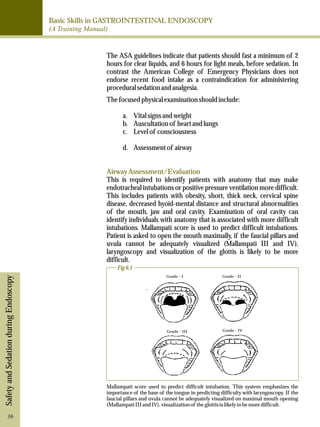
intubations. Mallampati score is used to predict difficult intubations. 
Patient is asked to open the mouth maximally, if the faucial pillars and 
uvula cannot be adequately visualized (Mallampati III and IV), 
laryngoscopy and visualization of the glottis is likely to be more 
difficult. 
Grade - II 
Grade - I 
Grade - III Grade - IV 
Fig 6.1 
Mallampati score used to predict difficult intubation. This system emphasizes the 
importance of the base of the tongue in predicting difficulty with laryngoscopy. If the 
faucial pillars and uvula cannot be adequately visualized on maximal mouth opening 
(Mallampati III and IV), visualization of the glottis is likely to be more difficult. 
36
Basic Skills in GASTROINTESTINAL ENDOSCOPY 
(A Training Manual) 
Safety and Sedation during Endoscopy 
Pharmacology of Sedation 
The goal of endoscopic sedation is to maximize patient comfort while 
minimizing the risk of drug related side effects. The drugs most widely 
used for endoscopic sedation are benzodiazepines and opioids. 
Opioids: 
The principal effects of the opioids are analgesia and sedation. In 
clinical practice, opioids are usually combined with a benzodiazepine 
for endoscopic sedation. 
The pharmacological effects of benzodiazepines include anxiolysis, 
sedation, amnesia, anticonvulsant effects, muscle relaxation and 
anaesthesia. The amnestic effect may persist after sedation has worn off. 
Diazepam 
The initial induction dose for endoscopic procedure is 5-10mg 
intravenously over 1 minute. If required, additional doses may be 
administered at 5 minutes interval. Dose reduction is required in 
debilitated or elderly patients. In general, 10mg is sufficient for most 
endoscopic procedures, although up to 20mg may be necessary if a 
narcotic is not being co-administered. 
The major side effect of diazepam is respiratory depression. This is 
dose dependent and results from depression of the central ventilatory 
response to hypoxia and hypercapnea. 
Respiratory depression is more likely to occur in patients with 
underlying respiratory disease or those receiving combination of a 
benzodiazepine and an opioid. 
Midazolam 
Midazolam is a water soluble, short acting benzodiazepine. It is 1.5-3.5 
times more potent than diazepam. Midazolam is distinguished from the 
other benzodiazepines by its more rapid onset of action and shorter 
duration of effect, the onset of effect for midazolam is 1-2 minutes and 
the peak effect occurs in 15-80 minutes. Midazolam clearance is reduced 
in the elderly, obese and those with hepatic and renal impairment. The 
bioavailibility of midazolam is increased by approximately 30% in 
patients using a hisamine (H2) receptor antagonist. 
The initial intravenous dose in healthy adults younger than 60 years of 
age is l mg (or no more than 0.03mg/kg injected over 1-2 minutes. 
37
Basic Skills in GASTROINTESTINAL ENDOSCOPY 
(A Training Manual) 
Safety and Sedation during Endoscopy 
Additional doses of 1mg may be admistered at 2-minutes intervals until 
adequate sedation is achieved. When midazolam is used with an opioid, 
a synergistic interaction occurs and reduction in the dose of midazolam 
may be indicated. Patients older than 60 years and those with ASA 
physical states III or greater require a dose reduction of 20% or more. A 
total intravenous dose greater than 6 mg is not usually required for 
routine endoscopic procedures. 
The major side effect of midazolam is respiratory depression. In some 
cases apnea may last as long as 30 minutes after administration of the 
last dose of midazolam. Midazolam induced respiratory depression 
may be an administration related phenomenon, with more rapid 
administration resulting in greater number of apneic episodes. Cardiac 
dysrhythmia has been reported rarely after administration of 
midazolam. 
Flumazenil 
Flumazenil is a benzodiazepine specific antagonist. Flumazenil 
competitively antagonizes the central effects of benzodiazepines, 
reversing sedation, psychomotor impairment, memory loss and 
respiratory depression. Flumazenil is water-soluble and can be 
administered by either continuous or bolus infusion. The half life of 
Flumazenil after intravenous administration is 0.7-1.3 hours and 
average duration of antagonism is 1 hour. 
Flumazenil has also been shown to reverse ventilatory depression in 
patients sedated with a combination of benzodiazepines and opioids. 
Midazolam induced reversal of respiratory depression occurs 
approximately 120 seconds after the intravenous administration of 
Flumazenil. 
Propofol 
Propofol is a hypnotic with minimal analgesic effect. At sub-hypnotic 
doses, propofol produces sedation and amnesia. Its duration of effect is 
4-8 minutes. The presence of cirrhosis or renal failure does not 
significantly affect its pharmacokinetic profile. Co-administration of 
other central nervous system medications such as opioids potentates 
the sedative effect of propofol. 
The cardiovascular effects of propofol include a decrease in cardiac 
output, systemic vascular resistance and arterial pressure. These effects 
respond rapidly to a dose reduction or interruption of drug infusion. 
38
Basic Skills in GASTROINTESTINAL ENDOSCOPY 
(A Training Manual) 
Safety and Sedation during Endoscopy 
Combination Propofol 
By combining small doses of several drugs that possess desirable 
pharmacologic actions it is possible to maximize the therapeutic actions 
of each while minimizing the likelihood of a dose related adverse 
reaction. This pharmacologic principle can be applied to procedural 
sedation. So, when propofol is combined with small doses of an opioid 
analgesic and a benzodiazepine, analgesia and amnesia can be achieved 
with sub-hypnotic doses of propofol, eliminating the need for deep 
sedation. Furthermore, precise dose titration is possible with smaller 
bolus doses of propofol (5-15mg) and the potential for reversibility is 
retained using Naloxone or Flumazenil. 
The protocols for combination propofol include a pre-induction dose 
of either an opioid or a benzodiazepine or both. An induction dose of 
propofol is then administered (5-15mg), followed by additional boluses 
of (5-15mg). The average cumulative doses of propofol in a 
combination regimen are 65-100mg during colonoscopy and 35-70mg 
during upper GI endoscopy. 
Ketamine 
Ketamine possesses both analgesic and sedative properties. After 
intravenous administration ketamine has a rapid onset of action 
(<1minute) and short duration of effect (10-15min). Ketamine is easy 
to administer and in contrast to benzodiazepine/narcotic regimens, 
does not depress airway or cardiovascular reflexes. The dose of 
ketamine for endoscopic sedation has been studied predominantly in 
the pediatric settings. 
Pharyngeal Anesthesia 
Pharyngeal Anesthesia is often used to suppress the gag-reflex during 
procedures involving the upper gastrointestinal tract. Commonly used 
topical anesthetics include benzocaine and lidocaine. They are 
administered by aerosol spray or gargling. The effect lasts for up to an 
hour. It probably provides little benefit for most patients receiving 
intravenous sedation. It may be acceptable to use topical anesthesia for 
some patients, particularly if light or no conscious sedation is 
administered. 
Patient Monitoring 
Patient monitoring is an essential element of endoscopic sedation. This 
includes both visual assessment as well as the use of devices to measure 
physiological parameters. Before sedating the patient, all monitoring 
and resuscitation equipment required for the intended level of sedation 
should be present and functioning. 
39
Basic Skills in GASTROINTESTINAL ENDOSCOPY 
(A Training Manual) 
Safety and Sedation during Endoscopy 
Staffing 
When sedation is used for gastrointestinal endoscopic procedures, 
there must be a minimum of three appropriate staff present for 
endoscopy, the endoscopist, the assistant to the endoscopist and the 
person providing sedation and monitoring of the patient. For all 
sedation for gastrointestinal endoscopic procedures, a medical 
practitioner with specific training and experience in airway management 
and resuscitation must be involved in the sedation or procedure itself. 
From the time of initiation of sedation a person with appropriate 
training must be present whose sole responsibility will be to monitor the 
patient's level of consciousness and cardio-respiratory status during the 
procedure and to assist in resuscitation if required. If major risk factors 
are identified or difficulties are anticipated, involvement of an 
anesthetist in administering sedation is recommended. 
Facilities and Equipment 
The procedure must be performed in a location, which is adequate in 
size and staffing and is equipped to deal with a cardiopulmonary 
emergency. A list of emergency resuscitation equipment and drugs is 
given in table. 
Table 6.2 Emergency Resuscitative Equipment 
vAssorted syringes, tourniquets, adhesive tape 
vIntravenous access equipment including fluids 
vBasic airway management equipment 
vOxygen supply 
vSuction machine and catheter 
vNasal cannulae and face-masksa 
vBag-mask ventilation device 
vOral and nasal airways (all sizes) 
vAdvanced airway management equipment 
vLaryngoscope handles and bladesa 
vEndotracheal tubes and styletsa 
vLaryngeal mask airwaya 
vCardiac equipment 
vPulse oximeter 
vCardiac defibrillator 
vEmergency medications 
vAtropine 
vDiphenhydramine 
vEpinephrine 
vEphedrine 
vFlumazenil 
vGlucose, 50% 
vHydrocortisone 
vLidocaine 
vNaloxone 
vSodium bicarbonate 
All appropriate sizes should be available. 
40
Basic Skills in GASTROINTESTINAL ENDOSCOPY 
(A Training Manual) 
Safety and Sedation during Endoscopy 
The equipment stocked on an emergency cart should be tailored to the 
practice environment and the training of the sedation team. It is 
strongly recommended that a cardiac defibrillator be available on site. 
Equipment for providing positive-pressure ventilation must be 
immediately available. This includes oral and nasal airways and an 
Ambu-bag. Advanced airway management equipment including 
laryngoscopes and endotracheal tubes, or laryngeal mask airways 
should be available on the emergency cart. 
Appropriate drugs for cardiopulmonary resuscitation and drugs for 
reversal of sedation due to benzodiazepines and opioids should be 
readily available. A pulse oximeter and cardiac monitor recording pulse, 
blood pressure and ECG should be attached to the patient. 
Technique and Monitoring 
All patients should have reliable venous access for endoscopic 
procedures requiring sedation. Dosage of benzodiazepines and opiates 
should be kept to a minimum to achieve sedation. Opioids should, 
whenever possible, be given before benzodiazepines and their effect 
observed before proceeding. 
Most endoscopic practices recommend that 5mg of midazolam should 
usually be the maximum dose given and that elderly patients are given 1- 
2mg initially with a sensible pause to observe effect. Doses of pethidine 
in excess of 50mg or Fentanyl 100mcg are seldom required and elderly 
patients will receive dose reduction (usually below 50%) when these 
drugs are used. Oxygen should be given to all sedated patient 
throughout the procedure and recovery. 
Clinical Monitoring 
Pulse oximetry should always be used during endoscopy. Oxygen de-saturation 
can occur during the endoscopic procedure when sedation is 
used, especially when the patient has been over sedated. A reading 
below 90% SpO2 is dangerous and requires immediate intervention. 
Preoxygenation with oxygen enriched air (2 liters per minute) is safe 
even in chronic obstructive pulmonary disease and greatly diminishes 
or prevents hypoxemia. This should be used routinely in all at-risk 
patients. In the event of de-saturation, encouraging the patient to 
breathe deeply with supplemental oxygen, termination of the 
procedure, assisted ventilation and pharmacological reversal of either 
the benzodiazepine and/or the opioid may be required. Homodynamic 
parameters also provide important feed back during an endoscopic 
procedure. Tachycardia and hypertension may indicate that the patient 
is sedated inadequately, whereas bradycardia and or hypotension may be 
41
Basic Skills in GASTROINTESTINAL ENDOSCOPY 
(A Training Manual) 
Safety and Sedation during Endoscopy 
an early indication of over-sedation. A base line blood pressure should 
be noted before the administration of sedation, and then at 3 – 5 
minutes interval throughout the procedure. The use of continuous 
electrocardiography during routine endoscopic procedure in low risk 
patients is not required. High-risk patients (including those with a 
history of dysrythmias) receiving sedation should be considered for 
cardiac monitoring. 
Continuum Sedation 
Sedation and /or analgesic agents produce alteration in a patient's level 
of consciousness. These changes in consciousness occur along a 
continuum that ranges from anxiolysis to general anesthesia. Four 
stages of sedation have been defined by a stimulus response 
relationship. 
Table. 6.3 Levels of Sedation and Analgesia 
Minimal sedation 
(anxiolysis) 
Moderate sedation/analgesia 
(conscious sedation) Deep sedation/analgesia General anesthesia 
Responsiveness Normal response to 
verbal stimulation 
Purposefula response to 
verbal or tactile stimulation 
Purposefula response 
following repeated or 
painful stimulation 
Unarousable, even with 
painful stimulus 
Airway 
Spontaneous 
ventilation 
No intervention required 
Adequate 
Intervention may 
be required 
May be inadequate 
Intervention often 
required 
Frequently inadequate 
Cardiovascular 
function 
Unaffected 
Unaffected 
Unaffected Usually maintained Usually maintained May be impaired 
A patient level of consciousness should be assessed and documented, 
beginning before the initiation of Sedation and continuing through out 
the procedure and recovery period, until the patient is suitable for 
discharge. 
Recovery And Discharge 
After the completion of endoscopy, patients receiving intravenous 
sedation require observation and monitoring. 
Standardized discharge criteria should be used to assess recovering 
from sedation. Several recovery scales have been developed. One such 
system is Aldrete scoring system, which evaluates 5 physiological 
parameters: respiration, oxygen saturation, blood pressure, 
consciousness and activity. 
42
Basic Skills in GASTROINTESTINAL ENDOSCOPY 
(A Training Manual) 
Safety and Sedation during Endoscopy 
Table 6.4 Aldrete Scoring Systems 
Respiration 
Able to take deep breath and cough 2 
Dyspnea/shallow breathing 1 
Apnea 0 
Oxygen saturation 
SaO2 95% on room air 2 
SaO2 90%–95% on room air 1 
SaO2 90% even with supplemental O 2 0 
Consciousness 
Fully awake 2 
Arousable on calling 1 
Not responding 0 
Circulation 
BP 20 mm Hg baseline 2 
BP 20–50 mm Hg baseline 1 
BP 50 mm Hg baseline 0 
Activity 
Able to move 4 extremities 2 
Able to move 2 extremities 1 
Able to move 0 extremities 0 
NOTE. Monitoring may be discontinued and patient discharged to 
home or appropriate unit when Aldrete score is 9 or greater. 
Monitoring may be discontinued and patient discharged to home when 
Aldrete score is 9 or greater. In addition to a physiological assessment, 
suitability for discharge includes an ability to dress and walk 
independently. All patients should receive verbal and written 
instructions for diet, activity, medications and follow up evaluation on 
discharge. A responsible individual should accompany the patient 
home. 
Informed Consent 
The philosophy behind the law of informed consent is that a patient has 
the right to make informed decisions about what happens to his or her 
body. Informed consent for endoscopic sedation requires that the 
patient understand the nature of the proposed sedations, the risks and 
benefits associated with it, the options (including no sedation) and the 
risks and benefits associated with the options. A direct face-to-face 
informed consent discussion also provides a good opportunity for the 
endoscopist to assess the patient's clinical sedation risks such as history 
of sedation reaction or difficult intubations and abnormal head and 
neck anatomy as well as the details and risks of the endoscopy 
procedure. All this should be documented in the form of a hand written 
note or signed pre-printed form. 
43
7 
Indications, Contraindications, Complications of 
Upper Gastrointestinal Endoscopy 
Upper gastrointestinal endoscopy, also known as esophago 
gastroduodenoscopy (EGD) is the method of choice for examining the 
esophagus, stomach and duodenum. In one, sitting it permits the gross 
visual inspection of the upper gastrointestinal tract, the collection of 
tissue and fluid sample, as well as emergency and elective therapeutic 
interventions. It can be performed quickly and safely with good patient 
tolerance and without extensive preparation. 
Indications 
1. Dysphagia 
2. Upper abdominal pain, heart burn, reflux 
3. Nausea, vomiting, anorexia, fullness, weight loss, anemia, 
haematemesis 
4. Diarrhea (tropical or non tropical sprue) 
5. Portal hypertension 
6. Unexplained aspiration, chronic cough 
Contraindications 
1. Corrosive ingestion 
2. Perforation 
3. Full stomach 
4. Advance heart failure, acute myocardial infarction 
5. Advanced respiratory failure 
Risks and Complications 
The rate of serious complication in upper GI endoscopy is small and is 
measured in tenths of a percent. Reports based on larger reviews show 
that mortality rate is less then 0.01%. 
Table 7.1 Complication rates in upper GI endoscopy 
Complication Complication rate Percentage of all 
complication 
Cardiac 1: 2000 60% 
Pulmonary 1: 4000 30% 
Perforation, bleeding 1: 15000 9% 
Infection 1: 50000 1% 
45
Basic Skills in GASTROINTESTINAL ENDOSCOPY 
(A Training Manual) 
Risk factors and high risk patient 
1. Advanced age 
2. NYHA class III-IV heat failure 
3. Severe aortic stenosis 
4. Severe pulmonary disease 
5. Bleeding tendency, platelet count < 50,000 and markedly prolonged 
prothrombin time 
6. Anaemia (hemoglobin < 8g/dl) 
7. Emergency Procedures 
Local Anesthesia 
Anesthetic throat sprays have the potential to incite an allergic reaction, 
produce cardiac side effects and promote aspiration. The overall risk of 
complication from pharyngeal anesthesia is approximately once every 10,000 
procedures. 
Sedation and Analgesia 
The principal risks are a fall in blood pressure and hypoxemia induced cardiac 
arrhythmia. Respiratory complications can range from hypoventilation to 
apnea. The most common problem is aspiration. 
Cardiac Complications 
Approximately 50% of the complications that occur in upper GI endoscopy 
are cardiac in nature. The most common arrhythmias are tachycardia and 
extra systoles, which have no clinical significance and are spontaneously 
reversible. Bradycardia is observed in less than 5%, occurring predominately 
in patients with coronary heart disease. This reflects silent myocardial 
ischemia, caused by arterial hypoxia due to increased cardiac workload. 
Respiratory complications 
Respiratory complications consist of hypoventilation, apnea and aspiration. 
Their overall incidence is low. The mortality is less than 1:50,000. 
Gastrointestinal Complications 
Perforation and Bleeding 
Although perforation and bleeding from gastroscopy are the complications 
that patients fear the most, they account for less than 10% of all 
complications. 
The most common sites of perforation in descending order of frequency are 
the esophagus, hypopharynx, duodenum and stomach. Predisposing factors 
Indications, Contraindications, Complications of 
Upper Gastrointestinal Endoscopy 46
Basic Skills in GASTROINTESTINAL ENDOSCOPY 
are diverticula, severe cervical spondylosis, and endoscopic interventions 
such as dilatation, prosthesis insertion and laser therapy. Severe post biopsy 
bleeding is quite rare. 
Infection 
The risk of clinically overt infection is extremely small, but does exist. The 
direct transmission of microorganisms from patient to patient by 
contaminated endoscopes has been described for Salmonellae, Mycobacteria, 
Helicobacter pylori, hepatitis B virus and other pathogens. Potential sources 
of infection are contaminated water bottles and the endoscope channel, 
which are more difficult to access and clean. Meticulous cleaning and 
disinfections after each endoscopy and before the first endoscopy of the day 
are essential elements of risk management. 
Nature of the procedure 
It is clear that procedures which inflict mucosal injuries are associated with a 
higher infection risk, such as dilatation, sclerotherapy, laser therapy etc. 
Patient associated risk 
Patient having cardiac anomalies, prosthetic valves and immunosuppression 
have increased risk of infection after upper GI endoscopy 
Diagnosis and Treatment of Complications 
Complications during examination 
Restlessness, agitation, pain, coughing, gagging. 
Causes Reasons for stopping the 
examination and withdrawing the 
endoscope 
ØNormal response to the examination 
ØFaculty examination technique (especially, 
poor intubation technique) 
ØNot enough verbal reassurance, inadequate 
preparation for the procedure 
ØMisdirected intubation, retroflexion in the 
pharynx 
ØPain due to unfavorable patient position 
ØParadoxical reaction to sedation 
ØRespiratory distress, pain, angina pectoris 
ØPreexisting illness: 
- Bronchial asthma, chronic obstructive 
lung disease 
- Alcohol abuse 
- Previous unpleasant endoscopy 
Brief assessment 
ØEndoscope position (retroflexed? 
Misdirected?) 
ØVerbal responsiveness of patient, 
cooperativeness 
ØHeart rate 
ØSerious preexisting illness 
ØElderly patient 
ØTachycardia > 140bpm, 
arrhythmia 
ØO2 saturation < 90%, 
declining 
ØUncooperative patient 
ØAngina pectoris 
Reasons for pausing but leaving 
the instrument in place 
ØNo preexisting illness 
ØYoung patient 
ØO2 saturation > 90% 
ØPatient responsive to verbal 
commands 
ØPatient and endoscopist 
agree to continue 
Treatment 
ØAccording to cause 
(A Training Manual) 
Indications, Contraindications, Complications of 
Upper Gastrointestinal Endoscopy 
Table 7.2 
47
Basic Skills in GASTROINTESTINAL ENDOSCOPY 
(A Training Manual) 
Indications, Contraindications, Complications of 
Upper Gastrointestinal Endoscopy 
Dyspnea 
Causes General treatment 
ØPsychogenic 
ØObstructed nasal breathing 
ØMisdirected intubation, aspiration 
ØCardiac decompensation 
Brief assessment 
ØRespiratory rate, breath sound, cyanosis 
ØO2 saturation 
ØPulse 
Reasons for stopping the examination and 
withdrawing the endoscope 
ØElderly patient 
ØPre-existing cardiopulmonary disease 
ØO2 saturation < 90% declining 
ØTachycardia > 140bpm 
Reasons for pausing but leaving the instrument 
in place 
ØNo preexisting illness 
ØYoung patient 
ØAdequate O2 saturation (>95%) 
Table 7.3 
ØFor significant dyspnea, treat 
according to the general rules 
for cardiopulmonary 
resuscitation: 
A Clear the airway and keep it 
Open (suction of mucus, 
vomitus, etc). 
B Ventilate (O2 by mask or 
nasal catheter): intubate if 
response is poor. 
C Maintain and stabilize the 
circulation, if necessary 
using external cardiac 
massage. 
D Place an intravenous line, 
give specific pharmacotherapy 
Specific treatments 
ØFor bronchoconstricion 
- Theophylline, 200mg i.v. 
- Prednisolone, 100mg i.v. 
- Beta-2 mimetics by aerosol 
- Beta-2 mimetics s.c. (e.g, 
Bricanyl 0.5-1.0mgsc.) 
ØFor cardiac decompensation 
- Nitroglycerine sublingual 
- Furosemide, 40-80mg i.v 
- With concomitant 
bronchospasm: 
theophylline, 200mg i.v. 
- Tratment of cardiac 
arrhythmias 
Bleeding 
Causes Course of action 
ØInstrument tip contact (pharynx, upper 
esophageal sphincter, duodenal bulb) 
ØVarices (ulcerations in the esophagus, 
stomach, and duodenum) 
ØMallory-Weiss syndrome 
ØLess common causes (see p. 155) 
ØCoagulation disorders, thrombocytopenia 
Table 7.4 
ØDo not with draw the 
endoscope 
Specific Treatment 
ØTreat for upper gastrointestinal 
bleeding (see p. 146) 
48
Basic Skills in GASTROINTESTINAL ENDOSCOPY 
Apnea 
Causes Specific treatment 
ØPharmacological: sedation, analgesia 
ØCardiac: asystole, ventricular fibrillation, 
bradycardia 
ØAnaphylactic shock 
Course of action 
ØDiscontinue examination, withdraw endoscope 
Brief Assessment 
ØRespiratory excursions, O2 saturation 
ØCarotid pulse 
General treatment 
ØFollow the general rules for cardiopulmonary 
resuscitation: 
A Clear the airway and keep it open (suction 
out mucus, vomitus, etc.). 
B Ventilate (O2 by mask or nasal catheter): 
intubate if response is poor. 
C Maintain and stabilize the circulation, if 
necessary using external cardiac massage. 
D Place an intravenous line, give specific 
pharmacotherapy. 
ØFor antagonizing the effect of 
benzodiazepines 
- Flumazenil (Anexate). 0.5-1mg 
repeat after three minutes if 
necessary 
- Caution: half-life of flumazenil < 
half-life of midazolam <<half-life of 
diazepam 
ØFor antagonizing the effect of opiates 
- Naloxone (Narcanti), 0.4- 
2mg, repeat after three 
minutes if necessary 
ØFor a cardiac cause 
- Bradycardia: 0.5-1mg atropine i.v., 
may require temporary pacemaker 
- Asystole: precordial thump, 0.5-1mg 
epinephrine in 10mL NaCI i.v., 
temporary pacemaker 
- Ventricular fibrillation: 
cardioversion (200, 300, 360J), 
repeat after 1mg epinephrine in 
10mL NaCI i.v. 
Ø For anaphylaxis 
- Epinephrine, 0.25-0.5mg in 10mL 
NaCI i.v. 
- Prednisolone, 250mg i.v. 
- Antihistamine (e.g., 2mg clemastine 
i.v.) 
- Volume: 500 -1000mL (e.g., 
crystalline or colloidal plasma 
substitute) 
(A Training Manual) 
Indications, Contraindications, Complications of 
Upper Gastrointestinal Endoscopy 
Loss of Consciousness 
Causes General Treatment 
ØSedation or analgesia 
ØHypoxia 
ØAsystole or ventricular fibrillation 
ØAnaphylaxis 
Course of action 
ØDiscontinue examination, withdraw 
instrument 
Brief Assessment 
ØVerbal responsiveness, response to painful 
stimuli. 
ØRespiratory excursions, O2 saturation 
ØCarotid pulse 
ØFollow the general rules for 
cardiopulmonary resuscitation: 
A Clear the airway and keep it 
open (suction out mucus, 
vomitus. etc.). 
B Ventilate (O2 by mask or nasal 
catheter): intubate it response 
is poor 
C Maintain and stabilize the 
circulation, if necessary using 
external cardiac massage. 
D Place an intravenous line, give 
specific pharmacotherapy. 
Specific Treatment 
ØAntagonize effects of 
benzodiazepines (see Apnea. 
P. 13). 
ØAntagonize effects of opiates 
(see Apnea, P.13). 
ØTreat for anaphylaxis (see 
Apnea, P.13.). 
Table 7.5 
Table 7.6 
49
Basic Skills in GASTROINTESTINAL ENDOSCOPY 
(A Training Manual) 
Indications, Contraindications, Complications of 
Upper Gastrointestinal Endoscopy 
Complication immediately after the examination 
or after a complaint free interval 
Pain 
Causes General Treatment 
ØNeck: pharyngeal injury, esophageal 
perforation 
ØChest: esophageal perforation, angina 
pectorisØ 
Abdomen: overdistention, perforation of the 
stomach or duodenum 
Diagnosis 
ØClinical findings 
- Pharyngeal inspection, cutaneous 
emphysema, abdominal findings. 
Table 7.7 
ØRadiographic findings 
- Plain film of the neck and 
chest (cutaneous 
emphysema? air in 
mediastinum?) 
- Standing abdominal plain 
film (free air?) 
- Abdominal plain film in 
LLD (free air?) 
ØECG if a cardiac cause is 
suspected 
Treatment 
ØNPOØFurther treatment according to 
cause 
Esophageal Perforation 
Risk Factor Diagnosis 
ØUncooperative patient 
ØDiverticula (especially Zenker diverticula). 
Strictures, ulcers. 
ØOsteophytes 
ØInterventions 
ØBougie or balloon dilation, sclerotherapy of 
verices 
Symptoms 
ØPain (neck, chest, back) 
ØCutaneous emphysema 
ØDysphagia 
Table 7.8 
ØRadiography findings 
- Plain film of chest and neck 
(free air?) 
- Contrast examination of the 
esophagus (with water-soluble 
medium) 
Treatment 
ØSurgical treatment 
ØConservative treatment only in 
selected cases 
ØNPOØ 
Antibiotic, proton pump 
inhibitor (PPI) i.v. 
50
Basic Skills in GASTROINTESTINAL ENDOSCOPY 
(A Training Manual) 
Indications, Contraindications, Complications of 
Upper Gastrointestinal Endoscopy 
Perforation of the Stomach or Duodenum 
Risk Factor Diagnosis 
ØDuodenal diverticula 
ØInterventions (polypectomy, laser therapy) 
Symptoms 
ØPain (epigastric, diffuse). Peritonism 
ØDiminished bowel sounds 
ØFall in blood pressure, tachycardia, sweating 
ØFever 
ØRadiographic findings 
- Standing abdominal pain 
film (free air?) 
- Abdominal plain film in 
LLD (free air?) 
Treatment 
ØSurgical treatment 
ØConservative treatment only in 
selected cases 
ØNPO nasogastric tube 
ØAntibiotic, PPI 
Dyspnea 
Causes Diagnosis 
ØAspiration 
ØCardiac decompensation 
Symptoms 
ØTachypnea? Cyanosis? Tachycardia? 
ØAuscultation 
ØArterial blood gas analysis 
ØChest radiograph 
ØECG 
Treatment 
ØAccording to cause 
Aspiration or Aspiration Pneumonia 
Risk Factor Treatment 
ØSedation, pharyngeal anesthesia 
ØUncooperative patients, elderly patients 
ØPatients with swallowing difficulties, with 
multiple morbidity 
ØEmergency endoscopy 
Symptoms 
ØDyspnea, cyanosis 
ØTachycardia, fever 
Diagnosis 
ØAuscultation 
- Fine of coarse rales 
ØRadiographs 
- May be negative (1), diffuse patchy 
infiltration 
ØAntibiotics (e.g., cefoxitin, 
tobramycin) 
ØPrednisolone, 250mg i.v 
ØO2 by nasal catheter if no 
response, intubate and ventilate 
Complications 
ØGlobal respiratory failure 
ØAdult respiratory distress 
syndrome (ARDS) 
ØAbscess 
Table 7.9 
Table 7.10 
51
Basic Skills in GASTROINTESTINAL ENDOSCOPY 
(A Training Manual) 
Indications, Contraindications, Complications of 
Upper Gastrointestinal Endoscopy 
Cardiac Decompenation 
Risk Factor Diagnosis 
ØElderly patients 
ØPreexisting cardiovascular disease 
ØAnemia 
Symptoms 
ØDyspnea, tachycardia, frothy sputum 
ØAcrocyanosis 
ØCold sweats 
ØAuscultation 
Table 7.11 
- Sometimes normal (1): 
moist rales, bronchospasm 
ØRadiography findings 
- Symmetrical hillar shadow, 
cardiac enlargement. Kerley B 
lines 
ØECG 
- Ischemia? Arrhythmia? 
Treatment 
ØO2 by nasal catheter 
ØNitrates, furosemide 
ØTreatment of arrhythmia 
ØAntianginal therapy as required 
Hepatemesis, Malena, Hypovolemia 
Risk Factor Diagnosis 
ØVarices 
ØGastric and duodenal ulcer 
ØThrombopenia, coagulation disorders, 
anticoagulant therapy 
ØInterventions (polypectomy, mucosectomy) 
Symptoms 
ØHematemesis 
ØMelena 
ØSymptoms of hemorrhagic shock 
ØEndoscopy 
Treatment 
Table 7.12 
ØSee relevant chapters. 
52
8 
Upper Gastrointestinal Endoscopy 
Examination Technique 
Instrument Handling 
The patient lies in left lateral position; the chin is tucked against the 
chest. The endoscopist should stand comfortably and the endoscope 
has to be held correctly. Its head should be placed in the palm of the left 
hand and gripped between the fourth and little fingers and base of the 
thumb, with the tip of the thumb resting on the up/down control. This 
grip leaves the first finger free to activate the air/water and suction 
button. The middle finger assists the thumb during major movements 
of the up/down control; with practice the left/right control can also be 
managed with the left thumb. The right hand thus remains free to push, 
pull and torque the instrument and also to control accessories such as 
the biopsy forceps, injection needle and diathermy snares etc. The right 
hand may be used intermittently to manage the left/right tip control and 
the brakes. 
The basic left hand grip should be maintained throughout the 
examination. Acute rotation of the instrument should be effected by 
rotating the hand not by rotating the instrument in the hand. 
The thumb can 
reach across to the left/right control. 
The thumb rests on the 
up / down control wheel, the 
forefinger on the air/water button 
and the middle finger can also assist. 
Fig 8.1 Instrument handling 
53
Basic Skills in GASTROINTESTINAL ENDOSCOPY 
(A Training Manual) 
Upper Gastrointestinal Endoscopy 
Orientation 
When referring to tip deflection it is convenient to use up/down and 
right/left in relation to the instrument view and the neutral position of 
the instrument head i.e. buttons up rather than to ceiling or floor, thus 
turning the up /down control anticlockwise as seen from the right 
(pushing the button of the wheel away from the endoscopist with the 
thumb) always moves the tip up relative to the field of view. This applies 
whatever the shaft rotation, if the hand and straight scope is rotated so 
that the buttons face the floor, 'up' deflection of the tip now points it 
towards the floor. 
Fig 8.2 Inversion of the endoscope and the 'up / down' convention 
Inserting the Endoscope 
Pre-check the endoscope for proper functioning and lubricate the distal 
20cms of the shaft just before inserting the endoscope through the 
mouth guard/bite guard, pre-rehearse up/down moments of the 
controls to ensure that the tip moves in the correct longitudinal axis to 
follow the pharynx, then pass the tip into the mouth guard. You will see 
a rough pale surface of the tongue in the upper part of the view. While 
advancing over the curve of tongue take care to stay in the mid line. The 
uvula is often seen projected upwards in the lower part of the view then 
as the tip advances the epiglottis and finally, the cricoarytenoid cartilage 
with the false vocal cords above it are visible in the upper part of the 
view. Due to the normal tonic contraction of the cricopharyngeal 
sphincter, the pharyngeal part of the esophagus is poorly seen except 
transiently during swallowing. At this point there will often be a 'red out' 
as the tip impacts into the cricopharyngeal sphincter; insufflate air, 
maintain gentle inward pressure and the instrument should slip into the 
esophagus. If necessary, ask the patient to swallow at this stage. 
Fig 8.3 Inversion of the endoscope and the 'up / down' convention 
a. Follow the centre of 
the tongue... 
b. ..... past the uvula..... c. ..... and the epiglottis..... d. ..... to pass below the 
cricoarytenoid on either side. 
54
Basic Skills in GASTROINTESTINAL ENDOSCOPY 
(A Training Manual) 
If a Zenker diverticulum is present in this region there is a risk of 
perforation. If endoscope is misdirected towards the trachea the 
endoscope should be withdrawn at once. 
The Routine Survey 
Whatever the precise indication it is usually appropriate to examine the 
entire esophagus, stomach and duodenum. It is important to develop a 
systematic routine to reduce the possibility of missing any area. The 
instrument is always advanced under direct vision, using air insufflation 
and suction as required and delaying occasionally during active 
peristalsis. The two golden rules for endoscopic safety are: 
Do not push if you cannot see and, If in doubt, inflate and pull back. 
Esophagus 
After the cricopharyngeal sphincter, other landmarks seen during 
esophagoscopy may include indentation from the left main bronchus 
and pulsation of the left atrium and aorta. The esophagogastric 
mucosal junction is clearly seen (at 38-40cm from the incisor teeth) 
where pale pink squamous esophageal mucosa abuts darker red gastric 
mucosa. This junction is often irregular and therefore is called the 'Z-line'. 
In normal patients the gastric mucosa is often seen 1cms above the 
diaphragm. Hiatus herniation is diagnosed if the Z-line remains move 
then 2cm above the hiatus. 
Landmarks in Esophagus 
Upper esophageal sphincter, approximately 14cm from the incisor 
teeth 
1. Slit like lumen 
2. Endoscope can be passed only during swallowing 
Cervical esophagus 
1. Approximately 16-20cm from the incisor teeth 
2. Collapsed 
3. Symmetrical round and delicate folds 
4. Straight course 
Mid Esophageal Constriction 
1. Approximately 27cms from the incisor teeth 
2. Indented by the aorta and left main bronchus 
Retrocardiac esophagus 
1. Approximately 30-38cm from the incisor teeth 
2. Elliptical indentation from heart and aorta 
Upper Gastrointestinal Endoscopy 
55
Basic Skills in GASTROINTESTINAL ENDOSCOPY 
(A Training Manual) 
3. Bowed posteriorly, then curves forward towards the 
diaphragm 
4. Pulsations present 
Lower esophageal constriction 
1. Approximately 36-38cm from the incisor teeth 
2. Venous Plexus 
3. Longitudinal folds with concentric luminal narrowing 
Stomach 
After the instrument has passed through the esophageal hiatus, the 
interior of the stomach can be viewed. The first region that is seen after 
entry is the junction of the fundus and body of the stomach. Usually 
there is a small pool of juice, which should be carefully removed by 
suction to minimize the risk of reflux and aspiration to aid the 
subsequent inspection of the fundus. 
The endoscope is then advanced towards the gastric body. The 
instrument tip is angled slightly forwards and towards the lesser 
curvature and the shaft is rotated slightly to the left. The endoscope is 
straightened, advanced and rotated slightly to the right (clockwise). The 
endoscope is then advanced with the tip angled slightly upwards passing 
below the ridge like annulus. The endoscope is then straightened, 
advanced and rotated slightly to the right; the pylorus is centered in the 
field of view and endoscope is advanced towards it. 
The body appears as funnel shaped cavity that tapers down to a 
constriction at the angulus. Before air is insufflated it is in a collapsed 
state. Inspection in the collapsed state shows a seemingly random 
pattern of tortuous mucosal folds on the greater curvature side. When 
air is added the folds straighten out and may be effaced when the lumen 
is maximally distended. Smaller folds run along the lesser curvature and 
along the anterior and posterior walls into the deeper part of the 
stomach. 
Marked tapering of the stomach is usually noted at the body on from 
junction. The typical curve of the angulus is visible in the distance. It 
provides a landmark for identifying the greater and lesser curves and 
anterior and posterior walls. The gastric folds generally give way to 
smooth mucosa as you proceed from the body of the stomach to the 
antrum. The antrum has the shape of a dome with the pylorus at the 
apex. The antral mucosal is smooth. 
56 Upper Gastrointestinal Endoscopy
Basic Skills in GASTROINTESTINAL ENDOSCOPY 
(A Training Manual) 
Retroflexions 
Retroflexion is necessary to obtain a complete view of the cardia and 
fundus. The retroflexion maneuver consists of the following 
components. 
- First the endoscope tip is directed upward in a U shape. 
- The endoscope is simultaneously withdrawn and rotated towards 
the greater curvature. 
- A combination of angling and twisting moments are used to inspect 
the cardia and fundus. 
With this maneuver the shaft of the endoscope can be seen in the upper 
part of the retroflexed image. This view demonstrates the prominent 
fold of the cardiac notch and the dome of the fundus. Frequently, the 
Z-line can be identified. Center the cardiac in the image, then rotate the 
endoscope 180 clockwise and back counter-clockwise to inspect all 
portions of the cardia. 
Relations of the Stomach 
Anterior wall Posterior wall 
Cardiac Lesser 
curvature Angulus 
Pylorus 
Inferior surface of 
liver 
Duodenum 
Fundus Fundus Body 
Diaphragm Chest wall 
Abdominal wall 
Spleen Diaphragm 
Heart 
Table 8.1 
Pancreas Duodenum 
Spleen 
The endoscope tip often passed swiftly into the duodenal bulb. The 
endoscope is advanced through the bulb to the superior duodenal angle. 
From this point the first valvulae conniventes can be seen to pass into 
the descending duodenum. The endoscope is advanced just until it 
abuts on the distal bulb wall. Now three things must be done 
simultaneously. 
1. Retroflex the tip by turning the control wheels 
2. Rotate Clockwise 
3. Slightly advance 
This has the following effects: The retroflexion maneuver raises the 
endoscope tip, rotating the shaft to the right angles, the deflected tip 
into the introitus of the descending duodenum and advancing the shaft 
moves the endoscope further down the descending limb. The duodenal 
bulb is relatively smooth and with air insufflation it is almost without 
Upper Gastrointestinal Endoscopy 
57
Basic Skills in GASTROINTESTINAL ENDOSCOPY 
(A Training Manual) 
folds. The descending duodenum is a curved tunnel and typically has 
valvulae conniventes. 
The anatomic locations recommended in order to optimize the 
endoscopic examination report are listed below. 
Image 1 Upper esophagus image taken about 20cm from the incisors 
to obtain a forward view of the esophagus. 
Image 2 2cm above the squamocolumnar juction (Z line). This 
endoscopic appearance is particularly important for confirming that a 
careful study of this area has been carried out, and to locate anomalies 
accurately, particularly in the case of esophagitis or Barrett's esphagitis 
Image 3 Cardia in inversion. An examination of the cardia in 
inversion allows visualization of the cardia and the totality of the 
upper part of the fundus in inversion. 
Image4 Upper part of the lesser curvature. This image provides good 
visibility after inflation of the upper part of the stomach (fundus). 
Image 5 Angulus in partial inversion. Positioning the endoscope in 
front of the angulus provides confirmation that a complete 
examination of the antrum, angulus and fundus seen in inversion has 
been performed. 
Image 6 Antrum the whole of the antrum is visualized with this 
image, assuming that the angulus has just been examined as described 
above. 
Image 7 Duodenal bulb. The image should be taken with the 
endoscope positioned on the bulbar side of the pylorus in order to see 
the entire bulb. 
Image 8 Second part of the duodenum. This confirms that a 
complete examination has been performed, with the end of the 
endoscope positioned near the papillary area. 
Fig 8.4 
Endoscopic views of different anatomic sites 
1 
2 
3 
4 
5 
6 
7 
8 
58 Upper Gastrointestinal Endoscopy 
1 -- 4 
5 -- 8
9 
Lower Gastrointestinal Endoscopy 
Indications and Limitations 
Colonoscopy is considered the gold standard for colonic examination. 
Flexible sigmoidoscopy, as regards logistics, safety and patient 
acceptability, has a significant role in clinically selected patients with 
minor symptoms. It can also be considered for population screening in 
countries with limited resources. 
High Yield Indications 
·Anemia/bleeding/occult blood loss 
·Persistent diarrhea 
·Inflammatory bowel disease 
·Colorectal cancer screening in high risk patients with family 
history 
·Abnormality on imaging 
·Therapy 
Low Yield Indications 
·Constipation 
·Flatulence 
·Altered bowel habits 
·Pain left iliac fossa 
Limitations 
·Incomplete examination can be due to inadequate bowel 
preparation, inadequate handling skills or an obstructing lesion. 
·Errors in colonoscopic localization are possible, unless the ileo-cecal 
value is reached. 
·Missing of lesions in blind spots in the cecum around acute 
bends and in the rectal ampulla. 
Complications 
Perforations: One perforation reported per 1700 colonoscopies in a 
series. The rate is more in unskilled endoscopist using heavy sedation or 
general anesthesia. It should not be considered a disgrace occasionally 
to abandon a difficult colonoscopy. 
59
Basic Skills in GASTROINTESTINAL ENDOSCOPY 
(A Training Manual) 
Lower Gastrointestinal Endoscopy 
The perforations are more common in a severely ulcerated or necrotic 
colon. The instrument tip and shaft perforations are usually due to 
inexperience and the use of excessive force when pushing in or pulling 
out. 
Air pressure perforations: This includes the blow out of diverticula, 
as they are thin walled and it is easy to confuse a large diverticulum with 
a bowel lumen. 
Hypotension: Hypotensive episodes and even cardiac or respiratory 
arrest can be prevented by the combination of over distention and the 
vagal stimulus of forceful and prolonged colonoscopy. Hypoxia is 
particularly likely in elderly patients. All sedated patients should be 
given oxygen prophylactically. 
Infections: Risk of infection has been mentioned in those with heart 
value replacement, previous infective endocarditis, recent vascular 
grafts and in immunosuppressed patients. 
Safety during Colonoscopy: 
The endoscopist must respect any protest from the patient. A mild 
groan in a sedated patient may be equivalent to a scream of pain 
without sedation; however, it is dangerous to give repeated doses of 
sedatives intravenously. Total colonoscopy is not always possible, even 
for experts. If there is a history of abdominal surgery or sepsis or if the 
instrument feels fixed and the patient is in pain the correct course is 
usually to stop. 
Contraindications: 
·Colonoscopy is contraindicated at least for 3 months after 
myocardial infection due to the risk of arrythmias. 
·Pregnancy is not a contraindication; however it should not be 
done if there is a history of miscarriage. 
·In any acute, severe inflammatory process (Ulcerative colitis, 
Crohn's disease or ischemic colitis) when abdominal 
tenderness is present colonoscopy should not be done due to 
increased risk of perforation. 
·Colonoscopy is absolutely contraindicated during and for 2-3 
weeks after an episode of acute diverticulitis, due to the risk of 
perforation from the localized abscess or cavity. 
60
Basic Skills in GASTROINTESTINAL ENDOSCOPY 
(A Training Manual) 
Lower Gastrointestinal Endoscopy 
Bowel Preparation 
Limited preparation alone is usually effective for limited colonoscopy 
or flexible sigmoidoscopy. Examination can be performed shortly 
after evaluation occurs usually within 10-15 minutes. 
Diverticular disease or stricturing lesions require full bowel 
preparation even for limited examination. 
Full Preparation 
The object of full preparation is to clean the whole colon. Dietary 
restriction is a crucial part of preparation. Iron preparation and 
constipating agents should be stopped 1-2 days before but most other 
medication can be continued. 
The patient should have no indigestible or high reside food for 24 
hours before colonoscopy. Staying for 24hours on clear fluids is even 
better. Balanced electrolyte solution (i.e. oralyte) with a physiological 
gut activator or a prokinetic agent to speed transit can be used. 
Balance electrolyte solution with polyethylene glycol solution (Peg- 
Electrolyte solution) is widely used. Mannitol is a disaccharide sugar 
for which the body has no absorptive enzyme. 1 liter of 10% mannitol 
followed by 1 liters of tap water is a useful way of achieving bowel 
preparation in 2-3 hours for those requiring urgent colonoscopy 
61
10 Colonoscopy / Sigmoidoscopy Technique 
Colonoscope are structurally similar to upper gastrointestinal 
endoscopes but are longer, wider diameter for better twist and torque 
control and have moveable flexible shaft. The bending section of the 
colonoscope tip is also longer and gently curved to avoid impaction in 
acute bends. The long colonoscopes are 165-180cm and intermediate 
length instruments are 130-145cms. Variable-stiffness colonoscopes 
have twist control on the shaft that forcibly compresses and rigidifies 
the scope. 
Endoscopic Anatomy 
The anal canal is 3cm long and it extends upto the squamo-columnar 
junction or dentate line. The rectum reaching 15cm proximal to the anal 
verge may have a capacious ampulla in its mid part as well as three or 
more prominent partial or semi-lunar folds (valves of houston) that 
create potential blinds spots, in any of which the endoscopist can miss 
significant pathology. Digital examination, direct inspection and if 
required rigid proctoscopy may be needed for compelete examination. 
The distal colon has thick circular muscles. Transverse colon is 
triangular in out line. Hanstral folds segment the interior of the colon. 
The three external teniae coli or longitudinal muscle bundles are only 
seen distally if the colon is abnormally capacious, bulging outwards 
between them. 
External structure can be seen the through the colonic wall typically as 
the blue, gray discoloration of the spleen or liver. 
Ceacum is last 5cm above illeocecal valve. 
Insertion 
The patient lies in the left lateral position. A digital examination of 
rectum with well lubricated finger is mandatory before insertion. The 
instrument tip is then inserted through the well lubricated anus. 
Inflating air down the endoscope while pressing the tip into the anal 
canal gives direct vision and facilitates insertion. 
Tight and tonic sphincter may take some time to relax, asking the patient 
to bear down may helps this. 
63
Basic Skills in GASTROINTESTINAL ENDOSCOPY 
(A Training Manual) 
After the scope has been inserted a red-out is the first view because the 
lens is pressed against the mucosa, insufflate air to distend the rectum 
and then rotate slightly or angulate or pull back, push in only when an 
adequate view has been obtained. The endoscope is torque-steer 
round the first few bends using up or down angulation and shaft twist 
alone to achieve most lateral movement rather then unnecessarily 
using the lateral angulation control. 
Retroversion in rectum: 
The rectal ampula is quite capacious so retroflexion is relatively easy. 
Choose the widest part of ampulla angulated both control fully and 
push entirely in ward to invert the tip toward the anal verge. 
Colonoscope Handling: 
Single handed approach 
In single handed colonoscopy the endoscopist manages the 
Colonoscope controls with the left hand, leaving the right hand free to 
hold the shaft. The shaft should be griped 25-30cms away from the 
anus. 
Right hand torque steering and twisting the shaft at the same time as 
angulating the tip up & down. The right hand can also feel whether the 
shaft tones easily (is straight) or there is resistance (due to looping). 
The shaft should always be held in the fingers. Rolling the shaft 
o between fingers and thumb allows major steering rotations upto 360 
o whereas wrist-twist manages only 180 
Colonoscopy / Sigmoidoscopy Technique 
Fig 10.1 Single handed maneuvering of the instrument shaft 
64
Basic Skills in GASTROINTESTINAL ENDOSCOPY 
(A Training Manual) 
Colonoscope Steering: 
Twisting (Torquing) the shaft only affects the tip when the shaft is 
straight when a loop is present in the shaft, twisting forces applied will 
be lost within the loop. When the shaft is straight, twist becomes an 
excellent way to torque or corkscrew around bends. This is particularly 
useful if the angle to be traversed is acute or fixed, because simply 
trying to push around will encounter severe resistance (often resulting 
in looping rather than progress). 
Colonoscopy / Sigmoidoscopy Technique Fig 10.2 Single handed Steering 
Twist only affects the 
tip if the shaft is straight. 
Up 
Left 
Down 
Right 
with a clockwise shaft twist: (a) an up-angled tip moves to the right (b) and a down-angled tip 
moves to the left. 
Torque steering is affected by the direction in which the tip is angulated 
with up angulations, clockwise torque moves the tip to the right, 
whereas it moves to the left if angulation is down. 
Steering with the lateral angulation control has least effect when the tip 
is already maximally angled (up and down). A fully angulated tip will 
not slide along the colon similarly an impacted tip cannot be steered 
and in this situation on attempted angulation the shaft moves instead. 
Two handed one person technique 
The two handed technique is mainly used by those with small hands, 
who may be unable to reach the lateral angulation control with the left 
thumb and may need to use right hand for this purpose. This means 
that briefly the instrument shaft will be left free while the angulation is 
made. So it is likely that endscopist is not torque steering efficiently. 
Two person colonoscopy 
Two person colonoscopy relies on an assistant to handle the shaft. The 
endoscopist control the body of the instrument with the left hand 
working the up/down control and air/water/suction valves and the 
right hand adjusting the right/left angulation control. The assistant 
pulls and pushes the endoscope according to the spoken instructions 
of the endoscopist. Unless endoscopist/assistant team work is skilled 
and interactive the two person approach to colonoscopy can be clumsy 
and illogical. 
65
Basic Skills in GASTROINTESTINAL ENDOSCOPY 
(A Training Manual) 
Insertion through the colon should be as quick as possible, become 
pushing and looping of the insertion phase is uncomfortable and 
stress full for the patient. Full inspection should be done on return 
journey. The over inflated sigmoid colon becomes long and tortuous. 
And form loops and acute bends but if shortened down and deflated it 
can be telescoped into a few centimeters. The comfortable and safe 
insertion depends upon the following principles. 
·Suction air frequently and fluid infrequently. 
·Whenever the colon is full distended or patient feels 
discomfort, suction of the excess air. 
·So insufflate as little as possible. 
·If there is no view pull back of once. 
·Keep the scope as straight as possible. 
Sigmoid Loops 
The sigmoid colon is 40-70cm long when stretched by the scope; it will 
crumple down to only 30cms – 35cms when the instrument is 
straightened fully. 
The sigmoid colon mesentery is inserted in a v-shape across the pelvic 
brim. It may often be modified by adhesions from previous 
inflammations or after hysterectomy the distal sigmoid colon may be 
angulated and fixed anteriorly into the space vacated by utrus. 
The shape of the pelvis and the sacral curve cause the colonoscope to 
pass anteriorly and then looped back to pass into descending colon in 
the left paravertibral gutter. The result is an antero posterior, clockwise 
spiral loop. When the sigmoid to runs anteriorly against the abdominal 
wall it is possible partially to reduce or modify it by pressing the lower 
abdomen with hand. 
The descending colon runs in affixed straight line, which is easy to pass 
with the colonoscope, except that there is usually an acute bend at the 
junction with the sigmoid colon. Some times when the sigmoid colon 
is long an alpha loop occurs, which avoids any angulation at the 
sigmoid descending junction. Pain is the commonest warning of loop 
formation. The loop can be recognized by loss of proportionate 
moment on pushing the shaft of the scope or paradoxical movement 
that the shaft sliding out as the shaft is pushed in. 
If the instrument is felt “jammed up” as the shaft loops more and 
more it becomes progressively less responsive to manipulation. 
Colonoscopy / Sigmoidoscopy Technique 66
Basic Skills in GASTROINTESTINAL ENDOSCOPY 
(A Training Manual) 
How to avoid Sigmoid loops 
Abdominal hand-pressure often helps a little during sigmoid insertion, 
since the sigmoid loop frequently loops anteriorly close to the 
abdominal wall. The assistant compresses non-specifically over the 
lower abdomen 20-30 seconds, when scope is pushed inward. 
The sigmoid loop can be avoided by pushing little and slowly and 
pulling often and fastly. 
Alpha loop straightening 
Alpha loop is usually straighten out as soon as the upper descending 
colon is reached at about 90cms. Alpha loop straightening is achieved 
by combined withdrawal and strong clockwise de-rotation. 
Sigmoid Descending Junction 
Sigmoid descending junction is an acute bend at approximately 40- 
70cms. As soon as the scope tip is partially into or around the sigmoid-descending 
junction the following steps can be tried. 
Pull back the shaft to reduce loop, the assistant pushes the left lower 
abdomen to compress the loop or reduce the abdominal space within 
which it can form. Deflate the colon to shorten it, then the tip being 
steered at the mucosa just before the inner angle so that on pushing in 
the tip slip pass the angle to point straight at the lumen of descending 
colon. 
Changing the patient to the right lateral position can sometimes 
improve visualization of the sigmoid-descending junction and may 
sometimes also cause the distal descending colon to drop down into a 
more favorable configuration for passage. The descending colon is a 
20cms long straight tube traversed in a few seconds. 
Splenic flexure 
The colon bends medially and anteriorly around the spleninc flexure 
the following maneuvers can be done straighten the scope, pull back 
with tip hooked around the flexure until the instrument tip is 40-60cm 
from the anus. Over angulation of the tip should be avoided. 
Deflate the colon slightly to shorten the flexure. Slowly push in the 
scope while twisting it clockwise, continued gentle inward pressure is 
needed. 
Colonoscopy / Sigmoidoscopy Technique 
(a) 
(b) 
(c) 
90cm 
Fig 10.3 (a) An alpha loop 
(b) de-rotates with clockwise 
twisted and withdrawal (c) to 
straighten completely 
67
Basic Skills in GASTROINTESTINAL ENDOSCOPY 
(A Training Manual) 
How to pass the splenic flexure 
·Pull back to strengthen the scope 
·Avoid over angulation of the tip. 
·Deflate the colon 
·Apply assistant hand pressure 
·Use clockwise torque on the shaft 
·Push in but slowly 
·Change position to back or right side and try again 
Transverse Colon 
It is relatively easy to pass through the triangular mucosal folds of the 
transverse colon, when the tip is in the proximal transverse colon 
anticlockwise torque often helps it to advance towards the hepatic 
flexure. 
Hepatic Flexure 
Assess the correct direction around the flexure, after the tip reaches 
into it, asks the patient to breathe in and hold the breath, which lowers 
the diaphragm and often the flexure. Aspirate the air carefully from the 
hepatic flexure to collapse it toward the tip. Steer the tip blindly around 
the arch of the flexure. Since hepatic flexure is very acute, both 
angulation controls, can be used simultaneously to achieve full 
angulation. Aspirate air again once the ascending colon is seen, in 
order to shorten the colon and drop the colonoscope down towards 
the cecum. 
(a) (b) (c) 
Reaching the cecum 
On seeing the ascending colon aspirate the air, the resulting collapse of 
the hepatic flexure and ascending colon will drop the tip downward 
toward the cecum. 
Colonoscopy / Sigmoidoscopy Technique 
Fig 10.3 (a) when around the hepatic flexure and viewing the ascending colon.. 
(b)... pull back to straighten ... (c) .... and aspirate to collapse the colon 
and pass toward the cecum. 
68
Basic Skills in GASTROINTESTINAL ENDOSCOPY 
(A Training Manual) 
The cecum can be voluminous with pronounced haustral in-floldings 
and tendency to spasm making it confusing to examine. The appendix 
orifice or ileo-cecal valve should be identified as landmarks, with or 
without imaging, also use right iliac fossa Trans-illumination or finger 
palpation indenting the cecal region to confirm location of the tip. 
How to localize 
Uncertainty in localization is one of the endoscopist's most serious 
problem. Distance of insertion of the instrument is inaccurate due to 
the elasticity of the colon, at 70cm the instrument may be on the 
sigmoid colon, the cecum or anywhere between. On withdrawal, the 
colon will shorten and straighten predictably so that measurement 
gives approximate localization. On withdrawal the cecum should be at 
70-80cm the transverse colon at 60cms the splenic flexure at 50cms. 
The descending colon at 40cm and the sigmoid colon at 30cm. 
The internal appearance of the colon can be misleading. In the 
sigmoid and descending colon the haustra and the colonic outline one 
generally circular, whereas the longitudinal muscle strips or teniae coli 
cause the characteristic triangular cross-section often seen in the 
transverse colon. Visible evidence of extra colonic viscera normally 
occurs at the hepatic flexure where there is seen to be a bluish grey 
indentation from the liver, but a similar appearance may sometimes 
occur at the splenic flexure or descending colon. 
The combination of an acute bend with sharp haustra and blue 
coloration is characteristic of the hepatic flexure and is a useful 
endoscopic land mark. Pulsation of adjacent arteries is seen in the 
sigmoid colon (left common-iliac artery) and transverse colon (right 
iliac). The ileo-cecal valve is the only definite land mark in the colon. 
Trans-illumination of the abdominal wall by instrument with bright 
illumination can be very helpful if other imaging modalities are not 
available, but in obese patients may need a darkened room. 
Finger indentation by palpation can be effective particularly in the 
ascending colon or cecum. 
The anatomic locations recommended in order to optimize the 
endoscopic examination report are listed below. 
Colonoscopy / Sigmoidoscopy Technique 
69
Basic Skills in GASTROINTESTINAL ENDOSCOPY 
(A Training Manual) 
The anatomic locations recommended in order to optimize the 
endoscopic examination report are listed below. 
Image 1 The lower part of the rectum 2 cm above the anal line. This 
first image shows the whole of the lower rectum. Image 2 The middle 
part of the sigmoid. This illustrates the most common sigmoid 
diseases, particularly diverticulitis, while taking into account the fact 
that the site at which the image is taken will inevitably be fairly approxi-mate. 
Image 3 The descending colon below the splenic flexure (spleen seen 
by trans-illumination). This is a relatively fixed point, allowing 
assessment of the completeness of the examination of the descending 
colon as far as the splenic flexure. 
Image 4 The transverse colon just after the splenic flexure. The left 
side of the transverse colon is seen. 
Image 5 The transverse colon before the hepatic flexure (liver seen by 
trans-illumination). The hepatic flexure is another reference point that 
is usually easily identified, confirming the examination of the colon up 
to this point. 
Image 6 The ascending colon under the hepatic flexure. This image 
visualizes the ascending colon, seen with a forward view. 
Image 7 The ileocecal valve. This is a fixed reference point situated on 
the ascending colon. 
Image 8 The cecum, with visualization of the appendiceal orifice. The 
cecum image confirms that the examination is complete and that the 
portion situated below the ileocecal valve has been examined. 
In upper gastrointestinal endoscopy the successive pictures taken are 
numbered according to the progression of the endoscope from 1 to 8: 
the highest number points to the most distant sector reached. The 
same policy is adopted for colonoscopy and the highest number also 
points to the most distant sector reached In this situation, the 
successive picture taken during the withdrawal of the endoscope will 
be numbered in decreasing order fro 1 to 8. 
Colonoscopy / Sigmoidoscopy Technique 
2 
6 
7 
8 
5 4 
3 
1 
1 -- 4 
5 -- 8 
70 
Fig 10.4 
Endoscopic views of different anatomic sites
11 Normal Endoscopic Findings 
Fig. 11.1 Cervical Esophagus 
a. Without air insufflation, the 
cervical esophagus is collapsed 
b. Slight air insufflation c. More forceful insufflation 
distance the esophagus, and 
lumen appears round and 
symmetrical 
Fig. 11.2 Cervical Esophagus 
a. Level of the aortic arch. Notice 
that this section is still proximal to 
the tracheal bifuracation, and the 
esophagus is indented only from 
the side by the aortic arch. The 
Impression from the left main 
bronchus is seen distally in the 
esophagus image 
b. Level of the left main bronchus. 
The esophagus is indented by the 
left main bronchus at this level 
c. Below the left main bronchus. 
The esophagus is indented only by 
the spinal column. The cardiac 
impression is seen distally in the 
image 
71
Basic Skills in GASTROINTESTINAL ENDOSCOPY 
(A Training Manual) 
Fig. 11.3 Distal esophagus 
a. Views of the lower esophageal 
constriction 
Fig. 11.4 Gastroesophageal Junction 
b. 
a. The sphincter is closed and 
shows a typical rosette like 
appearance 
b. The sphincter is starting to 
open, exposing the Z-line in the 
lower part of the Sphincter region 
c. The sphincter is open, exposing 
the interior of the stomach. The 
areas proximal and distal to the Z-line 
can now be clearly evaluated 
Normal Endoscopic Findings 72
Basic Skills in GASTROINTESTINAL ENDOSCOPY 
(A Training Manual) 
Fig. 11.5 Shape of the Z-line 
a. Ring Shaped b. Jagged c. Flame Shaped 
Fig. 11.6 Fundus-body junction and Gastric Body 
Normal Endoscopic Findings 
73 
a. View of the Fundus-body junction b. View of the Fundus-body junction
Basic Skills in GASTROINTESTINAL ENDOSCOPY 
(A Training Manual) 
Normal Endoscopic Findings 74 
Fig. 11.7 Pylorus 
a. View of the pylorus b. View of the pylorus 
Fig. 11.8 Body-Antrum Junction and Antrum 
a. Shape of the Body-antrum 
junction 
b. The angulus marks the 
transition to the antrum 
b. The antrum is largely 
free to rugal folds
Basic Skills in GASTROINTESTINAL ENDOSCOPY 
(A Training Manual) 
Normal Endoscopic Findings 
75 
Fig. 11.9 Antral Peristalsis 
a b c 
Fig. 11.10 Retroflexion across the angulus
Basic Skills in GASTROINTESTINAL ENDOSCOPY 
(A Training Manual) 
Normal Endoscopic Findings 76 
Fig. 11.11 Maneuvering the endoscope 
a-h The fundus is inspected by a combination 
of angling and rotation maneuvers 
i-k The fundus is approched by withdrawing the instrument 
Fig. 11.12 View into the duodenal bulb 
A small pool of fluid is visible at 
approximately the 11-o’ clock position
Basic Skills in GASTROINTESTINAL ENDOSCOPY 
(A Training Manual) 
Normal Endoscopic Findings 
77 
Fig. 11.13 Bulbar and proximal duodenum 
Anterior and posterior walls 
of the duodenal bulb 
Entrance to the descending duodenum 
Fig. 11.14 Descending Duodenum and Superior Duodenal Angle 
Descending duodenum Junction of the bulbar and 
descending duodenum 
Fig. 11.15 Duodenal Bulb 
Normal Duodenal bulb 
Notice the rounded. 
oblong shape 
Normal Duodenal bulb 
Notice the granular mucosal 
surface 
Normal Duodenal bulb 
The relatively coarse granular 
pattern of the mucosa is normal variant
Basic Skills in GASTROINTESTINAL ENDOSCOPY 
(A Training Manual) 
Normal Endoscopic Findings 78 
Fig. 11.16 Descending Duodenum 
Normal Descending Duodenum Normal Descending Duodenum 
Notice the fine granularity of the 
mucosal surface 
Normal Descending Duodenum 
Relatively coarse granular 
pattern of the mucosa
12 
Lesion Recognition 
Esophagus 
Fig. 12.1 Cardiac Incompetence 
Gaping Gastric inlet 
Gastric Interior is visible 
Several centimeters above the cardia 
Fig. 12.2 Hiatal Hernia, Sliding Hernia 
Double-ring configuration with an intervening, bell 
shaped dilatation. 
The gastroesophageal boundary, Z-line is with the 
dilated segment, several centimeters above the esophageal 
hiatus. 
Shortened distance between Z-line and incisor teeth. 
On retroflexion, bell shaped dilatation over the cardia. 
Ascent of the hernia during inspiration 
79
Basic Skills in GASTROINTESTINAL ENDOSCOPY 
(A Training Manual) 
Fig. 12.3 Para-esophageal Hernia 
Visible only during retroflexion 
Next to normal cardia is a second lumen with 
mucosal folds radiating into it. 
Fig. 12.4 Mallory Weiss Lesion 
Longitudinal blood stained or bleeding tear 
located at the gastroesophageal junction. 
Fig. 12.5 Reflux Esophagitis 
Involves the region from the distal esophagus 
to the Z line 
Erythema, erosion, fibrin deposits 
Ulceration 
Fig. 12.6 Barrett's Esophagus 
Reddened columnar epithelium during the 
full circumference of the esophagus 
Squamo-columnar junction located at 
least 3cms above the esophageal hiatus. 
Lesion Recognition 80
Basic Skills in GASTROINTESTINAL ENDOSCOPY 
(A Training Manual) 
Lesion Recognition 
Fig. 12.7 Peptic Stricture 
Concentric or eccentric narrowing 
Surface alterations 
Pseudo diverticulum proximal to the stricture 
Fig. 12.8 Candida Esophagitis 
Scattered, punctuate plaques, which 
may be whitish, yellowish or cream colored 
Fig. 12.9 Herpes Simplex Esophagitis 
Vesicles 
Sharply demarcated ulcers between the lesions 
Fig. 12.10 Chemical induced Esophagitis 
Erythema, bleeding 
Psuedomembrane, ulcer 
81
Basic Skills in GASTROINTESTINAL ENDOSCOPY 
(A Training Manual) 
Lesion Recognition 
Fig. 12.11 Grade I Esophageal Varices 
Distended veins at the level of the mucosa 
Fig. 12.12 Grade II Esophageal Varices 
Isolated straight varices that project into 
the lumen with no luminal narrowing 
Fig. 12.13 Grade III Esophageal Varices 
Large, tortuous varices that cause significant 
luminal narrowing 
Fig. 12.14 Grade IV Esophageal Varices 
Almost complete luminal obstruction 
82
Basic Skills in GASTROINTESTINAL ENDOSCOPY 
(A Training Manual) 
Lesion Recognition 
Fig. 12.15 Achalasia 
Failure of cardia to open during prolonged observation 
Fig. 12.16 Esophageal Varices with red wale marking 
83 
Fig. 12.17 Esophageal Carcinoma 
Ulcerated growth at lower end of esophagus 
Fig. 12.18 Esophageal Carcinoma 
Squamous cell carcinoma
Basic Skills in GASTROINTESTINAL ENDOSCOPY 
(A Training Manual) 
Lesion Recognition 
Fig. 12.19 Chronic Gastritis 
Erythema in antrum 
Fig. 12.21 Gastric Polyp 
84 
Stomach 
Fig. 12.20 Fundal Varices 
Tortuous vessels seen on the retroflexion of scope
Basic Skills in GASTROINTESTINAL ENDOSCOPY 
(A Training Manual) 
Lesion Recognition 
Fig. 12.22 Gastric Ulcer 
Ulcer over lesser curvature 
Fig. 12.23 Anigo-dysplesia 
Fig. 12.24 Gastric Erosions 
Gastric Lesion 
Fig. 12.25 Chronic Gastritis 
Prominent Vascular Pattern 
85
Basic Skills in GASTROINTESTINAL ENDOSCOPY 
(A Training Manual) 
Lesion Recognition 
Fig. 12.26 Gastric Ulcer 
Ulcer Located just proximal to the pylora 
Fig. 12.27 Gastric Polyp 
Polypoid was in Antrum 
Fig. 12.28 Gastric Carcinoma 
Retroflexed view showing tumor in cardiac region 
Duodenal Lesion 
Fig. 12.29 Duodenal Ulcer 
86
Basic Skills in GASTROINTESTINAL ENDOSCOPY 
Fig. 12.33 Necrotizing pancreatitis with marked inflammatory changes and 
hemorrhages in the duodenum 
(A Training Manual) 
Lesion Recognition 
Fig. 12.30 Bulbitis 
Fig. 12.31 Aspirin induced 
Duodenal ulcers with traces of hemotin 
Fig. 12.32 Multiple Villous adenomas in Duodenum 
Duodenal ulcers with traces of hemotin 
87
Basic Skills in GASTROINTESTINAL ENDOSCOPY 
(A Training Manual) 
Lesion Recognition 
Fig. 12.34 Carcinoma of the pancreatic head infiltrating 
88
Basic Skills in GASTROINTESTINAL ENDOSCOPY 
(A Training Manual) 
Lesion Recognition 
Colonic Lesion 
89 
Pathological Findings 
Fig. 12.35 
A case of antibiotic-associated colitis with 
multiple raised plaques (upper row) 
accompanied with hemorrhagic and edematous 
areas (lower row). 
Fig. 12.36 
Ceacum and Ileoceacal valve 
Fig. 12.37 
Colorectal Cancer 
Fig. 12.38 
Colorectal cancer with a flower-like appearance
Basic Skills in GASTROINTESTINAL ENDOSCOPY 
(A Training Manual) 
Lesion Recognition 90 
Fig. 12.39 
colorectal cancer with central excavation 
Fig. 12.40 
Multiple diverticula with luminal narrowing 
are seen at the left. At the right, an 
erythematous and swollen mucosa with 
narrowing of the lumen. 
Fig. 12.41 
Multiple diverticula with luminal narrowing 
are seen at the left. At the right, an erythematous 
and swollen mucosa with narrowing of the lumen. 2 
Fig. 12.42 
Malignant Polyp in a Patient with Ulcerative Colitis
Basic Skills in GASTROINTESTINAL ENDOSCOPY 
(A Training Manual) 
Lesion Recognition 
91 
Fig. 12.43 
Rectal Polyp 
Fig. 12.44 
Ulcerated Colitis
Basic Skills in GASTROINTESTINAL ENDOSCOPY 
(A Training Manual) 
Lesion Recognition 92 
Syllabus of 
BASIC SKILLS IN GASTROINTESTINAL 
ENDOSCOPY COURSE 
(Course Duration 2 Days) 
Scope of Course Course Director 
Module – I Endoscopy Equipment 
Didactic Lecture – I 
1. Fiber and Videoscope Structure 
2. Operating Procedures 
3. Accessories 
4. Use and Maintenance 
Module – II Endoscopy Unit and Staff 
Didactic Lecture – II 
1. Endoscopy Unit 
2. Procedure Room 
3. Preparation Room 
4. Disinfection Room 
Module – III Disinfection and Cleaning 
Didactic Lecture – III 
1. Disinfectants 
2. Storage 
3. Quality Assurance 
Module – IV Preparation and Safety 
1. Pre-procedural Assessment / Informed Consent 
2. Sedation / Monitoring / Recovery 
Module – V Antibiotics Prophylaxis 
1. Antibiotics prophylactic role will be discussed in group discussion format. 
Module – VI Hands on Training 
Participants will be divided into three groups; two groups will be introduced 
with the structure of endoscope, its accessories and endoscopy room and the 
third group will be involved in self learning. All three groups will be rotated in 
each section of the ‘hands on training’
Basic Skills in GASTROINTESTINAL ENDOSCOPY 
(A Training Manual) 
93 
Module – VII Upper GI Endoscopy 
Didactic Lecture – IV 
1. Indications 
2. Contraindications 
3. Complications 
Module – VIII Upper GI Endoscopy 
Didactic Lecture – V 
1. Instrument Handling 
2. Passing the instrument 
3. Routine Survey 
4. Problems during endoscopy 
Module – IX Lower GI Endoscopy (Sigmoidoscopy/Colonoscopy) 
Didactic Lecture – VI 
1. Indications, Limitations and Complications 
2. Preparation 
Module – X Lower GI Endoscopy (Sigmoidoscopy/Colonoscopy) 
Didactic Lecture – VII 
1. Techniques and Training
Basic Skills in GASTROINTESTINAL ENDOSCOPY 
(A Training Manual) 
94 
Module – XI Hands on Training 
Upper GI endoscopy room procedures 80min 
Module – XII Hands on Training 
Lower GI endoscopy room procedures 
Module – XIII Hands on Training 
Self Learning using computer based videos, images from atlas and other 
material 
Module – XIV Documentation 
1. Terminology and definitions 
2. Reporting of procedure 
3. Follow up 
Module – XV Evaluation 
1. Self Evaluation 
2. Evaluation of Program (Written, Verbal)
Basic Skills in GASTROINTESTINAL ENDOSCOPY 
(A Training Manual) 
95 
Consent Form
Basic Skills in GASTROINTESTINAL ENDOSCOPY 
(A Training Manual) 
Lesion Recognition 96 
Endoscopy Report
Basic Skills in GASTROINTESTINAL ENDOSCOPY 
Sigmoidoscopy Report 
(A Training Manual) 
Lesion Recognition 
97
Basic Skills in GASTROINTESTINAL ENDOSCOPY 
(A Training Manual) 
Lesion Recognition 98 
Colonoscopy Report
Gastroenterology & Hepatology Division 
Department of Medicine 
Holy Family Hospital 
Satellite Town, Rawalpindi - 46000 
Tel: +92 51 9290321- 7 / 9290422 
RAWALIANS RESEARCH FORUM 
ON G.I & LIVER DISEASES 
Rawalians' Research Forum on GI & Liver Diseases 
965-B, Saidpur Road, Satellite Town, Rawalpindi - 46000 
Tel: +92 51 4414174 / 4427614 
Fax: +92 51 5591281 
ISBN: 978 969 9200 01 4

Gastrointestinal endoscopy training manual

  • 1.
    Basic Skills in GASTROINTESTINAL ENDOSCOPY (A Training Manual) Muhammad Umar Hamama-Tul-Bushra RAWALIANSRESEARCHFORUM ON G.I & LIVER DISEASES Rawalians' Research Forum on GI & Liver Diseases
  • 2.
    Basic Skills in GASTROINTESTINAL ENDOSCOPY (A Training Manual) Muhammad Umar MBBS, MCPS, FCPS, FRCP (Glasg), FRCP (L), FACG, AGAF Chairman & Professor of Medicine Rawalpindi Medical College Rawalpindi Chief Gastroenterology & Hepatology Division Holy Family Hospital Rawalpindi Hamama-tul-Bushra BSc, MBBS, FCPS, FRCP (Glasg), FACG Professor of Medicine Rawalpindi Medical College Rawalpindi Consultant Gastroenterology & Hepatology Division Holy Family Hospital Rawalpindi
  • 3.
    Basic Skills inGASTROINTESTINAL ENDOSCOPY (A Training Manual) Basic Skills in GASTROINTESTINAL ENDOSCOPY - A Training Manual © 2007 Rawalians' Research Forum on GI & Liver Diseases. Library of Rawalians' Research Forum on GI & Liver Diseases - RS/ICT/437 All material in this manual is copyrighted by the author(s). No part of this publication may be reproduced, stored in a retrieval system, or transmitted, in any form or by means, electronic, mechanical, photocopying, recording or otherwise, without prior written permission of the author(s). Requests to reprint or reproduce material from this publication may be sent to Professor Muhammad Umar, Al-Shifa Clinic, 965-B Saidpur Road, Satellite Town, Rawalpindi, Pakistan. Although every effort has been made to ascertain the authenticity of the material provided by the contributors and to trace the copyright holders for borrowed material. If any omissions have occurred, the author(s), the editor and the publisher will be pleased to make the necessary arrangements at the first priority. ISBN: 978 969 9200 01 4 Edited by: Amir Rizwan,MBBS, DCPS-HCSM Designed & Composed by Jahanzeb Khan Printed & Published in the Islamic Republic of Pakistan in 2007 Rawalian’s Reasrch Forum Saidpur Road, Satellite Town, Rawalpindi - 46000 Tel: +92 51 4414174 / 4427614 / 9290422 / 9290321-7 Fax: +92 51 5591281 Gastroenterology & Hepatology Division Department of Medicine Holy Family Hospital Rawalpindi Tel: +92 51 4414174 / 4427614 / 9290422 Fax: +92 51 5591281 Email: drumarpk@yahoo.com
  • 4.
    Basic Skills inGASTROINTESTINAL ENDOSCOPY (A Training Manual) Foreword It is nature of a human being to discover the undiscovered that's why he started attempting to look into human body orifices and body cavities date back from antiquity. Most of these efforts were fruitless because of lack of light source. In 1806, Philip Bozzini presented the theoretical idea of Lichtleiter (Light Conductor). This basic idea of light conduction was exclusively used in future developments in gastrointestinal, urological, gynecological endoscopies and eventually the laparoscopy. While technological advances have made endoscopy one of the most common procedures for examining the gastrointestinal tract, learning how to maneuver the instruments and interpret the images can be frustrating for those without experience. This manual is specifically designed for beginners in endoscopy training. It has very illustrative and user friendly format, which comprehensively covers all aspects of basic skills in endoscopy. ·Clear descriptions and images of the instruments and how and when they are used ·Step-by-step instructions for handling the endoscope, such as insertion, air insufflation, irrigation, and more ·Useful checklists and tables that lay out the procedures from beginning to end, including preparations, necessary medication and anesthesia, required staff and supplemental equipment, potential risks and complications, etc. The manual also encompasses a complete full-color atlas that illustrates the entire spectrum of both normal and pathological findings. In addition to detailed explanations of each finding, the authors provide ·The endoscopic criteria and the most important differential diagnoses for each disorder ·Series of images showing common variants, as well as comparison photographs of differential diagnoses ·Useful guidelines for proper documentation Amir Rizwan, MBBS, DCPS-HCSM Research Coordinator Gastroenterology & Hepatology Division Holy Family Hospital Rawalpindi – Pakistan
  • 5.
    Basic Skills inGASTROINTESTINAL ENDOSCOPY (A Training Manual) About the Authors Muhammad Umar MBBS, MCPS, FCPS, FRCP (L), FRCP (Glasg), FACG, AGAF Graduated in 1981, with presidential gold medal from President of Pakistan from Rawalpindi Medical College Rawalpindi Pakistan, started his professional career as physician after obtaining membership (MCPS) and then fellowship (FCPS) of College of Physicians & Surgeons Pakistan in 1984 and 1985. He was awarded fellowships from American College of Gastroenterology (FACG) in 2003, Royal College of Physicians London (FRCP), Royal College of Physicians Glasgow (FRCP) in 2006, and American Gastroenterological Association (AGAF) in 2007. He was appointed Assistant Professor, then Associate Professor and currently the Professor & Chair of Medicine and Chief of Gastroenterology & Hepatology Division. He had keen zest for gastroenterology and specifically hepatology so he started pursuing his career in it. He started practicing gastroenterology by performing upper and lower GI procedures in general medical setting after formal training in endoscopy from CMH Rawalpindi and basic skills courses in the United States and the United Kingdom. He established GI & Liver Clinic, GI & Liver Learning Resource Centre, and Liver Research Clinic at Holy Family Hospital Rawalpindi. He has contributed to gastroenterology by publishing more than 70 review and original research papers in various national and international journals, two books on hepatology; Evidenced Based Approach to Hepatitis C Management and Hepatitis C in Pakistan. Moreover, he published National Hepatitis Practice Guidelines. He was awarded SJZ Research Award from Pakistan Society of Gastroenterology & GI Endoscopy in 2004. Currently, he is the President of Pakistan Society of Gastroenterology & GI Endoscopy, General Secretary of Pakistan Society of Hepatology, and President of Rawalians' Research Forum on GI & Liver Diseases. Hamama-tul-Bushra BSc, MBBS, FCPS, FRCP (Glasg), FACG She graduated from Rawalpindi Medical College Pakistan with distinction in 1981. She obtained fellowship from College of Physicians & Surgeons Pakistan (FCPS) in 1985 and started her career. She was honored with fellowships from Royal College of Physicians Glasgow (FRCP) and American College of Gastroenterology (FACG) in 2007. She was appointed Assistant Professor, then Associate Professor and currently the Professor of Medicine at Rawalpindi Medical College and Holy Family Hospital Rawalpindi Pakistan. She had very strong interest in gastroenterology and specifically hepatology so she started pursuing her career in it. She started practicing gastroenterology and developed GI Wing and Endoscopy Suit at District Headquarters Hospital Rawalpindi. She has a long list of publications including original and review papers, books, guidelines, and manuals. She has published about 80 research papers, two books on hepatology; Evidenced Based Approach to Hepatitis C Management and Hepatitis C in Pakistan. Moreover, she published National Hepatitis Practice Guidelines.
  • 6.
    Basic Skills inGASTROINTESTINAL ENDOSCOPY (A Training Manual) Contributors Masood Ahmed MBBS, FCPS Assistant Professor Holy Family Hospital Rawalpindi – Pakistan Muhammd Khurram MBBS, FCPS Assistant Professor Holy Family Hospital Rawalpindi – Pakistan Zahid M. Minhas MBBS, DCPS, PhD Senior Registrar Medicine Holy Family Hospital Rawalpindi – Pakistan Saima Ambreen MBBS, FCPS Senior Registrar Holy Family Hospital Rawalpindi – Pakistan Abdul Naeem MBBS Registrar Holy Family Hospital Rawalpindi – Pakistan Atif Nazir MBBS Registrar Holy Family Hospital Rawalpindi – Pakistan Omar Hayder MBBS House Physician Holy Family Hospital Rawalpindi – Pakistan Salman Abdul Qayyum MBBS Registrar Holy Family Hospital Rawalpindi - Pakistan
  • 8.
    1 Endoscopic Equipment 2 The Endoscopy Suite, Facilities and Staff 3 Disinfection of Endoscopes 4 Quality Assurance in Reprocessing 5 Antibiotic Prophylaxis for Gastrointestinal Endoscopy 6 Safety and Sedation during Endoscopy 7 Indications, Contraindications, Complications of Upper Gastrointestinal Endoscopy 8 Upper Gastrointestinal Endoscopy 9 Lower Gastrointestinal Endoscopy 10 Colonoscopy / Sigmoidoscopy Technique Normal Endoscopic Findings 11 Basic Skills in GASTROINTESTINAL ENDOSCOPY (A Training Manual) Contents 1 Introduction 1 3 9 15 23 27 35 45 53 59 63 71 12 79 Lesion Recognition
  • 10.
    Basic Skills inGASTROINTESTINAL ENDOSCOPY (A Training Manual) Introduction The word endoscopy is derived from the Greek word 'skopein' meaning 'to view' combining from prefix 'endo' meaning 'inside'. So Endoscopy means viewing inside the living body. th The endoscopes, which started as a simple, short, rigid, straight metallic tubes in 18 century went through a lot of innovation in last two centuries and now we have the long flexible fiberscope to video endoscopes. As the science and art of endoscopy evolved its role as purely a diagnostic tool has changed to a therapeutic armament. Endoscopy has become an important investigation in the management of dyspepsia and upper duodenal pain; similarly it has an important diagnostic and therapeutic role in upper GI bleed. As the incidence and prevalence of liver disease and especially de-compensated liver disease increases day by day, the demand of endoscopy is proportionally increasing. Gastrointestinal Endoscopy is a complex skill, requiring a period of formal training and experience with close supervision. Only a skilled professional can provide the high standards of patient care, accuracy in diagnosis, and appropriate therapeutic interventions with avoidance of complications. It has been further recommended that doctors performing endoscopy should have a professional commitment to two or more endoscopy sessions weekly. So to acquire and maintain proficiency, close liaison with other experienced endoscopists ensures that training is a continuous process. Multidisciplinary interactions between endoscopists, radiologists, pathologists, physicians and surgeons contribute to effective training and skills. Endoscopy Nurses 1. The main support to the endoscopist is given by nursing staff, although other properly trained health care workers can fit support roles. The specific role of the nurse in endoscopy is the care of patient before, during and after the procedure. 2. Training in patient monitoring and resuscitation techniques is essential for the nurse to cope with the unforeseen reactions and cardiorespiratory complications that may occur. 3. Endoscopes and their accessories are expensive and relatively delicate. Their incorrect maintenance and careless handling can damage them. Training in instrument handling and disinfection form an integral part of training of nurses and other endoscopy assistants and it is essential that all staff involved in endoscopy are kept up to date with ever-changing technology. 1
  • 12.
    1 Endoscopic Equipment Flexible endoscopes are complex. Basically they consist of control head and flexible shaft with a maneuverable tip. The head is connected to a light source via an umbilical cord, through which pass other tubes transmitting air, water and suction. The suction channel is used for the passage of diagnostic tools e.g. biopsy and therapeutic devices. Fig 1.1 Fibreoptic endoscope system Fiber optic instruments These are based on optical viewing bundles, well described as a highly flexible piece of illuminated spaghetti. The viewing bundle of standard fiber endoscope is 2-3mm in diameter and contains 20,000-40,000 fine glass fibers, each close to 10μm in diameter. However, fiber optic bundles are extremely flexible and an image can be transmitted even when tied in a knot. The distal lens which focuses the image on to the bundle is fixed. The image reconstructed at the top of the bundle is transmitted to the eye via focusing lens, adjusted to compensate for individual difference in refraction. Video Endoscope These are mechanically similar to fiber endoscopes, with a charged couple device (CCD) chip and supporting electronics mounted at the tip, to and from wiring replacing the optical bundle and further 3
  • 13.
    Basic Skills inGASTROINTESTINAL ENDOSCOPY (A Training Manual) electronics and switches occupying the site of the ocular lens on the upper part of the control head. Removing any need to hold the instrument close to the endoscopist's eye has hygienic advantages. The CCD chip is an array of 33,000-100,000 individual photon cells known as pixels. The number of pixels determines the resolution of the image. The screen image quality of present video endoscopes equals that of present fiberscopes in both colour and resolution. Components of the endoscope The endoscope consists of the supply plug, umbilical cord, control head, insertion tube (shaft), and bending section. A fiber optic endoscope has an eyepiece, while a video endoscope has remote control buttons for the video control unit. Endoscopic Equipment Fig 1.2 Components of the Endoscope Angulation control wheels Eyepiece Suction button Air/water button Biopsy port Umbilical cord Insertion tube Connection for water bottle Air vent Air tube Connection for suction pump Light guide Lens Air / water jet Light guide Instrument channel 4
  • 14.
    Basic Skills inGASTROINTESTINAL ENDOSCOPY Supply plug and umbilical cord (A Training Manual) The supply plug at the end of the umbilical cord has distal connectors for the light guide and air supply, side connectors for the water bottle and suction, and an air vent, which is not functional during endoscopy. The umbilical cord connects the supply plug to the control head. Control head and insertion tube Between the umbilical cord and insertion tube is the control head, which has control for air insufflation, irrigation, suction and for the bending section at the distal end of the scopes. At the intersection of the insertion tube and control head, there is a biopsy port for passing instruments down the endoscope shaft. The insertion tube has a distal bending section, whose tip carries the illuminating end of the light guide, air and water jets, the distal opening of the biopsy channel, and the lens of video chip. Fiber Optic vs. Video Endoscopy In a fiber optic endoscope, light is conducted from the distal lens to the eyepiece by bundles of optical glass fibers. In a video scope the image is captured with a video chip at the distal end of the endoscope, transmitted electronically and displayed on a monitor. Advantages and Disadvantages Video endoscopy offers several advantages over fiber optic endoscopy: high resolution, the convenience of a monitor display, which permits others in the room to view the image, and easier handling of the endoscope during the procedure. In therapeutic procedures, the assistant can coordinate in a better way by viewing the procedure. The main disadvantage of video endoscopy is its high cost. Illumination This is provided from an external high intensity source through one or Endoscopic Equipment Fig 1.3 Basic Design - control head and bending section 5
  • 15.
    Basic Skills inGASTROINTESTINAL ENDOSCOPY (A Training Manual) more light carrying bundles. Because the light intensity is reduced at any optical interface, light bundles run uninterrupted from the tip of the instrument through its connecting umbilical cord directly to the point of focus of the lamp. These may be Xenon arc (300 w) or halogen-filled tungsten filament lamps (150 w). Instrument Tip Control of the instrument tip depends upon pull wires attached at the tip, just beneath its outer protective shaft, and passing back through the length of the instrument shaft to the angling controls in the control head. The two angling wheels/knobs (for up/down and right/left movement) incorporate a friction braking system, so that the tip can be fixed temporarily in any directed position. The instrument shaft is torque stable so that rotatory corkscrewing moments applied to the head are transmitted to the tip if the shaft is relatively straight at the time. Instrument Channels An operating channel (usually 2-4mm in diameter) allows the passage of fine flexible accessories (e.g. biopsy forceps, cytology brushes, sclerotherapy needles, diathermy snares) from a port on the endoscope control head through the shaft and into the field of view. Endoscopic Equipment Fig 1.4 The tip of a forward viewing endoscope. Fig 1.5 A side-viewer with cannula protruding from the elevator 6
  • 16.
    Basic Skills inGASTROINTESTINAL ENDOSCOPY (A Training Manual) In some instruments (especially those with lateral viewing) the tip of the channel incorporates a small deflectable elevator or bridge which permits some directional control of the forceps and other accessories independent of the instrument tip, this elevator or bridge is controlled by a further thumb lever. The operating channel is also used for aspirations; an external suction pump is connected to the umbilical cord of the instrument near the light source and suction is diverted into the instrument channel by pressing the suction valve which has two positions, a neutral position and a suction position, the size varies with the instrument's purpose. Fig 1.6 Air insufflation and irrigation An ancillary small channel transmits air to distend the organ being examined. The air is supplied from a pump in the light source and is controlled by another valve. The air system also pressurizes the water Endoscopic Equipment Fig 1.7 Suction and instrumentation 7
  • 17.
    bottle so thata jet of water can be squirted across the distal lens to clean it. In colonoscopies, there is a separate proximal opening for the water channel, to allow high pressure flushing with a syringe. The air/water valve has three positions (a) Neutral Position: no air insufflations, no water jet (b) Air insufflations (c) Irrigation (water jet). Fig 1.8 Carry endoscopes carefully to avoid knocks to the optics, control head and tip. Handling the Endoscope The control head of the endoscope is held in the left hand. The index and middle finger activate the suction and air/water valves. Many examiners operate angulations control wheels with the right hand, but an endoscopist with large hands can also manage these controls with the left hand. This leaves the right hand free to manipulate the insertion tube. This is advantageous in certain situations. 8
  • 18.
    2 The EndoscopySuite, Facilities and Staff Setting up and running an endoscopy unit is a complex topic, of particular interest to directors and nurse managers. Staff and management Endoscopy units nowadays are complex organizations with many people of different back grounds and training. Procedures are performed by many different types of doctors including gastroenterologists, surgeons, internists and radiologists. There are also many different types of supporting staff. Most of the endoscopy assistants are nurses, whose primary role is to care for the patient's comfort and safety before, during and after the procedures. Nurses, nursing aides and technicians are responsible for cleaning, disinfection and maintenance of endoscopy equipment and accessories; other staff handles reception, documentation and billing duties. All of the staff needs to be specially trained and fully oriented. The unit must have a designated medical director responsible for overall policies. The director is assisted by an endoscopy nurse manager (Head Nurse) who helps to formulate policies and is responsible for implementing them on day to day bases. In the endoscopy room, a minimum of one qualified nurse and trained assistant will be required, with further nurse/endoscopy technician being responsible for cleaning and disinfection. The recovery area should have at least one qualified nurse and trained assistant to manage patients who are returning from the endoscopy room. Fig 2.1 Procedure room design Receptor Receptionist Endoscopy Room Nurses / Trained Assistant Recovery Room Nurses / Trained Assistant Reporting Room Doctor Cleaning and Disinfection Trained Nurse / Endoscopy Technician Medical Director Endoscopy Head Nurse 9
  • 19.
    Basic Skills inGASTROINTESTINAL ENDOSCOPY (A Training Manual) The Endoscopy Unit The endoscopy unit should have a smart public face and a more functional back hall. It certainly requires dedicated space, which should be suitable for out patients and inpatients, and be easily accessible both day and night. Procedure Rooms The number of endoscopy rooms required, depend on the volume and spectrum of procedures, sedation practices, quality of technical support and the presence or absence of trainees. How many procedures a room can handle? Most endscopists say that they can complete simple upper GI procedures within 20 min, colons 45min and ERCPs in under an hour. The bulk of the work load is the 'standard' procedures (i.e. upper GI and colons). So, a routine procedure room can hold 1200 procedures per year. Six procedures can take a whole day, especially when teaching is involved. Procedure Room Design Endoscopy procedures vary in complexity, so do the procedure room requirements. However, all procedure rooms share many common design features. Rectangular rooms often work better than square ones. They must be wide enough to enable the trolley (Stretcher) to be spun around its axis. Functional planning of the endoscopy room with avoidance of cross-traffic is crucial to efficient work. Geographical sphere of activity should be defined for doctors, nurses and trainees, with their relative equipment in the appropriate sector. Fig 2.2 Procedure room design The Endoscopy Suite, Facilities and Staff 10
  • 20.
    Basic Skills inGASTROINTESTINAL ENDOSCOPY (A Training Manual) The room should contain large sinks to accommodate contaminated accessories, adequate work surfaces, storage cupboards and power points. The floor should be washable and smooth. Any windows should have blackout curtains and blinds. Central room light should be dimmable with spot light over the work tops. The endscopist and nurses should have an easy access to the alarm systems. Door opening should be 4ft wide to facilitate moving patients' stretchers and large pieces of equipment. Procedure room should have a continuous supply of piped oxygen, always available suction (two outlets) and an alarm system. Fixed examination tables are unnecessary. Patient trolleys (stretchers) are convenient for examination and recovery. It should be possible to tilt the top into a head down position and it is convenient if the height of the trolley can be adjusted. There must be arrangements for maintaining a reasonable temperature and for extracting odors, both clinical and chemical. Efficiency of utilization would be improved if all procedure rooms could be used for all types of procedures. There is no need to separate upper GI examinations from colonoscopies, since the room requirements are similar. However some procedures require sophisticated, heavy and expensive equipment which cannot be moved or duplicated (i.e. X-ray machines and lasers); thus it is usual to have several standard rooms and one high-tech room. A floor area of 15-20 square meters (50-65 square feet) is adequate for a standard procedure room. Specialized procedure rooms Specialized rooms are usually large because of extra equipment for radiology, endoscopic ultrasound or laser. Fluoroscopic screenings must be available for many endoscopic procedures, especially dilatations. X-ray procedure rooms are larger than routine rooms. Correct siting of the table is essential. It is convenient for the radiologist and the endscopist to work on the same side of the table. It is essential to mount the video and fluoroscopy monitors side by side, across from the endoscopist and radiology staff. Rooms containing X-ray equipment need to be lead-lined with standard safety features. Rooms in which lasers are used must meet appropriate local safety standards for eye protection. The Endoscopy Suite, Facilities and Staff 11
  • 21.
    Basic Skills inGASTROINTESTINAL ENDOSCOPY (A Training Manual) Fig 2.3 ERCP room layout. setup the fluoromonitor (F) and video scope monitor (V) side across the X-ray table from the endoscopist Preparation and recovery areas Procedure rooms are the heart of an endoscopy unit but patients and their relatives spend move time in waiting, preparation and recovery areas. The quality of the facilities and good attitude of the staff involved provide the main impression for the patients. Preparation consists of the preliminary interviews, teaching and consent process, undressing and setting up an intravenous line (best done with the patient lying down). After a sedated examination, the patient lies on the trolley on which procedure was done for period of 20-60 minutes. After dressing, the patient should be joined by relatives, have consultation with endoscopist or the nurse and then discharged. Physical arrangement one requires are a waiting area for relatives, interview and undressing and preparation rooms. Lockers or a place should be available for valuables and clothes of the patient or such can be carried in a basket which can be stored underneath the examination stretcher. Storage and cleaning space Large areas are required for cleaning, disinfection and storage of endoscopes and their accessories. Instrument disinfection should be done in a restricted area with strong ventilation, because toxic chemicals are used (e.g. glutaraldehyde). A 'sequential' design is practical. Used instrument are brought through one door into a 'dirty zone' by passing through a series of cleaning / disinfection process, to end up hanging in the final clean zone, accessible through a second door. The Endoscopy Suite, Facilities and Staff 12
  • 22.
    Basic Skills inGASTROINTESTINAL ENDOSCOPY (A Training Manual) Fig 2.4 Cleaning area 'sequential' plan. A large work top is needed for packaging accessories. Reporting areas Reports are written, dictated or entered into computers immediately after procedures. A central reporting area should have arrangements for image management, video editing and record keeping. The Endoscopy Suite, Facilities and Staff 13
  • 24.
    3 Disinfection ofEndoscopes ·Flexible endoscopes are complex, versatile instruments that require proper and specialized decontamination and disinfections. In addition to the external surface of endoscopes their internal channels for air, water, aspiration and accessories are all exposed to body fluids. Flexible endoscopes are heat labile and cannot be autoclaved. ·A guiding principle for decontamination is that of universal precautions. Any patient must be considered a potential infectious risk, and each endoscope and device must be reprocessed with the same rigor following every endoscopic procedure. ·Endoscopy induced infection is usually due to procedural errors in decontamination. Other potential risk factors for transmission of infection include the use of older endoscopes with associated surface and working channel irregularities and the use of contaminated water bottles or irrigation solutions using substandard disinfectant or inadequate drying or storage of endoscope. Endoscopy related infections Infections can spread from patient to patient or patient to healthcare worker or staff members if equipment is reprocessed inadequately. Bacterial infections have been acquired during endoscopy, such as salmonella and pseudomonas, viral disease, such as hepatitis B, and Hepatitis C have all been transmitted during endoscopy. There is generally no risk of transmission of helminths, nematodes, platyhelminths, ascaris or liver flukes. However, concerns have been raised with respect to the risk of transmission of Giardia lambliasis, cryptosporydium species and amoebas. Patients with immune deficiency syndrome or severe neutropenia and those receiving immunosuppressive chemotherapy or those who have artificial cardiac valves have an increased risk of infection. Diseases may be transmitted from patient to endoscopic personnel. Studies have suggested that endoscopes are potential vectors for the transmission of Helicobacter pylori. Another example is acquisition of 15
  • 25.
    Basic Skills inGASTROINTESTINAL ENDOSCOPY (A Training Manual) herpes simplex ophthalmitis following esophageal biopsy. Healthcare workers are also at potential risk of infection with blood-borne viruses transmitted via sharps, such as spiked biopsy forceps. So, protection from direct contact with the endoscopes and accessories is essential. Gloves and aprons should be worn and protective masks and eye protection goggles should be available to avoid exposure to blood or body fluids. Traditionally, patients harboring potentially infectious microorganisms are scheduled for the end of endoscopy list in order to minimize cross infection. However, if universal endoscope decontamination regime is followed, which premises that all patients are potentially infectious, there is no need to place the patients with known infections last on the list. Nonetheless prevailing infection control policies often schedule patients with Methicillin Resistant Staphylococcus Aureus (MRSA) at the end of list. Staff known to be disease carriers should avoid duties that could transmit infection to patients. It is recommended that all staff be offered vaccination against hepatitis B. Decontaminant of Endoscopes Sterilization is defined as the complete destruction of all microorganism including bacterial spores. Sterilization is required for devices that are normally used in sterile areas of the body. Flexible endoscopes do not penetrate into the sterile areas of the body, but only have contact with mucosal membranes, so they only need a high level of disinfection rather than sterilization in order to kill bacteria, viruses, mycobacteria and some spores. Reprocessing of Endoscopes Before commencing with reprocessing of endoscopes and endoscopic accessories, protective clothing must be put on. Manual Cleaning a. As soon as the endoscope is removed from the patient, the air/water channel must be flushed for 10-15 seconds to eject refluxed blood and mucus. b. Detergent solution should be sucked/aspirated through the suction/biopsy channel to remove secretion and debris. c. The insertion tube should be wiped with discardable sponges or swabs to remove any blood, mucus or feces after conducting the leak testing. Disinfection of Endoscopes 16
  • 26.
    Basic Skills inGASTROINTESTINAL ENDOSCOPY (A Training Manual) d. The endoscope should be immersed in water and detergent, and cleaned externally. The distal end is brushed with a soft toothbrush especially targeting the air/water outlet nozzle. All valves are removed and washed. The biopsy channel opening and the suction part should be cleaned with a cotton bud. e. Brushing through the suction/instrument channel and all accessible channels must be done using a cleaning brush. The brush must be passed through the channel several times until clean, and the brush itself must be cleaned with detergent using a soft toothbrush each time it emerges. Introduce the cleaning brush via the biopsy port through the shaft, until it emerges from the distal end at least three times. Pass the cleaning brush through the suction channel opening after removing the suction button and down the shaft until it emerges from the distal end at least three times. Pass the cleaning brush from the suction channel opening in the other direction through the umbilical cord, until it emerges from the suction connector at least three times. After the channels have been thoroughly brushed, either put the endoscope into the reprocessor to complete disinfection or follow the manual method. Rinsing Rinse the endoscope and valves under running tap water of drinking quality. Immerse the endoscope and irrigate all channels by flushing with water followed by air to expel as much air as possible prior to disinfection. Disinfection Manual disinfection:- Disinfection must be carried out in a separate room with proper ventilation. Protective gloves, eye protection and aprons must be used and splashing must be avoided. The instrument should be fully immersed in 2% glutaraldehyde or other chemical disinfectant of equally potency. All channels must be filled with disinfectant and soaked for not less than 10 minutes. Rinsing of the instruments with water must be undertaken after disinfection, internally and externally to remove all traces of disinfectant. The water must be of drinking quality or alternatively, filtered water may be used for rinsing. Disinfection of Endoscopes 17
  • 27.
    Basic Skills inGASTROINTESTINAL ENDOSCOPY (A Training Manual) Dry the endoscope externally and flush each channel with air, wipe the eyepiece and light guide connector as well as the plugs before connecting the endoscope to the light source. Fit the air/water and suction valves and activate the air/water and suction channels. The endoscope is now ready for use again. Washer Disinfector: After manual cleaning, the endoscope is placed in an automatic disinfector and all channel connectors attached. This ensures exposure of all internal and external surfaces to the disinfectant. If automatic reprocessing cycle is interrupted disinfection cannot be assumed and entire process should be repeated. The advantages of automatic reprocessing are as follows. a. The likelihood of an essential step being omitted is reduced. b. All channels are properly irrigated. c. Exposure of skin, eyes and respiratory tract to disinfectants is reduced. d. Atmospheric pollution by the disinfectant is reduced. Drying and Storage of Endoscope Drying of endoscope prior to prolonged storage decreases bacterial colonization. Forced air can be used for drying. a. Storage should be done by hanging the scopes in a vertical position to facilitate drying. Remove all caps, valves and other detachable components. b. Uncoil insertion tube and umbilical cord. c. Endoscopes should be placed in well-ventilated rooms or cabinets. d. Clearly mark which endoscopes have been reprocessed. e. It is important to avoid the contamination of disinfected endoscopes by contact with environment. Endoscopic Accessories The following steps are important for disinfection/sterilization of all reusable accessories. i. Immediate washing in detergent solution. ii. Dismantle as far as possible iii. Brush with cleaning brush or tooth brush hollow iv. Flushing of detergent through lumen of hollow components v. Use an ultrasonic cleaner for all accessories vi. Rinse thoroughly in water of drinking quality Disinfection of Endoscopes 18
  • 28.
    Basic Skills inGASTROINTESTINAL ENDOSCOPY (A Training Manual) vii. Sterilization can be achieved by either auto claving where recommended by the manufacturer, ethylene oxide gas can be used, and though it is time-consuming and expensive. viii. Non-sterlizable accessories should be disinfected prior to use. ix. Avoid the use of defective or damaged accessories because such instrument may not operate properly and may also damage the endoscope instrument channel Disinfectants The ideal disinfection is effective against wider range of organisms including viruses and prion proteins. It should be compatible with endoscopes and accessories and be non-irritant and safe for users. Aldehyde based disinfectants Glutaraldehyde (GA) and its derivative kill most bacteria and viruses, like HIV and HBV in less than 5 minutes. Mycobacterium is more resistant to 2% glutaraldehyde. So the endoscopes are immersed for more than 20 minutes at room temperature. The standard method of disinfection is immersing for 20 minutes in a 2% glutaraldehyde solution. The maximum shelf life is 14 days. The advantages of glutaraldehyde are that it is effective, relatively inexpensive and does not damage endoscopes and accessories. However it has irritant and sensitizing properties. So can lend to allergic problems and can cause dermatitis, conjunctivitis, nasal irritation and asthma in endoscopy staff. In patients residues of glutaraldehyde after insufficient rinsing can cause colitis, abdominal cramps and bloody diarrhea. Glutaraldehyde can fix proteins and allows for biofilm creation. Orthophthaldehyde (OPA) It is a high level disinfectant. OPA completely destroys all viable common bacteria is 5 minutes of exposure. It is non irritant. High level disinfection is achieved in 12 minutes life span is 2 weeks. Peracetic acid (PAA) When compared peracetic acid has similar or better biocidal activity. A contact time of 5 minutes is recommended for the destruction of vegetative bacteria and viruses. The sporicidal activity requires immersion for 10 minutes (0.35 PAA), a contact time at 10-15minutes and a concentrations >0.09%. Disinfection of Endoscopes 19
  • 29.
    Basic Skills inGASTROINTESTINAL ENDOSCOPY (A Training Manual) PAA can remove hardened material in biopsy channels resulting from use of GA, Development of microorganism resistant has not been reported. PAA is less stable than GA. Once prepared it requires replacement every 24 hours. PAA has corrosive abilities and has vinegar like order. Damage of flexible scope has been reported after some brands of PAA. Personnel Protection during Endoscope Decontami-nation 1. Wear long-sleeved waterproof gowns. These should be changed between patients. 2. Use sterile gloves which are long enough to protect the forearms from splashes. 3. Goggles prevent conjunctival irritation and protect the wearer from splashes. 4. Disposable charcoal-impregnated face masks may reduce inhalation of vapour from disinfectants, but experience with them is not yet widespread. 5. An HSE-approved vapour respirator should be available in case of spillage or other emergencies. It should be stored away from disinfectants as the charcoal adsorbs fumes and respirators should be regularly replaced. Steps in Endoscope Decontamination As soon as possible after use: 1 Wipe down insertion tube 2 Flush air/water channels 3 Aspirate water through biopsy/suction channel 4 Dismantle detachable parts (e.g. valves) 5 Manually clean with enzymatic detergent followed by rinsing 6 Disinfect and rinse in an automatic reprocessor 7 Dry 8 Store appropriately Disinfection of Endoscopes 20
  • 30.
    Basic Skills inGASTROINTESTINAL ENDOSCOPY (A Training Manual) Microbicidal Activity Inactivation Disinfectant Spores Mycobacteria Bacteria Viruses Stable by organic Disinfection of Endoscopes matter Corrosive/ damaging Irritant (I) Env. Non Env. Glutaraldehyde 2% Moderate 3 hours Good 20 mins Good <5 mins Good <5 mins Good <5 mins Moderate (e.g. 14-28 days) No (?xative) No I/S Ortho-phthalaldehyde (0.55%) Poor >6 hours Good <5 mins Good <5 mins Good <5 mins Good <5 mins Moderate (30 days) No (?xative) No (staining) I Peracetic acid 0.2 - 0.35%* Varies 10 – 20 mins Varies 5 – 20 mins Good <5 mins Good <5 mins Good <5 mins No (1-3 days) No Slight I Alcohol (usually 70%) None Good <5 mins Good <5 mins Good <5 mins Moderate Variable Yes Yes (?xative) Slight (lens cements) No Chlorine dioxide Good 10 mins Good <5 mins Good <5 mins Good <5 mins Good <5 mins No (1-5 days) Yes Yes I Superoxidised water Good 10 mins Good <5 mins Good <5 mins Good <5 mins Good <5 mins No (< 1 day) Yes Yes No * activity varies with concentration of product Instrument Disinfectants: Properties Table 3.1 21
  • 31.
    Basic Skills inGASTROINTESTINAL ENDOSCOPY (A Training Manual) Endoscope Disinfection Process (Step – 1) Pre-cleaning ****** (Step – 2) *** * (Step – 3) *** * (Step – 4) * *** (Step – 5) * * (Step – 6) ** (Step – 7) *** Clear gross debris by sucking water through the working channel (250 ml/min). Expel any blood, mucus or other debris. Flush the air/water channel and wipe down the insertion shaft. Check for bite marks or other surface irregularities. Detach the endoscope from the light source/videoprocessor. Transport in a closed container to the reprocessing room. Cleaning Conduct leak testing and block testing. Immerse the endoscope in detergent or a soap solution. Clean all surfaces, brush channels and valves with a clean dedicated brush and a clean swab or tissue. Follow the same procedures for all accessories as for endoscope processing Rinsing Rinse the endoscope and valves under running tap water (must be drinking water quality). Immerse the endoscope and irrigate all channels. Discard the rinse water after each use to avoid concentration of the detergent and the risk of reduced efficacy of the disinfectant solution. Clean and rinse the container before the next procedure. Disinfection Immerse the endoscope and valves in a disinfectant solution of proven efficacy (GA, PAA, OPA etc). Irrigate all channels with a syringe until air is eliminated to avoid dead spaces. Contact time with the solution should be according to the manufacturer's recommendation Disinfection solution should be removed by flushing air before rinsing. Final Rinsing Rinse the endoscope and valves in drinking-quality or boiled water by immersing the endoscope and irrigating all channels. Discard the rinse water after each use to avoid concentration of the disinfectant and thus damage to mucosa. Drying Ensure correct final drying before storage. Dry with compressed air or if not available inject air with clean syringe. Storage Disassemble the endoscope. Store in well ventilated storage cupboard. Ensure the valves are dry and lubricate if necessary. v Store separately or store the endoscope in a clean closed box with the valves. Disinfection of Endoscopes 22
  • 32.
    4 Quality Assurancein Reprocessing Microbiological surveillance is an important means of evaluating the outcome quality of reprocessing procedures and is an instrument of regular quality control in gastrointestinal endoscopy, whether endoscopic procedures are performed in hospital, in private clinics or doctors offices. It is an instrument for detecting and redressing procedure, and for preventing the transmission of infections agents through endoscopy. Table. 4.1 Weaknesses and deficiencies in endoscope reprocessing (modified from reference[12]) a. Inadequate reprocessing of endoscopes and accessories - Inadequate cleaning (e. g. inadequate manual cleaning and brushing of endoscope channels) - Contaminated cleaning accessories (e. g. cleaning brushes) - Use of unsuitable or incompatible detergents and disinfectants - Inadequate concentrations and contact time of agents - Contaminated or time-expired solutions - Contaminated rinsing water - Fixed organic material (biofilm) in endoscopes, water pipes , containers, or washer-disinfectors - Use of nonsterile accessories in invasive diagnosis and treatment (e. g. nonsterile biopsy forceps, polypectomy snares) - Inadequate reprocessing of water bottles (e. g. no sterilization) - Use of tap water in water bottles b. Inadequate transport and storage of endoscopes - Insufficient drying before storage (e. g. Pseudomonas spp.) - Inappropriate storage conditions c. Contaminated or defective washer-disinfector - Contaminated pipes, containers, etc. - Contaminated final rinsing water - Mechanical/electronic defects of washer-disinfector - Incorrect use of washer-disinfector (e. g. wrong connections) - Lack of regular maintenance of washer-disinfector according to manufacturer’s recommendations d. Design limitations and damaged endoscopes - Small lumina, branched channels, not accessible to cleaning brushes - Damage to the surfaces (internal and external) of the endoscope, providing potential for contamination e. Contaminated water in the endoscopy unit - Contaminated main water pipes/supply - Contaminated or inadequate water supply systems (filtration etc.) 23
  • 33.
    Basic Skills inGASTROINTESTINAL ENDOSCOPY (A Training Manual) Quality Assurance in Reprocessing Sample for routine tests Endoscopes microbiological testing of endoscopes should cover 1. Channels 2. Outer surfaces 3. The connected water bottle. Liquid samples from endoscope channels Flash the appropriate channels with 20ml sterile saline and collect the liquid in a sterile container; the sample may be collected from all channels separately swabs from the outer surfaces of the endoscope saline swabs from the moistured distal end, valve parts and bridge elevators are taken and put in containers containing culture both. Swabs from the outer surfaces of the endoscope Saline moistened swabs from the distal end, valve ports, and bridge elevators are taken and put in containers containing culture broth. Organisms identified in microbiological tests Indication of origin Troubleshooting Escherichia coli, entero-cocci and Enterobacte-riaceae A: Insufficient cleaning and/or disinfection procedures, e. g.: - No brushing - Inadequate concentrations or exposure times of process chemicals B: Mechanical or electronic defects of washer-disinfector,e. g.: - Incorrect amounts and/or concentration of processing chemicals - Design flaws of washer-disinfector, with dead volumes A: Review whole reprocessing cycle with special emphasis on manual cleaning B: Initiate full maintenance of washer-disinfector Pseudomonas aerugino-sa and other gram-neg-ative nonfermenters A: - Insufficient final rinsing - Contamination of final rinsing water - Contamination of washer-disinfector due to mechanical or electronic defects - Contamination of filter systems - Design flaws of washer-disinfector with dead volumes B: Insufficient drying of endoscopes before storage A: Review water supply systems and procedures: - Water quality - Manual and/or washer-disinfector rinsing - Initiate full maintenance of washer-disinfector and filtration systems - Initiate autodisinfection cycle according to manufac-turer’s instructions (thermal disinfection is preferred) B: Review drying procedures before storage, and ventilation of storage facilities Staphyloccus aureus, Staphylococcus epider-midis Recontamination of endoscopes due to: - Inadequate storage and transport - Inadequate hand hygiene Review of hygiene arrangement for storage, transport and of manual handling Contamination from sampling Repeat sampling Atypical mycobacteria Legionella organisms Contamination of washer-disinfector and water system Review water supply systems and procedures: - Manual and/or washer-disinfector rinsing - Initiate autodisinfection cycle according to manufacturer’s instruction (thermal disinfection is preferred) - Initiate full maintenance of washer-disinfector and filtration systems Table. 4.2 24
  • 34.
    Basic Skills inGASTROINTESTINAL ENDOSCOPY (A Training Manual) Quality Assurance in Reprocessing Liquid sample from water bottles Two samples of 100ml are taken from the water bottle; ready for use should be tested. Adequate connectors should be used in order to take liquid samples from water bottles via the connection tube of the water bottle. Final rinse water of washer-disinfectors Two sample of 100ml water collected using a sterile syringe in sterile containers. Water supply Water sample should be taken from the top water. The samples should be sent to microbiologists for culture. Interpretation of results and corrective measure in case of contamination Total microbiological count The maximum total count in liquid samples from endoscope channels should be < 20cful channel. Indicator organism should not be found at any time. Cultures taken from swabs should be focused on the growth of indicator organisms. The maximum count from water samples should be < 10/100 efu/ml. Indicator organism should not be found at any time. 25
  • 36.
    5 Antibiotic Prophylaxisfor Gastrointestinal Endoscopy Bacteraemia occurring in a patient with a susceptible cardiac lesion may lead to infective endocarditis. Gastrointestinal endoscopy can infrequently give rise to transient bacteraemia but there is little evidence to suggest that endoscopic procedures have led to cases of endocarditis. Nevertheless, endoscopic procedures with a higher than average risk of bacteraemia in a patient with a susceptible cardiac lesion may carry a significant danger, and in these it is prudent to use antibiotic prophylaxis. Apart from cardiac infections there are a number of other infectious complications that may be attributable to gastrointestinal endoscopic procedures. These include pancreato-biliary sepsis following endoscopic retrograde cholangiopancreaticography (ERCP), infection of orthopaedic and other non-cardiac prosthesis and wound infections secondary to percutaneous endoscopic gastrostomy. The rate of bacteraemia after endoscopic procedures 1. Diagnostic upper gastrointestinal endoscopy and colonoscopy The bacteraemia rate is low, up to 4%. The risk of bacteraemia does not seem to increase with biopsy or polypectomy. Bacteria most often cultured after upper GI endoscopy are contaminants. 2. Esophageal dilatation and insertion of prosthesis This causes a significant bacteraemia reaching approximately 45%. Although mouth commensals are found most often following esophageal dilatation, oral decontamination with Clindamycin was not an effective prophylaxis. Disinfection of bougie dilators did however reduce post-procedural bacteraemia. The risk after balloon dilatation is probably small as this kind of dilator traverses the endoscope channel and has no contact with the oral cavity. However, no data is available to confirm or refuse these findings. Antibiotic Prophylaxis For Gastrointestinal Endoscopy 27
  • 37.
    Basic Skills inGASTROINTESTINAL ENDOSCOPY (A Training Manual) Antibiotic Prophylaxis For Gastrointestinal Endoscopy 3. Injection sclerosis of esophageal varices This is the second most important cause of bacteraemia associated with GI endoscopic procedures. Bacteraemia has been reported in up to 50% of patients under-going endoscopic sclerotherapy, but it has also been detected in up to 13% prior to diagnostic endoscopy. Bacteraemia as a result of contamination of the injection needle catheter that passes through the suction channel of the endoscope probably cannot be eliminated altogether. The technique of submucosal injection is increasingly being used for polypectomy or resection of flat mucosal lesions. As the suction channel contaminants are those of the digestive tract, contamination during submucosal injection cannot be avoided by using disinfected endoscope, sterile needles and injection fluids. Using an aseptic injection needle protected from contamination by a covered tip may reduce bacteraemia. 4. Endoscopic band ligation of esophageal varices This is considered a safe technique with a low risk of bacteraemia, ranging from 3-6%. 5. Laser therapy This may cause significant bacteraemia depending upon the nature of the procedure. In the upper GI tract the rate of bacteraemia following laser therapy is 31-34%. In the lower GI tract the likelihood of bacteraemia is less, approximately 19%. Laser therapy is believed to mechanically irritate the tumor tissue or mucosa and promote invasion of bacteria. 6. Percutaneous endoscopic gastrostomy (PEG) The most common infection is peristomal, which occurs in 30-34% of patients. Bacteria originating from two sources are involved depending on the techniques; esophageal in pull method and cutaneous in both push and pull method. 28
  • 38.
    7. ERCP BasicSkills in GASTROINTESTINAL ENDOSCOPY (A Training Manual) Cholangitis and sepsis are the commonest causes of death following ERCP. The major risk factor is biliary obstruction, which increases the risk of bacteraemia to 11-16%. There are two potential pathways for developing bacteraemia; infection of the pancreatic biliary system by instrumentation, or dissemination of already existing organism in an obstructed biliary tree. 8. The risk of infectious complications The majority of bacteraemia associated with gastrointestinal procedures are asymptomatic. As transient bacteraemia is unlikely to harm a normal individual, antibiotic prophylaxis is unnecessary unless there is susceptibility for endocarditis. There are only few endoscopic procedures, where the potential risk of infectious complications is significant. Table. 5.1 Endoscopic procedures associated with higher risk of infectious complications. · Oesophageal stricture dilation · Endoscopic sclerotherapy for oesophageal varices · Laser therapy in upper gastrointestinal tract · Endoscopic placement of percutaneous feeding tube Endoscopic retrograde cholangiopancreatography for known biliary obstruction or pancreatic pseudocyst Sepsis is unlikely to follow upper gastrointestinal endoscopy. Endocarditis attributable to colonoscopy is infrequently reported. Incidence of post dilatation bacteraemia is 21%, entirely caused by Streptococcus viridans. Reported cases of bacterial endocarditis attributable to dilatation of esophageal stricture occurred in patients with mitral insufficiency and mitral valve prolapse. These data support the use of antibiotic prophylaxis prior to endoscopic dilation of esophageal stricture. Bacteraemia associated with endoscopic Antibiotic Prophylaxis For Gastrointestinal Endoscopy 29
  • 39.
    Basic Skills inGASTROINTESTINAL ENDOSCOPY (A Training Manual) Antibiotic Prophylaxis For Gastrointestinal Endoscopy sclerotherapy for esophageal varices is well recognized and a number of septic complications such as septicemia, cerebral abscess, perinephric abscess and endocarditis have been reported. It has been shown that intravenous cefotaxime significantly reduces the frequency of bacteraemia after endoscopic sclerotherapy. Antibiotic prophylaxis should be instituted for individuals with a higher risk of endocarditis. Infectious complications after submucosal injection for polypectomy are exceedingly rare post polypectomy leucocytosis and fever associated with pain one usually caused by burning syndrome or inflammatory response due to hot biopsy forceps. Bacteraemia following laser therapy of the upper gastrointestinal tract is common and septic complications involving organisms commonly associated with endocarditis do occur. The risk therefore seems considerable and so antibiotic prophylaxis is recommended for high-risk patients. As the risk of bacteraemia following laser therapy in the colon is lower, the need for antibiotic prophylaxis is less clear. The wound infection is quite common after percutaneous endoscopic gastrostomy and antibiotic prophylaxis with piperacillin, cefotaxime and amoxycillin/clavulanic acid has been shown to be effective in reducing the rate of early local infection. Biliary sepsis is one of the major complications of ERCP, and although it occurs in only 0.4- 30
  • 40.
    Basic Skills inGASTROINTESTINAL ENDOSCOPY (A Training Manual) Antibiotic Prophylaxis For Gastrointestinal Endoscopy 0.8%, it is associated with 8-20% mortality rate. Antibiotic prophylaxis is recommended for patients who are likely to undergo therapeutic ERCP if there has been previous biliary sepsis, bile duct obstruction or pancreatic pseudocyst. 9. Identification of high risk patients The risk of endocarditis depends, largely on the nature of the cardiac condition. Cardiac and other clinical conditions have been divided into three groups according to their potential for the development of infectious complication. Table. 5.2 Conditions associated with a risk of endocarditis or symptomatic bacteraemia. ·High risk: §Prosthetic heart valve. §Previous endocarditis. §Surgically constructed systemic-pulmonary shunt or conduit. §Synthetic vascular graft less than 1 year old. 3 §Severe neutropenia (neutrophils<1 x 10 /l) ·The moderate, low or theoretical risk with: §Mitral valve prolapse with insufficiency. §Rheumatic valvular or congenital cardiac lesion. §Hypertrophic cardiomyopathy. §Ventriculo-peritoneal shunt. §Heart transplant. 3 §Moderate neutropenia (neutrophils 1 x 10 /l) § ·And no increased risk with: §Mitral valve prolapse without insufficiency. §Uncomplicated secundum atrial septal defect. §Cardiac pacemaker. §Coronary artery bypass graft. §Implanted defibrillator. All other patients. The risk of developing endocarditis is also 31
  • 41.
    Basic Skills inGASTROINTESTINAL ENDOSCOPY (A Training Manual) Antibiotic Prophylaxis For Gastrointestinal Endoscopy dependent upon bacteraemia. Although bacteraemia is common following many invasive endoscopic procedures, only certain bacteria commonly cause endocarditis. Haemolytic streptococci and staphylococci are the most likely, comprising respectively 55% and 25% cases associated with native valve and 30% and 45% of vascular prosthesis infections. Streptococcus viridians is the commonest cause of endocarditis following esophageal high risk therapeutic procedures. Antibiotic prophylaxis for bacterial endocarditis should be specifically directed against these organisms. It should be stressed that endocarditis hardly ever develops as a consequence of an endoscopic procedure. 10. Patients related risk factors Infection of synthetic vascular graft has a serious and potentially fatal consequence. Complete endothelialization of the graft does not occur for a period of one year and bacteraemia is potentially dangerous. Antibiotic prophylaxis is therefore recommended over this period. Existing evidence is insufficient to recommend antibiotic prophylaxis concerning the possibility of infection of orthopaedic, neurosurgical and other prosthesis. Antibiotic prophylaxis for transplant recipients on immunosuppression is not recommended, as little data on the incidence of infectious complication is available. Nevertheless neutropenia appears to increase the risk of post endoscopic symptomatic bacteraemia. Table Recommendations of the antibiotic prophylaxis according to the procedure. 32
  • 42.
    Basic Skills inGASTROINTESTINAL ENDOSCOPY (A Training Manual) Antibiotic Prophylaxis For Gastrointestinal Endoscopy Table. 5.3 Recommendations of the antibiotic prophylaxis according to the procedure. Procedure Patients risk group Antibiotic prophylaxis high risk procedures: high risk patients regimen A or B oesophageal dilation severe neutropenia regimen A or B plus C variceal sclerosis moderate risk patients not necessary laser therapy in upper GI regimen A or B may be considered low or average risk patients not recommended low risk procedures: high risk patients not necessary regimen A or B may be considered moderate or low risk patients not recommended ERCP · all patients with: biliary occlusion pancreatic pseudocyst previous cholangitis or · therapeutic ERCP regimen C PEG all patients regimen D Table. 5.4 Recommended antibiotic regimens A. Patients not allergic to penicillin. Adults: 1g amoxycyllin intramuscularly in 2.5ml 1% lignocaine hydrochloride plus 120 mg gentamicin intramuscularly just before start of the procedure, followed by 500 mg amoxycillin orally 6 hours later. Children under 10 years: 500 mg amoxycillin intramuscularly in 2.5ml 1% lignocaine hydrochloride plus 2 mg/kg body weight gentamicin intramuscularly, followed by 250 mg (children 5 -9 years) or 125 mg (children 0-4 years) amoxycillin orally 6 hours later. B. Patients allergic to penicillin or who have had penicillin more than once in the previous month. Adults: 1g vancomycin in slow intraven ous infusion over 100 minutes followed by 120 mg gentamicin intravenously 15 minutes before the procedure or 400 mg teicoplanin intravenously followed by 120 mg gentamicin 15 minutes before the procedure Children under 10 years: 20 mg/kg vancomycin by slow intravenous infusion followed by 2 mg/kg gentamicin intravenously or 6 mg/kg teicoplanin intravenously followed by 2 mg/kg gentamicin intravenously C. Prior to biliary procedures. 750 mg ciprofloxacin orally 60-90 minutes before the procedure or 120 mg gentamicin intravenously just before the procedure or a parenteral quinolon, cephalosporin or ureidopenicillin just before the procedure. D. Prior to percutaneous endoscopic gastrostomy 2 g cefotaxime (or equivalent) parenterally 30 minutes before th e procedure or 4 g piperacillin/0.5 g tazobactam parenterally or 1 g amoxycillin/clavulanic acid intravenously E. Patients with severe neutropenia Adults: Add 7.5 mg/kg metronidazole intravenously to any of the above regimens Children: Add 7.5 mg/kg metronidazole intravenously to any of the above regimens 33
  • 44.
    6 Safety andSedation during Endoscopy Preprocedure Assessment Assessment of patients through a medical history and evaluation of their physical condition should be done before administration of intravenous sedation. Essential elements of medical history include the following: i. Significant cardiac or pulmonary disease ii. Neurological or seizure disorder iii. Strider, snoring or sleep apnea iv. History of adverse reaction to sedation or anesthesia v. Current medications, drugs and allergies vi. Alcohol or drug abuse vii. Time of last oral intake In addition to above assessments, a patient's overall disease risk should be classified according to the American Society for Anesthesiology (ASA) physical status classification. Table 6.1 ASA Classification Class Description I The patient is normal and healthy II The patient has mild systemic disease that does not limit their activities (eg, controlled hypertension or controlled diabetes without systemic sequelae) III The patient has moderate or severe systemic disease, which does limit their activities (eg, stable angina or diabetes with systemic sequelae) IV The patient has severe systemic disease that is a constant potential threat to life (eg, severe congestive heart failure, end-stage renal failure) V The patient is morbid and is at substantial risk of death within 24 hours (with or without a procedure) E Emergency status: in addition to indicating underlying ASA status (1–5), any patient undergoing an emergency procedure is indicated by the suffix ”E” ASA Class I-III patients are appropriate candidates for administration of sedation by an endoscopist while administration of sedation in classes IV-V patients should be done by anesthesia specialists. There are a variety of recommendations for fasting before procedural sedation. This reflects that there are no studies showing a direct relationship between fasting time and the risk of pulmonary aspiration. 35
  • 45.
    Basic Skills inGASTROINTESTINAL ENDOSCOPY (A Training Manual) Safety and Sedation during Endoscopy The ASA guidelines indicate that patients should fast a minimum of 2 hours for clear liquids, and 6 hours for light meals, before sedation. In contrast the American College of Emergency Physicians does not endorse recent food intake as a contraindication for administering procedural sedation and analgesia. The focused physical examination should include: a. Vital signs and weight b. Auscultation of heart and lungs c. Level of consciousness d. Assessment of airway Airway Assessment/Evaluation This is required to identify patients with anatomy that may make endotracheal intubations or positive pressure ventilation more difficult. This includes patients with obesity, short, thick neck, cervical spine disease, decreased hyoid-mental distance and structural abnormalities of the mouth, jaw and oral cavity. Examination of oral cavity can identify individuals with anatomy that is associated with more difficult intubations. Mallampati score is used to predict difficult intubations. Patient is asked to open the mouth maximally, if the faucial pillars and uvula cannot be adequately visualized (Mallampati III and IV), laryngoscopy and visualization of the glottis is likely to be more difficult. Grade - II Grade - I Grade - III Grade - IV Fig 6.1 Mallampati score used to predict difficult intubation. This system emphasizes the importance of the base of the tongue in predicting difficulty with laryngoscopy. If the faucial pillars and uvula cannot be adequately visualized on maximal mouth opening (Mallampati III and IV), visualization of the glottis is likely to be more difficult. 36
  • 46.
    Basic Skills inGASTROINTESTINAL ENDOSCOPY (A Training Manual) Safety and Sedation during Endoscopy Pharmacology of Sedation The goal of endoscopic sedation is to maximize patient comfort while minimizing the risk of drug related side effects. The drugs most widely used for endoscopic sedation are benzodiazepines and opioids. Opioids: The principal effects of the opioids are analgesia and sedation. In clinical practice, opioids are usually combined with a benzodiazepine for endoscopic sedation. The pharmacological effects of benzodiazepines include anxiolysis, sedation, amnesia, anticonvulsant effects, muscle relaxation and anaesthesia. The amnestic effect may persist after sedation has worn off. Diazepam The initial induction dose for endoscopic procedure is 5-10mg intravenously over 1 minute. If required, additional doses may be administered at 5 minutes interval. Dose reduction is required in debilitated or elderly patients. In general, 10mg is sufficient for most endoscopic procedures, although up to 20mg may be necessary if a narcotic is not being co-administered. The major side effect of diazepam is respiratory depression. This is dose dependent and results from depression of the central ventilatory response to hypoxia and hypercapnea. Respiratory depression is more likely to occur in patients with underlying respiratory disease or those receiving combination of a benzodiazepine and an opioid. Midazolam Midazolam is a water soluble, short acting benzodiazepine. It is 1.5-3.5 times more potent than diazepam. Midazolam is distinguished from the other benzodiazepines by its more rapid onset of action and shorter duration of effect, the onset of effect for midazolam is 1-2 minutes and the peak effect occurs in 15-80 minutes. Midazolam clearance is reduced in the elderly, obese and those with hepatic and renal impairment. The bioavailibility of midazolam is increased by approximately 30% in patients using a hisamine (H2) receptor antagonist. The initial intravenous dose in healthy adults younger than 60 years of age is l mg (or no more than 0.03mg/kg injected over 1-2 minutes. 37
  • 47.
    Basic Skills inGASTROINTESTINAL ENDOSCOPY (A Training Manual) Safety and Sedation during Endoscopy Additional doses of 1mg may be admistered at 2-minutes intervals until adequate sedation is achieved. When midazolam is used with an opioid, a synergistic interaction occurs and reduction in the dose of midazolam may be indicated. Patients older than 60 years and those with ASA physical states III or greater require a dose reduction of 20% or more. A total intravenous dose greater than 6 mg is not usually required for routine endoscopic procedures. The major side effect of midazolam is respiratory depression. In some cases apnea may last as long as 30 minutes after administration of the last dose of midazolam. Midazolam induced respiratory depression may be an administration related phenomenon, with more rapid administration resulting in greater number of apneic episodes. Cardiac dysrhythmia has been reported rarely after administration of midazolam. Flumazenil Flumazenil is a benzodiazepine specific antagonist. Flumazenil competitively antagonizes the central effects of benzodiazepines, reversing sedation, psychomotor impairment, memory loss and respiratory depression. Flumazenil is water-soluble and can be administered by either continuous or bolus infusion. The half life of Flumazenil after intravenous administration is 0.7-1.3 hours and average duration of antagonism is 1 hour. Flumazenil has also been shown to reverse ventilatory depression in patients sedated with a combination of benzodiazepines and opioids. Midazolam induced reversal of respiratory depression occurs approximately 120 seconds after the intravenous administration of Flumazenil. Propofol Propofol is a hypnotic with minimal analgesic effect. At sub-hypnotic doses, propofol produces sedation and amnesia. Its duration of effect is 4-8 minutes. The presence of cirrhosis or renal failure does not significantly affect its pharmacokinetic profile. Co-administration of other central nervous system medications such as opioids potentates the sedative effect of propofol. The cardiovascular effects of propofol include a decrease in cardiac output, systemic vascular resistance and arterial pressure. These effects respond rapidly to a dose reduction or interruption of drug infusion. 38
  • 48.
    Basic Skills inGASTROINTESTINAL ENDOSCOPY (A Training Manual) Safety and Sedation during Endoscopy Combination Propofol By combining small doses of several drugs that possess desirable pharmacologic actions it is possible to maximize the therapeutic actions of each while minimizing the likelihood of a dose related adverse reaction. This pharmacologic principle can be applied to procedural sedation. So, when propofol is combined with small doses of an opioid analgesic and a benzodiazepine, analgesia and amnesia can be achieved with sub-hypnotic doses of propofol, eliminating the need for deep sedation. Furthermore, precise dose titration is possible with smaller bolus doses of propofol (5-15mg) and the potential for reversibility is retained using Naloxone or Flumazenil. The protocols for combination propofol include a pre-induction dose of either an opioid or a benzodiazepine or both. An induction dose of propofol is then administered (5-15mg), followed by additional boluses of (5-15mg). The average cumulative doses of propofol in a combination regimen are 65-100mg during colonoscopy and 35-70mg during upper GI endoscopy. Ketamine Ketamine possesses both analgesic and sedative properties. After intravenous administration ketamine has a rapid onset of action (<1minute) and short duration of effect (10-15min). Ketamine is easy to administer and in contrast to benzodiazepine/narcotic regimens, does not depress airway or cardiovascular reflexes. The dose of ketamine for endoscopic sedation has been studied predominantly in the pediatric settings. Pharyngeal Anesthesia Pharyngeal Anesthesia is often used to suppress the gag-reflex during procedures involving the upper gastrointestinal tract. Commonly used topical anesthetics include benzocaine and lidocaine. They are administered by aerosol spray or gargling. The effect lasts for up to an hour. It probably provides little benefit for most patients receiving intravenous sedation. It may be acceptable to use topical anesthesia for some patients, particularly if light or no conscious sedation is administered. Patient Monitoring Patient monitoring is an essential element of endoscopic sedation. This includes both visual assessment as well as the use of devices to measure physiological parameters. Before sedating the patient, all monitoring and resuscitation equipment required for the intended level of sedation should be present and functioning. 39
  • 49.
    Basic Skills inGASTROINTESTINAL ENDOSCOPY (A Training Manual) Safety and Sedation during Endoscopy Staffing When sedation is used for gastrointestinal endoscopic procedures, there must be a minimum of three appropriate staff present for endoscopy, the endoscopist, the assistant to the endoscopist and the person providing sedation and monitoring of the patient. For all sedation for gastrointestinal endoscopic procedures, a medical practitioner with specific training and experience in airway management and resuscitation must be involved in the sedation or procedure itself. From the time of initiation of sedation a person with appropriate training must be present whose sole responsibility will be to monitor the patient's level of consciousness and cardio-respiratory status during the procedure and to assist in resuscitation if required. If major risk factors are identified or difficulties are anticipated, involvement of an anesthetist in administering sedation is recommended. Facilities and Equipment The procedure must be performed in a location, which is adequate in size and staffing and is equipped to deal with a cardiopulmonary emergency. A list of emergency resuscitation equipment and drugs is given in table. Table 6.2 Emergency Resuscitative Equipment vAssorted syringes, tourniquets, adhesive tape vIntravenous access equipment including fluids vBasic airway management equipment vOxygen supply vSuction machine and catheter vNasal cannulae and face-masksa vBag-mask ventilation device vOral and nasal airways (all sizes) vAdvanced airway management equipment vLaryngoscope handles and bladesa vEndotracheal tubes and styletsa vLaryngeal mask airwaya vCardiac equipment vPulse oximeter vCardiac defibrillator vEmergency medications vAtropine vDiphenhydramine vEpinephrine vEphedrine vFlumazenil vGlucose, 50% vHydrocortisone vLidocaine vNaloxone vSodium bicarbonate All appropriate sizes should be available. 40
  • 50.
    Basic Skills inGASTROINTESTINAL ENDOSCOPY (A Training Manual) Safety and Sedation during Endoscopy The equipment stocked on an emergency cart should be tailored to the practice environment and the training of the sedation team. It is strongly recommended that a cardiac defibrillator be available on site. Equipment for providing positive-pressure ventilation must be immediately available. This includes oral and nasal airways and an Ambu-bag. Advanced airway management equipment including laryngoscopes and endotracheal tubes, or laryngeal mask airways should be available on the emergency cart. Appropriate drugs for cardiopulmonary resuscitation and drugs for reversal of sedation due to benzodiazepines and opioids should be readily available. A pulse oximeter and cardiac monitor recording pulse, blood pressure and ECG should be attached to the patient. Technique and Monitoring All patients should have reliable venous access for endoscopic procedures requiring sedation. Dosage of benzodiazepines and opiates should be kept to a minimum to achieve sedation. Opioids should, whenever possible, be given before benzodiazepines and their effect observed before proceeding. Most endoscopic practices recommend that 5mg of midazolam should usually be the maximum dose given and that elderly patients are given 1- 2mg initially with a sensible pause to observe effect. Doses of pethidine in excess of 50mg or Fentanyl 100mcg are seldom required and elderly patients will receive dose reduction (usually below 50%) when these drugs are used. Oxygen should be given to all sedated patient throughout the procedure and recovery. Clinical Monitoring Pulse oximetry should always be used during endoscopy. Oxygen de-saturation can occur during the endoscopic procedure when sedation is used, especially when the patient has been over sedated. A reading below 90% SpO2 is dangerous and requires immediate intervention. Preoxygenation with oxygen enriched air (2 liters per minute) is safe even in chronic obstructive pulmonary disease and greatly diminishes or prevents hypoxemia. This should be used routinely in all at-risk patients. In the event of de-saturation, encouraging the patient to breathe deeply with supplemental oxygen, termination of the procedure, assisted ventilation and pharmacological reversal of either the benzodiazepine and/or the opioid may be required. Homodynamic parameters also provide important feed back during an endoscopic procedure. Tachycardia and hypertension may indicate that the patient is sedated inadequately, whereas bradycardia and or hypotension may be 41
  • 51.
    Basic Skills inGASTROINTESTINAL ENDOSCOPY (A Training Manual) Safety and Sedation during Endoscopy an early indication of over-sedation. A base line blood pressure should be noted before the administration of sedation, and then at 3 – 5 minutes interval throughout the procedure. The use of continuous electrocardiography during routine endoscopic procedure in low risk patients is not required. High-risk patients (including those with a history of dysrythmias) receiving sedation should be considered for cardiac monitoring. Continuum Sedation Sedation and /or analgesic agents produce alteration in a patient's level of consciousness. These changes in consciousness occur along a continuum that ranges from anxiolysis to general anesthesia. Four stages of sedation have been defined by a stimulus response relationship. Table. 6.3 Levels of Sedation and Analgesia Minimal sedation (anxiolysis) Moderate sedation/analgesia (conscious sedation) Deep sedation/analgesia General anesthesia Responsiveness Normal response to verbal stimulation Purposefula response to verbal or tactile stimulation Purposefula response following repeated or painful stimulation Unarousable, even with painful stimulus Airway Spontaneous ventilation No intervention required Adequate Intervention may be required May be inadequate Intervention often required Frequently inadequate Cardiovascular function Unaffected Unaffected Unaffected Usually maintained Usually maintained May be impaired A patient level of consciousness should be assessed and documented, beginning before the initiation of Sedation and continuing through out the procedure and recovery period, until the patient is suitable for discharge. Recovery And Discharge After the completion of endoscopy, patients receiving intravenous sedation require observation and monitoring. Standardized discharge criteria should be used to assess recovering from sedation. Several recovery scales have been developed. One such system is Aldrete scoring system, which evaluates 5 physiological parameters: respiration, oxygen saturation, blood pressure, consciousness and activity. 42
  • 52.
    Basic Skills inGASTROINTESTINAL ENDOSCOPY (A Training Manual) Safety and Sedation during Endoscopy Table 6.4 Aldrete Scoring Systems Respiration Able to take deep breath and cough 2 Dyspnea/shallow breathing 1 Apnea 0 Oxygen saturation SaO2 95% on room air 2 SaO2 90%–95% on room air 1 SaO2 90% even with supplemental O 2 0 Consciousness Fully awake 2 Arousable on calling 1 Not responding 0 Circulation BP 20 mm Hg baseline 2 BP 20–50 mm Hg baseline 1 BP 50 mm Hg baseline 0 Activity Able to move 4 extremities 2 Able to move 2 extremities 1 Able to move 0 extremities 0 NOTE. Monitoring may be discontinued and patient discharged to home or appropriate unit when Aldrete score is 9 or greater. Monitoring may be discontinued and patient discharged to home when Aldrete score is 9 or greater. In addition to a physiological assessment, suitability for discharge includes an ability to dress and walk independently. All patients should receive verbal and written instructions for diet, activity, medications and follow up evaluation on discharge. A responsible individual should accompany the patient home. Informed Consent The philosophy behind the law of informed consent is that a patient has the right to make informed decisions about what happens to his or her body. Informed consent for endoscopic sedation requires that the patient understand the nature of the proposed sedations, the risks and benefits associated with it, the options (including no sedation) and the risks and benefits associated with the options. A direct face-to-face informed consent discussion also provides a good opportunity for the endoscopist to assess the patient's clinical sedation risks such as history of sedation reaction or difficult intubations and abnormal head and neck anatomy as well as the details and risks of the endoscopy procedure. All this should be documented in the form of a hand written note or signed pre-printed form. 43
  • 54.
    7 Indications, Contraindications,Complications of Upper Gastrointestinal Endoscopy Upper gastrointestinal endoscopy, also known as esophago gastroduodenoscopy (EGD) is the method of choice for examining the esophagus, stomach and duodenum. In one, sitting it permits the gross visual inspection of the upper gastrointestinal tract, the collection of tissue and fluid sample, as well as emergency and elective therapeutic interventions. It can be performed quickly and safely with good patient tolerance and without extensive preparation. Indications 1. Dysphagia 2. Upper abdominal pain, heart burn, reflux 3. Nausea, vomiting, anorexia, fullness, weight loss, anemia, haematemesis 4. Diarrhea (tropical or non tropical sprue) 5. Portal hypertension 6. Unexplained aspiration, chronic cough Contraindications 1. Corrosive ingestion 2. Perforation 3. Full stomach 4. Advance heart failure, acute myocardial infarction 5. Advanced respiratory failure Risks and Complications The rate of serious complication in upper GI endoscopy is small and is measured in tenths of a percent. Reports based on larger reviews show that mortality rate is less then 0.01%. Table 7.1 Complication rates in upper GI endoscopy Complication Complication rate Percentage of all complication Cardiac 1: 2000 60% Pulmonary 1: 4000 30% Perforation, bleeding 1: 15000 9% Infection 1: 50000 1% 45
  • 55.
    Basic Skills inGASTROINTESTINAL ENDOSCOPY (A Training Manual) Risk factors and high risk patient 1. Advanced age 2. NYHA class III-IV heat failure 3. Severe aortic stenosis 4. Severe pulmonary disease 5. Bleeding tendency, platelet count < 50,000 and markedly prolonged prothrombin time 6. Anaemia (hemoglobin < 8g/dl) 7. Emergency Procedures Local Anesthesia Anesthetic throat sprays have the potential to incite an allergic reaction, produce cardiac side effects and promote aspiration. The overall risk of complication from pharyngeal anesthesia is approximately once every 10,000 procedures. Sedation and Analgesia The principal risks are a fall in blood pressure and hypoxemia induced cardiac arrhythmia. Respiratory complications can range from hypoventilation to apnea. The most common problem is aspiration. Cardiac Complications Approximately 50% of the complications that occur in upper GI endoscopy are cardiac in nature. The most common arrhythmias are tachycardia and extra systoles, which have no clinical significance and are spontaneously reversible. Bradycardia is observed in less than 5%, occurring predominately in patients with coronary heart disease. This reflects silent myocardial ischemia, caused by arterial hypoxia due to increased cardiac workload. Respiratory complications Respiratory complications consist of hypoventilation, apnea and aspiration. Their overall incidence is low. The mortality is less than 1:50,000. Gastrointestinal Complications Perforation and Bleeding Although perforation and bleeding from gastroscopy are the complications that patients fear the most, they account for less than 10% of all complications. The most common sites of perforation in descending order of frequency are the esophagus, hypopharynx, duodenum and stomach. Predisposing factors Indications, Contraindications, Complications of Upper Gastrointestinal Endoscopy 46
  • 56.
    Basic Skills inGASTROINTESTINAL ENDOSCOPY are diverticula, severe cervical spondylosis, and endoscopic interventions such as dilatation, prosthesis insertion and laser therapy. Severe post biopsy bleeding is quite rare. Infection The risk of clinically overt infection is extremely small, but does exist. The direct transmission of microorganisms from patient to patient by contaminated endoscopes has been described for Salmonellae, Mycobacteria, Helicobacter pylori, hepatitis B virus and other pathogens. Potential sources of infection are contaminated water bottles and the endoscope channel, which are more difficult to access and clean. Meticulous cleaning and disinfections after each endoscopy and before the first endoscopy of the day are essential elements of risk management. Nature of the procedure It is clear that procedures which inflict mucosal injuries are associated with a higher infection risk, such as dilatation, sclerotherapy, laser therapy etc. Patient associated risk Patient having cardiac anomalies, prosthetic valves and immunosuppression have increased risk of infection after upper GI endoscopy Diagnosis and Treatment of Complications Complications during examination Restlessness, agitation, pain, coughing, gagging. Causes Reasons for stopping the examination and withdrawing the endoscope ØNormal response to the examination ØFaculty examination technique (especially, poor intubation technique) ØNot enough verbal reassurance, inadequate preparation for the procedure ØMisdirected intubation, retroflexion in the pharynx ØPain due to unfavorable patient position ØParadoxical reaction to sedation ØRespiratory distress, pain, angina pectoris ØPreexisting illness: - Bronchial asthma, chronic obstructive lung disease - Alcohol abuse - Previous unpleasant endoscopy Brief assessment ØEndoscope position (retroflexed? Misdirected?) ØVerbal responsiveness of patient, cooperativeness ØHeart rate ØSerious preexisting illness ØElderly patient ØTachycardia > 140bpm, arrhythmia ØO2 saturation < 90%, declining ØUncooperative patient ØAngina pectoris Reasons for pausing but leaving the instrument in place ØNo preexisting illness ØYoung patient ØO2 saturation > 90% ØPatient responsive to verbal commands ØPatient and endoscopist agree to continue Treatment ØAccording to cause (A Training Manual) Indications, Contraindications, Complications of Upper Gastrointestinal Endoscopy Table 7.2 47
  • 57.
    Basic Skills inGASTROINTESTINAL ENDOSCOPY (A Training Manual) Indications, Contraindications, Complications of Upper Gastrointestinal Endoscopy Dyspnea Causes General treatment ØPsychogenic ØObstructed nasal breathing ØMisdirected intubation, aspiration ØCardiac decompensation Brief assessment ØRespiratory rate, breath sound, cyanosis ØO2 saturation ØPulse Reasons for stopping the examination and withdrawing the endoscope ØElderly patient ØPre-existing cardiopulmonary disease ØO2 saturation < 90% declining ØTachycardia > 140bpm Reasons for pausing but leaving the instrument in place ØNo preexisting illness ØYoung patient ØAdequate O2 saturation (>95%) Table 7.3 ØFor significant dyspnea, treat according to the general rules for cardiopulmonary resuscitation: A Clear the airway and keep it Open (suction of mucus, vomitus, etc). B Ventilate (O2 by mask or nasal catheter): intubate if response is poor. C Maintain and stabilize the circulation, if necessary using external cardiac massage. D Place an intravenous line, give specific pharmacotherapy Specific treatments ØFor bronchoconstricion - Theophylline, 200mg i.v. - Prednisolone, 100mg i.v. - Beta-2 mimetics by aerosol - Beta-2 mimetics s.c. (e.g, Bricanyl 0.5-1.0mgsc.) ØFor cardiac decompensation - Nitroglycerine sublingual - Furosemide, 40-80mg i.v - With concomitant bronchospasm: theophylline, 200mg i.v. - Tratment of cardiac arrhythmias Bleeding Causes Course of action ØInstrument tip contact (pharynx, upper esophageal sphincter, duodenal bulb) ØVarices (ulcerations in the esophagus, stomach, and duodenum) ØMallory-Weiss syndrome ØLess common causes (see p. 155) ØCoagulation disorders, thrombocytopenia Table 7.4 ØDo not with draw the endoscope Specific Treatment ØTreat for upper gastrointestinal bleeding (see p. 146) 48
  • 58.
    Basic Skills inGASTROINTESTINAL ENDOSCOPY Apnea Causes Specific treatment ØPharmacological: sedation, analgesia ØCardiac: asystole, ventricular fibrillation, bradycardia ØAnaphylactic shock Course of action ØDiscontinue examination, withdraw endoscope Brief Assessment ØRespiratory excursions, O2 saturation ØCarotid pulse General treatment ØFollow the general rules for cardiopulmonary resuscitation: A Clear the airway and keep it open (suction out mucus, vomitus, etc.). B Ventilate (O2 by mask or nasal catheter): intubate if response is poor. C Maintain and stabilize the circulation, if necessary using external cardiac massage. D Place an intravenous line, give specific pharmacotherapy. ØFor antagonizing the effect of benzodiazepines - Flumazenil (Anexate). 0.5-1mg repeat after three minutes if necessary - Caution: half-life of flumazenil < half-life of midazolam <<half-life of diazepam ØFor antagonizing the effect of opiates - Naloxone (Narcanti), 0.4- 2mg, repeat after three minutes if necessary ØFor a cardiac cause - Bradycardia: 0.5-1mg atropine i.v., may require temporary pacemaker - Asystole: precordial thump, 0.5-1mg epinephrine in 10mL NaCI i.v., temporary pacemaker - Ventricular fibrillation: cardioversion (200, 300, 360J), repeat after 1mg epinephrine in 10mL NaCI i.v. Ø For anaphylaxis - Epinephrine, 0.25-0.5mg in 10mL NaCI i.v. - Prednisolone, 250mg i.v. - Antihistamine (e.g., 2mg clemastine i.v.) - Volume: 500 -1000mL (e.g., crystalline or colloidal plasma substitute) (A Training Manual) Indications, Contraindications, Complications of Upper Gastrointestinal Endoscopy Loss of Consciousness Causes General Treatment ØSedation or analgesia ØHypoxia ØAsystole or ventricular fibrillation ØAnaphylaxis Course of action ØDiscontinue examination, withdraw instrument Brief Assessment ØVerbal responsiveness, response to painful stimuli. ØRespiratory excursions, O2 saturation ØCarotid pulse ØFollow the general rules for cardiopulmonary resuscitation: A Clear the airway and keep it open (suction out mucus, vomitus. etc.). B Ventilate (O2 by mask or nasal catheter): intubate it response is poor C Maintain and stabilize the circulation, if necessary using external cardiac massage. D Place an intravenous line, give specific pharmacotherapy. Specific Treatment ØAntagonize effects of benzodiazepines (see Apnea. P. 13). ØAntagonize effects of opiates (see Apnea, P.13). ØTreat for anaphylaxis (see Apnea, P.13.). Table 7.5 Table 7.6 49
  • 59.
    Basic Skills inGASTROINTESTINAL ENDOSCOPY (A Training Manual) Indications, Contraindications, Complications of Upper Gastrointestinal Endoscopy Complication immediately after the examination or after a complaint free interval Pain Causes General Treatment ØNeck: pharyngeal injury, esophageal perforation ØChest: esophageal perforation, angina pectorisØ Abdomen: overdistention, perforation of the stomach or duodenum Diagnosis ØClinical findings - Pharyngeal inspection, cutaneous emphysema, abdominal findings. Table 7.7 ØRadiographic findings - Plain film of the neck and chest (cutaneous emphysema? air in mediastinum?) - Standing abdominal plain film (free air?) - Abdominal plain film in LLD (free air?) ØECG if a cardiac cause is suspected Treatment ØNPOØFurther treatment according to cause Esophageal Perforation Risk Factor Diagnosis ØUncooperative patient ØDiverticula (especially Zenker diverticula). Strictures, ulcers. ØOsteophytes ØInterventions ØBougie or balloon dilation, sclerotherapy of verices Symptoms ØPain (neck, chest, back) ØCutaneous emphysema ØDysphagia Table 7.8 ØRadiography findings - Plain film of chest and neck (free air?) - Contrast examination of the esophagus (with water-soluble medium) Treatment ØSurgical treatment ØConservative treatment only in selected cases ØNPOØ Antibiotic, proton pump inhibitor (PPI) i.v. 50
  • 60.
    Basic Skills inGASTROINTESTINAL ENDOSCOPY (A Training Manual) Indications, Contraindications, Complications of Upper Gastrointestinal Endoscopy Perforation of the Stomach or Duodenum Risk Factor Diagnosis ØDuodenal diverticula ØInterventions (polypectomy, laser therapy) Symptoms ØPain (epigastric, diffuse). Peritonism ØDiminished bowel sounds ØFall in blood pressure, tachycardia, sweating ØFever ØRadiographic findings - Standing abdominal pain film (free air?) - Abdominal plain film in LLD (free air?) Treatment ØSurgical treatment ØConservative treatment only in selected cases ØNPO nasogastric tube ØAntibiotic, PPI Dyspnea Causes Diagnosis ØAspiration ØCardiac decompensation Symptoms ØTachypnea? Cyanosis? Tachycardia? ØAuscultation ØArterial blood gas analysis ØChest radiograph ØECG Treatment ØAccording to cause Aspiration or Aspiration Pneumonia Risk Factor Treatment ØSedation, pharyngeal anesthesia ØUncooperative patients, elderly patients ØPatients with swallowing difficulties, with multiple morbidity ØEmergency endoscopy Symptoms ØDyspnea, cyanosis ØTachycardia, fever Diagnosis ØAuscultation - Fine of coarse rales ØRadiographs - May be negative (1), diffuse patchy infiltration ØAntibiotics (e.g., cefoxitin, tobramycin) ØPrednisolone, 250mg i.v ØO2 by nasal catheter if no response, intubate and ventilate Complications ØGlobal respiratory failure ØAdult respiratory distress syndrome (ARDS) ØAbscess Table 7.9 Table 7.10 51
  • 61.
    Basic Skills inGASTROINTESTINAL ENDOSCOPY (A Training Manual) Indications, Contraindications, Complications of Upper Gastrointestinal Endoscopy Cardiac Decompenation Risk Factor Diagnosis ØElderly patients ØPreexisting cardiovascular disease ØAnemia Symptoms ØDyspnea, tachycardia, frothy sputum ØAcrocyanosis ØCold sweats ØAuscultation Table 7.11 - Sometimes normal (1): moist rales, bronchospasm ØRadiography findings - Symmetrical hillar shadow, cardiac enlargement. Kerley B lines ØECG - Ischemia? Arrhythmia? Treatment ØO2 by nasal catheter ØNitrates, furosemide ØTreatment of arrhythmia ØAntianginal therapy as required Hepatemesis, Malena, Hypovolemia Risk Factor Diagnosis ØVarices ØGastric and duodenal ulcer ØThrombopenia, coagulation disorders, anticoagulant therapy ØInterventions (polypectomy, mucosectomy) Symptoms ØHematemesis ØMelena ØSymptoms of hemorrhagic shock ØEndoscopy Treatment Table 7.12 ØSee relevant chapters. 52
  • 62.
    8 Upper GastrointestinalEndoscopy Examination Technique Instrument Handling The patient lies in left lateral position; the chin is tucked against the chest. The endoscopist should stand comfortably and the endoscope has to be held correctly. Its head should be placed in the palm of the left hand and gripped between the fourth and little fingers and base of the thumb, with the tip of the thumb resting on the up/down control. This grip leaves the first finger free to activate the air/water and suction button. The middle finger assists the thumb during major movements of the up/down control; with practice the left/right control can also be managed with the left thumb. The right hand thus remains free to push, pull and torque the instrument and also to control accessories such as the biopsy forceps, injection needle and diathermy snares etc. The right hand may be used intermittently to manage the left/right tip control and the brakes. The basic left hand grip should be maintained throughout the examination. Acute rotation of the instrument should be effected by rotating the hand not by rotating the instrument in the hand. The thumb can reach across to the left/right control. The thumb rests on the up / down control wheel, the forefinger on the air/water button and the middle finger can also assist. Fig 8.1 Instrument handling 53
  • 63.
    Basic Skills inGASTROINTESTINAL ENDOSCOPY (A Training Manual) Upper Gastrointestinal Endoscopy Orientation When referring to tip deflection it is convenient to use up/down and right/left in relation to the instrument view and the neutral position of the instrument head i.e. buttons up rather than to ceiling or floor, thus turning the up /down control anticlockwise as seen from the right (pushing the button of the wheel away from the endoscopist with the thumb) always moves the tip up relative to the field of view. This applies whatever the shaft rotation, if the hand and straight scope is rotated so that the buttons face the floor, 'up' deflection of the tip now points it towards the floor. Fig 8.2 Inversion of the endoscope and the 'up / down' convention Inserting the Endoscope Pre-check the endoscope for proper functioning and lubricate the distal 20cms of the shaft just before inserting the endoscope through the mouth guard/bite guard, pre-rehearse up/down moments of the controls to ensure that the tip moves in the correct longitudinal axis to follow the pharynx, then pass the tip into the mouth guard. You will see a rough pale surface of the tongue in the upper part of the view. While advancing over the curve of tongue take care to stay in the mid line. The uvula is often seen projected upwards in the lower part of the view then as the tip advances the epiglottis and finally, the cricoarytenoid cartilage with the false vocal cords above it are visible in the upper part of the view. Due to the normal tonic contraction of the cricopharyngeal sphincter, the pharyngeal part of the esophagus is poorly seen except transiently during swallowing. At this point there will often be a 'red out' as the tip impacts into the cricopharyngeal sphincter; insufflate air, maintain gentle inward pressure and the instrument should slip into the esophagus. If necessary, ask the patient to swallow at this stage. Fig 8.3 Inversion of the endoscope and the 'up / down' convention a. Follow the centre of the tongue... b. ..... past the uvula..... c. ..... and the epiglottis..... d. ..... to pass below the cricoarytenoid on either side. 54
  • 64.
    Basic Skills inGASTROINTESTINAL ENDOSCOPY (A Training Manual) If a Zenker diverticulum is present in this region there is a risk of perforation. If endoscope is misdirected towards the trachea the endoscope should be withdrawn at once. The Routine Survey Whatever the precise indication it is usually appropriate to examine the entire esophagus, stomach and duodenum. It is important to develop a systematic routine to reduce the possibility of missing any area. The instrument is always advanced under direct vision, using air insufflation and suction as required and delaying occasionally during active peristalsis. The two golden rules for endoscopic safety are: Do not push if you cannot see and, If in doubt, inflate and pull back. Esophagus After the cricopharyngeal sphincter, other landmarks seen during esophagoscopy may include indentation from the left main bronchus and pulsation of the left atrium and aorta. The esophagogastric mucosal junction is clearly seen (at 38-40cm from the incisor teeth) where pale pink squamous esophageal mucosa abuts darker red gastric mucosa. This junction is often irregular and therefore is called the 'Z-line'. In normal patients the gastric mucosa is often seen 1cms above the diaphragm. Hiatus herniation is diagnosed if the Z-line remains move then 2cm above the hiatus. Landmarks in Esophagus Upper esophageal sphincter, approximately 14cm from the incisor teeth 1. Slit like lumen 2. Endoscope can be passed only during swallowing Cervical esophagus 1. Approximately 16-20cm from the incisor teeth 2. Collapsed 3. Symmetrical round and delicate folds 4. Straight course Mid Esophageal Constriction 1. Approximately 27cms from the incisor teeth 2. Indented by the aorta and left main bronchus Retrocardiac esophagus 1. Approximately 30-38cm from the incisor teeth 2. Elliptical indentation from heart and aorta Upper Gastrointestinal Endoscopy 55
  • 65.
    Basic Skills inGASTROINTESTINAL ENDOSCOPY (A Training Manual) 3. Bowed posteriorly, then curves forward towards the diaphragm 4. Pulsations present Lower esophageal constriction 1. Approximately 36-38cm from the incisor teeth 2. Venous Plexus 3. Longitudinal folds with concentric luminal narrowing Stomach After the instrument has passed through the esophageal hiatus, the interior of the stomach can be viewed. The first region that is seen after entry is the junction of the fundus and body of the stomach. Usually there is a small pool of juice, which should be carefully removed by suction to minimize the risk of reflux and aspiration to aid the subsequent inspection of the fundus. The endoscope is then advanced towards the gastric body. The instrument tip is angled slightly forwards and towards the lesser curvature and the shaft is rotated slightly to the left. The endoscope is straightened, advanced and rotated slightly to the right (clockwise). The endoscope is then advanced with the tip angled slightly upwards passing below the ridge like annulus. The endoscope is then straightened, advanced and rotated slightly to the right; the pylorus is centered in the field of view and endoscope is advanced towards it. The body appears as funnel shaped cavity that tapers down to a constriction at the angulus. Before air is insufflated it is in a collapsed state. Inspection in the collapsed state shows a seemingly random pattern of tortuous mucosal folds on the greater curvature side. When air is added the folds straighten out and may be effaced when the lumen is maximally distended. Smaller folds run along the lesser curvature and along the anterior and posterior walls into the deeper part of the stomach. Marked tapering of the stomach is usually noted at the body on from junction. The typical curve of the angulus is visible in the distance. It provides a landmark for identifying the greater and lesser curves and anterior and posterior walls. The gastric folds generally give way to smooth mucosa as you proceed from the body of the stomach to the antrum. The antrum has the shape of a dome with the pylorus at the apex. The antral mucosal is smooth. 56 Upper Gastrointestinal Endoscopy
  • 66.
    Basic Skills inGASTROINTESTINAL ENDOSCOPY (A Training Manual) Retroflexions Retroflexion is necessary to obtain a complete view of the cardia and fundus. The retroflexion maneuver consists of the following components. - First the endoscope tip is directed upward in a U shape. - The endoscope is simultaneously withdrawn and rotated towards the greater curvature. - A combination of angling and twisting moments are used to inspect the cardia and fundus. With this maneuver the shaft of the endoscope can be seen in the upper part of the retroflexed image. This view demonstrates the prominent fold of the cardiac notch and the dome of the fundus. Frequently, the Z-line can be identified. Center the cardiac in the image, then rotate the endoscope 180 clockwise and back counter-clockwise to inspect all portions of the cardia. Relations of the Stomach Anterior wall Posterior wall Cardiac Lesser curvature Angulus Pylorus Inferior surface of liver Duodenum Fundus Fundus Body Diaphragm Chest wall Abdominal wall Spleen Diaphragm Heart Table 8.1 Pancreas Duodenum Spleen The endoscope tip often passed swiftly into the duodenal bulb. The endoscope is advanced through the bulb to the superior duodenal angle. From this point the first valvulae conniventes can be seen to pass into the descending duodenum. The endoscope is advanced just until it abuts on the distal bulb wall. Now three things must be done simultaneously. 1. Retroflex the tip by turning the control wheels 2. Rotate Clockwise 3. Slightly advance This has the following effects: The retroflexion maneuver raises the endoscope tip, rotating the shaft to the right angles, the deflected tip into the introitus of the descending duodenum and advancing the shaft moves the endoscope further down the descending limb. The duodenal bulb is relatively smooth and with air insufflation it is almost without Upper Gastrointestinal Endoscopy 57
  • 67.
    Basic Skills inGASTROINTESTINAL ENDOSCOPY (A Training Manual) folds. The descending duodenum is a curved tunnel and typically has valvulae conniventes. The anatomic locations recommended in order to optimize the endoscopic examination report are listed below. Image 1 Upper esophagus image taken about 20cm from the incisors to obtain a forward view of the esophagus. Image 2 2cm above the squamocolumnar juction (Z line). This endoscopic appearance is particularly important for confirming that a careful study of this area has been carried out, and to locate anomalies accurately, particularly in the case of esophagitis or Barrett's esphagitis Image 3 Cardia in inversion. An examination of the cardia in inversion allows visualization of the cardia and the totality of the upper part of the fundus in inversion. Image4 Upper part of the lesser curvature. This image provides good visibility after inflation of the upper part of the stomach (fundus). Image 5 Angulus in partial inversion. Positioning the endoscope in front of the angulus provides confirmation that a complete examination of the antrum, angulus and fundus seen in inversion has been performed. Image 6 Antrum the whole of the antrum is visualized with this image, assuming that the angulus has just been examined as described above. Image 7 Duodenal bulb. The image should be taken with the endoscope positioned on the bulbar side of the pylorus in order to see the entire bulb. Image 8 Second part of the duodenum. This confirms that a complete examination has been performed, with the end of the endoscope positioned near the papillary area. Fig 8.4 Endoscopic views of different anatomic sites 1 2 3 4 5 6 7 8 58 Upper Gastrointestinal Endoscopy 1 -- 4 5 -- 8
  • 68.
    9 Lower GastrointestinalEndoscopy Indications and Limitations Colonoscopy is considered the gold standard for colonic examination. Flexible sigmoidoscopy, as regards logistics, safety and patient acceptability, has a significant role in clinically selected patients with minor symptoms. It can also be considered for population screening in countries with limited resources. High Yield Indications ·Anemia/bleeding/occult blood loss ·Persistent diarrhea ·Inflammatory bowel disease ·Colorectal cancer screening in high risk patients with family history ·Abnormality on imaging ·Therapy Low Yield Indications ·Constipation ·Flatulence ·Altered bowel habits ·Pain left iliac fossa Limitations ·Incomplete examination can be due to inadequate bowel preparation, inadequate handling skills or an obstructing lesion. ·Errors in colonoscopic localization are possible, unless the ileo-cecal value is reached. ·Missing of lesions in blind spots in the cecum around acute bends and in the rectal ampulla. Complications Perforations: One perforation reported per 1700 colonoscopies in a series. The rate is more in unskilled endoscopist using heavy sedation or general anesthesia. It should not be considered a disgrace occasionally to abandon a difficult colonoscopy. 59
  • 69.
    Basic Skills inGASTROINTESTINAL ENDOSCOPY (A Training Manual) Lower Gastrointestinal Endoscopy The perforations are more common in a severely ulcerated or necrotic colon. The instrument tip and shaft perforations are usually due to inexperience and the use of excessive force when pushing in or pulling out. Air pressure perforations: This includes the blow out of diverticula, as they are thin walled and it is easy to confuse a large diverticulum with a bowel lumen. Hypotension: Hypotensive episodes and even cardiac or respiratory arrest can be prevented by the combination of over distention and the vagal stimulus of forceful and prolonged colonoscopy. Hypoxia is particularly likely in elderly patients. All sedated patients should be given oxygen prophylactically. Infections: Risk of infection has been mentioned in those with heart value replacement, previous infective endocarditis, recent vascular grafts and in immunosuppressed patients. Safety during Colonoscopy: The endoscopist must respect any protest from the patient. A mild groan in a sedated patient may be equivalent to a scream of pain without sedation; however, it is dangerous to give repeated doses of sedatives intravenously. Total colonoscopy is not always possible, even for experts. If there is a history of abdominal surgery or sepsis or if the instrument feels fixed and the patient is in pain the correct course is usually to stop. Contraindications: ·Colonoscopy is contraindicated at least for 3 months after myocardial infection due to the risk of arrythmias. ·Pregnancy is not a contraindication; however it should not be done if there is a history of miscarriage. ·In any acute, severe inflammatory process (Ulcerative colitis, Crohn's disease or ischemic colitis) when abdominal tenderness is present colonoscopy should not be done due to increased risk of perforation. ·Colonoscopy is absolutely contraindicated during and for 2-3 weeks after an episode of acute diverticulitis, due to the risk of perforation from the localized abscess or cavity. 60
  • 70.
    Basic Skills inGASTROINTESTINAL ENDOSCOPY (A Training Manual) Lower Gastrointestinal Endoscopy Bowel Preparation Limited preparation alone is usually effective for limited colonoscopy or flexible sigmoidoscopy. Examination can be performed shortly after evaluation occurs usually within 10-15 minutes. Diverticular disease or stricturing lesions require full bowel preparation even for limited examination. Full Preparation The object of full preparation is to clean the whole colon. Dietary restriction is a crucial part of preparation. Iron preparation and constipating agents should be stopped 1-2 days before but most other medication can be continued. The patient should have no indigestible or high reside food for 24 hours before colonoscopy. Staying for 24hours on clear fluids is even better. Balanced electrolyte solution (i.e. oralyte) with a physiological gut activator or a prokinetic agent to speed transit can be used. Balance electrolyte solution with polyethylene glycol solution (Peg- Electrolyte solution) is widely used. Mannitol is a disaccharide sugar for which the body has no absorptive enzyme. 1 liter of 10% mannitol followed by 1 liters of tap water is a useful way of achieving bowel preparation in 2-3 hours for those requiring urgent colonoscopy 61
  • 72.
    10 Colonoscopy /Sigmoidoscopy Technique Colonoscope are structurally similar to upper gastrointestinal endoscopes but are longer, wider diameter for better twist and torque control and have moveable flexible shaft. The bending section of the colonoscope tip is also longer and gently curved to avoid impaction in acute bends. The long colonoscopes are 165-180cm and intermediate length instruments are 130-145cms. Variable-stiffness colonoscopes have twist control on the shaft that forcibly compresses and rigidifies the scope. Endoscopic Anatomy The anal canal is 3cm long and it extends upto the squamo-columnar junction or dentate line. The rectum reaching 15cm proximal to the anal verge may have a capacious ampulla in its mid part as well as three or more prominent partial or semi-lunar folds (valves of houston) that create potential blinds spots, in any of which the endoscopist can miss significant pathology. Digital examination, direct inspection and if required rigid proctoscopy may be needed for compelete examination. The distal colon has thick circular muscles. Transverse colon is triangular in out line. Hanstral folds segment the interior of the colon. The three external teniae coli or longitudinal muscle bundles are only seen distally if the colon is abnormally capacious, bulging outwards between them. External structure can be seen the through the colonic wall typically as the blue, gray discoloration of the spleen or liver. Ceacum is last 5cm above illeocecal valve. Insertion The patient lies in the left lateral position. A digital examination of rectum with well lubricated finger is mandatory before insertion. The instrument tip is then inserted through the well lubricated anus. Inflating air down the endoscope while pressing the tip into the anal canal gives direct vision and facilitates insertion. Tight and tonic sphincter may take some time to relax, asking the patient to bear down may helps this. 63
  • 73.
    Basic Skills inGASTROINTESTINAL ENDOSCOPY (A Training Manual) After the scope has been inserted a red-out is the first view because the lens is pressed against the mucosa, insufflate air to distend the rectum and then rotate slightly or angulate or pull back, push in only when an adequate view has been obtained. The endoscope is torque-steer round the first few bends using up or down angulation and shaft twist alone to achieve most lateral movement rather then unnecessarily using the lateral angulation control. Retroversion in rectum: The rectal ampula is quite capacious so retroflexion is relatively easy. Choose the widest part of ampulla angulated both control fully and push entirely in ward to invert the tip toward the anal verge. Colonoscope Handling: Single handed approach In single handed colonoscopy the endoscopist manages the Colonoscope controls with the left hand, leaving the right hand free to hold the shaft. The shaft should be griped 25-30cms away from the anus. Right hand torque steering and twisting the shaft at the same time as angulating the tip up & down. The right hand can also feel whether the shaft tones easily (is straight) or there is resistance (due to looping). The shaft should always be held in the fingers. Rolling the shaft o between fingers and thumb allows major steering rotations upto 360 o whereas wrist-twist manages only 180 Colonoscopy / Sigmoidoscopy Technique Fig 10.1 Single handed maneuvering of the instrument shaft 64
  • 74.
    Basic Skills inGASTROINTESTINAL ENDOSCOPY (A Training Manual) Colonoscope Steering: Twisting (Torquing) the shaft only affects the tip when the shaft is straight when a loop is present in the shaft, twisting forces applied will be lost within the loop. When the shaft is straight, twist becomes an excellent way to torque or corkscrew around bends. This is particularly useful if the angle to be traversed is acute or fixed, because simply trying to push around will encounter severe resistance (often resulting in looping rather than progress). Colonoscopy / Sigmoidoscopy Technique Fig 10.2 Single handed Steering Twist only affects the tip if the shaft is straight. Up Left Down Right with a clockwise shaft twist: (a) an up-angled tip moves to the right (b) and a down-angled tip moves to the left. Torque steering is affected by the direction in which the tip is angulated with up angulations, clockwise torque moves the tip to the right, whereas it moves to the left if angulation is down. Steering with the lateral angulation control has least effect when the tip is already maximally angled (up and down). A fully angulated tip will not slide along the colon similarly an impacted tip cannot be steered and in this situation on attempted angulation the shaft moves instead. Two handed one person technique The two handed technique is mainly used by those with small hands, who may be unable to reach the lateral angulation control with the left thumb and may need to use right hand for this purpose. This means that briefly the instrument shaft will be left free while the angulation is made. So it is likely that endscopist is not torque steering efficiently. Two person colonoscopy Two person colonoscopy relies on an assistant to handle the shaft. The endoscopist control the body of the instrument with the left hand working the up/down control and air/water/suction valves and the right hand adjusting the right/left angulation control. The assistant pulls and pushes the endoscope according to the spoken instructions of the endoscopist. Unless endoscopist/assistant team work is skilled and interactive the two person approach to colonoscopy can be clumsy and illogical. 65
  • 75.
    Basic Skills inGASTROINTESTINAL ENDOSCOPY (A Training Manual) Insertion through the colon should be as quick as possible, become pushing and looping of the insertion phase is uncomfortable and stress full for the patient. Full inspection should be done on return journey. The over inflated sigmoid colon becomes long and tortuous. And form loops and acute bends but if shortened down and deflated it can be telescoped into a few centimeters. The comfortable and safe insertion depends upon the following principles. ·Suction air frequently and fluid infrequently. ·Whenever the colon is full distended or patient feels discomfort, suction of the excess air. ·So insufflate as little as possible. ·If there is no view pull back of once. ·Keep the scope as straight as possible. Sigmoid Loops The sigmoid colon is 40-70cm long when stretched by the scope; it will crumple down to only 30cms – 35cms when the instrument is straightened fully. The sigmoid colon mesentery is inserted in a v-shape across the pelvic brim. It may often be modified by adhesions from previous inflammations or after hysterectomy the distal sigmoid colon may be angulated and fixed anteriorly into the space vacated by utrus. The shape of the pelvis and the sacral curve cause the colonoscope to pass anteriorly and then looped back to pass into descending colon in the left paravertibral gutter. The result is an antero posterior, clockwise spiral loop. When the sigmoid to runs anteriorly against the abdominal wall it is possible partially to reduce or modify it by pressing the lower abdomen with hand. The descending colon runs in affixed straight line, which is easy to pass with the colonoscope, except that there is usually an acute bend at the junction with the sigmoid colon. Some times when the sigmoid colon is long an alpha loop occurs, which avoids any angulation at the sigmoid descending junction. Pain is the commonest warning of loop formation. The loop can be recognized by loss of proportionate moment on pushing the shaft of the scope or paradoxical movement that the shaft sliding out as the shaft is pushed in. If the instrument is felt “jammed up” as the shaft loops more and more it becomes progressively less responsive to manipulation. Colonoscopy / Sigmoidoscopy Technique 66
  • 76.
    Basic Skills inGASTROINTESTINAL ENDOSCOPY (A Training Manual) How to avoid Sigmoid loops Abdominal hand-pressure often helps a little during sigmoid insertion, since the sigmoid loop frequently loops anteriorly close to the abdominal wall. The assistant compresses non-specifically over the lower abdomen 20-30 seconds, when scope is pushed inward. The sigmoid loop can be avoided by pushing little and slowly and pulling often and fastly. Alpha loop straightening Alpha loop is usually straighten out as soon as the upper descending colon is reached at about 90cms. Alpha loop straightening is achieved by combined withdrawal and strong clockwise de-rotation. Sigmoid Descending Junction Sigmoid descending junction is an acute bend at approximately 40- 70cms. As soon as the scope tip is partially into or around the sigmoid-descending junction the following steps can be tried. Pull back the shaft to reduce loop, the assistant pushes the left lower abdomen to compress the loop or reduce the abdominal space within which it can form. Deflate the colon to shorten it, then the tip being steered at the mucosa just before the inner angle so that on pushing in the tip slip pass the angle to point straight at the lumen of descending colon. Changing the patient to the right lateral position can sometimes improve visualization of the sigmoid-descending junction and may sometimes also cause the distal descending colon to drop down into a more favorable configuration for passage. The descending colon is a 20cms long straight tube traversed in a few seconds. Splenic flexure The colon bends medially and anteriorly around the spleninc flexure the following maneuvers can be done straighten the scope, pull back with tip hooked around the flexure until the instrument tip is 40-60cm from the anus. Over angulation of the tip should be avoided. Deflate the colon slightly to shorten the flexure. Slowly push in the scope while twisting it clockwise, continued gentle inward pressure is needed. Colonoscopy / Sigmoidoscopy Technique (a) (b) (c) 90cm Fig 10.3 (a) An alpha loop (b) de-rotates with clockwise twisted and withdrawal (c) to straighten completely 67
  • 77.
    Basic Skills inGASTROINTESTINAL ENDOSCOPY (A Training Manual) How to pass the splenic flexure ·Pull back to strengthen the scope ·Avoid over angulation of the tip. ·Deflate the colon ·Apply assistant hand pressure ·Use clockwise torque on the shaft ·Push in but slowly ·Change position to back or right side and try again Transverse Colon It is relatively easy to pass through the triangular mucosal folds of the transverse colon, when the tip is in the proximal transverse colon anticlockwise torque often helps it to advance towards the hepatic flexure. Hepatic Flexure Assess the correct direction around the flexure, after the tip reaches into it, asks the patient to breathe in and hold the breath, which lowers the diaphragm and often the flexure. Aspirate the air carefully from the hepatic flexure to collapse it toward the tip. Steer the tip blindly around the arch of the flexure. Since hepatic flexure is very acute, both angulation controls, can be used simultaneously to achieve full angulation. Aspirate air again once the ascending colon is seen, in order to shorten the colon and drop the colonoscope down towards the cecum. (a) (b) (c) Reaching the cecum On seeing the ascending colon aspirate the air, the resulting collapse of the hepatic flexure and ascending colon will drop the tip downward toward the cecum. Colonoscopy / Sigmoidoscopy Technique Fig 10.3 (a) when around the hepatic flexure and viewing the ascending colon.. (b)... pull back to straighten ... (c) .... and aspirate to collapse the colon and pass toward the cecum. 68
  • 78.
    Basic Skills inGASTROINTESTINAL ENDOSCOPY (A Training Manual) The cecum can be voluminous with pronounced haustral in-floldings and tendency to spasm making it confusing to examine. The appendix orifice or ileo-cecal valve should be identified as landmarks, with or without imaging, also use right iliac fossa Trans-illumination or finger palpation indenting the cecal region to confirm location of the tip. How to localize Uncertainty in localization is one of the endoscopist's most serious problem. Distance of insertion of the instrument is inaccurate due to the elasticity of the colon, at 70cm the instrument may be on the sigmoid colon, the cecum or anywhere between. On withdrawal, the colon will shorten and straighten predictably so that measurement gives approximate localization. On withdrawal the cecum should be at 70-80cm the transverse colon at 60cms the splenic flexure at 50cms. The descending colon at 40cm and the sigmoid colon at 30cm. The internal appearance of the colon can be misleading. In the sigmoid and descending colon the haustra and the colonic outline one generally circular, whereas the longitudinal muscle strips or teniae coli cause the characteristic triangular cross-section often seen in the transverse colon. Visible evidence of extra colonic viscera normally occurs at the hepatic flexure where there is seen to be a bluish grey indentation from the liver, but a similar appearance may sometimes occur at the splenic flexure or descending colon. The combination of an acute bend with sharp haustra and blue coloration is characteristic of the hepatic flexure and is a useful endoscopic land mark. Pulsation of adjacent arteries is seen in the sigmoid colon (left common-iliac artery) and transverse colon (right iliac). The ileo-cecal valve is the only definite land mark in the colon. Trans-illumination of the abdominal wall by instrument with bright illumination can be very helpful if other imaging modalities are not available, but in obese patients may need a darkened room. Finger indentation by palpation can be effective particularly in the ascending colon or cecum. The anatomic locations recommended in order to optimize the endoscopic examination report are listed below. Colonoscopy / Sigmoidoscopy Technique 69
  • 79.
    Basic Skills inGASTROINTESTINAL ENDOSCOPY (A Training Manual) The anatomic locations recommended in order to optimize the endoscopic examination report are listed below. Image 1 The lower part of the rectum 2 cm above the anal line. This first image shows the whole of the lower rectum. Image 2 The middle part of the sigmoid. This illustrates the most common sigmoid diseases, particularly diverticulitis, while taking into account the fact that the site at which the image is taken will inevitably be fairly approxi-mate. Image 3 The descending colon below the splenic flexure (spleen seen by trans-illumination). This is a relatively fixed point, allowing assessment of the completeness of the examination of the descending colon as far as the splenic flexure. Image 4 The transverse colon just after the splenic flexure. The left side of the transverse colon is seen. Image 5 The transverse colon before the hepatic flexure (liver seen by trans-illumination). The hepatic flexure is another reference point that is usually easily identified, confirming the examination of the colon up to this point. Image 6 The ascending colon under the hepatic flexure. This image visualizes the ascending colon, seen with a forward view. Image 7 The ileocecal valve. This is a fixed reference point situated on the ascending colon. Image 8 The cecum, with visualization of the appendiceal orifice. The cecum image confirms that the examination is complete and that the portion situated below the ileocecal valve has been examined. In upper gastrointestinal endoscopy the successive pictures taken are numbered according to the progression of the endoscope from 1 to 8: the highest number points to the most distant sector reached. The same policy is adopted for colonoscopy and the highest number also points to the most distant sector reached In this situation, the successive picture taken during the withdrawal of the endoscope will be numbered in decreasing order fro 1 to 8. Colonoscopy / Sigmoidoscopy Technique 2 6 7 8 5 4 3 1 1 -- 4 5 -- 8 70 Fig 10.4 Endoscopic views of different anatomic sites
  • 80.
    11 Normal EndoscopicFindings Fig. 11.1 Cervical Esophagus a. Without air insufflation, the cervical esophagus is collapsed b. Slight air insufflation c. More forceful insufflation distance the esophagus, and lumen appears round and symmetrical Fig. 11.2 Cervical Esophagus a. Level of the aortic arch. Notice that this section is still proximal to the tracheal bifuracation, and the esophagus is indented only from the side by the aortic arch. The Impression from the left main bronchus is seen distally in the esophagus image b. Level of the left main bronchus. The esophagus is indented by the left main bronchus at this level c. Below the left main bronchus. The esophagus is indented only by the spinal column. The cardiac impression is seen distally in the image 71
  • 81.
    Basic Skills inGASTROINTESTINAL ENDOSCOPY (A Training Manual) Fig. 11.3 Distal esophagus a. Views of the lower esophageal constriction Fig. 11.4 Gastroesophageal Junction b. a. The sphincter is closed and shows a typical rosette like appearance b. The sphincter is starting to open, exposing the Z-line in the lower part of the Sphincter region c. The sphincter is open, exposing the interior of the stomach. The areas proximal and distal to the Z-line can now be clearly evaluated Normal Endoscopic Findings 72
  • 82.
    Basic Skills inGASTROINTESTINAL ENDOSCOPY (A Training Manual) Fig. 11.5 Shape of the Z-line a. Ring Shaped b. Jagged c. Flame Shaped Fig. 11.6 Fundus-body junction and Gastric Body Normal Endoscopic Findings 73 a. View of the Fundus-body junction b. View of the Fundus-body junction
  • 83.
    Basic Skills inGASTROINTESTINAL ENDOSCOPY (A Training Manual) Normal Endoscopic Findings 74 Fig. 11.7 Pylorus a. View of the pylorus b. View of the pylorus Fig. 11.8 Body-Antrum Junction and Antrum a. Shape of the Body-antrum junction b. The angulus marks the transition to the antrum b. The antrum is largely free to rugal folds
  • 84.
    Basic Skills inGASTROINTESTINAL ENDOSCOPY (A Training Manual) Normal Endoscopic Findings 75 Fig. 11.9 Antral Peristalsis a b c Fig. 11.10 Retroflexion across the angulus
  • 85.
    Basic Skills inGASTROINTESTINAL ENDOSCOPY (A Training Manual) Normal Endoscopic Findings 76 Fig. 11.11 Maneuvering the endoscope a-h The fundus is inspected by a combination of angling and rotation maneuvers i-k The fundus is approched by withdrawing the instrument Fig. 11.12 View into the duodenal bulb A small pool of fluid is visible at approximately the 11-o’ clock position
  • 86.
    Basic Skills inGASTROINTESTINAL ENDOSCOPY (A Training Manual) Normal Endoscopic Findings 77 Fig. 11.13 Bulbar and proximal duodenum Anterior and posterior walls of the duodenal bulb Entrance to the descending duodenum Fig. 11.14 Descending Duodenum and Superior Duodenal Angle Descending duodenum Junction of the bulbar and descending duodenum Fig. 11.15 Duodenal Bulb Normal Duodenal bulb Notice the rounded. oblong shape Normal Duodenal bulb Notice the granular mucosal surface Normal Duodenal bulb The relatively coarse granular pattern of the mucosa is normal variant
  • 87.
    Basic Skills inGASTROINTESTINAL ENDOSCOPY (A Training Manual) Normal Endoscopic Findings 78 Fig. 11.16 Descending Duodenum Normal Descending Duodenum Normal Descending Duodenum Notice the fine granularity of the mucosal surface Normal Descending Duodenum Relatively coarse granular pattern of the mucosa
  • 88.
    12 Lesion Recognition Esophagus Fig. 12.1 Cardiac Incompetence Gaping Gastric inlet Gastric Interior is visible Several centimeters above the cardia Fig. 12.2 Hiatal Hernia, Sliding Hernia Double-ring configuration with an intervening, bell shaped dilatation. The gastroesophageal boundary, Z-line is with the dilated segment, several centimeters above the esophageal hiatus. Shortened distance between Z-line and incisor teeth. On retroflexion, bell shaped dilatation over the cardia. Ascent of the hernia during inspiration 79
  • 89.
    Basic Skills inGASTROINTESTINAL ENDOSCOPY (A Training Manual) Fig. 12.3 Para-esophageal Hernia Visible only during retroflexion Next to normal cardia is a second lumen with mucosal folds radiating into it. Fig. 12.4 Mallory Weiss Lesion Longitudinal blood stained or bleeding tear located at the gastroesophageal junction. Fig. 12.5 Reflux Esophagitis Involves the region from the distal esophagus to the Z line Erythema, erosion, fibrin deposits Ulceration Fig. 12.6 Barrett's Esophagus Reddened columnar epithelium during the full circumference of the esophagus Squamo-columnar junction located at least 3cms above the esophageal hiatus. Lesion Recognition 80
  • 90.
    Basic Skills inGASTROINTESTINAL ENDOSCOPY (A Training Manual) Lesion Recognition Fig. 12.7 Peptic Stricture Concentric or eccentric narrowing Surface alterations Pseudo diverticulum proximal to the stricture Fig. 12.8 Candida Esophagitis Scattered, punctuate plaques, which may be whitish, yellowish or cream colored Fig. 12.9 Herpes Simplex Esophagitis Vesicles Sharply demarcated ulcers between the lesions Fig. 12.10 Chemical induced Esophagitis Erythema, bleeding Psuedomembrane, ulcer 81
  • 91.
    Basic Skills inGASTROINTESTINAL ENDOSCOPY (A Training Manual) Lesion Recognition Fig. 12.11 Grade I Esophageal Varices Distended veins at the level of the mucosa Fig. 12.12 Grade II Esophageal Varices Isolated straight varices that project into the lumen with no luminal narrowing Fig. 12.13 Grade III Esophageal Varices Large, tortuous varices that cause significant luminal narrowing Fig. 12.14 Grade IV Esophageal Varices Almost complete luminal obstruction 82
  • 92.
    Basic Skills inGASTROINTESTINAL ENDOSCOPY (A Training Manual) Lesion Recognition Fig. 12.15 Achalasia Failure of cardia to open during prolonged observation Fig. 12.16 Esophageal Varices with red wale marking 83 Fig. 12.17 Esophageal Carcinoma Ulcerated growth at lower end of esophagus Fig. 12.18 Esophageal Carcinoma Squamous cell carcinoma
  • 93.
    Basic Skills inGASTROINTESTINAL ENDOSCOPY (A Training Manual) Lesion Recognition Fig. 12.19 Chronic Gastritis Erythema in antrum Fig. 12.21 Gastric Polyp 84 Stomach Fig. 12.20 Fundal Varices Tortuous vessels seen on the retroflexion of scope
  • 94.
    Basic Skills inGASTROINTESTINAL ENDOSCOPY (A Training Manual) Lesion Recognition Fig. 12.22 Gastric Ulcer Ulcer over lesser curvature Fig. 12.23 Anigo-dysplesia Fig. 12.24 Gastric Erosions Gastric Lesion Fig. 12.25 Chronic Gastritis Prominent Vascular Pattern 85
  • 95.
    Basic Skills inGASTROINTESTINAL ENDOSCOPY (A Training Manual) Lesion Recognition Fig. 12.26 Gastric Ulcer Ulcer Located just proximal to the pylora Fig. 12.27 Gastric Polyp Polypoid was in Antrum Fig. 12.28 Gastric Carcinoma Retroflexed view showing tumor in cardiac region Duodenal Lesion Fig. 12.29 Duodenal Ulcer 86
  • 96.
    Basic Skills inGASTROINTESTINAL ENDOSCOPY Fig. 12.33 Necrotizing pancreatitis with marked inflammatory changes and hemorrhages in the duodenum (A Training Manual) Lesion Recognition Fig. 12.30 Bulbitis Fig. 12.31 Aspirin induced Duodenal ulcers with traces of hemotin Fig. 12.32 Multiple Villous adenomas in Duodenum Duodenal ulcers with traces of hemotin 87
  • 97.
    Basic Skills inGASTROINTESTINAL ENDOSCOPY (A Training Manual) Lesion Recognition Fig. 12.34 Carcinoma of the pancreatic head infiltrating 88
  • 98.
    Basic Skills inGASTROINTESTINAL ENDOSCOPY (A Training Manual) Lesion Recognition Colonic Lesion 89 Pathological Findings Fig. 12.35 A case of antibiotic-associated colitis with multiple raised plaques (upper row) accompanied with hemorrhagic and edematous areas (lower row). Fig. 12.36 Ceacum and Ileoceacal valve Fig. 12.37 Colorectal Cancer Fig. 12.38 Colorectal cancer with a flower-like appearance
  • 99.
    Basic Skills inGASTROINTESTINAL ENDOSCOPY (A Training Manual) Lesion Recognition 90 Fig. 12.39 colorectal cancer with central excavation Fig. 12.40 Multiple diverticula with luminal narrowing are seen at the left. At the right, an erythematous and swollen mucosa with narrowing of the lumen. Fig. 12.41 Multiple diverticula with luminal narrowing are seen at the left. At the right, an erythematous and swollen mucosa with narrowing of the lumen. 2 Fig. 12.42 Malignant Polyp in a Patient with Ulcerative Colitis
  • 100.
    Basic Skills inGASTROINTESTINAL ENDOSCOPY (A Training Manual) Lesion Recognition 91 Fig. 12.43 Rectal Polyp Fig. 12.44 Ulcerated Colitis
  • 101.
    Basic Skills inGASTROINTESTINAL ENDOSCOPY (A Training Manual) Lesion Recognition 92 Syllabus of BASIC SKILLS IN GASTROINTESTINAL ENDOSCOPY COURSE (Course Duration 2 Days) Scope of Course Course Director Module – I Endoscopy Equipment Didactic Lecture – I 1. Fiber and Videoscope Structure 2. Operating Procedures 3. Accessories 4. Use and Maintenance Module – II Endoscopy Unit and Staff Didactic Lecture – II 1. Endoscopy Unit 2. Procedure Room 3. Preparation Room 4. Disinfection Room Module – III Disinfection and Cleaning Didactic Lecture – III 1. Disinfectants 2. Storage 3. Quality Assurance Module – IV Preparation and Safety 1. Pre-procedural Assessment / Informed Consent 2. Sedation / Monitoring / Recovery Module – V Antibiotics Prophylaxis 1. Antibiotics prophylactic role will be discussed in group discussion format. Module – VI Hands on Training Participants will be divided into three groups; two groups will be introduced with the structure of endoscope, its accessories and endoscopy room and the third group will be involved in self learning. All three groups will be rotated in each section of the ‘hands on training’
  • 102.
    Basic Skills inGASTROINTESTINAL ENDOSCOPY (A Training Manual) 93 Module – VII Upper GI Endoscopy Didactic Lecture – IV 1. Indications 2. Contraindications 3. Complications Module – VIII Upper GI Endoscopy Didactic Lecture – V 1. Instrument Handling 2. Passing the instrument 3. Routine Survey 4. Problems during endoscopy Module – IX Lower GI Endoscopy (Sigmoidoscopy/Colonoscopy) Didactic Lecture – VI 1. Indications, Limitations and Complications 2. Preparation Module – X Lower GI Endoscopy (Sigmoidoscopy/Colonoscopy) Didactic Lecture – VII 1. Techniques and Training
  • 103.
    Basic Skills inGASTROINTESTINAL ENDOSCOPY (A Training Manual) 94 Module – XI Hands on Training Upper GI endoscopy room procedures 80min Module – XII Hands on Training Lower GI endoscopy room procedures Module – XIII Hands on Training Self Learning using computer based videos, images from atlas and other material Module – XIV Documentation 1. Terminology and definitions 2. Reporting of procedure 3. Follow up Module – XV Evaluation 1. Self Evaluation 2. Evaluation of Program (Written, Verbal)
  • 104.
    Basic Skills inGASTROINTESTINAL ENDOSCOPY (A Training Manual) 95 Consent Form
  • 105.
    Basic Skills inGASTROINTESTINAL ENDOSCOPY (A Training Manual) Lesion Recognition 96 Endoscopy Report
  • 106.
    Basic Skills inGASTROINTESTINAL ENDOSCOPY Sigmoidoscopy Report (A Training Manual) Lesion Recognition 97
  • 107.
    Basic Skills inGASTROINTESTINAL ENDOSCOPY (A Training Manual) Lesion Recognition 98 Colonoscopy Report
  • 108.
    Gastroenterology & HepatologyDivision Department of Medicine Holy Family Hospital Satellite Town, Rawalpindi - 46000 Tel: +92 51 9290321- 7 / 9290422 RAWALIANS RESEARCH FORUM ON G.I & LIVER DISEASES Rawalians' Research Forum on GI & Liver Diseases 965-B, Saidpur Road, Satellite Town, Rawalpindi - 46000 Tel: +92 51 4414174 / 4427614 Fax: +92 51 5591281 ISBN: 978 969 9200 01 4