DYSPHAGIA
INTRODUCTION
• Difficulty with swallowing.
• Classification:
• Pharyngeal dysphagia – patient develops cough or splutter while
swallowing as food enters the airway or stays in the mouth.
• Esophageal dysphagia - specified by “food getting stuck” in the
pathway.
• Can be progressive or intermittent.
• Can affect swallowing of solids and/or fluids.
• Can also be acute—due to foreign body impaction or acute
infection or chronic due to causes like stricture or carcinoma.
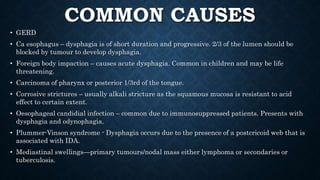
COMMON CAUSES
• GERD
• Ca esophagus – dysphagia is of short duration and progressive. 2/3 of the lumen should be
blocked by tumour to develop dysphagia.
• Foreign body impaction – causes acute dysphagia. Common in children and may be life
threatening.
• Carcinoma of pharynx or posterior 1/3rd of the tongue.
• Corrosive strictures – usually alkali stricture as the squamous mucosa is resistant to acid
effect to certain extent.
• Oesophageal candidial infection – common due to immunosuppressed patients. Presents with
dysphagia and odynophagia.
• Plummer-Vinson syndrome - Dysphagia occurs due to the presence of a postcricoid web that is
associated with IDA.
• Mediastinal swellings—primary tumours/nodal mass either lymphoma or secondaries or
tuberculosis.
RARE CAUSES
• Diffuse oesophageal spasm – incoordinated contractions of oesophagus causing chest
pain or dysphagia. It is common in distal 2/3rd of the oesophagus.
• Congenital anomalies – esophageal atresia (most common).
• Hiatal hernias – sliding hiatal hernias (most common).
• Achalasia – caused by loss of ganglion cells within the esophageal myenteric plexus.
• Esophageal diverticula – the most common being epiphrenic, hypopharyngeal
(Zenker’s), and mid-esophageal.
• A lower esophageal mucosal ring, also called a B ring , is a thin membranous
narrowing at the squamocolumnar mucosal junction.
• Web-like constrictions higher in the esophagus can be of congenital or inflammatory
origin.
• Boerhaave’s syndrome: It is vertical full thickness tear of
lower oesophagus due to vomiting with closed glottis. It is
often life threatening and emergency.
• Neurological causes like stroke, bulbar palsy, motor neuron
disease, Parkinson’s disease, etc.
• Drug-induced dysphagia: Drugs like KCl, quinine, NSAID
can cause dysphagia.
• Thyroid swelling – There will be always dyspnea when
dysphagia develops.
CLINICAL CO-RELATES
• Esophageal strictures typically cause progressive dysphagia,
first for solids, then for liquids.
• Motility disorders often cause intermittent dysphagia for both
solids and liquids.
• Schatzki’s/B ring causes episodic dysphagia for solids,
typically at the beginning of a meal.
• Oropharyngeal motor disorders typically present with
difficulty initiating deglutition ( transfer dysphagia ) and
nasal reflux or coughing with swallowing; and achalasia may
cause nocturnal regurgitation of undigested food.
INVESTIGATIONS
• Dysphagia should always be investigated urgently.
• Endoscopy (Esophagoscopy) is the investigation of choice because it
allows biopsy and dilatation of strictures.
• Even if the appearances are normal, biopsies should be taken to look for
eosinophilic esophagitis.
• Barium swallow with videofluoroscopic swallowing assessment is
indicated to detect major motility disorders. They may show irregular
filling defect or extrinsic compression.
• Esophageal manometry It is the gold standard for the assessment of
oesophageal motor activity. It is not a primary investigation and should
be performed only when the diagnosis has not been achieved by history,
barium radiology or endoscopy.
• pH monitoring – 24-hour ambulatory monitoring uses a pH-
sensitive probe positioned in the lower oesophagus and is used
to identify acid reflux episodes (pH < 4) in situations of GERD.
• Endosonography can assess site, layers of the oesophagus,
nodes, spread, etc. properly. Different layers are seen as
alternating hyperechoic and hypoechoic bands.
• Chest X-ray often shows mediastinal mass lesion/foreign body.
• CT scan chest is very useful method to identify the anatomical
location of the cause (nodes/tumour/aorta/cardiac
cause/congenital). Extent, spread, nodal status, size and
operability of an extra-luminal tumour also well-assessed.
TREATMENT
• Dependent on the cause.
• In GERD surgery is indicated in failure of drug treatment, sliding hernia,
Barrett’s ulcer, severe pain and presence of complications like
bleeding/stricture/shortening, respiratory problems. Fundoplication is the only
effective long-term beneficial therapy ideally available and considered now.
• Hernias are surgically repaired by excision of sac and repair of the defect.
• DES is treated nitrates, calcium channel blockers, bougie dilatation, long
oesophageal myotomy either video assisted or thoracotomy approach.
• Achalasia cardia is surgically treated with Modified Heller’s cardiomyotomy
with Toupet’s / Dor’s fundoplication.
• Symptomatic rings and webs are easily treated by dilatation.
• Treatment of diverticular is by surgical diverticulectomy
and cricopharyngeal myotomy or a marsupialization
procedure in which an endoscopic stapling device is used
to divide the cricopharyngeus.
• If it does not spontaneously resolve, impacted food is
dislodged endoscopically.
• Healing of more severe grades of caustic injury is
commonly associated with severe stricture formation and
often requires repeated dilatation.
THANK
YOU

DYSPHAGIA.pptx

  • 1.
  • 2.
    INTRODUCTION • Difficulty withswallowing. • Classification: • Pharyngeal dysphagia – patient develops cough or splutter while swallowing as food enters the airway or stays in the mouth. • Esophageal dysphagia - specified by “food getting stuck” in the pathway. • Can be progressive or intermittent. • Can affect swallowing of solids and/or fluids. • Can also be acute—due to foreign body impaction or acute infection or chronic due to causes like stricture or carcinoma.
  • 3.
    COMMON CAUSES • GERD •Ca esophagus – dysphagia is of short duration and progressive. 2/3 of the lumen should be blocked by tumour to develop dysphagia. • Foreign body impaction – causes acute dysphagia. Common in children and may be life threatening. • Carcinoma of pharynx or posterior 1/3rd of the tongue. • Corrosive strictures – usually alkali stricture as the squamous mucosa is resistant to acid effect to certain extent. • Oesophageal candidial infection – common due to immunosuppressed patients. Presents with dysphagia and odynophagia. • Plummer-Vinson syndrome - Dysphagia occurs due to the presence of a postcricoid web that is associated with IDA. • Mediastinal swellings—primary tumours/nodal mass either lymphoma or secondaries or tuberculosis.
  • 4.
    RARE CAUSES • Diffuseoesophageal spasm – incoordinated contractions of oesophagus causing chest pain or dysphagia. It is common in distal 2/3rd of the oesophagus. • Congenital anomalies – esophageal atresia (most common). • Hiatal hernias – sliding hiatal hernias (most common). • Achalasia – caused by loss of ganglion cells within the esophageal myenteric plexus. • Esophageal diverticula – the most common being epiphrenic, hypopharyngeal (Zenker’s), and mid-esophageal. • A lower esophageal mucosal ring, also called a B ring , is a thin membranous narrowing at the squamocolumnar mucosal junction. • Web-like constrictions higher in the esophagus can be of congenital or inflammatory origin.
  • 5.
    • Boerhaave’s syndrome:It is vertical full thickness tear of lower oesophagus due to vomiting with closed glottis. It is often life threatening and emergency. • Neurological causes like stroke, bulbar palsy, motor neuron disease, Parkinson’s disease, etc. • Drug-induced dysphagia: Drugs like KCl, quinine, NSAID can cause dysphagia. • Thyroid swelling – There will be always dyspnea when dysphagia develops.
  • 7.
    CLINICAL CO-RELATES • Esophagealstrictures typically cause progressive dysphagia, first for solids, then for liquids. • Motility disorders often cause intermittent dysphagia for both solids and liquids. • Schatzki’s/B ring causes episodic dysphagia for solids, typically at the beginning of a meal. • Oropharyngeal motor disorders typically present with difficulty initiating deglutition ( transfer dysphagia ) and nasal reflux or coughing with swallowing; and achalasia may cause nocturnal regurgitation of undigested food.
  • 8.
    INVESTIGATIONS • Dysphagia shouldalways be investigated urgently. • Endoscopy (Esophagoscopy) is the investigation of choice because it allows biopsy and dilatation of strictures. • Even if the appearances are normal, biopsies should be taken to look for eosinophilic esophagitis. • Barium swallow with videofluoroscopic swallowing assessment is indicated to detect major motility disorders. They may show irregular filling defect or extrinsic compression. • Esophageal manometry It is the gold standard for the assessment of oesophageal motor activity. It is not a primary investigation and should be performed only when the diagnosis has not been achieved by history, barium radiology or endoscopy.
  • 9.
    • pH monitoring– 24-hour ambulatory monitoring uses a pH- sensitive probe positioned in the lower oesophagus and is used to identify acid reflux episodes (pH < 4) in situations of GERD. • Endosonography can assess site, layers of the oesophagus, nodes, spread, etc. properly. Different layers are seen as alternating hyperechoic and hypoechoic bands. • Chest X-ray often shows mediastinal mass lesion/foreign body. • CT scan chest is very useful method to identify the anatomical location of the cause (nodes/tumour/aorta/cardiac cause/congenital). Extent, spread, nodal status, size and operability of an extra-luminal tumour also well-assessed.
  • 17.
    TREATMENT • Dependent onthe cause. • In GERD surgery is indicated in failure of drug treatment, sliding hernia, Barrett’s ulcer, severe pain and presence of complications like bleeding/stricture/shortening, respiratory problems. Fundoplication is the only effective long-term beneficial therapy ideally available and considered now. • Hernias are surgically repaired by excision of sac and repair of the defect. • DES is treated nitrates, calcium channel blockers, bougie dilatation, long oesophageal myotomy either video assisted or thoracotomy approach. • Achalasia cardia is surgically treated with Modified Heller’s cardiomyotomy with Toupet’s / Dor’s fundoplication. • Symptomatic rings and webs are easily treated by dilatation.
  • 18.
    • Treatment ofdiverticular is by surgical diverticulectomy and cricopharyngeal myotomy or a marsupialization procedure in which an endoscopic stapling device is used to divide the cricopharyngeus. • If it does not spontaneously resolve, impacted food is dislodged endoscopically. • Healing of more severe grades of caustic injury is commonly associated with severe stricture formation and often requires repeated dilatation.
  • 19.