Dysphagia
A&K
Dysphagia
1. Anatomy of oropharynx and hypopharynx
2. Physiology of swallowing
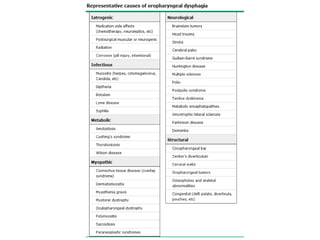
3. Causes of dysphagia
4. Investigation
5. Management
Anatomy of
oropharynx
and
hypopharynx
Anatomy of pharynx
3 parts:
1.Nasopharynx:
• From the posterior nasal
apertures to the
nasopharyngeal isthmus
2.Oropharynx:
• Nasopharyngygeal isthmus
to the upper border of
epiglottis
3.Laryngopharynx:
• From upper border of
epiglottis to lower border of
cricoid cartilage
Oropharynx
• Middle part of the pharynx behind oral cavity
Communicates with:
• Nasopharynx through nasopharyngeal
(pharyngeal) isthmus
• Oral cavity through the oropharyngeal isthmus
(isthmus of fauces)
• Laryngopharynx at the level of upper border of
epiglottis
“Isthmus of fauces = limit between the mouth cavity proper with the pharynx marked by
constricted aperture Palatopharyngeal and palatoglossal arches”
Lateral wall
• Presence of palatine tonsil which lies in the palatine fossa
• Posteriorly the wall is formed by the:
1.Superior constrictor of pharynx
2.Middle constrictor of pharynx
3.Inferior constrictor of pharynx
Laryngopharynx
• Lowest part
• Situated behind the larynx
• Extend from upper border of epiglottis to lower
border of cricoid cartilage
• 3 walls:
1.Anterior wall
2.Lateral wall
3.Posterior wall
Wall Structure
Anterior • Laryngeal inlet
• Posterior surface of cricoid and
arytenoid cartilage
Lateral • Piriform fossa:
-On each side of laryngeal inlet
-Boundaries:
Medially: aryepiglottic fold
Laterally: thyroid cartilage &
thyrohyoid membrane
Posterior • Formed by contrictor muscles
-superior constrictor m.
-middle contrictor m.
-inferior constrictor m.
Oesophagus
• Fibromuscular tube
• Length: 25cm
Begins from:
-Below laryngopharynx
-Cricoid cartilage
-At level C6 vertebra
Ends at:
-Cardiac orifice of stomach
-Left 7th costal cartilage
-At T10 vertebrae
• 3 parts
-cervical
-thoracic
-abdominal
Physiology of swallowing
Deglutition
• Deglutition
-phases
-control of esophageal motility
• Salivary glands
-cell types
-composition of saliva
-regulation of saliva secretion
Deglutition
• Swallowing
• A mechanism that moves food or liquid from the
mouth through the pharynx and esophagus into
the stomach .
• is facilitated by the secretion of saliva and mucus.
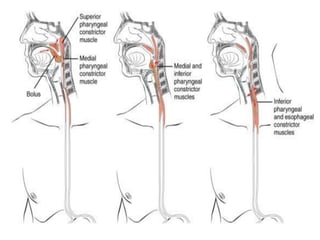
• Normal deglutition is a smooth coordinated
process that involves a complex series of voluntary
and involuntary neuromuscular contractions and
typically is divided into three distinct phases:
1)Oral
2)Pharyngeal
3)Esophageal
Oral phase
Pharyngeal phase
Esophageal phase
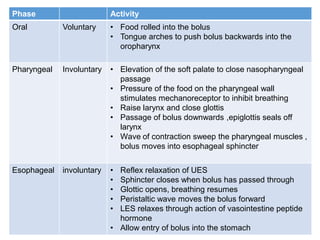
Phase Activity
Oral Voluntary • Food rolled into the bolus
• Tongue arches to push bolus backwards into the
oropharynx
Pharyngeal Involuntary • Elevation of the soft palate to close nasopharyngeal
passage
• Pressure of the food on the pharyngeal wall
stimulates mechanoreceptor to inhibit breathing
• Raise larynx and close glottis
• Passage of bolus downwards ,epiglottis seals off
larynx
• Wave of contraction sweep the pharyngeal muscles ,
bolus moves into esophageal sphincter
Esophageal involuntary • Reflex relaxation of UES
• Sphincter closes when bolus has passed through
• Glottic opens, breathing resumes
• Peristaltic wave moves the bolus forward
• LES relaxes through action of vasointestine peptide
hormone
• Allow entry of bolus into the stomach
Causes of dysphagia
Dysphagia
Dysphagia
• Difficulty in swallowing
• Sensation of obstruction of passage of food
bolus through the pharynx and oesophagus
within 15 seconds of bolus leaving the mouth
• Odynophagia  Pain with deglutition
Globus pharyngeus
• Sensation of lump or tightness in throat with no
organic causes
• Hypothesis
• GERD
• Oesophageal Dysmotility
• Psychogenic origin
• Common in middle age, no sex preponderance
• No true dysphagia, no weight loss, continual need
to swallow
Presbyphagia
• Physiological changes that occurs in deglutition with ageing
• Reduction in muscle mass and strength
• Resulting in chronic dysphagia a/w malnutrition and
aspiration
• Manage by modifying consistency of food and swallowing
therapy
• Commonly affect the oesophageal phase and its location
involved is usually oesophagus
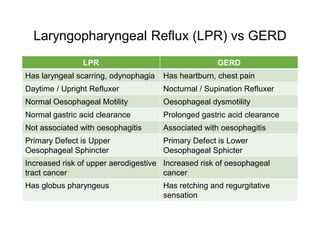
Laryngopharyngeal Reflux (LPR) vs GERD
LPR GERD
Has laryngeal scarring, odynophagia Has heartburn, chest pain
Daytime / Upright Refluxer Nocturnal / Supination Refluxer
Normal Oesophageal Motility Oesophageal dysmotility
Normal gastric acid clearance Prolonged gastric acid clearance
Not associated with oesophagitis Associated with oesophagitis
Primary Defect is Upper
Oesophageal Sphincter
Primary Defect is Lower
Oesophageal Sphicter
Increased risk of upper aerodigestive
tract cancer
Increased risk of oesophageal
cancer
Has globus pharyngeus Has retching and regurgitative
sensation
Laryngopharyngeal Reflux (LPR) vs GERD
Classification of dysphagia
• Oropharyngeal Dysphagia
• Oesophageal Dysphagia
Oropharyngeal Dysphagia
- Difficulty initiating deglutition
- Associated with coughing, choking, regurgitation,
aspiration, sensation of food in the pharynx
- Pathological site
- Oropharynx
- Oral dysfunction signs
- Drooling of saliva
- Hypersalivation (Sialorrhea)
- [Reason: compensatory mechanism for dysphagia]
- Piecemeal swallow
- Pharyngeal dysfunction signs
- Coughing
- Choking
- Regurgitation
Xerostomia
• Dry mouth
• Hyposalivation
• Causes dysphagia and difficulty in proper
pronounciation
• Advise for regular drinking of water
Causes of Xerostomia
1. Physiologic (Sleep, Age, Dehydrated, Anxiety)
2. Radiotherapy
3. Trauma to salivary glands
4. Drug/Toxic induced
- Anticholinergic, diuretics and sympathomimetics
- Alcohol
5. Sjögren's syndrome
6. Systemic causes
- DM, Hyperparathyroidism, Renal Failure
Acute Tonsilitis
• Inflammation of tonsils
• Can cause narrowing if too enlarge and can
obstruct food bolus going down
• Irritation by the food cause odynophagia
• Diagnosed by tonsillar surface swab
• Treatment includes pain relief (PCM), preventing
further inflammation (NSAIDs) and antibiotic
treatment.
• Tonsillectomy in indicated cases.
Acute Epiglottitis
• Inflammation of supraglottic region of the
oropharynx (epiglottis, arytenoid, aryepiglottic
folds)
• Food bolus going down the pharynx can irritate
the epiglottis and can cause odynophagia
• Manage by intubating to protect airway,
cricothyroidotomy in severe cases.
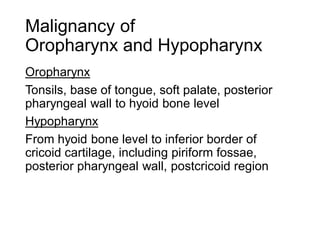
Malignancy of
Oropharynx and Hypopharynx
Oropharynx
Tonsils, base of tongue, soft palate, posterior
pharyngeal wall to hyoid bone level
Hypopharynx
From hyoid bone level to inferior border of
cricoid cartilage, including piriform fossae,
posterior pharyngeal wall, postcricoid region
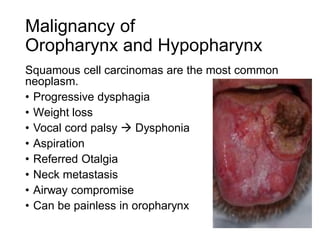
Malignancy of
Oropharynx and Hypopharynx
Squamous cell carcinomas are the most common
neoplasm.
• Progressive dysphagia
• Weight loss
• Vocal cord palsy  Dysphonia
• Aspiration
• Referred Otalgia
• Neck metastasis
• Airway compromise
• Can be painless in oropharynx
Malignancy of
Oropharynx and Hypopharynx
• Investigation
• Rigid endoscopy under GA (Map tumour extend)
• CT Neck and Chest
• MRI Neck and Chest
• Management
Non Invasive
• Nutritional and diet control
• Swallowing therapy
• Nasogastric tube insertion for nutritional supply
• Gastrostomy for cases unable to apply NGT
Invasive
• Surgery or
• Laser therapy
• Concurrent chemoradiotherapy
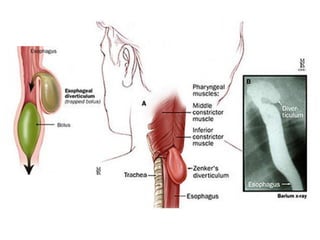
Pharyngeal pouch
• AKA Zenker’s Diverticulum
• Natural weakness in posterior aspect of
hypopharynx between the fibres of
thyropharyngeus and cricopharyngeus of
inferior pharyngeal constrictor.
• Pulsion diverticula form at the area with least
support, at Killian’s dehiscence.
Pharyngeal pouch
• Signs and symptoms
• Progressive dysphagia
• Weight loss
• Regurgitation of undigested food (in the pouch)
• Halitosis
• Coughing
• Gurgling sound during swallowing on neck
• X-Ray Finding
• Rising Tide sign
Management
• Small – Observe
• Large – Endoscopic Stapling
• Large and difficult to staple – Excise pouch
Oesophageal Dysphagia
- Difficulty swallowing several seconds after
initiating first swallow
- Associated with sensation of food stuck in
oesophagus
- Pathological site
- Oesophagus body
- Lower oesophageal sphincter
- Cardia of the stomach
Oesophageal Dysphagia
- Intrinsic (Mechanical)
- Extrinsic (Compressive)
- Motility Disorder
Intrinsic (Mechanical)
- Reflux induced stricture
- Oesophageal carcinoma
- Oesophageal diverticulitis
- Foreign body
Extrinsic (Compressive)
- Mediastinal Tumour
- Vascular Compression 2˚ Hypertension
- Cervical Osteophytes
Oesophageal Motility Disorders
- Achalasia
- Oesophageal Spasm
- Lower Oesophageal Sphincter Malfunction
- Gastroesophageal Reflux Disorder (GERD)
Oesophageal Achalasia
• Due to impaired oesophageal peristalsis and
lack of lower oesophageal sphincter relaxation
during deglutition
• Common in 20 – 60 years old
• Dysphagia affect both solid and liquid food
• Complication: Cough, aspiration pneumonitis
and chest pain
Oesophageal Achalasia
• Investigation: Barium swallow,
endoscopy and manometry
• Treatments : Balloon dilation, chemical
denervation and surgical myotomy of
lower oesophageal sphincter
Retained level of barium
Bird beak’s appearance
Investigation
Investigation
• Oesophagogastroduodenoscopy (OGDS)
• OGDS Guided Biopsy
• Barium Swallow Oesophagography
• Radiofluoroscopy Swallowing Study
• Computed Tomography (CT) Scan
• Oesophageal Manometry
• Functional Endoscopic Sinus Surgery (FESS)
• Endoscopic Ultrasonography (Detect Tumour and
LN Staging)
Management
History Taking
• What kind of food produces dysphagia?
• Liquid
• Solid
• Nature of dysphagia
• Intermittent
• Continual
• Progressive
• Associated SSx
• Coughing
• Regurgitation
• Choking
Physical Examination
• Profound weight loss (Malignancy or Achalasia)
• Glossopharyngeal nerve (CN IX)
• Vagus nerve (CN X)
• Uvula movement
• Palatal movement
• Gag reflex
• Cough reflex (Rarely done)
• Neck Examination – Thyroid Malignancy
• Inspection of Limbs – Scleroderma, Weakness
(Neuromuscular Disorder)
Goals of Management
• Improve food transfer to the stomach
• Prevent aspiration pneumonitis
• Treat underlying causes
Treatment method is based on aetiological
approach.
Management Cascade
• Oropharyngeal Dysphagia
Status of Centre Management Option(s)
Limited Resources Swallowing Rehabilitation
- Head and Body Posture
- Air-way closure maneuver
Diet Modification
Importance of Oral Hygiene
Feeding Tube
Better Resources Surgical Gastrostomy
Percutaneous Gastrostomy
Endoscopic Gastrostomy
Management Cascade
• Oesophageal Dysphagia
Status of Centre Management Option(s)
Limited Resources Acid Suppressive Medication (GERD)
- H2R Antag
- Proton Pump inhibitors
Smooth Muscle Relaxants (Spasm)
- Nifedipine 10 mg TDS
Better Resources Surgery (Antireflux, Myotomy)
Endoscopic Balloon Dilation
BOTOX Injection
Chemoradiotherapy (Tumour)
Palliative Therapy (Late stage tumour)
Management Cascade
• Achalasia
Status of Centre Management Option(s)
Limited Resources Pneumatic Balloon Dilation
Muscle Relaxant
- Nifedipine 10 mg Preprandial
Better Resources Laparoscopic Surgery
- Myotomy
- Heller’s Operation
Oesophagectomy
Group 4   dysphagia 2016 version 3.1 validated

Group 4 dysphagia 2016 version 3.1 validated

  • 1.
  • 2.
    Dysphagia 1. Anatomy oforopharynx and hypopharynx 2. Physiology of swallowing 3. Causes of dysphagia 4. Investigation 5. Management
  • 3.
  • 4.
  • 5.
    3 parts: 1.Nasopharynx: • Fromthe posterior nasal apertures to the nasopharyngeal isthmus 2.Oropharynx: • Nasopharyngygeal isthmus to the upper border of epiglottis 3.Laryngopharynx: • From upper border of epiglottis to lower border of cricoid cartilage
  • 6.
    Oropharynx • Middle partof the pharynx behind oral cavity Communicates with: • Nasopharynx through nasopharyngeal (pharyngeal) isthmus • Oral cavity through the oropharyngeal isthmus (isthmus of fauces) • Laryngopharynx at the level of upper border of epiglottis “Isthmus of fauces = limit between the mouth cavity proper with the pharynx marked by constricted aperture Palatopharyngeal and palatoglossal arches”
  • 7.
    Lateral wall • Presenceof palatine tonsil which lies in the palatine fossa • Posteriorly the wall is formed by the: 1.Superior constrictor of pharynx 2.Middle constrictor of pharynx 3.Inferior constrictor of pharynx
  • 8.
    Laryngopharynx • Lowest part •Situated behind the larynx • Extend from upper border of epiglottis to lower border of cricoid cartilage • 3 walls: 1.Anterior wall 2.Lateral wall 3.Posterior wall
  • 10.
    Wall Structure Anterior •Laryngeal inlet • Posterior surface of cricoid and arytenoid cartilage Lateral • Piriform fossa: -On each side of laryngeal inlet -Boundaries: Medially: aryepiglottic fold Laterally: thyroid cartilage & thyrohyoid membrane Posterior • Formed by contrictor muscles -superior constrictor m. -middle contrictor m. -inferior constrictor m.
  • 11.
    Oesophagus • Fibromuscular tube •Length: 25cm Begins from: -Below laryngopharynx -Cricoid cartilage -At level C6 vertebra Ends at: -Cardiac orifice of stomach -Left 7th costal cartilage -At T10 vertebrae • 3 parts -cervical -thoracic -abdominal
  • 12.
  • 13.
    Deglutition • Deglutition -phases -control ofesophageal motility • Salivary glands -cell types -composition of saliva -regulation of saliva secretion
  • 14.
    Deglutition • Swallowing • Amechanism that moves food or liquid from the mouth through the pharynx and esophagus into the stomach . • is facilitated by the secretion of saliva and mucus. • Normal deglutition is a smooth coordinated process that involves a complex series of voluntary and involuntary neuromuscular contractions and typically is divided into three distinct phases: 1)Oral 2)Pharyngeal 3)Esophageal
  • 16.
  • 17.
  • 18.
  • 19.
    Phase Activity Oral Voluntary• Food rolled into the bolus • Tongue arches to push bolus backwards into the oropharynx Pharyngeal Involuntary • Elevation of the soft palate to close nasopharyngeal passage • Pressure of the food on the pharyngeal wall stimulates mechanoreceptor to inhibit breathing • Raise larynx and close glottis • Passage of bolus downwards ,epiglottis seals off larynx • Wave of contraction sweep the pharyngeal muscles , bolus moves into esophageal sphincter Esophageal involuntary • Reflex relaxation of UES • Sphincter closes when bolus has passed through • Glottic opens, breathing resumes • Peristaltic wave moves the bolus forward • LES relaxes through action of vasointestine peptide hormone • Allow entry of bolus into the stomach
  • 20.
  • 21.
  • 22.
    Dysphagia • Difficulty inswallowing • Sensation of obstruction of passage of food bolus through the pharynx and oesophagus within 15 seconds of bolus leaving the mouth • Odynophagia  Pain with deglutition
  • 23.
    Globus pharyngeus • Sensationof lump or tightness in throat with no organic causes • Hypothesis • GERD • Oesophageal Dysmotility • Psychogenic origin • Common in middle age, no sex preponderance • No true dysphagia, no weight loss, continual need to swallow
  • 24.
    Presbyphagia • Physiological changesthat occurs in deglutition with ageing • Reduction in muscle mass and strength • Resulting in chronic dysphagia a/w malnutrition and aspiration • Manage by modifying consistency of food and swallowing therapy • Commonly affect the oesophageal phase and its location involved is usually oesophagus
  • 25.
    Laryngopharyngeal Reflux (LPR)vs GERD LPR GERD Has laryngeal scarring, odynophagia Has heartburn, chest pain Daytime / Upright Refluxer Nocturnal / Supination Refluxer Normal Oesophageal Motility Oesophageal dysmotility Normal gastric acid clearance Prolonged gastric acid clearance Not associated with oesophagitis Associated with oesophagitis Primary Defect is Upper Oesophageal Sphincter Primary Defect is Lower Oesophageal Sphicter Increased risk of upper aerodigestive tract cancer Increased risk of oesophageal cancer Has globus pharyngeus Has retching and regurgitative sensation
  • 26.
  • 27.
    Classification of dysphagia •Oropharyngeal Dysphagia • Oesophageal Dysphagia
  • 28.
    Oropharyngeal Dysphagia - Difficultyinitiating deglutition - Associated with coughing, choking, regurgitation, aspiration, sensation of food in the pharynx - Pathological site - Oropharynx - Oral dysfunction signs - Drooling of saliva - Hypersalivation (Sialorrhea) - [Reason: compensatory mechanism for dysphagia] - Piecemeal swallow - Pharyngeal dysfunction signs - Coughing - Choking - Regurgitation
  • 30.
    Xerostomia • Dry mouth •Hyposalivation • Causes dysphagia and difficulty in proper pronounciation • Advise for regular drinking of water
  • 31.
    Causes of Xerostomia 1.Physiologic (Sleep, Age, Dehydrated, Anxiety) 2. Radiotherapy 3. Trauma to salivary glands 4. Drug/Toxic induced - Anticholinergic, diuretics and sympathomimetics - Alcohol 5. Sjögren's syndrome 6. Systemic causes - DM, Hyperparathyroidism, Renal Failure
  • 32.
    Acute Tonsilitis • Inflammationof tonsils • Can cause narrowing if too enlarge and can obstruct food bolus going down • Irritation by the food cause odynophagia • Diagnosed by tonsillar surface swab • Treatment includes pain relief (PCM), preventing further inflammation (NSAIDs) and antibiotic treatment. • Tonsillectomy in indicated cases.
  • 33.
    Acute Epiglottitis • Inflammationof supraglottic region of the oropharynx (epiglottis, arytenoid, aryepiglottic folds) • Food bolus going down the pharynx can irritate the epiglottis and can cause odynophagia • Manage by intubating to protect airway, cricothyroidotomy in severe cases.
  • 34.
    Malignancy of Oropharynx andHypopharynx Oropharynx Tonsils, base of tongue, soft palate, posterior pharyngeal wall to hyoid bone level Hypopharynx From hyoid bone level to inferior border of cricoid cartilage, including piriform fossae, posterior pharyngeal wall, postcricoid region
  • 35.
    Malignancy of Oropharynx andHypopharynx Squamous cell carcinomas are the most common neoplasm. • Progressive dysphagia • Weight loss • Vocal cord palsy  Dysphonia • Aspiration • Referred Otalgia • Neck metastasis • Airway compromise • Can be painless in oropharynx
  • 36.
    Malignancy of Oropharynx andHypopharynx • Investigation • Rigid endoscopy under GA (Map tumour extend) • CT Neck and Chest • MRI Neck and Chest • Management Non Invasive • Nutritional and diet control • Swallowing therapy • Nasogastric tube insertion for nutritional supply • Gastrostomy for cases unable to apply NGT Invasive • Surgery or • Laser therapy • Concurrent chemoradiotherapy
  • 37.
    Pharyngeal pouch • AKAZenker’s Diverticulum • Natural weakness in posterior aspect of hypopharynx between the fibres of thyropharyngeus and cricopharyngeus of inferior pharyngeal constrictor. • Pulsion diverticula form at the area with least support, at Killian’s dehiscence.
  • 40.
    Pharyngeal pouch • Signsand symptoms • Progressive dysphagia • Weight loss • Regurgitation of undigested food (in the pouch) • Halitosis • Coughing • Gurgling sound during swallowing on neck • X-Ray Finding • Rising Tide sign
  • 42.
    Management • Small –Observe • Large – Endoscopic Stapling • Large and difficult to staple – Excise pouch
  • 43.
    Oesophageal Dysphagia - Difficultyswallowing several seconds after initiating first swallow - Associated with sensation of food stuck in oesophagus - Pathological site - Oesophagus body - Lower oesophageal sphincter - Cardia of the stomach
  • 44.
    Oesophageal Dysphagia - Intrinsic(Mechanical) - Extrinsic (Compressive) - Motility Disorder
  • 45.
    Intrinsic (Mechanical) - Refluxinduced stricture - Oesophageal carcinoma - Oesophageal diverticulitis - Foreign body
  • 46.
    Extrinsic (Compressive) - MediastinalTumour - Vascular Compression 2˚ Hypertension - Cervical Osteophytes
  • 47.
    Oesophageal Motility Disorders -Achalasia - Oesophageal Spasm - Lower Oesophageal Sphincter Malfunction - Gastroesophageal Reflux Disorder (GERD)
  • 48.
    Oesophageal Achalasia • Dueto impaired oesophageal peristalsis and lack of lower oesophageal sphincter relaxation during deglutition • Common in 20 – 60 years old • Dysphagia affect both solid and liquid food • Complication: Cough, aspiration pneumonitis and chest pain
  • 49.
    Oesophageal Achalasia • Investigation:Barium swallow, endoscopy and manometry • Treatments : Balloon dilation, chemical denervation and surgical myotomy of lower oesophageal sphincter Retained level of barium Bird beak’s appearance
  • 50.
  • 51.
    Investigation • Oesophagogastroduodenoscopy (OGDS) •OGDS Guided Biopsy • Barium Swallow Oesophagography • Radiofluoroscopy Swallowing Study • Computed Tomography (CT) Scan • Oesophageal Manometry • Functional Endoscopic Sinus Surgery (FESS) • Endoscopic Ultrasonography (Detect Tumour and LN Staging)
  • 52.
  • 53.
    History Taking • Whatkind of food produces dysphagia? • Liquid • Solid • Nature of dysphagia • Intermittent • Continual • Progressive • Associated SSx • Coughing • Regurgitation • Choking
  • 54.
    Physical Examination • Profoundweight loss (Malignancy or Achalasia) • Glossopharyngeal nerve (CN IX) • Vagus nerve (CN X) • Uvula movement • Palatal movement • Gag reflex • Cough reflex (Rarely done) • Neck Examination – Thyroid Malignancy • Inspection of Limbs – Scleroderma, Weakness (Neuromuscular Disorder)
  • 55.
    Goals of Management •Improve food transfer to the stomach • Prevent aspiration pneumonitis • Treat underlying causes Treatment method is based on aetiological approach.
  • 56.
    Management Cascade • OropharyngealDysphagia Status of Centre Management Option(s) Limited Resources Swallowing Rehabilitation - Head and Body Posture - Air-way closure maneuver Diet Modification Importance of Oral Hygiene Feeding Tube Better Resources Surgical Gastrostomy Percutaneous Gastrostomy Endoscopic Gastrostomy
  • 57.
    Management Cascade • OesophagealDysphagia Status of Centre Management Option(s) Limited Resources Acid Suppressive Medication (GERD) - H2R Antag - Proton Pump inhibitors Smooth Muscle Relaxants (Spasm) - Nifedipine 10 mg TDS Better Resources Surgery (Antireflux, Myotomy) Endoscopic Balloon Dilation BOTOX Injection Chemoradiotherapy (Tumour) Palliative Therapy (Late stage tumour)
  • 58.
    Management Cascade • Achalasia Statusof Centre Management Option(s) Limited Resources Pneumatic Balloon Dilation Muscle Relaxant - Nifedipine 10 mg Preprandial Better Resources Laparoscopic Surgery - Myotomy - Heller’s Operation Oesophagectomy