DYSPHAGIA
INTRODUCTION
AN OVRVIEWDr.B.Selvaraj MS;Mch;FICS;
Professor of Surgery
Melaka Manipal Medical college
Melaka 75150 Malaysia
Must To Know Core Clinical
Problems
1.Acute RLQ pain
2.Acute RUQ pain
3.Acute epigastric pain
4.Acute LLQ pain
5.Dysphagia
6.Abdominal lumps
7.Upper GI hemorrhage
8.Lower GI hemorrhage
9.Obstructive Jaundice
10.Breast lumps, Mastalgia & Nipple discharge
11.Neck swellings- Thyroid & Non thyroidal
12.Groin swellings
13.Scrotal swellings
14.Limb ischemia- Acute & Chronic
15.Varicose veins, DVT & Pulmonary Embolism
16.Renal & ureteric colic
17.Hematuria
18.Acute retention of urine
DYSPHAGIA
 Surgical Anatomy
 Physiology of deglutition/swallowing
 Causes of Dysphagia
 History/ Symptoms
 Physical Examinations/ Signs
 Investigations
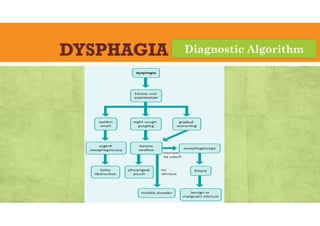
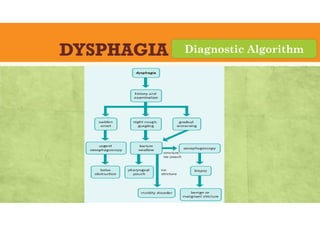
 Diagnostic Algorithm
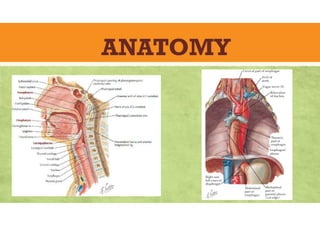
ANATOMY
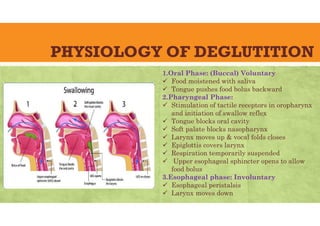
PHYSIOLOGY OF DEGLUTITION
1.Oral Phase: (Buccal) Voluntary
 Food moistened with saliva
 Tongue pushes food bolus backward
2.Pharyngeal Phase:
 Stimulation of tactile receptors in oropharynx
and initiation of swallow reflex
 Tongue blocks oral cavity
 Soft palate blocks nasopharynx
 Larynx moves up & vocal folds closes
 Epiglottis covers larynx
 Respiration temporarily suspended
 Upper esophageal sphincter opens to allow
food bolus
3.Esophageal phase: Involuntary
 Esophageal peristalsis
 Larynx moves down
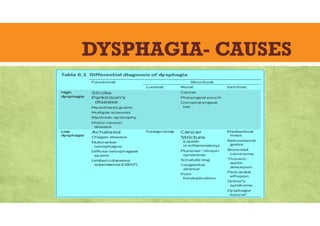
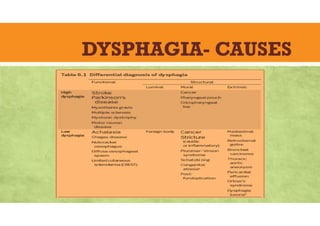
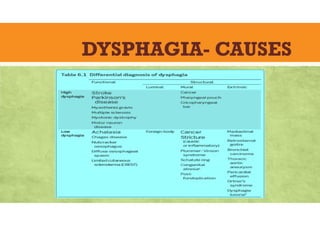
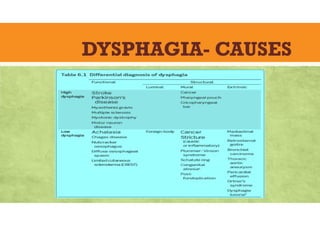
DYSPHAGIA- CAUSES
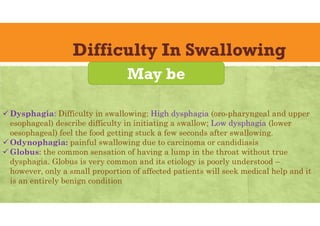
Difficulty In Swallowing
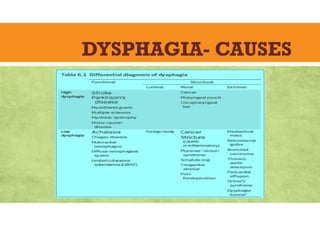
 Dysphagia: Difficulty in swallowing; High dysphagia (oro-pharyngeal and upper
esophageal) describe difficulty in initiating a swallow; Low dysphagia (lower
oesophageal) feel the food getting stuck a few seconds after swallowing.
 Odynophagia: painful swallowing due to carcinoma or candidiasis
 Globus: the common sensation of having a lump in the throat without true
dysphagia. Globus is very common and its etiology is poorly understood –
however, only a small proportion of affected patients will seek medical help and it
is an entirely benign condition
May be
DYSPHAGIA
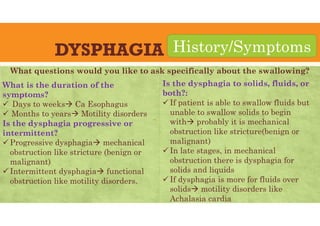
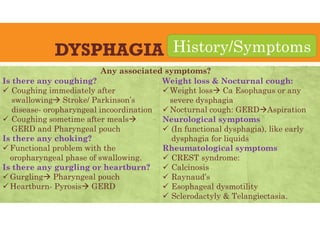
What is the duration of the
symptoms?
 Days to weeks Ca Esophagus
 Months to years Motility disorders
Is the dysphagia progressive or
intermittent?
 Progressive dysphagia mechanical
obstruction like stricture (benign or
malignant)
 Intermittent dysphagia functional
obstruction like motility disorders.
History/Symptoms
Is the dysphagia to solids, fluids, or
both?:
 If patient is able to swallow fluids but
unable to swallow solids to begin
with probably it is mechanical
obstruction like stricture(benign or
malignant)
 In late stages, in mechanical
obstruction there is dysphagia for
solids and liquids
 If dysphagia is more for fluids over
solids motility disorders like
Achalasia cardia
What questions would you like to ask specifically about the swallowing?
DYSPHAGIA
Is there any coughing?
 Coughing immediately after
swallowing Stroke/ Parkinson’s
disease- oropharyngeal incoordination
 Coughing sometime after meals
GERD and Pharyngeal pouch
Is there any choking?
 Functional problem with the
oropharyngeal phase of swallowing.
Is there any gurgling or heartburn?
 Gurgling Pharyngeal pouch
 Heartburn- Pyrosis GERD
History/Symptoms
Weight loss & Nocturnal cough:
 Weight loss Ca Esophagus or any
severe dysphagia
 Nocturnal cough: GERDAspiration
Neurological symptoms
 (In functional dysphagia), like early
dysphagia for liquids
Rheumatological symptoms
 CREST syndrome:
 Calcinosis
 Raynaud’s
 Esophageal dysmotility
 Sclerodactyly & Telangiectasia.
Any associated symptoms?
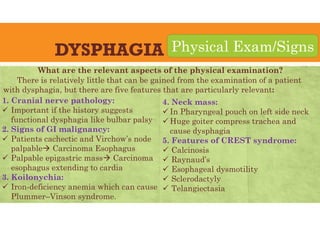
DYSPHAGIA
1. Cranial nerve pathology:
 Important if the history suggests
functional dysphagia like bulbar palsy
2. Signs of GI malignancy:
 Patients cachectic and Virchow’s node
palpable Carcinoma Esophagus
 Palpable epigastric mass Carcinoma
esophagus extending to cardia
3. Koilonychia:
 Iron-deficiency anemia which can cause
Plummer–Vinson syndrome.
Physical Exam/Signs
4. Neck mass:
 In Pharyngeal pouch on left side neck
 Huge goiter compress trachea and
cause dysphagia
5. Features of CREST syndrome:
 Calcinosis
 Raynaud’s
 Esophageal dysmotility
 Sclerodactyly
 Telangiectasia
What are the relevant aspects of the physical examination?
There is relatively little that can be gained from the examination of a patient
with dysphagia, but there are five features that are particularly relevant:
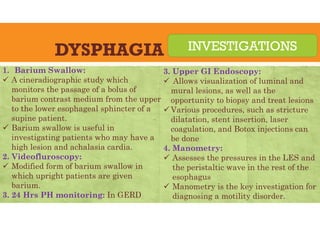
DYSPHAGIA
1. Barium Swallow:
 A cineradiographic study which
monitors the passage of a bolus of
barium contrast medium from the upper
to the lower esophageal sphincter of a
supine patient.
 Barium swallow is useful in
investigating patients who may have a
high lesion and achalasia cardia.
2. Videofluroscopy:
 Modified form of barium swallow in
which upright patients are given
barium.
3. 24 Hrs PH monitoring: In GERD
INVESTIGATIONS
3. Upper GI Endoscopy:
 Allows visualization of luminal and
mural lesions, as well as the
opportunity to biopsy and treat lesions
 Various procedures, such as stricture
dilatation, stent insertion, laser
coagulation, and Botox injections can
be done
4. Manometry:
 Assesses the pressures in the LES and
the peristaltic wave in the rest of the
esophagus
 Manometry is the key investigation for
diagnosing a motility disorder.
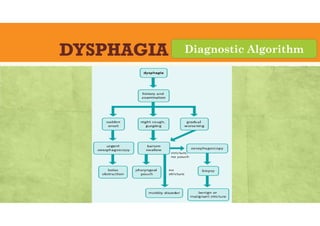
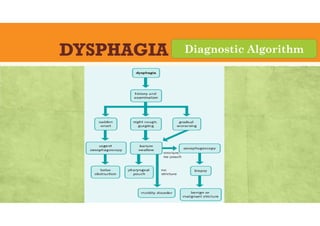
DYSPHAGIA Diagnostic Algorithm
Peripheral Arterial Diseases(PAD)
ZENKER’S DIVERTICULUM
DYSPHAGIA
AN OVRVIEWDr.B.Selvaraj MS;Mch;FICS;
Professor of Surgery
Melaka Manipal Medical college
Melaka 75150 Malaysia
ZENKER’S DIVERTICULUM
 Causes for Dysphagia
 Etiopathogenesis
 Clinical features
 Investigations
 Treatment
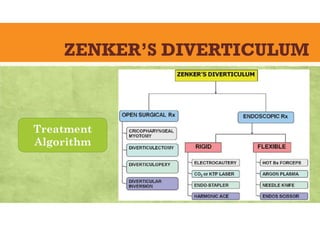
 Treatment Algorithm
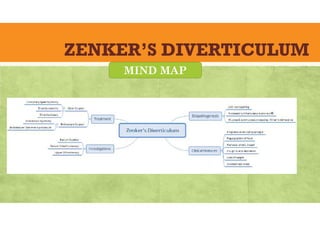
 Mindmap
DYSPHAGIA- CAUSES
ZENKER’S DIVERTICULUM
Etiopathogenesis
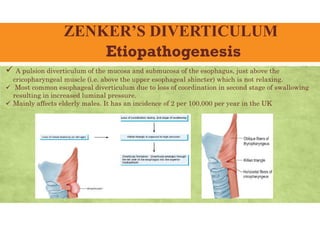
 A pulsion diverticulum of the mucosa and submucosa of the esophagus, just above the
cricopharyngeal muscle (i.e. above the upper esophageal shincter) which is not relaxing.
 Most common esophageal diverticulum due to loss of coordination in second stage of swallowing
resulting in increased luminal pressure.
 Mainly affects elderly males. It has an incidence of 2 per 100,000 per year in the UK
ZENKER’S DIVERTICULUM
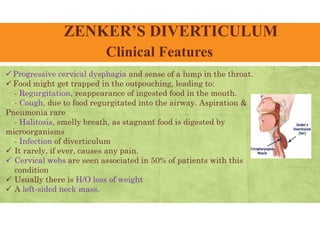
Clinical Features
 Progressive cervical dysphagia and sense of a lump in the throat.
 Food might get trapped in the outpouching, leading to:
- Regurgitation, reappearance of ingested food in the mouth.
- Cough, due to food regurgitated into the airway. Aspiration &
Pneumonia rare
- Halitosis, smelly breath, as stagnant food is digested by
microorganisms
- Infection of diverticulum
 It rarely, if ever, causes any pain.
 Cervical webs are seen associated in 50% of patients with this
condition
 Usually there is H/O loss of weight
 A left-sided neck mass.
ZENKER’S DIVERTICULUM
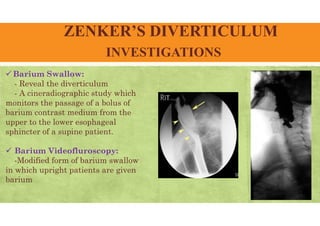
INVESTIGATIONS
 Barium Swallow:
- Reveal the diverticulum
- A cineradiographic study which
monitors the passage of a bolus of
barium contrast medium from the
upper to the lower esophageal
sphincter of a supine patient.
 Barium Videofluroscopy:
-Modified form of barium swallow
in which upright patients are given
barium
ZENKER’S DIVERTICULUM
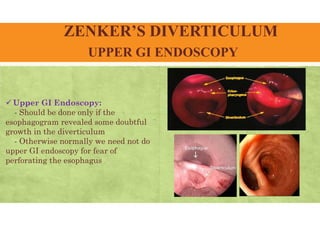
UPPER GI ENDOSCOPY
 Upper GI Endoscopy:
- Should be done only if the
esophagogram revealed some doubtful
growth in the diverticulum
- Otherwise normally we need not do
upper GI endoscopy for fear of
perforating the esophagus
ZENKER’S DIVERTICULUM
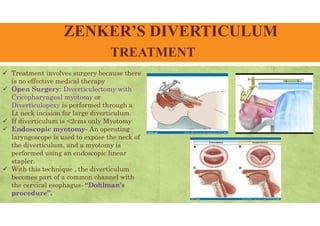
TREATMENT
 Treatment involves surgery because there
is no effective medical therapy
 Open Surgery: Diverticulectomy with
Cricopharyngeal myotomy or
Diverticulopexy is performed through a
Lt neck incision for large diverticulum.
 If diverticulum is <2cms only Myotomy
 Endoscopic myotomy- An operating
laryngoscope is used to expose the neck of
the diverticulum, and a myotomy is
performed using an endoscopic linear
stapler.
 With this technique , the diverticulum
becomes part of a common channel with
the cervical esophagus- “Dohlman’s
procedure”.
DYSPHAGIA Diagnostic Algorithm
ZENKER’S DIVERTICULUM
Treatment
Algorithm
ZENKER’S DIVERTICULUM
MIND MAP
Peripheral Arterial Diseases(PAD)
GASTRO ESOPHAGEAL
REFLUX DISEASE
(GERD)
DYSPHAGIA
AN OVRVIEWDr.B.Selvaraj MS;Mch;FICS;
“Surgical Educator”
Malaysia
GASTRO-ESOPHAGEAL
REFLUX DISEASE
 Causes of dysphagia
 Definition
 Etiology
 Pathophysiology
 Clinical Features- Symptoms & Signs
 Complications
 Investigations- Workup
 Management
 Mindmap
 Diagnostic algorithm
 Treatment algorithm
DYSPHAGIA- CAUSES
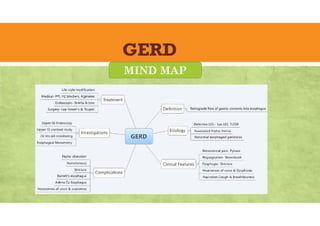
GERD
DEFINITION
 Montreal consensus panel (44 experts):
“ Retrograde flow of stomach contents into esophagus
causing troublesome symptoms and/or complications”
Troublesome—patient has to decide when reflux
interferes with lifestyle
GERD
Why do we care about reflux?
 Patients experience reflux symptoms
• 44% monthly
• 20% weekly
• 4-7% daily
 Most common gastrointestinal diagnosis on outpatient physician
visits
Frequency and severity does not predict esophagitis, stricture, or
cancer development
GERD
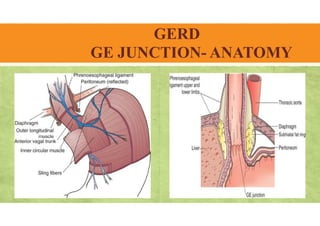
GE JUNCTION- ANATOMY
GERD
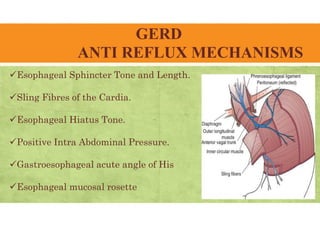
ANTI REFLUX MECHANISMS
Esophageal Sphincter Tone and Length.
Sling Fibres of the Cardia.
Esophageal Hiatus Tone.
Positive Intra Abdominal Pressure.
Gastroesophageal acute angle of His
Esophageal mucosal rosette
GERD
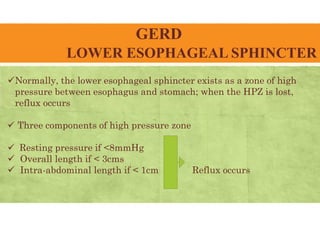
LOWER ESOPHAGEAL SPHINCTER
Normally, the lower esophageal sphincter exists as a zone of high
pressure between esophagus and stomach; when the HPZ is lost,
reflux occurs
 Three components of high pressure zone
 Resting pressure if <8mmHg
 Overall length if < 3cms
 Intra-abdominal length if < 1cm Reflux occurs
GERD
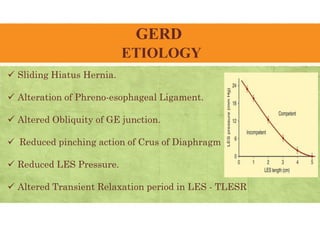
ETIOLOGY
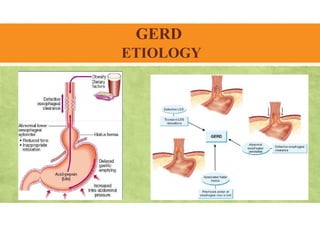
 Sliding Hiatus Hernia.
 Alteration of Phreno-esophageal Ligament.
 Altered Obliquity of GE junction.
 Reduced pinching action of Crus of Diaphragm
 Reduced LES Pressure.
 Altered Transient Relaxation period in LES - TLESR
GERD
ETIOLOGY
GERD
PATHOPHYSIOLOGY
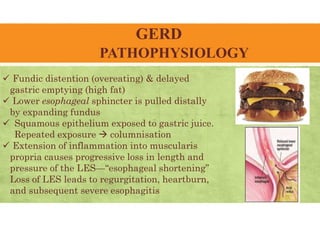
 Fundic distention (overeating) & delayed
gastric emptying (high fat)
 Lower esophageal sphincter is pulled distally
by expanding fundus
 Squamous epithelium exposed to gastric juice.
Repeated exposure  columnisation
 Extension of inflammation into muscularis
propria causes progressive loss in length and
pressure of the LES—“esophageal shortening”
Loss of LES leads to regurgitation, heartburn,
and subsequent severe esophagitis
GERD
PATHOPHYSIOLOGY
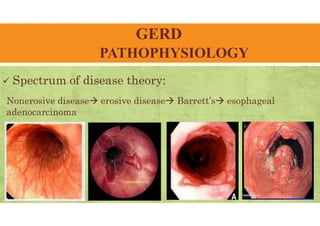
 Spectrum of disease theory:
Nonerosive disease erosive disease Barrett’s esophageal
adenocarcinoma
GERD
CLINICAL FEATURES
 Heartburn- Pyrosis
Retrosternal pain1-2 hours after
eating, often at night, relieved
by antacids
 Regurgitation (Waterbrash)
Spontaneous return of gastric
contents proximal to GE jxn
into mouth; less well relieved
with antacids
 Dysphagia (40%)—difficulty
with swallowing should prompt
search for pathologic condition
Stricture esophagus
 Hoarseness of Voice /
Dysphonia
 Respiratory Symptoms
Cough / Expectoration
Wheeze / Breathlessness
Aspiration
GERD
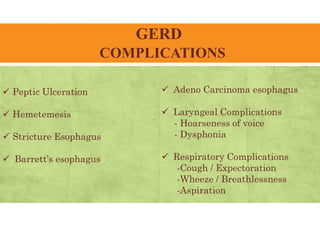
COMPLICATIONS
 Peptic Ulceration
 Hemetemesis
 Stricture Esophagus
 Barrett’s esophagus
 Adeno Carcinoma esophagus
 Laryngeal Complications
- Hoarseness of voice
- Dysphonia
 Respiratory Complications
-Cough / Expectoration
-Wheeze / Breathlessness
-Aspiration
GERD
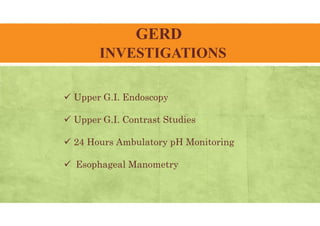
INVESTIGATIONS
 Upper G.I. Endoscopy
 Upper G.I. Contrast Studies
 24 Hours Ambulatory pH Monitoring
 Esophageal Manometry
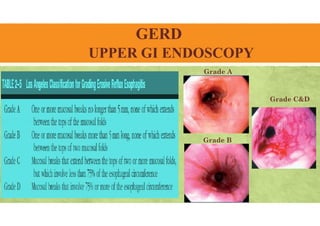
GERD
UPPER GI ENDOSCOPY
Grade A
Grade B
Grade C&D
GERD
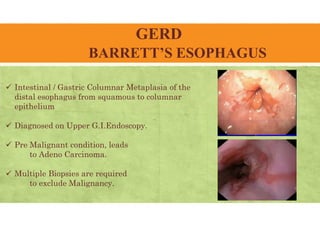
BARRETT’S ESOPHAGUS
 Intestinal / Gastric Columnar Metaplasia of the
distal esophagus from squamous to columnar
epithelium
 Diagnosed on Upper G.I.Endoscopy.
 Pre Malignant condition, leads
to Adeno Carcinoma.
 Multiple Biopsies are required
to exclude Malignancy.
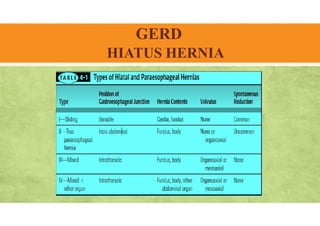
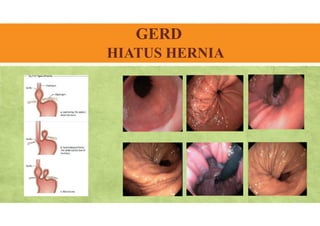
GERD
HIATUS HERNIA
GERD
HIATUS HERNIA
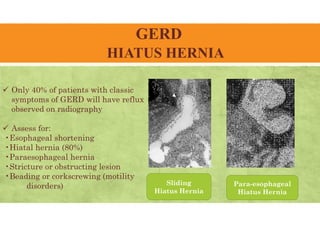
GERD
HIATUS HERNIA
 Only 40% of patients with classic
symptoms of GERD will have reflux
observed on radiography
 Assess for:
•Esophageal shortening
•Hiatal hernia (80%)
•Paraesophageal hernia
•Stricture or obstructing lesion
•Beading or corkscrewing (motility
disorders) Sliding
Hiatus Hernia
Para-esophageal
Hiatus Hernia
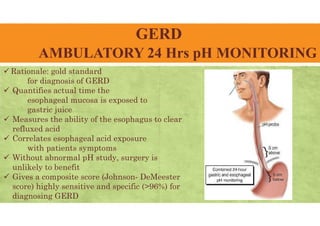
GERD
AMBULATORY 24 Hrs pH MONITORING
 Rationale: gold standard
for diagnosis of GERD
 Quantifies actual time the
esophageal mucosa is exposed to
gastric juice
 Measures the ability of the esophagus to clear
refluxed acid
 Correlates esophageal acid exposure
with patients symptoms
 Without abnormal pH study, surgery is
unlikely to benefit
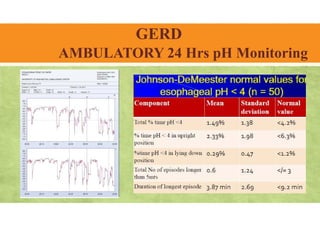
 Gives a composite score (Johnson- DeMeester
score) highly sensitive and specific (>96%) for
diagnosing GERD
GERD
AMBULATORY 24 Hrs pH Monitoring
GERD
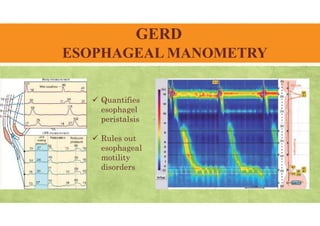
ESOPHAGEAL MANOMETRY
 Quantifies
esophagel
peristalsis
 Rules out
esophageal
motility
disorders
GERD
TREATMENT
Treatment Goals for GERD
Eliminate symptoms
Heal esophagitis
Manage or prevent complications
Maintain remission
GERD
TREATMENT
Lifestyle Modifications are Cornerstone of GERD Therapy
 Elevate head of bed 4-6 inches
 Avoid eating within 2-3 hours of bedtime
 Lose weight if overweight
 Stop smoking
 Modify diet
 Eat more frequent but smaller meals
 Avoid fatty/fried food, peppermint, chocolate,
alcohol, carbonated beverages, coffee and tea
 OTC medications prn
GERD
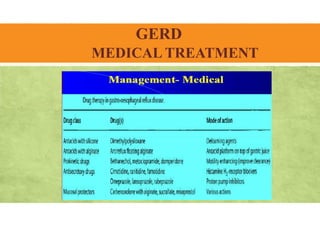
MEDICAL TREATMENT
GERD
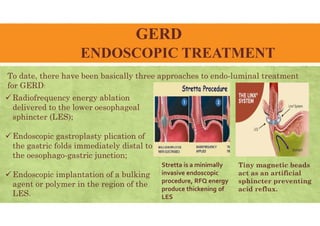
ENDOSCOPIC TREATMENT
To date, there have been basically three approaches to endo-luminal treatment
for GERD:
 Radiofrequency energy ablation
delivered to the lower oesophageal
sphincter (LES);
 Endoscopic gastroplasty plication of
the gastric folds immediately distal to
the oesophago-gastric junction;
 Endoscopic implantation of a bulking
agent or polymer in the region of the
LES.
Tiny magnetic beads
act as an artificial
sphincter preventing
acid reflux.
Stretta is a minimally
invasive endoscopic
procedure, RFQ energy
produce thickening of
LES
GERD
SURGICAL TREATMENT
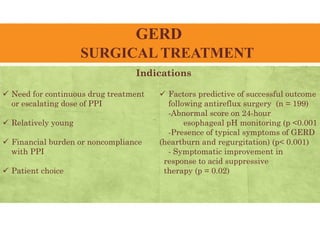
Indications
 Need for continuous drug treatment
or escalating dose of PPI
 Relatively young
 Financial burden or noncompliance
with PPI
 Patient choice
 Factors predictive of successful outcome
following antireflux surgery (n = 199)
-Abnormal score on 24-hour
esophageal pH monitoring (p <0.001
-Presence of typical symptoms of GERD
(heartburn and regurgitation) (p< 0.001)
- Symptomatic improvement in
response to acid suppressive
therapy (p = 0.02)
GERD
SURGICAL TREATMENT
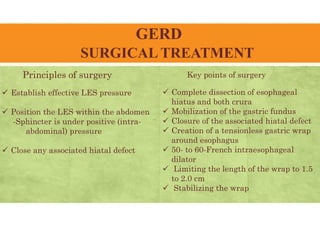
Principles of surgery
 Establish effective LES pressure
 Position the LES within the abdomen
-Sphincter is under positive (intra-
abdominal) pressure
 Close any associated hiatal defect
Key points of surgery
 Complete dissection of esophageal
hiatus and both crura
 Mobilization of the gastric fundus
 Closure of the associated hiatal defect
 Creation of a tensionless gastric wrap
around esophagus
 50- to 60-French intraesophageal
dilator
 Limiting the length of the wrap to 1.5
to 2.0 cm
 Stabilizing the wrap
GERD
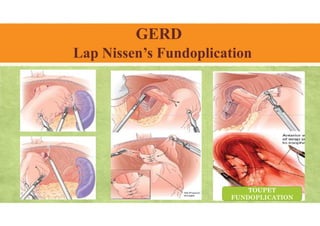
Lap Nissen’s Fundoplication
TOUPET
FUNDOPLICATION
GERD
MIND MAP
DYSPHAGIA Diagnostic Algorithm
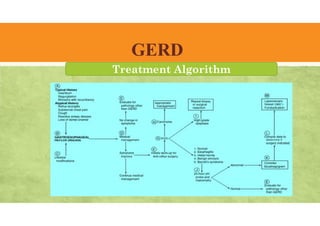
GERD
Treatment Algorithm
Peripheral Arterial Diseases(PAD)
ACHALASIA CARDIA
DYSPHAGIA
AN OVRVIEWDr.B.Selvaraj MS;Mch;FICS;
“Surgical Educator”
Malaysia
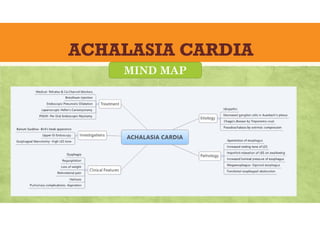
ACHALASIA CARDIA
Objectives
 Causes for dysphagia
 Etiopathogenesis of achalasia
 Clinical features of achalasia
 Workup of achalasia
 Management of achalasia
 New development in the treatment of
achalasia
 Mindmap
 Diagnostic Algorithm
 Treatment Algorithm
DYSPHAGIA- CAUSES
ACHALASIA CARDIA
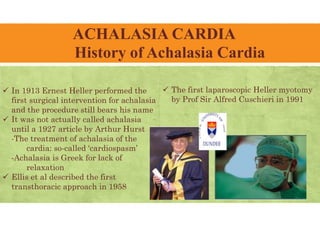
History of Achalasia Cardia
 In 1913 Ernest Heller performed the
first surgical intervention for achalasia
and the procedure still bears his name
 It was not actually called achalasia
until a 1927 article by Arthur Hurst
-The treatment of achalasia of the
cardia: so-called ‘cardiospasm’
-Achalasia is Greek for lack of
relaxation
 Ellis et al described the first
transthoracic approach in 1958
 The first laparoscopic Heller myotomy
by Prof Sir Alfred Cuschieri in 1991
ACHALASIA CARDIA
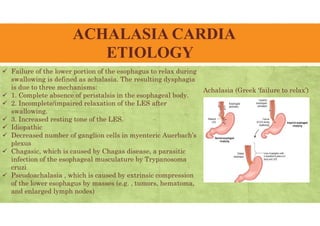
ETIOLOGY
 Failure of the lower portion of the esophagus to relax during
swallowing is defined as achalasia. The resulting dysphagia
is due to three mechanisms:
 1. Complete absence of peristalsis in the esophageal body.
 2. Incomplete/impaired relaxation of the LES after
swallowing.
 3. Increased resting tone of the LES.
 Idiopathic
 Decreased number of ganglion cells in myenteric Auerbach’s
plexus
 Chagasic, which is caused by Chagas disease, a parasitic
infection of the esophageal musculature by Trypanosoma
cruzi
 Pseudoachalasia , which is caused by extrinsic compression
of the lower esophagus by masses (e.g. , tumors, hematoma,
and enlarged lymph nodes)
Achalasia (Greek ‘failure to relax’)
ACHALASIA CARDIA
PATHOLOGY
 Histologic examination shows a decrease in the neurons of the myenteric
plexuses (Auerbach’s plexus)
 There is a preferential decrease in the nitric oxide producing cells which
contribute to LES relaxation
 There is a relative sparing of the cholinergic neurons responsible for maintaining
LES tone
 The loss of these inhibitory neurons leads to an increased resting tone in the LES
 It also leads to aperistalsis of the esophagus
 These result in elevation of intraluminal esophageal pressure, esophageal
dilatation, and subsequent progressive loss of normal swallowing mechanisms—
a functional holdup of ingested material.
ACHALASIA CARDIA
Clinical Features
 Dysphagia:
-Most common symptom of achalasia is dysphagia
-Patients often report that food sticks in their chest
-Liquids to begin with and then for solids also
-They tend to augment the passage of food by drinking liquids
 Regurgitation:
-Because of functional obstruction
-The passive return of food to the mouth after eating.
 Loss of weight: in 60% of patients
 Chest pain: occurs in 43% of those with achalasia. Heartburn & Halitosis
may occur as retained food and liquids in the distal esophagus ferment.
 Pulmonary complications: include cough and chronic aspiration. They occur
in 10% to 30% of those with achalasia
ACHALASIA CARDIA
INVESTIGATIONS
 Onset of symptoms is slow and gradual. The average time between
onset of symptoms and diagnosis is over four years.
 In patients with suspected achalasia, there are three important
tools in diagnosing achalasia
 1.Barium swallow
 2.Upper GI Endoscopy
 3.Esophageal Manometry
ACHALASIA CARDIA
BARIUM SWALLOW
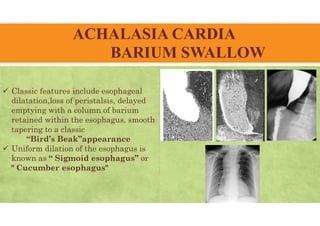
 Classic features include esophageal
dilatation,loss of peristalsis, delayed
emptying with a column of barium
retained within the esophagus, smooth
tapering to a classic
“Bird’s Beak”appearance
 Uniform dilation of the esophagus is
known as “ Sigmoid esophagus” or
" Cucumber esophagus"
ACHALASIA CARDIA
UPPER GI ENDOSCOPY
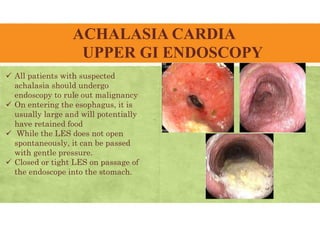
 All patients with suspected
achalasia should undergo
endoscopy to rule out malignancy
 On entering the esophagus, it is
usually large and will potentially
have retained food
 While the LES does not open
spontaneously, it can be passed
with gentle pressure.
 Closed or tight LES on passage of
the endoscope into the stomach.
ACHALASIA CARDIA
ESOPHAGEAL MANOMETRY
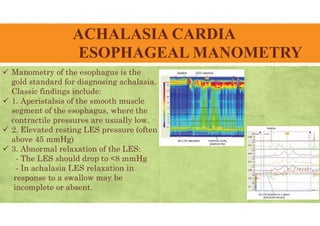
 Manometry of the esophagus is the
gold standard for diagnosing achalasia.
Classic findings include:
 1. Aperistalsis of the smooth muscle
segment of the esophagus, where the
contractile pressures are usually low.
 2. Elevated resting LES pressure (often
above 45 mmHg)
 3. Abnormal relaxation of the LES:
- The LES should drop to <8 mmHg
- In achalasia LES relaxation in
response to a swallow may be
incomplete or absent.
ACHALASIA CARDIA
TREATMENT
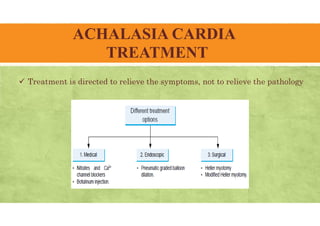
 Treatment is directed to relieve the symptoms, not to relieve the pathology
ACHALASIA CARDIA
TREATMENT
Medical therapy
 Nitrates given sublingually can
decrease LES pressure and offer
short-term relief of dysphagic
symptoms. However, they do not
affect LES function, and efficacy
decreases over time
 Calcium-channel blockers can
decrease LES pressure and relieve
dysphagic symptoms. However, as
with nitrates, the function of the LES
does not improve, side effects are
common, and efficacy is short-lived.
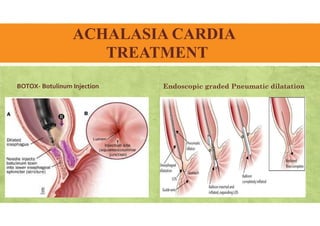
Botulinum toxin A
 Botulinum toxin blocks release of
acetylcholine at nerve receptors
and,when injected into the LES, leads
to relaxation of the LES by inhibiting
the function of the unopposed neurons
that cause LES contraction.
 Three-fourths of patients respond to an
initial inj ection
 Efficacy decreases over time with
multiple treatments and recurrence
after 6 months.
ACHALASIA CARDIA
TREATMENT
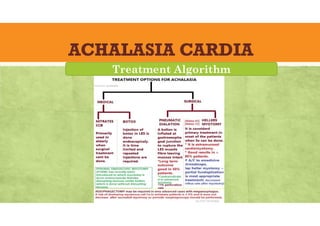
 Compared to botulinum toxin and medications, pneumatic dilatation is the
most effective nonsurgical therapy.
 Involves passing the pneumatic device to the LES, using both endoscopy and
fluoroscopy to properly place the balloon
 The balloon is inflated to a pressure between 7 to 15 psi
 Pneumatic dilatation forcefully disrupts the hypertrophied muscle fibers of the
LES, leading to decreased LES pressure
 Patients are usually observed for six hours and then discharged home
 Complications include a 1% to 6% risk of esophageal perforation
Endoscopic graded pneumatic dilatation
ACHALASIA CARDIA
TREATMENT
Endoscopic graded Pneumatic dilatationBOTOX- Botulinum Injection
ACHALASIA CARDIA
TREATMENT
Heller’s Cardiomyotomy
 The operation consists of splitting the longitudinal muscle fibers and dividing
the circular muscle fibers of the distal esophagus at the area of the LES.
 The myotomy is carried down onto the gastric cardia for 2 to 3 cms,
 The operation can be performed through the chest or abdomen and is most
commonly done via laparoscopy
 A fundoplication is usually performed along with the myotomy because 30% to
40% of patients develop symptomatic gastroesophageal reflux disease (GERD).
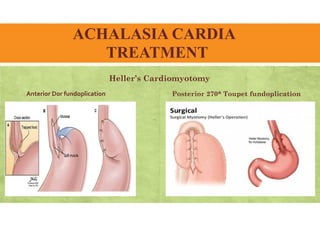
 Anterior Dor or posterior 270* Toupet fundoplication is done
 Myotomy lowers LES pressure more reliably than medication, botulinum toxin,
or pneumatic dilatation
ACHALASIA CARDIA
TREATMENT
Heller’s Cardiomyotomy
Anterior Dor fundoplication Posterior 270* Toupet fundoplication
ACHALASIA CARDIA
NEW TREATMENT
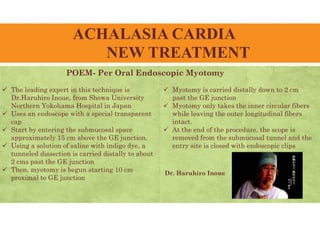
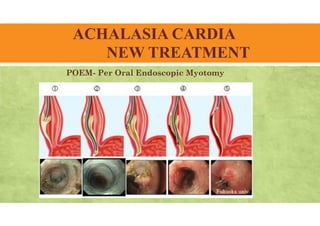
POEM- Per Oral Endoscopic Myotomy
 The leading expert in this technique is
Dr.Haruhiro Inoue, from Showa University
Northern Yokohama Hospital in Japan
 Uses an endoscope with a special transparent
cap
 Start by entering the submucosal space
approximately 15 cm above the GE junction.
 Using a solution of saline with indigo dye, a
tunneled dissection is carried distally to about
2 cms past the GE junction
 Then, myotomy is begun starting 10 cm
proximal to GE junction
 Myotomy is carried distally down to 2 cm
past the GE junction
 Myotomy only takes the inner circular fibers
while leaving the outer longitudinal fibers
intact.
 At the end of the procedure, the scope is
removed from the submucosal tunnel and the
entry site is closed with endoscopic clips
Dr. Haruhiro Inoue
ACHALASIA CARDIA
NEW TREATMENT
POEM- Per Oral Endoscopic Myotomy
ACHALASIA CARDIA
MIND MAP
DYSPHAGIA Diagnostic Algorithm
ACHALASIA CARDIA
Treatment Algorithm
Peripheral Arterial Diseases(PAD)
CARCINOMA OF ESOPHAGUS
DYSPHAGIA
AN OVRVIEWDr.B.Selvaraj MS;Mch;FICS;
“Surgical Educator”
Malaysia
CARCINOMA OF ESOPHAGUS
 Causes for Dysphagia
 Etiology
 Pathology
 Clinical features
 Investigations
 Treatment
 Complications
 Mindmap
 Diagnostic Algorithm for dysphagia
 Treatment Algorithm
DYSPHAGIA- CAUSES
CARCINOMA OF ESOPHAGUS
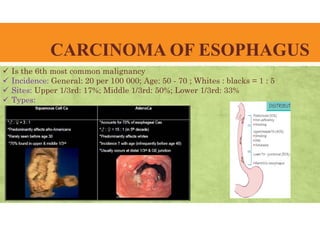
 Is the 6th most common malignancy
 Incidence: General: 20 per 100 000; Age: 50 - 70 ; Whites : blacks = 1 : 5
 Sites: Upper 1/3rd: 17%; Middle 1/3rd: 50%; Lower 1/3rd: 33%
 Types:
CARCINOMA OF ESOPHAGUS
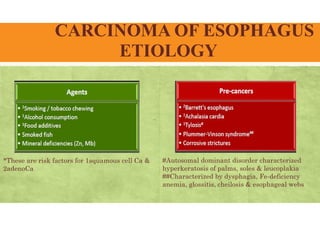
ETIOLOGY
#Autosomal dominant disorder characterized
hyperkeratosis of palms, soles & leucoplakia
##Characterized by dysphagia, Fe-deficiency
anemia, glossitis, cheilosis & esophageal webs
*These are risk factors for 1squamous cell Ca &
2adenoCa
CARCINOMA OF ESOPHAGUS
PATHOLOGY
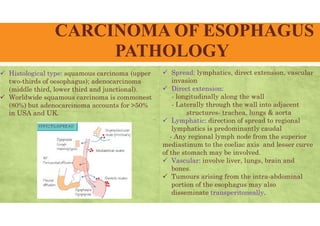
 Histological type: squamous carcinoma (upper
two-thirds of oesophagus); adenocarcinoma
(middle third, lower third and junctional).
 Worldwide squamous carcinoma is commonest
(80%) but adenocarcinoma accounts for >50%
in USA and UK.
 Spread: lymphatics, direct extension, vascular
invasion
 Direct extension:
- longitudinally along the wall
- Laterally through the wall into adjacent
structures- trachea, lungs & aorta
 Lymphatic: direction of spread to regional
lymphatics is predominantly caudal
- Any regional lymph node from the superior
mediastinum to the coeliac axis and lesser curve
of the stomach may be involved.
 Vascular: involve liver, lungs, brain and
bones.
 Tumours arising from the intra-abdominal
portion of the esophagus may also
disseminate transperitoneally.
CARCINOMA OF ESOPHAGUS
CLINICAL FEATURES
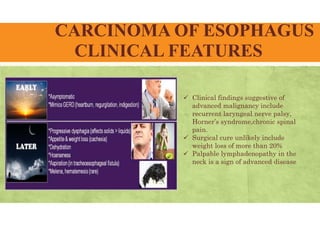
 Clinical findings suggestive of
advanced malignancy include
recurrent laryngeal nerve palsy,
Horner’s syndrome,chronic spinal
pain.
 Surgical cure unlikely include
weight loss of more than 20%
 Palpable lymphadenopathy in the
neck is a sign of advanced disease
CARCINOMA OF ESOPHAGUS
INVESTIGATIONS
 Upper GI Endoscopy and Biopsy
 Barium Swallow
 Endoscopic Ultrasound
 CECT- contrast Enhanced CT
 Bronchoscopy
 PET- Scan
 MRI- Scan
CARCINOMA OF ESOPHAGUS
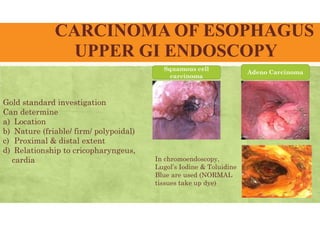
UPPER GI ENDOSCOPY
Gold standard investigation
Can determine
a) Location
b) Nature (friable/ firm/ polypoidal)
c) Proximal & distal extent
d) Relationship to cricopharyngeus,
cardia
Squamous cell
carcinoma
Adeno Carcinoma
In chromoendoscopy,
Lugol’s Iodine & Toluidine
Blue are used (NORMAL
tissues take up dye)
CARCINOMA OF ESOPHAGUS
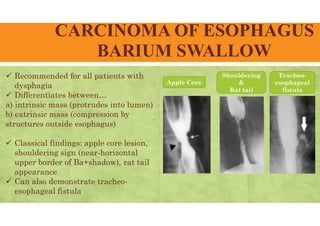
BARIUM SWALLOW
 Recommended for all patients with
dysphagia
 Differentiates between…
a) intrinsic mass (protrudes into lumen)
b) extrinsic mass (compression by
structures outside esophagus)
 Classical findings: apple core lesion,
shouldering sign (near-horizontal
upper border of Ba+shadow), rat tail
appearance
 Can also demonstrate tracheo-
esophageal fistula
Apple Core
Shouldering
&
Rat tail
Tracheo-
esophageal
fistula
CARCINOMA OF ESOPHAGUS
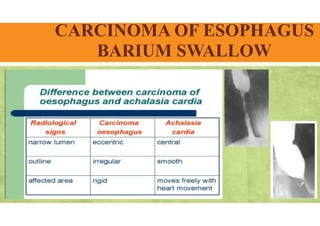
BARIUM SWALLOW
CARCINOMA OF ESOPHAGUS
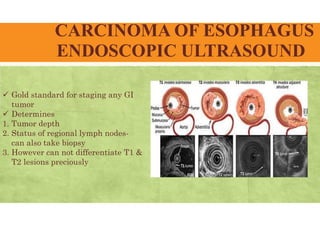
ENDOSCOPIC ULTRASOUND
 Gold standard for staging any GI
tumor
 Determines
1. Tumor depth
2. Status of regional lymph nodes-
can also take biopsy
3. However can not differentiate T1 &
T2 lesions preciously
CARCINOMA OF ESOPHAGUS
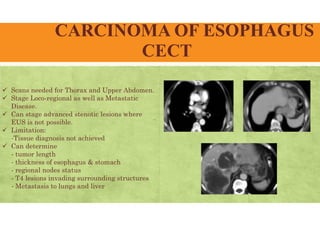
CECT
 Scans needed for Thorax and Upper Abdomen.
 Stage Loco-regional as well as Metastatic
Disease.
 Can stage advanced stenotic lesions where
EUS is not possible.
 Limitation:
-Tissue diagnosis not achieved
 Can determine
- tumor length
- thickness of esophagus & stomach
- regional nodes status
- T4 lesions invading surrounding structures
- Metastasis to lungs and liver
CARCINOMA OF ESOPHAGUS
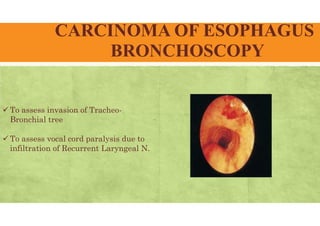
BRONCHOSCOPY
 To assess invasion of Tracheo-
Bronchial tree
 To assess vocal cord paralysis due to
infiltration of Recurrent Laryngeal N.
CARCINOMA OF ESOPHAGUS
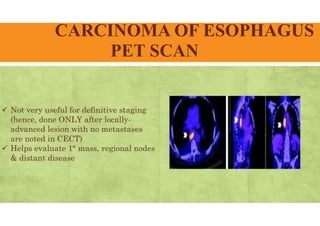
PET SCAN
 Not very useful for definitive staging
(hence, done ONLY after locally-
advanced lesion with no metastases
are noted in CECT)
 Helps evaluate 1° mass, regional nodes
& distant disease
CARCINOMA OF ESOPHAGUS
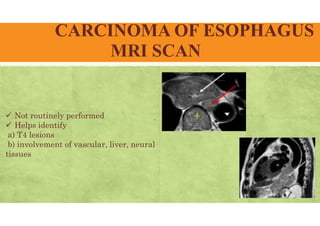
MRI SCAN
 Not routinely performed
 Helps identify
a) T4 lesions
b) involvement of vascular, liver, neural
tissues
CARCINOMA OF ESOPHAGUS
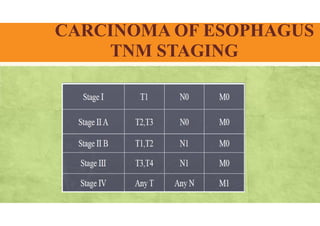
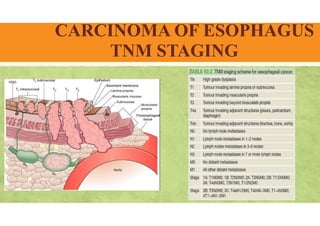
TNM STAGING
CARCINOMA OF ESOPHAGUS
TNM STAGING
CARCINOMA OF ESOPHAGUS
TREATMENT
Curative( Stage I, II, III)
 Stage I (T1a/N0/M0) – Endoscopic Mucosal
Resection
 Stage I and IIA disease (T1/N0/M0 – T2/N0/M0) –
Surgical resection is potentially curative only if
lymph nodes are not involved and clear tumours
margins can be achieved
 Stage IIB and III (T1/N1/M0 - T4/anyN/M0) –
Surgery or neoadjuvant chemotherapy (cisplatin
and fluorouracil) or chemoradiation followed by
surgery or definitive chemoradiation
 The role of neoadjuvant or adjuvant chemotherapy
or chemoradiotherapy continues to be explored in
clinical trials.
 Chemoradiotherapy and radiotherapy are
occasionally used with curative intent in patients
deemed not suitable for surgery
Palliation (Stage IV disease – anyT/anyN/M1)
 Partially covered self-expanding metal stents are the
intubation of choice for obstructive symptoms –
especially useful when tracheo-oesophageal fistula
present ± laser therapy.
 Radiotherapy – external beam DXT or endoluminal
brachytherapy
 Laser resection (Nd : YAG laser) of the tumour to
create lumen
 Photodynamic therapy: photosensitizing agents
(given IV) are taken up by dysplastic malignant
tissue which is damaged when photons (light) is
applied.
 Reconstruction is by jejunal or gastric ‘pull-up’
or rarely colon interposition
CARCINOMA OF ESOPHAGUS
TREATMENT
 Three surgical approaches for esophageal cancer
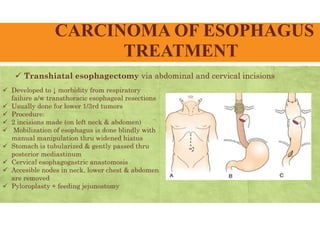
 Transhiatal esophagectomy via abdominal and cervical incisions
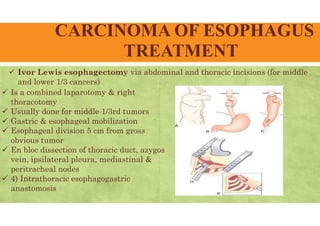
 Ivor Lewis esophagectomy via abdominal and thoracic incisions (for upper
and middle 1/3 cancers)
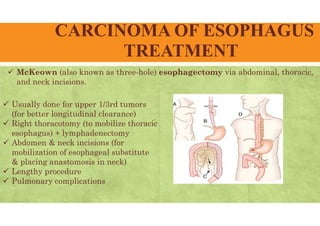
 McKeown (also known as three-hole) esophagectomy via abdominal, thoracic,
and neck incisions.
CARCINOMA OF ESOPHAGUS
TREATMENT
 Transhiatal esophagectomy via abdominal and cervical incisions
 Developed to ↓ morbidity from respiratory
failure a/w transthoracic esophageal resections
 Usually done for lower 1/3rd tumors
 Procedure:
 2 incisions made (on left neck & abdomen)
 Mobilization of esophagus is done blindly with
manual manipulation thru widened hiatus
 Stomach is tubularized & gently passed thru
posterior mediastinum
 Cervical esophagogastric anastomosis
 Accesible nodes in neck, lower chest & abdomen
are removed
 Pyloroplasty + feeding jejunostomy
CARCINOMA OF ESOPHAGUS
TREATMENT
 Ivor Lewis esophagectomy via abdominal and thoracic incisions (for middle
and lower 1/3 cancers)
 Is a combined laparotomy & right
thoracotomy
 Usually done for middle 1/3rd tumors
 Gastric & esophageal mobilization
 Esophageal division 5 cm from gross
obvious tumor
 En bloc dissection of thoracic duct, azygos
vein, ipsilateral pleura, mediastinal &
peritracheal nodes
 4) Intrathoracic esophagogastric
anastomosis
CARCINOMA OF ESOPHAGUS
TREATMENT
 McKeown (also known as three-hole) esophagectomy via abdominal, thoracic,
and neck incisions.
 Usually done for upper 1/3rd tumors
(for better longitudinal clearance)
 Right thoracotomy (to mobilize thoracic
esophagus) + lymphadenectomy
 Abdomen & neck incisions (for
mobilization of esophageal substitute
& placing anastomosis in neck)
 Lengthy procedure
 Pulmonary complications
CARCINOMA OF ESOPHAGUS
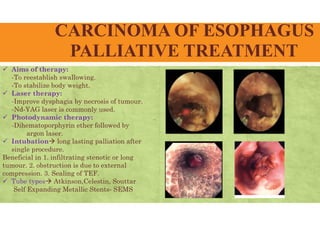
PALLIATIVE TREATMENT
 Aims of therapy:
-To reestablish swallowing.
-To stabilize body weight.
 Laser therapy:
-Improve dysphagia by necrosis of tumour.
-Nd-YAG laser is commonly used.
 Photodynamic therapy:
-Dihematoporphyrin ether followed by
argon laser.
 Intubation long lasting palliation after
single procedure.
Beneficial in 1. infiltrating stenotic or long
tumour. 2. obstruction is due to external
compression. 3. Sealing of TEF.
 Tube types Atkinson,Celestin, Souttar
Self Expanding Metallic Stents- SEMS
CARCINOMA OF ESOPHAGUS
COMPLICATIONS OF SURGERY
 Pulmonary Empyema&Sepsis
 Anastomotic Leak Mediastinitis
 Conduit Necrosis
 Anastomotic stricture.
 Recurrent laryngeal nerve injury
 Chylothorax
 Gastro-esophageal reflux.
 Colonic dysmotility.
 Recurrence
CARCINOMA OF ESOPHAGUS
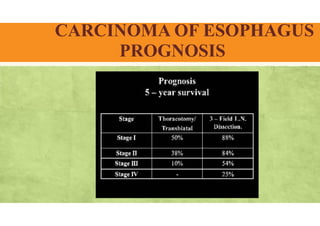
PROGNOSIS
CARCINOMA OF ESOPHAGUS
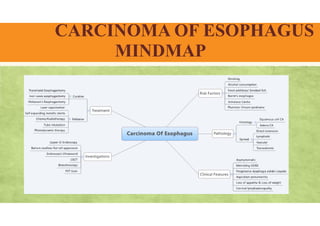
MINDMAP
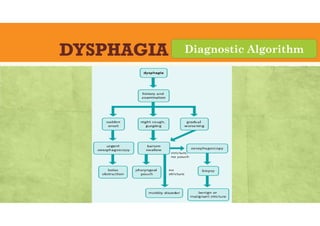
DYSPHAGIA Diagnostic Algorithm
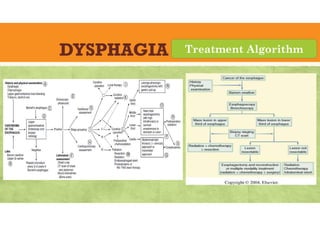
DYSPHAGIA Treatment Algorithm
Peripheral Arterial Diseases(PAD)

Dysphagia

  • 1.
    DYSPHAGIA INTRODUCTION AN OVRVIEWDr.B.Selvaraj MS;Mch;FICS; Professorof Surgery Melaka Manipal Medical college Melaka 75150 Malaysia
  • 2.
    Must To KnowCore Clinical Problems 1.Acute RLQ pain 2.Acute RUQ pain 3.Acute epigastric pain 4.Acute LLQ pain 5.Dysphagia 6.Abdominal lumps 7.Upper GI hemorrhage 8.Lower GI hemorrhage 9.Obstructive Jaundice 10.Breast lumps, Mastalgia & Nipple discharge 11.Neck swellings- Thyroid & Non thyroidal 12.Groin swellings 13.Scrotal swellings 14.Limb ischemia- Acute & Chronic 15.Varicose veins, DVT & Pulmonary Embolism 16.Renal & ureteric colic 17.Hematuria 18.Acute retention of urine
  • 3.
    DYSPHAGIA  Surgical Anatomy Physiology of deglutition/swallowing  Causes of Dysphagia  History/ Symptoms  Physical Examinations/ Signs  Investigations  Diagnostic Algorithm
  • 4.
  • 5.
    PHYSIOLOGY OF DEGLUTITION 1.OralPhase: (Buccal) Voluntary  Food moistened with saliva  Tongue pushes food bolus backward 2.Pharyngeal Phase:  Stimulation of tactile receptors in oropharynx and initiation of swallow reflex  Tongue blocks oral cavity  Soft palate blocks nasopharynx  Larynx moves up & vocal folds closes  Epiglottis covers larynx  Respiration temporarily suspended  Upper esophageal sphincter opens to allow food bolus 3.Esophageal phase: Involuntary  Esophageal peristalsis  Larynx moves down
  • 6.
  • 7.
    Difficulty In Swallowing Dysphagia: Difficulty in swallowing; High dysphagia (oro-pharyngeal and upper esophageal) describe difficulty in initiating a swallow; Low dysphagia (lower oesophageal) feel the food getting stuck a few seconds after swallowing.  Odynophagia: painful swallowing due to carcinoma or candidiasis  Globus: the common sensation of having a lump in the throat without true dysphagia. Globus is very common and its etiology is poorly understood – however, only a small proportion of affected patients will seek medical help and it is an entirely benign condition May be
  • 8.
    DYSPHAGIA What is theduration of the symptoms?  Days to weeks Ca Esophagus  Months to years Motility disorders Is the dysphagia progressive or intermittent?  Progressive dysphagia mechanical obstruction like stricture (benign or malignant)  Intermittent dysphagia functional obstruction like motility disorders. History/Symptoms Is the dysphagia to solids, fluids, or both?:  If patient is able to swallow fluids but unable to swallow solids to begin with probably it is mechanical obstruction like stricture(benign or malignant)  In late stages, in mechanical obstruction there is dysphagia for solids and liquids  If dysphagia is more for fluids over solids motility disorders like Achalasia cardia What questions would you like to ask specifically about the swallowing?
  • 9.
    DYSPHAGIA Is there anycoughing?  Coughing immediately after swallowing Stroke/ Parkinson’s disease- oropharyngeal incoordination  Coughing sometime after meals GERD and Pharyngeal pouch Is there any choking?  Functional problem with the oropharyngeal phase of swallowing. Is there any gurgling or heartburn?  Gurgling Pharyngeal pouch  Heartburn- Pyrosis GERD History/Symptoms Weight loss & Nocturnal cough:  Weight loss Ca Esophagus or any severe dysphagia  Nocturnal cough: GERDAspiration Neurological symptoms  (In functional dysphagia), like early dysphagia for liquids Rheumatological symptoms  CREST syndrome:  Calcinosis  Raynaud’s  Esophageal dysmotility  Sclerodactyly & Telangiectasia. Any associated symptoms?
  • 10.
    DYSPHAGIA 1. Cranial nervepathology:  Important if the history suggests functional dysphagia like bulbar palsy 2. Signs of GI malignancy:  Patients cachectic and Virchow’s node palpable Carcinoma Esophagus  Palpable epigastric mass Carcinoma esophagus extending to cardia 3. Koilonychia:  Iron-deficiency anemia which can cause Plummer–Vinson syndrome. Physical Exam/Signs 4. Neck mass:  In Pharyngeal pouch on left side neck  Huge goiter compress trachea and cause dysphagia 5. Features of CREST syndrome:  Calcinosis  Raynaud’s  Esophageal dysmotility  Sclerodactyly  Telangiectasia What are the relevant aspects of the physical examination? There is relatively little that can be gained from the examination of a patient with dysphagia, but there are five features that are particularly relevant:
  • 11.
    DYSPHAGIA 1. Barium Swallow: A cineradiographic study which monitors the passage of a bolus of barium contrast medium from the upper to the lower esophageal sphincter of a supine patient.  Barium swallow is useful in investigating patients who may have a high lesion and achalasia cardia. 2. Videofluroscopy:  Modified form of barium swallow in which upright patients are given barium. 3. 24 Hrs PH monitoring: In GERD INVESTIGATIONS 3. Upper GI Endoscopy:  Allows visualization of luminal and mural lesions, as well as the opportunity to biopsy and treat lesions  Various procedures, such as stricture dilatation, stent insertion, laser coagulation, and Botox injections can be done 4. Manometry:  Assesses the pressures in the LES and the peristaltic wave in the rest of the esophagus  Manometry is the key investigation for diagnosing a motility disorder.
  • 12.
  • 13.
  • 14.
    ZENKER’S DIVERTICULUM DYSPHAGIA AN OVRVIEWDr.B.SelvarajMS;Mch;FICS; Professor of Surgery Melaka Manipal Medical college Melaka 75150 Malaysia
  • 15.
    ZENKER’S DIVERTICULUM  Causesfor Dysphagia  Etiopathogenesis  Clinical features  Investigations  Treatment  Treatment Algorithm  Mindmap
  • 16.
  • 17.
    ZENKER’S DIVERTICULUM Etiopathogenesis  Apulsion diverticulum of the mucosa and submucosa of the esophagus, just above the cricopharyngeal muscle (i.e. above the upper esophageal shincter) which is not relaxing.  Most common esophageal diverticulum due to loss of coordination in second stage of swallowing resulting in increased luminal pressure.  Mainly affects elderly males. It has an incidence of 2 per 100,000 per year in the UK
  • 18.
    ZENKER’S DIVERTICULUM Clinical Features Progressive cervical dysphagia and sense of a lump in the throat.  Food might get trapped in the outpouching, leading to: - Regurgitation, reappearance of ingested food in the mouth. - Cough, due to food regurgitated into the airway. Aspiration & Pneumonia rare - Halitosis, smelly breath, as stagnant food is digested by microorganisms - Infection of diverticulum  It rarely, if ever, causes any pain.  Cervical webs are seen associated in 50% of patients with this condition  Usually there is H/O loss of weight  A left-sided neck mass.
  • 19.
    ZENKER’S DIVERTICULUM INVESTIGATIONS  BariumSwallow: - Reveal the diverticulum - A cineradiographic study which monitors the passage of a bolus of barium contrast medium from the upper to the lower esophageal sphincter of a supine patient.  Barium Videofluroscopy: -Modified form of barium swallow in which upright patients are given barium
  • 20.
    ZENKER’S DIVERTICULUM UPPER GIENDOSCOPY  Upper GI Endoscopy: - Should be done only if the esophagogram revealed some doubtful growth in the diverticulum - Otherwise normally we need not do upper GI endoscopy for fear of perforating the esophagus
  • 21.
    ZENKER’S DIVERTICULUM TREATMENT  Treatmentinvolves surgery because there is no effective medical therapy  Open Surgery: Diverticulectomy with Cricopharyngeal myotomy or Diverticulopexy is performed through a Lt neck incision for large diverticulum.  If diverticulum is <2cms only Myotomy  Endoscopic myotomy- An operating laryngoscope is used to expose the neck of the diverticulum, and a myotomy is performed using an endoscopic linear stapler.  With this technique , the diverticulum becomes part of a common channel with the cervical esophagus- “Dohlman’s procedure”.
  • 22.
  • 23.
  • 24.
  • 25.
  • 26.
    GASTRO ESOPHAGEAL REFLUX DISEASE (GERD) DYSPHAGIA ANOVRVIEWDr.B.Selvaraj MS;Mch;FICS; “Surgical Educator” Malaysia
  • 27.
    GASTRO-ESOPHAGEAL REFLUX DISEASE  Causesof dysphagia  Definition  Etiology  Pathophysiology  Clinical Features- Symptoms & Signs  Complications  Investigations- Workup  Management  Mindmap  Diagnostic algorithm  Treatment algorithm
  • 28.
  • 29.
    GERD DEFINITION  Montreal consensuspanel (44 experts): “ Retrograde flow of stomach contents into esophagus causing troublesome symptoms and/or complications” Troublesome—patient has to decide when reflux interferes with lifestyle
  • 30.
    GERD Why do wecare about reflux?  Patients experience reflux symptoms • 44% monthly • 20% weekly • 4-7% daily  Most common gastrointestinal diagnosis on outpatient physician visits Frequency and severity does not predict esophagitis, stricture, or cancer development
  • 31.
  • 32.
    GERD ANTI REFLUX MECHANISMS EsophagealSphincter Tone and Length. Sling Fibres of the Cardia. Esophageal Hiatus Tone. Positive Intra Abdominal Pressure. Gastroesophageal acute angle of His Esophageal mucosal rosette
  • 33.
    GERD LOWER ESOPHAGEAL SPHINCTER Normally,the lower esophageal sphincter exists as a zone of high pressure between esophagus and stomach; when the HPZ is lost, reflux occurs  Three components of high pressure zone  Resting pressure if <8mmHg  Overall length if < 3cms  Intra-abdominal length if < 1cm Reflux occurs
  • 34.
    GERD ETIOLOGY  Sliding HiatusHernia.  Alteration of Phreno-esophageal Ligament.  Altered Obliquity of GE junction.  Reduced pinching action of Crus of Diaphragm  Reduced LES Pressure.  Altered Transient Relaxation period in LES - TLESR
  • 35.
  • 36.
    GERD PATHOPHYSIOLOGY  Fundic distention(overeating) & delayed gastric emptying (high fat)  Lower esophageal sphincter is pulled distally by expanding fundus  Squamous epithelium exposed to gastric juice. Repeated exposure  columnisation  Extension of inflammation into muscularis propria causes progressive loss in length and pressure of the LES—“esophageal shortening” Loss of LES leads to regurgitation, heartburn, and subsequent severe esophagitis
  • 37.
    GERD PATHOPHYSIOLOGY  Spectrum ofdisease theory: Nonerosive disease erosive disease Barrett’s esophageal adenocarcinoma
  • 38.
    GERD CLINICAL FEATURES  Heartburn-Pyrosis Retrosternal pain1-2 hours after eating, often at night, relieved by antacids  Regurgitation (Waterbrash) Spontaneous return of gastric contents proximal to GE jxn into mouth; less well relieved with antacids  Dysphagia (40%)—difficulty with swallowing should prompt search for pathologic condition Stricture esophagus  Hoarseness of Voice / Dysphonia  Respiratory Symptoms Cough / Expectoration Wheeze / Breathlessness Aspiration
  • 39.
    GERD COMPLICATIONS  Peptic Ulceration Hemetemesis  Stricture Esophagus  Barrett’s esophagus  Adeno Carcinoma esophagus  Laryngeal Complications - Hoarseness of voice - Dysphonia  Respiratory Complications -Cough / Expectoration -Wheeze / Breathlessness -Aspiration
  • 40.
    GERD INVESTIGATIONS  Upper G.I.Endoscopy  Upper G.I. Contrast Studies  24 Hours Ambulatory pH Monitoring  Esophageal Manometry
  • 41.
    GERD UPPER GI ENDOSCOPY GradeA Grade B Grade C&D
  • 42.
    GERD BARRETT’S ESOPHAGUS  Intestinal/ Gastric Columnar Metaplasia of the distal esophagus from squamous to columnar epithelium  Diagnosed on Upper G.I.Endoscopy.  Pre Malignant condition, leads to Adeno Carcinoma.  Multiple Biopsies are required to exclude Malignancy.
  • 43.
  • 44.
  • 45.
    GERD HIATUS HERNIA  Only40% of patients with classic symptoms of GERD will have reflux observed on radiography  Assess for: •Esophageal shortening •Hiatal hernia (80%) •Paraesophageal hernia •Stricture or obstructing lesion •Beading or corkscrewing (motility disorders) Sliding Hiatus Hernia Para-esophageal Hiatus Hernia
  • 46.
    GERD AMBULATORY 24 HrspH MONITORING  Rationale: gold standard for diagnosis of GERD  Quantifies actual time the esophageal mucosa is exposed to gastric juice  Measures the ability of the esophagus to clear refluxed acid  Correlates esophageal acid exposure with patients symptoms  Without abnormal pH study, surgery is unlikely to benefit  Gives a composite score (Johnson- DeMeester score) highly sensitive and specific (>96%) for diagnosing GERD
  • 47.
  • 48.
  • 49.
    GERD TREATMENT Treatment Goals forGERD Eliminate symptoms Heal esophagitis Manage or prevent complications Maintain remission
  • 50.
    GERD TREATMENT Lifestyle Modifications areCornerstone of GERD Therapy  Elevate head of bed 4-6 inches  Avoid eating within 2-3 hours of bedtime  Lose weight if overweight  Stop smoking  Modify diet  Eat more frequent but smaller meals  Avoid fatty/fried food, peppermint, chocolate, alcohol, carbonated beverages, coffee and tea  OTC medications prn
  • 51.
  • 52.
    GERD ENDOSCOPIC TREATMENT To date,there have been basically three approaches to endo-luminal treatment for GERD:  Radiofrequency energy ablation delivered to the lower oesophageal sphincter (LES);  Endoscopic gastroplasty plication of the gastric folds immediately distal to the oesophago-gastric junction;  Endoscopic implantation of a bulking agent or polymer in the region of the LES. Tiny magnetic beads act as an artificial sphincter preventing acid reflux. Stretta is a minimally invasive endoscopic procedure, RFQ energy produce thickening of LES
  • 53.
    GERD SURGICAL TREATMENT Indications  Needfor continuous drug treatment or escalating dose of PPI  Relatively young  Financial burden or noncompliance with PPI  Patient choice  Factors predictive of successful outcome following antireflux surgery (n = 199) -Abnormal score on 24-hour esophageal pH monitoring (p <0.001 -Presence of typical symptoms of GERD (heartburn and regurgitation) (p< 0.001) - Symptomatic improvement in response to acid suppressive therapy (p = 0.02)
  • 54.
    GERD SURGICAL TREATMENT Principles ofsurgery  Establish effective LES pressure  Position the LES within the abdomen -Sphincter is under positive (intra- abdominal) pressure  Close any associated hiatal defect Key points of surgery  Complete dissection of esophageal hiatus and both crura  Mobilization of the gastric fundus  Closure of the associated hiatal defect  Creation of a tensionless gastric wrap around esophagus  50- to 60-French intraesophageal dilator  Limiting the length of the wrap to 1.5 to 2.0 cm  Stabilizing the wrap
  • 55.
  • 56.
  • 57.
  • 58.
  • 59.
  • 60.
    ACHALASIA CARDIA DYSPHAGIA AN OVRVIEWDr.B.SelvarajMS;Mch;FICS; “Surgical Educator” Malaysia
  • 61.
    ACHALASIA CARDIA Objectives  Causesfor dysphagia  Etiopathogenesis of achalasia  Clinical features of achalasia  Workup of achalasia  Management of achalasia  New development in the treatment of achalasia  Mindmap  Diagnostic Algorithm  Treatment Algorithm
  • 62.
  • 63.
    ACHALASIA CARDIA History ofAchalasia Cardia  In 1913 Ernest Heller performed the first surgical intervention for achalasia and the procedure still bears his name  It was not actually called achalasia until a 1927 article by Arthur Hurst -The treatment of achalasia of the cardia: so-called ‘cardiospasm’ -Achalasia is Greek for lack of relaxation  Ellis et al described the first transthoracic approach in 1958  The first laparoscopic Heller myotomy by Prof Sir Alfred Cuschieri in 1991
  • 64.
    ACHALASIA CARDIA ETIOLOGY  Failureof the lower portion of the esophagus to relax during swallowing is defined as achalasia. The resulting dysphagia is due to three mechanisms:  1. Complete absence of peristalsis in the esophageal body.  2. Incomplete/impaired relaxation of the LES after swallowing.  3. Increased resting tone of the LES.  Idiopathic  Decreased number of ganglion cells in myenteric Auerbach’s plexus  Chagasic, which is caused by Chagas disease, a parasitic infection of the esophageal musculature by Trypanosoma cruzi  Pseudoachalasia , which is caused by extrinsic compression of the lower esophagus by masses (e.g. , tumors, hematoma, and enlarged lymph nodes) Achalasia (Greek ‘failure to relax’)
  • 65.
    ACHALASIA CARDIA PATHOLOGY  Histologicexamination shows a decrease in the neurons of the myenteric plexuses (Auerbach’s plexus)  There is a preferential decrease in the nitric oxide producing cells which contribute to LES relaxation  There is a relative sparing of the cholinergic neurons responsible for maintaining LES tone  The loss of these inhibitory neurons leads to an increased resting tone in the LES  It also leads to aperistalsis of the esophagus  These result in elevation of intraluminal esophageal pressure, esophageal dilatation, and subsequent progressive loss of normal swallowing mechanisms— a functional holdup of ingested material.
  • 66.
    ACHALASIA CARDIA Clinical Features Dysphagia: -Most common symptom of achalasia is dysphagia -Patients often report that food sticks in their chest -Liquids to begin with and then for solids also -They tend to augment the passage of food by drinking liquids  Regurgitation: -Because of functional obstruction -The passive return of food to the mouth after eating.  Loss of weight: in 60% of patients  Chest pain: occurs in 43% of those with achalasia. Heartburn & Halitosis may occur as retained food and liquids in the distal esophagus ferment.  Pulmonary complications: include cough and chronic aspiration. They occur in 10% to 30% of those with achalasia
  • 67.
    ACHALASIA CARDIA INVESTIGATIONS  Onsetof symptoms is slow and gradual. The average time between onset of symptoms and diagnosis is over four years.  In patients with suspected achalasia, there are three important tools in diagnosing achalasia  1.Barium swallow  2.Upper GI Endoscopy  3.Esophageal Manometry
  • 68.
    ACHALASIA CARDIA BARIUM SWALLOW Classic features include esophageal dilatation,loss of peristalsis, delayed emptying with a column of barium retained within the esophagus, smooth tapering to a classic “Bird’s Beak”appearance  Uniform dilation of the esophagus is known as “ Sigmoid esophagus” or " Cucumber esophagus"
  • 69.
    ACHALASIA CARDIA UPPER GIENDOSCOPY  All patients with suspected achalasia should undergo endoscopy to rule out malignancy  On entering the esophagus, it is usually large and will potentially have retained food  While the LES does not open spontaneously, it can be passed with gentle pressure.  Closed or tight LES on passage of the endoscope into the stomach.
  • 70.
    ACHALASIA CARDIA ESOPHAGEAL MANOMETRY Manometry of the esophagus is the gold standard for diagnosing achalasia. Classic findings include:  1. Aperistalsis of the smooth muscle segment of the esophagus, where the contractile pressures are usually low.  2. Elevated resting LES pressure (often above 45 mmHg)  3. Abnormal relaxation of the LES: - The LES should drop to <8 mmHg - In achalasia LES relaxation in response to a swallow may be incomplete or absent.
  • 71.
    ACHALASIA CARDIA TREATMENT  Treatmentis directed to relieve the symptoms, not to relieve the pathology
  • 72.
    ACHALASIA CARDIA TREATMENT Medical therapy Nitrates given sublingually can decrease LES pressure and offer short-term relief of dysphagic symptoms. However, they do not affect LES function, and efficacy decreases over time  Calcium-channel blockers can decrease LES pressure and relieve dysphagic symptoms. However, as with nitrates, the function of the LES does not improve, side effects are common, and efficacy is short-lived. Botulinum toxin A  Botulinum toxin blocks release of acetylcholine at nerve receptors and,when injected into the LES, leads to relaxation of the LES by inhibiting the function of the unopposed neurons that cause LES contraction.  Three-fourths of patients respond to an initial inj ection  Efficacy decreases over time with multiple treatments and recurrence after 6 months.
  • 73.
    ACHALASIA CARDIA TREATMENT  Comparedto botulinum toxin and medications, pneumatic dilatation is the most effective nonsurgical therapy.  Involves passing the pneumatic device to the LES, using both endoscopy and fluoroscopy to properly place the balloon  The balloon is inflated to a pressure between 7 to 15 psi  Pneumatic dilatation forcefully disrupts the hypertrophied muscle fibers of the LES, leading to decreased LES pressure  Patients are usually observed for six hours and then discharged home  Complications include a 1% to 6% risk of esophageal perforation Endoscopic graded pneumatic dilatation
  • 74.
    ACHALASIA CARDIA TREATMENT Endoscopic gradedPneumatic dilatationBOTOX- Botulinum Injection
  • 75.
    ACHALASIA CARDIA TREATMENT Heller’s Cardiomyotomy The operation consists of splitting the longitudinal muscle fibers and dividing the circular muscle fibers of the distal esophagus at the area of the LES.  The myotomy is carried down onto the gastric cardia for 2 to 3 cms,  The operation can be performed through the chest or abdomen and is most commonly done via laparoscopy  A fundoplication is usually performed along with the myotomy because 30% to 40% of patients develop symptomatic gastroesophageal reflux disease (GERD).  Anterior Dor or posterior 270* Toupet fundoplication is done  Myotomy lowers LES pressure more reliably than medication, botulinum toxin, or pneumatic dilatation
  • 76.
    ACHALASIA CARDIA TREATMENT Heller’s Cardiomyotomy AnteriorDor fundoplication Posterior 270* Toupet fundoplication
  • 77.
    ACHALASIA CARDIA NEW TREATMENT POEM-Per Oral Endoscopic Myotomy  The leading expert in this technique is Dr.Haruhiro Inoue, from Showa University Northern Yokohama Hospital in Japan  Uses an endoscope with a special transparent cap  Start by entering the submucosal space approximately 15 cm above the GE junction.  Using a solution of saline with indigo dye, a tunneled dissection is carried distally to about 2 cms past the GE junction  Then, myotomy is begun starting 10 cm proximal to GE junction  Myotomy is carried distally down to 2 cm past the GE junction  Myotomy only takes the inner circular fibers while leaving the outer longitudinal fibers intact.  At the end of the procedure, the scope is removed from the submucosal tunnel and the entry site is closed with endoscopic clips Dr. Haruhiro Inoue
  • 78.
    ACHALASIA CARDIA NEW TREATMENT POEM-Per Oral Endoscopic Myotomy
  • 79.
  • 80.
  • 81.
  • 82.
  • 83.
    CARCINOMA OF ESOPHAGUS DYSPHAGIA ANOVRVIEWDr.B.Selvaraj MS;Mch;FICS; “Surgical Educator” Malaysia
  • 84.
    CARCINOMA OF ESOPHAGUS Causes for Dysphagia  Etiology  Pathology  Clinical features  Investigations  Treatment  Complications  Mindmap  Diagnostic Algorithm for dysphagia  Treatment Algorithm
  • 85.
  • 86.
    CARCINOMA OF ESOPHAGUS Is the 6th most common malignancy  Incidence: General: 20 per 100 000; Age: 50 - 70 ; Whites : blacks = 1 : 5  Sites: Upper 1/3rd: 17%; Middle 1/3rd: 50%; Lower 1/3rd: 33%  Types:
  • 87.
    CARCINOMA OF ESOPHAGUS ETIOLOGY #Autosomaldominant disorder characterized hyperkeratosis of palms, soles & leucoplakia ##Characterized by dysphagia, Fe-deficiency anemia, glossitis, cheilosis & esophageal webs *These are risk factors for 1squamous cell Ca & 2adenoCa
  • 88.
    CARCINOMA OF ESOPHAGUS PATHOLOGY Histological type: squamous carcinoma (upper two-thirds of oesophagus); adenocarcinoma (middle third, lower third and junctional).  Worldwide squamous carcinoma is commonest (80%) but adenocarcinoma accounts for >50% in USA and UK.  Spread: lymphatics, direct extension, vascular invasion  Direct extension: - longitudinally along the wall - Laterally through the wall into adjacent structures- trachea, lungs & aorta  Lymphatic: direction of spread to regional lymphatics is predominantly caudal - Any regional lymph node from the superior mediastinum to the coeliac axis and lesser curve of the stomach may be involved.  Vascular: involve liver, lungs, brain and bones.  Tumours arising from the intra-abdominal portion of the esophagus may also disseminate transperitoneally.
  • 89.
    CARCINOMA OF ESOPHAGUS CLINICALFEATURES  Clinical findings suggestive of advanced malignancy include recurrent laryngeal nerve palsy, Horner’s syndrome,chronic spinal pain.  Surgical cure unlikely include weight loss of more than 20%  Palpable lymphadenopathy in the neck is a sign of advanced disease
  • 90.
    CARCINOMA OF ESOPHAGUS INVESTIGATIONS Upper GI Endoscopy and Biopsy  Barium Swallow  Endoscopic Ultrasound  CECT- contrast Enhanced CT  Bronchoscopy  PET- Scan  MRI- Scan
  • 91.
    CARCINOMA OF ESOPHAGUS UPPERGI ENDOSCOPY Gold standard investigation Can determine a) Location b) Nature (friable/ firm/ polypoidal) c) Proximal & distal extent d) Relationship to cricopharyngeus, cardia Squamous cell carcinoma Adeno Carcinoma In chromoendoscopy, Lugol’s Iodine & Toluidine Blue are used (NORMAL tissues take up dye)
  • 92.
    CARCINOMA OF ESOPHAGUS BARIUMSWALLOW  Recommended for all patients with dysphagia  Differentiates between… a) intrinsic mass (protrudes into lumen) b) extrinsic mass (compression by structures outside esophagus)  Classical findings: apple core lesion, shouldering sign (near-horizontal upper border of Ba+shadow), rat tail appearance  Can also demonstrate tracheo- esophageal fistula Apple Core Shouldering & Rat tail Tracheo- esophageal fistula
  • 93.
  • 94.
    CARCINOMA OF ESOPHAGUS ENDOSCOPICULTRASOUND  Gold standard for staging any GI tumor  Determines 1. Tumor depth 2. Status of regional lymph nodes- can also take biopsy 3. However can not differentiate T1 & T2 lesions preciously
  • 95.
    CARCINOMA OF ESOPHAGUS CECT Scans needed for Thorax and Upper Abdomen.  Stage Loco-regional as well as Metastatic Disease.  Can stage advanced stenotic lesions where EUS is not possible.  Limitation: -Tissue diagnosis not achieved  Can determine - tumor length - thickness of esophagus & stomach - regional nodes status - T4 lesions invading surrounding structures - Metastasis to lungs and liver
  • 96.
    CARCINOMA OF ESOPHAGUS BRONCHOSCOPY To assess invasion of Tracheo- Bronchial tree  To assess vocal cord paralysis due to infiltration of Recurrent Laryngeal N.
  • 97.
    CARCINOMA OF ESOPHAGUS PETSCAN  Not very useful for definitive staging (hence, done ONLY after locally- advanced lesion with no metastases are noted in CECT)  Helps evaluate 1° mass, regional nodes & distant disease
  • 98.
    CARCINOMA OF ESOPHAGUS MRISCAN  Not routinely performed  Helps identify a) T4 lesions b) involvement of vascular, liver, neural tissues
  • 99.
  • 100.
  • 101.
    CARCINOMA OF ESOPHAGUS TREATMENT Curative(Stage I, II, III)  Stage I (T1a/N0/M0) – Endoscopic Mucosal Resection  Stage I and IIA disease (T1/N0/M0 – T2/N0/M0) – Surgical resection is potentially curative only if lymph nodes are not involved and clear tumours margins can be achieved  Stage IIB and III (T1/N1/M0 - T4/anyN/M0) – Surgery or neoadjuvant chemotherapy (cisplatin and fluorouracil) or chemoradiation followed by surgery or definitive chemoradiation  The role of neoadjuvant or adjuvant chemotherapy or chemoradiotherapy continues to be explored in clinical trials.  Chemoradiotherapy and radiotherapy are occasionally used with curative intent in patients deemed not suitable for surgery Palliation (Stage IV disease – anyT/anyN/M1)  Partially covered self-expanding metal stents are the intubation of choice for obstructive symptoms – especially useful when tracheo-oesophageal fistula present ± laser therapy.  Radiotherapy – external beam DXT or endoluminal brachytherapy  Laser resection (Nd : YAG laser) of the tumour to create lumen  Photodynamic therapy: photosensitizing agents (given IV) are taken up by dysplastic malignant tissue which is damaged when photons (light) is applied.  Reconstruction is by jejunal or gastric ‘pull-up’ or rarely colon interposition
  • 102.
    CARCINOMA OF ESOPHAGUS TREATMENT Three surgical approaches for esophageal cancer  Transhiatal esophagectomy via abdominal and cervical incisions  Ivor Lewis esophagectomy via abdominal and thoracic incisions (for upper and middle 1/3 cancers)  McKeown (also known as three-hole) esophagectomy via abdominal, thoracic, and neck incisions.
  • 103.
    CARCINOMA OF ESOPHAGUS TREATMENT Transhiatal esophagectomy via abdominal and cervical incisions  Developed to ↓ morbidity from respiratory failure a/w transthoracic esophageal resections  Usually done for lower 1/3rd tumors  Procedure:  2 incisions made (on left neck & abdomen)  Mobilization of esophagus is done blindly with manual manipulation thru widened hiatus  Stomach is tubularized & gently passed thru posterior mediastinum  Cervical esophagogastric anastomosis  Accesible nodes in neck, lower chest & abdomen are removed  Pyloroplasty + feeding jejunostomy
  • 104.
    CARCINOMA OF ESOPHAGUS TREATMENT Ivor Lewis esophagectomy via abdominal and thoracic incisions (for middle and lower 1/3 cancers)  Is a combined laparotomy & right thoracotomy  Usually done for middle 1/3rd tumors  Gastric & esophageal mobilization  Esophageal division 5 cm from gross obvious tumor  En bloc dissection of thoracic duct, azygos vein, ipsilateral pleura, mediastinal & peritracheal nodes  4) Intrathoracic esophagogastric anastomosis
  • 105.
    CARCINOMA OF ESOPHAGUS TREATMENT McKeown (also known as three-hole) esophagectomy via abdominal, thoracic, and neck incisions.  Usually done for upper 1/3rd tumors (for better longitudinal clearance)  Right thoracotomy (to mobilize thoracic esophagus) + lymphadenectomy  Abdomen & neck incisions (for mobilization of esophageal substitute & placing anastomosis in neck)  Lengthy procedure  Pulmonary complications
  • 106.
    CARCINOMA OF ESOPHAGUS PALLIATIVETREATMENT  Aims of therapy: -To reestablish swallowing. -To stabilize body weight.  Laser therapy: -Improve dysphagia by necrosis of tumour. -Nd-YAG laser is commonly used.  Photodynamic therapy: -Dihematoporphyrin ether followed by argon laser.  Intubation long lasting palliation after single procedure. Beneficial in 1. infiltrating stenotic or long tumour. 2. obstruction is due to external compression. 3. Sealing of TEF.  Tube types Atkinson,Celestin, Souttar Self Expanding Metallic Stents- SEMS
  • 107.
    CARCINOMA OF ESOPHAGUS COMPLICATIONSOF SURGERY  Pulmonary Empyema&Sepsis  Anastomotic Leak Mediastinitis  Conduit Necrosis  Anastomotic stricture.  Recurrent laryngeal nerve injury  Chylothorax  Gastro-esophageal reflux.  Colonic dysmotility.  Recurrence
  • 108.
  • 109.
  • 110.
  • 111.
  • 112.