Dueling Network Architectures for Deep
Reinforcement Learning (ICML 2016)
Yoonho Lee
Department of Computer Science and Engineering
Pohang University of Science and Technology
October 11, 2016
Outline
Reinforcement Learning
Definition of RL
Mathematical formulations
Algorithms
Neural Fitted Q Iteration
Deep Q Network
Double Deep Q Network
Prioritized Experience Replay
Dueling Network
Outline
Reinforcement Learning
Definition of RL
Mathematical formulations
Algorithms
Neural Fitted Q Iteration
Deep Q Network
Double Deep Q Network
Prioritized Experience Replay
Dueling Network
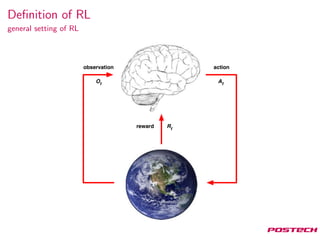
Definition of RL
general setting of RL
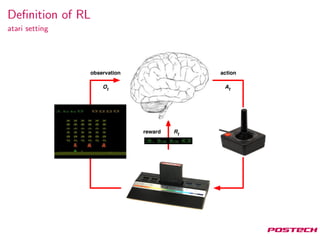
Definition of RL
atari setting
Outline
Reinforcement Learning
Definition of RL
Mathematical formulations
Algorithms
Neural Fitted Q Iteration
Deep Q Network
Double Deep Q Network
Prioritized Experience Replay
Dueling Network
Mathematical formulations
objective of RL
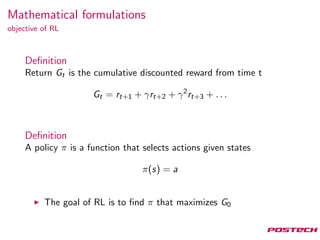
Definition
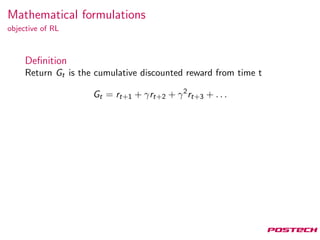
Return Gt is the cumulative discounted reward from time t
Gt = rt+1 + γrt+2 + γ2
rt+3 + . . .
Mathematical formulations
objective of RL
Definition
Return Gt is the cumulative discounted reward from time t
Gt = rt+1 + γrt+2 + γ2
rt+3 + . . .
Definition
A policy π is a function that selects actions given states
π(s) = a
The goal of RL is to find π that maximizes G0
Mathematical formulations
Q-Value
Gt =
∞
i=0
γk
rt+i+1
Definition
The action-value (Q-value) function Qπ(s, a) is the expectation of
Gt under taking action a, and then following policy π afterwards
Qπ(s, a) = Eπ[Gt|St = s, At = a, At+i = π(St+i )∀i ∈ N]
”How good is action a in state s?”
Mathematical formulations
Optimal Q-value
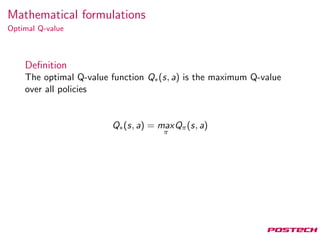
Definition
The optimal Q-value function Q∗(s, a) is the maximum Q-value
over all policies
Q∗(s, a) = max
π
Qπ(s, a)
Mathematical formulations
Optimal Q-value
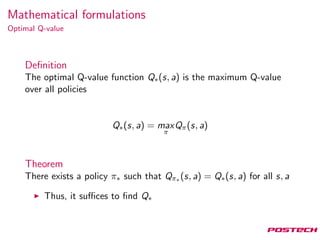
Definition
The optimal Q-value function Q∗(s, a) is the maximum Q-value
over all policies
Q∗(s, a) = max
π
Qπ(s, a)
Theorem
There exists a policy π∗ such that Qπ∗ (s, a) = Q∗(s, a) for all s, a
Thus, it suffices to find Q∗
Mathematical formulations
Q-Learning
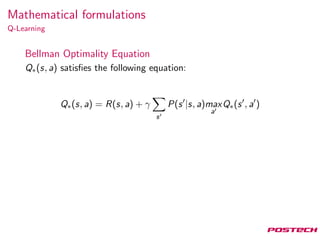
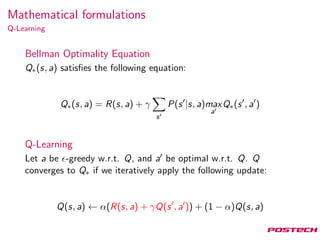
Bellman Optimality Equation
Q∗(s, a) satisfies the following equation:
Q∗(s, a) = R(s, a) + γ
s
P(s |s, a)max
a
Q∗(s , a )
Mathematical formulations
Q-Learning
Bellman Optimality Equation
Q∗(s, a) satisfies the following equation:
Q∗(s, a) = R(s, a) + γ
s
P(s |s, a)max
a
Q∗(s , a )
Q-Learning
Let a be -greedy w.r.t. Q, and a be optimal w.r.t. Q. Q
converges to Q∗ if we iteratively apply the following update:
Q(s, a) ← α(R(s, a) + γQ(s , a )) + (1 − α)Q(s, a)
Mathematical formulations
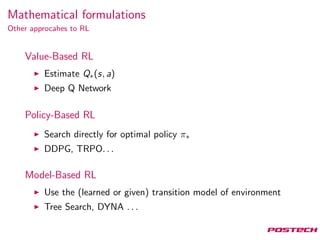
Other approcahes to RL
Value-Based RL
Estimate Q∗(s, a)
Deep Q Network
Policy-Based RL
Search directly for optimal policy π∗
DDPG, TRPO. . .
Model-Based RL
Use the (learned or given) transition model of environment
Tree Search, DYNA . . .
Outline
Reinforcement Learning
Definition of RL
Mathematical formulations
Algorithms
Neural Fitted Q Iteration
Deep Q Network
Double Deep Q Network
Prioritized Experience Replay
Dueling Network
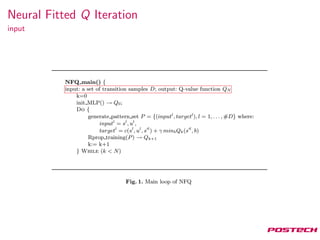
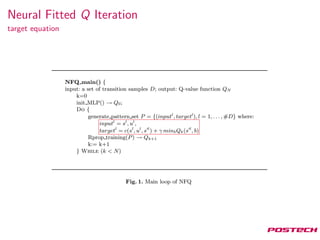
Neural Fitted Q Iteration
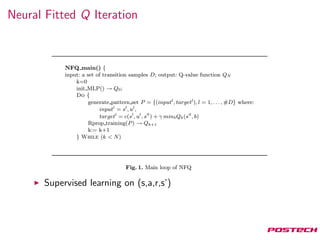
Supervised learning on (s,a,r,s’)
Neural Fitted Q Iteration
input
Neural Fitted Q Iteration
target equation
Neural Fitted Q Iteration
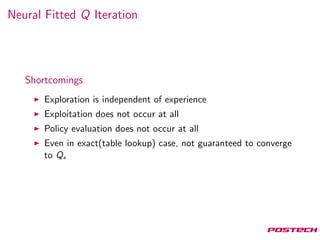
Shortcomings
Exploration is independent of experience
Exploitation does not occur at all
Policy evaluation does not occur at all
Even in exact(table lookup) case, not guaranteed to converge
to Q∗
Outline
Reinforcement Learning
Definition of RL
Mathematical formulations
Algorithms
Neural Fitted Q Iteration
Deep Q Network
Double Deep Q Network
Prioritized Experience Replay
Dueling Network
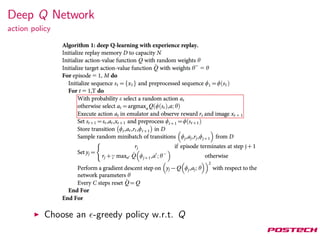
Deep Q Network
action policy
Choose an -greedy policy w.r.t. Q
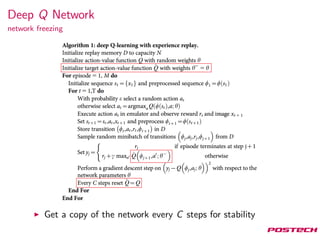
Deep Q Network
network freezing
Get a copy of the network every C steps for stability
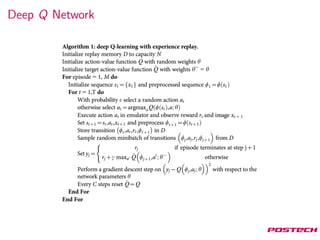
Deep Q Network
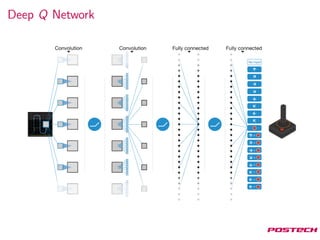
Deep Q Network
Deep Q Network
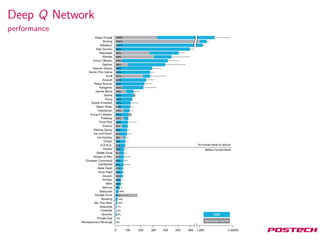
performance
Deep Q Network
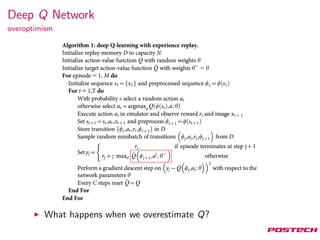
overoptimism
What happens when we overestimate Q?
Deep Q Network
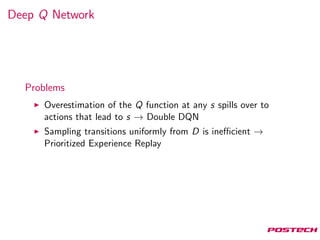
Problems
Overestimation of the Q function at any s spills over to
actions that lead to s → Double DQN
Sampling transitions uniformly from D is inefficient →
Prioritized Experience Replay
Outline
Reinforcement Learning
Definition of RL
Mathematical formulations
Algorithms
Neural Fitted Q Iteration
Deep Q Network
Double Deep Q Network
Prioritized Experience Replay
Dueling Network
Double Deep Q Network
target
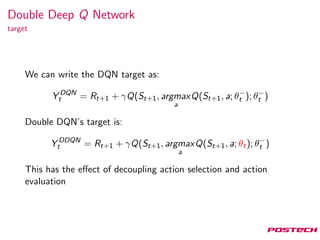
We can write the DQN target as:
Y DQN
t = Rt+1 + γQ(St+1, argmax
a
Q(St+1, a; θ−
t ); θ−
t )
Double DQN’s target is:
Y DDQN
t = Rt+1 + γQ(St+1, argmax
a
Q(St+1, a; θt); θ−
t )
This has the effect of decoupling action selection and action
evaluation
Double Deep Q Network
performance
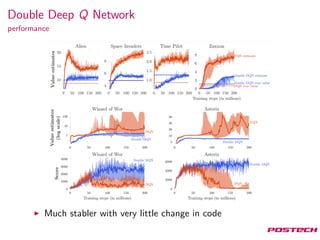
Much stabler with very little change in code
Outline
Reinforcement Learning
Definition of RL
Mathematical formulations
Algorithms
Neural Fitted Q Iteration
Deep Q Network
Double Deep Q Network
Prioritized Experience Replay
Dueling Network
Prioritized Experience Replay
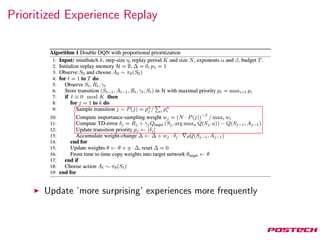
Update ’more surprising’ experiences more frequently
Outline
Reinforcement Learning
Definition of RL
Mathematical formulations
Algorithms
Neural Fitted Q Iteration
Deep Q Network
Double Deep Q Network
Prioritized Experience Replay
Dueling Network
Dueling Network
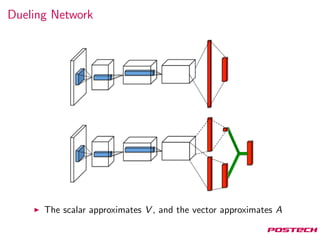
The scalar approximates V , and the vector approximates A
Dueling Network
forward pass equation
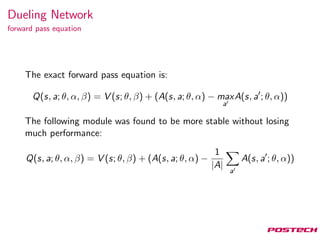
The exact forward pass equation is:
Q(s, a; θ, α, β) = V (s; θ, β) + (A(s, a; θ, α) − max
a
A(s, a ; θ, α))
The following module was found to be more stable without losing
much performance:
Q(s, a; θ, α, β) = V (s; θ, β) + (A(s, a; θ, α) −
1
|A|
a
A(s, a ; θ, α))
Dueling Network
attention
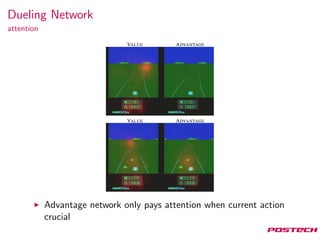
Advantage network only pays attention when current action
crucial
Dueling Network
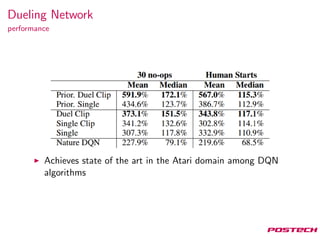
performance
Achieves state of the art in the Atari domain among DQN
algorithms
Dueling Network
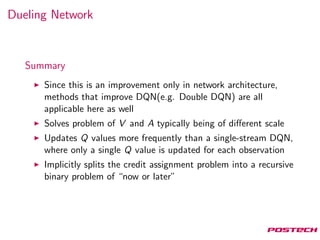
Summary
Since this is an improvement only in network architecture,
methods that improve DQN(e.g. Double DQN) are all
applicable here as well
Solves problem of V and A typically being of different scale
Updates Q values more frequently than a single-stream DQN,
where only a single Q value is updated for each observation
Implicitly splits the credit assignment problem into a recursive
binary problem of “now or later”
Dueling Network
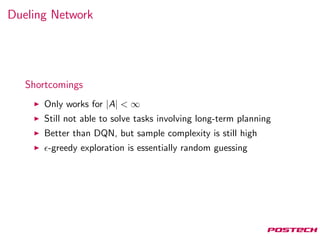
Shortcomings
Only works for |A| < ∞
Still not able to solve tasks involving long-term planning
Better than DQN, but sample complexity is still high
-greedy exploration is essentially random guessing

Dueling Network Architectures for Deep Reinforcement Learning