Lab Seminar
Deep Reinforcement Learning
with Double Q-Learning
Seunghyeok Back
2018. 11. 05
Graduate Student in MS&ph.D integrated course
Artificial intelligence Lab
shback@gist.ac.kr
School of Integrated Technology (SIT)
Gwangju Institute of Science and Technology (GIST)
Introduction
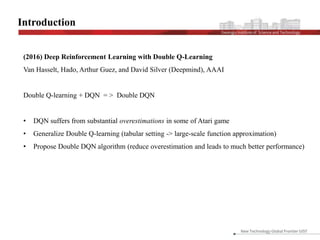
(2016) Deep Reinforcement Learning with Double Q-Learning
Van Hasselt, Hado, Arthur Guez, and David Silver (Deepmind), AAAI
Double Q-learning + DQN = > Double DQN
• DQN suffers from substantial overestimations in some of Atari game
• Generalize Double Q-learning (tabular setting -> large-scale function approximation)
• Propose Double DQN algorithm (reduce overestimation and leads to much better performance)
RL goal: Find optimal policy
Q-learning: Find optimal policy using action-value function
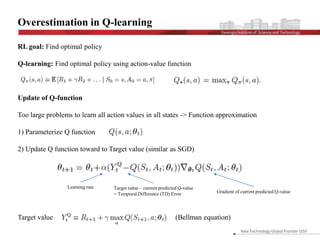
Update of Q-function
Too large problems to learn all action values in all states -> Function approximation
1) Parameterize Q function
2) Update Q function toward to Target value (similar as SGD)
Target value (Bellman equation)
Overestimation in Q-learning
Target value – current predicted Q-value
= Temporal Difference (TD) Error
Learning rate
Gradient of current predicted Q-value
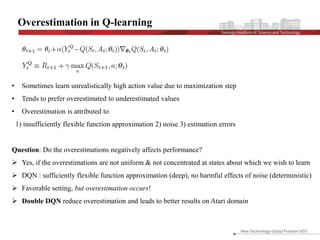
• Sometimes learn unrealistically high action value due to maximization step
• Tends to prefer overestimated to underestimated values
• Overestimation is attributed to
1) insufficiently flexible function approximation 2) noise 3) estimation errors
Question: Do the overestimations negatively affects performance?
 Yes, if the overestimations are not uniform & not concentrated at states about which we wish to learn
 DQN : sufficiently flexible function approximation (deep), no harmful effects of noise (deterministic)
 Favorable setting, but overestimation occurs!
 Double DQN reduce overestimation and leads to better results on Atari domain
Overestimation in Q-learning
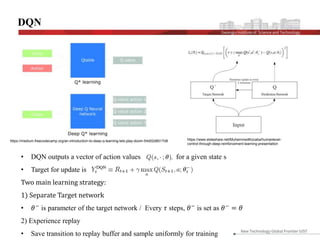
• DQN outputs a vector of action values for a given state s
• Target for update is
Two main learning strategy:
1) Separate Target network
• 𝜃−
is parameter of the target network / Every 𝜏 steps, 𝜃−
is set as 𝜃−
= 𝜃
2) Experience replay
• Save transition to replay buffer and sample uniformly for training
DQN
https://medium.freecodecamp.org/an-introduction-to-deep-q-learning-lets-play-doom-54d02d8017d8 https://www.slideshare.net/MuhammedKocaba/humanlevel-
control-through-deep-reinforcement-learning-presentation
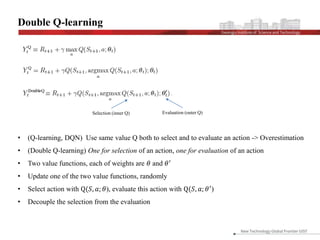
• (Q-learning, DQN) Use same value Q both to select and to evaluate an action -> Overestimation
• (Double Q-learning) One for selection of an action, one for evaluation of an action
• Two value functions, each of weights are 𝜃 and 𝜃′
• Update one of the two value functions, randomly
• Select action with Q(𝑆, 𝑎; 𝜃), evaluate this action with Q(𝑆, 𝑎; 𝜃′
)
• Decouple the selection from the evaluation
Double Q-learning
Selection (inner Q) Evaluation (outer Q)
Use target network as a second value function without introducing additional networks
Double Q-learning
• Pick one from two value function and update
• Each value function can be used for both evaluation and selection
Double DQN
• Target network Q(𝑆, 𝑎; 𝜃−
) is used only for the evaluation, not for the selection
• Remains a periodic copy of the online network to the target network
• Value functions are not fully decoupled from each other
• Minimal possible change of DQN towards Double Q-learning
• Get most of the benefit of Double Q-learning, while keeping the rest of the DQN
• Fair comparison and minimal computational overhead
Double DQN
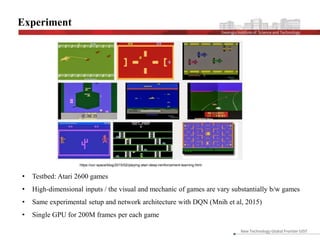
• Testbed: Atari 2600 games
• High-dimensional inputs / the visual and mechanic of games are vary substantially b/w games
• Same experimental setup and network architecture with DQN (Mnih et al, 2015)
• Single GPU for 200M frames per each game
Experiment
https://ocr.space/blog/2015/02/playing-atari-deep-reinforcement-learning.html
Results on overoptimism
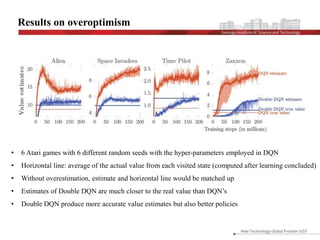
• 6 Atari games with 6 different random seeds with the hyper-parameters employed in DQN
• Horizontal line: average of the actual value from each visited state (computed after learning concluded)
• Without overestimation, estimate and horizontal line would be matched up
• Estimates of Double DQN are much closer to the real value than DQN’s
• Double DQN produce more accurate value estimates but also better policies
Results on overoptimism
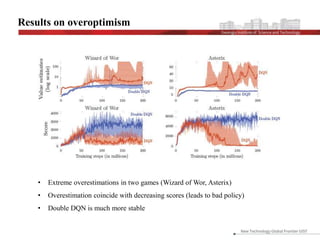
• Extreme overestimations in two games (Wizard of Wor, Asterix)
• Overestimation coincide with decreasing scores (leads to bad policy)
• Double DQN is much more stable
Quality of the learned policies
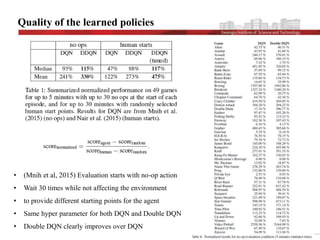
• (Mnih et al, 2015) Evaluation starts with no-op action
• Wait 30 times while not affecting the environment
• to provide different starting points for the agent
• Same hyper parameter for both DQN and Double DQN
• Double DQN clearly improves over DQN
Quality of the learned policies
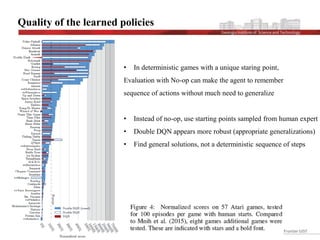
• In deterministic games with a unique staring point,
Evaluation with No-op can make the agent to remember
sequence of actions without much need to generalize
• Instead of no-op, use starting points sampled from human expert
• Double DQN appears more robust (appropriate generalizations)
• Find general solutions, not a deterministic sequence of steps

deep reinforcement learning with double q learning

  • 1.
    Lab Seminar Deep ReinforcementLearning with Double Q-Learning Seunghyeok Back 2018. 11. 05 Graduate Student in MS&ph.D integrated course Artificial intelligence Lab shback@gist.ac.kr School of Integrated Technology (SIT) Gwangju Institute of Science and Technology (GIST)
  • 2.
    Introduction (2016) Deep ReinforcementLearning with Double Q-Learning Van Hasselt, Hado, Arthur Guez, and David Silver (Deepmind), AAAI Double Q-learning + DQN = > Double DQN • DQN suffers from substantial overestimations in some of Atari game • Generalize Double Q-learning (tabular setting -> large-scale function approximation) • Propose Double DQN algorithm (reduce overestimation and leads to much better performance)
  • 3.
    RL goal: Findoptimal policy Q-learning: Find optimal policy using action-value function Update of Q-function Too large problems to learn all action values in all states -> Function approximation 1) Parameterize Q function 2) Update Q function toward to Target value (similar as SGD) Target value (Bellman equation) Overestimation in Q-learning Target value – current predicted Q-value = Temporal Difference (TD) Error Learning rate Gradient of current predicted Q-value
  • 4.
    • Sometimes learnunrealistically high action value due to maximization step • Tends to prefer overestimated to underestimated values • Overestimation is attributed to 1) insufficiently flexible function approximation 2) noise 3) estimation errors Question: Do the overestimations negatively affects performance?  Yes, if the overestimations are not uniform & not concentrated at states about which we wish to learn  DQN : sufficiently flexible function approximation (deep), no harmful effects of noise (deterministic)  Favorable setting, but overestimation occurs!  Double DQN reduce overestimation and leads to better results on Atari domain Overestimation in Q-learning
  • 5.
    • DQN outputsa vector of action values for a given state s • Target for update is Two main learning strategy: 1) Separate Target network • 𝜃− is parameter of the target network / Every 𝜏 steps, 𝜃− is set as 𝜃− = 𝜃 2) Experience replay • Save transition to replay buffer and sample uniformly for training DQN https://medium.freecodecamp.org/an-introduction-to-deep-q-learning-lets-play-doom-54d02d8017d8 https://www.slideshare.net/MuhammedKocaba/humanlevel- control-through-deep-reinforcement-learning-presentation
  • 6.
    • (Q-learning, DQN)Use same value Q both to select and to evaluate an action -> Overestimation • (Double Q-learning) One for selection of an action, one for evaluation of an action • Two value functions, each of weights are 𝜃 and 𝜃′ • Update one of the two value functions, randomly • Select action with Q(𝑆, 𝑎; 𝜃), evaluate this action with Q(𝑆, 𝑎; 𝜃′ ) • Decouple the selection from the evaluation Double Q-learning Selection (inner Q) Evaluation (outer Q)
  • 7.
    Use target networkas a second value function without introducing additional networks Double Q-learning • Pick one from two value function and update • Each value function can be used for both evaluation and selection Double DQN • Target network Q(𝑆, 𝑎; 𝜃− ) is used only for the evaluation, not for the selection • Remains a periodic copy of the online network to the target network • Value functions are not fully decoupled from each other • Minimal possible change of DQN towards Double Q-learning • Get most of the benefit of Double Q-learning, while keeping the rest of the DQN • Fair comparison and minimal computational overhead Double DQN
  • 8.
    • Testbed: Atari2600 games • High-dimensional inputs / the visual and mechanic of games are vary substantially b/w games • Same experimental setup and network architecture with DQN (Mnih et al, 2015) • Single GPU for 200M frames per each game Experiment https://ocr.space/blog/2015/02/playing-atari-deep-reinforcement-learning.html
  • 9.
    Results on overoptimism •6 Atari games with 6 different random seeds with the hyper-parameters employed in DQN • Horizontal line: average of the actual value from each visited state (computed after learning concluded) • Without overestimation, estimate and horizontal line would be matched up • Estimates of Double DQN are much closer to the real value than DQN’s • Double DQN produce more accurate value estimates but also better policies
  • 10.
    Results on overoptimism •Extreme overestimations in two games (Wizard of Wor, Asterix) • Overestimation coincide with decreasing scores (leads to bad policy) • Double DQN is much more stable
  • 11.
    Quality of thelearned policies • (Mnih et al, 2015) Evaluation starts with no-op action • Wait 30 times while not affecting the environment • to provide different starting points for the agent • Same hyper parameter for both DQN and Double DQN • Double DQN clearly improves over DQN
  • 12.
    Quality of thelearned policies • In deterministic games with a unique staring point, Evaluation with No-op can make the agent to remember sequence of actions without much need to generalize • Instead of no-op, use starting points sampled from human expert • Double DQN appears more robust (appropriate generalizations) • Find general solutions, not a deterministic sequence of steps