Modular Multitask Reinforcement Learning with
Policy Sketches
Yoonho Lee
Department of Computer Science and Engineering
Pohang University of Science and Technology
August 09, 2017
Modular Multitask Reinforcement Learning with Policy
Sketches
ICML 2017 Best Paper Honorable Mention
Hierarchical Reinforcement Learning
Proposes a looser form of task supervision for RL agents
(compared to e.g. reward shaping)
Proposed form of task supervision is decoupled from the
environment
Proposes a new way to use NNs for hierarchical RL
Natural extensions to zero-shot and unlabelled RL
Hierarchical Reinforcement Learning
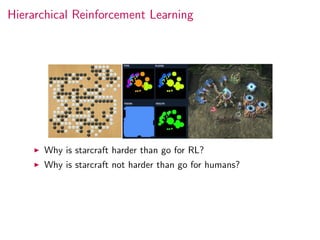
Why is starcraft harder than go for RL?
Why is starcraft not harder than go for humans?
Hierarchical Reinforcement Learning
Decision = Action. RL algorithms are designed with decisions
in mind, but operate on actions.
Real world decisions have hierarchical structure(e.g. cook
dinner → cut potato → activate arm muscle)
Effective knowledge reuse
Effecient credit assignment
Open question: How do we discover salient/reusable
decisions?
Previous Work
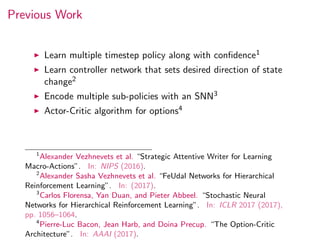
Learn multiple timestep policy along with confidence1
Learn controller network that sets desired direction of state
change2
Encode multiple sub-policies with an SNN3
Actor-Critic algorithm for options4
1
Alexander Vezhnevets et al. “Strategic Attentive Writer for Learning
Macro-Actions”. In: NIPS (2016).
2
Alexander Sasha Vezhnevets et al. “FeUdal Networks for Hierarchical
Reinforcement Learning”. In: (2017).
3
Carlos Florensa, Yan Duan, and Pieter Abbeel. “Stochastic Neural
Networks for Hierarchical Reinforcement Learning”. In: ICLR 2017 (2017),
pp. 1056–1064.
4
Pierre-Luc Bacon, Jean Harb, and Doina Precup. “The Option-Critic
Architecture”. In: AAAI (2017).
Previous Work
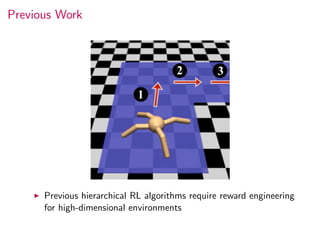
Previous hierarchical RL algorithms require reward engineering
for high-dimensional environments
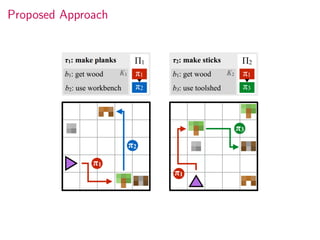
Proposed Approach
Proposed Approach
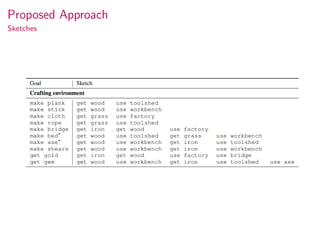
Sketches
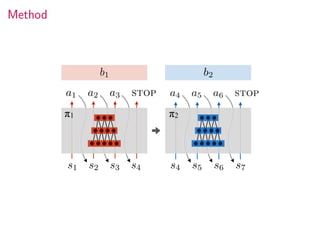
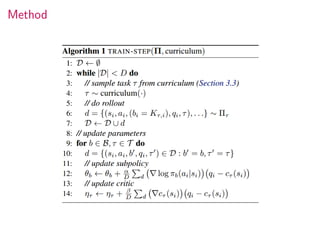
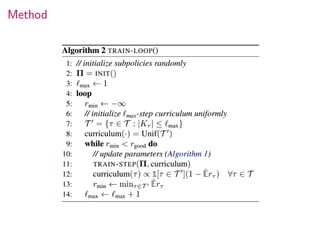
Method
Method
Method
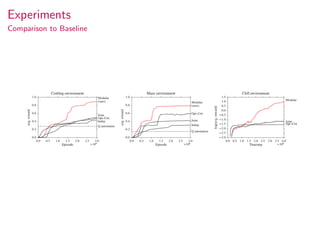
Experiments
Comparison to Baseline
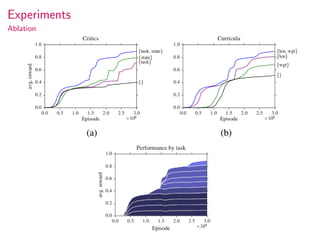
Experiments
Ablation
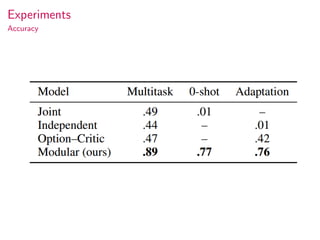
Experiments
Accuracy
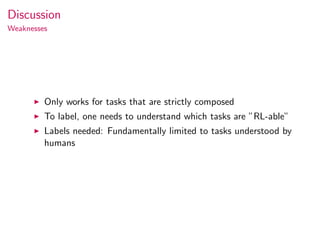
Discussion
Weaknesses
Only works for tasks that are strictly composed
To label, one needs to understand which tasks are ”RL-able”
Labels needed: Fundamentally limited to tasks understood by
humans
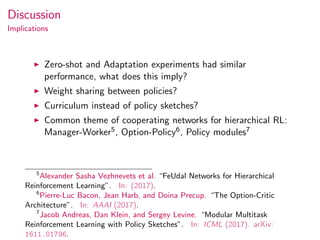
Discussion
Implications
Zero-shot and Adaptation experiments had similar
performance, what does this imply?
Weight sharing between policies?
Curriculum instead of policy sketches?
Common theme of cooperating networks for hierarchical RL:
Manager-Worker5, Option-Policy6, Policy modules7
5
Alexander Sasha Vezhnevets et al. “FeUdal Networks for Hierarchical
Reinforcement Learning”. In: (2017).
6
Pierre-Luc Bacon, Jean Harb, and Doina Precup. “The Option-Critic
Architecture”. In: AAAI (2017).
7
Jacob Andreas, Dan Klein, and Sergey Levine. “Modular Multitask
Reinforcement Learning with Policy Sketches”. In: ICML (2017). arXiv:
1611.01796.
References I
[1] Jacob Andreas, Dan Klein, and Sergey Levine. “Modular
Multitask Reinforcement Learning with Policy Sketches”. In:
ICML (2017). arXiv: 1611.01796.
[2] Pierre-Luc Bacon, Jean Harb, and Doina Precup. “The
Option-Critic Architecture”. In: AAAI (2017).
[3] Carlos Florensa, Yan Duan, and Pieter Abbeel. “Stochastic
Neural Networks for Hierarchical Reinforcement Learning”.
In: ICLR 2017 (2017), pp. 1056–1064.
[4] Alexander Vezhnevets et al. “Strategic Attentive Writer for
Learning Macro-Actions”. In: NIPS (2016).
[5] Alexander Sasha Vezhnevets et al. “FeUdal Networks for
Hierarchical Reinforcement Learning”. In: (2017).
Thank You

Modular Multitask Reinforcement Learning with Policy Sketches

  • 1.
    Modular Multitask ReinforcementLearning with Policy Sketches Yoonho Lee Department of Computer Science and Engineering Pohang University of Science and Technology August 09, 2017
  • 2.
    Modular Multitask ReinforcementLearning with Policy Sketches ICML 2017 Best Paper Honorable Mention Hierarchical Reinforcement Learning Proposes a looser form of task supervision for RL agents (compared to e.g. reward shaping) Proposed form of task supervision is decoupled from the environment Proposes a new way to use NNs for hierarchical RL Natural extensions to zero-shot and unlabelled RL
  • 3.
    Hierarchical Reinforcement Learning Whyis starcraft harder than go for RL? Why is starcraft not harder than go for humans?
  • 4.
    Hierarchical Reinforcement Learning Decision= Action. RL algorithms are designed with decisions in mind, but operate on actions. Real world decisions have hierarchical structure(e.g. cook dinner → cut potato → activate arm muscle) Effective knowledge reuse Effecient credit assignment Open question: How do we discover salient/reusable decisions?
  • 5.
    Previous Work Learn multipletimestep policy along with confidence1 Learn controller network that sets desired direction of state change2 Encode multiple sub-policies with an SNN3 Actor-Critic algorithm for options4 1 Alexander Vezhnevets et al. “Strategic Attentive Writer for Learning Macro-Actions”. In: NIPS (2016). 2 Alexander Sasha Vezhnevets et al. “FeUdal Networks for Hierarchical Reinforcement Learning”. In: (2017). 3 Carlos Florensa, Yan Duan, and Pieter Abbeel. “Stochastic Neural Networks for Hierarchical Reinforcement Learning”. In: ICLR 2017 (2017), pp. 1056–1064. 4 Pierre-Luc Bacon, Jean Harb, and Doina Precup. “The Option-Critic Architecture”. In: AAAI (2017).
  • 6.
    Previous Work Previous hierarchicalRL algorithms require reward engineering for high-dimensional environments
  • 7.
  • 8.
  • 9.
  • 10.
  • 11.
  • 12.
  • 13.
  • 14.
  • 15.
    Discussion Weaknesses Only works fortasks that are strictly composed To label, one needs to understand which tasks are ”RL-able” Labels needed: Fundamentally limited to tasks understood by humans
  • 16.
    Discussion Implications Zero-shot and Adaptationexperiments had similar performance, what does this imply? Weight sharing between policies? Curriculum instead of policy sketches? Common theme of cooperating networks for hierarchical RL: Manager-Worker5, Option-Policy6, Policy modules7 5 Alexander Sasha Vezhnevets et al. “FeUdal Networks for Hierarchical Reinforcement Learning”. In: (2017). 6 Pierre-Luc Bacon, Jean Harb, and Doina Precup. “The Option-Critic Architecture”. In: AAAI (2017). 7 Jacob Andreas, Dan Klein, and Sergey Levine. “Modular Multitask Reinforcement Learning with Policy Sketches”. In: ICML (2017). arXiv: 1611.01796.
  • 17.
    References I [1] JacobAndreas, Dan Klein, and Sergey Levine. “Modular Multitask Reinforcement Learning with Policy Sketches”. In: ICML (2017). arXiv: 1611.01796. [2] Pierre-Luc Bacon, Jean Harb, and Doina Precup. “The Option-Critic Architecture”. In: AAAI (2017). [3] Carlos Florensa, Yan Duan, and Pieter Abbeel. “Stochastic Neural Networks for Hierarchical Reinforcement Learning”. In: ICLR 2017 (2017), pp. 1056–1064. [4] Alexander Vezhnevets et al. “Strategic Attentive Writer for Learning Macro-Actions”. In: NIPS (2016). [5] Alexander Sasha Vezhnevets et al. “FeUdal Networks for Hierarchical Reinforcement Learning”. In: (2017).
  • 18.