Continuous control with deep
reinforcement learning
2016-06-28
Taehoon Kim
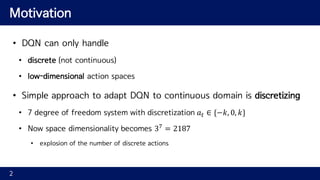
Motivation
• DQN can only handle
• discrete (not continuous)
• low-dimensional action spaces
• Simple approach to adapt DQN to continuous domain is discretizing
• 7 degree of freedom system with discretization 𝑎" ∈ {−𝑘, 0, 𝑘}
• Now space dimensionality becomes 3+
= 2187
• explosion of the number of discrete actions
2
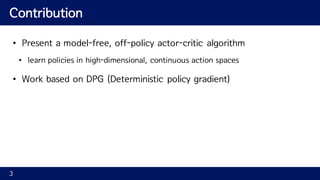
Contribution
• Present a model-free, off-policy actor-critic algorithm
• learn policies in high-dimensional, continuous action spaces
• Work based on DPG (Deterministic policy gradient)
3
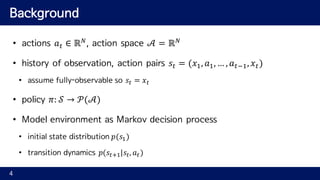
Background
• actions 𝑎" ∈ ℝ2
, action space 𝒜 = ℝ2
• history of observation, action pairs 𝑠" = (𝑥7, 𝑎7, … , 𝑎"97, 𝑥")
• assume fully-observable so 𝑠" = 𝑥"
• policy 𝜋: 𝒮 → 𝒫(𝒜)
• Model environment as Markov decision process
• initial state distribution 𝑝(𝑠7)
• transition dynamics 𝑝(𝑠"A7|𝑠", 𝑎")
4
Background
• Discounted future reward 𝑅" = ∑ 𝛾F9"
𝑟(𝑠F, 𝑎F)H
FI"
• Goal of RL is to learn a policy 𝜋 which maximizes the expected return
• from the start distribution 𝐽 = 𝔼LM ,NM~P,QM~R[𝑅7]
• Discounted state visitation distribution for a policy 𝜋: ρR
5
Background
• action-value function 𝑄R
𝑠", 𝑎" = 𝔼LMW",NMXY~P,QMXY~R[𝑅"|𝑠", 𝑎"]
• expected return after taking an action 𝑎" in state 𝑠" and following policy 𝜋
• Bellman equation
• 𝑄R
𝑠", 𝑎" = 𝔼LY,NYZ[~P[𝑟 𝑠", 𝑎" + 𝛾𝔼QYZ[~R 𝑄R
(𝑠"A7, 𝑎"A7) ]
• With deterministic policy 𝜇: 𝒮 → 𝒜
• 𝑄^
𝑠", 𝑎" = 𝔼LY,NYZ[~P[𝑟 𝑠", 𝑎" + 𝛾𝑄^
𝑠"A7, 𝜇(𝑠"A7 )]
6
Background
• Expectation only depends on the environment
• possible to learn 𝑄 𝝁
off-policy, where transitions are generated from
different stochastic policy 𝜷
• Q-learning with greedy policy 𝜇 𝑠 = arg max
f
𝑄 𝑠, 𝑎
• 𝐿 𝜃i
= 𝔼NY~jk,QY~l,NY~P[ 𝑄 𝑠", 𝑎" 𝜃i
− 𝑦"
n
]
• where 𝑦" = 𝑟 𝑠", 𝑎" + 𝛾𝑄(𝑠"A7, 𝜇(𝑠"A7)|𝜃i
)
• To scale Q-learning into large non-linear approximators:
• a replay buffer, a separate target network
7
(a	commonly	used	off-policy algorithm)
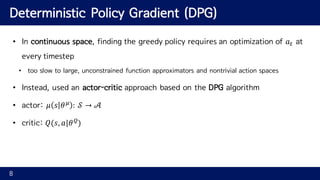
Deterministic Policy Gradient (DPG)
• In continuous space, finding the greedy policy requires an optimization of 𝑎" at
every timestep
• too slow to large, unconstrained function approximators and nontrivial action spaces
• Instead, used an actor-critic approach based on the DPG algorithm
• actor: 𝜇 𝑠 𝜃^
: 	𝒮 → 𝒜
• critic: 𝑄(𝑠, 𝑎|𝜃i
)
8
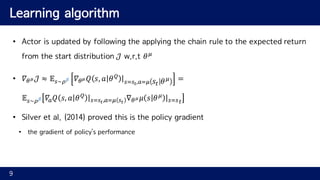
Learning algorithm
• Actor is updated by following the applying the chain rule to the expected return
from the start distribution 𝒥 w.r.t 𝜃^
• 𝛻rs 𝒥 ≈ 𝔼N~j 𝜷 𝛻rs 𝑄 𝑠, 𝑎 𝜃i |NINY,QI^ 𝑠" 𝜃^ =
𝔼N~j 𝜷 𝛻Q 𝑄 𝑠, 𝑎 𝜃i |NINY,QI^ NY
∇rs 𝜇 𝑠 𝜃^ |NIN"
• Silver et al. (2014) proved this is the policy gradient
• the gradient of policy’s performance
9
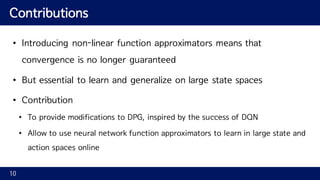
Contributions
• Introducing non-linear function approximators means that
convergence is no longer guaranteed
• But essential to learn and generalize on large state spaces
• Contribution
• To provide modifications to DPG, inspired by the success of DQN
• Allow to use neural network function approximators to learn in large state and
action spaces online
10
Challenges 1
• NN for RL usually assume that the samples are i.i.d.
• but when the samples are generated from exploring sequentially in an environment,
this assumption no longer holds.
• As DQN, we use replay buffer to address this issue
• As DQN, we used target network for stable learning but use “soft” target
updates
• 𝜃` ← 𝜏𝜃 + 1 − 𝜏 𝜃`, with 𝜏 ≪ 1
• Target network slowly change that greatly improve the stability of learning
11
Challenges 2
• When learning from low dimensional feature vector, observations may have
different physical units (i.e. positions and velocities)
• make it difficult to learn effectively and also to find hyper-parameters which generalize across
environments
• Use batch normalization [Ioffe & Szegedy, 2015] to normalize each dimension
across the samples in a minibatch to have unit mean and variance
• Also maintains a running average of the mean and variance for normalization during testing
• Use all layers of 𝜇 and 𝑄 prior to the action input
• Can train different units without needing to manually ensure the units were within a set range
12
(exploration	or	evaluation)
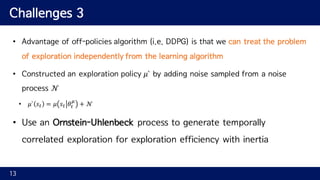
Challenges 3
• Advantage of off-policies algorithm (i.e. DDPG) is that we can treat the problem
of exploration independently from the learning algorithm
• Constructed an exploration policy 𝜇` by adding noise sampled from a noise
process 𝒩
• 𝜇` 𝑠" = 𝜇 𝑠" 𝜃"
^
+ 𝒩
• Use an Ornstein-Uhlenbeck process to generate temporally
correlated exploration for exploration efficiency with inertia
13
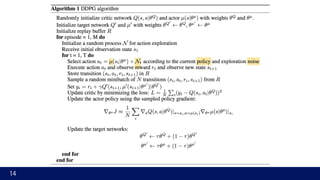
14
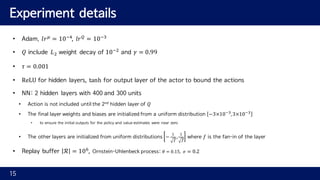
Experiment details
• Adam. 𝑙𝑟^
= 109|
, 𝑙𝑟i
= 109}
• 𝑄 include 𝐿n weight decay of 109n
and 𝛾 = 0.99
• 𝜏 = 0.001
• ReLU for hidden layers, tanh for output layer of the actor to bound the actions
• NN: 2 hidden layers with 400 and 300 units
• Action is not included until the 2nd hidden layer of 𝑄
• The final layer weights and biases are initialized from a uniform distribution −3×10⁹}
,3×109}
• to ensure the initial outputs for the policy and value estimates were near zero
• The other layers are initialized from uniform distributions −
7
•
,
7
•
where 𝑓 is the fan-in of the layer
• Replay buffer ℛ = 10„
, Ornstein-Uhlenbeck process: 𝜃 = 0.15, 𝜎 = 0.2
15
References
1. [Wang, 2015] Wang, Z., de Freitas, N., & Lanctot, M. (2015). Dueling network architectures for
deep reinforcement learning. arXiv preprint arXiv:1511.06581.
2. [Van, 2015] Van Hasselt, H., Guez, A., & Silver, D. (2015). Deep reinforcement learning with
double Q-learning. CoRR, abs/1509.06461.
3. [Schaul, 2015] Schaul, T., Quan, J., Antonoglou, I., & Silver, D. (2015). Prioritized experience
replay. arXiv preprint arXiv:1511.05952.
4. [Sutton, 1998] Sutton, R. S., & Barto, A. G. (1998). Reinforcement learning: An introduction(Vol.
1, No. 1). Cambridge: MIT press.
16

Continuous control with deep reinforcement learning (DDPG)

  • 1.
    Continuous control withdeep reinforcement learning 2016-06-28 Taehoon Kim
  • 2.
    Motivation • DQN canonly handle • discrete (not continuous) • low-dimensional action spaces • Simple approach to adapt DQN to continuous domain is discretizing • 7 degree of freedom system with discretization 𝑎" ∈ {−𝑘, 0, 𝑘} • Now space dimensionality becomes 3+ = 2187 • explosion of the number of discrete actions 2
  • 3.
    Contribution • Present amodel-free, off-policy actor-critic algorithm • learn policies in high-dimensional, continuous action spaces • Work based on DPG (Deterministic policy gradient) 3
  • 4.
    Background • actions 𝑎"∈ ℝ2 , action space 𝒜 = ℝ2 • history of observation, action pairs 𝑠" = (𝑥7, 𝑎7, … , 𝑎"97, 𝑥") • assume fully-observable so 𝑠" = 𝑥" • policy 𝜋: 𝒮 → 𝒫(𝒜) • Model environment as Markov decision process • initial state distribution 𝑝(𝑠7) • transition dynamics 𝑝(𝑠"A7|𝑠", 𝑎") 4
  • 5.
    Background • Discounted futurereward 𝑅" = ∑ 𝛾F9" 𝑟(𝑠F, 𝑎F)H FI" • Goal of RL is to learn a policy 𝜋 which maximizes the expected return • from the start distribution 𝐽 = 𝔼LM ,NM~P,QM~R[𝑅7] • Discounted state visitation distribution for a policy 𝜋: ρR 5
  • 6.
    Background • action-value function𝑄R 𝑠", 𝑎" = 𝔼LMW",NMXY~P,QMXY~R[𝑅"|𝑠", 𝑎"] • expected return after taking an action 𝑎" in state 𝑠" and following policy 𝜋 • Bellman equation • 𝑄R 𝑠", 𝑎" = 𝔼LY,NYZ[~P[𝑟 𝑠", 𝑎" + 𝛾𝔼QYZ[~R 𝑄R (𝑠"A7, 𝑎"A7) ] • With deterministic policy 𝜇: 𝒮 → 𝒜 • 𝑄^ 𝑠", 𝑎" = 𝔼LY,NYZ[~P[𝑟 𝑠", 𝑎" + 𝛾𝑄^ 𝑠"A7, 𝜇(𝑠"A7 )] 6
  • 7.
    Background • Expectation onlydepends on the environment • possible to learn 𝑄 𝝁 off-policy, where transitions are generated from different stochastic policy 𝜷 • Q-learning with greedy policy 𝜇 𝑠 = arg max f 𝑄 𝑠, 𝑎 • 𝐿 𝜃i = 𝔼NY~jk,QY~l,NY~P[ 𝑄 𝑠", 𝑎" 𝜃i − 𝑦" n ] • where 𝑦" = 𝑟 𝑠", 𝑎" + 𝛾𝑄(𝑠"A7, 𝜇(𝑠"A7)|𝜃i ) • To scale Q-learning into large non-linear approximators: • a replay buffer, a separate target network 7 (a commonly used off-policy algorithm)
  • 8.
    Deterministic Policy Gradient(DPG) • In continuous space, finding the greedy policy requires an optimization of 𝑎" at every timestep • too slow to large, unconstrained function approximators and nontrivial action spaces • Instead, used an actor-critic approach based on the DPG algorithm • actor: 𝜇 𝑠 𝜃^ : 𝒮 → 𝒜 • critic: 𝑄(𝑠, 𝑎|𝜃i ) 8
  • 9.
    Learning algorithm • Actoris updated by following the applying the chain rule to the expected return from the start distribution 𝒥 w.r.t 𝜃^ • 𝛻rs 𝒥 ≈ 𝔼N~j 𝜷 𝛻rs 𝑄 𝑠, 𝑎 𝜃i |NINY,QI^ 𝑠" 𝜃^ = 𝔼N~j 𝜷 𝛻Q 𝑄 𝑠, 𝑎 𝜃i |NINY,QI^ NY ∇rs 𝜇 𝑠 𝜃^ |NIN" • Silver et al. (2014) proved this is the policy gradient • the gradient of policy’s performance 9
  • 10.
    Contributions • Introducing non-linearfunction approximators means that convergence is no longer guaranteed • But essential to learn and generalize on large state spaces • Contribution • To provide modifications to DPG, inspired by the success of DQN • Allow to use neural network function approximators to learn in large state and action spaces online 10
  • 11.
    Challenges 1 • NNfor RL usually assume that the samples are i.i.d. • but when the samples are generated from exploring sequentially in an environment, this assumption no longer holds. • As DQN, we use replay buffer to address this issue • As DQN, we used target network for stable learning but use “soft” target updates • 𝜃` ← 𝜏𝜃 + 1 − 𝜏 𝜃`, with 𝜏 ≪ 1 • Target network slowly change that greatly improve the stability of learning 11
  • 12.
    Challenges 2 • Whenlearning from low dimensional feature vector, observations may have different physical units (i.e. positions and velocities) • make it difficult to learn effectively and also to find hyper-parameters which generalize across environments • Use batch normalization [Ioffe & Szegedy, 2015] to normalize each dimension across the samples in a minibatch to have unit mean and variance • Also maintains a running average of the mean and variance for normalization during testing • Use all layers of 𝜇 and 𝑄 prior to the action input • Can train different units without needing to manually ensure the units were within a set range 12 (exploration or evaluation)
  • 13.
    Challenges 3 • Advantageof off-policies algorithm (i.e. DDPG) is that we can treat the problem of exploration independently from the learning algorithm • Constructed an exploration policy 𝜇` by adding noise sampled from a noise process 𝒩 • 𝜇` 𝑠" = 𝜇 𝑠" 𝜃" ^ + 𝒩 • Use an Ornstein-Uhlenbeck process to generate temporally correlated exploration for exploration efficiency with inertia 13
  • 14.
  • 15.
    Experiment details • Adam.𝑙𝑟^ = 109| , 𝑙𝑟i = 109} • 𝑄 include 𝐿n weight decay of 109n and 𝛾 = 0.99 • 𝜏 = 0.001 • ReLU for hidden layers, tanh for output layer of the actor to bound the actions • NN: 2 hidden layers with 400 and 300 units • Action is not included until the 2nd hidden layer of 𝑄 • The final layer weights and biases are initialized from a uniform distribution −3×10⁹} ,3×109} • to ensure the initial outputs for the policy and value estimates were near zero • The other layers are initialized from uniform distributions − 7 • , 7 • where 𝑓 is the fan-in of the layer • Replay buffer ℛ = 10„ , Ornstein-Uhlenbeck process: 𝜃 = 0.15, 𝜎 = 0.2 15
  • 16.
    References 1. [Wang, 2015]Wang, Z., de Freitas, N., & Lanctot, M. (2015). Dueling network architectures for deep reinforcement learning. arXiv preprint arXiv:1511.06581. 2. [Van, 2015] Van Hasselt, H., Guez, A., & Silver, D. (2015). Deep reinforcement learning with double Q-learning. CoRR, abs/1509.06461. 3. [Schaul, 2015] Schaul, T., Quan, J., Antonoglou, I., & Silver, D. (2015). Prioritized experience replay. arXiv preprint arXiv:1511.05952. 4. [Sutton, 1998] Sutton, R. S., & Barto, A. G. (1998). Reinforcement learning: An introduction(Vol. 1, No. 1). Cambridge: MIT press. 16