Python Certification Training For Data Science www.edureka.co/python
Agenda
Introduction To Machine Learning
1
What is Reinforcement Learning?
2
Reinforcement Learning with an
Analogy3
Reinforcement Learning Process
4
Reinforcement Learning – Counter
strike example5
Reinforcement Learning Definitions
6
Reinforcement Learning Concepts
7
Markov’s Decision Process
8
Understanding Q-Learning
9
Hands-On
10
Python Certification Training For Data Science www.edureka.co/python
Introduction To Machine Learning
Python Certification Training For Data Science www.edureka.co/python
What Is Machine Learning?
Machine learning is a subset of artificial intelligence (AI) which provides machines the ability to learn automatically &
improve from experience without being explicitly programmed.
They look the same!
Cherry
Apple
Orange
Data
Algorithm
Python Certification Training For Data Science www.edureka.co/python
Types Of Machine Learning
Reinforcement LearningSupervised Learning Unsupervised Learning
Python Certification Training For Data Science www.edureka.co/python
What Is Reinforcement Learning?
Python Certification Training For Data Science www.edureka.co/python
What Is Reinforcement Learning?
Reinforcement learning is a type of Machine Learning where an agent learns to behave in a
environment by performing actions and seeing the results
Python Certification Training For Data Science www.edureka.co/python
Reinforcement Learning With
An Analogy
Python Certification Training For Data Science www.edureka.co/python
Reinforcement Learning With An Analogy
Scenario 1: Baby starts crawling and makes it to the candy
Python Certification Training For Data Science www.edureka.co/python
Reinforcement Learning With An Analogy
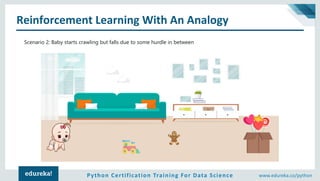
Scenario 2: Baby starts crawling but falls due to some hurdle in between
Python Certification Training For Data Science www.edureka.co/python
Reinforcement Learning With An Analogy
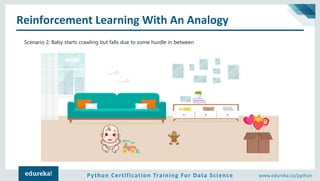
Scenario 2: Baby starts crawling but falls due to some hurdle in between
Python Certification Training For Data Science www.edureka.co/python
Reinforcement Learning Process
Python Certification Training For Data Science www.edureka.co/python
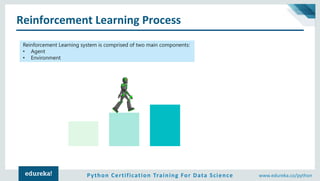
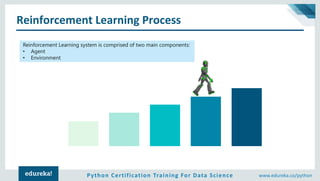
Reinforcement Learning Process
Reinforcement Learning system is comprised of two main components:
• Agent
• Environment
Agent
Environment
Python Certification Training For Data Science www.edureka.co/python
Reinforcement Learning Process
Reinforcement Learning system is comprised of two main components:
• Agent
• Environment
Python Certification Training For Data Science www.edureka.co/python
Reinforcement Learning Process
Reinforcement Learning system is comprised of two main components:
• Agent
• Environment
Python Certification Training For Data Science www.edureka.co/python
Reinforcement Learning Process
Reinforcement Learning system is comprised of two main components:
• Agent
• Environment
Python Certification Training For Data Science www.edureka.co/python
Reinforcement Learning Process
Reinforcement Learning system is comprised of two main components:
• Agent
• Environment
Python Certification Training For Data Science www.edureka.co/python
Reinforcement Learning Process
Reinforcement Learning system is comprised of two main components:
• Agent
• Environment
Python Certification Training For Data Science www.edureka.co/python
Reinforcement Learning Process
Reinforcement Learning system is comprised of two main components:
• Agent
• Environment
Python Certification Training For Data Science www.edureka.co/python
Reinforcement Learning Process
Reinforcement Learning system is comprised of two main components:
• Agent
• Environment
Python Certification Training For Data Science www.edureka.co/python
Reinforcement Learning Process
Reinforcement Learning system is comprised of two main components:
• Agent
• Environment
Python Certification Training For Data Science www.edureka.co/python
Reinforcement Learning Process
Reinforcement Learning system is comprised of two main components:
• Agent
• Environment
Python Certification Training For Data Science www.edureka.co/python
Reinforcement Learning Process
Reinforcement Learning system is comprised of two main components:
• Agent
• Environment
Python Certification Training For Data Science www.edureka.co/python
Reinforcement Learning – Counter
Strike Example
Python Certification Training For Data Science www.edureka.co/python
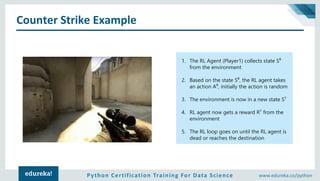
Counter Strike Example
1. The RL Agent (Player1) collects state S⁰
from the environment
2. Based on the state S⁰, the RL agent takes
an action A⁰, initially the action is random
3. The environment is now in a new state S¹
4. RL agent now gets a reward R¹ from the
environment
5. The RL loop goes on until the RL agent is
dead or reaches the destination
Python Certification Training For Data Science www.edureka.co/python
Reinforcement Learning
Definitions
Python Certification Training For Data Science www.edureka.co/python
Reinforcement Learning Definitions
Agent: The RL algorithm that learns from trial and error
Environment: The world through which the agent moves
Action (A): All the possible steps that the agent can take
State (S): Current condition returned by the environment
Python Certification Training For Data Science www.edureka.co/python
Reinforcement Learning Definitions
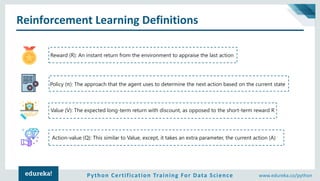
Reward (R): An instant return from the environment to appraise the last action
Policy (π): The approach that the agent uses to determine the next action based on the current state
Value (V): The expected long-term return with discount, as opposed to the short-term reward R
Action-value (Q): This similar to Value, except, it takes an extra parameter, the current action (A)
Python Certification Training For Data Science www.edureka.co/python
Reinforcement Learning Concepts
Python Certification Training For Data Science www.edureka.co/python
Reward Maximization
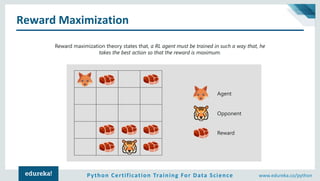
Reward maximization theory states that, a RL agent must be trained in such a way that, he
takes the best action so that the reward is maximum.
Agent
Opponent
Reward
Python Certification Training For Data Science www.edureka.co/python
Exploration & Exploitation
Exploitation is about using the already known exploited information to heighten the rewards
Exploration is about exploring and capturing more information about an environment
Agent
Opponent
Reward
Python Certification Training For Data Science www.edureka.co/python
Markov’s Decision Process
Python Certification Training For Data Science www.edureka.co/python
Markov Decision Process
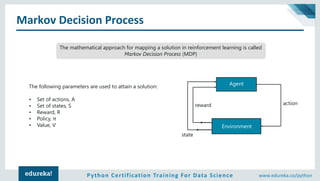
The mathematical approach for mapping a solution in reinforcement learning is called
Markov Decision Process (MDP)
The following parameters are used to attain a solution:
• Set of actions, A
• Set of states, S
• Reward, R
• Policy, π
• Value, V
Agent
Environment
state
reward action
Python Certification Training For Data Science www.edureka.co/python
Markov Decision Process – Shortest Path Problem
A
B
C
D
30
-20
-10
10
50
15
Goal: Find the shortest path between A and D with minimum possible cost
In this problem,
• Set of states are denoted by nodes i.e. {A, B, C, D}
• Action is to traverse from one node to another {A -> B, C -> D}
• Reward is the cost represented by each edge
• Policy is the path taken to reach the destination {A -> C -> D}
Python Certification Training For Data Science www.edureka.co/python
Understanding Q - Learning
Python Certification Training For Data Science www.edureka.co/python
Understanding Q-Learning With An Example
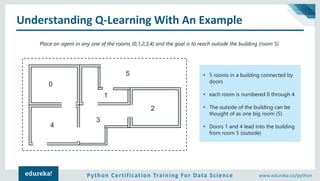
• 5 rooms in a building connected by
doors
• each room is numbered 0 through 4
• The outside of the building can be
thought of as one big room (5)
• Doors 1 and 4 lead into the building
from room 5 (outside)
Place an agent in any one of the rooms (0,1,2,3,4) and the goal is to reach outside the building (room 5)
0
4
3
1
2
5
Python Certification Training For Data Science www.edureka.co/python
Understanding Q-Learning With An Example
0
4
3
1
2
5
Let’s represent the rooms on a graph, each room as a node, and each door as a link
1
2 3
40
5 Goal
Python Certification Training For Data Science www.edureka.co/python
Understanding Q-Learning With An Example
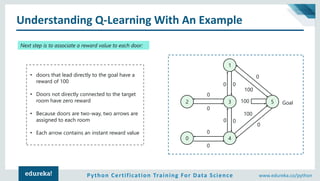
Next step is to associate a reward value to each door:
• doors that lead directly to the goal have a
reward of 100
• Doors not directly connected to the target
room have zero reward
• Because doors are two-way, two arrows are
assigned to each room
• Each arrow contains an instant reward value
1
2 3
40
5 Goal
00
0
0
0
0
0 0
0
0
100
100
100
Python Certification Training For Data Science www.edureka.co/python
Understanding Q-Learning With An Example
The terminology in Q-Learning includes the terms state and action:
• Room (including room 5) represents a state
• agent's movement from one room to another represents an action
• In the figure, a state is depicted as a node, while "action" is represented by the arrows
Example (Agent traverse from room 2 to room5):
1. Initial state = state 2
2. State 2 -> state 3
3. State 3 -> state (2, 1, 4)
4. State 4 -> state 5
1
2 3
40
5 Goal
00
0
0
0
0
0 0
0
0
100
100
100
Python Certification Training For Data Science www.edureka.co/python
Understanding Q-Learning With An Example
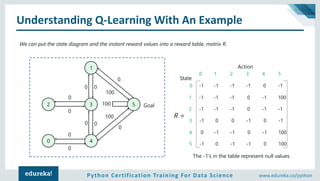
We can put the state diagram and the instant reward values into a reward table, matrix R.
The -1's in the table represent null values
1
2 3
40
5 Goal
00
0
0
0
0
0 0
0
0
100
100
100
0 1 2 3 4 5
-1 -1 -1 -1 0 -1
-1 -1 -1 0 -1 100
-1 -1 -1 0 -1 -1
-1 0 0 -1 0 -1
0 -1 -1 0 -1 100
-1 0 -1 -1 0 100
0
1
2
3
4
5
State
Action
R =
Python Certification Training For Data Science www.edureka.co/python
Understanding Q-Learning With An Example
Add another matrix Q, representing the memory of what the agent has learned through experience.
• The rows of matrix Q represent the current state of the agent
• columns represent the possible actions leading to the next state
• Formula to calculate the Q matrix:
Q(state, action) = R(state, action) + Gamma * Max [Q(next state, all actions)]
The Gamma parameter has a range of 0 to 1 (0 <= Gamma > 1).
• If Gamma is closer to zero, the agent will tend to consider only
immediate rewards.
• If Gamma is closer to one, the agent will consider future rewards
with greater weight
Note
Python Certification Training For Data Science www.edureka.co/python
Q – Learning Algorithm
1
2
3
4
5
6
7
8
9
Set the gamma parameter, and environment rewards in matrix R
Initialize matrix Q to zero
Select a random initial state
Set initial state = current state
Select one among all possible actions for the current state
Using this possible action, consider going to the next state
Get maximum Q value for this next state based on all possible actions
Compute: Q(state, action) = R(state, action) + Gamma * Max[Q(next state, all actions)]
Repeat above steps until current state = goal state
Python Certification Training For Data Science www.edureka.co/python
Q – Learning Example
First step is to set the value of the learning parameter Gamma = 0.8, and the initial state as Room 1.
Next, initialize matrix Q as a zero matrix:
• From room 1 you can either go to room 3 or 5, let’s select room 5.
• From room 5, calculate maximum Q value for this next state based on all possible actions:
Q(state, action) = R(state, action) + Gamma * Max[Q(next state, all actions)]
Q(1,5) = R(1,5) + 0.8 * Max[Q(5,1), Q(5,4), Q(5,5)] = 100 + 0.8 * 0 = 100
1
3
5
1
4
5
Python Certification Training For Data Science www.edureka.co/python
Q – Learning Example
First step is to set the value of the learning parameter Gamma = 0.8, and the initial state as Room 1.
Next, initialize matrix Q as a zero matrix:
• From room 1 you can either go to room 3 or 5, let’s select room 5.
• From room 5, calculate maximum Q value for this next state based on all possible actions
Q(state, action) = R(state, action) + Gamma * Max[Q(next state, all actions)]
Q(1,5) = R(1,5) + 0.8 * Max[Q(5,1), Q(5,4), Q(5,5)] = 100 + 0.8 * 0 = 100
1
3
5
1
4
5
Python Certification Training For Data Science www.edureka.co/python
Q – Learning Example
For the next episode, we start with a randomly chosen initial state, i.e. state 3
• From room 3 you can either go to room 1,2 or 4, let’s select room 1.
• From room 1, calculate maximum Q value for this next state based on all possible actions:
Q(state, action) = R(state, action) + Gamma * Max[Q(next state, all actions)]
Q(3,1) = R(3,1) + 0.8 * Max[Q(1,3), Q(1,5)]= 0 + 0.8 * [0, 100] = 80
The matrix Q get’s updated
3
1
2
4
3
5
Python Certification Training For Data Science www.edureka.co/python
Q – Learning Example
For the next episode, the next state, 1, now becomes the current state. We repeat the inner loop of the Q
learning algorithm because state 1 is not the goal state.
• From room 1 you can either go to room 3 or 5, let’s select room 5.
• From room 5, calculate maximum Q value for this next state based on all possible actions:
Q(state, action) = R(state, action) + Gamma * Max[Q(next state, all actions)]
Q(1,5) = R(1,5) + 0.8 * Max[Q(5,1), Q(5,4), Q(5,5)] = 100 + 0.8 * 0 = 100
The matrix Q remains the same since, Q(1,5) is already fed to the agent
1
3
5
1
4
5
Python Certification Training For Data Science www.edureka.co/python
Demo
<YouTube Video Link in the Description>
Python Certification Training For Data Science www.edureka.co/python
WebDriver vs. IDE vs. RC
➢ Data Warehouse is like a relational database designed for analytical needs.
➢ It functions on the basis of OLAP (Online Analytical Processing).
➢ It is a central location where consolidated data from multiple locations (databases) are stored.

Reinforcement Learning Tutorial | Edureka

  • 2.
    Python Certification TrainingFor Data Science www.edureka.co/python Agenda Introduction To Machine Learning 1 What is Reinforcement Learning? 2 Reinforcement Learning with an Analogy3 Reinforcement Learning Process 4 Reinforcement Learning – Counter strike example5 Reinforcement Learning Definitions 6 Reinforcement Learning Concepts 7 Markov’s Decision Process 8 Understanding Q-Learning 9 Hands-On 10
  • 3.
    Python Certification TrainingFor Data Science www.edureka.co/python Introduction To Machine Learning
  • 4.
    Python Certification TrainingFor Data Science www.edureka.co/python What Is Machine Learning? Machine learning is a subset of artificial intelligence (AI) which provides machines the ability to learn automatically & improve from experience without being explicitly programmed. They look the same! Cherry Apple Orange Data Algorithm
  • 5.
    Python Certification TrainingFor Data Science www.edureka.co/python Types Of Machine Learning Reinforcement LearningSupervised Learning Unsupervised Learning
  • 6.
    Python Certification TrainingFor Data Science www.edureka.co/python What Is Reinforcement Learning?
  • 7.
    Python Certification TrainingFor Data Science www.edureka.co/python What Is Reinforcement Learning? Reinforcement learning is a type of Machine Learning where an agent learns to behave in a environment by performing actions and seeing the results
  • 8.
    Python Certification TrainingFor Data Science www.edureka.co/python Reinforcement Learning With An Analogy
  • 9.
    Python Certification TrainingFor Data Science www.edureka.co/python Reinforcement Learning With An Analogy Scenario 1: Baby starts crawling and makes it to the candy
  • 10.
    Python Certification TrainingFor Data Science www.edureka.co/python Reinforcement Learning With An Analogy Scenario 2: Baby starts crawling but falls due to some hurdle in between
  • 11.
    Python Certification TrainingFor Data Science www.edureka.co/python Reinforcement Learning With An Analogy Scenario 2: Baby starts crawling but falls due to some hurdle in between
  • 12.
    Python Certification TrainingFor Data Science www.edureka.co/python Reinforcement Learning Process
  • 13.
    Python Certification TrainingFor Data Science www.edureka.co/python Reinforcement Learning Process Reinforcement Learning system is comprised of two main components: • Agent • Environment Agent Environment
  • 14.
    Python Certification TrainingFor Data Science www.edureka.co/python Reinforcement Learning Process Reinforcement Learning system is comprised of two main components: • Agent • Environment
  • 15.
    Python Certification TrainingFor Data Science www.edureka.co/python Reinforcement Learning Process Reinforcement Learning system is comprised of two main components: • Agent • Environment
  • 16.
    Python Certification TrainingFor Data Science www.edureka.co/python Reinforcement Learning Process Reinforcement Learning system is comprised of two main components: • Agent • Environment
  • 17.
    Python Certification TrainingFor Data Science www.edureka.co/python Reinforcement Learning Process Reinforcement Learning system is comprised of two main components: • Agent • Environment
  • 18.
    Python Certification TrainingFor Data Science www.edureka.co/python Reinforcement Learning Process Reinforcement Learning system is comprised of two main components: • Agent • Environment
  • 19.
    Python Certification TrainingFor Data Science www.edureka.co/python Reinforcement Learning Process Reinforcement Learning system is comprised of two main components: • Agent • Environment
  • 20.
    Python Certification TrainingFor Data Science www.edureka.co/python Reinforcement Learning Process Reinforcement Learning system is comprised of two main components: • Agent • Environment
  • 21.
    Python Certification TrainingFor Data Science www.edureka.co/python Reinforcement Learning Process Reinforcement Learning system is comprised of two main components: • Agent • Environment
  • 22.
    Python Certification TrainingFor Data Science www.edureka.co/python Reinforcement Learning Process Reinforcement Learning system is comprised of two main components: • Agent • Environment
  • 23.
    Python Certification TrainingFor Data Science www.edureka.co/python Reinforcement Learning Process Reinforcement Learning system is comprised of two main components: • Agent • Environment
  • 24.
    Python Certification TrainingFor Data Science www.edureka.co/python Reinforcement Learning – Counter Strike Example
  • 25.
    Python Certification TrainingFor Data Science www.edureka.co/python Counter Strike Example 1. The RL Agent (Player1) collects state S⁰ from the environment 2. Based on the state S⁰, the RL agent takes an action A⁰, initially the action is random 3. The environment is now in a new state S¹ 4. RL agent now gets a reward R¹ from the environment 5. The RL loop goes on until the RL agent is dead or reaches the destination
  • 26.
    Python Certification TrainingFor Data Science www.edureka.co/python Reinforcement Learning Definitions
  • 27.
    Python Certification TrainingFor Data Science www.edureka.co/python Reinforcement Learning Definitions Agent: The RL algorithm that learns from trial and error Environment: The world through which the agent moves Action (A): All the possible steps that the agent can take State (S): Current condition returned by the environment
  • 28.
    Python Certification TrainingFor Data Science www.edureka.co/python Reinforcement Learning Definitions Reward (R): An instant return from the environment to appraise the last action Policy (π): The approach that the agent uses to determine the next action based on the current state Value (V): The expected long-term return with discount, as opposed to the short-term reward R Action-value (Q): This similar to Value, except, it takes an extra parameter, the current action (A)
  • 29.
    Python Certification TrainingFor Data Science www.edureka.co/python Reinforcement Learning Concepts
  • 30.
    Python Certification TrainingFor Data Science www.edureka.co/python Reward Maximization Reward maximization theory states that, a RL agent must be trained in such a way that, he takes the best action so that the reward is maximum. Agent Opponent Reward
  • 31.
    Python Certification TrainingFor Data Science www.edureka.co/python Exploration & Exploitation Exploitation is about using the already known exploited information to heighten the rewards Exploration is about exploring and capturing more information about an environment Agent Opponent Reward
  • 32.
    Python Certification TrainingFor Data Science www.edureka.co/python Markov’s Decision Process
  • 33.
    Python Certification TrainingFor Data Science www.edureka.co/python Markov Decision Process The mathematical approach for mapping a solution in reinforcement learning is called Markov Decision Process (MDP) The following parameters are used to attain a solution: • Set of actions, A • Set of states, S • Reward, R • Policy, π • Value, V Agent Environment state reward action
  • 34.
    Python Certification TrainingFor Data Science www.edureka.co/python Markov Decision Process – Shortest Path Problem A B C D 30 -20 -10 10 50 15 Goal: Find the shortest path between A and D with minimum possible cost In this problem, • Set of states are denoted by nodes i.e. {A, B, C, D} • Action is to traverse from one node to another {A -> B, C -> D} • Reward is the cost represented by each edge • Policy is the path taken to reach the destination {A -> C -> D}
  • 35.
    Python Certification TrainingFor Data Science www.edureka.co/python Understanding Q - Learning
  • 36.
    Python Certification TrainingFor Data Science www.edureka.co/python Understanding Q-Learning With An Example • 5 rooms in a building connected by doors • each room is numbered 0 through 4 • The outside of the building can be thought of as one big room (5) • Doors 1 and 4 lead into the building from room 5 (outside) Place an agent in any one of the rooms (0,1,2,3,4) and the goal is to reach outside the building (room 5) 0 4 3 1 2 5
  • 37.
    Python Certification TrainingFor Data Science www.edureka.co/python Understanding Q-Learning With An Example 0 4 3 1 2 5 Let’s represent the rooms on a graph, each room as a node, and each door as a link 1 2 3 40 5 Goal
  • 38.
    Python Certification TrainingFor Data Science www.edureka.co/python Understanding Q-Learning With An Example Next step is to associate a reward value to each door: • doors that lead directly to the goal have a reward of 100 • Doors not directly connected to the target room have zero reward • Because doors are two-way, two arrows are assigned to each room • Each arrow contains an instant reward value 1 2 3 40 5 Goal 00 0 0 0 0 0 0 0 0 100 100 100
  • 39.
    Python Certification TrainingFor Data Science www.edureka.co/python Understanding Q-Learning With An Example The terminology in Q-Learning includes the terms state and action: • Room (including room 5) represents a state • agent's movement from one room to another represents an action • In the figure, a state is depicted as a node, while "action" is represented by the arrows Example (Agent traverse from room 2 to room5): 1. Initial state = state 2 2. State 2 -> state 3 3. State 3 -> state (2, 1, 4) 4. State 4 -> state 5 1 2 3 40 5 Goal 00 0 0 0 0 0 0 0 0 100 100 100
  • 40.
    Python Certification TrainingFor Data Science www.edureka.co/python Understanding Q-Learning With An Example We can put the state diagram and the instant reward values into a reward table, matrix R. The -1's in the table represent null values 1 2 3 40 5 Goal 00 0 0 0 0 0 0 0 0 100 100 100 0 1 2 3 4 5 -1 -1 -1 -1 0 -1 -1 -1 -1 0 -1 100 -1 -1 -1 0 -1 -1 -1 0 0 -1 0 -1 0 -1 -1 0 -1 100 -1 0 -1 -1 0 100 0 1 2 3 4 5 State Action R =
  • 41.
    Python Certification TrainingFor Data Science www.edureka.co/python Understanding Q-Learning With An Example Add another matrix Q, representing the memory of what the agent has learned through experience. • The rows of matrix Q represent the current state of the agent • columns represent the possible actions leading to the next state • Formula to calculate the Q matrix: Q(state, action) = R(state, action) + Gamma * Max [Q(next state, all actions)] The Gamma parameter has a range of 0 to 1 (0 <= Gamma > 1). • If Gamma is closer to zero, the agent will tend to consider only immediate rewards. • If Gamma is closer to one, the agent will consider future rewards with greater weight Note
  • 42.
    Python Certification TrainingFor Data Science www.edureka.co/python Q – Learning Algorithm 1 2 3 4 5 6 7 8 9 Set the gamma parameter, and environment rewards in matrix R Initialize matrix Q to zero Select a random initial state Set initial state = current state Select one among all possible actions for the current state Using this possible action, consider going to the next state Get maximum Q value for this next state based on all possible actions Compute: Q(state, action) = R(state, action) + Gamma * Max[Q(next state, all actions)] Repeat above steps until current state = goal state
  • 43.
    Python Certification TrainingFor Data Science www.edureka.co/python Q – Learning Example First step is to set the value of the learning parameter Gamma = 0.8, and the initial state as Room 1. Next, initialize matrix Q as a zero matrix: • From room 1 you can either go to room 3 or 5, let’s select room 5. • From room 5, calculate maximum Q value for this next state based on all possible actions: Q(state, action) = R(state, action) + Gamma * Max[Q(next state, all actions)] Q(1,5) = R(1,5) + 0.8 * Max[Q(5,1), Q(5,4), Q(5,5)] = 100 + 0.8 * 0 = 100 1 3 5 1 4 5
  • 44.
    Python Certification TrainingFor Data Science www.edureka.co/python Q – Learning Example First step is to set the value of the learning parameter Gamma = 0.8, and the initial state as Room 1. Next, initialize matrix Q as a zero matrix: • From room 1 you can either go to room 3 or 5, let’s select room 5. • From room 5, calculate maximum Q value for this next state based on all possible actions Q(state, action) = R(state, action) + Gamma * Max[Q(next state, all actions)] Q(1,5) = R(1,5) + 0.8 * Max[Q(5,1), Q(5,4), Q(5,5)] = 100 + 0.8 * 0 = 100 1 3 5 1 4 5
  • 45.
    Python Certification TrainingFor Data Science www.edureka.co/python Q – Learning Example For the next episode, we start with a randomly chosen initial state, i.e. state 3 • From room 3 you can either go to room 1,2 or 4, let’s select room 1. • From room 1, calculate maximum Q value for this next state based on all possible actions: Q(state, action) = R(state, action) + Gamma * Max[Q(next state, all actions)] Q(3,1) = R(3,1) + 0.8 * Max[Q(1,3), Q(1,5)]= 0 + 0.8 * [0, 100] = 80 The matrix Q get’s updated 3 1 2 4 3 5
  • 46.
    Python Certification TrainingFor Data Science www.edureka.co/python Q – Learning Example For the next episode, the next state, 1, now becomes the current state. We repeat the inner loop of the Q learning algorithm because state 1 is not the goal state. • From room 1 you can either go to room 3 or 5, let’s select room 5. • From room 5, calculate maximum Q value for this next state based on all possible actions: Q(state, action) = R(state, action) + Gamma * Max[Q(next state, all actions)] Q(1,5) = R(1,5) + 0.8 * Max[Q(5,1), Q(5,4), Q(5,5)] = 100 + 0.8 * 0 = 100 The matrix Q remains the same since, Q(1,5) is already fed to the agent 1 3 5 1 4 5
  • 47.
    Python Certification TrainingFor Data Science www.edureka.co/python Demo <YouTube Video Link in the Description>
  • 48.
    Python Certification TrainingFor Data Science www.edureka.co/python WebDriver vs. IDE vs. RC ➢ Data Warehouse is like a relational database designed for analytical needs. ➢ It functions on the basis of OLAP (Online Analytical Processing). ➢ It is a central location where consolidated data from multiple locations (databases) are stored.