GRAPHICAL METHOD
Limitation of Graphical Method Graphical solution is limited to linear programming models containing only two decision variables.
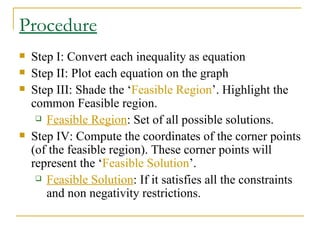
Procedure Step I: Convert each inequality as equation Step II: Plot each equation on the graph Step III: Shade the ‘ Feasible Region ’. Highlight the common Feasible region. Feasible Region : Set of all possible solutions. Step IV: Compute the coordinates of the corner points (of the feasible region). These corner points will represent the ‘ Feasible Solution ’. Feasible Solution : If it satisfies all the constraints and non negativity restrictions.
Procedure (Cont…) Step V: Substitute the coordinates of the corner points into the objective function to see which gives the  Optimal Value . That will be the  ‘ Optimal Solution ’. Optimal Solution : If it optimizes (maximizes or minimizes) the objective function. Unbounded Solution : If the value of the objective function can be increased or decreased indefinitely, Such solutions are called Unbounded solution.  Inconsistent Solution : It means the solution of problem does not exist. This is possible when there is no common feasible region.
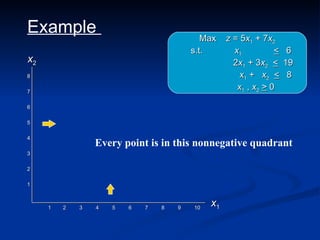
8 7 6 5 4 3 2 1 1  2  3  4  5  6  7  8  9  10   x 2 x 1 Example  Max  z  = 5 x 1  + 7 x 2 s.t.  x 1   <   6 2 x 1  + 3 x 2   <   19 x 1  +  x 2   <   8   x 1  ,  x 2   >  0 Every point is in this nonnegative quadrant
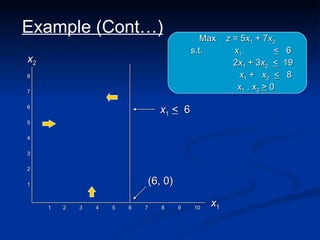
8 7 6 5 4 3 2 1 1  2  3  4  5  6  7  8  9  10   x 2 x 1 x 1   <   6 (6, 0) Example (Cont…) Max  z  = 5 x 1  + 7 x 2 s.t.  x 1   <   6 2 x 1  + 3 x 2   <   19 x 1  +  x 2   <   8   x 1  ,  x 2   >  0
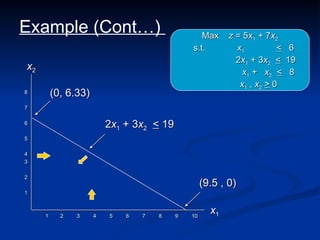
8 7 6 5 4 3 2 1 1  2  3  4  5  6  7  8  9  10  2 x 1  + 3 x 2   <  19  x 2 x 1 (0, 6.33) (9.5 , 0) Max  z  = 5 x 1  + 7 x 2 s.t.  x 1   <   6 2 x 1  + 3 x 2   <   19 x 1  +  x 2   <   8   x 1  ,  x 2   >  0 Example (Cont…)
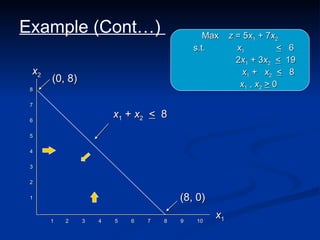
8 7 6 5 4 3 2 1 1  2  3  4  5  6  7  8  9  10  x 2 x 1 x 1  +  x 2   <   8 (0, 8) (8, 0) Max  z  = 5 x 1  + 7 x 2 s.t.  x 1   <   6 2 x 1  + 3 x 2   <   19 x 1  +  x 2   <   8   x 1  ,  x 2   >  0 Example (Cont…)
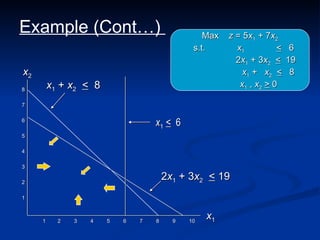
8 7 6 5 4 3 2 1 1  2  3  4  5  6  7  8  9  10  2 x 1  + 3 x 2   <  19  x 2 x 1 x 1  +  x 2   <   8 x 1   <   6 Max  z  = 5 x 1  + 7 x 2 s.t.  x 1   <   6 2 x 1  + 3 x 2   <   19 x 1  +  x 2   <   8   x 1  ,  x 2   >  0 Example (Cont…)
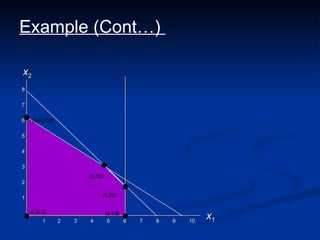
8 7 6 5 4 3 2 1 1  2  3  4  5  6  7  8  9  10  x 2 x 1 Example (Cont…)  A (0,0) (6,0)B (6,2)C (5,3)D (0,6.33)E
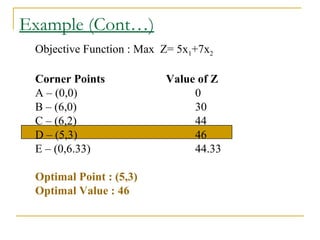
Objective Function : Max  Z= 5x 1 +7x 2 Corner Points   Value of Z A – (0,0) 0 B – (6,0) 30 C – (6,2) 44 D – (5,3) 46 E – (0,6.33) 44.33 Optimal Point : (5,3) Optimal Value : 46 Example (Cont…)
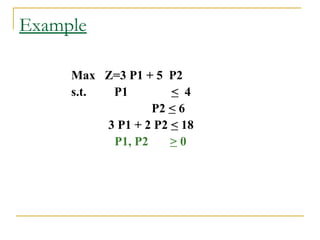
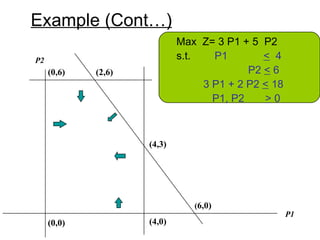
Example Max  Z=3 P1 + 5  P2 s.t.  P1  <   4  P2  <  6  3 P1 + 2 P2  <  18  P1, P2  >  0
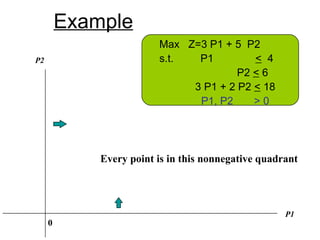
Example P1 P2 0 Every point is in this nonnegative quadrant  Max  Z=3 P1 + 5  P2 s.t.  P1  <   4  P2  <  6  3 P1 + 2 P2  <  18  P1, P2  >  0
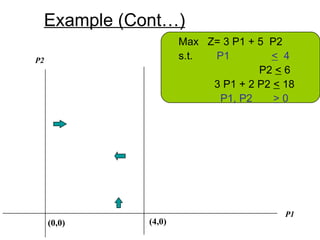
Example (Cont…) P1 P2 (0,0) Max  Z= 3 P1 + 5  P2 s.t.  P1  <   4   P2  <  6  3 P1 + 2 P2  <  18  P1, P2  >  0  (4,0)
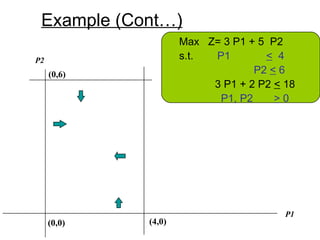
Example (Cont…) P1 P2 (0,0) Max  Z= 3 P1 + 5  P2 s.t.  P1  <   4   P2  <  6   3 P1 + 2 P2  <  18  P1, P2  >  0  (4,0) (0,6)
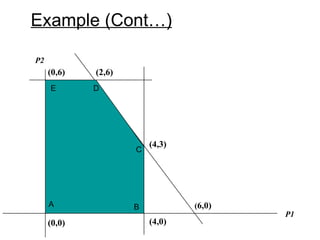
Example (Cont…) P1 P2 (0,0) Max  Z= 3 P1 + 5  P2 s.t.  P1  <   4 P2  <  6 3 P1 + 2 P2  <  18   P1, P2  >  0  (4,0) (0,6) (2,6) (4,3) ( 6,0)
Example (Cont…) P1 P2 (0,0) (4,0) (0,6) (2,6) (4,3) ( 6,0) A B C D E
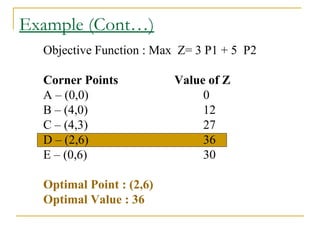
Example (Cont…) Objective Function : Max  Z= 3 P1 + 5  P2  Corner Points   Value of Z A – (0,0) 0 B – (4,0) 12 C – (4,3) 27 D – (2,6) 36 E – (0,6) 30 Optimal Point : (2,6) Optimal Value : 36
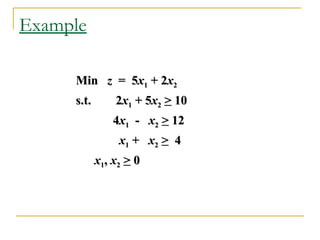
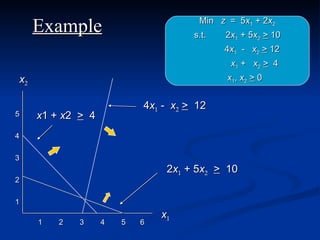
Example Min  z  =  5 x 1  + 2 x 2 s.t.  2 x 1  + 5 x 2   >  10 4 x 1   -  x 2   >  12 x 1  +  x 2   >   4 x 1 ,  x 2   >  0
5 4 3 2 1 1  2  3  4  5  6 x 2 4 x 1  -  x 2   >   12 2 x 1  + 5 x 2   >   10 x 1 Example Min  z  =  5 x 1  + 2 x 2 s.t.  2 x 1  + 5 x 2   >  10 4 x 1   -  x 2   >  12 x 1  +  x 2   >   4 x 1 ,  x 2   >  0 x 1 +  x 2  >   4
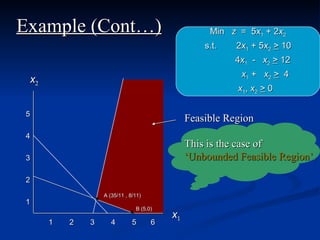
5 4 3 2 1 1  2  3  4  5  6 x 2 x 1 Feasible Region This is the case of  ‘Unbounded Feasible Region’. Example (Cont…) Min  z  =  5 x 1  + 2 x 2 s.t.  2 x 1  + 5 x 2   >  10 4 x 1   -  x 2   >  12 x 1  +  x 2   >   4 x 1 ,  x 2   >  0 A (35/11 , 8/11) B (5,0)
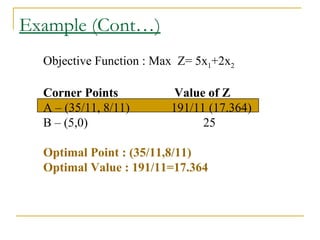
Example (Cont…) Objective Function : Max  Z= 5x 1 +2x 2   Corner Points   Value of Z A – (35/11, 8/11) 191/11 (17.364) B – (5,0) 25 Optimal Point : (35/11,8/11) Optimal Value : 191/11=17.364
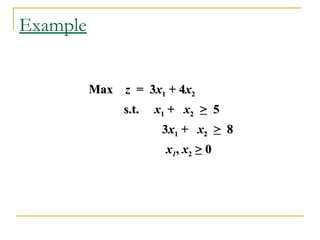
Example Max  z  =  3 x 1  + 4 x 2   s.t.  x 1  +  x 2   >   5   3 x 1  +  x 2   >   8 x 1 ,  x 2   >  0
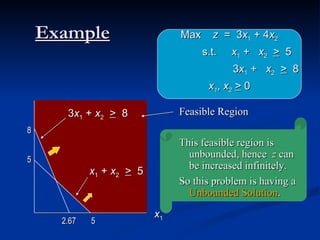
Example x 1 3 x 1  +  x 2   >   8 x 1  +  x 2   >   5 5 5 8 2.67 Max  z  =  3 x 1  + 4 x 2   s.t.  x 1  +  x 2   >   5   3 x 1  +  x 2   >   8 x 1 ,  x 2   >  0 Feasible Region This feasible region is unbounded, hence  z  can be increased infinitely. So this problem is having a  Unbounded Solution .
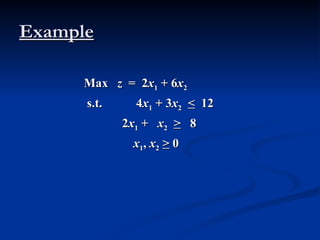
Example Max  z   =  2 x 1  + 6 x 2 s.t.  4 x 1  + 3 x 2   <   12   2 x 1  +  x 2   >   8 x 1 ,  x 2   >  0
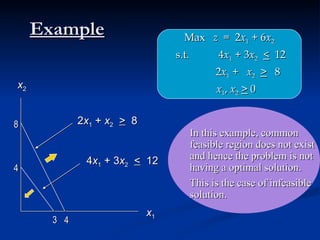
Example Max  z   =  2 x 1  + 6 x 2 s.t.  4 x 1  + 3 x 2   <   12   2 x 1  +  x 2   >   8 x 1 ,  x 2   >  0 x 2 x 1 4 x 1  + 3 x 2   <   12 2 x 1  +  x 2   >   8 3 4 4 8 In this example, common feasible region does not exist and hence the problem is not having a optimal solution.  This is the case of infeasible solution.

Graphical Method

  • 1.
  • 2.
    Limitation of GraphicalMethod Graphical solution is limited to linear programming models containing only two decision variables.
  • 3.
    Procedure Step I:Convert each inequality as equation Step II: Plot each equation on the graph Step III: Shade the ‘ Feasible Region ’. Highlight the common Feasible region. Feasible Region : Set of all possible solutions. Step IV: Compute the coordinates of the corner points (of the feasible region). These corner points will represent the ‘ Feasible Solution ’. Feasible Solution : If it satisfies all the constraints and non negativity restrictions.
  • 4.
    Procedure (Cont…) StepV: Substitute the coordinates of the corner points into the objective function to see which gives the Optimal Value . That will be the ‘ Optimal Solution ’. Optimal Solution : If it optimizes (maximizes or minimizes) the objective function. Unbounded Solution : If the value of the objective function can be increased or decreased indefinitely, Such solutions are called Unbounded solution. Inconsistent Solution : It means the solution of problem does not exist. This is possible when there is no common feasible region.
  • 5.
    8 7 65 4 3 2 1 1 2 3 4 5 6 7 8 9 10 x 2 x 1 Example Max z = 5 x 1 + 7 x 2 s.t. x 1 < 6 2 x 1 + 3 x 2 < 19 x 1 + x 2 < 8 x 1 , x 2 > 0 Every point is in this nonnegative quadrant
  • 6.
    8 7 65 4 3 2 1 1 2 3 4 5 6 7 8 9 10 x 2 x 1 x 1 < 6 (6, 0) Example (Cont…) Max z = 5 x 1 + 7 x 2 s.t. x 1 < 6 2 x 1 + 3 x 2 < 19 x 1 + x 2 < 8 x 1 , x 2 > 0
  • 7.
    8 7 65 4 3 2 1 1 2 3 4 5 6 7 8 9 10 2 x 1 + 3 x 2 < 19 x 2 x 1 (0, 6.33) (9.5 , 0) Max z = 5 x 1 + 7 x 2 s.t. x 1 < 6 2 x 1 + 3 x 2 < 19 x 1 + x 2 < 8 x 1 , x 2 > 0 Example (Cont…)
  • 8.
    8 7 65 4 3 2 1 1 2 3 4 5 6 7 8 9 10 x 2 x 1 x 1 + x 2 < 8 (0, 8) (8, 0) Max z = 5 x 1 + 7 x 2 s.t. x 1 < 6 2 x 1 + 3 x 2 < 19 x 1 + x 2 < 8 x 1 , x 2 > 0 Example (Cont…)
  • 9.
    8 7 65 4 3 2 1 1 2 3 4 5 6 7 8 9 10 2 x 1 + 3 x 2 < 19 x 2 x 1 x 1 + x 2 < 8 x 1 < 6 Max z = 5 x 1 + 7 x 2 s.t. x 1 < 6 2 x 1 + 3 x 2 < 19 x 1 + x 2 < 8 x 1 , x 2 > 0 Example (Cont…)
  • 10.
    8 7 65 4 3 2 1 1 2 3 4 5 6 7 8 9 10 x 2 x 1 Example (Cont…) A (0,0) (6,0)B (6,2)C (5,3)D (0,6.33)E
  • 11.
    Objective Function :Max Z= 5x 1 +7x 2 Corner Points Value of Z A – (0,0) 0 B – (6,0) 30 C – (6,2) 44 D – (5,3) 46 E – (0,6.33) 44.33 Optimal Point : (5,3) Optimal Value : 46 Example (Cont…)
  • 12.
    Example Max Z=3 P1 + 5 P2 s.t. P1 < 4 P2 < 6 3 P1 + 2 P2 < 18 P1, P2 > 0
  • 13.
    Example P1 P20 Every point is in this nonnegative quadrant Max Z=3 P1 + 5 P2 s.t. P1 < 4 P2 < 6 3 P1 + 2 P2 < 18 P1, P2 > 0
  • 14.
    Example (Cont…) P1P2 (0,0) Max Z= 3 P1 + 5 P2 s.t. P1 < 4 P2 < 6 3 P1 + 2 P2 < 18 P1, P2 > 0 (4,0)
  • 15.
    Example (Cont…) P1P2 (0,0) Max Z= 3 P1 + 5 P2 s.t. P1 < 4 P2 < 6 3 P1 + 2 P2 < 18 P1, P2 > 0 (4,0) (0,6)
  • 16.
    Example (Cont…) P1P2 (0,0) Max Z= 3 P1 + 5 P2 s.t. P1 < 4 P2 < 6 3 P1 + 2 P2 < 18 P1, P2 > 0 (4,0) (0,6) (2,6) (4,3) ( 6,0)
  • 17.
    Example (Cont…) P1P2 (0,0) (4,0) (0,6) (2,6) (4,3) ( 6,0) A B C D E
  • 18.
    Example (Cont…) ObjectiveFunction : Max Z= 3 P1 + 5 P2 Corner Points Value of Z A – (0,0) 0 B – (4,0) 12 C – (4,3) 27 D – (2,6) 36 E – (0,6) 30 Optimal Point : (2,6) Optimal Value : 36
  • 19.
    Example Min z = 5 x 1 + 2 x 2 s.t. 2 x 1 + 5 x 2 > 10 4 x 1 - x 2 > 12 x 1 + x 2 > 4 x 1 , x 2 > 0
  • 20.
    5 4 32 1 1 2 3 4 5 6 x 2 4 x 1 - x 2 > 12 2 x 1 + 5 x 2 > 10 x 1 Example Min z = 5 x 1 + 2 x 2 s.t. 2 x 1 + 5 x 2 > 10 4 x 1 - x 2 > 12 x 1 + x 2 > 4 x 1 , x 2 > 0 x 1 + x 2 > 4
  • 21.
    5 4 32 1 1 2 3 4 5 6 x 2 x 1 Feasible Region This is the case of ‘Unbounded Feasible Region’. Example (Cont…) Min z = 5 x 1 + 2 x 2 s.t. 2 x 1 + 5 x 2 > 10 4 x 1 - x 2 > 12 x 1 + x 2 > 4 x 1 , x 2 > 0 A (35/11 , 8/11) B (5,0)
  • 22.
    Example (Cont…) ObjectiveFunction : Max Z= 5x 1 +2x 2 Corner Points Value of Z A – (35/11, 8/11) 191/11 (17.364) B – (5,0) 25 Optimal Point : (35/11,8/11) Optimal Value : 191/11=17.364
  • 23.
    Example Max z = 3 x 1 + 4 x 2 s.t. x 1 + x 2 > 5 3 x 1 + x 2 > 8 x 1 , x 2 > 0
  • 24.
    Example x 13 x 1 + x 2 > 8 x 1 + x 2 > 5 5 5 8 2.67 Max z = 3 x 1 + 4 x 2 s.t. x 1 + x 2 > 5 3 x 1 + x 2 > 8 x 1 , x 2 > 0 Feasible Region This feasible region is unbounded, hence z can be increased infinitely. So this problem is having a Unbounded Solution .
  • 25.
    Example Max z = 2 x 1 + 6 x 2 s.t. 4 x 1 + 3 x 2 < 12 2 x 1 + x 2 > 8 x 1 , x 2 > 0
  • 26.
    Example Max z = 2 x 1 + 6 x 2 s.t. 4 x 1 + 3 x 2 < 12 2 x 1 + x 2 > 8 x 1 , x 2 > 0 x 2 x 1 4 x 1 + 3 x 2 < 12 2 x 1 + x 2 > 8 3 4 4 8 In this example, common feasible region does not exist and hence the problem is not having a optimal solution. This is the case of infeasible solution.