Guided by,
Mrs.ANILA MOL
Asst.professor
ECE
LMCST
PRESENTED BY,
ALEX M CHACKO
S7 ECE
ROLL NO: 11
LMCST
INTRODUCTION
.
1
 It is one of the new developed technology.
 Researchers from Texas , &university of
Houston working on just such a concept back in
2013.
 They focused on a certain type of piezoelectric
material at around 21 nanometer thick.
 South Korean researchers developed the
effective method.
2
 You have probably heard of renewably energy source like
solar , wind,…
 Have you ever thought about sound energy?
 Sound that always exists in our everyday life and
environments has been overlooked as a source.
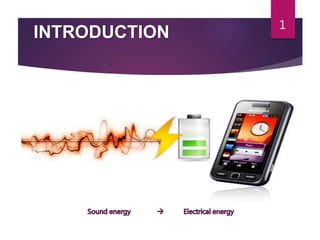
 This motivated us to realize power generation by turning
sound energy from speech , music into electrical power.
 Sound pollution is a great disadvantage that we come
across our daily life.
 But using this technology we can convert this great
disadvantage to our use
3
WORKING PRINCIPLE
 It works on the principle of piezo electric
phenomenon.
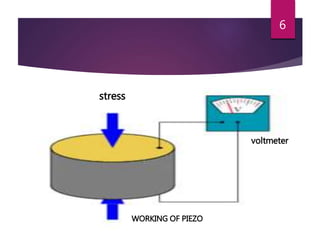
 The generation of an electric charge in certain non
conducting material when they are subjected to
mechanical stress is called piezoelectric effects
(conversion of ME to EE)
4
What is piezo ?
 Piezo is used to describe the materials that accumulate a
charge as a result of piezoelectric effect.
 Piezo material , including crystals and ceramics generate a
voltage in response to an applied mechanical force.
 In reverse piezoelectric effect, these same material will
lengthen or shorten in response to an applied voltage.
 The voltage at force generated by piezo material are small
and usually required amplification.
5
6
WORKING OF PIEZO
stress
voltmeter
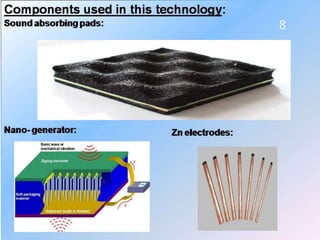
COMPONENTS
Sound absorbing pads
Zn electrodes
Nano- generator
7
8
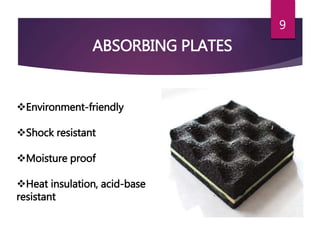
Environment-friendly
Shock resistant
Moisture proof
Heat insulation, acid-base
resistant
9
ABSORBING PLATES
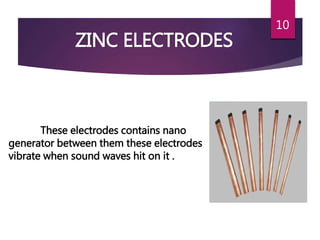
These electrodes contains nano
generator between them these electrodes
vibrate when sound waves hit on it .
10
ZINC ELECTRODES
11
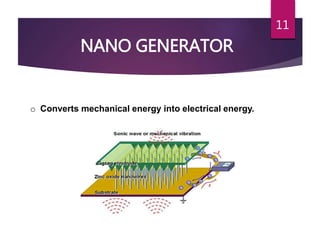
NANO GENERATOR
o Converts mechanical energy into electrical energy.
CONSTRUCTION
 Tiny strands of zinc oxide sandwiched between two
electrodes.
 A sound absorbing pad is placed on the top of zinc oxide.
 Nano generator is placed between the sandwiched zinc
oxide and electrode.
12
13
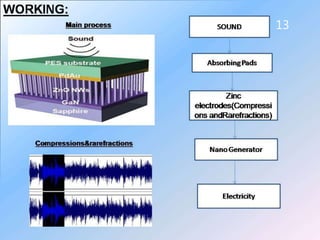
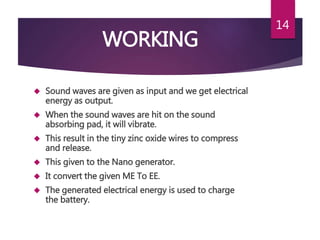
WORKING
 Sound waves are given as input and we get electrical
energy as output.
 When the sound waves are hit on the sound
absorbing pad, it will vibrate.
 This result in the tiny zinc oxide wires to compress
and release.
 This given to the Nano generator.
 It convert the given ME To EE.
 The generated electrical energy is used to charge
the battery.
14
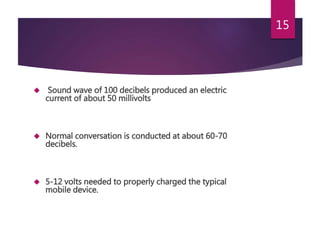
 Sound wave of 100 decibels produced an electric
current of about 50 millivolts
 Normal conversation is conducted at about 60-70
decibels.
 5-12 volts needed to properly charged the typical
mobile device.
15
16
ADVANTAGES
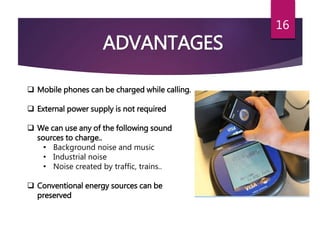
 Mobile phones can be charged while calling.
 External power supply is not required
 We can use any of the following sound
sources to charge..
• Background noise and music
• Industrial noise
• Noise created by traffic, trains..
 Conventional energy sources can be
preserved
DISADVANTAGES
 It is expensive.
 Construction is difficult.
 Only possible for low voltage application.
17
SCOPE FOR FUTURE
 Sound insulating walls near highways and airports to
produce electricity for lightning and other use.
 Recharge electric cars by tapping into the energy in
traffic noise.
 Both reducing noise levels and capturing wasted
energy.
18
CONCLUSION
 Sound pollution is a great disadvantage that we
come across our daily life.
 By using this great disadvantage to our use.
 Voice usage to charge mobile phones creates a new
era with cleanly environment along with saving
energy.
19
REFERENCE
 www.Seminarpaper.com
 www.Authorstream.com
 www.Gizmag.com
 www.Pptsforece.blogspot.com
 www.Wikipedia.com
20
23
24
QUERIES???

Voice usage mobile charging

  • 2.
    Guided by, Mrs.ANILA MOL Asst.professor ECE LMCST PRESENTEDBY, ALEX M CHACKO S7 ECE ROLL NO: 11 LMCST
  • 3.
  • 4.
     It isone of the new developed technology.  Researchers from Texas , &university of Houston working on just such a concept back in 2013.  They focused on a certain type of piezoelectric material at around 21 nanometer thick.  South Korean researchers developed the effective method. 2
  • 5.
     You haveprobably heard of renewably energy source like solar , wind,…  Have you ever thought about sound energy?  Sound that always exists in our everyday life and environments has been overlooked as a source.  This motivated us to realize power generation by turning sound energy from speech , music into electrical power.  Sound pollution is a great disadvantage that we come across our daily life.  But using this technology we can convert this great disadvantage to our use 3
  • 6.
    WORKING PRINCIPLE  Itworks on the principle of piezo electric phenomenon.  The generation of an electric charge in certain non conducting material when they are subjected to mechanical stress is called piezoelectric effects (conversion of ME to EE) 4
  • 7.
    What is piezo?  Piezo is used to describe the materials that accumulate a charge as a result of piezoelectric effect.  Piezo material , including crystals and ceramics generate a voltage in response to an applied mechanical force.  In reverse piezoelectric effect, these same material will lengthen or shorten in response to an applied voltage.  The voltage at force generated by piezo material are small and usually required amplification. 5
  • 8.
  • 9.
    COMPONENTS Sound absorbing pads Znelectrodes Nano- generator 7
  • 10.
  • 11.
    Environment-friendly Shock resistant Moisture proof Heatinsulation, acid-base resistant 9 ABSORBING PLATES
  • 12.
    These electrodes containsnano generator between them these electrodes vibrate when sound waves hit on it . 10 ZINC ELECTRODES
  • 13.
    11 NANO GENERATOR o Convertsmechanical energy into electrical energy.
  • 14.
    CONSTRUCTION  Tiny strandsof zinc oxide sandwiched between two electrodes.  A sound absorbing pad is placed on the top of zinc oxide.  Nano generator is placed between the sandwiched zinc oxide and electrode. 12
  • 15.
  • 16.
    WORKING  Sound wavesare given as input and we get electrical energy as output.  When the sound waves are hit on the sound absorbing pad, it will vibrate.  This result in the tiny zinc oxide wires to compress and release.  This given to the Nano generator.  It convert the given ME To EE.  The generated electrical energy is used to charge the battery. 14
  • 17.
     Sound waveof 100 decibels produced an electric current of about 50 millivolts  Normal conversation is conducted at about 60-70 decibels.  5-12 volts needed to properly charged the typical mobile device. 15
  • 18.
    16 ADVANTAGES  Mobile phonescan be charged while calling.  External power supply is not required  We can use any of the following sound sources to charge.. • Background noise and music • Industrial noise • Noise created by traffic, trains..  Conventional energy sources can be preserved
  • 19.
    DISADVANTAGES  It isexpensive.  Construction is difficult.  Only possible for low voltage application. 17
  • 20.
    SCOPE FOR FUTURE Sound insulating walls near highways and airports to produce electricity for lightning and other use.  Recharge electric cars by tapping into the energy in traffic noise.  Both reducing noise levels and capturing wasted energy. 18
  • 21.
    CONCLUSION  Sound pollutionis a great disadvantage that we come across our daily life.  By using this great disadvantage to our use.  Voice usage to charge mobile phones creates a new era with cleanly environment along with saving energy. 19
  • 22.
    REFERENCE  www.Seminarpaper.com  www.Authorstream.com www.Gizmag.com  www.Pptsforece.blogspot.com  www.Wikipedia.com 20
  • 23.
  • 24.