DSP Lectures
                                ETE 315

                       INTRODUCTION


                        Prof. A.H.M. Asadul Huq, Ph.D.
                   http://asadul.drivehq.com/students.htm
                           asadul.huq@ulab.edu.bd


February 3, 2013                    A.H.                    1
INTRODUCTION
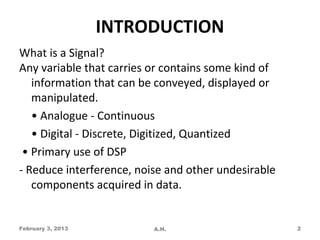
What is a Signal?
Any variable that carries or contains some kind of
   information that can be conveyed, displayed or
   manipulated.
   • Analogue - Continuous
   • Digital - Discrete, Digitized, Quantized
 • Primary use of DSP
- Reduce interference, noise and other undesirable
   components acquired in data.


February 3, 2013          A.H.                       2
Advantage Vs. Disadvantages
Advantages of Digital Systems
• Guaranteed Accuracy
• Perfect Reproducibility
• Non-variant with Temperature and Age
• Greater Flexibility
• Superior Performance
• Most modern data is already in digital format


February 3, 2013       A.H.                       3
Advantage Vs. Disadvantages
Disadvantages
• Speed and Cost ???
• Design Time
• Finite Wordlength


February 3, 2013       A.H.          4
Application Areas
Image Processing
• Pattern Recognition
• Computer/ Robotic Vision
Commercial
• Movie Special Effects
• Video Conferencing
Telecommunications
• Echo Cancellation
• Data Communications


February 3, 2013          A.H.         5
Application Areas
 Speech/ Audio
• Speech Recognition
• Text to Speech
Military
• Radar/ Sonar Processing
• Missile Guidance
Consumer Applications
• Mobile Phones
• HDTV

February 3, 2013            A.H.       6
Application Areas
Instrumentation/ Control
• Noise Reduction
• Data Compression
Space
• Space Photograph Enhancement (Hubble etc.)
• Interplanetary Probes
Medical
• Ultrasound
  ECG

February 3, 2013          A.H.                 7
Basic Elements of DSP System


             Fig. 1.3 [Proa]. Block diagram of a DSP System


02/03/13 15:00                          8                A.H.
Characteristics of Practical Digital Signal

    For a signal to be completely representable
    and storable in a digital system-

•   Discrete-Time
•   Discrete-Valued
•   Finite duration
•   Finite number of discrete values


02/03/13 15:00           A.H.                     9
Basic Parts of an A/D Converter [Proa P. 22]


        Fig. Proa 1.14 (modified) Block diagram of A/D Converter

• Sampling: Convertd C-T signal into D-T signal by taking
  “samples” of the C-T signal at D-T instants. At the point D we
  obtain x(nTs)=x(n). Ts is called sampling interval

• Quantization: Converts C-V D-T signal into D-V D-T signal
  (Digital signal xq at the point E). Diff between x(n) and xq(n) is
  called quantization error [See more in Proakis 33].

02/03/13 15:00                         10                 A.H.
Coding and Sampling Theory
Coding: Converts xq(n) in to binary sequence
• Sampling Theorem:
    If the frequency component in a signal is fmax ,
    then the signal should be sampled at the rate
    of at least 2fmax for the samples to describe the
    signal completely. –
fs >= 2fmax
[See more in Proakis P.30]
                             11
02/03/13 15:00                               A.H.
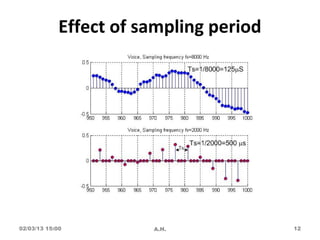
Effect of sampling period


02/03/13 15:00          A.H.             12
Wave-2


                 Wave-1                     Wave-3


Listen to original sound at Fs = 8000 Hz in Normal
Tempo [Wave-1]
Listen to the sound at reduced Fs = 2000 Hz in Normal
Tempo [Wave-2]
Listen to the sound at Fs = 2000 Hz in fast tempo
[Wave-3].
 Listen to the sound at Fs = 8000 Hz in SLOW tempo
02/03/13 15:00            A.H.                       13
Simple Manipulations of D-T Signals [52]
Types of manipulations-
• Transformation of independent variables (time
  index).
      - Shifting: Delay, Advance
• Modification of dependent variable (amplitude
  values).
      Addition
      Multiplication
      Amplitude scaling

February 3, 2013         A.H.                     14
Shifting [P.52]
               x(n)                   y(n)=x(n-k)
                         Shift by k

Shift Operation –
• Shifting of a signal x(n) is moving of the signal along n
  index. In the shifting process, the independent
  variable n is replaced by n-k.
• Shift equation: y(n) = x(n-k), k is an integer
• 2 types of shift operations -
   – Right shift – k is positive [Delay]
   – Left shift – k is negative [Advance]

February 3, 2013               A.H.                      15
Shift Example [P. 53]


• [a] x(n) = [-1 0 1 2 3 4 4 4 4 4]
• [b] x(n-3) = [-1 0 1 2 3 4 4 4 4 4] [Delayed]
• [c] x(n+2) = [-1 0 1 2 3 4 4 4 4 4] [Advanced]

February 3, 2013            A.H.                   16
Fold

    In this operation each sample of x(n) flips
      around n=0.
    Folding equation: y(n) = x(-n)
    Note:
    • Operation of Folding AND Shifting of a signal are not
      commutative
      i.e., TD{ FD[ (x) ] } ≠ FD{ TD[ (x) ] }.
                                                    ≠
      (See Proa 53 for proof)


February 3, 2013                A.H.                          17
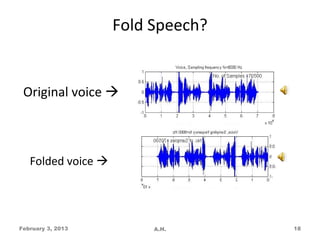
Fold Speech?


 Original voice 


   Folded voice 


February 3, 2013         A.H.      18
Fold and Shift Example


• [a] x(n) = [2 2 2 0 1 2 3 4]
• [b] x(-n) = [ 4 3 2 1 0 2 2 2 ] [Folded]
• [c] x(-n+2) = [ 4 3 2 1 0 2 2 2 ] [Folded and right
                                            Shifted]


February 3, 2013             A.H.                       19
Key DSP Operations
There are 5 basic DSP operations
• Convolution
• Correlation
• Filtering
• Transformation
• Modulation


February 3, 2013           A.H.         20
Convolution
• Definition:
  Given 2 finite length sequences, x(n) and h(n),
  their linear convolution is
                    y( n ) = x( n )* h( n )
                              ∞
                         = ∑ x( k )h( n − k )
                            k = −∞

 • Where the symbol [*] is used to denote
   convolution

 February 3, 2013                    A.H.           21
The process of computing Convolution
To obtain y(n0) at some instant of time, n = n0
                         ∞
              y( n 0 ) = ∑ x( k )h( n 0 − k )
                       k = −∞

1. Fold h(k) about k=0 to obtain h(-k)
2. Shift h(-k) by n0 to the right to obtain h(n0–k)
3. Multiply x(k) by h(n0 –k) to obtain the product sequence
4. Sum all the elements of v to obtain y(n0)
To obtain y(n) [i.e., complete convolution output] -
    Repeat steps 2-4 for all time shifts


February 3, 2013                  A.H.                        22
Example of computing Convolution
Problem Proa 2.3.2
Given, h(n)=[1,2,1,-1]; and x(n)=[1,2,3,1]
Compute the convolution output
y(n)=h(n)*x(n).

             x(n)                 y(n)=x(n)*h(n)
                    h(n)


February 3, 2013           A.H.                    23
Solution
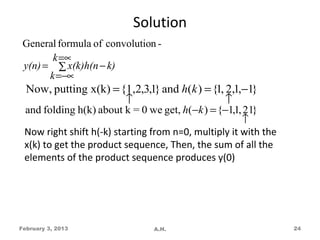
 General formula of convolution -
        k =∝
 y(n) = ∑ x(k)h(n − k)
       k =−∝
  Now, putting x(k) = {1,2,3,1} and h(k ) = {1, 2,1,−1}
                       ↑                        ↑
 and folding h(k) about k = 0 we get, h(−k ) = {−1,1, 21}
                                                      ↑
 Now right shift h(-k) starting from n=0, multiply it with the
 x(k) to get the product sequence, Then, the sum of all the
 elements of the product sequence produces y(0)


February 3, 2013                A.H.                             24
Solution … continued
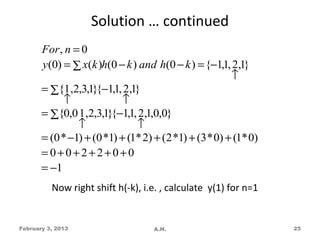
       For , n = 0
       y(0) = ∑ x(k )h(0 − k ) and h(0 − k ) = {−1,1, 2,1}
                                                        ↑
       = ∑{1,2,3,1}{−1,1, 2,1}
            ↑               ↑
       = ∑{0,0 1 ,2,3,1}{−1,1, 2,1,0,0}
                ↑              ↑
       = (0 * −1) + (0 *1) + (1* 2) + (2 *1) + (3 * 0) + (1* 0)
       =0+0+2+2+0+0
       = −1
          Now right shift h(-k), i.e. , calculate y(1) for n=1


February 3, 2013                    A.H.                          25
Solution …. continued
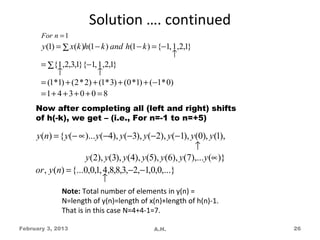
       For n = 1
       y (1) = ∑ x(k )h(1 − k ) and h(1 − k ) = {−1, 1 ,2,1}
                                                     ↑
       = ∑{1,2,3,1}{−1, 1 ,2,1}
             ↑            ↑
       = (1*1) + (2 * 2) + (1* 3) + (0 *1) + (−1* 0)
       =1+ 4 + 3 + 0 + 0 = 8
     Now after completing all (left and right) shifts
     of h(-k), we get – (i.e., For n=-1 to n=+5)

     y(n) = { y(− ∝)... y(−4), y(−3), y(−2), y(−1), y(0), y(1),
                                                       ↑
                     y(2), y(3), y(4), y(5), y(6), y(7),... y(∝)}
     or , y(n) = {...0,0,1, 4,8,8,3,−2,−1,0,0,...}
                           ↑
              Note: Total number of elements in y(n) =
              N=length of y(n)=length of x(n)+length of h(n)-1.
              That is in this case N=4+4-1=7.

February 3, 2013                              A.H.                  26
Animation of Convolution


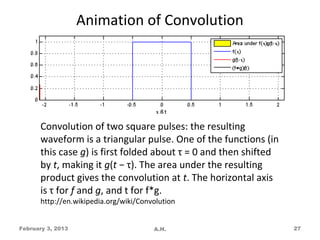
      Convolution of two square pulses: the resulting
      waveform is a triangular pulse. One of the functions (in
      this case g) is first folded about τ = 0 and then shifted
      by t, making it g(t − τ). The area under the resulting
      product gives the convolution at t. The horizontal axis
      is τ for f and g, and t for f*g.
      http://en.wikipedia.org/wiki/Convolution


February 3, 2013                       A.H.                       27
Correlation [Proa 120]
• Correlation is an operation that enables the
  measurement of the degree to which 2
  sequences are similar

• There are 2 types of correlations -
1. Crosscorrelation
2. Autocorrelation

February 3, 2013            A.H.                 28
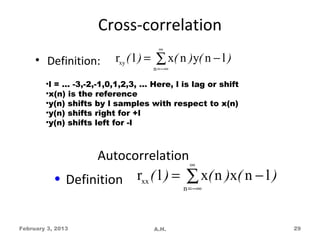
Cross-correlation
                                     ∞

     • Definition:        rxy ( l ) = ∑ x( n )y( n − l )
                                   n = −∞

        •l = … -3,-2,-1,0,1,2,3, … Here, l is lag or shift
        •x(n) is the reference
        •y(n) shifts by l samples with respect to x(n)
        •y(n) shifts right for +l
        •y(n) shifts left for -l


                  Autocorrelation
                                    ∞

           • Definition rxx ( l ) = ∑ x( n )x( n − l )
                                            n = −∞


February 3, 2013                    A.H.                     29
Correlation example [Proa 120]
 Example 2.6.1
Determine the cross-correlation sequence rxy (l) of
  the sequences –
x(n) = {2,-1,3,7,1,2,-3}
y(n) = {1,1,-1,2,-2,4,1,-2,5}


February 3, 2013          A.H.                   30
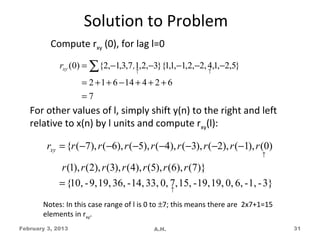
Solution to Problem
          Compute rxy (0), for lag l=0

             rxy (0) = ∑{2,−1,3,7 ,1,2,−3}{1,1,−1,2,−2, 4,1,−2,5}
                                    ↑                     ↑

                   = 2 + 1 + 6 − 14 + 4 + 2 + 6
                   =7
   For other values of l, simply shift y(n) to the right and left
   relative to x(n) by l units and compute rxy(l):

         rxy = {r (−7), r (−6), r (−5), r (−4), r (−3), r (−2), r (−1), r (0)
                                                                           ↑

             r (1), r (2), r (3), r (4), r (5), r (6), r (7)}
             = {10, - 9, 19, 36, - 14, 33, 0, 7, 15, - 19, 19, 0, 6, - 1, - 3}
                                                ↑

       Notes: In this case range of l is 0 to ±7; this means there are 2x7+1=15
       elements in rxy.
February 3, 2013                         A.H.                                     31
Similarities between computation of
     Cross-correlation and convolution of 2
                    sequences
• Similarities are apparent
• Convolution computation- fold  shift  multiply one
  sequence with the other to get the product sequence, and
  then elements of the product sequence are summed to get
  the conv. output.
• Cross-correlation computation – Same operations except the
  folding one.
• rxy(l) = x(l) * y(-l) [See text]


February 3, 2013             A.H.                          32
DSP Lecture
                      INTRODUCTION
                               THE END

                              THANK YOU

              This ppt may be downloaded from my web site:
                 http://asadul.drivehq.com/students.htm
              Password (email address): dsp.ete@ulab.edu.bd

                    This password does not live long !


Feb 3, 2013                      A.H.                         33

Dsp lecture vol 1 introduction

  • 1.
    DSP Lectures ETE 315 INTRODUCTION Prof. A.H.M. Asadul Huq, Ph.D. http://asadul.drivehq.com/students.htm asadul.huq@ulab.edu.bd February 3, 2013 A.H. 1
  • 2.
    INTRODUCTION What is aSignal? Any variable that carries or contains some kind of information that can be conveyed, displayed or manipulated. • Analogue - Continuous • Digital - Discrete, Digitized, Quantized • Primary use of DSP - Reduce interference, noise and other undesirable components acquired in data. February 3, 2013 A.H. 2
  • 3.
    Advantage Vs. Disadvantages Advantagesof Digital Systems • Guaranteed Accuracy • Perfect Reproducibility • Non-variant with Temperature and Age • Greater Flexibility • Superior Performance • Most modern data is already in digital format February 3, 2013 A.H. 3
  • 4.
    Advantage Vs. Disadvantages Disadvantages •Speed and Cost ??? • Design Time • Finite Wordlength February 3, 2013 A.H. 4
  • 5.
    Application Areas Image Processing •Pattern Recognition • Computer/ Robotic Vision Commercial • Movie Special Effects • Video Conferencing Telecommunications • Echo Cancellation • Data Communications February 3, 2013 A.H. 5
  • 6.
    Application Areas Speech/Audio • Speech Recognition • Text to Speech Military • Radar/ Sonar Processing • Missile Guidance Consumer Applications • Mobile Phones • HDTV February 3, 2013 A.H. 6
  • 7.
    Application Areas Instrumentation/ Control •Noise Reduction • Data Compression Space • Space Photograph Enhancement (Hubble etc.) • Interplanetary Probes Medical • Ultrasound ECG February 3, 2013 A.H. 7
  • 8.
    Basic Elements ofDSP System Fig. 1.3 [Proa]. Block diagram of a DSP System 02/03/13 15:00 8 A.H.
  • 9.
    Characteristics of PracticalDigital Signal For a signal to be completely representable and storable in a digital system- • Discrete-Time • Discrete-Valued • Finite duration • Finite number of discrete values 02/03/13 15:00 A.H. 9
  • 10.
    Basic Parts ofan A/D Converter [Proa P. 22] Fig. Proa 1.14 (modified) Block diagram of A/D Converter • Sampling: Convertd C-T signal into D-T signal by taking “samples” of the C-T signal at D-T instants. At the point D we obtain x(nTs)=x(n). Ts is called sampling interval • Quantization: Converts C-V D-T signal into D-V D-T signal (Digital signal xq at the point E). Diff between x(n) and xq(n) is called quantization error [See more in Proakis 33]. 02/03/13 15:00 10 A.H.
  • 11.
    Coding and SamplingTheory Coding: Converts xq(n) in to binary sequence • Sampling Theorem: If the frequency component in a signal is fmax , then the signal should be sampled at the rate of at least 2fmax for the samples to describe the signal completely. – fs >= 2fmax [See more in Proakis P.30] 11 02/03/13 15:00 A.H.
  • 12.
    Effect of samplingperiod 02/03/13 15:00 A.H. 12
  • 13.
    Wave-2 Wave-1 Wave-3 Listen to original sound at Fs = 8000 Hz in Normal Tempo [Wave-1] Listen to the sound at reduced Fs = 2000 Hz in Normal Tempo [Wave-2] Listen to the sound at Fs = 2000 Hz in fast tempo [Wave-3]. Listen to the sound at Fs = 8000 Hz in SLOW tempo 02/03/13 15:00 A.H. 13
  • 14.
    Simple Manipulations ofD-T Signals [52] Types of manipulations- • Transformation of independent variables (time index). - Shifting: Delay, Advance • Modification of dependent variable (amplitude values). Addition Multiplication Amplitude scaling February 3, 2013 A.H. 14
  • 15.
    Shifting [P.52] x(n) y(n)=x(n-k) Shift by k Shift Operation – • Shifting of a signal x(n) is moving of the signal along n index. In the shifting process, the independent variable n is replaced by n-k. • Shift equation: y(n) = x(n-k), k is an integer • 2 types of shift operations - – Right shift – k is positive [Delay] – Left shift – k is negative [Advance] February 3, 2013 A.H. 15
  • 16.
    Shift Example [P.53] • [a] x(n) = [-1 0 1 2 3 4 4 4 4 4] • [b] x(n-3) = [-1 0 1 2 3 4 4 4 4 4] [Delayed] • [c] x(n+2) = [-1 0 1 2 3 4 4 4 4 4] [Advanced] February 3, 2013 A.H. 16
  • 17.
    Fold In this operation each sample of x(n) flips around n=0. Folding equation: y(n) = x(-n) Note: • Operation of Folding AND Shifting of a signal are not commutative i.e., TD{ FD[ (x) ] } ≠ FD{ TD[ (x) ] }. ≠ (See Proa 53 for proof) February 3, 2013 A.H. 17
  • 18.
    Fold Speech? Originalvoice  Folded voice  February 3, 2013 A.H. 18
  • 19.
    Fold and ShiftExample • [a] x(n) = [2 2 2 0 1 2 3 4] • [b] x(-n) = [ 4 3 2 1 0 2 2 2 ] [Folded] • [c] x(-n+2) = [ 4 3 2 1 0 2 2 2 ] [Folded and right Shifted] February 3, 2013 A.H. 19
  • 20.
    Key DSP Operations Thereare 5 basic DSP operations • Convolution • Correlation • Filtering • Transformation • Modulation February 3, 2013 A.H. 20
  • 21.
    Convolution • Definition: Given 2 finite length sequences, x(n) and h(n), their linear convolution is y( n ) = x( n )* h( n ) ∞ = ∑ x( k )h( n − k ) k = −∞ • Where the symbol [*] is used to denote convolution February 3, 2013 A.H. 21
  • 22.
    The process ofcomputing Convolution To obtain y(n0) at some instant of time, n = n0 ∞ y( n 0 ) = ∑ x( k )h( n 0 − k ) k = −∞ 1. Fold h(k) about k=0 to obtain h(-k) 2. Shift h(-k) by n0 to the right to obtain h(n0–k) 3. Multiply x(k) by h(n0 –k) to obtain the product sequence 4. Sum all the elements of v to obtain y(n0) To obtain y(n) [i.e., complete convolution output] - Repeat steps 2-4 for all time shifts February 3, 2013 A.H. 22
  • 23.
    Example of computingConvolution Problem Proa 2.3.2 Given, h(n)=[1,2,1,-1]; and x(n)=[1,2,3,1] Compute the convolution output y(n)=h(n)*x(n). x(n) y(n)=x(n)*h(n) h(n) February 3, 2013 A.H. 23
  • 24.
    Solution General formulaof convolution - k =∝ y(n) = ∑ x(k)h(n − k) k =−∝ Now, putting x(k) = {1,2,3,1} and h(k ) = {1, 2,1,−1} ↑ ↑ and folding h(k) about k = 0 we get, h(−k ) = {−1,1, 21} ↑ Now right shift h(-k) starting from n=0, multiply it with the x(k) to get the product sequence, Then, the sum of all the elements of the product sequence produces y(0) February 3, 2013 A.H. 24
  • 25.
    Solution … continued For , n = 0 y(0) = ∑ x(k )h(0 − k ) and h(0 − k ) = {−1,1, 2,1} ↑ = ∑{1,2,3,1}{−1,1, 2,1} ↑ ↑ = ∑{0,0 1 ,2,3,1}{−1,1, 2,1,0,0} ↑ ↑ = (0 * −1) + (0 *1) + (1* 2) + (2 *1) + (3 * 0) + (1* 0) =0+0+2+2+0+0 = −1 Now right shift h(-k), i.e. , calculate y(1) for n=1 February 3, 2013 A.H. 25
  • 26.
    Solution …. continued For n = 1 y (1) = ∑ x(k )h(1 − k ) and h(1 − k ) = {−1, 1 ,2,1} ↑ = ∑{1,2,3,1}{−1, 1 ,2,1} ↑ ↑ = (1*1) + (2 * 2) + (1* 3) + (0 *1) + (−1* 0) =1+ 4 + 3 + 0 + 0 = 8 Now after completing all (left and right) shifts of h(-k), we get – (i.e., For n=-1 to n=+5) y(n) = { y(− ∝)... y(−4), y(−3), y(−2), y(−1), y(0), y(1), ↑ y(2), y(3), y(4), y(5), y(6), y(7),... y(∝)} or , y(n) = {...0,0,1, 4,8,8,3,−2,−1,0,0,...} ↑ Note: Total number of elements in y(n) = N=length of y(n)=length of x(n)+length of h(n)-1. That is in this case N=4+4-1=7. February 3, 2013 A.H. 26
  • 27.
    Animation of Convolution Convolution of two square pulses: the resulting waveform is a triangular pulse. One of the functions (in this case g) is first folded about τ = 0 and then shifted by t, making it g(t − τ). The area under the resulting product gives the convolution at t. The horizontal axis is τ for f and g, and t for f*g. http://en.wikipedia.org/wiki/Convolution February 3, 2013 A.H. 27
  • 28.
    Correlation [Proa 120] •Correlation is an operation that enables the measurement of the degree to which 2 sequences are similar • There are 2 types of correlations - 1. Crosscorrelation 2. Autocorrelation February 3, 2013 A.H. 28
  • 29.
    Cross-correlation ∞ • Definition: rxy ( l ) = ∑ x( n )y( n − l ) n = −∞ •l = … -3,-2,-1,0,1,2,3, … Here, l is lag or shift •x(n) is the reference •y(n) shifts by l samples with respect to x(n) •y(n) shifts right for +l •y(n) shifts left for -l Autocorrelation ∞ • Definition rxx ( l ) = ∑ x( n )x( n − l ) n = −∞ February 3, 2013 A.H. 29
  • 30.
    Correlation example [Proa120] Example 2.6.1 Determine the cross-correlation sequence rxy (l) of the sequences – x(n) = {2,-1,3,7,1,2,-3} y(n) = {1,1,-1,2,-2,4,1,-2,5} February 3, 2013 A.H. 30
  • 31.
    Solution to Problem Compute rxy (0), for lag l=0 rxy (0) = ∑{2,−1,3,7 ,1,2,−3}{1,1,−1,2,−2, 4,1,−2,5} ↑ ↑ = 2 + 1 + 6 − 14 + 4 + 2 + 6 =7 For other values of l, simply shift y(n) to the right and left relative to x(n) by l units and compute rxy(l): rxy = {r (−7), r (−6), r (−5), r (−4), r (−3), r (−2), r (−1), r (0) ↑ r (1), r (2), r (3), r (4), r (5), r (6), r (7)} = {10, - 9, 19, 36, - 14, 33, 0, 7, 15, - 19, 19, 0, 6, - 1, - 3} ↑ Notes: In this case range of l is 0 to ±7; this means there are 2x7+1=15 elements in rxy. February 3, 2013 A.H. 31
  • 32.
    Similarities between computationof Cross-correlation and convolution of 2 sequences • Similarities are apparent • Convolution computation- fold  shift  multiply one sequence with the other to get the product sequence, and then elements of the product sequence are summed to get the conv. output. • Cross-correlation computation – Same operations except the folding one. • rxy(l) = x(l) * y(-l) [See text] February 3, 2013 A.H. 32
  • 33.
    DSP Lecture INTRODUCTION THE END THANK YOU This ppt may be downloaded from my web site: http://asadul.drivehq.com/students.htm Password (email address): dsp.ete@ulab.edu.bd This password does not live long ! Feb 3, 2013 A.H. 33

Editor's Notes

  • #2 DSP Lectures Vol-1 Feb 3, 2013 A.H.