Math 285 - Spring 2012 - Review Material - Exam 3
Section 9.2 - Fourier Series and Convergence
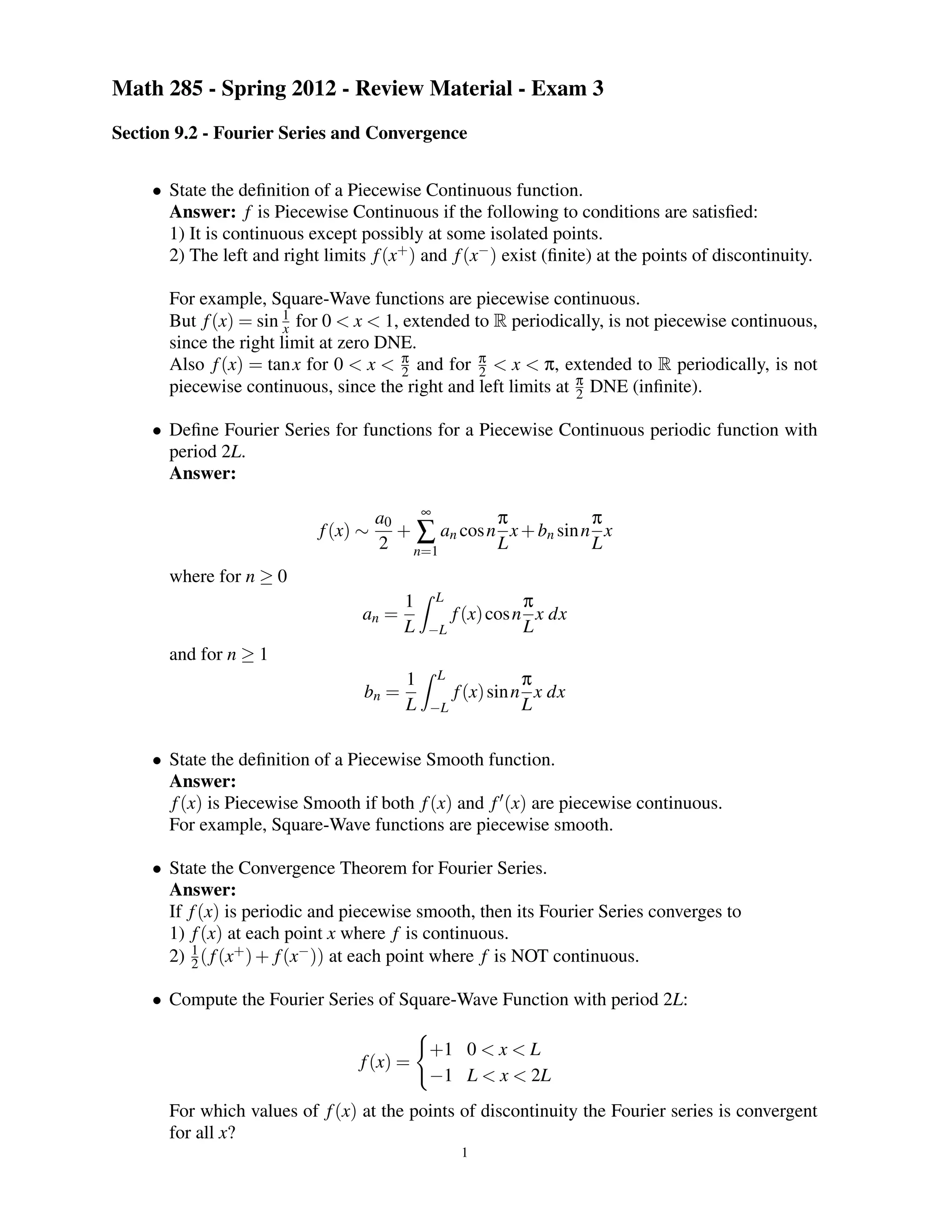
• State the definition of a Piecewise Continuous function.
Answer: f is Piecewise Continuous if the following to conditions are satisfied:
1) It is continuous except possibly at some isolated points.
2) The left and right limits f(x+) and f(x−) exist (finite) at the points of discontinuity.
For example, Square-Wave functions are piecewise continuous.
But f(x) = sin 1
x for 0 < x < 1, extended to R periodically, is not piecewise continuous,
since the right limit at zero DNE.
Also f(x) = tanx for 0 < x < π
2 and for π
2 < x < π, extended to R periodically, is not
piecewise continuous, since the right and left limits at π
2 DNE (infinite).
• Define Fourier Series for functions for a Piecewise Continuous periodic function with
period 2L.
Answer:
f(x) ∼
a0
2
+
∞
∑
n=1
an cosn
π
L
x+bn sinn
π
L
x
where for n ≥ 0
an =
1
L
L
−L
f(x)cosn
π
L
x dx
and for n ≥ 1
bn =
1
L
L
−L
f(x)sinn
π
L
x dx
• State the definition of a Piecewise Smooth function.
Answer:
f(x) is Piecewise Smooth if both f(x) and f (x) are piecewise continuous.
For example, Square-Wave functions are piecewise smooth.
• State the Convergence Theorem for Fourier Series.
Answer:
If f(x) is periodic and piecewise smooth, then its Fourier Series converges to
1) f(x) at each point x where f is continuous.
2) 1
2(f(x+)+ f(x−)) at each point where f is NOT continuous.
• Compute the Fourier Series of Square-Wave Function with period 2L:
f(x) =
+1 0 < x < L
−1 L < x < 2L
For which values of f(x) at the points of discontinuity the Fourier series is convergent
for all x?
1
2
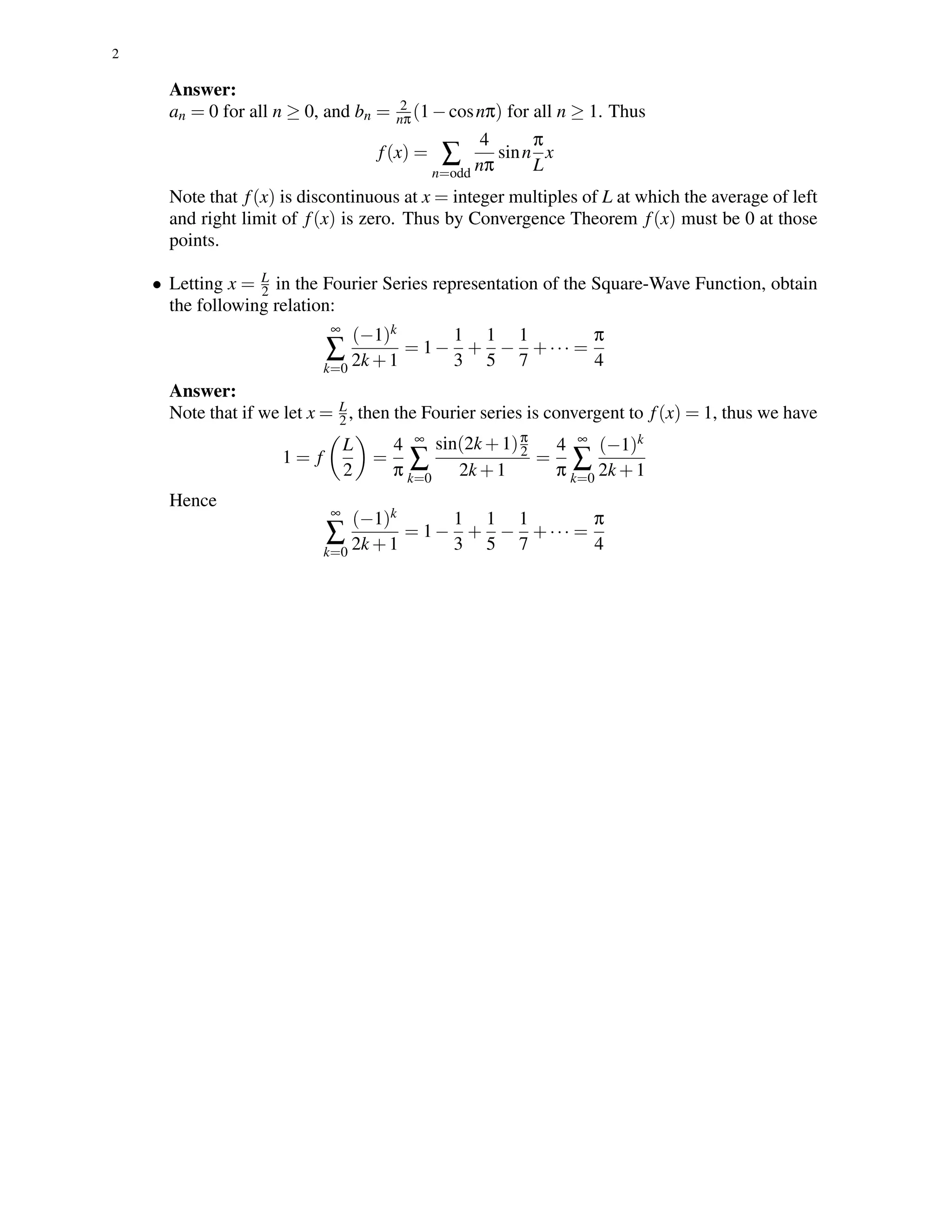
Answer:
an = 0 for all n ≥ 0, and bn = 2
nπ(1−cosnπ) for all n ≥ 1. Thus
f(x) = ∑
n=odd
4
nπ
sinn
π
L
x
Note that f(x) is discontinuous at x = integer multiples of L at which the average of left
and right limit of f(x) is zero. Thus by Convergence Theorem f(x) must be 0 at those
points.
• Letting x = L
2 in the Fourier Series representation of the Square-Wave Function, obtain
the following relation:
∞
∑
k=0
(−1)k
2k +1
= 1−
1
3
+
1
5
−
1
7
+··· =
π
4
Answer:
Note that if we let x = L
2 , then the Fourier series is convergent to f(x) = 1, thus we have
1 = f
L
2
=
4
π
∞
∑
k=0
sin(2k +1)π
2
2k +1
=
4
π
∞
∑
k=0
(−1)k
2k +1
Hence
∞
∑
k=0
(−1)k
2k +1
= 1−
1
3
+
1
5
−
1
7
+··· =
π
4
3
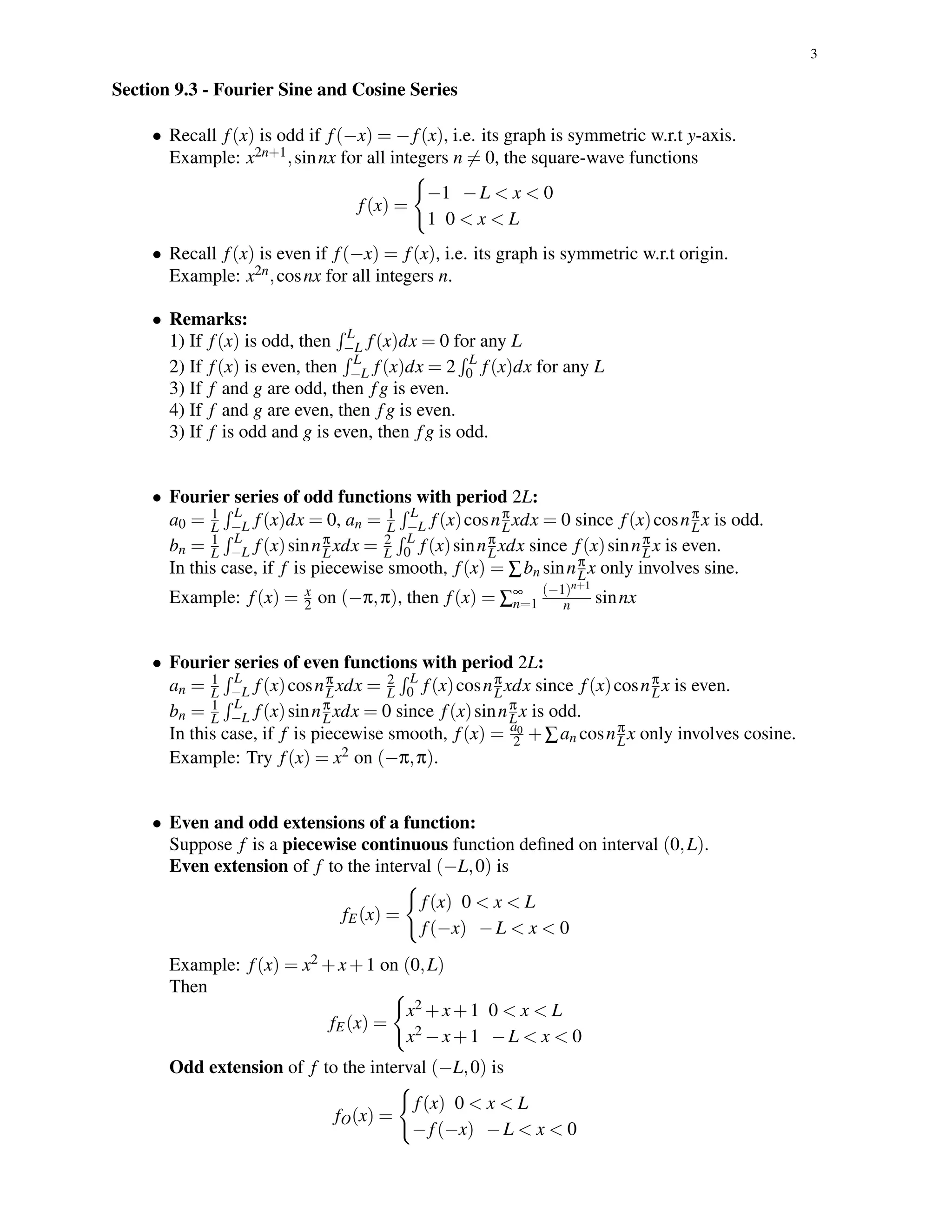
Section 9.3 - Fourier Sine and Cosine Series
• Recall f(x) is odd if f(−x) = −f(x), i.e. its graph is symmetric w.r.t y-axis.
Example: x2n+1,sinnx for all integers n = 0, the square-wave functions
f(x) =
−1 −L < x < 0
1 0 < x < L
• Recall f(x) is even if f(−x) = f(x), i.e. its graph is symmetric w.r.t origin.
Example: x2n,cosnx for all integers n.
• Remarks:
1) If f(x) is odd, then L
−L f(x)dx = 0 for any L
2) If f(x) is even, then L
−L f(x)dx = 2 L
0 f(x)dx for any L
3) If f and g are odd, then fg is even.
4) If f and g are even, then fg is even.
3) If f is odd and g is even, then fg is odd.
• Fourier series of odd functions with period 2L:
a0 = 1
L
L
−L f(x)dx = 0, an = 1
L
L
−L f(x)cosnπ
Lxdx = 0 since f(x)cosnπ
Lx is odd.
bn = 1
L
L
−L f(x)sinnπ
Lxdx = 2
L
L
0 f(x)sinnπ
Lxdx since f(x)sinnπ
Lx is even.
In this case, if f is piecewise smooth, f(x) = ∑bn sinnπ
Lx only involves sine.
Example: f(x) = x
2 on (−π,π), then f(x) = ∑∞
n=1
(−1)n+1
n sinnx
• Fourier series of even functions with period 2L:
an = 1
L
L
−L f(x)cosnπ
Lxdx = 2
L
L
0 f(x)cosnπ
Lxdx since f(x)cosnπ
Lx is even.
bn = 1
L
L
−L f(x)sinnπ
Lxdx = 0 since f(x)sinnπ
Lx is odd.
In this case, if f is piecewise smooth, f(x) = a0
2 +∑an cosnπ
Lx only involves cosine.
Example: Try f(x) = x2 on (−π,π).
• Even and odd extensions of a function:
Suppose f is a piecewise continuous function defined on interval (0,L).
Even extension of f to the interval (−L,0) is
fE(x) =
f(x) 0 < x < L
f(−x) −L < x < 0
Example: f(x) = x2 +x+1 on (0,L)
Then
fE(x) =
x2 +x+1 0 < x < L
x2 −x+1 −L < x < 0
Odd extension of f to the interval (−L,0) is
fO(x) =
f(x) 0 < x < L
−f(−x) −L < x < 0
4
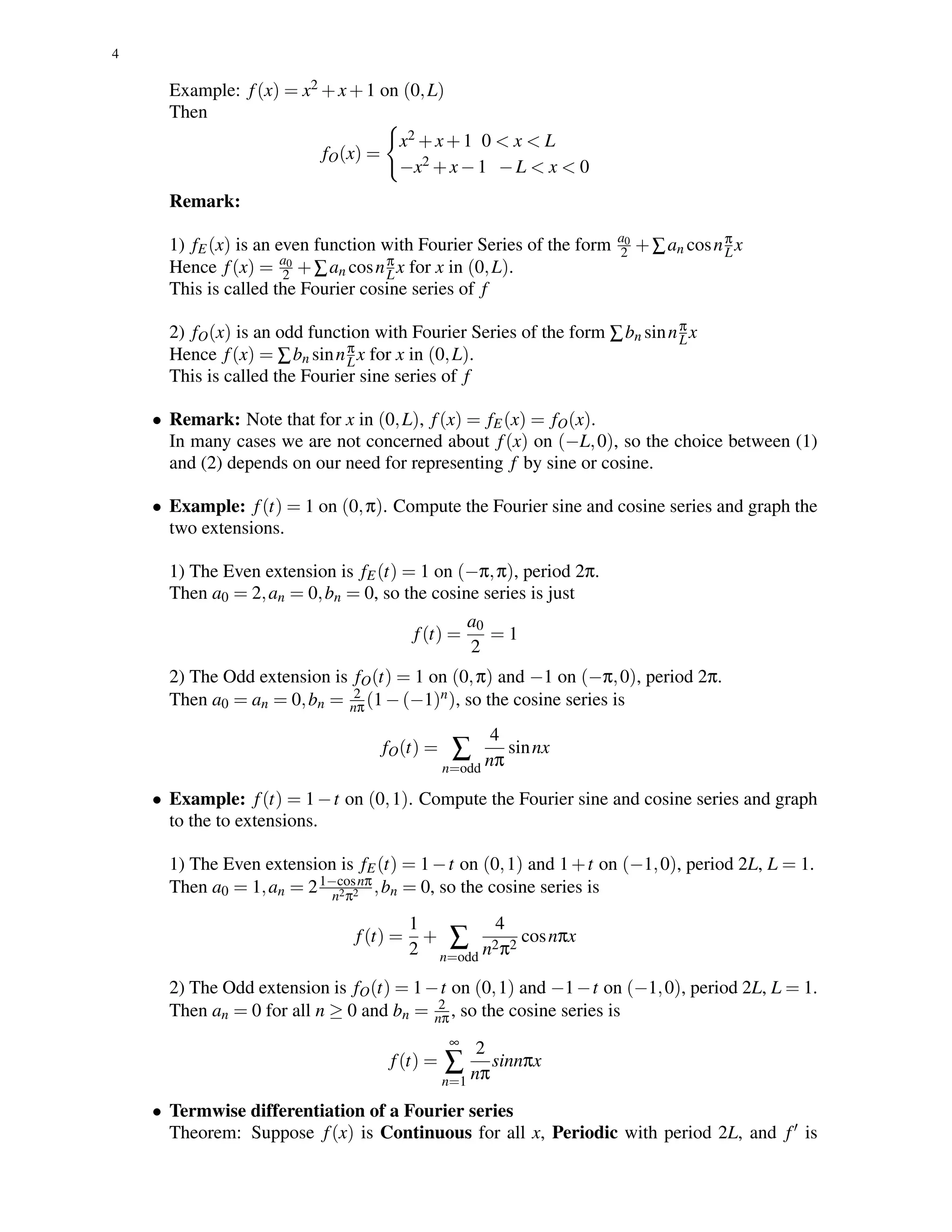
Example: f(x) = x2 +x+1 on (0,L)
Then
fO(x) =
x2 +x+1 0 < x < L
−x2 +x−1 −L < x < 0
Remark:
1) fE(x) is an even function with Fourier Series of the form a0
2 +∑an cosnπ
Lx
Hence f(x) = a0
2 +∑an cosnπ
Lx for x in (0,L).
This is called the Fourier cosine series of f
2) fO(x) is an odd function with Fourier Series of the form ∑bn sinnπ
Lx
Hence f(x) = ∑bn sinnπ
Lx for x in (0,L).
This is called the Fourier sine series of f
• Remark: Note that for x in (0,L), f(x) = fE(x) = fO(x).
In many cases we are not concerned about f(x) on (−L,0), so the choice between (1)
and (2) depends on our need for representing f by sine or cosine.
• Example: f(t) = 1 on (0,π). Compute the Fourier sine and cosine series and graph the
two extensions.
1) The Even extension is fE(t) = 1 on (−π,π), period 2π.
Then a0 = 2,an = 0,bn = 0, so the cosine series is just
f(t) =
a0
2
= 1
2) The Odd extension is fO(t) = 1 on (0,π) and −1 on (−π,0), period 2π.
Then a0 = an = 0,bn = 2
nπ(1−(−1)n), so the cosine series is
fO(t) = ∑
n=odd
4
nπ
sinnx
• Example: f(t) = 1−t on (0,1). Compute the Fourier sine and cosine series and graph
to the to extensions.
1) The Even extension is fE(t) = 1−t on (0,1) and 1+t on (−1,0), period 2L, L = 1.
Then a0 = 1,an = 21−cosnπ
n2π2 ,bn = 0, so the cosine series is
f(t) =
1
2
+ ∑
n=odd
4
n2π2
cosnπx
2) The Odd extension is fO(t) = 1−t on (0,1) and −1−t on (−1,0), period 2L, L = 1.
Then an = 0 for all n ≥ 0 and bn = 2
nπ, so the cosine series is
f(t) =
∞
∑
n=1
2
nπ
sinnπx
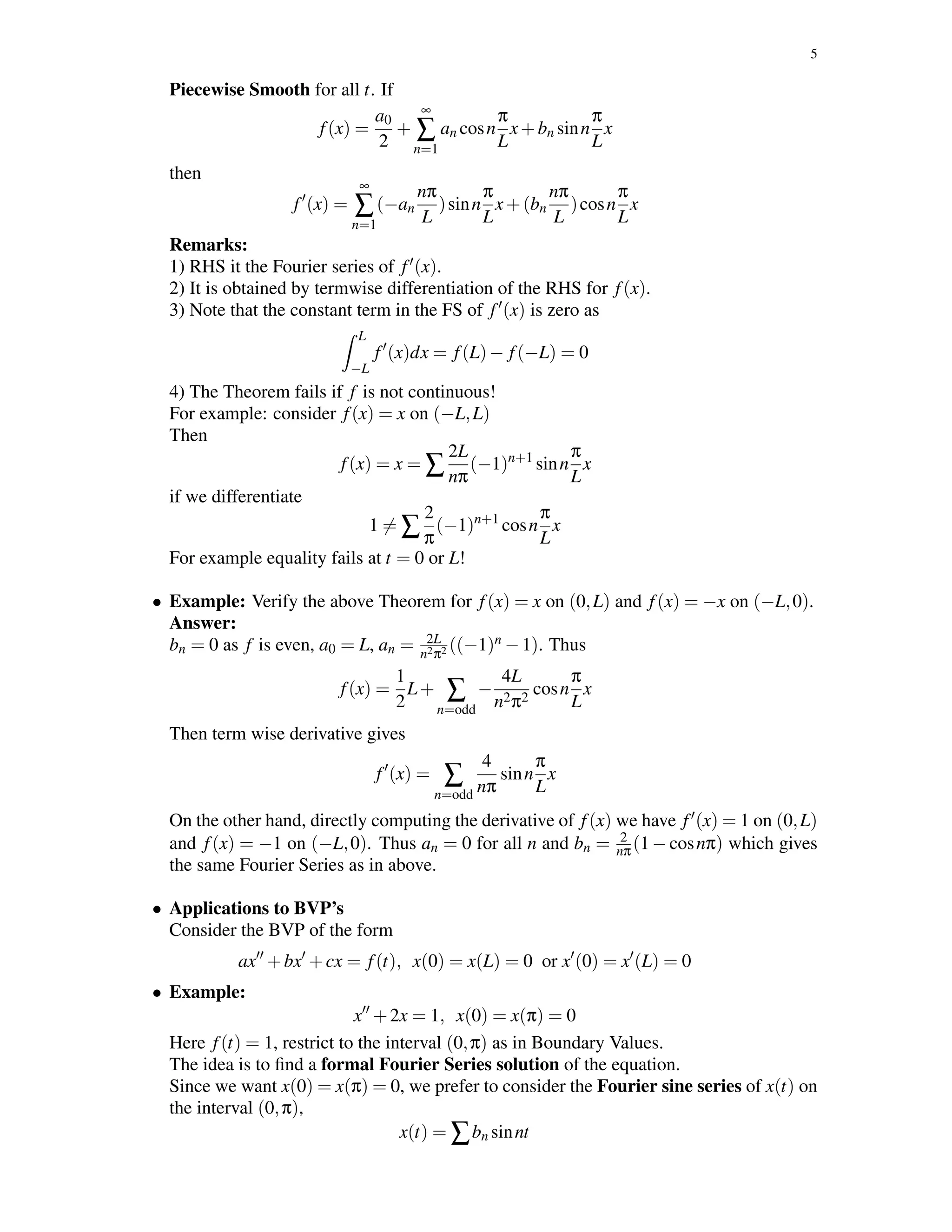
• Termwise differentiation of a Fourier series
Theorem: Suppose f(x) is Continuous for all x, Periodic with period 2L, and f is
5
Piecewise Smooth for all t. If
f(x) =
a0
2
+
∞
∑
n=1
an cosn
π
L
x+bn sinn
π
L
x
then
f (x) =
∞
∑
n=1
(−an
nπ
L
)sinn
π
L
x+(bn
nπ
L
)cosn
π
L
x
Remarks:
1) RHS it the Fourier series of f (x).
2) It is obtained by termwise differentiation of the RHS for f(x).
3) Note that the constant term in the FS of f (x) is zero as
L
−L
f (x)dx = f(L)− f(−L) = 0
4) The Theorem fails if f is not continuous!
For example: consider f(x) = x on (−L,L)
Then
f(x) = x = ∑
2L
nπ
(−1)n+1
sinn
π
L
x
if we differentiate
1 = ∑
2
π
(−1)n+1
cosn
π
L
x
For example equality fails at t = 0 or L!
• Example: Verify the above Theorem for f(x) = x on (0,L) and f(x) = −x on (−L,0).
Answer:
bn = 0 as f is even, a0 = L, an = 2L
n2π2 ((−1)n −1). Thus
f(x) =
1
2
L+ ∑
n=odd
−
4L
n2π2
cosn
π
L
x
Then term wise derivative gives
f (x) = ∑
n=odd
4
nπ
sinn
π
L
x
On the other hand, directly computing the derivative of f(x) we have f (x) = 1 on (0,L)
and f(x) = −1 on (−L,0). Thus an = 0 for all n and bn = 2
nπ(1 − cosnπ) which gives
the same Fourier Series as in above.
• Applications to BVP’s
Consider the BVP of the form
ax +bx +cx = f(t), x(0) = x(L) = 0 or x (0) = x (L) = 0
• Example:
x +2x = 1, x(0) = x(π) = 0
Here f(t) = 1, restrict to the interval (0,π) as in Boundary Values.
The idea is to find a formal Fourier Series solution of the equation.
Since we want x(0) = x(π) = 0, we prefer to consider the Fourier sine series of x(t) on
the interval (0,π),
x(t) = ∑bn sinnt
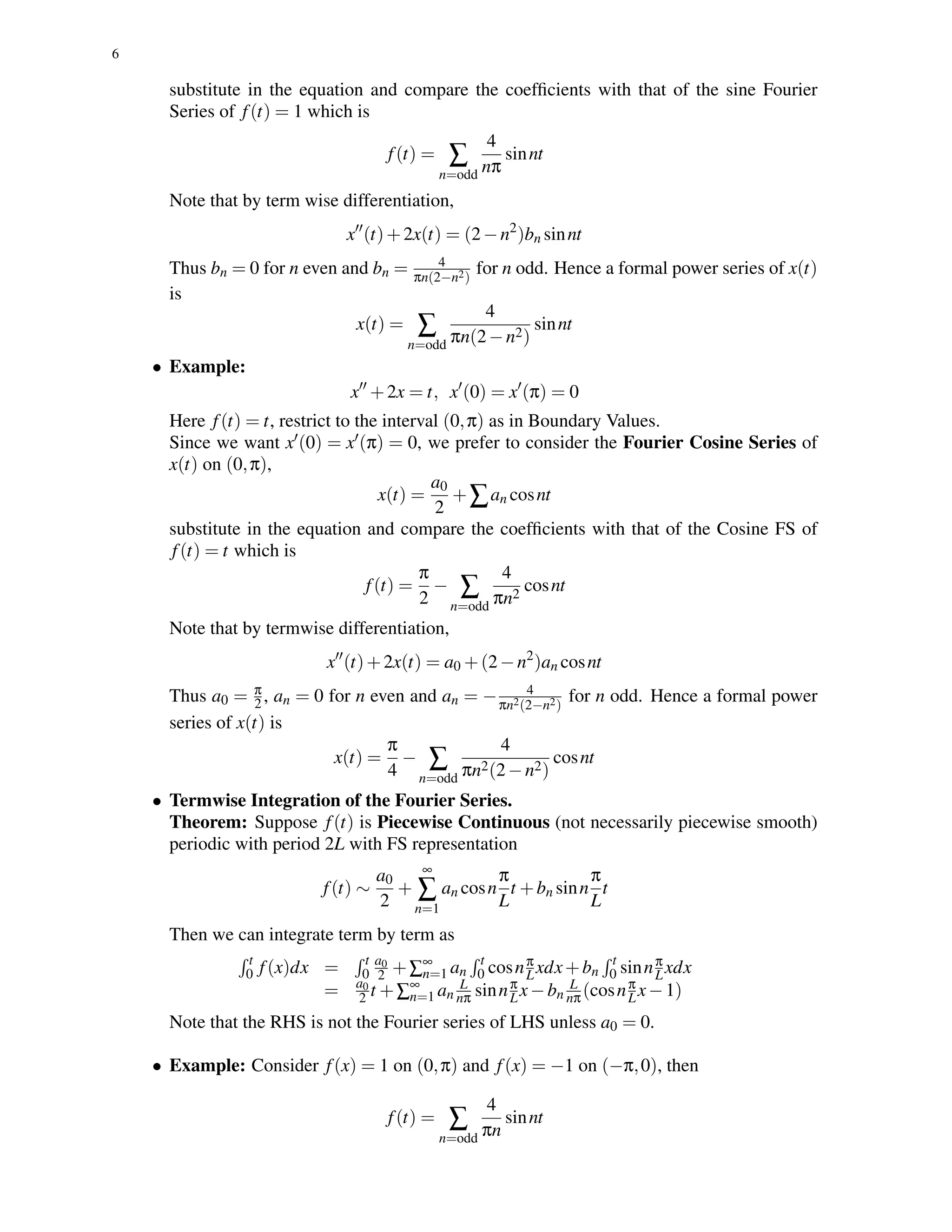
6
substitute in the equation and compare the coefficients with that of the sine Fourier
Series of f(t) = 1 which is
f(t) = ∑
n=odd
4
nπ
sinnt
Note that by term wise differentiation,
x (t)+2x(t) = (2−n2
)bn sinnt
Thus bn = 0 for n even and bn = 4
πn(2−n2)
for n odd. Hence a formal power series of x(t)
is
x(t) = ∑
n=odd
4
πn(2−n2)
sinnt
• Example:
x +2x = t, x (0) = x (π) = 0
Here f(t) = t, restrict to the interval (0,π) as in Boundary Values.
Since we want x (0) = x (π) = 0, we prefer to consider the Fourier Cosine Series of
x(t) on (0,π),
x(t) =
a0
2
+∑an cosnt
substitute in the equation and compare the coefficients with that of the Cosine FS of
f(t) = t which is
f(t) =
π
2
− ∑
n=odd
4
πn2
cosnt
Note that by termwise differentiation,
x (t)+2x(t) = a0 +(2−n2
)an cosnt
Thus a0 = π
2 , an = 0 for n even and an = − 4
πn2(2−n2)
for n odd. Hence a formal power
series of x(t) is
x(t) =
π
4
− ∑
n=odd
4
πn2(2−n2)
cosnt
• Termwise Integration of the Fourier Series.
Theorem: Suppose f(t) is Piecewise Continuous (not necessarily piecewise smooth)
periodic with period 2L with FS representation
f(t) ∼
a0
2
+
∞
∑
n=1
an cosn
π
L
t +bn sinn
π
L
t
Then we can integrate term by term as
t
0 f(x)dx = t
0
a0
2 +∑∞
n=1 an
t
0 cosnπ
Lxdx+bn
t
0 sinnπ
Lxdx
= a0
2 t +∑∞
n=1 an
L
nπ sinnπ
Lx−bn
L
nπ(cosnπ
Lx−1)
Note that the RHS is not the Fourier series of LHS unless a0 = 0.
• Example: Consider f(x) = 1 on (0,π) and f(x) = −1 on (−π,0), then
f(t) = ∑
n=odd
4
πn
sinnt
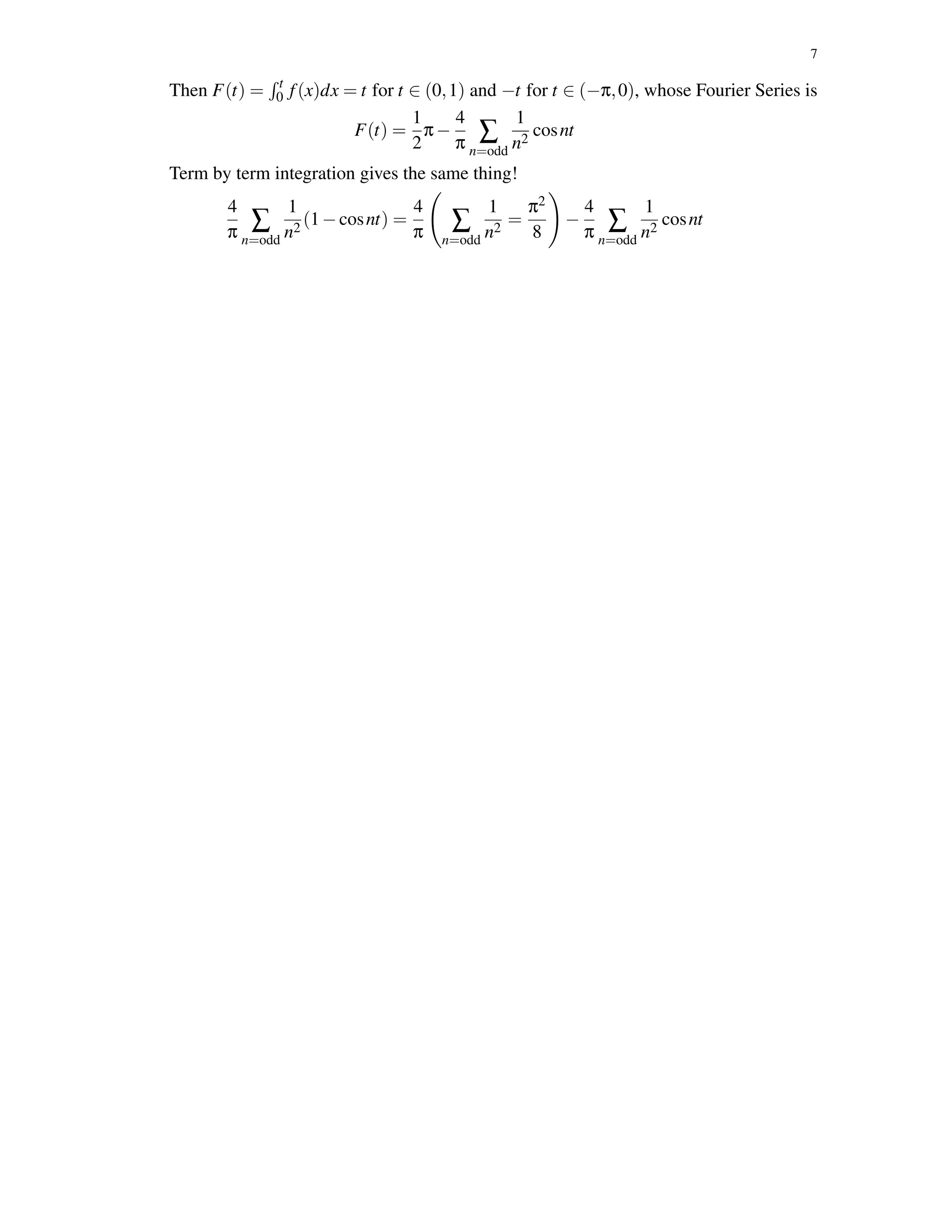
7
Then F(t) = t
0 f(x)dx = t for t ∈ (0,1) and −t for t ∈ (−π,0), whose Fourier Series is
F(t) =
1
2
π−
4
π ∑
n=odd
1
n2
cosnt
Term by term integration gives the same thing!
4
π ∑
n=odd
1
n2
(1−cosnt) =
4
π ∑
n=odd
1
n2
=
π2
8
−
4
π ∑
n=odd
1
n2
cosnt
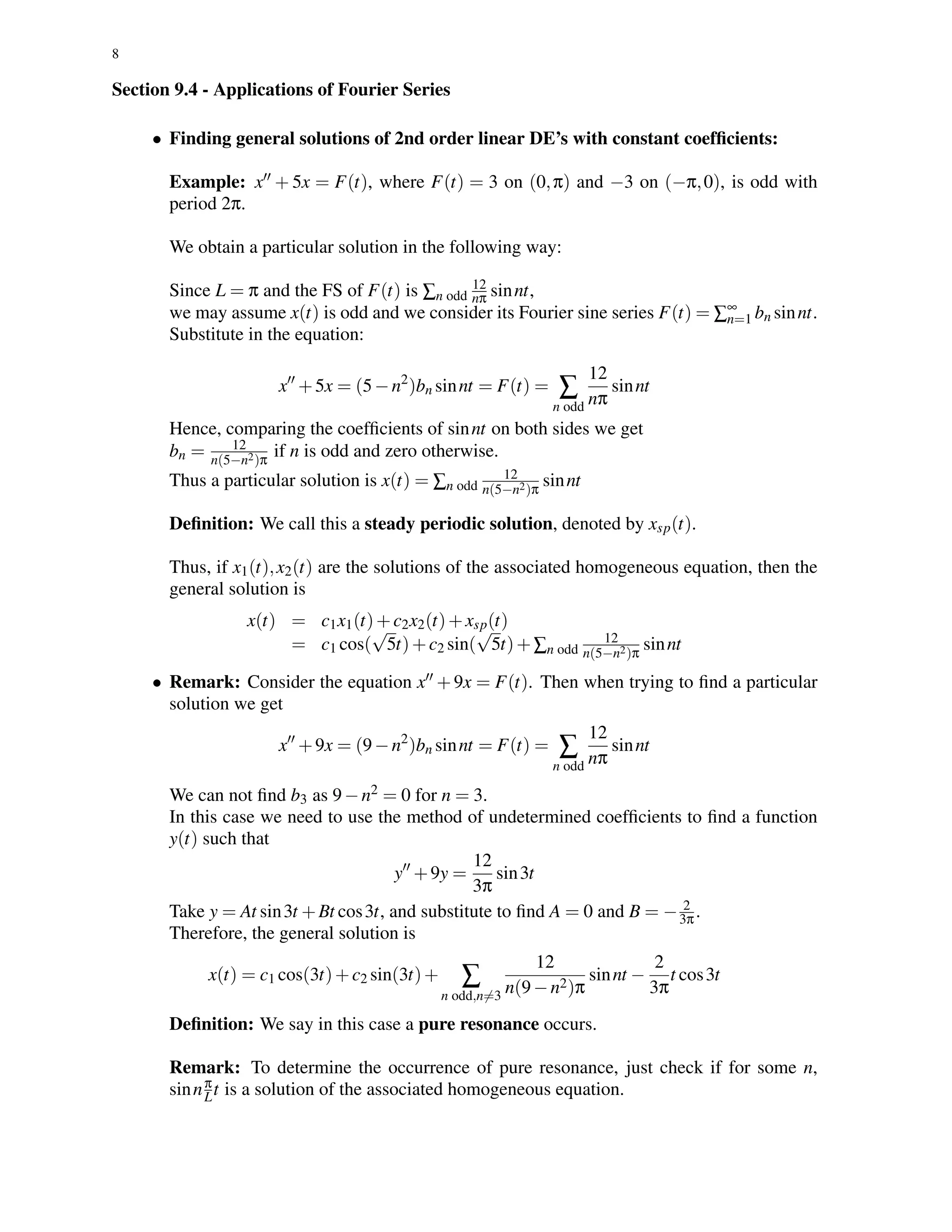
8
Section 9.4 - Applications of Fourier Series
• Finding general solutions of 2nd order linear DE’s with constant coefficients:
Example: x + 5x = F(t), where F(t) = 3 on (0,π) and −3 on (−π,0), is odd with
period 2π.
We obtain a particular solution in the following way:
Since L = π and the FS of F(t) is ∑n odd
12
nπ sinnt,
we may assume x(t) is odd and we consider its Fourier sine series F(t) = ∑∞
n=1 bn sinnt.
Substitute in the equation:
x +5x = (5−n2
)bn sinnt = F(t) = ∑
n odd
12
nπ
sinnt
Hence, comparing the coefficients of sinnt on both sides we get
bn = 12
n(5−n2)π
if n is odd and zero otherwise.
Thus a particular solution is x(t) = ∑n odd
12
n(5−n2)π
sinnt
Definition: We call this a steady periodic solution, denoted by xsp(t).
Thus, if x1(t),x2(t) are the solutions of the associated homogeneous equation, then the
general solution is
x(t) = c1x1(t)+c2x2(t)+xsp(t)
= c1 cos(
√
5t)+c2 sin(
√
5t)+∑n odd
12
n(5−n2)π
sinnt
• Remark: Consider the equation x +9x = F(t). Then when trying to find a particular
solution we get
x +9x = (9−n2
)bn sinnt = F(t) = ∑
n odd
12
nπ
sinnt
We can not find b3 as 9−n2 = 0 for n = 3.
In this case we need to use the method of undetermined coefficients to find a function
y(t) such that
y +9y =
12
3π
sin3t
Take y = At sin3t +Bt cos3t, and substitute to find A = 0 and B = − 2
3π.
Therefore, the general solution is
x(t) = c1 cos(3t)+c2 sin(3t)+ ∑
n odd,n=3
12
n(9−n2)π
sinnt −
2
3π
t cos3t
Definition: We say in this case a pure resonance occurs.
Remark: To determine the occurrence of pure resonance, just check if for some n,
sinnπ
Lt is a solution of the associated homogeneous equation.
9
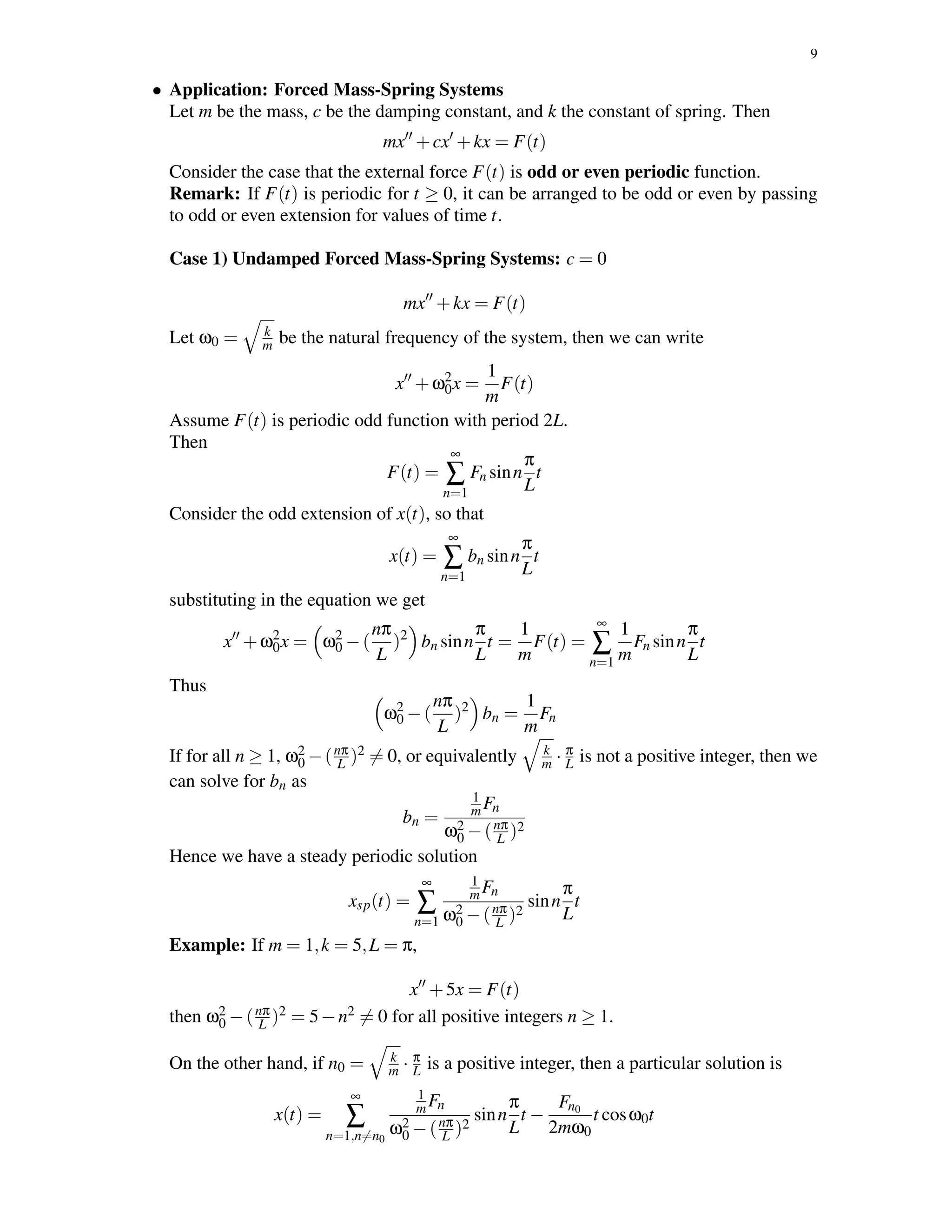
• Application: Forced Mass-Spring Systems
Let m be the mass, c be the damping constant, and k the constant of spring. Then
mx +cx +kx = F(t)
Consider the case that the external force F(t) is odd or even periodic function.
Remark: If F(t) is periodic for t ≥ 0, it can be arranged to be odd or even by passing
to odd or even extension for values of time t.
Case 1) Undamped Forced Mass-Spring Systems: c = 0
mx +kx = F(t)
Let ω0 = k
m be the natural frequency of the system, then we can write
x +ω2
0x =
1
m
F(t)
Assume F(t) is periodic odd function with period 2L.
Then
F(t) =
∞
∑
n=1
Fn sinn
π
L
t
Consider the odd extension of x(t), so that
x(t) =
∞
∑
n=1
bn sinn
π
L
t
substituting in the equation we get
x +ω2
0x = ω2
0 −(
nπ
L
)2
bn sinn
π
L
t =
1
m
F(t) =
∞
∑
n=1
1
m
Fn sinn
π
L
t
Thus
ω2
0 −(
nπ
L
)2
bn =
1
m
Fn
If for all n ≥ 1, ω2
0 −(nπ
L )2 = 0, or equivalently k
m · π
L is not a positive integer, then we
can solve for bn as
bn =
1
mFn
ω2
0 −(nπ
L )2
Hence we have a steady periodic solution
xsp(t) =
∞
∑
n=1
1
mFn
ω2
0 −(nπ
L )2
sinn
π
L
t
Example: If m = 1,k = 5,L = π,
x +5x = F(t)
then ω2
0 −(nπ
L )2 = 5−n2 = 0 for all positive integers n ≥ 1.
On the other hand, if n0 = k
m · π
L is a positive integer, then a particular solution is
x(t) =
∞
∑
n=1,n=n0
1
mFn
ω2
0 −(nπ
L )2
sinn
π
L
t −
Fn0
2mω0
t cosω0t
10
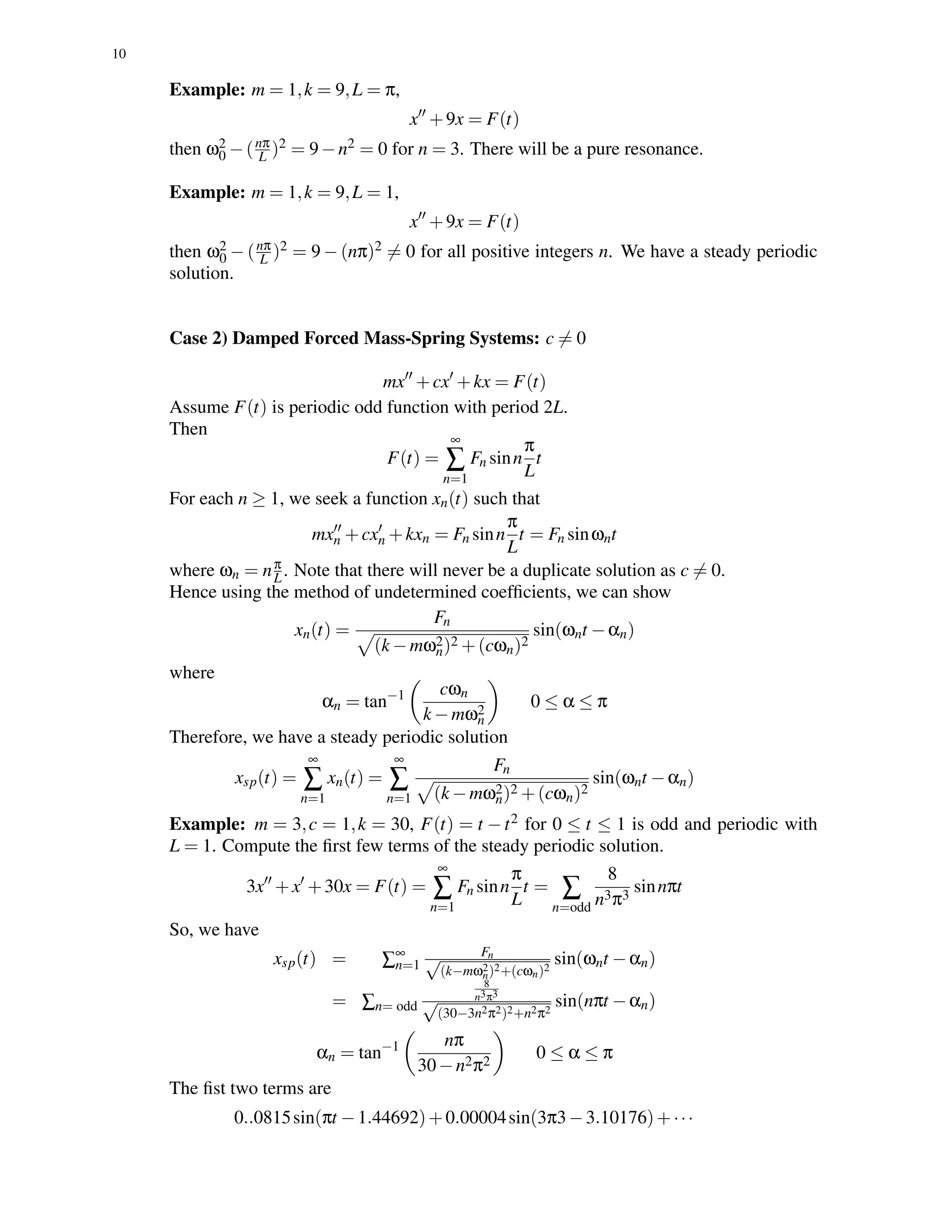
Example: m = 1,k = 9,L = π,
x +9x = F(t)
then ω2
0 −(nπ
L )2 = 9−n2 = 0 for n = 3. There will be a pure resonance.
Example: m = 1,k = 9,L = 1,
x +9x = F(t)
then ω2
0 − (nπ
L )2 = 9 − (nπ)2 = 0 for all positive integers n. We have a steady periodic
solution.
Case 2) Damped Forced Mass-Spring Systems: c = 0
mx +cx +kx = F(t)
Assume F(t) is periodic odd function with period 2L.
Then
F(t) =
∞
∑
n=1
Fn sinn
π
L
t
For each n ≥ 1, we seek a function xn(t) such that
mxn +cxn +kxn = Fn sinn
π
L
t = Fn sinωnt
where ωn = nπ
L. Note that there will never be a duplicate solution as c = 0.
Hence using the method of undetermined coefficients, we can show
xn(t) =
Fn
(k −mω2
n)2 +(cωn)2
sin(ωnt −αn)
where
αn = tan−1 cωn
k −mω2
n
0 ≤ α ≤ π
Therefore, we have a steady periodic solution
xsp(t) =
∞
∑
n=1
xn(t) =
∞
∑
n=1
Fn
(k −mω2
n)2 +(cωn)2
sin(ωnt −αn)
Example: m = 3,c = 1,k = 30, F(t) = t −t2 for 0 ≤ t ≤ 1 is odd and periodic with
L = 1. Compute the first few terms of the steady periodic solution.
3x +x +30x = F(t) =
∞
∑
n=1
Fn sinn
π
L
t = ∑
n=odd
8
n3π3
sinnπt
So, we have
xsp(t) = ∑∞
n=1
Fn√
(k−mω2
n)2+(cωn)2
sin(ωnt −αn)
= ∑n= odd
8
n3π3
√
(30−3n2π2)2+n2π2
sin(nπt −αn)
αn = tan−1 nπ
30−n2π2
0 ≤ α ≤ π
The fist two terms are
0..0815sin(πt −1.44692)+0.00004sin(3π3−3.10176)+···
11
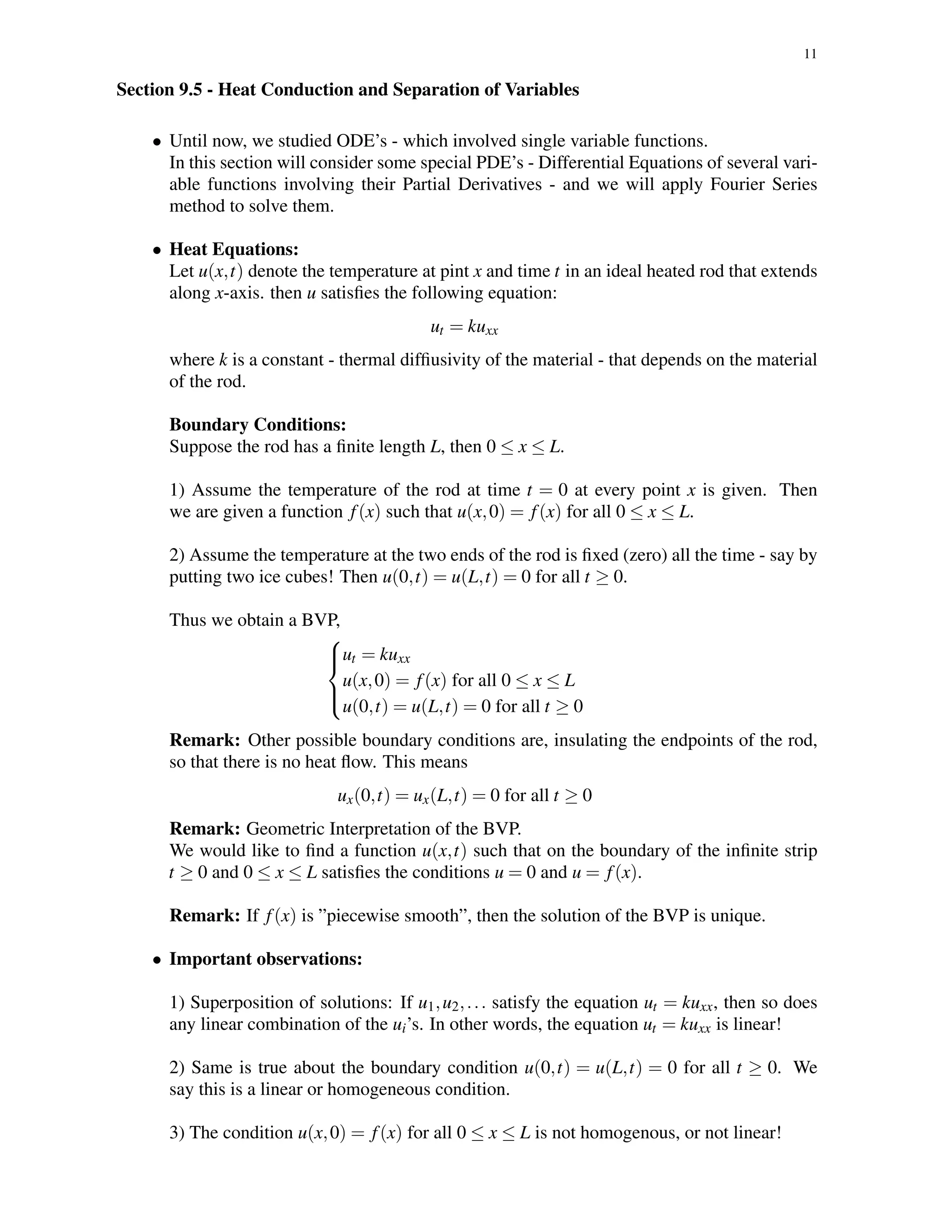
Section 9.5 - Heat Conduction and Separation of Variables
• Until now, we studied ODE’s - which involved single variable functions.
In this section will consider some special PDE’s - Differential Equations of several vari-
able functions involving their Partial Derivatives - and we will apply Fourier Series
method to solve them.
• Heat Equations:
Let u(x,t) denote the temperature at pint x and time t in an ideal heated rod that extends
along x-axis. then u satisfies the following equation:
ut = kuxx
where k is a constant - thermal diffiusivity of the material - that depends on the material
of the rod.
Boundary Conditions:
Suppose the rod has a finite length L, then 0 ≤ x ≤ L.
1) Assume the temperature of the rod at time t = 0 at every point x is given. Then
we are given a function f(x) such that u(x,0) = f(x) for all 0 ≤ x ≤ L.
2) Assume the temperature at the two ends of the rod is fixed (zero) all the time - say by
putting two ice cubes! Then u(0,t) = u(L,t) = 0 for all t ≥ 0.
Thus we obtain a BVP,



ut = kuxx
u(x,0) = f(x) for all 0 ≤ x ≤ L
u(0,t) = u(L,t) = 0 for all t ≥ 0
Remark: Other possible boundary conditions are, insulating the endpoints of the rod,
so that there is no heat flow. This means
ux(0,t) = ux(L,t) = 0 for all t ≥ 0
Remark: Geometric Interpretation of the BVP.
We would like to find a function u(x,t) such that on the boundary of the infinite strip
t ≥ 0 and 0 ≤ x ≤ L satisfies the conditions u = 0 and u = f(x).
Remark: If f(x) is ”piecewise smooth”, then the solution of the BVP is unique.
• Important observations:
1) Superposition of solutions: If u1,u2,... satisfy the equation ut = kuxx, then so does
any linear combination of the ui’s. In other words, the equation ut = kuxx is linear!
2) Same is true about the boundary condition u(0,t) = u(L,t) = 0 for all t ≥ 0. We
say this is a linear or homogeneous condition.
3) The condition u(x,0) = f(x) for all 0 ≤ x ≤ L is not homogenous, or not linear!
12
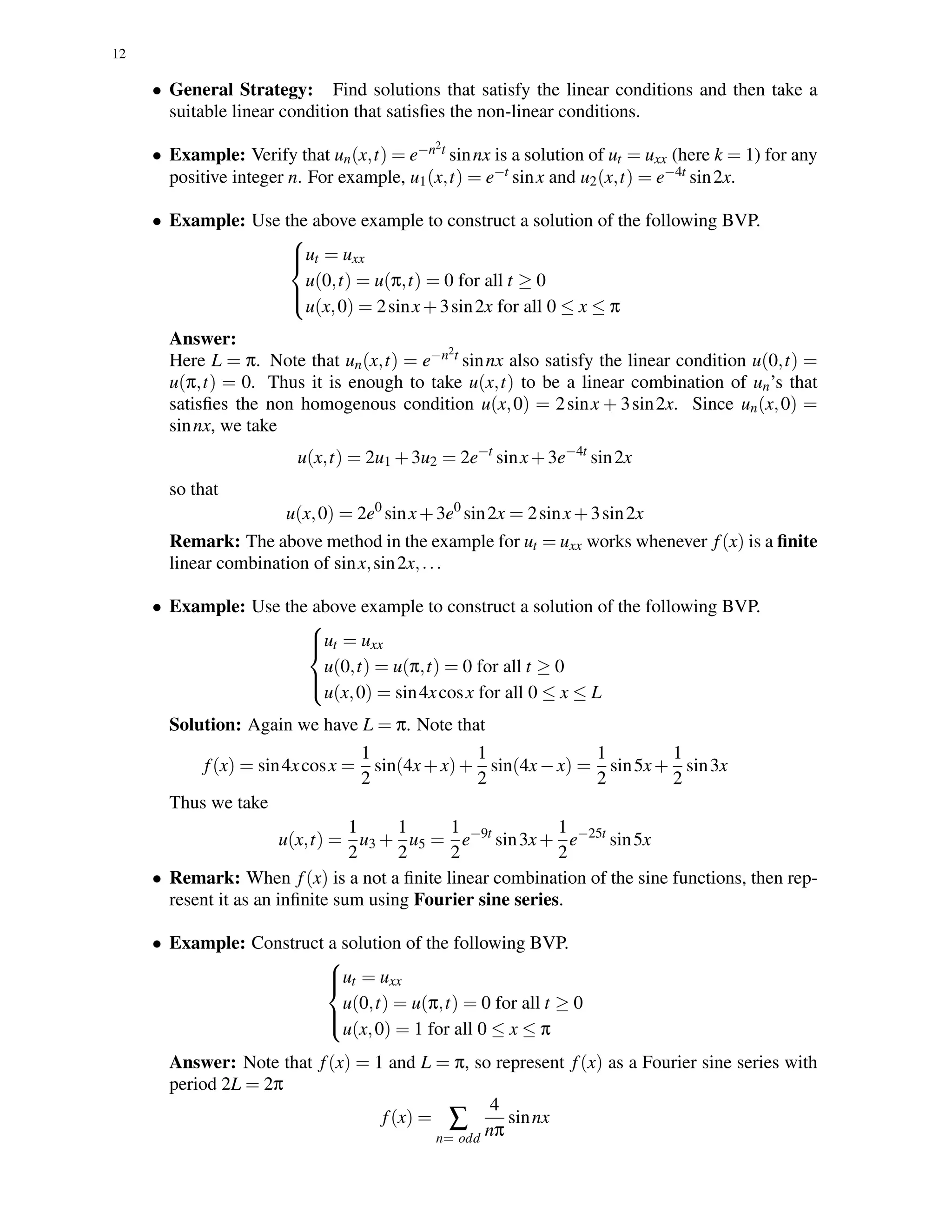
• General Strategy: Find solutions that satisfy the linear conditions and then take a
suitable linear condition that satisfies the non-linear conditions.
• Example: Verify that un(x,t) = e−n2t sinnx is a solution of ut = uxx (here k = 1) for any
positive integer n. For example, u1(x,t) = e−t sinx and u2(x,t) = e−4t sin2x.
• Example: Use the above example to construct a solution of the following BVP.



ut = uxx
u(0,t) = u(π,t) = 0 for all t ≥ 0
u(x,0) = 2sinx+3sin2x for all 0 ≤ x ≤ π
Answer:
Here L = π. Note that un(x,t) = e−n2t sinnx also satisfy the linear condition u(0,t) =
u(π,t) = 0. Thus it is enough to take u(x,t) to be a linear combination of un’s that
satisfies the non homogenous condition u(x,0) = 2sinx + 3sin2x. Since un(x,0) =
sinnx, we take
u(x,t) = 2u1 +3u2 = 2e−t
sinx+3e−4t
sin2x
so that
u(x,0) = 2e0
sinx+3e0
sin2x = 2sinx+3sin2x
Remark: The above method in the example for ut = uxx works whenever f(x) is a finite
linear combination of sinx,sin2x,...
• Example: Use the above example to construct a solution of the following BVP.



ut = uxx
u(0,t) = u(π,t) = 0 for all t ≥ 0
u(x,0) = sin4xcosx for all 0 ≤ x ≤ L
Solution: Again we have L = π. Note that
f(x) = sin4xcosx =
1
2
sin(4x+x)+
1
2
sin(4x−x) =
1
2
sin5x+
1
2
sin3x
Thus we take
u(x,t) =
1
2
u3 +
1
2
u5 =
1
2
e−9t
sin3x+
1
2
e−25t
sin5x
• Remark: When f(x) is a not a finite linear combination of the sine functions, then rep-
resent it as an infinite sum using Fourier sine series.
• Example: Construct a solution of the following BVP.



ut = uxx
u(0,t) = u(π,t) = 0 for all t ≥ 0
u(x,0) = 1 for all 0 ≤ x ≤ π
Answer: Note that f(x) = 1 and L = π, so represent f(x) as a Fourier sine series with
period 2L = 2π
f(x) = ∑
n= odd
4
nπ
sinnx
13
Thus we take
u(x,t) = ∑
n= odd
4
nπ
un(x,t) = ∑
n= odd
4
nπ
en2t
sinnx
This is a formal series solution of the BVP, one needs to check the convergence, ...
We only take finitely many terms for many applications.
• In general, to solve the following BVP (k is anything, not necessarily 1, and L is any-
thing, not just π)



ut = kuxx
u(0,t) = u(π,t) = 0 for all t ≥ 0
u(x,0) = f(x) for all 0 ≤ x ≤ L
we observe that
un(x,t) = e−k(nπ
L )2t
sinn
π
L
x
satisfies the equation ut = kuxx and the homogenous boundary condition u(0,t) = u(L,t) =
0 for all t ≥ 0. Thus, represent f(x) as a Fourier sine series with period 2L,
f(x) =
∞
∑
n=1
bn sinn
π
L
x
Then
u(x,t) :=
∞
∑
n=1
bnun(x,t) =
∞
∑
n=1
bne−k(nπ
L )2t
sinn
π
L
x
satisfies the non homogenous condition u(x,0) = f(x) for all 0 ≤ x ≤ L.
• Case of a rod with insulated endpoints:
Consider the BVP corresponding to a heated rod with insulated endpoint,



ut = kuxx
ux(0,t) = ux(π,t) = 0 for all t ≥ 0
u(x,0) = f(x) for all 0 ≤ x ≤ L
we observe that for n ≥ 0,
un(x,t) = e−k(nπ
L )2t
cosn
π
L
x
satisfies the equation ut = kuxx and the homogenous boundary condition ux(0,t) =
ux(L,t) = 0 for all t ≥ 0.
Remark: for n = 0, we get u0 = 1 which satisfies the linear conditions!
Thus, represent f(x) as a Fourier cosine series with period 2L,
f(x) =
a0
2
+
∞
∑
n=1
an cosn
π
L
x
Then
u(x,t) :=
a0
2
+
∞
∑
n=1
anun(x,t) =
a0
2
+
∞
∑
n=1
ane−k(nπ
L )2t
cosn
π
L
x
satisfies the non homogenous condition u(x,0) = f(x) for all 0 ≤ x ≤ L.
14
• Remarks:
1) In the BVP for heated rod with zero temperature in the endpoints, we have
lim
t→∞
u(x,t) = lim
t→∞
∞
∑
n=1
bne−k(nπ
L )2t
sinn
π
L
x = 0
in other words, heat goes away with no insulation, thus temperature is zero at the end!
2) In the BVP for heated rod with insulated endpoints, we have
lim
t→∞
u(x,t) = lim
t→∞
a0
2
+
∞
∑
n=1
bne−k(nπ
L )2t
cosn
π
L
x =
a0
2
which means, with insulation heat distributes evenly throughout the rod, which is the
average of the initial temperature as
a0
2
=
1
L
L
0
f(x)dx
15
Section 9.6 - Vibrating Strings and the One-Dimensional Wave Equation
• Consider a uniform flexible string of length L with fixed endpoints,
stretched along x-axis in the xy-plane from x = 0 to x = L.
Let y(x,t) denote the displacement of the points x on the string at time t
(we assume the points move parallel to y-axis).
Then y satisfies the One-dimensional wave equation:
ytt = a2
yxx
where a is a constant that depend on the material of the string and the tension!
Boundary Conditions:
1) Since the endpoints are fixed, y(0,t) = y(L,t) = 0.
2) The initial position of the string y(x,0) at each x is given as a function y(x,0) = f(x).
3) The solution also depends on the initial velocity yt(x,0) of the string at each x, given
as a function yt(x,0) = g(x).
Thus we obtain the following BVP



ytt = a2yxx
y(0,t) = y(L,t) = 0 for all t ≥ 0
y(x,0) = f(x) for all 0 ≤ x ≤ L
yt(x,0) = g(x) for all 0 ≤ x ≤ L
• Important Observations:
1) ytt = a2yxx is a linear equation. Thus the superposition of solutions applies.
2) Condition y(0,t) = y(L,t) = 0 is linear.
3) Conditions y(x,0) = f(x) and yt(x,0) = g(x) are not linear.
• General Strategy: Split the BVP into two problems,
(A)



ytt = a2yxx
y(0,t) = y(L,t) = 0 for all t ≥ 0
y(x,0) = f(x) for all 0 ≤ x ≤ L
yt(x,0) = 0 for all 0 ≤ x ≤ L
(B)



ytt = a2yxx
y(0,t) = y(L,t) = 0 for all t ≥ 0
y(x,0) = 0 for all 0 ≤ x ≤ L
yt(x,0) = g(x) for all 0 ≤ x ≤ L
If yA(x,t) and yB(x,t) are the respective solutions, then
y(x,t) = yA(x,t)+yB(x,t)
satisfies the original BVP as
y(x,0) = yA(x,0)+yB(x,0) = f(x)+0 = f(x)
and
yt(x,0) = (yA)t(x,0)+(yB)t(x,0) = 0+g(x) = g(x)
• Solving a BVP of type (A)
(A)



ytt = a2yxx
y(0,t) = y(L,t) = 0 for all t ≥ 0
y(x,0) = f(x) for all 0 ≤ x ≤ L
yt(x,0) = 0 for all 0 ≤ x ≤ L
16
Verify directly that for all positive integers n, the function
yn(x,t) = cosn
π
L
at ·sinn
π
L
x
satisfies the equation ytt = a2yxx and the linear conditions y(0,t) = y(L,t) = 0 and
yt(x,0) = 0. Thus, by superposition law, we need to find coefficients bn such that
y(x,t) =
∞
∑
n=1
bnyn(x,t) =
∞
∑
n=1
bn cosn
π
L
at ·sinn
π
L
x
satisfies y(x,0) = f(x). Note that
f(x) = y(x,0) =
∞
∑
n=1
bnyn(x,0) =
∞
∑
n=1
bn sinn
π
L
x
Thus bn’s are the Fourier sine coefficients of f(x).
• Example: Triangle initial position (pulled from the midpoint) with zero initial velocity
Assume a = 1, L = π and f(x) =
x if 0 < x < π
2
π−x if π
2 < x < π
. Then the BVP is type (A)
(A)



ytt = yxx
y(0,t) = y(π,t) = 0 for all t ≥ 0
y(x,0) = f(x) =
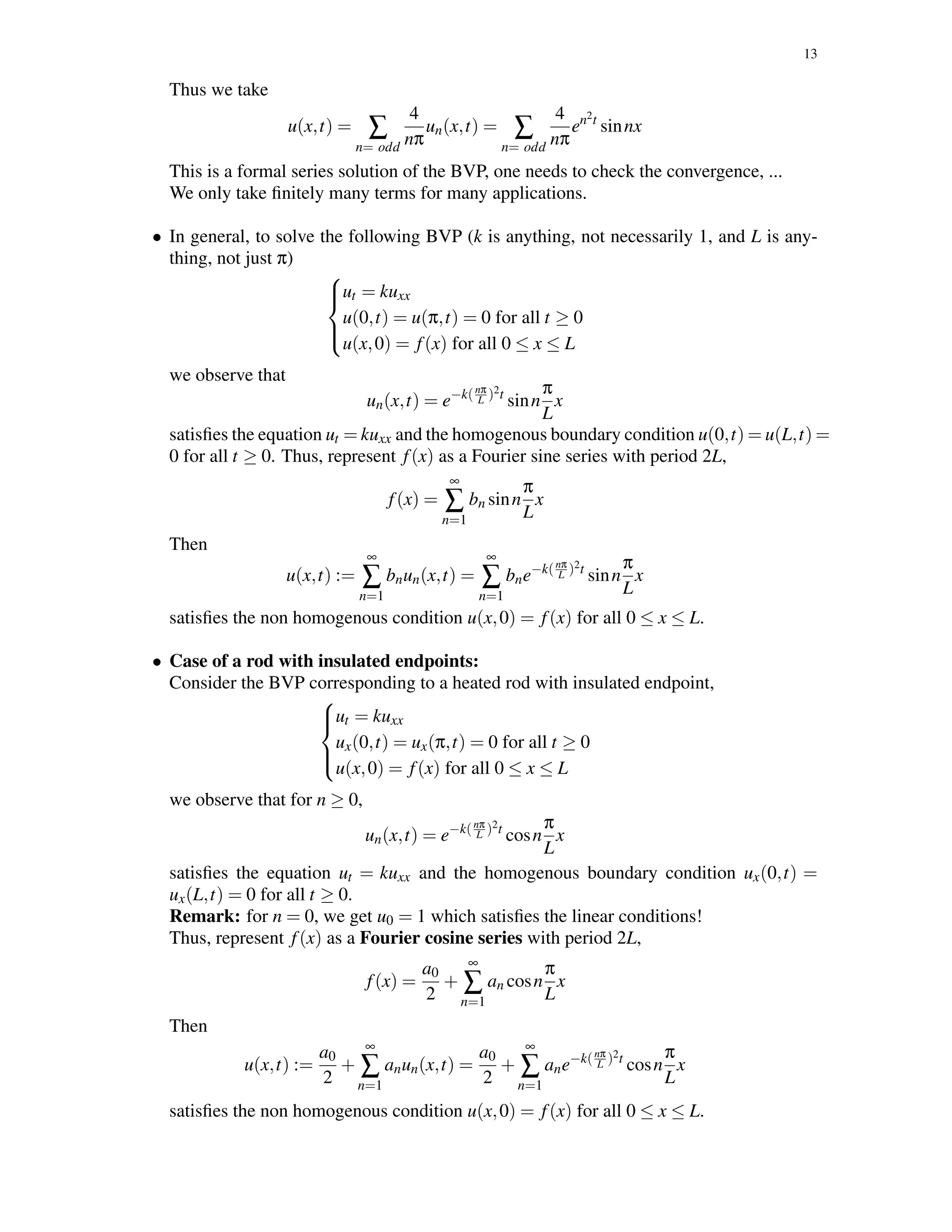
x if 0 < x < π
2
π−x if π
2 < x < π
yt(x,0) = 0 for all 0 ≤ x ≤ π
Fourier sine series of f(x) is
∞
∑
n=1
4sin nπ
2
πn2
sinnx = ∑
n=odd
4(−1)
n−1
2
πn2
sinnx
Thus, since a = 1 and L = π,
y(x,t) = ∑∞
n=1 bn cosnπ
Lat ·sinnπ
Lx
= ∑∞
n=1
4sin nπ
2
πn2 ·cosnt ·sinnx
= ∑n=odd
4(−1)
n−1
2
πn2 ·cosnt ·sinnx
= ∑n=odd
4(−1)
n−1
2
πn2 ·cosnt ·sinnx
= 4
π cost sinx− 4
9π cos3t sin3x+ 4
25π cos5t sin5x+···
• Remark: Using the identity
2sinAcosB = sin(A+B)+sin(A−B)
we can write the solution as
17
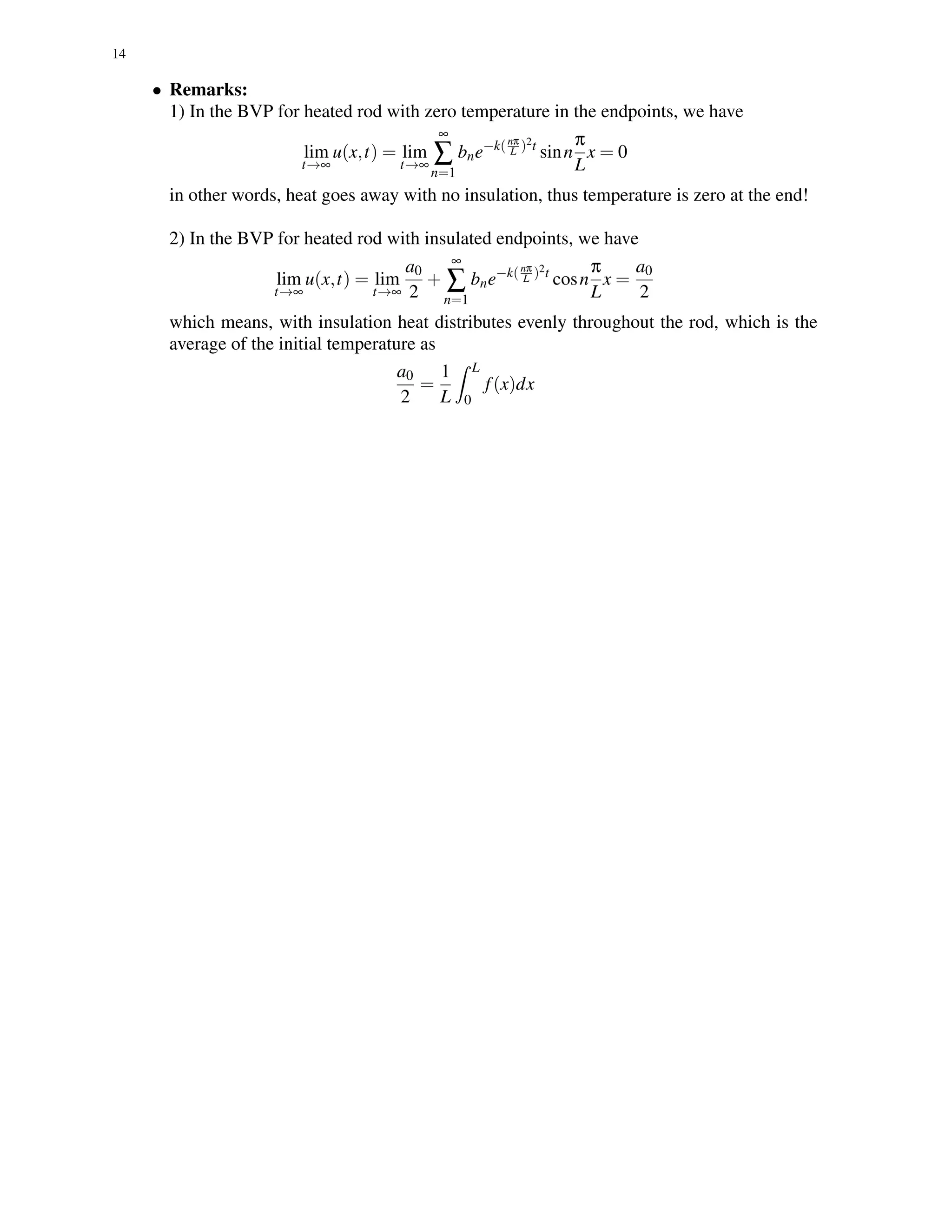
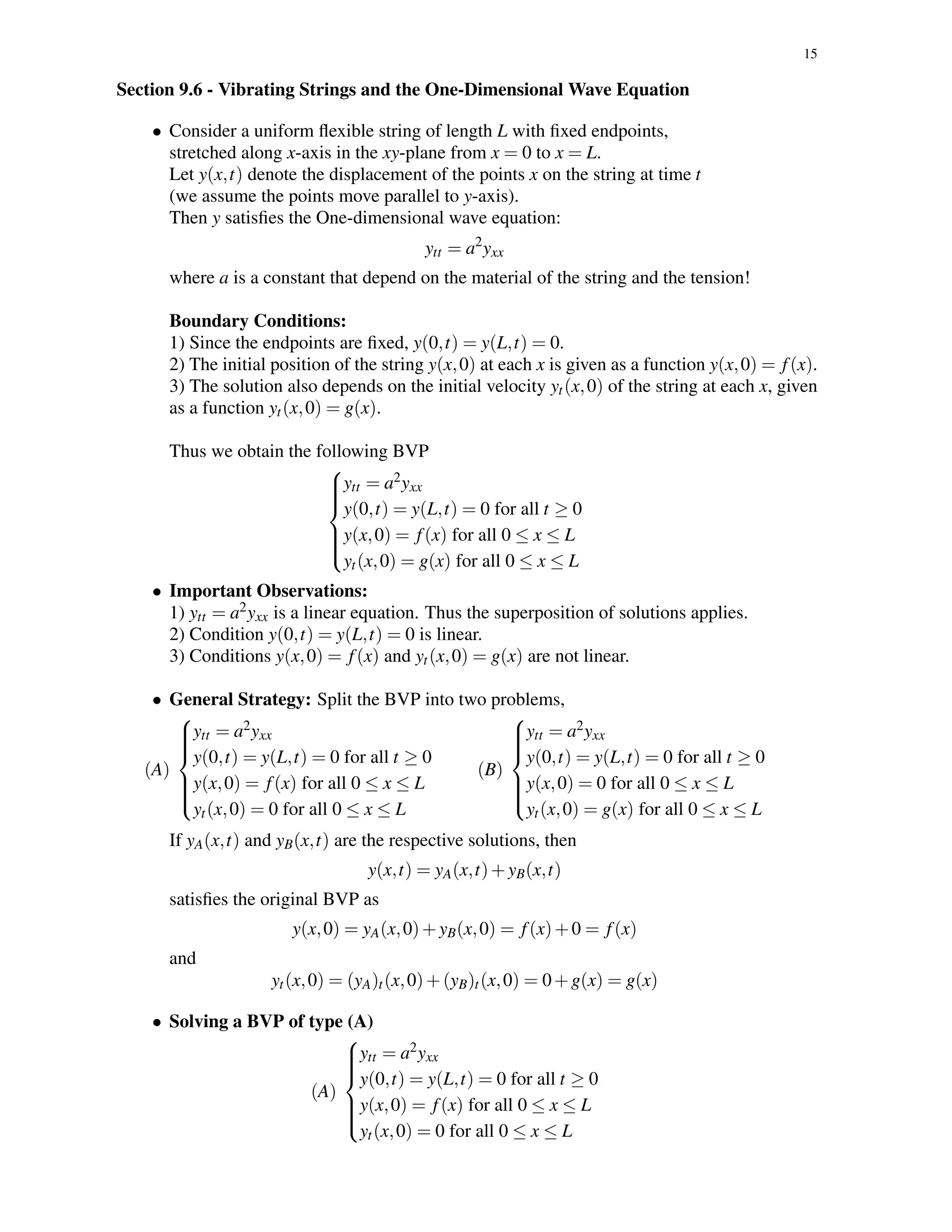
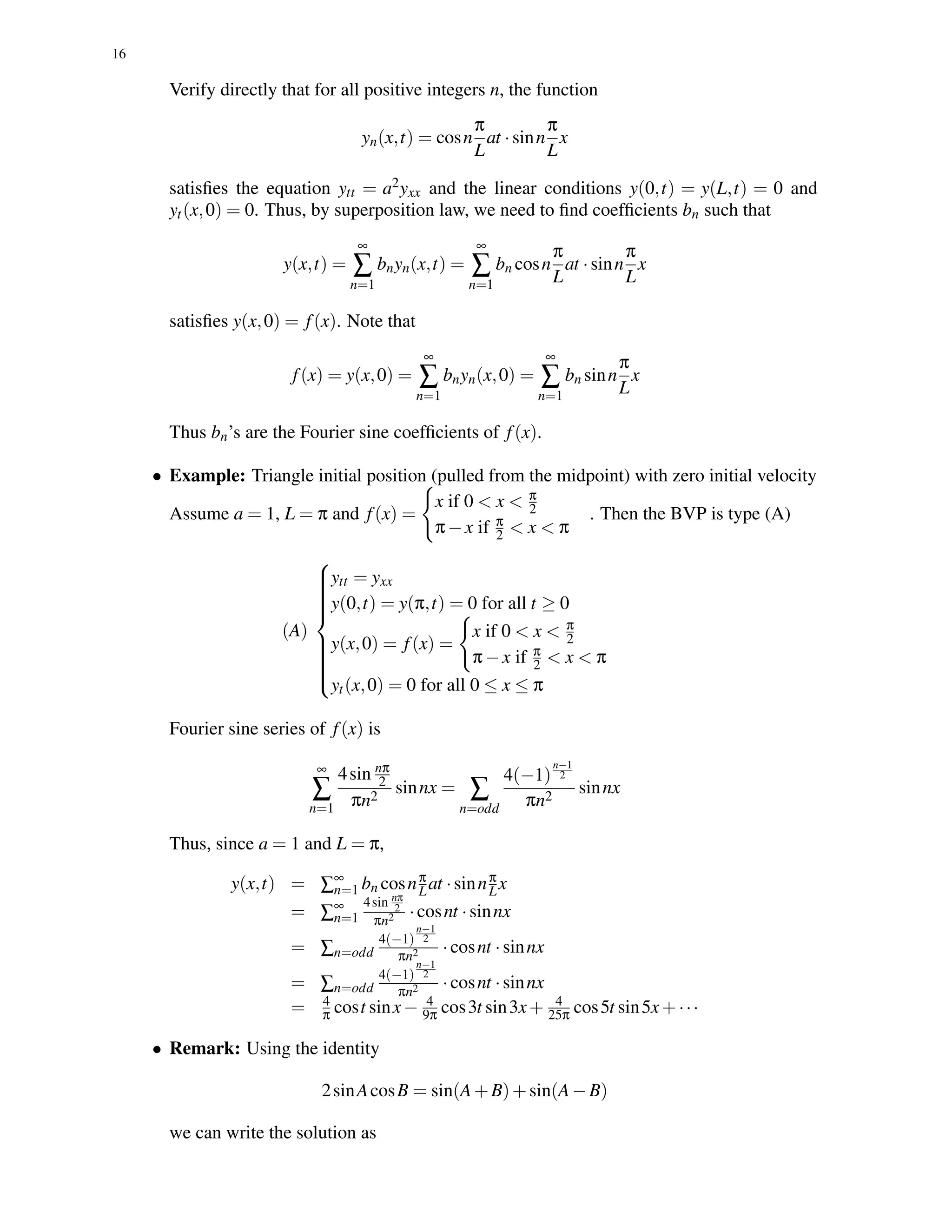
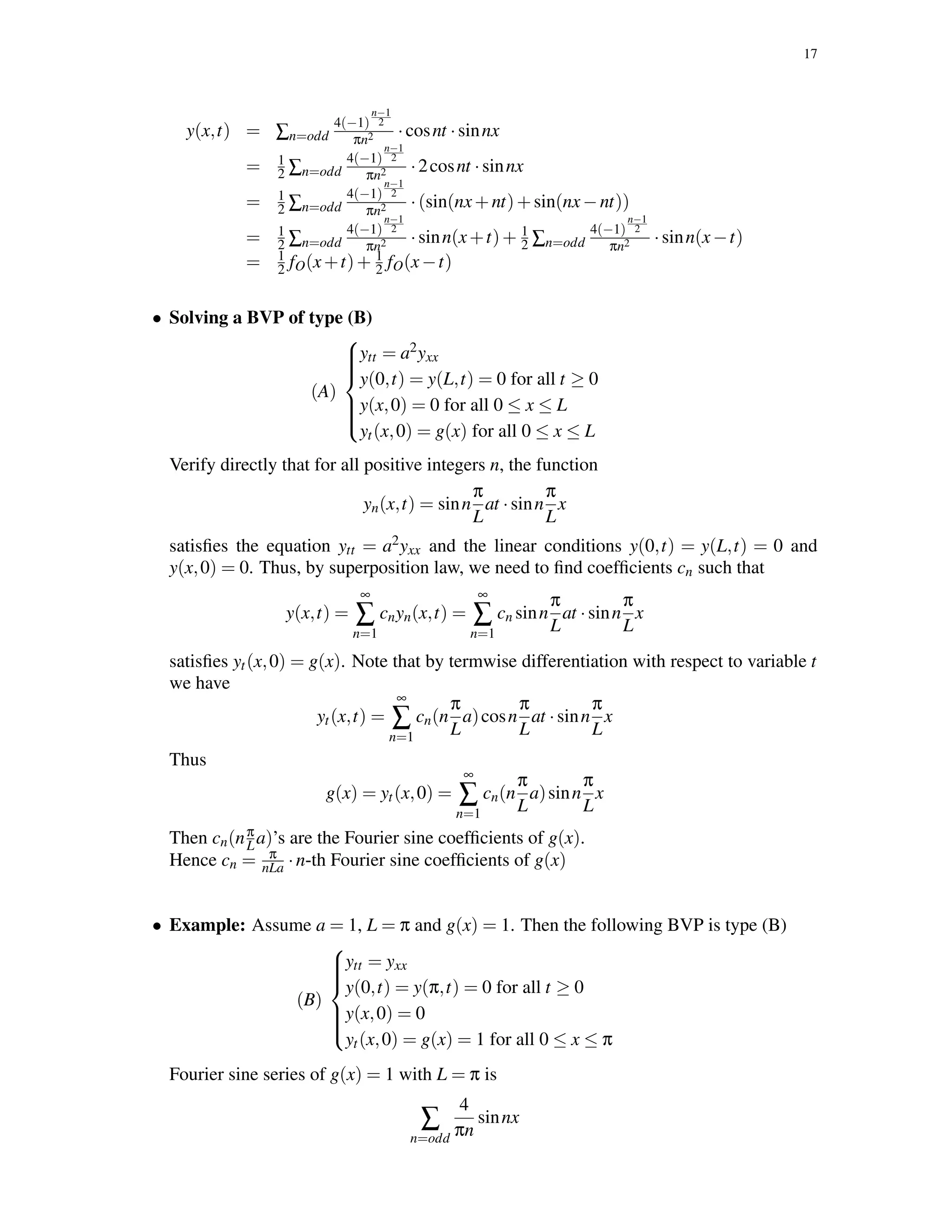
y(x,t) = ∑n=odd
4(−1)
n−1
2
πn2 ·cosnt ·sinnx
= 1
2 ∑n=odd
4(−1)
n−1
2
πn2 ·2cosnt ·sinnx
= 1
2 ∑n=odd
4(−1)
n−1
2
πn2 ·(sin(nx+nt)+sin(nx−nt))
= 1
2 ∑n=odd
4(−1)
n−1
2
πn2 ·sinn(x+t)+ 1
2 ∑n=odd
4(−1)
n−1
2
πn2 ·sinn(x−t)
= 1
2 fO(x+t)+ 1
2 fO(x−t)
• Solving a BVP of type (B)
(A)



ytt = a2yxx
y(0,t) = y(L,t) = 0 for all t ≥ 0
y(x,0) = 0 for all 0 ≤ x ≤ L
yt(x,0) = g(x) for all 0 ≤ x ≤ L
Verify directly that for all positive integers n, the function
yn(x,t) = sinn
π
L
at ·sinn
π
L
x
satisfies the equation ytt = a2yxx and the linear conditions y(0,t) = y(L,t) = 0 and
y(x,0) = 0. Thus, by superposition law, we need to find coefficients cn such that
y(x,t) =
∞
∑
n=1
cnyn(x,t) =
∞
∑
n=1
cn sinn
π
L
at ·sinn
π
L
x
satisfies yt(x,0) = g(x). Note that by termwise differentiation with respect to variable t
we have
yt(x,t) =
∞
∑
n=1
cn(n
π
L
a)cosn
π
L
at ·sinn
π
L
x
Thus
g(x) = yt(x,0) =
∞
∑
n=1
cn(n
π
L
a)sinn
π
L
x
Then cn(nπ
La)’s are the Fourier sine coefficients of g(x).
Hence cn = π
nLa ·n-th Fourier sine coefficients of g(x)
• Example: Assume a = 1, L = π and g(x) = 1. Then the following BVP is type (B)
(B)



ytt = yxx
y(0,t) = y(π,t) = 0 for all t ≥ 0
y(x,0) = 0
yt(x,0) = g(x) = 1 for all 0 ≤ x ≤ π
Fourier sine series of g(x) = 1 with L = π is
∑
n=odd
4
πn
sinnx
18
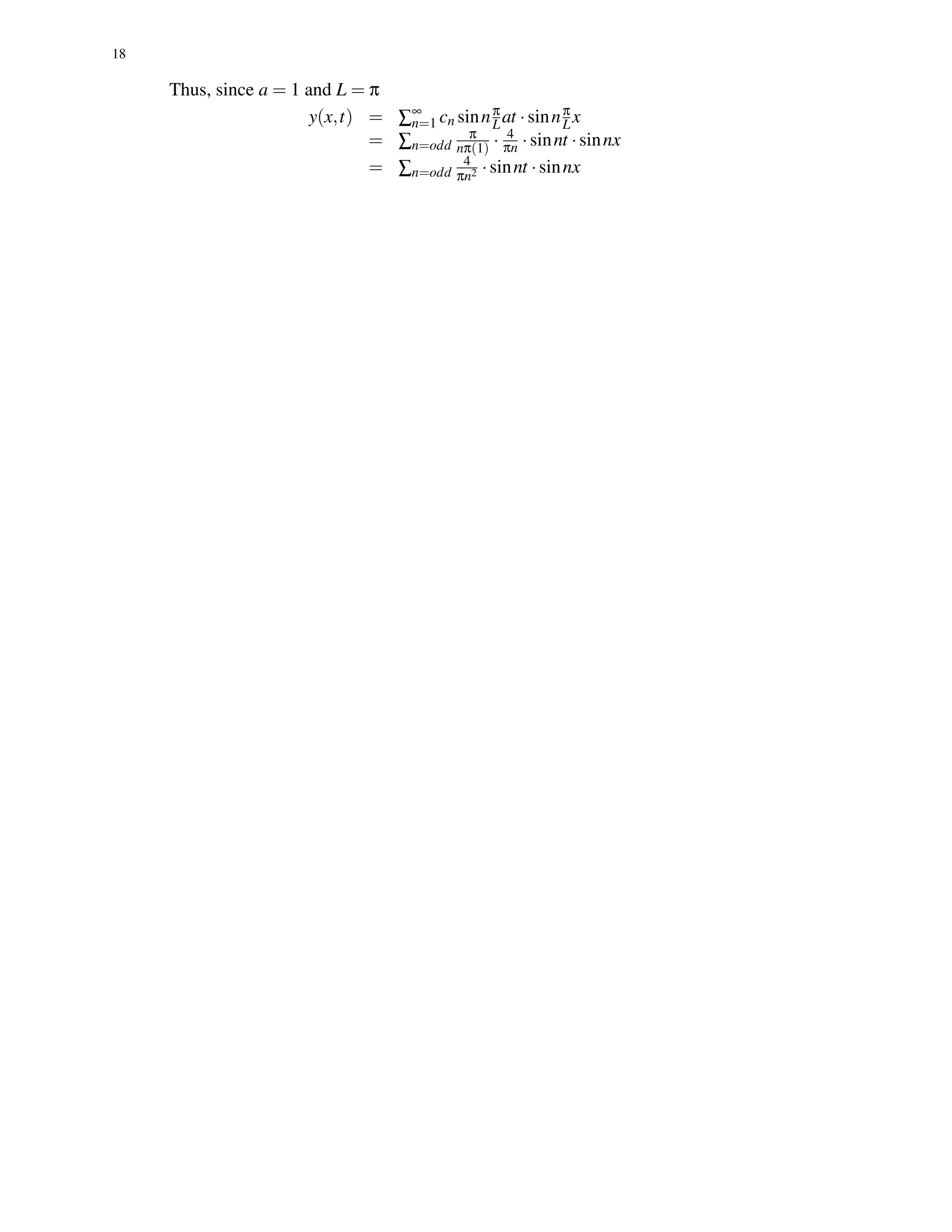
Thus, since a = 1 and L = π
y(x,t) = ∑∞
n=1 cn sinnπ
Lat ·sinnπ
Lx
= ∑n=odd
π
nπ(1) · 4
πn ·sinnt ·sinnx
= ∑n=odd
4
πn2 ·sinnt ·sinnx
19
Section 9.7 - Steady-State Temperature and Laplace’s Equation
• Consider the temperature in a 2-dimensional uniform thin plate in xy-plane
bounded by a piecewise smooth curve C.
Let u(x,y,t) denote the temperature of the point (x,y) at time t.
Then the 2-dimensional eat equation states that
ut = k(uxx +uyy)
where k is a constant that depends on the material of the plate.
If we let ∇2u = uxx +uyy, which is called the laplacian of u, then we can write
ut = k∇2
u
Remark: The 2-dimensional wave equation is
ztt = a2
(zxx +zyy) = a2
∇2
z
where z(x,y,t) is the position of the point (x,y) in a vibration elastic surface at time t.
• Case of the steady state temperature: i.e. we consider a 2-dimensional heat equation
in which the temperature does not change in time (The assumption is after a while
temperature becomes steady). Thus
ut = 0
Therefore, ∇2u = uxx +uyy = 0.
This equation is called the 2-dimensional Laplace equation.
• Boundary problems and Laplace equation:
If we know the temperature on the boundary C of a plate, as a function f(x,y), can we
determine the temp. at every point inside the plate?
In other word, can we solve the BVP
uxx +uyy = 0
u(x,y) = f(x,y) on the boundary of the plate
This BVP is called a Dirichlet Problem.
• Remark: If the Boundary C is Piecewise Smooth and the function f(x,y) is Nice!, then
Dirichlet Problem has a unique solution.
We will consider the cases that C is rectangular or circular!
• Case of Rectangular Plates:
Suppose the plate is a rectangle positioned in xy-plane with vertices (0,0),(0,b),(a,b),(a,0).
Assume we are given the temp. at each side of the rectangle.
Then we have the following type BVP.
20



uxx +uyy = 0
u(x,0) = f1(x,y),0 < x < a
u(x,b) = f2(x,y),0 < x < a
u(0,y) = g1(x,y),0 < y < b
u(a,y) = g1(x,y),0 < y < b
• General Strategy:
The main equation uxx + uyy = 0 is linear, but all of the boundary conditions are non-
linear, the idea is to split this BVP into 4 simpler BVP denotes by A, B, C, D, in which
only one of the boundary conditions in non-linear and apply Fourier series method there,
and and the end,
u(x,y) = uA(x,y)+uB(x,y)+uC(x,y)+uD(x,y)
• Solving a type BVP of type (A)
For 0 < x < a and 0 < y < b,



uxx +uyy = 0
u(x,0) = f1(x,y)
u(x,b) = 0
u(0,y) = 0
u(a,y) = 0
In this case, one can show
un(x,y) = sin
nπ
a
x·sinh
nπ
a
(b−y)
satisfies the linear conditions of the BVP.
Recall that sinhx = 1
2(ex −e−x) and coshx = 1
2(ex +e−x),
so (sinhx) = coshx and (coshx) = −sinhx
• Method of separation of variables: To actually find un’s
Assume u(x,y) = X(x)Y(y).
Then uxx +uyy = 0 implies X Y +XY = 0.
Thus X
X = −Y
Y .
Since RHS only depends on y and LHS only depends on x, these fractions must be con-
stant, say −λ.
Then X
X = −λ and Y
Y = λ.
Thus we obtain X and Y are nonzero solutions of X +λX = 0 and Y −λY = 0, such
that Y(b) = 0, X(0) = X(a) = 0
This is an endpoint problem on X,
we seek those values of λ for which there are nonzero solutions X, such that X(0) =
X(a) = 0. The eigen values are λn = (nπ
a )2
and the corresponding eigenfunctions are scalar multiples of Xn(x) = sin nπ
a x.
Now substitute λn = (nπ
a )2 in Y −λY = 0 with Y(b) = 0, and solve for Y(y).
We obtain the solutions are a scalar multiple of Yn(y) = sinh nπ
a (b−y).
Hence un(x,y) = Xn(x)Yn(y) = sin nπ
a x·sinh nπ
a (b−y)
21
• Back to solving a type BVP of type (A)
We want u(x,y) = ∑cnun(x,y) such that u(x,0) = f1(x).
Hence
f1(x) = u(x,0) = ∑cnun(x,0) = ∑cn ·sin
nπ
a
x·sinh
nπ
a
(b)
Therefore, cn · sinh nπ
a (b) is the n-th Fourier sine coefficient bn of f1(x) over interval
(0,a). Hence
cn = bn/sinh
nπb
a
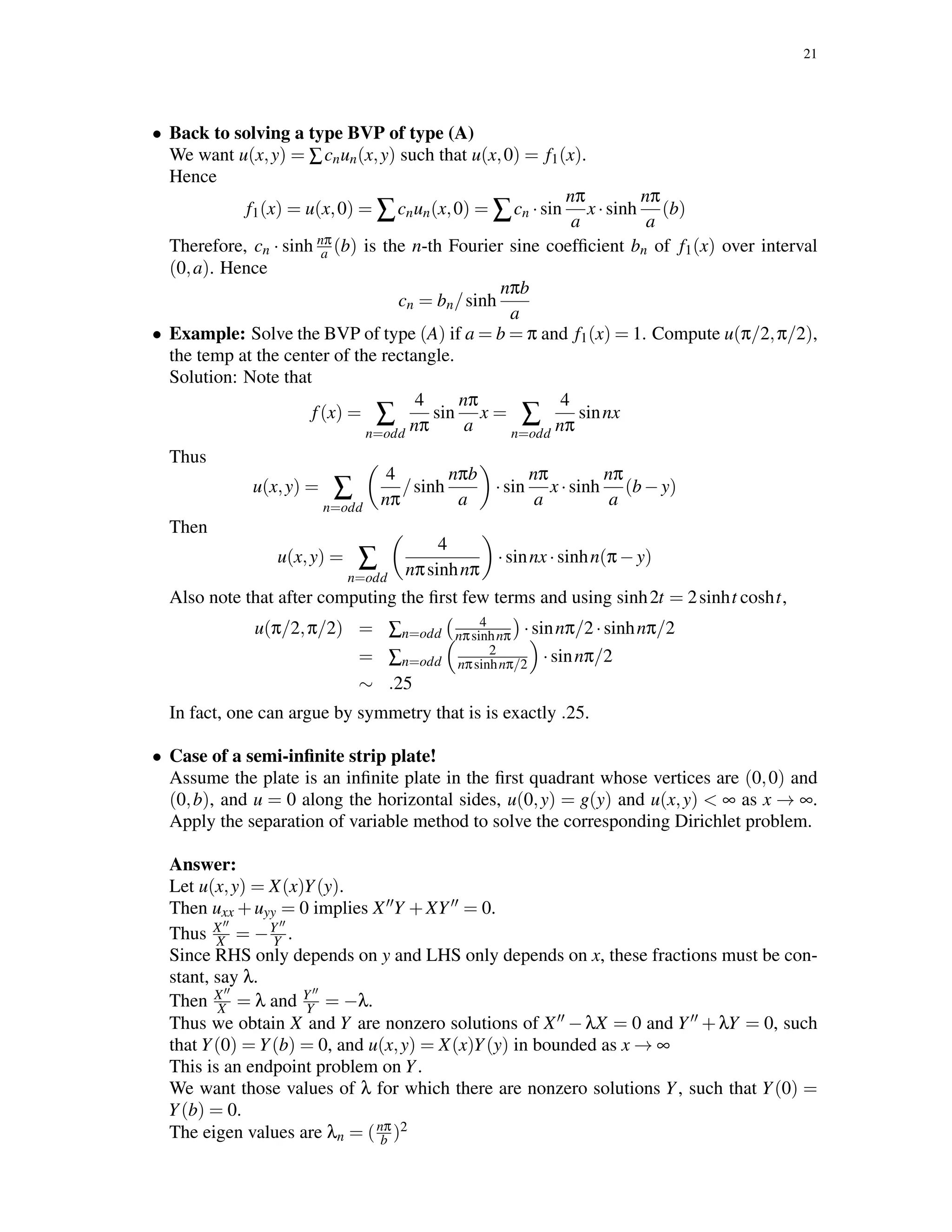
• Example: Solve the BVP of type (A) if a = b = π and f1(x) = 1. Compute u(π/2,π/2),
the temp at the center of the rectangle.
Solution: Note that
f(x) = ∑
n=odd
4
nπ
sin
nπ
a
x = ∑
n=odd
4
nπ
sinnx
Thus
u(x,y) = ∑
n=odd
4
nπ
/sinh
nπb
a
·sin
nπ
a
x·sinh
nπ
a
(b−y)
Then
u(x,y) = ∑
n=odd
4
nπsinhnπ
·sinnx·sinhn(π−y)
Also note that after computing the first few terms and using sinh2t = 2sinht cosht,
u(π/2,π/2) = ∑n=odd
4
nπsinhnπ ·sinnπ/2·sinhnπ/2
= ∑n=odd
2
nπsinhnπ/2 ·sinnπ/2
∼ .25
In fact, one can argue by symmetry that is is exactly .25.
• Case of a semi-infinite strip plate!
Assume the plate is an infinite plate in the first quadrant whose vertices are (0,0) and
(0,b), and u = 0 along the horizontal sides, u(0,y) = g(y) and u(x,y) < ∞ as x → ∞.
Apply the separation of variable method to solve the corresponding Dirichlet problem.
Answer:
Let u(x,y) = X(x)Y(y).
Then uxx +uyy = 0 implies X Y +XY = 0.
Thus X
X = −Y
Y .
Since RHS only depends on y and LHS only depends on x, these fractions must be con-
stant, say λ.
Then X
X = λ and Y
Y = −λ.
Thus we obtain X and Y are nonzero solutions of X −λX = 0 and Y +λY = 0, such
that Y(0) = Y(b) = 0, and u(x,y) = X(x)Y(y) in bounded as x → ∞
This is an endpoint problem on Y.
We want those values of λ for which there are nonzero solutions Y, such that Y(0) =
Y(b) = 0.
The eigen values are λn = (nπ
b )2
22
and the corresponding eigenfunctions are scalar multiples of Yn(y) = sin nπ
b y.
Now substitute λn = (nπ
b )2 in X −λX = 0 and solve for X(x).
We obtain Xn(x) = Ane
nπ
b x +Bne−nπ
b x
Since un = XnYn and u and Yn = sin nπ
b y are bounded, then Xn must be bounded too.
Hence An = 0. Suppress bn.
Thus un(x,y) = Xn(x)Yn(y) = e−nπ
b x
·sin nπ
b y
Note that un(x,0) = un(x,b) = 0 and un(x,y) < ∞ as x → ∞.
Now, to solve the BVP:
We want u(x,y) = ∑cnun(x,y) such that u(0,y) = g(y).
Hence
g(y) = u(0,y) = ∑cnun(0,y) = ∑cn ·(1)·sin
nπ
b
y
Therefore, cn is the n-th Fourier sine coefficient bn of g(y) over interval (0,b).
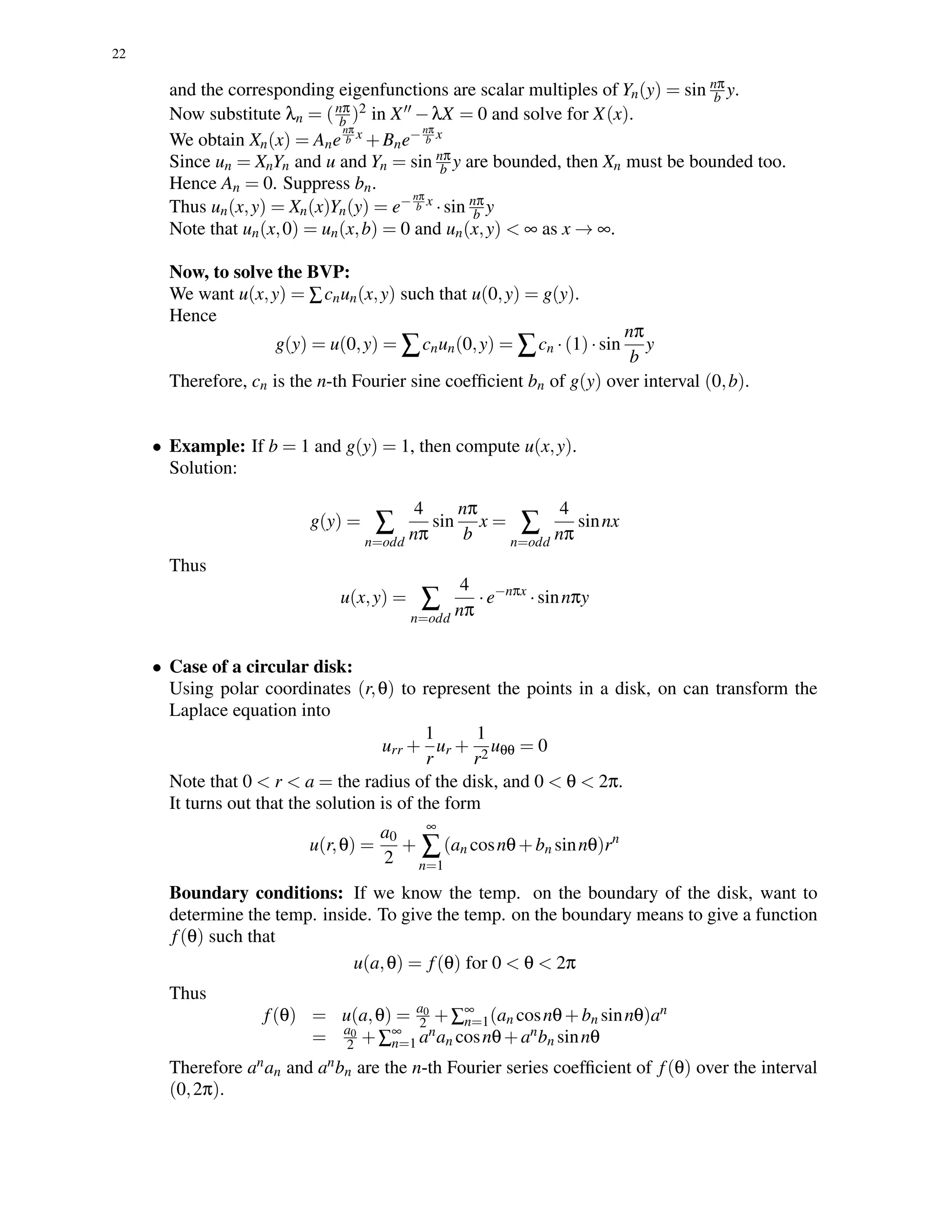
• Example: If b = 1 and g(y) = 1, then compute u(x,y).
Solution:
g(y) = ∑
n=odd
4
nπ
sin
nπ
b
x = ∑
n=odd
4
nπ
sinnx
Thus
u(x,y) = ∑
n=odd
4
nπ
·e−nπx
·sinnπy
• Case of a circular disk:
Using polar coordinates (r,θ) to represent the points in a disk, on can transform the
Laplace equation into
urr +
1
r
ur +
1
r2
uθθ = 0
Note that 0 < r < a = the radius of the disk, and 0 < θ < 2π.
It turns out that the solution is of the form
u(r,θ) =
a0
2
+
∞
∑
n=1
(an cosnθ+bn sinnθ)rn
Boundary conditions: If we know the temp. on the boundary of the disk, want to
determine the temp. inside. To give the temp. on the boundary means to give a function
f(θ) such that
u(a,θ) = f(θ) for 0 < θ < 2π
Thus
f(θ) = u(a,θ) = a0
2 +∑∞
n=1(an cosnθ+bn sinnθ)an
= a0
2 +∑∞
n=1 anan cosnθ+anbn sinnθ
Therefore anan and anbn are the n-th Fourier series coefficient of f(θ) over the interval
(0,2π).
23
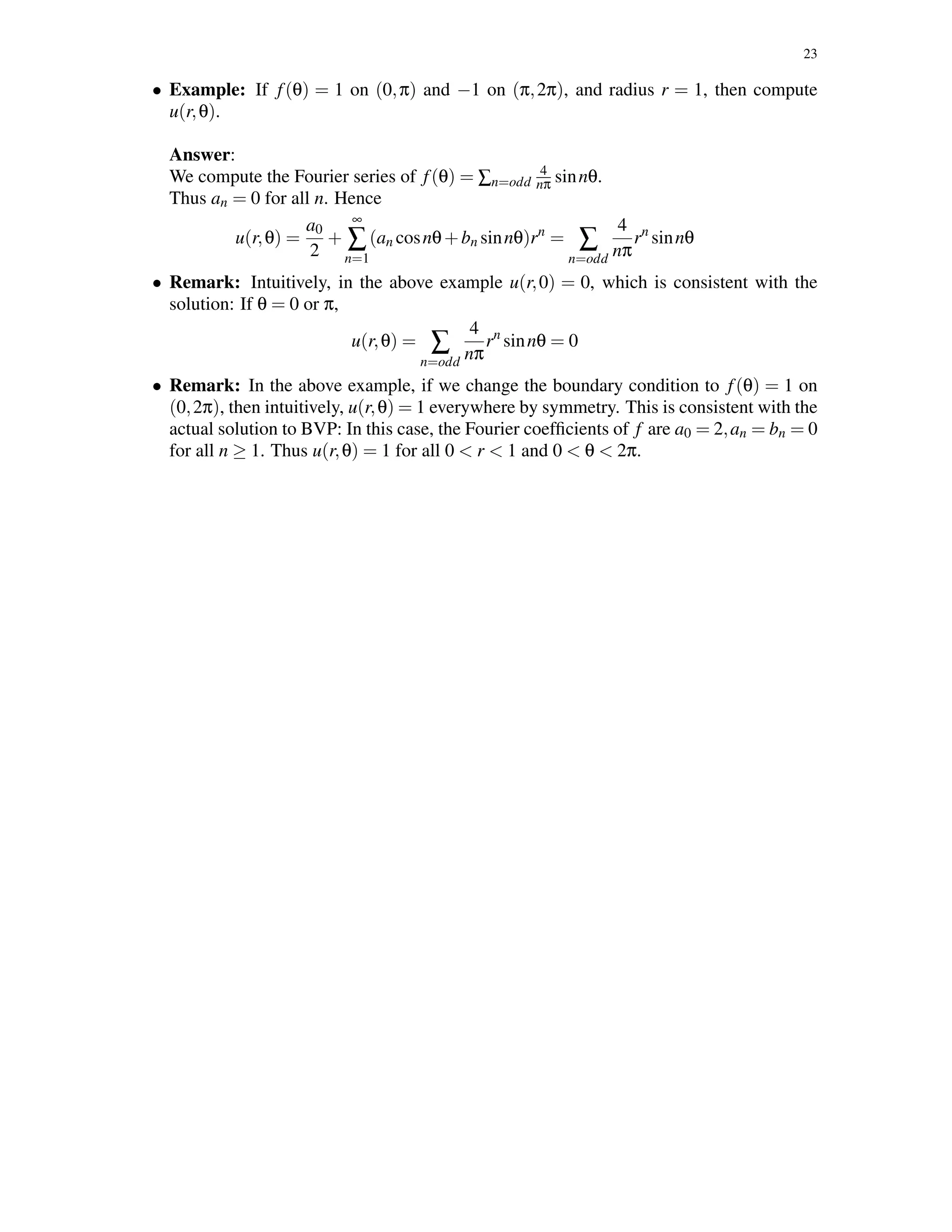
• Example: If f(θ) = 1 on (0,π) and −1 on (π,2π), and radius r = 1, then compute
u(r,θ).
Answer:
We compute the Fourier series of f(θ) = ∑n=odd
4
nπ sinnθ.
Thus an = 0 for all n. Hence
u(r,θ) =
a0
2
+
∞
∑
n=1
(an cosnθ+bn sinnθ)rn
= ∑
n=odd
4
nπ
rn
sinnθ
• Remark: Intuitively, in the above example u(r,0) = 0, which is consistent with the
solution: If θ = 0 or π,
u(r,θ) = ∑
n=odd
4
nπ
rn
sinnθ = 0
• Remark: In the above example, if we change the boundary condition to f(θ) = 1 on
(0,2π), then intuitively, u(r,θ) = 1 everywhere by symmetry. This is consistent with the
actual solution to BVP: In this case, the Fourier coefficients of f are a0 = 2,an = bn = 0
for all n ≥ 1. Thus u(r,θ) = 1 for all 0 < r < 1 and 0 < θ < 2π.

Fourier series of odd functions with period 2 l

  • 1.
    Math 285 -Spring 2012 - Review Material - Exam 3 Section 9.2 - Fourier Series and Convergence • State the definition of a Piecewise Continuous function. Answer: f is Piecewise Continuous if the following to conditions are satisfied: 1) It is continuous except possibly at some isolated points. 2) The left and right limits f(x+) and f(x−) exist (finite) at the points of discontinuity. For example, Square-Wave functions are piecewise continuous. But f(x) = sin 1 x for 0 < x < 1, extended to R periodically, is not piecewise continuous, since the right limit at zero DNE. Also f(x) = tanx for 0 < x < π 2 and for π 2 < x < π, extended to R periodically, is not piecewise continuous, since the right and left limits at π 2 DNE (infinite). • Define Fourier Series for functions for a Piecewise Continuous periodic function with period 2L. Answer: f(x) ∼ a0 2 + ∞ ∑ n=1 an cosn π L x+bn sinn π L x where for n ≥ 0 an = 1 L L −L f(x)cosn π L x dx and for n ≥ 1 bn = 1 L L −L f(x)sinn π L x dx • State the definition of a Piecewise Smooth function. Answer: f(x) is Piecewise Smooth if both f(x) and f (x) are piecewise continuous. For example, Square-Wave functions are piecewise smooth. • State the Convergence Theorem for Fourier Series. Answer: If f(x) is periodic and piecewise smooth, then its Fourier Series converges to 1) f(x) at each point x where f is continuous. 2) 1 2(f(x+)+ f(x−)) at each point where f is NOT continuous. • Compute the Fourier Series of Square-Wave Function with period 2L: f(x) = +1 0 < x < L −1 L < x < 2L For which values of f(x) at the points of discontinuity the Fourier series is convergent for all x? 1
  • 2.
    2 Answer: an = 0for all n ≥ 0, and bn = 2 nπ(1−cosnπ) for all n ≥ 1. Thus f(x) = ∑ n=odd 4 nπ sinn π L x Note that f(x) is discontinuous at x = integer multiples of L at which the average of left and right limit of f(x) is zero. Thus by Convergence Theorem f(x) must be 0 at those points. • Letting x = L 2 in the Fourier Series representation of the Square-Wave Function, obtain the following relation: ∞ ∑ k=0 (−1)k 2k +1 = 1− 1 3 + 1 5 − 1 7 +··· = π 4 Answer: Note that if we let x = L 2 , then the Fourier series is convergent to f(x) = 1, thus we have 1 = f L 2 = 4 π ∞ ∑ k=0 sin(2k +1)π 2 2k +1 = 4 π ∞ ∑ k=0 (−1)k 2k +1 Hence ∞ ∑ k=0 (−1)k 2k +1 = 1− 1 3 + 1 5 − 1 7 +··· = π 4
  • 3.
    3 Section 9.3 -Fourier Sine and Cosine Series • Recall f(x) is odd if f(−x) = −f(x), i.e. its graph is symmetric w.r.t y-axis. Example: x2n+1,sinnx for all integers n = 0, the square-wave functions f(x) = −1 −L < x < 0 1 0 < x < L • Recall f(x) is even if f(−x) = f(x), i.e. its graph is symmetric w.r.t origin. Example: x2n,cosnx for all integers n. • Remarks: 1) If f(x) is odd, then L −L f(x)dx = 0 for any L 2) If f(x) is even, then L −L f(x)dx = 2 L 0 f(x)dx for any L 3) If f and g are odd, then fg is even. 4) If f and g are even, then fg is even. 3) If f is odd and g is even, then fg is odd. • Fourier series of odd functions with period 2L: a0 = 1 L L −L f(x)dx = 0, an = 1 L L −L f(x)cosnπ Lxdx = 0 since f(x)cosnπ Lx is odd. bn = 1 L L −L f(x)sinnπ Lxdx = 2 L L 0 f(x)sinnπ Lxdx since f(x)sinnπ Lx is even. In this case, if f is piecewise smooth, f(x) = ∑bn sinnπ Lx only involves sine. Example: f(x) = x 2 on (−π,π), then f(x) = ∑∞ n=1 (−1)n+1 n sinnx • Fourier series of even functions with period 2L: an = 1 L L −L f(x)cosnπ Lxdx = 2 L L 0 f(x)cosnπ Lxdx since f(x)cosnπ Lx is even. bn = 1 L L −L f(x)sinnπ Lxdx = 0 since f(x)sinnπ Lx is odd. In this case, if f is piecewise smooth, f(x) = a0 2 +∑an cosnπ Lx only involves cosine. Example: Try f(x) = x2 on (−π,π). • Even and odd extensions of a function: Suppose f is a piecewise continuous function defined on interval (0,L). Even extension of f to the interval (−L,0) is fE(x) = f(x) 0 < x < L f(−x) −L < x < 0 Example: f(x) = x2 +x+1 on (0,L) Then fE(x) = x2 +x+1 0 < x < L x2 −x+1 −L < x < 0 Odd extension of f to the interval (−L,0) is fO(x) = f(x) 0 < x < L −f(−x) −L < x < 0
  • 4.
    4 Example: f(x) =x2 +x+1 on (0,L) Then fO(x) = x2 +x+1 0 < x < L −x2 +x−1 −L < x < 0 Remark: 1) fE(x) is an even function with Fourier Series of the form a0 2 +∑an cosnπ Lx Hence f(x) = a0 2 +∑an cosnπ Lx for x in (0,L). This is called the Fourier cosine series of f 2) fO(x) is an odd function with Fourier Series of the form ∑bn sinnπ Lx Hence f(x) = ∑bn sinnπ Lx for x in (0,L). This is called the Fourier sine series of f • Remark: Note that for x in (0,L), f(x) = fE(x) = fO(x). In many cases we are not concerned about f(x) on (−L,0), so the choice between (1) and (2) depends on our need for representing f by sine or cosine. • Example: f(t) = 1 on (0,π). Compute the Fourier sine and cosine series and graph the two extensions. 1) The Even extension is fE(t) = 1 on (−π,π), period 2π. Then a0 = 2,an = 0,bn = 0, so the cosine series is just f(t) = a0 2 = 1 2) The Odd extension is fO(t) = 1 on (0,π) and −1 on (−π,0), period 2π. Then a0 = an = 0,bn = 2 nπ(1−(−1)n), so the cosine series is fO(t) = ∑ n=odd 4 nπ sinnx • Example: f(t) = 1−t on (0,1). Compute the Fourier sine and cosine series and graph to the to extensions. 1) The Even extension is fE(t) = 1−t on (0,1) and 1+t on (−1,0), period 2L, L = 1. Then a0 = 1,an = 21−cosnπ n2π2 ,bn = 0, so the cosine series is f(t) = 1 2 + ∑ n=odd 4 n2π2 cosnπx 2) The Odd extension is fO(t) = 1−t on (0,1) and −1−t on (−1,0), period 2L, L = 1. Then an = 0 for all n ≥ 0 and bn = 2 nπ, so the cosine series is f(t) = ∞ ∑ n=1 2 nπ sinnπx • Termwise differentiation of a Fourier series Theorem: Suppose f(x) is Continuous for all x, Periodic with period 2L, and f is
  • 5.
    5 Piecewise Smooth forall t. If f(x) = a0 2 + ∞ ∑ n=1 an cosn π L x+bn sinn π L x then f (x) = ∞ ∑ n=1 (−an nπ L )sinn π L x+(bn nπ L )cosn π L x Remarks: 1) RHS it the Fourier series of f (x). 2) It is obtained by termwise differentiation of the RHS for f(x). 3) Note that the constant term in the FS of f (x) is zero as L −L f (x)dx = f(L)− f(−L) = 0 4) The Theorem fails if f is not continuous! For example: consider f(x) = x on (−L,L) Then f(x) = x = ∑ 2L nπ (−1)n+1 sinn π L x if we differentiate 1 = ∑ 2 π (−1)n+1 cosn π L x For example equality fails at t = 0 or L! • Example: Verify the above Theorem for f(x) = x on (0,L) and f(x) = −x on (−L,0). Answer: bn = 0 as f is even, a0 = L, an = 2L n2π2 ((−1)n −1). Thus f(x) = 1 2 L+ ∑ n=odd − 4L n2π2 cosn π L x Then term wise derivative gives f (x) = ∑ n=odd 4 nπ sinn π L x On the other hand, directly computing the derivative of f(x) we have f (x) = 1 on (0,L) and f(x) = −1 on (−L,0). Thus an = 0 for all n and bn = 2 nπ(1 − cosnπ) which gives the same Fourier Series as in above. • Applications to BVP’s Consider the BVP of the form ax +bx +cx = f(t), x(0) = x(L) = 0 or x (0) = x (L) = 0 • Example: x +2x = 1, x(0) = x(π) = 0 Here f(t) = 1, restrict to the interval (0,π) as in Boundary Values. The idea is to find a formal Fourier Series solution of the equation. Since we want x(0) = x(π) = 0, we prefer to consider the Fourier sine series of x(t) on the interval (0,π), x(t) = ∑bn sinnt
  • 6.
    6 substitute in theequation and compare the coefficients with that of the sine Fourier Series of f(t) = 1 which is f(t) = ∑ n=odd 4 nπ sinnt Note that by term wise differentiation, x (t)+2x(t) = (2−n2 )bn sinnt Thus bn = 0 for n even and bn = 4 πn(2−n2) for n odd. Hence a formal power series of x(t) is x(t) = ∑ n=odd 4 πn(2−n2) sinnt • Example: x +2x = t, x (0) = x (π) = 0 Here f(t) = t, restrict to the interval (0,π) as in Boundary Values. Since we want x (0) = x (π) = 0, we prefer to consider the Fourier Cosine Series of x(t) on (0,π), x(t) = a0 2 +∑an cosnt substitute in the equation and compare the coefficients with that of the Cosine FS of f(t) = t which is f(t) = π 2 − ∑ n=odd 4 πn2 cosnt Note that by termwise differentiation, x (t)+2x(t) = a0 +(2−n2 )an cosnt Thus a0 = π 2 , an = 0 for n even and an = − 4 πn2(2−n2) for n odd. Hence a formal power series of x(t) is x(t) = π 4 − ∑ n=odd 4 πn2(2−n2) cosnt • Termwise Integration of the Fourier Series. Theorem: Suppose f(t) is Piecewise Continuous (not necessarily piecewise smooth) periodic with period 2L with FS representation f(t) ∼ a0 2 + ∞ ∑ n=1 an cosn π L t +bn sinn π L t Then we can integrate term by term as t 0 f(x)dx = t 0 a0 2 +∑∞ n=1 an t 0 cosnπ Lxdx+bn t 0 sinnπ Lxdx = a0 2 t +∑∞ n=1 an L nπ sinnπ Lx−bn L nπ(cosnπ Lx−1) Note that the RHS is not the Fourier series of LHS unless a0 = 0. • Example: Consider f(x) = 1 on (0,π) and f(x) = −1 on (−π,0), then f(t) = ∑ n=odd 4 πn sinnt
  • 7.
    7 Then F(t) =t 0 f(x)dx = t for t ∈ (0,1) and −t for t ∈ (−π,0), whose Fourier Series is F(t) = 1 2 π− 4 π ∑ n=odd 1 n2 cosnt Term by term integration gives the same thing! 4 π ∑ n=odd 1 n2 (1−cosnt) = 4 π ∑ n=odd 1 n2 = π2 8 − 4 π ∑ n=odd 1 n2 cosnt
  • 8.
    8 Section 9.4 -Applications of Fourier Series • Finding general solutions of 2nd order linear DE’s with constant coefficients: Example: x + 5x = F(t), where F(t) = 3 on (0,π) and −3 on (−π,0), is odd with period 2π. We obtain a particular solution in the following way: Since L = π and the FS of F(t) is ∑n odd 12 nπ sinnt, we may assume x(t) is odd and we consider its Fourier sine series F(t) = ∑∞ n=1 bn sinnt. Substitute in the equation: x +5x = (5−n2 )bn sinnt = F(t) = ∑ n odd 12 nπ sinnt Hence, comparing the coefficients of sinnt on both sides we get bn = 12 n(5−n2)π if n is odd and zero otherwise. Thus a particular solution is x(t) = ∑n odd 12 n(5−n2)π sinnt Definition: We call this a steady periodic solution, denoted by xsp(t). Thus, if x1(t),x2(t) are the solutions of the associated homogeneous equation, then the general solution is x(t) = c1x1(t)+c2x2(t)+xsp(t) = c1 cos( √ 5t)+c2 sin( √ 5t)+∑n odd 12 n(5−n2)π sinnt • Remark: Consider the equation x +9x = F(t). Then when trying to find a particular solution we get x +9x = (9−n2 )bn sinnt = F(t) = ∑ n odd 12 nπ sinnt We can not find b3 as 9−n2 = 0 for n = 3. In this case we need to use the method of undetermined coefficients to find a function y(t) such that y +9y = 12 3π sin3t Take y = At sin3t +Bt cos3t, and substitute to find A = 0 and B = − 2 3π. Therefore, the general solution is x(t) = c1 cos(3t)+c2 sin(3t)+ ∑ n odd,n=3 12 n(9−n2)π sinnt − 2 3π t cos3t Definition: We say in this case a pure resonance occurs. Remark: To determine the occurrence of pure resonance, just check if for some n, sinnπ Lt is a solution of the associated homogeneous equation.
  • 9.
    9 • Application: ForcedMass-Spring Systems Let m be the mass, c be the damping constant, and k the constant of spring. Then mx +cx +kx = F(t) Consider the case that the external force F(t) is odd or even periodic function. Remark: If F(t) is periodic for t ≥ 0, it can be arranged to be odd or even by passing to odd or even extension for values of time t. Case 1) Undamped Forced Mass-Spring Systems: c = 0 mx +kx = F(t) Let ω0 = k m be the natural frequency of the system, then we can write x +ω2 0x = 1 m F(t) Assume F(t) is periodic odd function with period 2L. Then F(t) = ∞ ∑ n=1 Fn sinn π L t Consider the odd extension of x(t), so that x(t) = ∞ ∑ n=1 bn sinn π L t substituting in the equation we get x +ω2 0x = ω2 0 −( nπ L )2 bn sinn π L t = 1 m F(t) = ∞ ∑ n=1 1 m Fn sinn π L t Thus ω2 0 −( nπ L )2 bn = 1 m Fn If for all n ≥ 1, ω2 0 −(nπ L )2 = 0, or equivalently k m · π L is not a positive integer, then we can solve for bn as bn = 1 mFn ω2 0 −(nπ L )2 Hence we have a steady periodic solution xsp(t) = ∞ ∑ n=1 1 mFn ω2 0 −(nπ L )2 sinn π L t Example: If m = 1,k = 5,L = π, x +5x = F(t) then ω2 0 −(nπ L )2 = 5−n2 = 0 for all positive integers n ≥ 1. On the other hand, if n0 = k m · π L is a positive integer, then a particular solution is x(t) = ∞ ∑ n=1,n=n0 1 mFn ω2 0 −(nπ L )2 sinn π L t − Fn0 2mω0 t cosω0t
  • 10.
    10 Example: m =1,k = 9,L = π, x +9x = F(t) then ω2 0 −(nπ L )2 = 9−n2 = 0 for n = 3. There will be a pure resonance. Example: m = 1,k = 9,L = 1, x +9x = F(t) then ω2 0 − (nπ L )2 = 9 − (nπ)2 = 0 for all positive integers n. We have a steady periodic solution. Case 2) Damped Forced Mass-Spring Systems: c = 0 mx +cx +kx = F(t) Assume F(t) is periodic odd function with period 2L. Then F(t) = ∞ ∑ n=1 Fn sinn π L t For each n ≥ 1, we seek a function xn(t) such that mxn +cxn +kxn = Fn sinn π L t = Fn sinωnt where ωn = nπ L. Note that there will never be a duplicate solution as c = 0. Hence using the method of undetermined coefficients, we can show xn(t) = Fn (k −mω2 n)2 +(cωn)2 sin(ωnt −αn) where αn = tan−1 cωn k −mω2 n 0 ≤ α ≤ π Therefore, we have a steady periodic solution xsp(t) = ∞ ∑ n=1 xn(t) = ∞ ∑ n=1 Fn (k −mω2 n)2 +(cωn)2 sin(ωnt −αn) Example: m = 3,c = 1,k = 30, F(t) = t −t2 for 0 ≤ t ≤ 1 is odd and periodic with L = 1. Compute the first few terms of the steady periodic solution. 3x +x +30x = F(t) = ∞ ∑ n=1 Fn sinn π L t = ∑ n=odd 8 n3π3 sinnπt So, we have xsp(t) = ∑∞ n=1 Fn√ (k−mω2 n)2+(cωn)2 sin(ωnt −αn) = ∑n= odd 8 n3π3 √ (30−3n2π2)2+n2π2 sin(nπt −αn) αn = tan−1 nπ 30−n2π2 0 ≤ α ≤ π The fist two terms are 0..0815sin(πt −1.44692)+0.00004sin(3π3−3.10176)+···
  • 11.
    11 Section 9.5 -Heat Conduction and Separation of Variables • Until now, we studied ODE’s - which involved single variable functions. In this section will consider some special PDE’s - Differential Equations of several vari- able functions involving their Partial Derivatives - and we will apply Fourier Series method to solve them. • Heat Equations: Let u(x,t) denote the temperature at pint x and time t in an ideal heated rod that extends along x-axis. then u satisfies the following equation: ut = kuxx where k is a constant - thermal diffiusivity of the material - that depends on the material of the rod. Boundary Conditions: Suppose the rod has a finite length L, then 0 ≤ x ≤ L. 1) Assume the temperature of the rod at time t = 0 at every point x is given. Then we are given a function f(x) such that u(x,0) = f(x) for all 0 ≤ x ≤ L. 2) Assume the temperature at the two ends of the rod is fixed (zero) all the time - say by putting two ice cubes! Then u(0,t) = u(L,t) = 0 for all t ≥ 0. Thus we obtain a BVP,    ut = kuxx u(x,0) = f(x) for all 0 ≤ x ≤ L u(0,t) = u(L,t) = 0 for all t ≥ 0 Remark: Other possible boundary conditions are, insulating the endpoints of the rod, so that there is no heat flow. This means ux(0,t) = ux(L,t) = 0 for all t ≥ 0 Remark: Geometric Interpretation of the BVP. We would like to find a function u(x,t) such that on the boundary of the infinite strip t ≥ 0 and 0 ≤ x ≤ L satisfies the conditions u = 0 and u = f(x). Remark: If f(x) is ”piecewise smooth”, then the solution of the BVP is unique. • Important observations: 1) Superposition of solutions: If u1,u2,... satisfy the equation ut = kuxx, then so does any linear combination of the ui’s. In other words, the equation ut = kuxx is linear! 2) Same is true about the boundary condition u(0,t) = u(L,t) = 0 for all t ≥ 0. We say this is a linear or homogeneous condition. 3) The condition u(x,0) = f(x) for all 0 ≤ x ≤ L is not homogenous, or not linear!
  • 12.
    12 • General Strategy:Find solutions that satisfy the linear conditions and then take a suitable linear condition that satisfies the non-linear conditions. • Example: Verify that un(x,t) = e−n2t sinnx is a solution of ut = uxx (here k = 1) for any positive integer n. For example, u1(x,t) = e−t sinx and u2(x,t) = e−4t sin2x. • Example: Use the above example to construct a solution of the following BVP.    ut = uxx u(0,t) = u(π,t) = 0 for all t ≥ 0 u(x,0) = 2sinx+3sin2x for all 0 ≤ x ≤ π Answer: Here L = π. Note that un(x,t) = e−n2t sinnx also satisfy the linear condition u(0,t) = u(π,t) = 0. Thus it is enough to take u(x,t) to be a linear combination of un’s that satisfies the non homogenous condition u(x,0) = 2sinx + 3sin2x. Since un(x,0) = sinnx, we take u(x,t) = 2u1 +3u2 = 2e−t sinx+3e−4t sin2x so that u(x,0) = 2e0 sinx+3e0 sin2x = 2sinx+3sin2x Remark: The above method in the example for ut = uxx works whenever f(x) is a finite linear combination of sinx,sin2x,... • Example: Use the above example to construct a solution of the following BVP.    ut = uxx u(0,t) = u(π,t) = 0 for all t ≥ 0 u(x,0) = sin4xcosx for all 0 ≤ x ≤ L Solution: Again we have L = π. Note that f(x) = sin4xcosx = 1 2 sin(4x+x)+ 1 2 sin(4x−x) = 1 2 sin5x+ 1 2 sin3x Thus we take u(x,t) = 1 2 u3 + 1 2 u5 = 1 2 e−9t sin3x+ 1 2 e−25t sin5x • Remark: When f(x) is a not a finite linear combination of the sine functions, then rep- resent it as an infinite sum using Fourier sine series. • Example: Construct a solution of the following BVP.    ut = uxx u(0,t) = u(π,t) = 0 for all t ≥ 0 u(x,0) = 1 for all 0 ≤ x ≤ π Answer: Note that f(x) = 1 and L = π, so represent f(x) as a Fourier sine series with period 2L = 2π f(x) = ∑ n= odd 4 nπ sinnx
  • 13.
    13 Thus we take u(x,t)= ∑ n= odd 4 nπ un(x,t) = ∑ n= odd 4 nπ en2t sinnx This is a formal series solution of the BVP, one needs to check the convergence, ... We only take finitely many terms for many applications. • In general, to solve the following BVP (k is anything, not necessarily 1, and L is any- thing, not just π)    ut = kuxx u(0,t) = u(π,t) = 0 for all t ≥ 0 u(x,0) = f(x) for all 0 ≤ x ≤ L we observe that un(x,t) = e−k(nπ L )2t sinn π L x satisfies the equation ut = kuxx and the homogenous boundary condition u(0,t) = u(L,t) = 0 for all t ≥ 0. Thus, represent f(x) as a Fourier sine series with period 2L, f(x) = ∞ ∑ n=1 bn sinn π L x Then u(x,t) := ∞ ∑ n=1 bnun(x,t) = ∞ ∑ n=1 bne−k(nπ L )2t sinn π L x satisfies the non homogenous condition u(x,0) = f(x) for all 0 ≤ x ≤ L. • Case of a rod with insulated endpoints: Consider the BVP corresponding to a heated rod with insulated endpoint,    ut = kuxx ux(0,t) = ux(π,t) = 0 for all t ≥ 0 u(x,0) = f(x) for all 0 ≤ x ≤ L we observe that for n ≥ 0, un(x,t) = e−k(nπ L )2t cosn π L x satisfies the equation ut = kuxx and the homogenous boundary condition ux(0,t) = ux(L,t) = 0 for all t ≥ 0. Remark: for n = 0, we get u0 = 1 which satisfies the linear conditions! Thus, represent f(x) as a Fourier cosine series with period 2L, f(x) = a0 2 + ∞ ∑ n=1 an cosn π L x Then u(x,t) := a0 2 + ∞ ∑ n=1 anun(x,t) = a0 2 + ∞ ∑ n=1 ane−k(nπ L )2t cosn π L x satisfies the non homogenous condition u(x,0) = f(x) for all 0 ≤ x ≤ L.
  • 14.
    14 • Remarks: 1) Inthe BVP for heated rod with zero temperature in the endpoints, we have lim t→∞ u(x,t) = lim t→∞ ∞ ∑ n=1 bne−k(nπ L )2t sinn π L x = 0 in other words, heat goes away with no insulation, thus temperature is zero at the end! 2) In the BVP for heated rod with insulated endpoints, we have lim t→∞ u(x,t) = lim t→∞ a0 2 + ∞ ∑ n=1 bne−k(nπ L )2t cosn π L x = a0 2 which means, with insulation heat distributes evenly throughout the rod, which is the average of the initial temperature as a0 2 = 1 L L 0 f(x)dx
  • 15.
    15 Section 9.6 -Vibrating Strings and the One-Dimensional Wave Equation • Consider a uniform flexible string of length L with fixed endpoints, stretched along x-axis in the xy-plane from x = 0 to x = L. Let y(x,t) denote the displacement of the points x on the string at time t (we assume the points move parallel to y-axis). Then y satisfies the One-dimensional wave equation: ytt = a2 yxx where a is a constant that depend on the material of the string and the tension! Boundary Conditions: 1) Since the endpoints are fixed, y(0,t) = y(L,t) = 0. 2) The initial position of the string y(x,0) at each x is given as a function y(x,0) = f(x). 3) The solution also depends on the initial velocity yt(x,0) of the string at each x, given as a function yt(x,0) = g(x). Thus we obtain the following BVP    ytt = a2yxx y(0,t) = y(L,t) = 0 for all t ≥ 0 y(x,0) = f(x) for all 0 ≤ x ≤ L yt(x,0) = g(x) for all 0 ≤ x ≤ L • Important Observations: 1) ytt = a2yxx is a linear equation. Thus the superposition of solutions applies. 2) Condition y(0,t) = y(L,t) = 0 is linear. 3) Conditions y(x,0) = f(x) and yt(x,0) = g(x) are not linear. • General Strategy: Split the BVP into two problems, (A)    ytt = a2yxx y(0,t) = y(L,t) = 0 for all t ≥ 0 y(x,0) = f(x) for all 0 ≤ x ≤ L yt(x,0) = 0 for all 0 ≤ x ≤ L (B)    ytt = a2yxx y(0,t) = y(L,t) = 0 for all t ≥ 0 y(x,0) = 0 for all 0 ≤ x ≤ L yt(x,0) = g(x) for all 0 ≤ x ≤ L If yA(x,t) and yB(x,t) are the respective solutions, then y(x,t) = yA(x,t)+yB(x,t) satisfies the original BVP as y(x,0) = yA(x,0)+yB(x,0) = f(x)+0 = f(x) and yt(x,0) = (yA)t(x,0)+(yB)t(x,0) = 0+g(x) = g(x) • Solving a BVP of type (A) (A)    ytt = a2yxx y(0,t) = y(L,t) = 0 for all t ≥ 0 y(x,0) = f(x) for all 0 ≤ x ≤ L yt(x,0) = 0 for all 0 ≤ x ≤ L
  • 16.
    16 Verify directly thatfor all positive integers n, the function yn(x,t) = cosn π L at ·sinn π L x satisfies the equation ytt = a2yxx and the linear conditions y(0,t) = y(L,t) = 0 and yt(x,0) = 0. Thus, by superposition law, we need to find coefficients bn such that y(x,t) = ∞ ∑ n=1 bnyn(x,t) = ∞ ∑ n=1 bn cosn π L at ·sinn π L x satisfies y(x,0) = f(x). Note that f(x) = y(x,0) = ∞ ∑ n=1 bnyn(x,0) = ∞ ∑ n=1 bn sinn π L x Thus bn’s are the Fourier sine coefficients of f(x). • Example: Triangle initial position (pulled from the midpoint) with zero initial velocity Assume a = 1, L = π and f(x) = x if 0 < x < π 2 π−x if π 2 < x < π . Then the BVP is type (A) (A)    ytt = yxx y(0,t) = y(π,t) = 0 for all t ≥ 0 y(x,0) = f(x) = x if 0 < x < π 2 π−x if π 2 < x < π yt(x,0) = 0 for all 0 ≤ x ≤ π Fourier sine series of f(x) is ∞ ∑ n=1 4sin nπ 2 πn2 sinnx = ∑ n=odd 4(−1) n−1 2 πn2 sinnx Thus, since a = 1 and L = π, y(x,t) = ∑∞ n=1 bn cosnπ Lat ·sinnπ Lx = ∑∞ n=1 4sin nπ 2 πn2 ·cosnt ·sinnx = ∑n=odd 4(−1) n−1 2 πn2 ·cosnt ·sinnx = ∑n=odd 4(−1) n−1 2 πn2 ·cosnt ·sinnx = 4 π cost sinx− 4 9π cos3t sin3x+ 4 25π cos5t sin5x+··· • Remark: Using the identity 2sinAcosB = sin(A+B)+sin(A−B) we can write the solution as
  • 17.
    17 y(x,t) = ∑n=odd 4(−1) n−1 2 πn2·cosnt ·sinnx = 1 2 ∑n=odd 4(−1) n−1 2 πn2 ·2cosnt ·sinnx = 1 2 ∑n=odd 4(−1) n−1 2 πn2 ·(sin(nx+nt)+sin(nx−nt)) = 1 2 ∑n=odd 4(−1) n−1 2 πn2 ·sinn(x+t)+ 1 2 ∑n=odd 4(−1) n−1 2 πn2 ·sinn(x−t) = 1 2 fO(x+t)+ 1 2 fO(x−t) • Solving a BVP of type (B) (A)    ytt = a2yxx y(0,t) = y(L,t) = 0 for all t ≥ 0 y(x,0) = 0 for all 0 ≤ x ≤ L yt(x,0) = g(x) for all 0 ≤ x ≤ L Verify directly that for all positive integers n, the function yn(x,t) = sinn π L at ·sinn π L x satisfies the equation ytt = a2yxx and the linear conditions y(0,t) = y(L,t) = 0 and y(x,0) = 0. Thus, by superposition law, we need to find coefficients cn such that y(x,t) = ∞ ∑ n=1 cnyn(x,t) = ∞ ∑ n=1 cn sinn π L at ·sinn π L x satisfies yt(x,0) = g(x). Note that by termwise differentiation with respect to variable t we have yt(x,t) = ∞ ∑ n=1 cn(n π L a)cosn π L at ·sinn π L x Thus g(x) = yt(x,0) = ∞ ∑ n=1 cn(n π L a)sinn π L x Then cn(nπ La)’s are the Fourier sine coefficients of g(x). Hence cn = π nLa ·n-th Fourier sine coefficients of g(x) • Example: Assume a = 1, L = π and g(x) = 1. Then the following BVP is type (B) (B)    ytt = yxx y(0,t) = y(π,t) = 0 for all t ≥ 0 y(x,0) = 0 yt(x,0) = g(x) = 1 for all 0 ≤ x ≤ π Fourier sine series of g(x) = 1 with L = π is ∑ n=odd 4 πn sinnx
  • 18.
    18 Thus, since a= 1 and L = π y(x,t) = ∑∞ n=1 cn sinnπ Lat ·sinnπ Lx = ∑n=odd π nπ(1) · 4 πn ·sinnt ·sinnx = ∑n=odd 4 πn2 ·sinnt ·sinnx
  • 19.
    19 Section 9.7 -Steady-State Temperature and Laplace’s Equation • Consider the temperature in a 2-dimensional uniform thin plate in xy-plane bounded by a piecewise smooth curve C. Let u(x,y,t) denote the temperature of the point (x,y) at time t. Then the 2-dimensional eat equation states that ut = k(uxx +uyy) where k is a constant that depends on the material of the plate. If we let ∇2u = uxx +uyy, which is called the laplacian of u, then we can write ut = k∇2 u Remark: The 2-dimensional wave equation is ztt = a2 (zxx +zyy) = a2 ∇2 z where z(x,y,t) is the position of the point (x,y) in a vibration elastic surface at time t. • Case of the steady state temperature: i.e. we consider a 2-dimensional heat equation in which the temperature does not change in time (The assumption is after a while temperature becomes steady). Thus ut = 0 Therefore, ∇2u = uxx +uyy = 0. This equation is called the 2-dimensional Laplace equation. • Boundary problems and Laplace equation: If we know the temperature on the boundary C of a plate, as a function f(x,y), can we determine the temp. at every point inside the plate? In other word, can we solve the BVP uxx +uyy = 0 u(x,y) = f(x,y) on the boundary of the plate This BVP is called a Dirichlet Problem. • Remark: If the Boundary C is Piecewise Smooth and the function f(x,y) is Nice!, then Dirichlet Problem has a unique solution. We will consider the cases that C is rectangular or circular! • Case of Rectangular Plates: Suppose the plate is a rectangle positioned in xy-plane with vertices (0,0),(0,b),(a,b),(a,0). Assume we are given the temp. at each side of the rectangle. Then we have the following type BVP.
  • 20.
    20    uxx +uyy =0 u(x,0) = f1(x,y),0 < x < a u(x,b) = f2(x,y),0 < x < a u(0,y) = g1(x,y),0 < y < b u(a,y) = g1(x,y),0 < y < b • General Strategy: The main equation uxx + uyy = 0 is linear, but all of the boundary conditions are non- linear, the idea is to split this BVP into 4 simpler BVP denotes by A, B, C, D, in which only one of the boundary conditions in non-linear and apply Fourier series method there, and and the end, u(x,y) = uA(x,y)+uB(x,y)+uC(x,y)+uD(x,y) • Solving a type BVP of type (A) For 0 < x < a and 0 < y < b,    uxx +uyy = 0 u(x,0) = f1(x,y) u(x,b) = 0 u(0,y) = 0 u(a,y) = 0 In this case, one can show un(x,y) = sin nπ a x·sinh nπ a (b−y) satisfies the linear conditions of the BVP. Recall that sinhx = 1 2(ex −e−x) and coshx = 1 2(ex +e−x), so (sinhx) = coshx and (coshx) = −sinhx • Method of separation of variables: To actually find un’s Assume u(x,y) = X(x)Y(y). Then uxx +uyy = 0 implies X Y +XY = 0. Thus X X = −Y Y . Since RHS only depends on y and LHS only depends on x, these fractions must be con- stant, say −λ. Then X X = −λ and Y Y = λ. Thus we obtain X and Y are nonzero solutions of X +λX = 0 and Y −λY = 0, such that Y(b) = 0, X(0) = X(a) = 0 This is an endpoint problem on X, we seek those values of λ for which there are nonzero solutions X, such that X(0) = X(a) = 0. The eigen values are λn = (nπ a )2 and the corresponding eigenfunctions are scalar multiples of Xn(x) = sin nπ a x. Now substitute λn = (nπ a )2 in Y −λY = 0 with Y(b) = 0, and solve for Y(y). We obtain the solutions are a scalar multiple of Yn(y) = sinh nπ a (b−y). Hence un(x,y) = Xn(x)Yn(y) = sin nπ a x·sinh nπ a (b−y)
  • 21.
    21 • Back tosolving a type BVP of type (A) We want u(x,y) = ∑cnun(x,y) such that u(x,0) = f1(x). Hence f1(x) = u(x,0) = ∑cnun(x,0) = ∑cn ·sin nπ a x·sinh nπ a (b) Therefore, cn · sinh nπ a (b) is the n-th Fourier sine coefficient bn of f1(x) over interval (0,a). Hence cn = bn/sinh nπb a • Example: Solve the BVP of type (A) if a = b = π and f1(x) = 1. Compute u(π/2,π/2), the temp at the center of the rectangle. Solution: Note that f(x) = ∑ n=odd 4 nπ sin nπ a x = ∑ n=odd 4 nπ sinnx Thus u(x,y) = ∑ n=odd 4 nπ /sinh nπb a ·sin nπ a x·sinh nπ a (b−y) Then u(x,y) = ∑ n=odd 4 nπsinhnπ ·sinnx·sinhn(π−y) Also note that after computing the first few terms and using sinh2t = 2sinht cosht, u(π/2,π/2) = ∑n=odd 4 nπsinhnπ ·sinnπ/2·sinhnπ/2 = ∑n=odd 2 nπsinhnπ/2 ·sinnπ/2 ∼ .25 In fact, one can argue by symmetry that is is exactly .25. • Case of a semi-infinite strip plate! Assume the plate is an infinite plate in the first quadrant whose vertices are (0,0) and (0,b), and u = 0 along the horizontal sides, u(0,y) = g(y) and u(x,y) < ∞ as x → ∞. Apply the separation of variable method to solve the corresponding Dirichlet problem. Answer: Let u(x,y) = X(x)Y(y). Then uxx +uyy = 0 implies X Y +XY = 0. Thus X X = −Y Y . Since RHS only depends on y and LHS only depends on x, these fractions must be con- stant, say λ. Then X X = λ and Y Y = −λ. Thus we obtain X and Y are nonzero solutions of X −λX = 0 and Y +λY = 0, such that Y(0) = Y(b) = 0, and u(x,y) = X(x)Y(y) in bounded as x → ∞ This is an endpoint problem on Y. We want those values of λ for which there are nonzero solutions Y, such that Y(0) = Y(b) = 0. The eigen values are λn = (nπ b )2
  • 22.
    22 and the correspondingeigenfunctions are scalar multiples of Yn(y) = sin nπ b y. Now substitute λn = (nπ b )2 in X −λX = 0 and solve for X(x). We obtain Xn(x) = Ane nπ b x +Bne−nπ b x Since un = XnYn and u and Yn = sin nπ b y are bounded, then Xn must be bounded too. Hence An = 0. Suppress bn. Thus un(x,y) = Xn(x)Yn(y) = e−nπ b x ·sin nπ b y Note that un(x,0) = un(x,b) = 0 and un(x,y) < ∞ as x → ∞. Now, to solve the BVP: We want u(x,y) = ∑cnun(x,y) such that u(0,y) = g(y). Hence g(y) = u(0,y) = ∑cnun(0,y) = ∑cn ·(1)·sin nπ b y Therefore, cn is the n-th Fourier sine coefficient bn of g(y) over interval (0,b). • Example: If b = 1 and g(y) = 1, then compute u(x,y). Solution: g(y) = ∑ n=odd 4 nπ sin nπ b x = ∑ n=odd 4 nπ sinnx Thus u(x,y) = ∑ n=odd 4 nπ ·e−nπx ·sinnπy • Case of a circular disk: Using polar coordinates (r,θ) to represent the points in a disk, on can transform the Laplace equation into urr + 1 r ur + 1 r2 uθθ = 0 Note that 0 < r < a = the radius of the disk, and 0 < θ < 2π. It turns out that the solution is of the form u(r,θ) = a0 2 + ∞ ∑ n=1 (an cosnθ+bn sinnθ)rn Boundary conditions: If we know the temp. on the boundary of the disk, want to determine the temp. inside. To give the temp. on the boundary means to give a function f(θ) such that u(a,θ) = f(θ) for 0 < θ < 2π Thus f(θ) = u(a,θ) = a0 2 +∑∞ n=1(an cosnθ+bn sinnθ)an = a0 2 +∑∞ n=1 anan cosnθ+anbn sinnθ Therefore anan and anbn are the n-th Fourier series coefficient of f(θ) over the interval (0,2π).
  • 23.
    23 • Example: Iff(θ) = 1 on (0,π) and −1 on (π,2π), and radius r = 1, then compute u(r,θ). Answer: We compute the Fourier series of f(θ) = ∑n=odd 4 nπ sinnθ. Thus an = 0 for all n. Hence u(r,θ) = a0 2 + ∞ ∑ n=1 (an cosnθ+bn sinnθ)rn = ∑ n=odd 4 nπ rn sinnθ • Remark: Intuitively, in the above example u(r,0) = 0, which is consistent with the solution: If θ = 0 or π, u(r,θ) = ∑ n=odd 4 nπ rn sinnθ = 0 • Remark: In the above example, if we change the boundary condition to f(θ) = 1 on (0,2π), then intuitively, u(r,θ) = 1 everywhere by symmetry. This is consistent with the actual solution to BVP: In this case, the Fourier coefficients of f are a0 = 2,an = bn = 0 for all n ≥ 1. Thus u(r,θ) = 1 for all 0 < r < 1 and 0 < θ < 2π.