E E 315
                        T
                     Adaptive Filter

        Vol-7


                    A.H.M. Asadul Huq, Ph.D.
            http://asadul.drivehq.com/students.htm
                     asadul.huq@ulab.edu.bd


02/03/13 15:14              A.H.                     1
Adaptive Digital Filter

       References
       1. Digital Signal Processing Principles … 4/e – John G.
           Proakis et al.
       2. Adaptive filter theory – Simon Haykin
       3. Adaptive Filters Theory and Applications – B.
           Farhang-Boroujeny
       4. Digital Signal Processing A practical Approach –
           Emmanuel C. Ifeachor (P 645 – 680, 2/e)


02/03/13 15:14                  A.H.                             2
Fixed versus Adaptive Filter Design
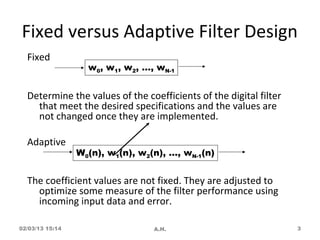
  Fixed
                   w0, w1, w2, …, wN-1


  Determine the values of the coefficients of the digital filter
    that meet the desired specifications and the values are
    not changed once they are implemented.

  Adaptive
                 W0(n), w1(n), w2(n), …, wN-1(n)


  The coefficient values are not fixed. They are adjusted to
    optimize some measure of the filter performance using
    incoming input data and error.

02/03/13 15:14                    A.H.                             3
Introduction to Adaptive Filter [Efea 541]

  • An adaptive filter is a digital filter with self-
    adjusting characteristics.
  • It adapts, automatically, to changes in its
    input signals.
  • A variety of recursive algorithms have been
    developed for the operation of adaptive
    filters, e.g., LMS, RLS, etc.


02/03/13 15:14            A.H.                          4
Continued      … Introduction to the Adaptive Filter
                             [Far 2]


   • The figure shows a filter emphasizing the way it is used in
     typical problems.
   • The filter is used to reshape certain input signals in such a
     way that its output is a good estimate of the given desired
     signal.
   • The process of selecting or adapting in this case the filter
     parameters (coefficients) so as to achieve the best match
     between the desired signal and the filter output is often
     done by optimizing an appropriately defined performance
     function.

02/03/13 15:14                  A.H.                                 5
Continued …    Introduction to the Adaptive Filter
  •    The performance function can be defined in a statistical or
       deterministic framework.
  •    In the statistical approach, the most commonly used performance
       function is the mean-square value of the error signal, i.e. the
       difference between the desired signal and the filter output. For
       stationary input and desired signals, minimizing the mean-square
       error results in the well-known Wiener filter, which is said to be
       optimum in the mean-square sense.
  •    Most algorithms are practical solutions to Wiener filters.
  •    In the deterministic approach, the usual choice of performance
       function is a weighted sum of the squared error signal. Minimizing
       this function results in a filter which is optimum for the given set of
       data.
  •    Depending on the certain statistical properties of the data, the
       deterministic solution will approach the statistical solution, i.e. the
       Wiener filter, for large data lengths.


02/03/13 15:14                          A.H.                                     6
AF Classes
• Identification – The AF provides a model that
  represents an unknown system.
• Inverse Modeling – The AF provides an inverse model
  that represents an unknown system.
• Prediction – The AF provides the best prediction of
  the present value of a random signal.
• Interference Canceling – The AF is used in such a way
  that it can cancel unknown interference contained in
  an information signal.


02/03/13 15:14            A.H.                        7
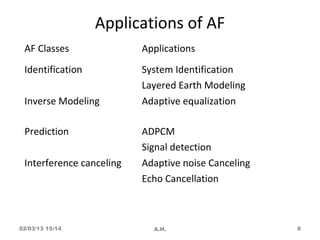
Applications of AF
 AF Classes               Applications
 Identification           System Identification
                          Layered Earth Modeling
 Inverse Modeling         Adaptive equalization

 Prediction               ADPCM
                          Signal detection
 Interference canceling   Adaptive noise Canceling
                          Echo Cancellation


02/03/13 15:14              A.H.                     8
Adaptive Filter Structure [Far 3]


                        M −1
                 y (n) = ∑ wi (n) x(n − i )
                         i =0


02/03/13 15:14                  A.H.          9
Continued ..   Adaptive Filter Structure
• Adaptive filter is implemented using a transversal (FIR),
  lattice or even IIR structure.
• FIR structure is the most widely used because of its
  simplicity and guaranteed stability
• Where, the filter has input x(n) and an output, y(n). The
  sequence d(n) is called the desired signal. wi(n)s are the
  filter tap weights (coefficients) and M is the filter length.
  The tap weights vary in time and are controlled by a
  suitable adaptive algorithm.
• The output, y(n), is generated as a linear combination of the
  delayed samples of the input sequence, x(n), according to
  the equation -       M −1
                   y (n) = ∑ wi (n) x(n − i )
                            i =0
02/03/13 15:14                     A.H.                       10
Adaptive Filter Algorithms [Ifea 648]
  • LMS – Least Mean Square
  • RLS – Recursive Least Squares
  • Kalman Filter Algorithms

  LMS
  • The most efficient in terms of computation and storage
    requirements
  • Does not suffer from the numerical instability problem.
  • Popular


02/03/13 15:14                A.H.                            11
The LMS Algorithm
                 [Far 138, Ifea 654, Hay 299, Proa 902-905]


02/03/13 15:14                      A.H.                      12
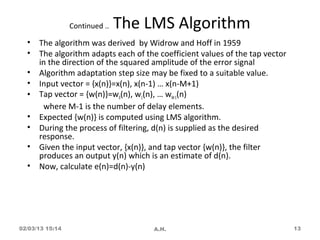
Continued ..   The LMS Algorithm
  •   The algorithm was derived by Widrow and Hoff in 1959
  •   The algorithm adapts each of the coefficient values of the tap vector
      in the direction of the squared amplitude of the error signal
  •   Algorithm adaptation step size may be fixed to a suitable value.
  •   Input vector = {x(n)}=x(n), x(n-1) … x(n-M+1)
  •   Tap vector = {w(n)}=w0(n), w1(n), … wM-1(n)
       where M-1 is the number of delay elements.
  •   Expected {w(n)} is computed using LMS algorithm.
  •   During the process of filtering, d(n) is supplied as the desired
      response.
  •   Given the input vector, {x(n)}, and tap vector {w(n)}, the filter
      produces an output y(n) which is an estimate of d(n).
  •   Now, calculate e(n)=d(n)-y(n)


02/03/13 15:14                        A.H.                                    13
Continued ..   The LMS Algorithm
 We write here 3 basic relations of the LMS
 algorithm [Hay 303, Far 141]
1. Filter output              y ( n) = w T ( n) x ( n)

2. Estimation error           e( n ) = d ( n ) − y ( n )

3. Tap-weight update          w (n + 1) = w (n) + µx (n)e(n)


02/03/13 15:14                      A.H.                       14
Summary of the LMS Algorithm [Far 141]


02/03/13 15:14      A.H.                   15
AF Application: Noise Cancellation
                    [Hay 48, Far 21, Proa 896]


  • Adaptive Noise Cancelling (ANC) is performed by
    subtracting noise from a signal (where noise has
    been mixed) for the purpose of improved signal-
    to-noise ratio.
  • The filtering and subtraction are controlled by the
    adaptive process.
  • Basically an adaptive noise canceller is a dual
    input, closed adaptive control system.


02/03/13 15:14                 A.H.                       16
Adaptive Noise Canceller (ANC)


                 Fig. (Proa 13.1.14) AF Canceller

02/03/13 15:14                 A.H.                 17
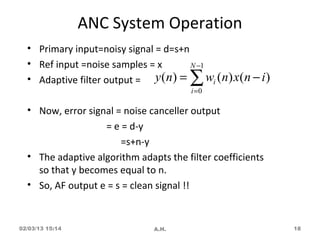
ANC System Operation
  • Primary input=noisy signal = d=s+n
  • Ref input =noise samples = x       N −1
  • Adaptive filter output = y ( n) =   ∑   wi (n) x(n − i )
                                         i =0

  • Now, error signal = noise canceller output
                   = e = d-y
                       =s+n-y
  • The adaptive algorithm adapts the filter coefficients
    so that y becomes equal to n.
  • So, AF output e = s = clean signal !!


02/03/13 15:14                  A.H.                           18
HOME WORKS
  • Application of Adaptive filtering to system
    identification(System Modeling) problem [Proa
    P882].
  • Adaptive Channel Equalization [Proa 883].
  • Adaptive Echo Canellation [Proa 887].


02/03/13 15:14           A.H.                       19
DSP Lecture
                 ADAPTIVE FILTER

                  THE END


                 THANK YOU

02/03/13 15:14         A.H.        20

Dsp lecture vol 7 adaptive filter

  • 1.
    E E 315 T Adaptive Filter Vol-7 A.H.M. Asadul Huq, Ph.D. http://asadul.drivehq.com/students.htm asadul.huq@ulab.edu.bd 02/03/13 15:14 A.H. 1
  • 2.
    Adaptive Digital Filter References 1. Digital Signal Processing Principles … 4/e – John G. Proakis et al. 2. Adaptive filter theory – Simon Haykin 3. Adaptive Filters Theory and Applications – B. Farhang-Boroujeny 4. Digital Signal Processing A practical Approach – Emmanuel C. Ifeachor (P 645 – 680, 2/e) 02/03/13 15:14 A.H. 2
  • 3.
    Fixed versus AdaptiveFilter Design Fixed w0, w1, w2, …, wN-1 Determine the values of the coefficients of the digital filter that meet the desired specifications and the values are not changed once they are implemented. Adaptive W0(n), w1(n), w2(n), …, wN-1(n) The coefficient values are not fixed. They are adjusted to optimize some measure of the filter performance using incoming input data and error. 02/03/13 15:14 A.H. 3
  • 4.
    Introduction to AdaptiveFilter [Efea 541] • An adaptive filter is a digital filter with self- adjusting characteristics. • It adapts, automatically, to changes in its input signals. • A variety of recursive algorithms have been developed for the operation of adaptive filters, e.g., LMS, RLS, etc. 02/03/13 15:14 A.H. 4
  • 5.
    Continued … Introduction to the Adaptive Filter [Far 2] • The figure shows a filter emphasizing the way it is used in typical problems. • The filter is used to reshape certain input signals in such a way that its output is a good estimate of the given desired signal. • The process of selecting or adapting in this case the filter parameters (coefficients) so as to achieve the best match between the desired signal and the filter output is often done by optimizing an appropriately defined performance function. 02/03/13 15:14 A.H. 5
  • 6.
    Continued … Introduction to the Adaptive Filter • The performance function can be defined in a statistical or deterministic framework. • In the statistical approach, the most commonly used performance function is the mean-square value of the error signal, i.e. the difference between the desired signal and the filter output. For stationary input and desired signals, minimizing the mean-square error results in the well-known Wiener filter, which is said to be optimum in the mean-square sense. • Most algorithms are practical solutions to Wiener filters. • In the deterministic approach, the usual choice of performance function is a weighted sum of the squared error signal. Minimizing this function results in a filter which is optimum for the given set of data. • Depending on the certain statistical properties of the data, the deterministic solution will approach the statistical solution, i.e. the Wiener filter, for large data lengths. 02/03/13 15:14 A.H. 6
  • 7.
    AF Classes • Identification– The AF provides a model that represents an unknown system. • Inverse Modeling – The AF provides an inverse model that represents an unknown system. • Prediction – The AF provides the best prediction of the present value of a random signal. • Interference Canceling – The AF is used in such a way that it can cancel unknown interference contained in an information signal. 02/03/13 15:14 A.H. 7
  • 8.
    Applications of AF AF Classes Applications Identification System Identification Layered Earth Modeling Inverse Modeling Adaptive equalization Prediction ADPCM Signal detection Interference canceling Adaptive noise Canceling Echo Cancellation 02/03/13 15:14 A.H. 8
  • 9.
    Adaptive Filter Structure[Far 3] M −1 y (n) = ∑ wi (n) x(n − i ) i =0 02/03/13 15:14 A.H. 9
  • 10.
    Continued .. Adaptive Filter Structure • Adaptive filter is implemented using a transversal (FIR), lattice or even IIR structure. • FIR structure is the most widely used because of its simplicity and guaranteed stability • Where, the filter has input x(n) and an output, y(n). The sequence d(n) is called the desired signal. wi(n)s are the filter tap weights (coefficients) and M is the filter length. The tap weights vary in time and are controlled by a suitable adaptive algorithm. • The output, y(n), is generated as a linear combination of the delayed samples of the input sequence, x(n), according to the equation - M −1 y (n) = ∑ wi (n) x(n − i ) i =0 02/03/13 15:14 A.H. 10
  • 11.
    Adaptive Filter Algorithms[Ifea 648] • LMS – Least Mean Square • RLS – Recursive Least Squares • Kalman Filter Algorithms LMS • The most efficient in terms of computation and storage requirements • Does not suffer from the numerical instability problem. • Popular 02/03/13 15:14 A.H. 11
  • 12.
    The LMS Algorithm [Far 138, Ifea 654, Hay 299, Proa 902-905] 02/03/13 15:14 A.H. 12
  • 13.
    Continued .. The LMS Algorithm • The algorithm was derived by Widrow and Hoff in 1959 • The algorithm adapts each of the coefficient values of the tap vector in the direction of the squared amplitude of the error signal • Algorithm adaptation step size may be fixed to a suitable value. • Input vector = {x(n)}=x(n), x(n-1) … x(n-M+1) • Tap vector = {w(n)}=w0(n), w1(n), … wM-1(n) where M-1 is the number of delay elements. • Expected {w(n)} is computed using LMS algorithm. • During the process of filtering, d(n) is supplied as the desired response. • Given the input vector, {x(n)}, and tap vector {w(n)}, the filter produces an output y(n) which is an estimate of d(n). • Now, calculate e(n)=d(n)-y(n) 02/03/13 15:14 A.H. 13
  • 14.
    Continued .. The LMS Algorithm We write here 3 basic relations of the LMS algorithm [Hay 303, Far 141] 1. Filter output y ( n) = w T ( n) x ( n) 2. Estimation error e( n ) = d ( n ) − y ( n ) 3. Tap-weight update w (n + 1) = w (n) + µx (n)e(n) 02/03/13 15:14 A.H. 14
  • 15.
    Summary of theLMS Algorithm [Far 141] 02/03/13 15:14 A.H. 15
  • 16.
    AF Application: NoiseCancellation [Hay 48, Far 21, Proa 896] • Adaptive Noise Cancelling (ANC) is performed by subtracting noise from a signal (where noise has been mixed) for the purpose of improved signal- to-noise ratio. • The filtering and subtraction are controlled by the adaptive process. • Basically an adaptive noise canceller is a dual input, closed adaptive control system. 02/03/13 15:14 A.H. 16
  • 17.
    Adaptive Noise Canceller(ANC) Fig. (Proa 13.1.14) AF Canceller 02/03/13 15:14 A.H. 17
  • 18.
    ANC System Operation • Primary input=noisy signal = d=s+n • Ref input =noise samples = x N −1 • Adaptive filter output = y ( n) = ∑ wi (n) x(n − i ) i =0 • Now, error signal = noise canceller output = e = d-y =s+n-y • The adaptive algorithm adapts the filter coefficients so that y becomes equal to n. • So, AF output e = s = clean signal !! 02/03/13 15:14 A.H. 18
  • 19.
    HOME WORKS • Application of Adaptive filtering to system identification(System Modeling) problem [Proa P882]. • Adaptive Channel Equalization [Proa 883]. • Adaptive Echo Canellation [Proa 887]. 02/03/13 15:14 A.H. 19
  • 20.
    DSP Lecture ADAPTIVE FILTER THE END THANK YOU 02/03/13 15:14 A.H. 20

Editor's Notes

  • #2 DSP Lecture Vol-7 Adaptive Filter February 3, 2013 A.H.