Chemical Bonding I:
  Basic Concepts
          Chapter 9


    Copyright © The McGraw-Hill Companies, Inc. Permission required for reproduction or display.
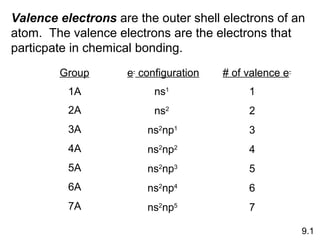
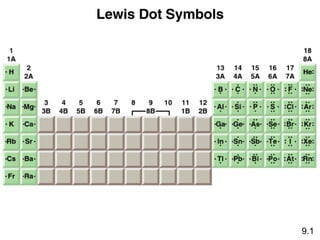
Valence electrons are the outer shell electrons of an
atom. The valence electrons are the electrons that
particpate in chemical bonding.
        Group       e- configuration   # of valence e-
          1A              ns1               1
          2A              ns2               2
          3A            ns2np1              3
          4A            ns2np2              4
          5A            ns2np3              5
          6A            ns2np4              6
          7A            ns2np5              7

                                                         9.1
9.1
The Ionic Bond


   Li + F         Li+ F -
1s22s1 22s22p5
     1s          [He]2Ne]2p6
                  1s2[ 2s2
                   1s


          Li      Li+ + e-
   -
  e +     F       F -

  Li+ +   F -     Li+ F -


                               9.2
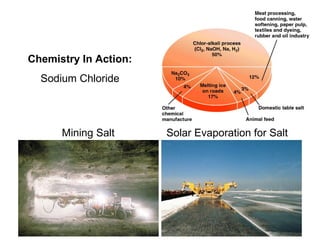
Chemistry In Action:
  Sodium Chloride


      Mining Salt      Solar Evaporation for Salt
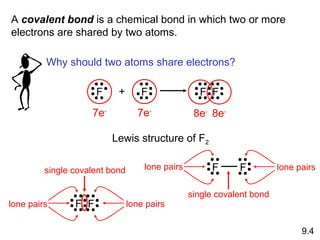
A covalent bond is a chemical bond in which two or more
electrons are shared by two atoms.

         Why should two atoms share electrons?

                      F    +       F               F F
                    7e-           7e-             8e- 8e-

                          Lewis structure of F2

         single covalent bond       lone pairs        F      F          lone pairs


                                                 single covalent bond
lone pairs      F F             lone pairs


                                                                              9.4
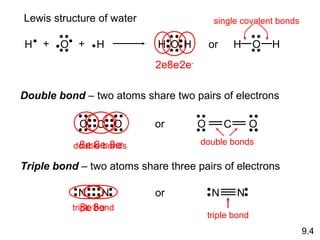
Lewis structure of water                     single covalent bonds

H   +   O +     H           H O H           or       H    O   H
                            2e-8e-2e-

Double bond – two atoms share two pairs of electrons

            O C O          or           O        C        O
            8e- 8e- 8e-
           double bonds                 double bonds

Triple bond – two atoms share three pairs of electrons

            N N             or               N       N
          triple-8e-
             8e bond
                                            triple bond
                                                                     9.4
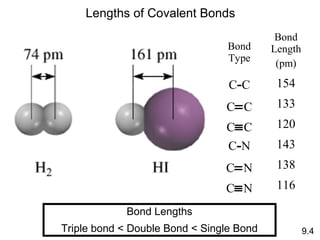
Lengths of Covalent Bonds
                                           Bond
                                 Bond     Length
                                 Type      (pm)

                                 C-C       154
                                C= C       133
                                C≡ C       120
                                C-N        143
                                C= N       138
                                C≡ N       116

            Bond Lengths
Triple bond < Double Bond < Single Bond            9.4
9.4
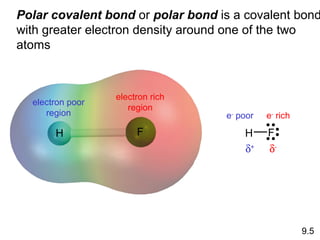
Polar covalent bond or polar bond is a covalent bond
with greater electron density around one of the two
atoms


                  electron rich
  electron poor
                     region
     region                        e- poor   e- rich

       H               F               H     F
                                       δ+    δ-


                                                       9.5
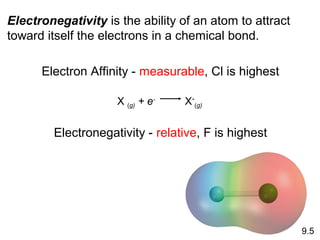
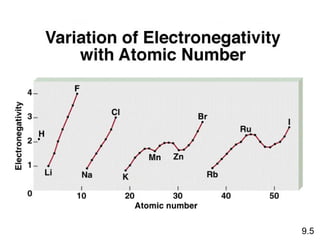
Electronegativity is the ability of an atom to attract
toward itself the electrons in a chemical bond.

      Electron Affinity - measurable, Cl is highest

                    X (g) + e-   X-(g)


        Electronegativity - relative, F is highest


                                                         9.5
9.5
9.5
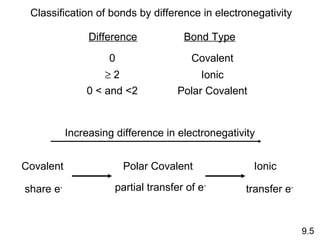
Classification of bonds by difference in electronegativity

                Difference            Bond Type
                    0                   Covalent
                   ≥2                     Ionic
               0 < and <2            Polar Covalent


           Increasing difference in electronegativity


Covalent                Polar Covalent                Ionic

share e-              partial transfer of e-       transfer e-


                                                                 9.5
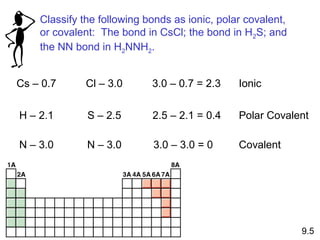
Classify the following bonds as ionic, polar covalent,
    or covalent: The bond in CsCl; the bond in H2S; and
    the NN bond in H2NNH2.


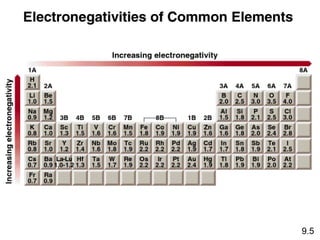
Cs – 0.7      Cl – 3.0      3.0 – 0.7 = 2.3    Ionic

H – 2.1       S – 2.5       2.5 – 2.1 = 0.4    Polar Covalent

N – 3.0       N – 3.0       3.0 – 3.0 = 0      Covalent


                                                             9.5
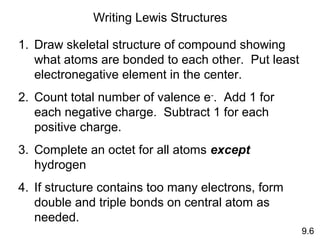
Writing Lewis Structures

1. Draw skeletal structure of compound showing
   what atoms are bonded to each other. Put least
   electronegative element in the center.
2. Count total number of valence e-. Add 1 for
   each negative charge. Subtract 1 for each
   positive charge.
3. Complete an octet for all atoms except
   hydrogen
4. If structure contains too many electrons, form
   double and triple bonds on central atom as
   needed.
                                                    9.6
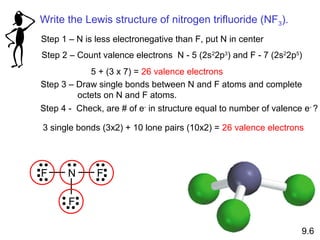
Write the Lewis structure of nitrogen trifluoride (NF3).
Step 1 – N is less electronegative than F, put N in center
Step 2 – Count valence electrons N - 5 (2s22p3) and F - 7 (2s22p5)
            5 + (3 x 7) = 26 valence electrons
Step 3 – Draw single bonds between N and F atoms and complete
         octets on N and F atoms.
Step 4 - Check, are # of e- in structure equal to number of valence e- ?

3 single bonds (3x2) + 10 lone pairs (10x2) = 26 valence electrons


F      N      F

       F

                                                                   9.6
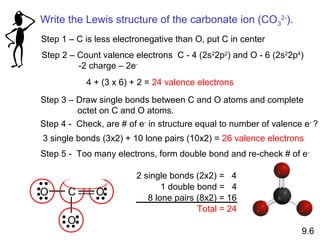
Write the Lewis structure of the carbonate ion (CO 32-).
Step 1 – C is less electronegative than O, put C in center
Step 2 – Count valence electrons C - 4 (2s22p2) and O - 6 (2s22p4)
         -2 charge – 2e-
           4 + (3 x 6) + 2 = 24 valence electrons
Step 3 – Draw single bonds between C and O atoms and complete
         octet on C and O atoms.
Step 4 - Check, are # of e- in structure equal to number of valence e- ?
3 single bonds (3x2) + 10 lone pairs (10x2) = 26 valence electrons
Step 5 - Too many electrons, form double bond and re-check # of e -

                        2 single bonds (2x2) = 4
                               1 double bond = 4
O      C      O            8 lone pairs (8x2) = 16
                                        Total = 24
       O
                                                                   9.6
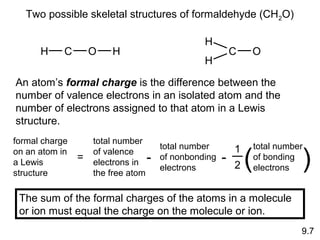
Two possible skeletal structures of formaldehyde (CH2O)

                                                  H
      H     C       O   H                                   C   O
                                                  H

An atom’s formal charge is the difference between the
number of valence electrons in an isolated atom and the
number of electrons assigned to that atom in a Lewis
structure.
formal charge       total number
                                        total number                total number

                                                                (              )
on an atom in       of valence                              1
a Lewis
                =   electrons in    -   of nonbonding   -   2
                                                                    of bonding
                                        electrons                   electrons
structure           the free atom

 The sum of the formal charges of the atoms in a molecule
 or ion must equal the charge on the molecule or ion.
                                                                               9.7
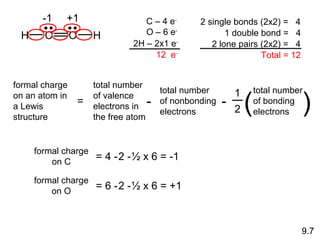
-1   +1                      C – 4 e-         2 single bonds (2x2) = 4
 H     C        O       H           O – 6 e-                1 double bond = 4
                                 2H – 2x1 e-            2 lone pairs (2x2) = 4
                                      12 e-                          Total = 12


formal charge           total number
                                            total number                total number

                                                                    (              )
on an atom in           of valence                              1
a Lewis
                    =   electrons in    -   of nonbonding   -   2
                                                                        of bonding
                                            electrons                   electrons
structure               the free atom


     formal charge
         on C
                   = 4 -2 - ½ x 6 = -1

     formal charge
         on O
                   = 6 -2 - ½ x 6 = +1


                                                                                   9.7
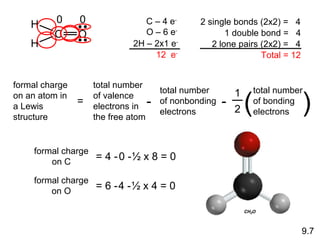
H    0      0               C – 4 e-         2 single bonds (2x2) = 4
         C      O               O – 6 e-                1 double bond = 4
    H                        2H – 2x1 e-            2 lone pairs (2x2) = 4
                                  12 e-                          Total = 12


formal charge       total number
                                        total number                total number

                                                                (              )
on an atom in       of valence                              1
a Lewis
                =   electrons in    -   of nonbonding   -   2
                                                                    of bonding
                                        electrons                   electrons
structure           the free atom


    formal charge
        on C
                  = 4 - 0 -½ x 8 = 0

    formal charge
        on O
                  = 6 -4 - ½ x 4 = 0


                                                                               9.7
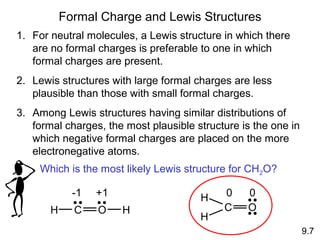
Formal Charge and Lewis Structures
1. For neutral molecules, a Lewis structure in which there
   are no formal charges is preferable to one in which
   formal charges are present.
2. Lewis structures with large formal charges are less
   plausible than those with small formal charges.
3. Among Lewis structures having similar distributions of
   formal charges, the most plausible structure is the one in
   which negative formal charges are placed on the more
   electronegative atoms.
     Which is the most likely Lewis structure for CH2O?

             -1   +1                   H    0    0
       H     C    O    H                    C    O
                                       H
                                                                9.7
Exceptions to the Octet Rule

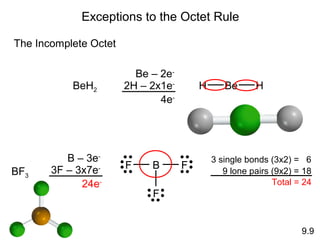
The Incomplete Octet

                         Be – 2e-
           BeH2        2H – 2x1e-       H      Be      H
                              4e-


          B – 3e-                           3 single bonds (3x2) = 6
       3F – 3x7e-      F    B       F
BF3                                            9 lone pairs (9x2) = 18
             24e-                                           Total = 24
                            F


                                                                   9.9
Exceptions to the Octet Rule

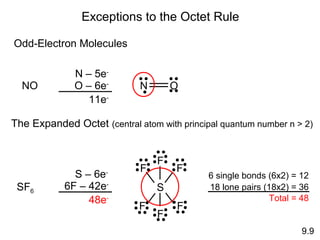
Odd-Electron Molecules

              N – 5e-
  NO          O – 6e-        N       O
                11e-

The Expanded Octet (central atom with principal quantum number n > 2)


                                 F
                             F       F
              S – 6e-                        6 single bonds (6x2) = 12
 SF6        6F – 42e-            S           18 lone pairs (18x2) = 36
                 48e-                                        Total = 48
                             F       F
                                 F
                                                                     9.9

Chemical Bonding - Basic Concepts

  • 1.
    Chemical Bonding I: Basic Concepts Chapter 9 Copyright © The McGraw-Hill Companies, Inc. Permission required for reproduction or display.
  • 2.
    Valence electrons arethe outer shell electrons of an atom. The valence electrons are the electrons that particpate in chemical bonding. Group e- configuration # of valence e- 1A ns1 1 2A ns2 2 3A ns2np1 3 4A ns2np2 4 5A ns2np3 5 6A ns2np4 6 7A ns2np5 7 9.1
  • 3.
  • 4.
    The Ionic Bond Li + F Li+ F - 1s22s1 22s22p5 1s [He]2Ne]2p6 1s2[ 2s2 1s Li Li+ + e- - e + F F - Li+ + F - Li+ F - 9.2
  • 5.
    Chemistry In Action: Sodium Chloride Mining Salt Solar Evaporation for Salt
  • 6.
    A covalent bondis a chemical bond in which two or more electrons are shared by two atoms. Why should two atoms share electrons? F + F F F 7e- 7e- 8e- 8e- Lewis structure of F2 single covalent bond lone pairs F F lone pairs single covalent bond lone pairs F F lone pairs 9.4
  • 7.
    Lewis structure ofwater single covalent bonds H + O + H H O H or H O H 2e-8e-2e- Double bond – two atoms share two pairs of electrons O C O or O C O 8e- 8e- 8e- double bonds double bonds Triple bond – two atoms share three pairs of electrons N N or N N triple-8e- 8e bond triple bond 9.4
  • 8.
    Lengths of CovalentBonds Bond Bond Length Type (pm) C-C 154 C= C 133 C≡ C 120 C-N 143 C= N 138 C≡ N 116 Bond Lengths Triple bond < Double Bond < Single Bond 9.4
  • 9.
  • 10.
    Polar covalent bondor polar bond is a covalent bond with greater electron density around one of the two atoms electron rich electron poor region region e- poor e- rich H F H F δ+ δ- 9.5
  • 11.
    Electronegativity is theability of an atom to attract toward itself the electrons in a chemical bond. Electron Affinity - measurable, Cl is highest X (g) + e- X-(g) Electronegativity - relative, F is highest 9.5
  • 12.
  • 13.
  • 14.
    Classification of bondsby difference in electronegativity Difference Bond Type 0 Covalent ≥2 Ionic 0 < and <2 Polar Covalent Increasing difference in electronegativity Covalent Polar Covalent Ionic share e- partial transfer of e- transfer e- 9.5
  • 15.
    Classify the followingbonds as ionic, polar covalent, or covalent: The bond in CsCl; the bond in H2S; and the NN bond in H2NNH2. Cs – 0.7 Cl – 3.0 3.0 – 0.7 = 2.3 Ionic H – 2.1 S – 2.5 2.5 – 2.1 = 0.4 Polar Covalent N – 3.0 N – 3.0 3.0 – 3.0 = 0 Covalent 9.5
  • 16.
    Writing Lewis Structures 1.Draw skeletal structure of compound showing what atoms are bonded to each other. Put least electronegative element in the center. 2. Count total number of valence e-. Add 1 for each negative charge. Subtract 1 for each positive charge. 3. Complete an octet for all atoms except hydrogen 4. If structure contains too many electrons, form double and triple bonds on central atom as needed. 9.6
  • 17.
    Write the Lewisstructure of nitrogen trifluoride (NF3). Step 1 – N is less electronegative than F, put N in center Step 2 – Count valence electrons N - 5 (2s22p3) and F - 7 (2s22p5) 5 + (3 x 7) = 26 valence electrons Step 3 – Draw single bonds between N and F atoms and complete octets on N and F atoms. Step 4 - Check, are # of e- in structure equal to number of valence e- ? 3 single bonds (3x2) + 10 lone pairs (10x2) = 26 valence electrons F N F F 9.6
  • 18.
    Write the Lewisstructure of the carbonate ion (CO 32-). Step 1 – C is less electronegative than O, put C in center Step 2 – Count valence electrons C - 4 (2s22p2) and O - 6 (2s22p4) -2 charge – 2e- 4 + (3 x 6) + 2 = 24 valence electrons Step 3 – Draw single bonds between C and O atoms and complete octet on C and O atoms. Step 4 - Check, are # of e- in structure equal to number of valence e- ? 3 single bonds (3x2) + 10 lone pairs (10x2) = 26 valence electrons Step 5 - Too many electrons, form double bond and re-check # of e - 2 single bonds (2x2) = 4 1 double bond = 4 O C O 8 lone pairs (8x2) = 16 Total = 24 O 9.6
  • 19.
    Two possible skeletalstructures of formaldehyde (CH2O) H H C O H C O H An atom’s formal charge is the difference between the number of valence electrons in an isolated atom and the number of electrons assigned to that atom in a Lewis structure. formal charge total number total number total number ( ) on an atom in of valence 1 a Lewis = electrons in - of nonbonding - 2 of bonding electrons electrons structure the free atom The sum of the formal charges of the atoms in a molecule or ion must equal the charge on the molecule or ion. 9.7
  • 20.
    -1 +1 C – 4 e- 2 single bonds (2x2) = 4 H C O H O – 6 e- 1 double bond = 4 2H – 2x1 e- 2 lone pairs (2x2) = 4 12 e- Total = 12 formal charge total number total number total number ( ) on an atom in of valence 1 a Lewis = electrons in - of nonbonding - 2 of bonding electrons electrons structure the free atom formal charge on C = 4 -2 - ½ x 6 = -1 formal charge on O = 6 -2 - ½ x 6 = +1 9.7
  • 21.
    H 0 0 C – 4 e- 2 single bonds (2x2) = 4 C O O – 6 e- 1 double bond = 4 H 2H – 2x1 e- 2 lone pairs (2x2) = 4 12 e- Total = 12 formal charge total number total number total number ( ) on an atom in of valence 1 a Lewis = electrons in - of nonbonding - 2 of bonding electrons electrons structure the free atom formal charge on C = 4 - 0 -½ x 8 = 0 formal charge on O = 6 -4 - ½ x 4 = 0 9.7
  • 22.
    Formal Charge andLewis Structures 1. For neutral molecules, a Lewis structure in which there are no formal charges is preferable to one in which formal charges are present. 2. Lewis structures with large formal charges are less plausible than those with small formal charges. 3. Among Lewis structures having similar distributions of formal charges, the most plausible structure is the one in which negative formal charges are placed on the more electronegative atoms. Which is the most likely Lewis structure for CH2O? -1 +1 H 0 0 H C O H C O H 9.7
  • 23.
    Exceptions to theOctet Rule The Incomplete Octet Be – 2e- BeH2 2H – 2x1e- H Be H 4e- B – 3e- 3 single bonds (3x2) = 6 3F – 3x7e- F B F BF3 9 lone pairs (9x2) = 18 24e- Total = 24 F 9.9
  • 24.
    Exceptions to theOctet Rule Odd-Electron Molecules N – 5e- NO O – 6e- N O 11e- The Expanded Octet (central atom with principal quantum number n > 2) F F F S – 6e- 6 single bonds (6x2) = 12 SF6 6F – 42e- S 18 lone pairs (18x2) = 36 48e- Total = 48 F F F 9.9