Warm-Up What are valence electrons? Electrons in the highest occupied energy level of an atom. Which group of atoms hardly react at all? Nobel gases. Isotopes of an element have different number of  A) neutrons   C) protons B) electrons D) nuclei
4-2: Ionic & Covalent Bonding Describe   how ionization energy affects ionic bonding. Predict  the composition of an ionic compound from its formula. Describe  how covalent bonds are formed. Relate  the properties of ionic and covalent compounds.
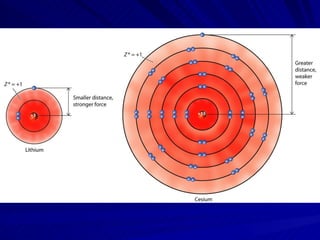
Ionization Energy It requires energy to remove an electron from an atom. Energy has to be added to the electron to overcome its attraction to the nucleus. This energy is called  ionization energy High ionization energy = difficult to remove. Low ionization energy = easy to remove.


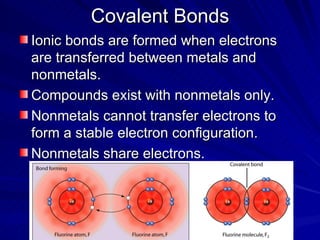
Covalent Bonds Ionic bonds are formed when electrons are transferred between metals and nonmetals. Compounds exist with nonmetals only. Nonmetals cannot transfer electrons to form a stable electron configuration. Nonmetals share electrons.
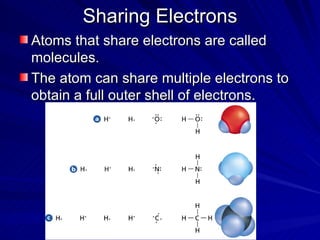
Sharing Electrons Atoms that share electrons are called molecules. The atom can share multiple electrons to obtain a full outer shell of electrons.
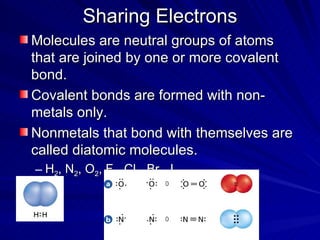
Sharing Electrons Molecules are neutral groups of atoms that are joined by one or more covalent bond. Covalent bonds are formed with non-metals only.  Nonmetals that bond with themselves are called diatomic molecules. H 2 , N 2 , O 2 , F 2 , Cl 2 , Br 2 , I 2 ,
 
Multiple Covalent Bonding Atoms can share multiple pairs of electrons Types of covalent bonds Single – one shared set of electrons Double – two shared sets of electrons Triple – three shared sets of electrons Quadruple can not form because of electron repulsion.
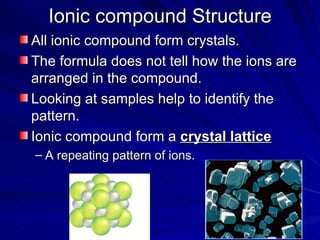
Ionic compound Structure All ionic compound form crystals. The formula does not tell how the ions are arranged in the compound. Looking at samples help to identify the pattern. Ionic compound form a  crystal lattice A repeating pattern of ions.
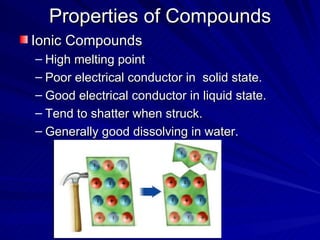
Properties of Compounds Ionic Compounds High melting point Poor electrical conductor in  solid state. Good electrical conductor in liquid state. Tend to shatter when struck. Generally good dissolving in water.
Properties of Compounds Covalent Compounds Low melting points Generally soft and pliable (won’t shatter). Poor conductors of heat and electricity. Most covalent compounds are poorly soluble in water.
Summary Which type of elements make covalent bonds? Nonmetals. Which type of bond is stronger? Ionic or covalent Ionic because ionic compounds have very high melting points. Which type of compound does not usually dissolve in water? Covalent

4-2 Ionic & Covalent Bonding

  • 1.
    Warm-Up What arevalence electrons? Electrons in the highest occupied energy level of an atom. Which group of atoms hardly react at all? Nobel gases. Isotopes of an element have different number of A) neutrons C) protons B) electrons D) nuclei
  • 2.
    4-2: Ionic &Covalent Bonding Describe how ionization energy affects ionic bonding. Predict the composition of an ionic compound from its formula. Describe how covalent bonds are formed. Relate the properties of ionic and covalent compounds.
  • 3.
    Ionization Energy Itrequires energy to remove an electron from an atom. Energy has to be added to the electron to overcome its attraction to the nucleus. This energy is called ionization energy High ionization energy = difficult to remove. Low ionization energy = easy to remove.
  • 4.
  • 5.
  • 6.
  • 7.
    Covalent Bonds Ionicbonds are formed when electrons are transferred between metals and nonmetals. Compounds exist with nonmetals only. Nonmetals cannot transfer electrons to form a stable electron configuration. Nonmetals share electrons.
  • 8.
    Sharing Electrons Atomsthat share electrons are called molecules. The atom can share multiple electrons to obtain a full outer shell of electrons.
  • 9.
    Sharing Electrons Moleculesare neutral groups of atoms that are joined by one or more covalent bond. Covalent bonds are formed with non-metals only. Nonmetals that bond with themselves are called diatomic molecules. H 2 , N 2 , O 2 , F 2 , Cl 2 , Br 2 , I 2 ,
  • 10.
  • 11.
    Multiple Covalent BondingAtoms can share multiple pairs of electrons Types of covalent bonds Single – one shared set of electrons Double – two shared sets of electrons Triple – three shared sets of electrons Quadruple can not form because of electron repulsion.
  • 12.
    Ionic compound StructureAll ionic compound form crystals. The formula does not tell how the ions are arranged in the compound. Looking at samples help to identify the pattern. Ionic compound form a crystal lattice A repeating pattern of ions.
  • 13.
    Properties of CompoundsIonic Compounds High melting point Poor electrical conductor in solid state. Good electrical conductor in liquid state. Tend to shatter when struck. Generally good dissolving in water.
  • 14.
    Properties of CompoundsCovalent Compounds Low melting points Generally soft and pliable (won’t shatter). Poor conductors of heat and electricity. Most covalent compounds are poorly soluble in water.
  • 15.
    Summary Which typeof elements make covalent bonds? Nonmetals. Which type of bond is stronger? Ionic or covalent Ionic because ionic compounds have very high melting points. Which type of compound does not usually dissolve in water? Covalent