Confused mind: Post operative
cognitive dysfunction
Dr. Priyanka Gupta
Associate Professor, Deptt. Of Anaesthesia
AIIMS Rishikesh
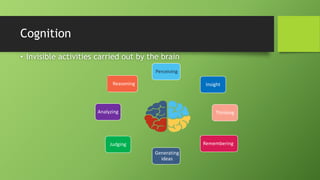
Cognition
• Invisible activities carried out by the brain
Perceiving
Analyzing
Reasoning
Judging
Generating
ideas
Remembering
Thinking
Insight
• MR. A says that 6 month back his 70 year old father underwent hip
replacement surgery. After the surgery he is not “The same”
• “He forgets things and will ask the same thing several times”
• He says, father was sharp as a tack before the operation. “He’s
more like 80 % of him now”
What went wrong with this patient?
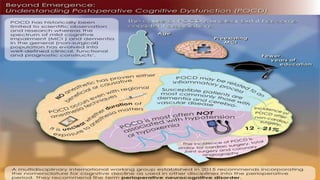
Post operative cognitive dysfunction
• First described by Bedford in 1955 (The Lancet) as “ Adverse
cerebral effects of Anaesthesia on old people”
• No universally accepted definition
• There is no International Statistical Classification of Disease code
• POCD is a neurodegenerative condition, acquired after surgery and
anaesthesia, and is similar to Alzheimer’s disease (AD) in
symptoms and risk factors.
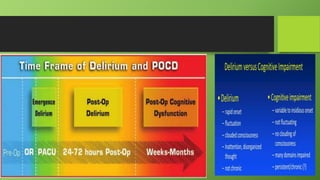
• POCD- a form of cognitive dysfunction that begins between seven
days to one year after surgery British Journal of Anaesthesia, 119 (S1): i115–i125 (2017)
Postoperative cognitive dysfunction
• Subtle condition, lack of clinical symptoms
• Memory & concentration domains affected
• Visuospatial perception, motor skills and executive function are
affected
• Consciousness unaffected
• Last weeks to months
• Usually reversible
Incidence/ Prevalence
• ~ 40% of Patients of >60 year, hospitalized for major non cardiac
surgery have POCD at discharge
• ~ 10% have POCD, three months later Anesthesiology. 2008 Jan;108(1):18-30
• ~30-50% of patients, underwent cardiac surgery had POCD with
first 6 weeks
• 10-50% of patients, had persisting dysfunction at 6 months Acta
Anaesthesiol Scand. 2010 July ; 54(6): 663–677.
• ~25-30% patient developed POCD following CEA (no difference in
regional/GA) Anesth Analg. 2008 Aug; 107(2): 636–642.
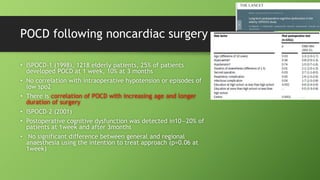
POCD following noncardiac surgery
• ISPOCD-1 (1998), 1218 elderly patients, 25% of patients
developed POCD at 1 week, 10% at 3 months
• No correlation with intraoperative hypotension or episodes of
low spo2
• There is correlation of POCD with increasing age and longer
duration of surgery
• ISPOCD-2 (2001)
• Postoperative cognitive dysfunction was detected in10—20% of
patients at 1week and after 3months
• No significant difference between general and regional
anaesthesia using the intention to treat approach (p=0.06 at
1week)
Risk factors for POCD
Patient Surgery Anaesthesia
Advanced age Extensive surgical procedure Extensive surgical procedure
Pre-existing
cerebral/cardiac/vascular
disease
Intra/post op complications Marked disturbance in
homeostasis
Preoperative cognitive
impairment
Secondary surgery Hypoxia/ hypoperfusion
Low education level Intra/post op anaesthesia
related complications
Alcohol abuse
Nutritional deficiency
Apo lipoprotein E genotype
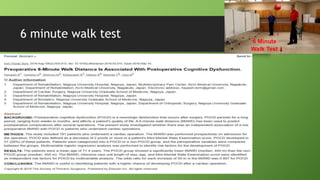
6 minute walk test
Classification
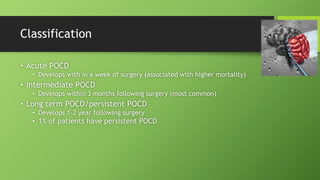
• Acute POCD
• Develops with in a week of surgery (associated with higher mortality)
• Intermediate POCD
• Develops within 3 months following surgery (most common)
• Long term POCD/persistent POCD
• Develops 1-2 year following surgery
• 1% of patients have persistent POCD
Pathophysiology of POCD
• Peripheral initiation of inflammation
• Disruption of Blood-Brain-Barrier
• Microglial activation
• Oxidative stress
• Cholinergic anti inflammatory pathway
Peripheral initiation of inflammation
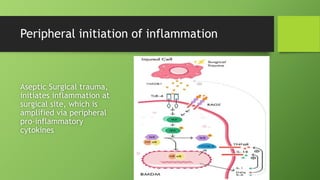
Aseptic Surgical trauma,
initiates inflammation at
surgical site, which is
amplified via peripheral
pro-inflammatory
cytokines
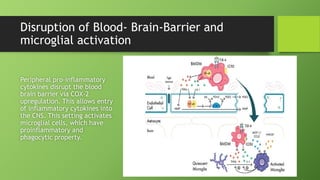
Disruption of Blood- Brain-Barrier and
microglial activation
Peripheral pro-inflammatory
cytokines disrupt the blood
brain barrier via COX-2
upregulation. This allows entry
of inflammatory cytokines into
the CNS. This setting activates
microglial cells, which have
proinflammatory and
phagocytic property.
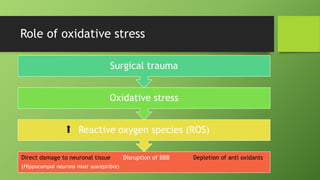
Role of oxidative stress
Direct damage to neuronal tissue Disruption of BBB Depletion of anti oxidants
(Hippocampal neurons most susceptible)
Reactive oxygen species (ROS)
Oxidative stress
Surgical trauma
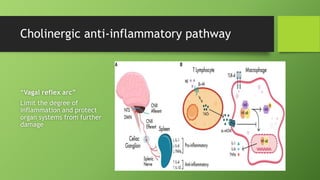
Cholinergic anti-inflammatory pathway
“Vagal reflex arc”
Limit the degree of
inflammation and protect
organ systems from further
damage
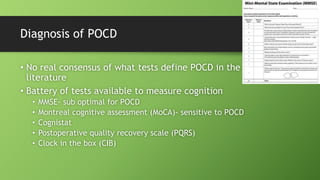
Diagnosis of POCD
• No real consensus of what tests define POCD in the
literature
• Battery of tests available to measure cognition
• MMSE- sub optimal for POCD
• Montreal cognitive assessment (MoCA)- sensitive to POCD
• Cognistat
• Postoperative quality recovery scale (PQRS)
• Clock in the box (CIB)
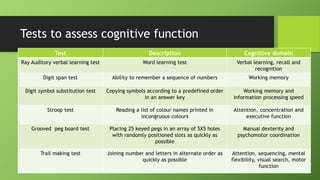
Tests to assess cognitive function
Test Description Cognitive domain
Ray Auditory verbal learning test Word learning test Verbal learning, recall and
recognition
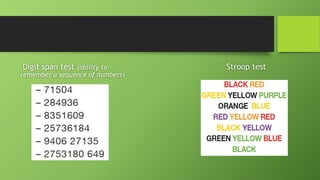
Digit span test Ability to remember a sequence of numbers Working memory
Digit symbol substitution test Copying symbols according to a predefined order
in an answer key
Working memory and
information processing speed
Stroop test Reading a list of colour names printed in
incongruous colours
Attention, concentration and
executive function
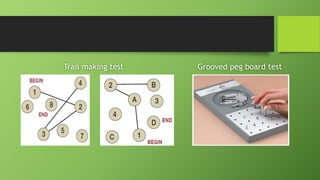
Grooved peg board test Placing 25 keyed pegs in an array of 5X5 holes
with randomly positioned slots as quickly as
possible
Manual dexterity and
psychomotor coordination
Trail making test Joining number and letters in alternate order as
quickly as possible
Attention, sequencing, mental
flexibility, visual search, motor
function
Digit span test (ability to
remember a sequence of numbers)
Stroop test
Trail making test Grooved peg board test
Montreal cognition assessment Clock drawing test
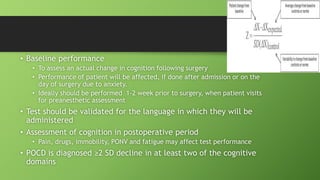
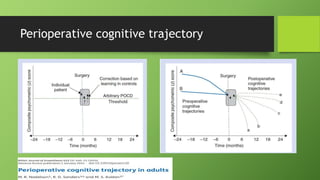
• Baseline performance
• To assess an actual change in cognition following surgery
• Performance of patient will be affected, if done after admission or on the
day of surgery due to anxiety.
• Ideally should be performed 1-2 week prior to surgery, when patient visits
for preanesthetic assessment
• Test should be validated for the language in which they will be
administered
• Assessment of cognition in postoperative period
• Pain, drugs, immobility, PONV and fatigue may affect test performance
• POCD is diagnosed ≥2 SD decline in at least two of the cognitive
domains
Perioperative cognitive trajectory
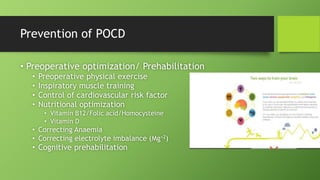
Prevention of POCD
• Preoperative optimization/ Prehabilitation
• Preoperative physical exercise
• Inspiratory muscle training
• Control of cardiovascular risk factor
• Nutritional optimization
• Vitamin B12/Folic acid/Homocysteine
• Vitamin D
• Correcting Anaemia
• Correcting electrolyte imbalance (Mg+2)
• Cognitive prehabilitation
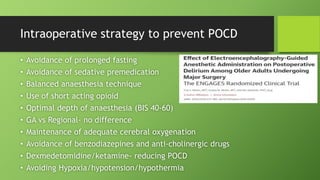
Intraoperative strategy to prevent POCD
• Avoidance of prolonged fasting
• Avoidance of sedative premedication
• Balanced anaesthesia technique
• Use of short acting opioid
• Optimal depth of anaesthesia (BIS 40-60)
• GA vs Regional- no difference
• Maintenance of adequate cerebral oxygenation
• Avoidance of benzodiazepines and anti-cholinergic drugs
• Dexmedetomidine/ketamine- reducing POCD
• Avoiding Hypoxia/hypotension/hypothermia
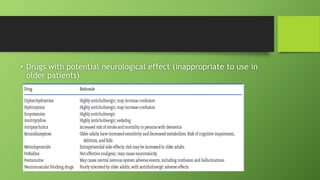
• Drugs with potential neurological effect (inappropriate to use in
older patients)
Postoperative strategy
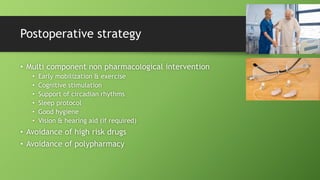
• Multi component non pharmacological intervention
• Early mobilization & exercise
• Cognitive stimulation
• Support of circadian rhythms
• Sleep protocol
• Good hygiene
• Vision & hearing aid (if required)
• Avoidance of high risk drugs
• Avoidance of polypharmacy
• Postoperative pain management
• Non opioid strategy (Gabapentin, paracetamol, NSAIDS)
• Regional anaesthesia/ nerve blocks
• Removal of Foley’s catheter as early as possible
• Maintenance of electrolytes
Novel therapies to treat/prevent POCD
• COX-2 inhibitor (Parecoxib)
• COX- 2 selective anti inflammatory drug
• Reduces microglial activation
• Thus reduces neuroinflammation (primary mechanism of POCD)
• Few studies have shown reduction in incidence and severity of
POCD with perioperative use of parecoxib (Zhu, Y.-Z., Yao, R., Zhang, Z.,
Xu, H., & Wang, L.-W. (2016). Parecoxib prevents early postoperative cognitive dysfunction in
elderly patients undergoing total knee arthroplasty. Medicine, 95(28),
Statins
• HMG-CoA reductase (rate limiting enzyme)
• Inhibiting conversion of HMGCR into Mevalonic acid
• Downregulation of NADPH Production
• Reducing oxidative stress
• Shown beneficial effects in the patients undergoing carotid
endarterectomy by minimizing POCD (Heyer, Eric J., Mergeche, J. L., Wang,
S., Gaudet, J. G., & Connolly, E. S. (2015). Impact of Cognitive Dysfunction on Survival in
Patients With and Without Statin UseFollowing Carotid Endarterectomy. Neurosurgery, 77(6),
880–887)
Pregabalin
• Anti-convulsant drug
• Binds to α2δ subunit of voltage gated calcium channel
• These channels are prominently expressed in hippocampus
• By binding to these channel, pregabalin alters the release of
neurotransmitter
• Moderates microglial activation and downregulate cytokine production
• Promising result in preclinical data
• Conflicting role in improving cognition in humans
• Might itself affect cognition
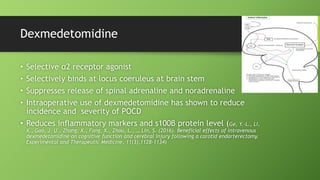
Dexmedetomidine
• Selective α2 receptor agonist
• Selectively binds at locus coeruleus at brain stem
• Suppresses release of spinal adrenaline and noradrenaline
• Intraoperative use of dexmedetomidine has shown to reduce
incidence and severity of POCD
• Reduces inflammatory markers and s100β protein level (Ge, Y.-L., Li,
X., Gao, J. U., Zhang, X., Fang, X., Zhou, L., … Lin, S. (2016). Beneficial effects of intravenous
dexmedetomidine on cognitive function and cerebral injury following a carotid endarterectomy.
Experimental and Therapeutic Medicine, 11(3),1128–1134)
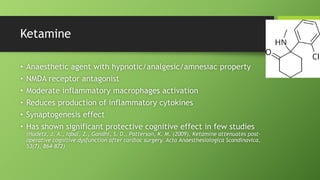
Ketamine
• Anaesthetic agent with hypnotic/analgesic/amnesiac property
• NMDA receptor antagonist
• Moderate inflammatory macrophages activation
• Reduces production of inflammatory cytokines
• Synaptogenesis effect
• Has shown significant protective cognitive effect in few studies
(Hudetz, J. A., Iqbal, Z., Gandhi, S. D., Patterson, K. M. (2009). Ketamine attenuates post-
operative cognitive dysfunction after cardiac surgery. Acta Anaesthesiologica Scandinavica,
53(7), 864–872)
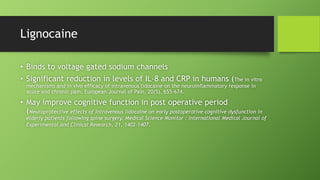
Lignocaine
• Binds to voltage gated sodium channels
• Significant reduction in levels of IL-8 and CRP in humans (The in vitro
mechanisms and in vivo efficacy of intravenous lidocaine on the neuroinflammatory response in
acute and chronic pain. European Journal of Pain, 20(5), 655–674.
• May improve cognitive function in post operative period
(Neuroprotective effects of intravenous lidocaine on early postoperative cognitive dysfunction in
elderly patients following spine surgery. Medical Science Monitor : International Medical Journal of
Experimental and Clinical Research, 21, 1402–1407.
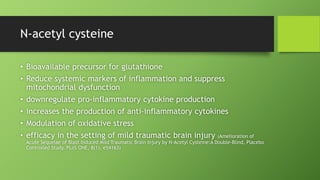
Minocycline
• Tetracycline group of antibiotic,
commonly used to treat acne
• Highly fat soluble, easily cross BBB
• Has anti-inflammatory and microglial
inhibitory properties
• Reduces excitotoxicity
• Minocycline may have potential for
prevention and treatment of POCD
N-acetyl cysteine
• Bioavailable precursor for glutathione
• Reduce systemic markers of inflammation and suppress
mitochondrial dysfunction
• downregulate pro-inflammatory cytokine production
• increases the production of anti-inflammatory cytokines
• Modulation of oxidative stress
• efficacy in the setting of mild traumatic brain injury (Amelioration of
Acute Sequelae of Blast Induced Mild Traumatic Brain Injury by N-Acetyl Cysteine:A Double-Blind, Placebo
Controlled Study. PLoS ONE, 8(1), e54163)
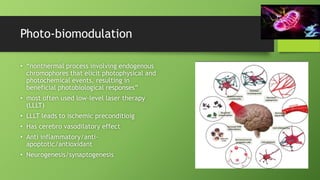
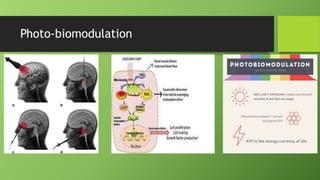
Photo-biomodulation
• “nonthermal process involving endogenous
chromophores that elicit photophysical and
photochemical events, resulting in
beneficial photobiological responses”
• most often used low-level laser therapy
(LLLT)
• LLLT leads to ischemic preconditioig
• Has cerebro vasodilatory effect
• Anti inflammatory/anti-
apoptotic/antioxidant
• Neurogenesis/synaptogenesis
Photo-biomodulation
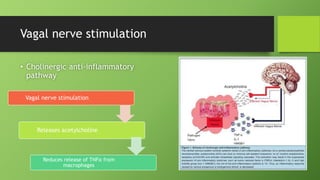
Vagal nerve stimulation
• Cholinergic anti-inflammatory
pathway
Vagal nerve stimulation
Releases acetylcholine
Reduces release of TNFα from
macrophages
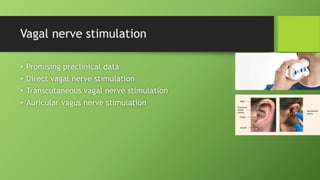
Vagal nerve stimulation
• Promising preclinical data
• Direct vagal nerve stimulation
• Transcutaneous vagal nerve stimulation
• Auricular vagus nerve stimulation
Why so much discussion and research
going on about POCD?
Consequences of POCD
• Life expectancy has increased
• By 2050 it is estimated that about 16% of the world’s population
will be aged > 65 years,
• Concomitant increase in the need for surgical intervention for a
variety of diseases for this group of patients
• Burden of cognitive impairment increased
• POCD - considerable impact on quality of life
• Withdrawal from society
• Economic burden
• Increased dependency
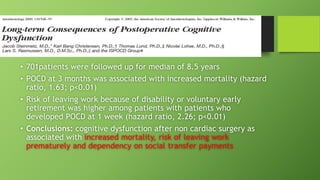
• 701patients were followed up for median of 8.5 years
• POCD at 3 months was associated with increased mortality (hazard
ratio, 1.63; p<0.01)
• Risk of leaving work because of disability or voluntary early
retirement was higher among patients with patients who
developed POCD at 1 week (hazard ratio, 2.26; p<0.01)
• Conclusions: cognitive dysfunction after non cardiac surgery as
associated with increased mortality, risk of leaving work
prematurely and dependency on social transfer payments
Summary
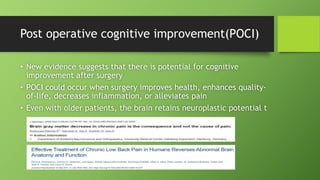
Post operative cognitive improvement(POCI)
• New evidence suggests that there is potential for cognitive
improvement after surgery
• POCI could occur when surgery improves health, enhances quality-
of-life, decreases inflammation, or alleviates pain
• Even with older patients, the brain retains neuroplastic potential t
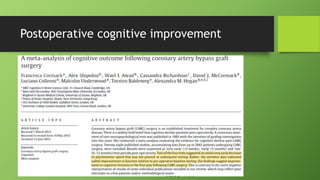
Postoperative cognitive improvement
post operative cognitive dysfunction

post operative cognitive dysfunction

  • 1.
    Confused mind: Postoperative cognitive dysfunction Dr. Priyanka Gupta Associate Professor, Deptt. Of Anaesthesia AIIMS Rishikesh
  • 2.
    Cognition • Invisible activitiescarried out by the brain Perceiving Analyzing Reasoning Judging Generating ideas Remembering Thinking Insight
  • 3.
    • MR. Asays that 6 month back his 70 year old father underwent hip replacement surgery. After the surgery he is not “The same” • “He forgets things and will ask the same thing several times” • He says, father was sharp as a tack before the operation. “He’s more like 80 % of him now” What went wrong with this patient?
  • 4.
    Post operative cognitivedysfunction • First described by Bedford in 1955 (The Lancet) as “ Adverse cerebral effects of Anaesthesia on old people” • No universally accepted definition • There is no International Statistical Classification of Disease code • POCD is a neurodegenerative condition, acquired after surgery and anaesthesia, and is similar to Alzheimer’s disease (AD) in symptoms and risk factors. • POCD- a form of cognitive dysfunction that begins between seven days to one year after surgery British Journal of Anaesthesia, 119 (S1): i115–i125 (2017)
  • 5.
    Postoperative cognitive dysfunction •Subtle condition, lack of clinical symptoms • Memory & concentration domains affected • Visuospatial perception, motor skills and executive function are affected • Consciousness unaffected • Last weeks to months • Usually reversible
  • 6.
    Incidence/ Prevalence • ~40% of Patients of >60 year, hospitalized for major non cardiac surgery have POCD at discharge • ~ 10% have POCD, three months later Anesthesiology. 2008 Jan;108(1):18-30 • ~30-50% of patients, underwent cardiac surgery had POCD with first 6 weeks • 10-50% of patients, had persisting dysfunction at 6 months Acta Anaesthesiol Scand. 2010 July ; 54(6): 663–677. • ~25-30% patient developed POCD following CEA (no difference in regional/GA) Anesth Analg. 2008 Aug; 107(2): 636–642.
  • 7.
    POCD following noncardiacsurgery • ISPOCD-1 (1998), 1218 elderly patients, 25% of patients developed POCD at 1 week, 10% at 3 months • No correlation with intraoperative hypotension or episodes of low spo2 • There is correlation of POCD with increasing age and longer duration of surgery • ISPOCD-2 (2001) • Postoperative cognitive dysfunction was detected in10—20% of patients at 1week and after 3months • No significant difference between general and regional anaesthesia using the intention to treat approach (p=0.06 at 1week)
  • 8.
    Risk factors forPOCD Patient Surgery Anaesthesia Advanced age Extensive surgical procedure Extensive surgical procedure Pre-existing cerebral/cardiac/vascular disease Intra/post op complications Marked disturbance in homeostasis Preoperative cognitive impairment Secondary surgery Hypoxia/ hypoperfusion Low education level Intra/post op anaesthesia related complications Alcohol abuse Nutritional deficiency Apo lipoprotein E genotype
  • 9.
  • 11.
    Classification • Acute POCD •Develops with in a week of surgery (associated with higher mortality) • Intermediate POCD • Develops within 3 months following surgery (most common) • Long term POCD/persistent POCD • Develops 1-2 year following surgery • 1% of patients have persistent POCD
  • 12.
    Pathophysiology of POCD •Peripheral initiation of inflammation • Disruption of Blood-Brain-Barrier • Microglial activation • Oxidative stress • Cholinergic anti inflammatory pathway
  • 13.
    Peripheral initiation ofinflammation Aseptic Surgical trauma, initiates inflammation at surgical site, which is amplified via peripheral pro-inflammatory cytokines
  • 14.
    Disruption of Blood-Brain-Barrier and microglial activation Peripheral pro-inflammatory cytokines disrupt the blood brain barrier via COX-2 upregulation. This allows entry of inflammatory cytokines into the CNS. This setting activates microglial cells, which have proinflammatory and phagocytic property.
  • 15.
    Role of oxidativestress Direct damage to neuronal tissue Disruption of BBB Depletion of anti oxidants (Hippocampal neurons most susceptible) Reactive oxygen species (ROS) Oxidative stress Surgical trauma
  • 16.
    Cholinergic anti-inflammatory pathway “Vagalreflex arc” Limit the degree of inflammation and protect organ systems from further damage
  • 17.
    Diagnosis of POCD •No real consensus of what tests define POCD in the literature • Battery of tests available to measure cognition • MMSE- sub optimal for POCD • Montreal cognitive assessment (MoCA)- sensitive to POCD • Cognistat • Postoperative quality recovery scale (PQRS) • Clock in the box (CIB)
  • 18.
    Tests to assesscognitive function Test Description Cognitive domain Ray Auditory verbal learning test Word learning test Verbal learning, recall and recognition Digit span test Ability to remember a sequence of numbers Working memory Digit symbol substitution test Copying symbols according to a predefined order in an answer key Working memory and information processing speed Stroop test Reading a list of colour names printed in incongruous colours Attention, concentration and executive function Grooved peg board test Placing 25 keyed pegs in an array of 5X5 holes with randomly positioned slots as quickly as possible Manual dexterity and psychomotor coordination Trail making test Joining number and letters in alternate order as quickly as possible Attention, sequencing, mental flexibility, visual search, motor function
  • 19.
    Digit span test(ability to remember a sequence of numbers) Stroop test
  • 20.
    Trail making testGrooved peg board test
  • 21.
  • 22.
    • Baseline performance •To assess an actual change in cognition following surgery • Performance of patient will be affected, if done after admission or on the day of surgery due to anxiety. • Ideally should be performed 1-2 week prior to surgery, when patient visits for preanesthetic assessment • Test should be validated for the language in which they will be administered • Assessment of cognition in postoperative period • Pain, drugs, immobility, PONV and fatigue may affect test performance • POCD is diagnosed ≥2 SD decline in at least two of the cognitive domains
  • 23.
  • 24.
    Prevention of POCD •Preoperative optimization/ Prehabilitation • Preoperative physical exercise • Inspiratory muscle training • Control of cardiovascular risk factor • Nutritional optimization • Vitamin B12/Folic acid/Homocysteine • Vitamin D • Correcting Anaemia • Correcting electrolyte imbalance (Mg+2) • Cognitive prehabilitation
  • 25.
    Intraoperative strategy toprevent POCD • Avoidance of prolonged fasting • Avoidance of sedative premedication • Balanced anaesthesia technique • Use of short acting opioid • Optimal depth of anaesthesia (BIS 40-60) • GA vs Regional- no difference • Maintenance of adequate cerebral oxygenation • Avoidance of benzodiazepines and anti-cholinergic drugs • Dexmedetomidine/ketamine- reducing POCD • Avoiding Hypoxia/hypotension/hypothermia
  • 26.
    • Drugs withpotential neurological effect (inappropriate to use in older patients)
  • 27.
    Postoperative strategy • Multicomponent non pharmacological intervention • Early mobilization & exercise • Cognitive stimulation • Support of circadian rhythms • Sleep protocol • Good hygiene • Vision & hearing aid (if required) • Avoidance of high risk drugs • Avoidance of polypharmacy
  • 28.
    • Postoperative painmanagement • Non opioid strategy (Gabapentin, paracetamol, NSAIDS) • Regional anaesthesia/ nerve blocks • Removal of Foley’s catheter as early as possible • Maintenance of electrolytes
  • 30.
    Novel therapies totreat/prevent POCD • COX-2 inhibitor (Parecoxib) • COX- 2 selective anti inflammatory drug • Reduces microglial activation • Thus reduces neuroinflammation (primary mechanism of POCD) • Few studies have shown reduction in incidence and severity of POCD with perioperative use of parecoxib (Zhu, Y.-Z., Yao, R., Zhang, Z., Xu, H., & Wang, L.-W. (2016). Parecoxib prevents early postoperative cognitive dysfunction in elderly patients undergoing total knee arthroplasty. Medicine, 95(28),
  • 31.
    Statins • HMG-CoA reductase(rate limiting enzyme) • Inhibiting conversion of HMGCR into Mevalonic acid • Downregulation of NADPH Production • Reducing oxidative stress • Shown beneficial effects in the patients undergoing carotid endarterectomy by minimizing POCD (Heyer, Eric J., Mergeche, J. L., Wang, S., Gaudet, J. G., & Connolly, E. S. (2015). Impact of Cognitive Dysfunction on Survival in Patients With and Without Statin UseFollowing Carotid Endarterectomy. Neurosurgery, 77(6), 880–887)
  • 32.
    Pregabalin • Anti-convulsant drug •Binds to α2δ subunit of voltage gated calcium channel • These channels are prominently expressed in hippocampus • By binding to these channel, pregabalin alters the release of neurotransmitter • Moderates microglial activation and downregulate cytokine production • Promising result in preclinical data • Conflicting role in improving cognition in humans • Might itself affect cognition
  • 33.
    Dexmedetomidine • Selective α2receptor agonist • Selectively binds at locus coeruleus at brain stem • Suppresses release of spinal adrenaline and noradrenaline • Intraoperative use of dexmedetomidine has shown to reduce incidence and severity of POCD • Reduces inflammatory markers and s100β protein level (Ge, Y.-L., Li, X., Gao, J. U., Zhang, X., Fang, X., Zhou, L., … Lin, S. (2016). Beneficial effects of intravenous dexmedetomidine on cognitive function and cerebral injury following a carotid endarterectomy. Experimental and Therapeutic Medicine, 11(3),1128–1134)
  • 34.
    Ketamine • Anaesthetic agentwith hypnotic/analgesic/amnesiac property • NMDA receptor antagonist • Moderate inflammatory macrophages activation • Reduces production of inflammatory cytokines • Synaptogenesis effect • Has shown significant protective cognitive effect in few studies (Hudetz, J. A., Iqbal, Z., Gandhi, S. D., Patterson, K. M. (2009). Ketamine attenuates post- operative cognitive dysfunction after cardiac surgery. Acta Anaesthesiologica Scandinavica, 53(7), 864–872)
  • 35.
    Lignocaine • Binds tovoltage gated sodium channels • Significant reduction in levels of IL-8 and CRP in humans (The in vitro mechanisms and in vivo efficacy of intravenous lidocaine on the neuroinflammatory response in acute and chronic pain. European Journal of Pain, 20(5), 655–674. • May improve cognitive function in post operative period (Neuroprotective effects of intravenous lidocaine on early postoperative cognitive dysfunction in elderly patients following spine surgery. Medical Science Monitor : International Medical Journal of Experimental and Clinical Research, 21, 1402–1407.
  • 36.
    Minocycline • Tetracycline groupof antibiotic, commonly used to treat acne • Highly fat soluble, easily cross BBB • Has anti-inflammatory and microglial inhibitory properties • Reduces excitotoxicity • Minocycline may have potential for prevention and treatment of POCD
  • 37.
    N-acetyl cysteine • Bioavailableprecursor for glutathione • Reduce systemic markers of inflammation and suppress mitochondrial dysfunction • downregulate pro-inflammatory cytokine production • increases the production of anti-inflammatory cytokines • Modulation of oxidative stress • efficacy in the setting of mild traumatic brain injury (Amelioration of Acute Sequelae of Blast Induced Mild Traumatic Brain Injury by N-Acetyl Cysteine:A Double-Blind, Placebo Controlled Study. PLoS ONE, 8(1), e54163)
  • 38.
    Photo-biomodulation • “nonthermal processinvolving endogenous chromophores that elicit photophysical and photochemical events, resulting in beneficial photobiological responses” • most often used low-level laser therapy (LLLT) • LLLT leads to ischemic preconditioig • Has cerebro vasodilatory effect • Anti inflammatory/anti- apoptotic/antioxidant • Neurogenesis/synaptogenesis
  • 39.
  • 40.
    Vagal nerve stimulation •Cholinergic anti-inflammatory pathway Vagal nerve stimulation Releases acetylcholine Reduces release of TNFα from macrophages
  • 41.
    Vagal nerve stimulation •Promising preclinical data • Direct vagal nerve stimulation • Transcutaneous vagal nerve stimulation • Auricular vagus nerve stimulation
  • 42.
    Why so muchdiscussion and research going on about POCD?
  • 43.
    Consequences of POCD •Life expectancy has increased • By 2050 it is estimated that about 16% of the world’s population will be aged > 65 years, • Concomitant increase in the need for surgical intervention for a variety of diseases for this group of patients • Burden of cognitive impairment increased • POCD - considerable impact on quality of life • Withdrawal from society • Economic burden • Increased dependency
  • 44.
    • 701patients werefollowed up for median of 8.5 years • POCD at 3 months was associated with increased mortality (hazard ratio, 1.63; p<0.01) • Risk of leaving work because of disability or voluntary early retirement was higher among patients with patients who developed POCD at 1 week (hazard ratio, 2.26; p<0.01) • Conclusions: cognitive dysfunction after non cardiac surgery as associated with increased mortality, risk of leaving work prematurely and dependency on social transfer payments
  • 45.
  • 46.
    Post operative cognitiveimprovement(POCI) • New evidence suggests that there is potential for cognitive improvement after surgery • POCI could occur when surgery improves health, enhances quality- of-life, decreases inflammation, or alleviates pain • Even with older patients, the brain retains neuroplastic potential t
  • 47.