LUNG ISOLATION
TECHNIQUES
-Dr.SANJAYA BHARATHI
INTRODUCTION
Used when it is desirable to ventilate only one lung.
OLV is performed either by endobronchial tube or by
blocking ventilation of c/l lung.
These techniques are increasingly used in
thoracic,pulmonary,cardiac,esophageal,vascular and
orthopedic spinal surgeries.
LUNG ISOLATION DEVICES
โ—The three types of lung isolation devices are:
1. 1.left or right double lumen endobronchial tube,
2. 2. bronchial blockers,
3. 3.Single lumen endotracheal tube placed in a
mainstem bronchus.
Whether a DLT or blocker is used to provide lung separation,
proper position should be confirmed by fiberoptic bronchoscopy
(FOB).
Double-lumen endobronchial tubes
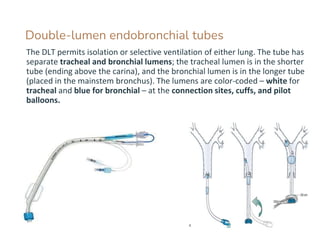
โ— The DLT permits isolation or selective ventilation of either lung. The tube has
separate tracheal and bronchial lumens; the tracheal lumen is in the shorter
tube (ending above the carina), and the bronchial lumen is in the longer tube
(placed in the mainstem bronchus). The lumens are color-coded โ€“ white for
tracheal and blue for bronchial โ€“ at the connection sites, cuffs, and pilot
balloons.
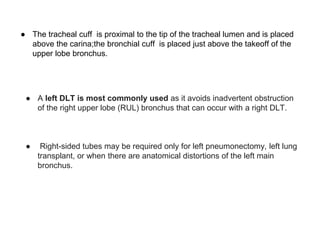
โ— The tracheal cuff is proximal to the tip of the tracheal lumen and is placed
above the carina;the bronchial cuff is placed just above the takeoff of the
upper lobe bronchus.
โ— A left DLT is most commonly used as it avoids inadvertent obstruction
of the right upper lobe (RUL) bronchus that can occur with a right DLT.
โ— Right-sided tubes may be required only for left pneumonectomy, left lung
transplant, or when there are anatomical distortions of the left main
bronchus.
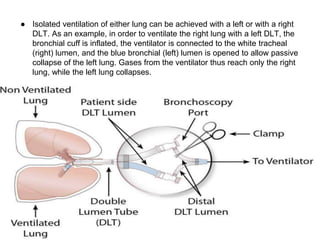
โ— Isolated ventilation of either lung can be achieved with a left or with a right
DLT. As an example, in order to ventilate the right lung with a left DLT, the
bronchial cuff is inflated, the ventilator is connected to the white tracheal
(right) lumen, and the blue bronchial (left) lumen is opened to allow passive
collapse of the left lung. Gases from the ventilator thus reach only the right
lung, while the left lung collapses.
Advantages of Double-Lumen Tubes
1. DLTs are preferable to endobronchial blockers because they provide
a superior protective seal to prevent contamination of the unaffected lung
from diseased lung.
2. DLTs are preferred for bilateral procedures such as bilateral lung
transplantation, bilateral sympathectomy, and bilateral lung wedge
resection. Once in place, they minimize the manipulation and resulting
hemodynamic response.
3. DLTs have less tendency to dislocate during surgical manipulation and
patient positioning.
4. It is easier to suction thick secretions or blood clots through the lumen
of the DLT.
Disadvantages of Double-Lumen Tubes
1. DLTs are bulky and may be more difficult to insert and position
compared with SLTs.
2. It may be challenging to switch from a DLT to an SLT if the patient
requires postoperative ventilatory support.
3.Previous studies have found a higher incidence of sore throat,
hoarseness, and pharyngeal or bronchial tree laceration associated
with DLT use.
Bronchial blockers
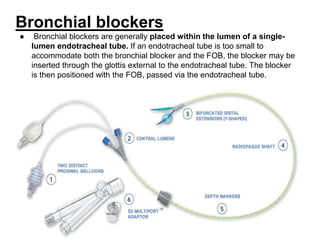
โ— Bronchial blockers are generally placed within the lumen of a single-
lumen endotracheal tube. If an endotracheal tube is too small to
accommodate both the bronchial blocker and the FOB, the blocker may be
inserted through the glottis external to the endotracheal tube. The blocker
is then positioned with the FOB, passed via the endotracheal tube.
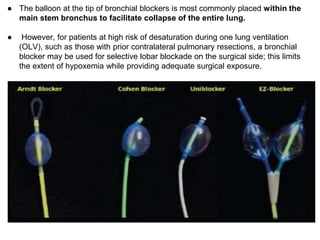
โ— The balloon at the tip of bronchial blockers is most commonly placed within the
main stem bronchus to facilitate collapse of the entire lung.
โ— However, for patients at high risk of desaturation during one lung ventilation
(OLV), such as those with prior contralateral pulmonary resections, a bronchial
blocker may be used for selective lobar blockade on the surgical side; this limits
the extent of hypoxemia while providing adequate surgical exposure.
โ— Bronchial blockers have a balloon at the tip and a hollow center channel
that can be used to apply continuous positive airway pressure (CPAP), or
suction to assist collapse of the lung.
โ— The Univent tube consists of a single-lumen endotracheal tube with the Fuji
Uniblocker embedded within its wall.
โ— The EZ-Blocker is designed with a Y shape and two distal extensions that ride
over the carina, and each lung can be selectively deflated .it may be used for
bilateral surgery without repositioning.
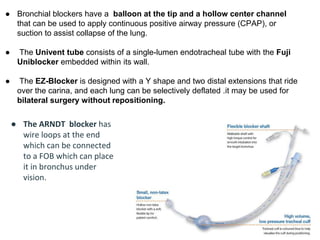
โ— The ARNDT blocker has
wire loops at the end
which can be connected
to a FOB which can place
it in bronchus under
vision.
Endobronchial Blockers -advantages
The most significant advantage is the decrease in
hemodynamic stress.
Because the blocker is inserted through an SLT, it is less
stimulating than the insertion and manipulation of a DLT.
The blocker technique was associated with a decreased incidence
of vocal cord injuries (44%DLT vs 17% in EB).
Some patients arrive from the intensive care unit to the operating
room with endotracheal tubes in place; insertion of a blocker
would be the best option to avoid changing the existing SLT.
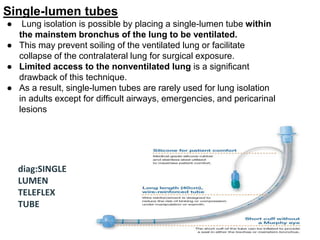
Single-lumen tubes
โ— Lung isolation is possible by placing a single-lumen tube within
the mainstem bronchus of the lung to be ventilated.
โ— This may prevent soiling of the ventilated lung or facilitate
collapse of the contralateral lung for surgical exposure.
โ— Limited access to the nonventilated lung is a significant
drawback of this technique.
โ— As a result, single-lumen tubes are rarely used for lung isolation
in adults except for difficult airways, emergencies, and pericarinal
lesions
diag:SINGLE
LUMEN
TELEFLEX
TUBE
Thank you

LUNG ISOLATION techniques and one lung ventilation

  • 1.
  • 2.
    INTRODUCTION Used when itis desirable to ventilate only one lung. OLV is performed either by endobronchial tube or by blocking ventilation of c/l lung. These techniques are increasingly used in thoracic,pulmonary,cardiac,esophageal,vascular and orthopedic spinal surgeries.
  • 3.
    LUNG ISOLATION DEVICES โ—Thethree types of lung isolation devices are: 1. 1.left or right double lumen endobronchial tube, 2. 2. bronchial blockers, 3. 3.Single lumen endotracheal tube placed in a mainstem bronchus. Whether a DLT or blocker is used to provide lung separation, proper position should be confirmed by fiberoptic bronchoscopy (FOB).
  • 4.
    Double-lumen endobronchial tubes โ—The DLT permits isolation or selective ventilation of either lung. The tube has separate tracheal and bronchial lumens; the tracheal lumen is in the shorter tube (ending above the carina), and the bronchial lumen is in the longer tube (placed in the mainstem bronchus). The lumens are color-coded โ€“ white for tracheal and blue for bronchial โ€“ at the connection sites, cuffs, and pilot balloons.
  • 5.
    โ— The trachealcuff is proximal to the tip of the tracheal lumen and is placed above the carina;the bronchial cuff is placed just above the takeoff of the upper lobe bronchus. โ— A left DLT is most commonly used as it avoids inadvertent obstruction of the right upper lobe (RUL) bronchus that can occur with a right DLT. โ— Right-sided tubes may be required only for left pneumonectomy, left lung transplant, or when there are anatomical distortions of the left main bronchus.
  • 6.
    โ— Isolated ventilationof either lung can be achieved with a left or with a right DLT. As an example, in order to ventilate the right lung with a left DLT, the bronchial cuff is inflated, the ventilator is connected to the white tracheal (right) lumen, and the blue bronchial (left) lumen is opened to allow passive collapse of the left lung. Gases from the ventilator thus reach only the right lung, while the left lung collapses.
  • 7.
    Advantages of Double-LumenTubes 1. DLTs are preferable to endobronchial blockers because they provide a superior protective seal to prevent contamination of the unaffected lung from diseased lung. 2. DLTs are preferred for bilateral procedures such as bilateral lung transplantation, bilateral sympathectomy, and bilateral lung wedge resection. Once in place, they minimize the manipulation and resulting hemodynamic response. 3. DLTs have less tendency to dislocate during surgical manipulation and patient positioning. 4. It is easier to suction thick secretions or blood clots through the lumen of the DLT.
  • 8.
    Disadvantages of Double-LumenTubes 1. DLTs are bulky and may be more difficult to insert and position compared with SLTs. 2. It may be challenging to switch from a DLT to an SLT if the patient requires postoperative ventilatory support. 3.Previous studies have found a higher incidence of sore throat, hoarseness, and pharyngeal or bronchial tree laceration associated with DLT use.
  • 9.
    Bronchial blockers โ— Bronchialblockers are generally placed within the lumen of a single- lumen endotracheal tube. If an endotracheal tube is too small to accommodate both the bronchial blocker and the FOB, the blocker may be inserted through the glottis external to the endotracheal tube. The blocker is then positioned with the FOB, passed via the endotracheal tube.
  • 10.
    โ— The balloonat the tip of bronchial blockers is most commonly placed within the main stem bronchus to facilitate collapse of the entire lung. โ— However, for patients at high risk of desaturation during one lung ventilation (OLV), such as those with prior contralateral pulmonary resections, a bronchial blocker may be used for selective lobar blockade on the surgical side; this limits the extent of hypoxemia while providing adequate surgical exposure.
  • 11.
    โ— Bronchial blockershave a balloon at the tip and a hollow center channel that can be used to apply continuous positive airway pressure (CPAP), or suction to assist collapse of the lung. โ— The Univent tube consists of a single-lumen endotracheal tube with the Fuji Uniblocker embedded within its wall. โ— The EZ-Blocker is designed with a Y shape and two distal extensions that ride over the carina, and each lung can be selectively deflated .it may be used for bilateral surgery without repositioning. โ— The ARNDT blocker has wire loops at the end which can be connected to a FOB which can place it in bronchus under vision.
  • 12.
    Endobronchial Blockers -advantages Themost significant advantage is the decrease in hemodynamic stress. Because the blocker is inserted through an SLT, it is less stimulating than the insertion and manipulation of a DLT. The blocker technique was associated with a decreased incidence of vocal cord injuries (44%DLT vs 17% in EB). Some patients arrive from the intensive care unit to the operating room with endotracheal tubes in place; insertion of a blocker would be the best option to avoid changing the existing SLT.
  • 13.
    Single-lumen tubes โ— Lungisolation is possible by placing a single-lumen tube within the mainstem bronchus of the lung to be ventilated. โ— This may prevent soiling of the ventilated lung or facilitate collapse of the contralateral lung for surgical exposure. โ— Limited access to the nonventilated lung is a significant drawback of this technique. โ— As a result, single-lumen tubes are rarely used for lung isolation in adults except for difficult airways, emergencies, and pericarinal lesions diag:SINGLE LUMEN TELEFLEX TUBE
  • 14.