1    Change of variables in double integrals
Review of the idea of substitution
  Consider the integral
                                           2
                                               x cos(x2 )dx.
                                       0
To evaluate this integral we use the u-substitution

                                               u = x2 .

This substitution send the interval [0, 2] onto the interval [0, 4]. Since

                                           du = 2xdx                                       (1)

    the integral becomes

                             1         4                   1
                                           cos udu =         sin 4.
                             2     0                       2
We want to perform similar subsitutions for multiple integrals.
  Jacobians
  Let
                     x = g(u, v) and y = h(u, v)                                           (2)
be a transformation of the plane. Then the Jacobian of this transformation
is defined by
                              ∂x   ∂x
                  ∂(x, y)                ∂x ∂y ∂x ∂y
                          = ∂u ∂y =
                              ∂y
                                   ∂v          −                       (3)
                  ∂(u, v)     ∂u   ∂v    ∂u ∂v    ∂v ∂u

    Theorem
    Let
                         x = g(u, v) and y = h(u, v)
be a transformation of the plane that is one to one from a region S in the
(u, v)-plane to a region R in the (x, y)-plane. If g and h have continuous
partial derivatives such that the Jacobian is never zero, then

                                                                           ∂(x, y)
                  f (x, y)dxdy =                   f [g(u, v), h(u, v)]|           |dudv   (4)
              R                                S                           ∂(u, v)

Here | . . . | means the absolute value.


                                                     1
Remark A useful fact is that
                                              ∂(x, y)        1
                                          |           | = ∂(u,v)                                  (5)
                                              ∂(u, v)    | ∂(x,y) |

      Example
      Use an appropriate change of variables to evaluate

                                                     (x − y)2 dxdy                                (6)
                                                 R

where R is the parallelogram with vertices (0, 0), (1, 1), (2, 0) and (1, −1).
(excercise: draw the domain R).

      Solution:
      We find that the equations of the four lines that make the parallelogram
are
                 x−y =0 x−y =2 x+y =0 x+y =2                                                      (7)
      The equations (7) suggest the change of variables

                                      u=x−y                       v =x+y                          (8)

      Solving (8) for x and y gives
                                                u+v                     v−u
                                      x=                          y=                              (9)
                                                 2                       2
      The Jacobian is
                                     ∂x        ∂x                   1   1
                ∂(x, y)              ∂u        ∂v                   2   2
                                                                                      1 1  1
                        =                             =                      =         + =       (10)
                ∂(u, v)              ∂y
                                     ∂u
                                               ∂y
                                               ∂v
                                                                   −1
                                                                    2
                                                                        1
                                                                        2             4 4  2

   The region S in the (u, v) is the square 0 < u < 2, 0 < v < 2. Since
x − y = u, the integral becomes
                       2       2     1                    2       u3 2            2   4      8
                                   u2 dudv =                  [     ] dv =              dv =
                   0       0         2                0           6 0         0       3      3
   Polar coordinates
   We know describe examples in which double integrals can be evaluated
by changing to polar coordinates. Recall that polar coordinates are defined
by
                         x = r cos θ y = r sin θ                       (11)

                                                          2
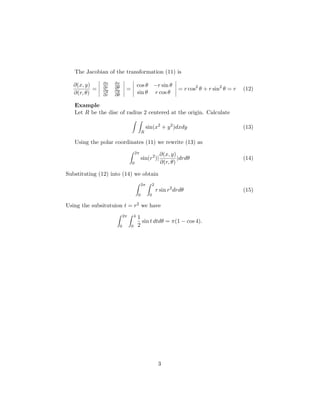
The Jacobian of the transformation (11) is
               ∂x   ∂x
   ∂(x, y)                                cos θ −r sin θ
           =   ∂r
               ∂y
                    ∂θ
                    ∂y        =                                       = r cos2 θ + r sin2 θ = r   (12)
   ∂(r, θ)     ∂r   ∂θ
                                          sin θ r cos θ

   Example
   Let R be the disc of radius 2 centered at the origin. Calculate

                                                   sin(x2 + y 2 )dxdy                             (13)
                                              R

   Using the polar coordinates (11) we rewrite (13) as
                                      2π                     ∂(x, y)
                                              sin(r2 )|              |drdθ                        (14)
                                  0                          ∂(r, θ)

Substituting (12) into (14) we obtain
                                              2π        2
                                                            r sin r2 drdθ                         (15)
                                          0         0

Using the subsitutuion t = r2 we have
                             2π       4   1
                                            sin t dtdθ = π(1 − cos 4).
                         0        0       2


                                                             3

Change of variables in double integrals

  • 1.
    1 Change of variables in double integrals Review of the idea of substitution Consider the integral 2 x cos(x2 )dx. 0 To evaluate this integral we use the u-substitution u = x2 . This substitution send the interval [0, 2] onto the interval [0, 4]. Since du = 2xdx (1) the integral becomes 1 4 1 cos udu = sin 4. 2 0 2 We want to perform similar subsitutions for multiple integrals. Jacobians Let x = g(u, v) and y = h(u, v) (2) be a transformation of the plane. Then the Jacobian of this transformation is defined by ∂x ∂x ∂(x, y) ∂x ∂y ∂x ∂y = ∂u ∂y = ∂y ∂v − (3) ∂(u, v) ∂u ∂v ∂u ∂v ∂v ∂u Theorem Let x = g(u, v) and y = h(u, v) be a transformation of the plane that is one to one from a region S in the (u, v)-plane to a region R in the (x, y)-plane. If g and h have continuous partial derivatives such that the Jacobian is never zero, then ∂(x, y) f (x, y)dxdy = f [g(u, v), h(u, v)]| |dudv (4) R S ∂(u, v) Here | . . . | means the absolute value. 1
  • 2.
    Remark A usefulfact is that ∂(x, y) 1 | | = ∂(u,v) (5) ∂(u, v) | ∂(x,y) | Example Use an appropriate change of variables to evaluate (x − y)2 dxdy (6) R where R is the parallelogram with vertices (0, 0), (1, 1), (2, 0) and (1, −1). (excercise: draw the domain R). Solution: We find that the equations of the four lines that make the parallelogram are x−y =0 x−y =2 x+y =0 x+y =2 (7) The equations (7) suggest the change of variables u=x−y v =x+y (8) Solving (8) for x and y gives u+v v−u x= y= (9) 2 2 The Jacobian is ∂x ∂x 1 1 ∂(x, y) ∂u ∂v 2 2 1 1 1 = = = + = (10) ∂(u, v) ∂y ∂u ∂y ∂v −1 2 1 2 4 4 2 The region S in the (u, v) is the square 0 < u < 2, 0 < v < 2. Since x − y = u, the integral becomes 2 2 1 2 u3 2 2 4 8 u2 dudv = [ ] dv = dv = 0 0 2 0 6 0 0 3 3 Polar coordinates We know describe examples in which double integrals can be evaluated by changing to polar coordinates. Recall that polar coordinates are defined by x = r cos θ y = r sin θ (11) 2
  • 3.
    The Jacobian ofthe transformation (11) is ∂x ∂x ∂(x, y) cos θ −r sin θ = ∂r ∂y ∂θ ∂y = = r cos2 θ + r sin2 θ = r (12) ∂(r, θ) ∂r ∂θ sin θ r cos θ Example Let R be the disc of radius 2 centered at the origin. Calculate sin(x2 + y 2 )dxdy (13) R Using the polar coordinates (11) we rewrite (13) as 2π ∂(x, y) sin(r2 )| |drdθ (14) 0 ∂(r, θ) Substituting (12) into (14) we obtain 2π 2 r sin r2 drdθ (15) 0 0 Using the subsitutuion t = r2 we have 2π 4 1 sin t dtdθ = π(1 − cos 4). 0 0 2 3