Restriction Analysis
Lecture Bioinformatics
UAAR
DNA and its bonds
• DNA molecules are macromolecules that hold
the genetic information of living organisms.
• The covalent bond joining adjacent nucleotides
in DNA is called a phosphodiester bond.
• The phosphodiester bonds between nucleotides
in DNA molecules are very stable unless they are
physically stretched or exposed to enzymes
called nucleases.
Endo- and Exonucleases
• Nucleases are enzymes capable of breaking (hydrolyzing)
phosphodiester bonds in DNA molecules.
• Classified into two major groups:
• Exonucleases: If the enzyme digest nucleotides from the
ends of the DNA molecules.
• Endonucleases: If the enzyme digest nucleotides in the
interior of a DNA molecule.
• Restriction enzyme: A protein that recognizes a particular
sequence of DNA and cuts the DNA at that site (the
restriction site)
Restriction enzymes
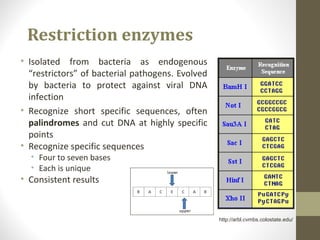
• Isolated from bacteria as endogenous
“restrictors” of bacterial pathogens. Evolved
by bacteria to protect against viral DNA
infection
• Recognize short specific sequences, often
palindromes and cut DNA at highly specific
points
• Recognize specific sequences
• Four to seven bases
• Each is unique
• Consistent results
http://arbl.cvmbs.colostate.edu/
Different enzymes…different
sites…different cuts
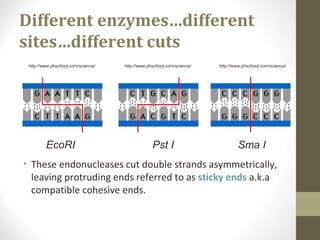
• These endonucleases cut double strands asymmetrically,
leaving protruding ends referred to as sticky ends a.k.a
compatible cohesive ends.
http://www.phschool.com/science/ http://www.phschool.com/science/ http://www.phschool.com/science/
EcoRI Sma IPst I
Digestion Procedure
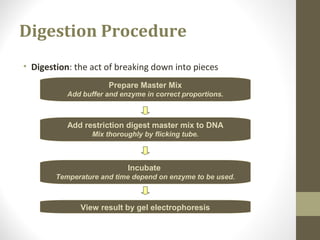
• Digestion: the act of breaking down into pieces
Add restriction digest master mix to DNA
Mix thoroughly by flicking tube.
Incubate
Temperature and time depend on enzyme to be used.
Prepare Master Mix
Add buffer and enzyme in correct proportions.
View result by gel electrophoresis
Restriction Digest Analysis
• Aim: the digested fragments must be separated and identified.
• Fragments are separated by agarose gel electrophoresis.
[Agarose is a large polysaccharide].
• Gel electrophoresis: your DNA will move through spaces in
agarose against a current
• DNA has a negative charge and will migrate towards the
cathode
Restriction Digest Analysis
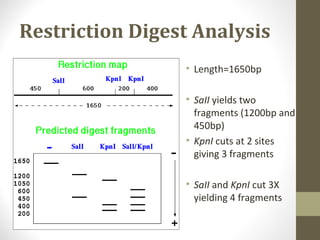
• Length=1650bp
• SaII yields two
fragments (1200bp and
450bp)
• KpnI cuts at 2 sites
giving 3 fragments
• SaII and KpnI cut 3X
yielding 4 fragments
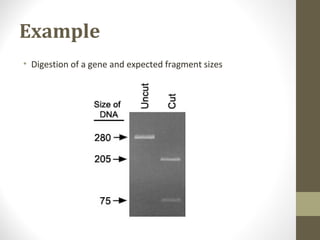
Example
• Digestion of a gene and expected fragment sizes
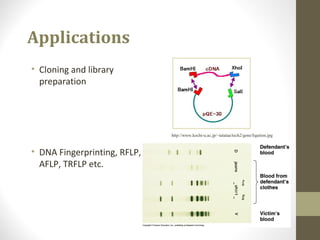
Applications
• Cloning and library
preparation
• DNA Fingerprinting, RFLP,
AFLP, TRFLP etc.
http://www.kochi-u.ac.jp/~tatataa/tech2/gene/ligation.jpg
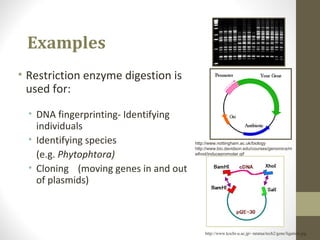
Examples
• Restriction enzyme digestion is
used for:
• DNA fingerprinting- Identifying
individuals
• Identifying species
(e.g. Phytophtora)
• Cloning (moving genes in and out
of plasmids)
http://www.nottingham.ac.uk/biology
http://www.bio.davidson.edu/courses/genomics/m
ethod/inducepromoter.gif
http://www.kochi-u.ac.jp/~tatataa/tech2/gene/ligation.jpg
Non-Examples
Restriction enzyme digestion is
NOT used for:
• Cutting RNA
• Sequencing DNA
Resources
http://www.phschool.com/science/biology_place/biocoach/red/intro.html
http://www.vivo.colostate.edu/hbooks/genetics/biotech/enzymes/cuteffects.html
http://web.indstate.edu/thcme/mwking/molecularmedicine.html#restriction
http://www.fermentas.com
http://www.chemsoc.org/timeline/graphic/1984_dnaf.jpg
END
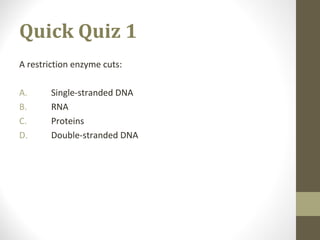
Quick Quiz 1
A restriction enzyme cuts:
A. Single-stranded DNA
B. RNA
C. Proteins
D. Double-stranded DNA
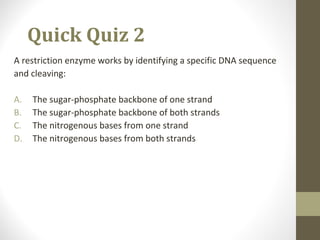
Quick Quiz 2
A restriction enzyme works by identifying a specific DNA sequence
and cleaving:
A. The sugar-phosphate backbone of one strand
B. The sugar-phosphate backbone of both strands
C. The nitrogenous bases from one strand
D. The nitrogenous bases from both strands
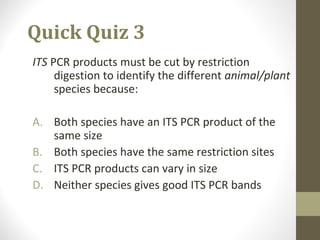
Quick Quiz 3
ITS PCR products must be cut by restriction
digestion to identify the different animal/plant
species because:
A. Both species have an ITS PCR product of the
same size
B. Both species have the same restriction sites
C. ITS PCR products can vary in size
D. Neither species gives good ITS PCR bands
Questions
• 1. What is a nuclease?
• DNA held by covalent bond joining adjacent nucleotides in DNA is called a phosphodiester
bond. The phosphodiester bond between nucleotide in DNA molecules are very stable
unless they are physically stretched or exposed to enzymes name nucleases.
• Enzyme capable of breaking (hydrolyzing) phosphodiester bonds in DNA molecules and
classified into exonuclease and endonuclease .
• 2. How does an endonuclease differ from an exonuclease?
• Endonuclease digest DNA by breaking phosphodiester bonds in the interior of DNA
molecule. Exonuclease enzyme digest nucleotides from the ends of the DNA molecule.
• 3. What is a restriction endonucleases? Write names of some restriction endouclease.
• Restriction endonucleases are a special class of Endonuclease from bacteria to cut DNA.
EcoRI & Hind III. These are enzymes that digest DNA by recognizing specific short
sequences of bases called palindromic.

Restriction digestion

  • 1.
  • 2.
    DNA and itsbonds • DNA molecules are macromolecules that hold the genetic information of living organisms. • The covalent bond joining adjacent nucleotides in DNA is called a phosphodiester bond. • The phosphodiester bonds between nucleotides in DNA molecules are very stable unless they are physically stretched or exposed to enzymes called nucleases.
  • 3.
    Endo- and Exonucleases •Nucleases are enzymes capable of breaking (hydrolyzing) phosphodiester bonds in DNA molecules. • Classified into two major groups: • Exonucleases: If the enzyme digest nucleotides from the ends of the DNA molecules. • Endonucleases: If the enzyme digest nucleotides in the interior of a DNA molecule. • Restriction enzyme: A protein that recognizes a particular sequence of DNA and cuts the DNA at that site (the restriction site)
  • 4.
    Restriction enzymes • Isolatedfrom bacteria as endogenous “restrictors” of bacterial pathogens. Evolved by bacteria to protect against viral DNA infection • Recognize short specific sequences, often palindromes and cut DNA at highly specific points • Recognize specific sequences • Four to seven bases • Each is unique • Consistent results http://arbl.cvmbs.colostate.edu/
  • 5.
    Different enzymes…different sites…different cuts •These endonucleases cut double strands asymmetrically, leaving protruding ends referred to as sticky ends a.k.a compatible cohesive ends. http://www.phschool.com/science/ http://www.phschool.com/science/ http://www.phschool.com/science/ EcoRI Sma IPst I
  • 6.
    Digestion Procedure • Digestion:the act of breaking down into pieces Add restriction digest master mix to DNA Mix thoroughly by flicking tube. Incubate Temperature and time depend on enzyme to be used. Prepare Master Mix Add buffer and enzyme in correct proportions. View result by gel electrophoresis
  • 7.
    Restriction Digest Analysis •Aim: the digested fragments must be separated and identified. • Fragments are separated by agarose gel electrophoresis. [Agarose is a large polysaccharide]. • Gel electrophoresis: your DNA will move through spaces in agarose against a current • DNA has a negative charge and will migrate towards the cathode
  • 8.
    Restriction Digest Analysis •Length=1650bp • SaII yields two fragments (1200bp and 450bp) • KpnI cuts at 2 sites giving 3 fragments • SaII and KpnI cut 3X yielding 4 fragments
  • 9.
    Example • Digestion ofa gene and expected fragment sizes
  • 10.
    Applications • Cloning andlibrary preparation • DNA Fingerprinting, RFLP, AFLP, TRFLP etc. http://www.kochi-u.ac.jp/~tatataa/tech2/gene/ligation.jpg
  • 11.
    Examples • Restriction enzymedigestion is used for: • DNA fingerprinting- Identifying individuals • Identifying species (e.g. Phytophtora) • Cloning (moving genes in and out of plasmids) http://www.nottingham.ac.uk/biology http://www.bio.davidson.edu/courses/genomics/m ethod/inducepromoter.gif http://www.kochi-u.ac.jp/~tatataa/tech2/gene/ligation.jpg
  • 12.
    Non-Examples Restriction enzyme digestionis NOT used for: • Cutting RNA • Sequencing DNA
  • 13.
  • 14.
  • 15.
    Quick Quiz 1 Arestriction enzyme cuts: A. Single-stranded DNA B. RNA C. Proteins D. Double-stranded DNA
  • 16.
    Quick Quiz 2 Arestriction enzyme works by identifying a specific DNA sequence and cleaving: A. The sugar-phosphate backbone of one strand B. The sugar-phosphate backbone of both strands C. The nitrogenous bases from one strand D. The nitrogenous bases from both strands
  • 17.
    Quick Quiz 3 ITSPCR products must be cut by restriction digestion to identify the different animal/plant species because: A. Both species have an ITS PCR product of the same size B. Both species have the same restriction sites C. ITS PCR products can vary in size D. Neither species gives good ITS PCR bands
  • 18.
    Questions • 1. Whatis a nuclease? • DNA held by covalent bond joining adjacent nucleotides in DNA is called a phosphodiester bond. The phosphodiester bond between nucleotide in DNA molecules are very stable unless they are physically stretched or exposed to enzymes name nucleases. • Enzyme capable of breaking (hydrolyzing) phosphodiester bonds in DNA molecules and classified into exonuclease and endonuclease . • 2. How does an endonuclease differ from an exonuclease? • Endonuclease digest DNA by breaking phosphodiester bonds in the interior of DNA molecule. Exonuclease enzyme digest nucleotides from the ends of the DNA molecule. • 3. What is a restriction endonucleases? Write names of some restriction endouclease. • Restriction endonucleases are a special class of Endonuclease from bacteria to cut DNA. EcoRI & Hind III. These are enzymes that digest DNA by recognizing specific short sequences of bases called palindromic.

Editor's Notes

  • #5 Palindrome: A region of double-stranded DNA in which the nucleotide sequence of one strand is identical with an inverted sequence in the complementary strand. a palindrome reads the same thing in both directions
  • #6 If somewhere else that palindrome is present and you incubate it with EcoR1, you’ll get another cut. So every time EcoR1 recognizes this palindrome on your plasmid, it will cut through the DNA. So when it opens up the DNA, may get a couple of unpaired bases, and those unpaired bases are called sticky ends, and if you throw some nucleotides from different species, you can make recombinant DNA.
  • #7 Optimal digestion is dependent in large part upon salt concentration of buffer, incubation time, incubation temperature, degree of methylation of DNA (inhibits enzyme activity). These factors also influence STAR activity. Soma restriction enzymes are said to exhibit STAR activity when they cut non-specifically at sites outside their recognition sequence(s).
  • #11 Transformation of pGLO – green fluorescent protein gene from jellyfish PCR amplify small amounts of DNA from crime scene, Digest DNA and compare pattern of bands – DNA fingerprint