DNA Replication
DNA – DOUBLE
HELICALSTRUCTURE
WATSON and CRICK- Model
DNA – DOUBLE HELICALSTRUCTURE
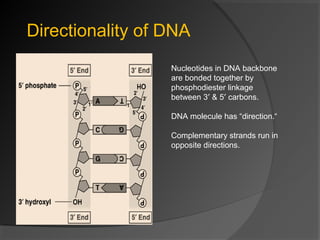
Directionality of DNA
Nucleotides in DNA backbone
are bonded together by
phosphodiester linkage
between 3′ & 5′ carbons.
DNA molecule has “direction.“
Complementary strands run in
opposite directions.
DNA Replication- Introduction
 Basis for inheritance
 Fundamental process occurring in all
cells for copying DNA to transfer the
genetic information to daughter cells
 Each cell must replicate its DNA before
division.
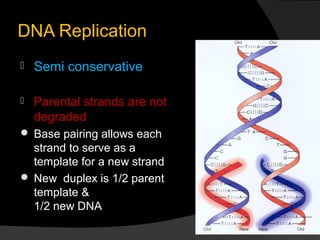
DNA Replication
 Semi conservative
 Parental strands are not
degraded
 Base pairing allows each
strand to serve as a
template for a new strand
 New duplex is 1/2 parent
template &
1/2 new DNA
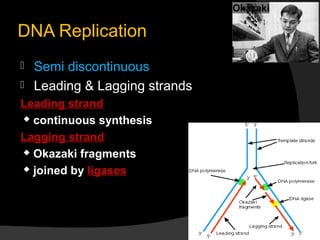
DNA Replication
 Semi discontinuous
 Leading & Lagging strands
Leading strand
 continuous synthesis
Lagging strand
 Okazaki fragments
 joined by ligases
Okazaki
DNA Replication
 Energy of Replication
 The nucleotides arrive as
 nucleoside triphosphates
DNA base, sugar with PPP
○ P-P-P = energy for bonding
DNA bases arrive with their own energy source
for bonding
bonded by enzyme: DNA polymerase III
DNA Replication
 Primer is needed
DNA polymerase can only add nucleotides
to 3′ end of a growing DNA strand
○ need a “starter” nucleotide to make a
bond
strand only grows 5′→3′.
Template is read in the 3′-5′ direction while
polymerization takes place in the 5′→3′
direction
Primer
RNA primer
 Synthesized by Primase
 serves as a starter sequence for DNA
polymerase III
 Only one RNA Primer-required for the
leading strand
 RNA Primers for the lagging strand depend
on the number of “OKAZAKI
FRAGMENTS”
 RNA Primer has a free 3’OH group to
which the first Nucleotide is bound.
DNA Replication-Steps
 Identification of the origins of replication
 Unwinding (denaturation) of dsDNA to provide an
ssDNA template
 Formation of the replication fork
 Initiation of DNA synthesis and elongation
 Primer removal and ligation of the newly
synthesized DNA segments
 Reconstitution of chromatin structure
Components of Replication
 DNA polymerases- Deoxynucleotide
polymerization
 Helicase -Processive unwinding of DNA
 Topoisomerases Relieve torsional strain that
results from helicase-induced unwinding
 RNA primase Initiates synthesis of RNA
primers
 Single-strand binding proteins Prevent
premature reannealing of dsDNA
 DNA ligase Seals the single strand nick
between the nascent chain and Okazaki
fragments on lagging strand
Origin of Replication-
Prokaryotes
 At the origin of replication (ori), there is an
association of sequence-specific dsDNA-
binding proteins with a series of direct
repeat DNA sequences.
 In E coli, the oriC is bound by the protein
dnaA.
 a complex is formed consisting of 150–250
bp of DNA and multimers of the DNA-
binding protein. This leads to the local
denaturation and unwinding of an adjacent
A+T-rich region of DNA.
Origin of Replication -Eukaryotes
 Functionally similar autonomously replicating
sequences (ARS) or replicators have been identified in
yeast cells.
 The ARS contains a somewhat degenerate 11-bp
sequence called the origin replication element (ORE).
 The ORE binds a set of proteins, analogous to the dnaA
protein of E coli, which is collectively called the origin
recognition complex (ORC).
 The ORE is located adjacent to an approximately 80-bp
A+T-rich sequence that is easy to unwind. This is called
the DNA unwinding element (DUE).
Unwinding of DNA
 The interaction of proteins with ori
defines the start site of replication and
provides a short region of ssDNA
essential for initiation of synthesis of the
nascent DNA strand.
 DNA Helicase allows for processive
unwinding of DNA.
 Single-stranded DNA-binding proteins
(SSBs) stabilize this complex.
 In cooperation with SSB, this leads to
DNA unwinding and active replication.
Unwinding of DNA
Formation of the Replication
Fork
 The polymerase III holoenzyme binds to
template DNA as part of a multiprotein
complex
 DNA polymerases only synthesize DNA in the
5' to 3' direction,
 Because the DNA strands are antiparallel , the
polymerase functions asymmetrically.
 On the leading (forward) strand, the DNA is
synthesized continuously.
 On the lagging (retrograde) strand, the DNA is
synthesized in short (1–5 kb)fragments, the
so-called Okazaki fragments.
Replication Fork
Formation of Replication
Bubbles
 Replication occurs in both directions
along the length of DNA and both
strands are replicated simultaneously.
 This replication process generates
"replication bubbles"
Replication Bubbles
The DNA Polymerase Complex
 A number of different DNA polymerase
molecules engage in DNA replication. These
share three important properties: (1) chain
elongation, (2) Processivity, and (3)
proofreading.
 Chain elongation accounts for the rate (in
nucleotides per second) at which
polymerization occurs.
 Processivity is an expression of the number of
nucleotides added to the nascent chain before
the polymerase disengages from the template.
 The proofreading function identifies copying
errors and corrects them
DNA Polymerase Complex
 In E coli, polymerase III (pol III)
functions at the replication fork. Of all
polymerases, it catalyzes the highest
rate of chain elongation and is the most
processive.
 Polymerase II (pol II) is mostly involved
in proofreading and DNA repair.
 Polymerase I (pol I) completes chain
synthesis between Okazaki fragments
on the lagging strand.
Differences between DNA
Polymerase I, II and III
Eukaryotic DNA polymerases
 Eukaryotic cells have counterparts for
each of these enzymes plus some
additional ones. A comparison is shown
in Table-
Initiation & Elongation of DNA
Synthesis
 Primer-The priming process involves the
nucleophilic attack by the 3'-hydroxyl
group of the RNA primer on the
phosphate of the first entering
deoxynucleoside triphosphate with the
splitting off of pyrophosphate.
 Mammalian DNA polymerase Alpha is
mainly responsible for the synthesis of
primer.
Initiation & Elongation of DNA
Synthesis
 Selection of the proper
deoxyribonucleotide whose terminal 3'-
hydroxyl group is to be attacked is
dependent upon proper base pairing
with the other strand of the DNA
molecule according to the rules
proposed originally by Watson and Crick
Initiation & Elongation of DNA
Synthesis
 When an adenine deoxyribonucleoside
monophosphoryl moiety is in the template
position, a thymidine triphosphate will enter
and its phosphate will be attacked by the 3'-
hydroxyl group of the deoxyribonucleoside
monophosphoryl most recently added to the
polymer.
 By this stepwise process, the template dictates
which deoxyribonucleoside triphosphate is
complementary and by hydrogen bonding
holds it in place while the 3'-hydroxyl group of
the growing strand attacks and incorporates
the new nucleotide into the polymer.
Base pairing in DNA Replication
DNA Topo isomerases
 Relief of super coils is dome by Topo
isomerases
 Two types:
 Topoisomerases I : acts by making a transient
single cut in the backbone of the DNA, enabling
the strands to swivel around each other to
remove the build-up of twists
 Topoisomerase II (DNA Gyrase) acts by
introducing double standed breaks enabling one
double-stranded DNA to pass through another,
thereby removing knots and entanglements that
can form within and between DNA molecules.
Formation of super coils
Mechanism of action of Topo
isomerases(Type-I and Type-II)
Primer removal and Nick
sealing
 Primers are removed by DNA
polymerase I by replacing
ribonucleotides with deoxy
Ribonucleotides
 Nicks are sealed by DNA ligase
 Multiple primers on the Lagging strand
while single primer on the leading
strand.
Proof reading and Editing
 1000 bases/second =
lots of typos!
 DNA polymerase I
 proofreads & corrects typos
 repairs mismatched bases
 removes abnormal bases
○ repairs damage
throughout life
 reduces error rate from
1 in 10,000 to
1 in 100 million bases
Termination of replication
 In prokaryotes:
DNA replication terminates when
replication forks reach specific
“termination sites”.
 the two replication forks meet each
other on the opposite end of the
parental circular DNA .
Termination of replication
 This process is completed in about 30
minutes, a replication rate of 3 x 10⁵
bp/min in prokaryotes
 The entire mammalian genome
replicates in approximately 9 hours, the
average period required for formation of
a tetraploid genome from a diploid
genome in a replicating cell.
Reconstitution of Chromatin
Structure
 chromatin structure must be re-formed
after replication. Newly replicated DNA
is rapidly assembled into nucleosomes,
and the preexisting and newly
assembled histone octamers are
randomly distributed to each arm of the
replication fork.
DNA Synthesis and the Cell
Cycle
 In animal cells, including human
cells, the replication of the DNA
genome occurs only during the
synthetic or S phase.
 This is usually temporally separated
from the mitotic phase by non
synthetic periods referred to as gap
1 (G1) and gap 2 (G2), occurring
before and after the S phase,
respectively
 The cell prepares for DNA synthesis
in G1 and for mitosis in G2.
Telomeres
 In eukaryotic replication, following
removal of RNA Primer from the
5’end of lagging strand; a gap is left.
 This gap exposes DNA strand to
attack of 5’ exonucleases.
 This problem is overcome by
Telomerase.
Telomeres
Repeating, non-coding sequences at
the end of chromosomes = protective
cap
 limit to ~50 cell divisions
Mechanism of action of
Telomerase
The enzyme synthesizes
(TTAGGG)n repeats on to the Telomere
sequences, using an internal RNA template.
Mechanism of action of
Telomerase(Contd.)
Telomerase acts like a reverse Transcriptase. It recognizes 3’ end of
telomere, based on the RNA component, a small DNA strand is
synthesized
Mechanism of action of
Telomerase(Contd.)
Telomerase
 different level of activity in
different cells
 High in stem cells &
cancers
 Activity lost in old
age
 Potential target for
newer anticancer
drugs
Inhibitors of DNA replication
 Bacterial DNA Gyrase(Type II
Topoisomerase)- Inhibited by
Novobiocin and Nalidixic acid.
 Ciprofloxacin interferes with DNA
breakage and rejoining process
 Mammalian topoisomerases – inhibited
by Etoposide and Adriamycin, used as
anticancer drugs.
 Nucleoside analogues also inhibit
replication and are used as anticancer
drugs.
Summary of Replication
 Unwinding- forms replication fork
 Primase- Synthesizes RNA primer
 Continuous synthesis -Leading strand
 Discontinuous synthesis – Lagging
strand (Okazaki fragments)
 Synthesis 5’-3’ direction
 Primers removed, nick sealed
 Proof reading by DNA polymerases
 Organized in to chromatin structure

DNA Replication

  • 1.
  • 2.
  • 3.
    DNA – DOUBLEHELICALSTRUCTURE
  • 4.
    Directionality of DNA Nucleotidesin DNA backbone are bonded together by phosphodiester linkage between 3′ & 5′ carbons. DNA molecule has “direction.“ Complementary strands run in opposite directions.
  • 5.
    DNA Replication- Introduction Basis for inheritance  Fundamental process occurring in all cells for copying DNA to transfer the genetic information to daughter cells  Each cell must replicate its DNA before division.
  • 6.
    DNA Replication  Semiconservative  Parental strands are not degraded  Base pairing allows each strand to serve as a template for a new strand  New duplex is 1/2 parent template & 1/2 new DNA
  • 7.
    DNA Replication  Semidiscontinuous  Leading & Lagging strands Leading strand  continuous synthesis Lagging strand  Okazaki fragments  joined by ligases Okazaki
  • 8.
    DNA Replication  Energyof Replication  The nucleotides arrive as  nucleoside triphosphates DNA base, sugar with PPP ○ P-P-P = energy for bonding DNA bases arrive with their own energy source for bonding bonded by enzyme: DNA polymerase III
  • 9.
    DNA Replication  Primeris needed DNA polymerase can only add nucleotides to 3′ end of a growing DNA strand ○ need a “starter” nucleotide to make a bond strand only grows 5′→3′. Template is read in the 3′-5′ direction while polymerization takes place in the 5′→3′ direction
  • 10.
    Primer RNA primer  Synthesizedby Primase  serves as a starter sequence for DNA polymerase III  Only one RNA Primer-required for the leading strand  RNA Primers for the lagging strand depend on the number of “OKAZAKI FRAGMENTS”  RNA Primer has a free 3’OH group to which the first Nucleotide is bound.
  • 11.
    DNA Replication-Steps  Identificationof the origins of replication  Unwinding (denaturation) of dsDNA to provide an ssDNA template  Formation of the replication fork  Initiation of DNA synthesis and elongation  Primer removal and ligation of the newly synthesized DNA segments  Reconstitution of chromatin structure
  • 12.
    Components of Replication DNA polymerases- Deoxynucleotide polymerization  Helicase -Processive unwinding of DNA  Topoisomerases Relieve torsional strain that results from helicase-induced unwinding  RNA primase Initiates synthesis of RNA primers  Single-strand binding proteins Prevent premature reannealing of dsDNA  DNA ligase Seals the single strand nick between the nascent chain and Okazaki fragments on lagging strand
  • 13.
    Origin of Replication- Prokaryotes At the origin of replication (ori), there is an association of sequence-specific dsDNA- binding proteins with a series of direct repeat DNA sequences.  In E coli, the oriC is bound by the protein dnaA.  a complex is formed consisting of 150–250 bp of DNA and multimers of the DNA- binding protein. This leads to the local denaturation and unwinding of an adjacent A+T-rich region of DNA.
  • 14.
    Origin of Replication-Eukaryotes  Functionally similar autonomously replicating sequences (ARS) or replicators have been identified in yeast cells.  The ARS contains a somewhat degenerate 11-bp sequence called the origin replication element (ORE).  The ORE binds a set of proteins, analogous to the dnaA protein of E coli, which is collectively called the origin recognition complex (ORC).  The ORE is located adjacent to an approximately 80-bp A+T-rich sequence that is easy to unwind. This is called the DNA unwinding element (DUE).
  • 15.
    Unwinding of DNA The interaction of proteins with ori defines the start site of replication and provides a short region of ssDNA essential for initiation of synthesis of the nascent DNA strand.  DNA Helicase allows for processive unwinding of DNA.  Single-stranded DNA-binding proteins (SSBs) stabilize this complex.  In cooperation with SSB, this leads to DNA unwinding and active replication.
  • 16.
  • 17.
    Formation of theReplication Fork  The polymerase III holoenzyme binds to template DNA as part of a multiprotein complex  DNA polymerases only synthesize DNA in the 5' to 3' direction,  Because the DNA strands are antiparallel , the polymerase functions asymmetrically.  On the leading (forward) strand, the DNA is synthesized continuously.  On the lagging (retrograde) strand, the DNA is synthesized in short (1–5 kb)fragments, the so-called Okazaki fragments.
  • 18.
  • 19.
    Formation of Replication Bubbles Replication occurs in both directions along the length of DNA and both strands are replicated simultaneously.  This replication process generates "replication bubbles"
  • 20.
  • 21.
    The DNA PolymeraseComplex  A number of different DNA polymerase molecules engage in DNA replication. These share three important properties: (1) chain elongation, (2) Processivity, and (3) proofreading.  Chain elongation accounts for the rate (in nucleotides per second) at which polymerization occurs.  Processivity is an expression of the number of nucleotides added to the nascent chain before the polymerase disengages from the template.  The proofreading function identifies copying errors and corrects them
  • 22.
    DNA Polymerase Complex In E coli, polymerase III (pol III) functions at the replication fork. Of all polymerases, it catalyzes the highest rate of chain elongation and is the most processive.  Polymerase II (pol II) is mostly involved in proofreading and DNA repair.  Polymerase I (pol I) completes chain synthesis between Okazaki fragments on the lagging strand.
  • 23.
  • 24.
    Eukaryotic DNA polymerases Eukaryotic cells have counterparts for each of these enzymes plus some additional ones. A comparison is shown in Table-
  • 25.
    Initiation & Elongationof DNA Synthesis  Primer-The priming process involves the nucleophilic attack by the 3'-hydroxyl group of the RNA primer on the phosphate of the first entering deoxynucleoside triphosphate with the splitting off of pyrophosphate.  Mammalian DNA polymerase Alpha is mainly responsible for the synthesis of primer.
  • 26.
    Initiation & Elongationof DNA Synthesis  Selection of the proper deoxyribonucleotide whose terminal 3'- hydroxyl group is to be attacked is dependent upon proper base pairing with the other strand of the DNA molecule according to the rules proposed originally by Watson and Crick
  • 27.
    Initiation & Elongationof DNA Synthesis  When an adenine deoxyribonucleoside monophosphoryl moiety is in the template position, a thymidine triphosphate will enter and its phosphate will be attacked by the 3'- hydroxyl group of the deoxyribonucleoside monophosphoryl most recently added to the polymer.  By this stepwise process, the template dictates which deoxyribonucleoside triphosphate is complementary and by hydrogen bonding holds it in place while the 3'-hydroxyl group of the growing strand attacks and incorporates the new nucleotide into the polymer.
  • 28.
    Base pairing inDNA Replication
  • 29.
    DNA Topo isomerases Relief of super coils is dome by Topo isomerases  Two types:  Topoisomerases I : acts by making a transient single cut in the backbone of the DNA, enabling the strands to swivel around each other to remove the build-up of twists  Topoisomerase II (DNA Gyrase) acts by introducing double standed breaks enabling one double-stranded DNA to pass through another, thereby removing knots and entanglements that can form within and between DNA molecules.
  • 30.
  • 31.
    Mechanism of actionof Topo isomerases(Type-I and Type-II)
  • 32.
    Primer removal andNick sealing  Primers are removed by DNA polymerase I by replacing ribonucleotides with deoxy Ribonucleotides  Nicks are sealed by DNA ligase  Multiple primers on the Lagging strand while single primer on the leading strand.
  • 33.
    Proof reading andEditing  1000 bases/second = lots of typos!  DNA polymerase I  proofreads & corrects typos  repairs mismatched bases  removes abnormal bases ○ repairs damage throughout life  reduces error rate from 1 in 10,000 to 1 in 100 million bases
  • 34.
    Termination of replication In prokaryotes: DNA replication terminates when replication forks reach specific “termination sites”.  the two replication forks meet each other on the opposite end of the parental circular DNA .
  • 35.
    Termination of replication This process is completed in about 30 minutes, a replication rate of 3 x 10⁵ bp/min in prokaryotes  The entire mammalian genome replicates in approximately 9 hours, the average period required for formation of a tetraploid genome from a diploid genome in a replicating cell.
  • 36.
    Reconstitution of Chromatin Structure chromatin structure must be re-formed after replication. Newly replicated DNA is rapidly assembled into nucleosomes, and the preexisting and newly assembled histone octamers are randomly distributed to each arm of the replication fork.
  • 37.
    DNA Synthesis andthe Cell Cycle  In animal cells, including human cells, the replication of the DNA genome occurs only during the synthetic or S phase.  This is usually temporally separated from the mitotic phase by non synthetic periods referred to as gap 1 (G1) and gap 2 (G2), occurring before and after the S phase, respectively  The cell prepares for DNA synthesis in G1 and for mitosis in G2.
  • 38.
    Telomeres  In eukaryoticreplication, following removal of RNA Primer from the 5’end of lagging strand; a gap is left.  This gap exposes DNA strand to attack of 5’ exonucleases.  This problem is overcome by Telomerase.
  • 39.
    Telomeres Repeating, non-coding sequencesat the end of chromosomes = protective cap  limit to ~50 cell divisions
  • 40.
    Mechanism of actionof Telomerase The enzyme synthesizes (TTAGGG)n repeats on to the Telomere sequences, using an internal RNA template.
  • 41.
    Mechanism of actionof Telomerase(Contd.) Telomerase acts like a reverse Transcriptase. It recognizes 3’ end of telomere, based on the RNA component, a small DNA strand is synthesized
  • 42.
    Mechanism of actionof Telomerase(Contd.) Telomerase  different level of activity in different cells  High in stem cells & cancers  Activity lost in old age  Potential target for newer anticancer drugs
  • 43.
    Inhibitors of DNAreplication  Bacterial DNA Gyrase(Type II Topoisomerase)- Inhibited by Novobiocin and Nalidixic acid.  Ciprofloxacin interferes with DNA breakage and rejoining process  Mammalian topoisomerases – inhibited by Etoposide and Adriamycin, used as anticancer drugs.  Nucleoside analogues also inhibit replication and are used as anticancer drugs.
  • 44.
    Summary of Replication Unwinding- forms replication fork  Primase- Synthesizes RNA primer  Continuous synthesis -Leading strand  Discontinuous synthesis – Lagging strand (Okazaki fragments)  Synthesis 5’-3’ direction  Primers removed, nick sealed  Proof reading by DNA polymerases  Organized in to chromatin structure