By:
Ana Rose D. Jaraba
Bsed-3B
Attitude
• defined as a mental predisposition to act that
is to expressed by evaluating a particular entity
w/ some degree of favor or disfavor.
Comprised of four components.
a. Cognitions
b. Affect
c. Behavioral Intentions
d. Evaluation
1. Cognitions
• beliefs, theories , expectancies , cause- and
–effect beliefs and perceptions relative to
the object.
2. Affect
• refers to our feeling with respect to the
focal object such as fear, liking, or anger.
3. Behavioural Intentions
• are our goals, aspirations, and our expected
responses to the attitude object
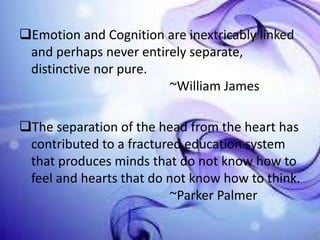
Emotion and Cognition are inextricably linked
and perhaps never entirely separate,
distinctive nor pure.
~William James
The separation of the head from the heart has
contributed to a fractured education system
that produces minds that do not know how to
feel and hearts that do not know how to think.
~Parker Palmer
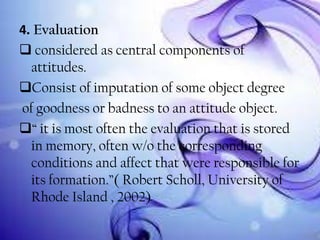
4. Evaluation
 considered as central components of
attitudes.
Consist of imputation of some object degree
of goodness or badness to an attitude object.
“ it is most often the evaluation that is stored
in memory, often w/o the corresponding
conditions and affect that were responsible for
its formation.”( Robert Scholl, University of
Rhode Island , 2002)
Why study of
attitudes?
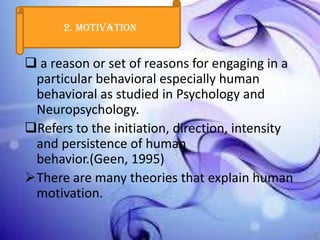
2. Motivation

 a reason or set of reasons for engaging in a
particular behavioral especially human
behavioral as studied in Psychology and
Neuropsychology.
Refers to the initiation, direction, intensity
and persistence of human
behavior.(Geen, 1995)
There are many theories that explain human
motivation.
The Need Theory
1. Abraham Maslow’s hierarchy
physiological
Safety and security
Social
Self esteem
Self actualization
2. Frederick Herzberg’s two factor theory
Concludes that certain factors in the workplace
result in the job satisfaction, while others do
not, but if absent lead to dissatisfaction. He
distinguished b/w:
Motivators
Hygiene factors(e.g. status, job security)
3. Clayton Alderfer
 ERG Theory( existence, relatedness and
growth).
Physiological and safety, the lower order
needs, are placed in the existence category
 love and self esteem needs in the relatedness
category
The growth category contained the self –
actualization needs.
MOTIVATION IN EDUCATION
Can have several effects on how students learn
and their behavior towards the subject matter
(Ormrod, 2003). it can:
1. direct behavior toward particular goals.
2. Lead to increased effort and energy.
3. Increase initiation of and persistence in
, activities.
4. Enhance cognitive processing.
5. Determine what consequences are reinforcing.
6. Lead to improved performance.
Two kinds of Motivation
1. Intrinsic Motivation
Occurs when people are internally
motivated to do something.
2. Extrinsic Motivation
Comes into play when a student is
compelled to do something or act in a
certain way.
3.
3. SELF -EFFICACY
 an impression that one is capable of
performing in a certain manner or attaining
certain goals.
A belief that one has the capabilities to execute
the courses of actions required to manage
prospective situations.
THANK YOU FOR
LISTENING!!!!

Affective learning competency

  • 1.
    By: Ana Rose D.Jaraba Bsed-3B
  • 2.
    Attitude • defined asa mental predisposition to act that is to expressed by evaluating a particular entity w/ some degree of favor or disfavor. Comprised of four components. a. Cognitions b. Affect c. Behavioral Intentions d. Evaluation
  • 3.
    1. Cognitions • beliefs,theories , expectancies , cause- and –effect beliefs and perceptions relative to the object. 2. Affect • refers to our feeling with respect to the focal object such as fear, liking, or anger. 3. Behavioural Intentions • are our goals, aspirations, and our expected responses to the attitude object
  • 4.
    Emotion and Cognitionare inextricably linked and perhaps never entirely separate, distinctive nor pure. ~William James The separation of the head from the heart has contributed to a fractured education system that produces minds that do not know how to feel and hearts that do not know how to think. ~Parker Palmer
  • 5.
    4. Evaluation  consideredas central components of attitudes. Consist of imputation of some object degree of goodness or badness to an attitude object. “ it is most often the evaluation that is stored in memory, often w/o the corresponding conditions and affect that were responsible for its formation.”( Robert Scholl, University of Rhode Island , 2002)
  • 6.
  • 7.
    2. Motivation  areason or set of reasons for engaging in a particular behavioral especially human behavioral as studied in Psychology and Neuropsychology. Refers to the initiation, direction, intensity and persistence of human behavior.(Geen, 1995) There are many theories that explain human motivation.
  • 8.
    The Need Theory 1.Abraham Maslow’s hierarchy physiological Safety and security Social Self esteem Self actualization
  • 9.
    2. Frederick Herzberg’stwo factor theory Concludes that certain factors in the workplace result in the job satisfaction, while others do not, but if absent lead to dissatisfaction. He distinguished b/w: Motivators Hygiene factors(e.g. status, job security)
  • 10.
    3. Clayton Alderfer ERG Theory( existence, relatedness and growth). Physiological and safety, the lower order needs, are placed in the existence category  love and self esteem needs in the relatedness category The growth category contained the self – actualization needs.
  • 11.
    MOTIVATION IN EDUCATION Canhave several effects on how students learn and their behavior towards the subject matter (Ormrod, 2003). it can: 1. direct behavior toward particular goals. 2. Lead to increased effort and energy. 3. Increase initiation of and persistence in , activities. 4. Enhance cognitive processing. 5. Determine what consequences are reinforcing. 6. Lead to improved performance.
  • 12.
    Two kinds ofMotivation 1. Intrinsic Motivation Occurs when people are internally motivated to do something. 2. Extrinsic Motivation Comes into play when a student is compelled to do something or act in a certain way.
  • 13.
    3. 3. SELF -EFFICACY an impression that one is capable of performing in a certain manner or attaining certain goals. A belief that one has the capabilities to execute the courses of actions required to manage prospective situations.
  • 14.