DNA Cloning methods
Presented By,
S.Divya,
2017600805
TAMIL NADU AGRICULTURAL
UNIVERSITY , COIMBATORE- 641003
DNA CLONING
 DNA cloning is a technique for reproducing DNA fragments.
 It can be achieved by two different approaches:
▪ cell based (in vivo)
▪ using polymerase chain reaction (PCR) (in vitro).
CLONING PROCESS
 Gene of interest is cut out with RE
 Host plasmid is cut with same RE
 Gene is inserted into plasmid and ligated
with ligase
 New plasmid inserted into bacterium
(transform)
PLASMID CLONING STRATEGY
 Involves five steps:
Enzyme restriction digest of DNA sample.
Enzyme restriction digest of DNA plasmid vector.
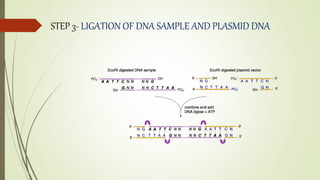
Ligation of DNA sample products and plasmid vector.
Transformation with the ligation products.
Growth on agar plates with selection for antibiotic resistance.
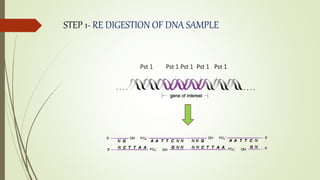
STEP 1- RE DIGESTION OF DNA SAMPLE
Pst 1 Pst 1 Pst 1 Pst 1 Pst 1
STEP 2- RE DIGESTION OF PLASMID DNA
STEP 3- LIGATION OF DNA SAMPLE AND PLASMID DNA
Clone a foreign DNA into the PstI site
of pBR322
 Cut the vector to generate the
sticky ends
 Cut foreign DNA with PstI also –
compatible ends
 Combine vector and foreign DNA
with DNA ligase to seal sticky ends
 Now transform the plasmid into E.
coli
4-8
Cloning using pBR322
STEP 4- TRANSFORMATION OF LIGATION PRODUCTS
 The process of transferring exogenous DNA into cells is call
“transformation”
 There are basically two general methods for transforming
bacteria. The first is a chemical method utilizing CaCl2 and heat
shock to promote DNA entry into cells.
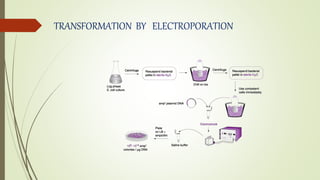
 A second method is called electroporation based on a short pulse
of electric charge to facilitate DNA uptake.
CHEMICAL TRANSFORMATION WITH CALCIUM
CHLORIDE
TRANSFORMATION BY ELECTROPORATION
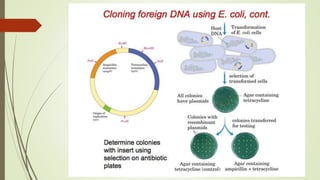
STEP 5. GROWTH ON AGAR PLATES
 If new DNA is inserted at that PstI restriction site, it
inactivates the gene for ampicillin resistance.
 Plasmid then has gene for tetracyclin resistance, but not
for ampicillin. This can be used to select for host cells
with new DNA.
STEP 5
TYPES OF CLONING VECTORS
PLASMID VECTORS
 Plasmid vectors are used to clone DNA ranging in size from several base
pairs to several thousands of base pairs (100bp -10kb).
 ColE1 based, pUC vehicles
commercially available ones,
 eg pBR322, pBlueScript
Disadvantages using plasmids
 Cannot accept large fragments
 Sizes range from 0- 10 kb
 Standard methods of transformation are inefficient
BACTERIOPHAGE LAMBDA
 Phage lambda is a bacteriophage or phage, i.e. bacterial virus, that uses E. coli
as host.
 Its structure is that of a typical phage: head, tail, tail fibres.
 Infection: lambda tail fibres adsorb to a cell surface receptor, the tail contracts,
and the DNA is injected.
 The DNA circularizes at the cos site, and lambda begins its life cycle in the E. coli
host.
BACTERIOPHAGE LAMBDA
COSMID VECTOR
 Purpose:
1. Clone large inserts of DNA: size ~
45 kb
 Features:
Cosmids are Plasmids with one or
two Lambda Cos sites.
 Presence of the Cos site permits in
vitro packaging of cosmid DNA into
Lambda particles
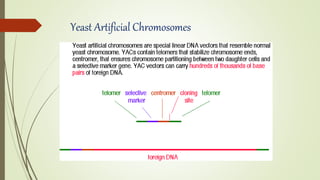
Yeast Artificial Chromosomes
 Purpose:
 Cloning vehicles that propagate in eukaryotic cell hosts as eukaryotic
Chromosomes
 Clone very large inserts of DNA: 100 kb - 10 Mb
 Features:
YAC cloning vehicles are plasmids
Final chimeric DNA is a linear DNA molecule with telomeric ends: Artificial
Chromosome
RETROVIRAL VECTORS
 Retroviral vectors are used to introduce new or altered genes into the genomes of
human and animal cells.
 Retroviruses are RNA viruses.
 The viral RNA is converted into DNA by the viral reverse transcriptase and then is
efficiently integrated into the host genome
 Any foreign or mutated host gene introduced into the retroviral genome will be
integrated into the host chromosome and can reside there practically indefinitely.
 Retroviral vectors are widely used to study oncogenes and other human genes.
SHUTTLE VECTORS
 Shuttle vectors can replicate in two different organisms, e.g.
bacteria and yeast, or mammalian cells and bacteria.
 They have the appropriate origins of replication.
 Hence one can clone a gene in bacteria, maybe modify it or
mutate it in bacteria, and test its function by introducing it into
yeast or animal cells.
PCR cloning strategies
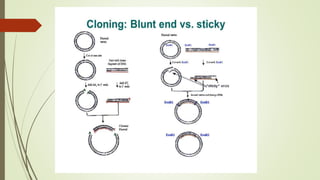
 Cloning methods for PCR products are divided into three types:
(i) blunt-end cloning
(ii) sticky-end cloning
(iii) T-A cloning
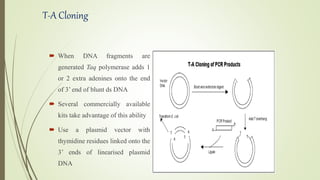
T-A Cloning
 When DNA fragments are
generated Taq polymerase adds 1
or 2 extra adenines onto the end
of 3’ end of blunt ds DNA
 Several commercially available
kits take advantage of this ability
 Use a plasmid vector with
thymidine residues linked onto the
3’ ends of linearised plasmid
DNA
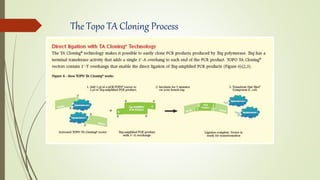
The Topo TA Cloning Process
Why Are We Topo Cloning?
PCR generates the exact gene fragment we want to clone.
PCR products and no other DNA are ligated into the Topo
vector by the topoisomerase.
Ligation is highly efficient (as high as 90%).
Selection of transformants is highly effiecient
A very large number of white colonies is generated
Reference
S.S.Purohit ,Biotechnology Fundamentals and Applications,Fourth
Edition AGROBIOS Publishers
DNA cloning

DNA cloning

  • 1.
    DNA Cloning methods PresentedBy, S.Divya, 2017600805 TAMIL NADU AGRICULTURAL UNIVERSITY , COIMBATORE- 641003
  • 2.
    DNA CLONING  DNAcloning is a technique for reproducing DNA fragments.  It can be achieved by two different approaches: ▪ cell based (in vivo) ▪ using polymerase chain reaction (PCR) (in vitro).
  • 3.
    CLONING PROCESS  Geneof interest is cut out with RE  Host plasmid is cut with same RE  Gene is inserted into plasmid and ligated with ligase  New plasmid inserted into bacterium (transform)
  • 4.
    PLASMID CLONING STRATEGY Involves five steps: Enzyme restriction digest of DNA sample. Enzyme restriction digest of DNA plasmid vector. Ligation of DNA sample products and plasmid vector. Transformation with the ligation products. Growth on agar plates with selection for antibiotic resistance.
  • 5.
    STEP 1- REDIGESTION OF DNA SAMPLE Pst 1 Pst 1 Pst 1 Pst 1 Pst 1
  • 6.
    STEP 2- REDIGESTION OF PLASMID DNA
  • 7.
    STEP 3- LIGATIONOF DNA SAMPLE AND PLASMID DNA
  • 8.
    Clone a foreignDNA into the PstI site of pBR322  Cut the vector to generate the sticky ends  Cut foreign DNA with PstI also – compatible ends  Combine vector and foreign DNA with DNA ligase to seal sticky ends  Now transform the plasmid into E. coli 4-8 Cloning using pBR322
  • 9.
    STEP 4- TRANSFORMATIONOF LIGATION PRODUCTS  The process of transferring exogenous DNA into cells is call “transformation”  There are basically two general methods for transforming bacteria. The first is a chemical method utilizing CaCl2 and heat shock to promote DNA entry into cells.  A second method is called electroporation based on a short pulse of electric charge to facilitate DNA uptake.
  • 10.
  • 11.
  • 12.
    STEP 5. GROWTHON AGAR PLATES
  • 14.
     If newDNA is inserted at that PstI restriction site, it inactivates the gene for ampicillin resistance.  Plasmid then has gene for tetracyclin resistance, but not for ampicillin. This can be used to select for host cells with new DNA. STEP 5
  • 15.
  • 16.
    PLASMID VECTORS  Plasmidvectors are used to clone DNA ranging in size from several base pairs to several thousands of base pairs (100bp -10kb).  ColE1 based, pUC vehicles commercially available ones,  eg pBR322, pBlueScript
  • 17.
    Disadvantages using plasmids Cannot accept large fragments  Sizes range from 0- 10 kb  Standard methods of transformation are inefficient
  • 18.
    BACTERIOPHAGE LAMBDA  Phagelambda is a bacteriophage or phage, i.e. bacterial virus, that uses E. coli as host.  Its structure is that of a typical phage: head, tail, tail fibres.  Infection: lambda tail fibres adsorb to a cell surface receptor, the tail contracts, and the DNA is injected.  The DNA circularizes at the cos site, and lambda begins its life cycle in the E. coli host.
  • 19.
  • 20.
    COSMID VECTOR  Purpose: 1.Clone large inserts of DNA: size ~ 45 kb  Features: Cosmids are Plasmids with one or two Lambda Cos sites.  Presence of the Cos site permits in vitro packaging of cosmid DNA into Lambda particles
  • 21.
  • 22.
    Yeast Artificial Chromosomes Purpose:  Cloning vehicles that propagate in eukaryotic cell hosts as eukaryotic Chromosomes  Clone very large inserts of DNA: 100 kb - 10 Mb  Features: YAC cloning vehicles are plasmids Final chimeric DNA is a linear DNA molecule with telomeric ends: Artificial Chromosome
  • 23.
    RETROVIRAL VECTORS  Retroviralvectors are used to introduce new or altered genes into the genomes of human and animal cells.  Retroviruses are RNA viruses.  The viral RNA is converted into DNA by the viral reverse transcriptase and then is efficiently integrated into the host genome  Any foreign or mutated host gene introduced into the retroviral genome will be integrated into the host chromosome and can reside there practically indefinitely.  Retroviral vectors are widely used to study oncogenes and other human genes.
  • 24.
    SHUTTLE VECTORS  Shuttlevectors can replicate in two different organisms, e.g. bacteria and yeast, or mammalian cells and bacteria.  They have the appropriate origins of replication.  Hence one can clone a gene in bacteria, maybe modify it or mutate it in bacteria, and test its function by introducing it into yeast or animal cells.
  • 25.
    PCR cloning strategies Cloning methods for PCR products are divided into three types: (i) blunt-end cloning (ii) sticky-end cloning (iii) T-A cloning
  • 26.
    T-A Cloning  WhenDNA fragments are generated Taq polymerase adds 1 or 2 extra adenines onto the end of 3’ end of blunt ds DNA  Several commercially available kits take advantage of this ability  Use a plasmid vector with thymidine residues linked onto the 3’ ends of linearised plasmid DNA
  • 27.
    The Topo TACloning Process
  • 28.
    Why Are WeTopo Cloning? PCR generates the exact gene fragment we want to clone. PCR products and no other DNA are ligated into the Topo vector by the topoisomerase. Ligation is highly efficient (as high as 90%). Selection of transformants is highly effiecient A very large number of white colonies is generated
  • 31.
    Reference S.S.Purohit ,Biotechnology Fundamentalsand Applications,Fourth Edition AGROBIOS Publishers