RNA Silencing/RNAi
RNA SILENCING


• The process of knock-down of any gene

• Functions as a antiviral mechanism

• May be post transcriptional as well as transcriptional gene
  silencing

• Two types of short RNA molecules are involved

    miRNA

    siRNA
Short history of post-transcriptional gene silencing

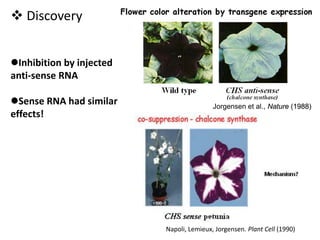
 1990 Jorgensen :

  Introduction of transgenes homologous to
  endogenous genes often resulted in plants with both
  genes suppressed!
    Called Co-suppression
    Resulted in degradation of the endogenous and the
     transgene mRNA
 Discovery


Inhibition by injected
anti-sense RNA

Sense RNA had similar                    Jorgensen et al., Nature (1988)
effects!


                          Napoli, Lemieux, Jorgensen. Plant Cell (1990)
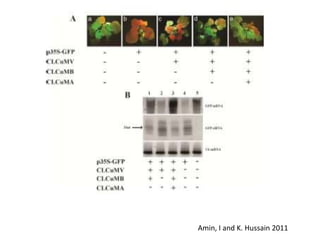
Amin, I and K. Hussain 2011
Contd….

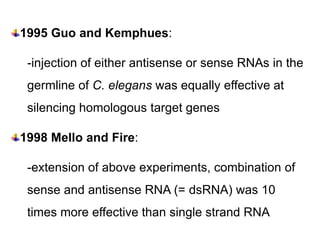
1995 Guo and Kemphues:

 -injection of either antisense or sense RNAs in the
 germline of C. elegans was equally effective at
 silencing homologous target genes

1998 Mello and Fire:

 -extension of above experiments, combination of
 sense and antisense RNA (= dsRNA) was 10
 times more effective than single strand RNA
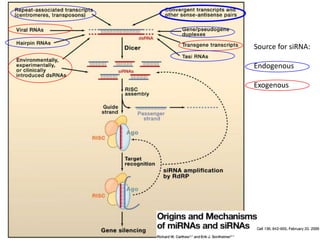
Source for siRNA:

Endogenous

Exogenous
double-stranded RNAs are produced by:
– transcription of inverted repeats
– viral replication
– transcription of RNA by RNA-dependent RNA-
  polymerases (RdRP)
  double-stranded RNA triggers cleavage of
  homologous mRNA
   PTGS-defective plants are more sensitive to infection
  by RNA viruses
  in RNAi defective nematodes, transposons are much
  more active
Dicer

 Double-stranded RNA triggers processed into siRNAs

 by enzyme RNAseIII family, specifically the Dicer family

  Dicer family proteins are ATP-dependent nucleases.

  These proteins dice long dsRNA into small RNA
duplexes of 21-26nt sizes.

 Loss of dicer: loss of silencing process
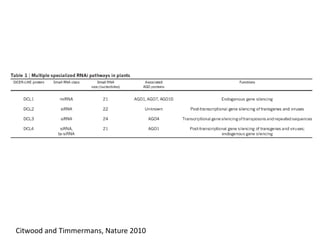
Citwood and Timmermans, Nature 2010
RISC
• RISC has helicase, exonuclease, endonucelase
  and homology searching proteins.
• Initial RISC is inactive until transformed into
  active form by unwinding of the siRNA duplex
  and loss of sense (passenger) strand
• Antisense (guide) strand defines specificity of
  RNAi
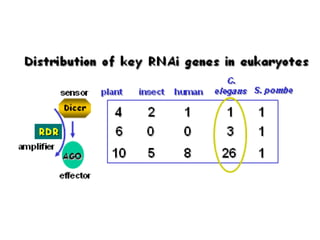
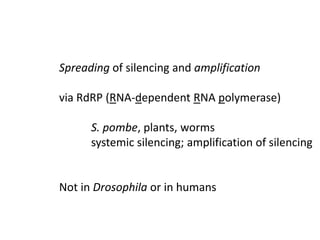
Spreading of silencing and amplification

via RdRP (RNA-dependent RNA polymerase)

      S. pombe, plants, worms
      systemic silencing; amplification of silencing


Not in Drosophila or in humans
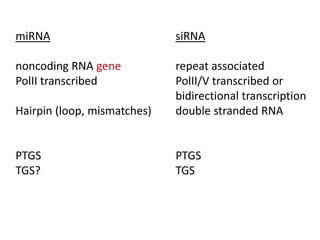
miRNA                        siRNA

noncoding RNA gene           repeat associated
PolII transcribed            PolII/V transcribed or
                             bidirectional transcription
Hairpin (loop, mismatches)   double stranded RNA


PTGS                         PTGS
TGS?                         TGS
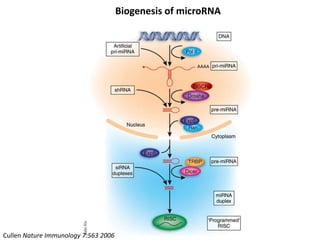
Biogenesis of microRNA


Cullen Nature Immunology 7:563 2006
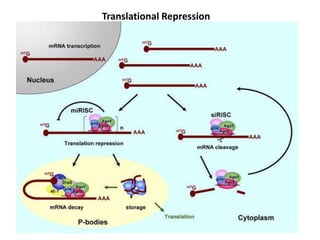
Translational Repression
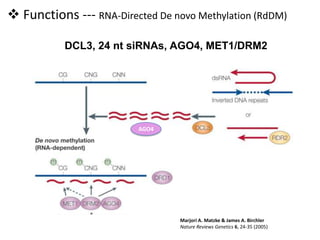
 Functions --- RNA-Directed De novo Methylation (RdDM)

           DCL3, 24 nt siRNAs, AGO4, MET1/DRM2


                         AGO4


                                 Marjori A. Matzke & James A. Birchler
                                 Nature Reviews Genetics 6, 24-35 (2005)
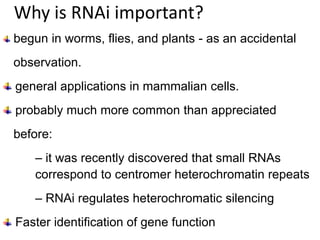
Why is RNAi important?
begun in worms, flies, and plants - as an accidental
observation.
general applications in mammalian cells.
probably much more common than appreciated
before:
   – it was recently discovered that small RNAs
   correspond to centromer heterochromatin repeats
   – RNAi regulates heterochromatic silencing
Faster identification of gene function
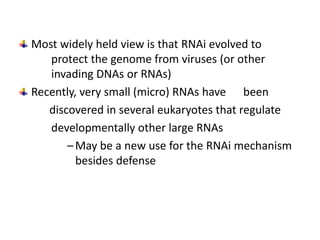
Most widely held view is that RNAi evolved to
   protect the genome from viruses (or other
   invading DNAs or RNAs)
Recently, very small (micro) RNAs have been
   discovered in several eukaryotes that regulate
   developmentally other large RNAs
       – May be a new use for the RNAi mechanism
         besides defense
Contd…..
  Powerful for analyzing unknown genes in
 sequence genomes.
      efforts are being undertaken to target every
       human gene via miRNAs
 Gene therapy: down-regulation of certain
  genes/mutated alleles
  Cancer treatments
     – knock-out of genes required for cell proliferation
     – knock-out of genes encoding key structural
      proteins

Rna silencing

  • 1.
  • 2.
    RNA SILENCING • Theprocess of knock-down of any gene • Functions as a antiviral mechanism • May be post transcriptional as well as transcriptional gene silencing • Two types of short RNA molecules are involved  miRNA  siRNA
  • 3.
    Short history ofpost-transcriptional gene silencing 1990 Jorgensen : Introduction of transgenes homologous to endogenous genes often resulted in plants with both genes suppressed! Called Co-suppression Resulted in degradation of the endogenous and the transgene mRNA
  • 4.
     Discovery Inhibition byinjected anti-sense RNA Sense RNA had similar Jorgensen et al., Nature (1988) effects! Napoli, Lemieux, Jorgensen. Plant Cell (1990)
  • 5.
    Amin, I andK. Hussain 2011
  • 6.
    Contd…. 1995 Guo andKemphues: -injection of either antisense or sense RNAs in the germline of C. elegans was equally effective at silencing homologous target genes 1998 Mello and Fire: -extension of above experiments, combination of sense and antisense RNA (= dsRNA) was 10 times more effective than single strand RNA
  • 7.
  • 8.
    double-stranded RNAs areproduced by: – transcription of inverted repeats – viral replication – transcription of RNA by RNA-dependent RNA- polymerases (RdRP) double-stranded RNA triggers cleavage of homologous mRNA PTGS-defective plants are more sensitive to infection by RNA viruses in RNAi defective nematodes, transposons are much more active
  • 9.
    Dicer Double-stranded RNAtriggers processed into siRNAs by enzyme RNAseIII family, specifically the Dicer family Dicer family proteins are ATP-dependent nucleases. These proteins dice long dsRNA into small RNA duplexes of 21-26nt sizes. Loss of dicer: loss of silencing process
  • 10.
  • 11.
    RISC • RISC hashelicase, exonuclease, endonucelase and homology searching proteins. • Initial RISC is inactive until transformed into active form by unwinding of the siRNA duplex and loss of sense (passenger) strand • Antisense (guide) strand defines specificity of RNAi
  • 13.
    Spreading of silencingand amplification via RdRP (RNA-dependent RNA polymerase) S. pombe, plants, worms systemic silencing; amplification of silencing Not in Drosophila or in humans
  • 14.
    miRNA siRNA noncoding RNA gene repeat associated PolII transcribed PolII/V transcribed or bidirectional transcription Hairpin (loop, mismatches) double stranded RNA PTGS PTGS TGS? TGS
  • 15.
    Biogenesis of microRNA CullenNature Immunology 7:563 2006
  • 16.
  • 17.
     Functions ---RNA-Directed De novo Methylation (RdDM) DCL3, 24 nt siRNAs, AGO4, MET1/DRM2 AGO4 Marjori A. Matzke & James A. Birchler Nature Reviews Genetics 6, 24-35 (2005)
  • 18.
    Why is RNAiimportant? begun in worms, flies, and plants - as an accidental observation. general applications in mammalian cells. probably much more common than appreciated before: – it was recently discovered that small RNAs correspond to centromer heterochromatin repeats – RNAi regulates heterochromatic silencing Faster identification of gene function
  • 19.
    Most widely heldview is that RNAi evolved to protect the genome from viruses (or other invading DNAs or RNAs) Recently, very small (micro) RNAs have been discovered in several eukaryotes that regulate developmentally other large RNAs – May be a new use for the RNAi mechanism besides defense
  • 20.
    Contd….. Powerfulfor analyzing unknown genes in sequence genomes.  efforts are being undertaken to target every human gene via miRNAs Gene therapy: down-regulation of certain genes/mutated alleles Cancer treatments – knock-out of genes required for cell proliferation – knock-out of genes encoding key structural proteins