PRESENATION ON DMA AND DMA 
CONROLLER 8237 
BY 
ASHWINI AWATARE
CONTENTS :-> 
What is DMA 
DMA defination 
Basic DMA operation 
DMA controller 
Data transfer with DMA controller 
DMA Controller options for data transfer 
8237 DMA Controller 
Register Organization of 8237 
Data Transfer modes
What is DMA :-direct memory 
access 
data are transfered by executing instructions such as 
move DATAIN,R0 
An instruction to transfer input or output data is 
executed only after the processer determines that 
the I/O device is ready . 
to transfer large blocks of data at high speed, an 
alternative approach is used . A special control unit 
may be provided to allow transfer of a block of data 
directly 
between an external device and the main memory 
,without continues intervention by the processer. 
this approach is called 'direct memory access'
DMA transfers are performed by a control 
circuit that is part of the I/O device interface. 
we refer to this circuit as a DMA controller. 
the DMA controller performs the function that 
would normally be carried out by the processer 
when accessing the main memory. 
Device wishing to perform DMA asserts the 
processors bus request signal 
Processor completes the current bus cycle and 
then asserts the bus grant signal to the device.
The device then asserts the bus grant ack. 
signal. 
The processor senses in the change in the state 
of bus grant ack. signal and starts listening to the 
data and address bus for DMA activity. 
The DMA device performs the transfer from the 
source to destination address. 
During these transfers, the processor monitors 
the addresses on the bus and checks if any 
location modified during DMA operations is 
cached in the processor. If the processor detects 
a cached address on the bus…..cnti..
it can take one of the two actions: 
Processor invalidates the internal cache entry for 
the address involved in DMA write operation 
Processor updates the internal cache when a DMA 
write is detected 
Once the DMA operations have been completed, 
the device releases the bus by asserting the bus 
release signal. 
Processor acknowledges the bus release and 
resumes its bus cycles from the point it left off.
DMA 
DMA Definitions: 
DMA occurs between an I/O device and memory 
without the use of the microprocessor 
 DMA read transfer data from the memory to I/O 
device 
 DMA write transfer data from the I/O to memory 
 MRDC & IOWC signals to simultaneously activate 
for read DMA
Basic DMA operation :- 
The direct memory access (DMA) I/O technique 
provides direct access to the memory while the 
microprocessor is temporarily disabled. 
 A DMA controller temporarily borrows the address 
bus, data bus, and control bus from the 
microprocessor and transfers the data bytes directly 
between an I/O port and a series of memory 
locations. 
 The DMA transfer is also used to do high-speed 
memory-to memory transfers. 
 Two control signals are used to request and 
acknowledge a DMA transfer in the microprocessor-based 
system.
The HOLD signal is a bus request signal which 
asks the microprocessor to release control of 
the buses after the current bus cycle. 
 The HLDA signal is a bus grant signal which 
indicates that the microprocessor has indeed 
released control of its buses by placing the buses 
at their high-impedance states. 
 The HOLD input has a higher priority than the 
INTR or NMI interrupt inputs.
Data transfer with a DMA 
Controller
Data transfer with DMA controller 
During a block input byte transfer, the following 
sequence occurs as the data byte is sent from the 
interface to the memory: 
The interface sends the DMA controller a 
request for DMA service. 
A Bus request is made to the HOLD pin (active 
High) on the 8086 microprocessor and the 
controller gains control of the bus. 
A Bus grant is returned to the DMA controller 
from the Hold Acknowledge (HLDA) pin (active 
High) on the 8086 microprocessor.
The DMA controller places contents of the 
address register onto the address bus. 
The controller sends the interface a DMA 
acknowledgment, which tells the interface to put 
data on the data bus. (For an output it signals 
the interface to latch the next data placed on the 
bus.) 
The data byte is transferred to the memory 
location indicated by the address bus. 
The interface latches the data.
The Bus request is dropped, the HOLD pin goes 
Low, and the controller relinquishes the bus. 
The Bus grant from the 8086 microprocessor is 
dropped and the HLDA pin goes Low. 
The address register is incremented by 1. 
The byte count is decremented by 1. 
If the byte count is non-zero, return to step 1, 
otherwise stop
DMA Controller options for data 
transfer 
The DMA Controller has several options 
available for the transfer of data. 
 They are:- 
1) Cycle steal 
2) Burst transfer 
3) Hidden DMA
1) CYCLE STEAL :-> 
• A read or write signal is generated by the DMAC, 
and the I/O device either generates or latches 
the data. The DMAC effectively steals cycles 
from the processor in order to transfer the byte, 
so single byte transfer is also known as cycle 
stealing
2). BURST TRANSFER :-> 
• To achieve block transfers, some DMAC's 
incorporate an automatic sequencing of the 
value presented on the address bus. A register is 
used as a byte count, being decremented for each 
byte transfer, and upon the byte count reaching 
zero, the DMAC will release the bus. When the 
DMAC operates in burst mode, the CPU is halted 
for the duration of the data transfer.
3) HIDDEN DMA:-> 
• It is possible to perform hidden DMA, which is 
transparent to the normal operation of the CPU. In 
other words, the bus is grabbed by the DMAC when 
the processor is not using it. 
• The DMAC monitors the execution of the processor, 
and when it recognises the processor executing an 
instruction which has sufficient empty clock cycles 
to perform a byte transfer, it waits till the processor 
is decoding the op code, then grabs the bus during 
this time. The processor is not slowed down, but 
continues processing normally. Naturally, the data 
transfer by the DMAC must be completed before the 
processor starts
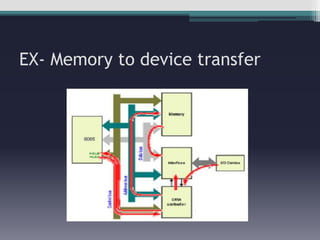
EX- Memory to device transfer
8237 DMA Controller 
The 8237 DMA controller supplies the memory 
and I/O with control signals and memory 
address information during the DMA transfer. 
 The 8237 is capable of DMA transfers at rates of 
up to 1.6M bytes per second. 
 Each channel is capable of addressing a full 
64K-byte section of memory and can transfer up 
to 64K bytes with a single programming.
Register Organization of 8237
1. Current Address Register 
Each of 4 DMA channels of 8237 has a 16-bit 
current address register that holds the current 
memory address , being accessed during DMA 
transfer . 
The address is automatically incremented or 
decremented after each transfer & resulting 
address value is again stored current address 
register . 
This can be byte – wise programmed by CPU i.e. 
lower byte 1st & higher byte later .
2.Current Word Register 
Each channel has a 16- bit current word register 
that holds the number of data byte transfers of 
be carried out. 
The word count is decremented after each 
transfer &new value is again stored back to the 
current word register . 
When count becomes zero an EOP signal will be 
generated . This can be written in successive 
bytes by the CPU ,in program mode
3.Base Address & Base Word Count 
Register 
Each channel has a pair of these register . These 
maintains an original copy of the resp. initial 
current address register & current word register 
(before increment or decrement) resp. 
These are automatically written along with 
current register . 
These cannot be read by the CPU . The contents 
of these register are used internally for auto – 
initialization.
4. Command Register 
This is 8 – bit controls the complete operation of 
8237. 
This can be programmed by the CPU and 
cleared by a reset operation .
5.Mode Register 
Each of channel has 8 bit mode register . This is 
written by the CPU program mode. 
Bits 0 or 1 of mode register determine which of 
the four channel mode register is to be written . 
The bits 2 & 3 indicate the type of DMA transfer. 
Bit 4 indicates whether auto- initialization is 
selected or not , while bit 5 indicates whether 
address increment or decrement mode is 
selected .
6.Request Register 
Each channel has a request register bit 
associated with it , in the request register . 
These are nonmaskable & subject to 
prioritization by the priority resolving network 
of 8237 . 
Each bit is set or reset under program control or 
is cleared upon generation of a TC or an external 
EOP. This register is cleared by reset.
7.Mask Register 
Each of 4 channel has a mask bit which can be 
set under program control to disable the 
incoming DREQ request at the specific channel . 
This bit is set when corresponding channel 
produces an EOP signal , if channel is not 
programmed for auto – initialization . 
The register is set to FFH after a reset operation. 
This disables all the DMA request till the mask 
register is cleared
8.Temporary Register 
The temporary register holds data during 
memory to memory data transfers . 
After the completion of the transfer operation , 
the last word transferred remains in the 
temporary register till it is cleared by the reset 
operation .
9.Status Register 
Status register keeps the track of the all DMA 
channel pending request & status of their 
terminal count . 
The bit Do-D3 are updates every time , the 
corresponding channel reaches TC or external 
EOP occurs . These are cleared upon reset and 
also on each status read operation .
Important signal pins 
DREQ3 – DREQ0 (DMA request): 
Used to request a DMA transfer for a 
particular DMA channel. 
DACK3 – DACK0 (DMA channel 
acknowledge): Acknowledges a 
channel DMA request from a device. 
 HRQ (Hold request): Requests a 
DMA transfer.
HLDA (Hold acknowledge) signals the 8237 that 
the microprocessor has relinquished control of 
the address, data and control buses. 
MEMW (Memory write): Used as an output to 
cause memory to write data during a DMA write 
cycle. 
 MEMR (Memory read): Used as an output to 
cause memory to read data during a DMA read 
cycle
 A3 – A0 : address pins select an internal 
register during programming and provide part 
of the DMA transfer address during DMA 
operation. 
A7 – A4 : address pins are outputs that provide 
part of the DMA transfer address during a DMA 
operation. 
 DB0 – DB7 : data bus, connected to 
microprocessor and are used during the 
programming DMA controller.
Data Transfer modes 
1) Single Transfer Mode 
 In Single Transfer mode the device is programmed 
to make one transfer only. 
 The word count will be decremented and the 
address decremented or incremented following each 
transfer. 
 When the word count ``rolls over'' from zero to 
FFFFH, a Terminal Count (TC) will cause an Auto 
initialize if the channel has been programmed to do 
so.
2) Block Transfer Mode 
 In Block Transfer mode the device is activated 
by DREQ to continue making transfers during 
the service until a TC, caused by word count 
going to FFFFH, or an external End of Process 
(EOP) is encountered. 
 DREQ need only be held active until DACK 
becomes active. Again, an Auto initialization will 
occur at the end of the service if the channel has 
been programmed for it.
3)Demand transfer mode 
Device continues transfer until a TC is reached 
or an external EOP is detected or the DREQ 
signal goes inactive . 
After the I/O device is able to catch up , the 
service mat be re-established activating DREQ 
signal again. 
Only EOP generated by TC or external EOP can 
cause the auto- initialization and only if it is 
programmed for .
4)Cascade mode 
In this mode ,more than one 8237 can be 
connected together to provide more than four 
DMA channels . 
The HRQ & HLDA signals from additional 
8237s are connected with DREQ & DACK pins 
of channel of the host rsp. 
The priority of the DMA requests may be 
preserved at each level.
5)Memory to memory transfer 
• To perform the transfer of the block of data from 
one set of memory address to another one ,this 
mode is used. 
• The transfer is initialize by setting DREQo using 
software command . 
• The 8237 sends HRQ signal to CPU as usual & 
when HLDA signal is activated by CPU ,device 
starts operating in block transfer mode to read 
the data from file.
• The channel 0 current register acts as a source 
pointer. 
• The byte read data from memory is stored in an 
internal temporary register of 8237. 
• The channel 1 current register acts as a 
destination pointer to write the data from 
temporary register to the destination memory. 
• The pointers are automatically incremented or 
decremented , depending upon the 
programming .
THANK 
YOU

Dma and dma controller 8237

  • 1.
    PRESENATION ON DMAAND DMA CONROLLER 8237 BY ASHWINI AWATARE
  • 2.
    CONTENTS :-> Whatis DMA DMA defination Basic DMA operation DMA controller Data transfer with DMA controller DMA Controller options for data transfer 8237 DMA Controller Register Organization of 8237 Data Transfer modes
  • 3.
    What is DMA:-direct memory access data are transfered by executing instructions such as move DATAIN,R0 An instruction to transfer input or output data is executed only after the processer determines that the I/O device is ready . to transfer large blocks of data at high speed, an alternative approach is used . A special control unit may be provided to allow transfer of a block of data directly between an external device and the main memory ,without continues intervention by the processer. this approach is called 'direct memory access'
  • 4.
    DMA transfers areperformed by a control circuit that is part of the I/O device interface. we refer to this circuit as a DMA controller. the DMA controller performs the function that would normally be carried out by the processer when accessing the main memory. Device wishing to perform DMA asserts the processors bus request signal Processor completes the current bus cycle and then asserts the bus grant signal to the device.
  • 5.
    The device thenasserts the bus grant ack. signal. The processor senses in the change in the state of bus grant ack. signal and starts listening to the data and address bus for DMA activity. The DMA device performs the transfer from the source to destination address. During these transfers, the processor monitors the addresses on the bus and checks if any location modified during DMA operations is cached in the processor. If the processor detects a cached address on the bus…..cnti..
  • 6.
    it can takeone of the two actions: Processor invalidates the internal cache entry for the address involved in DMA write operation Processor updates the internal cache when a DMA write is detected Once the DMA operations have been completed, the device releases the bus by asserting the bus release signal. Processor acknowledges the bus release and resumes its bus cycles from the point it left off.
  • 7.
    DMA DMA Definitions: DMA occurs between an I/O device and memory without the use of the microprocessor  DMA read transfer data from the memory to I/O device  DMA write transfer data from the I/O to memory  MRDC & IOWC signals to simultaneously activate for read DMA
  • 8.
    Basic DMA operation:- The direct memory access (DMA) I/O technique provides direct access to the memory while the microprocessor is temporarily disabled.  A DMA controller temporarily borrows the address bus, data bus, and control bus from the microprocessor and transfers the data bytes directly between an I/O port and a series of memory locations.  The DMA transfer is also used to do high-speed memory-to memory transfers.  Two control signals are used to request and acknowledge a DMA transfer in the microprocessor-based system.
  • 9.
    The HOLD signalis a bus request signal which asks the microprocessor to release control of the buses after the current bus cycle.  The HLDA signal is a bus grant signal which indicates that the microprocessor has indeed released control of its buses by placing the buses at their high-impedance states.  The HOLD input has a higher priority than the INTR or NMI interrupt inputs.
  • 10.
    Data transfer witha DMA Controller
  • 11.
    Data transfer withDMA controller During a block input byte transfer, the following sequence occurs as the data byte is sent from the interface to the memory: The interface sends the DMA controller a request for DMA service. A Bus request is made to the HOLD pin (active High) on the 8086 microprocessor and the controller gains control of the bus. A Bus grant is returned to the DMA controller from the Hold Acknowledge (HLDA) pin (active High) on the 8086 microprocessor.
  • 12.
    The DMA controllerplaces contents of the address register onto the address bus. The controller sends the interface a DMA acknowledgment, which tells the interface to put data on the data bus. (For an output it signals the interface to latch the next data placed on the bus.) The data byte is transferred to the memory location indicated by the address bus. The interface latches the data.
  • 13.
    The Bus requestis dropped, the HOLD pin goes Low, and the controller relinquishes the bus. The Bus grant from the 8086 microprocessor is dropped and the HLDA pin goes Low. The address register is incremented by 1. The byte count is decremented by 1. If the byte count is non-zero, return to step 1, otherwise stop
  • 14.
    DMA Controller optionsfor data transfer The DMA Controller has several options available for the transfer of data.  They are:- 1) Cycle steal 2) Burst transfer 3) Hidden DMA
  • 15.
    1) CYCLE STEAL:-> • A read or write signal is generated by the DMAC, and the I/O device either generates or latches the data. The DMAC effectively steals cycles from the processor in order to transfer the byte, so single byte transfer is also known as cycle stealing
  • 16.
    2). BURST TRANSFER:-> • To achieve block transfers, some DMAC's incorporate an automatic sequencing of the value presented on the address bus. A register is used as a byte count, being decremented for each byte transfer, and upon the byte count reaching zero, the DMAC will release the bus. When the DMAC operates in burst mode, the CPU is halted for the duration of the data transfer.
  • 17.
    3) HIDDEN DMA:-> • It is possible to perform hidden DMA, which is transparent to the normal operation of the CPU. In other words, the bus is grabbed by the DMAC when the processor is not using it. • The DMAC monitors the execution of the processor, and when it recognises the processor executing an instruction which has sufficient empty clock cycles to perform a byte transfer, it waits till the processor is decoding the op code, then grabs the bus during this time. The processor is not slowed down, but continues processing normally. Naturally, the data transfer by the DMAC must be completed before the processor starts
  • 18.
    EX- Memory todevice transfer
  • 19.
    8237 DMA Controller The 8237 DMA controller supplies the memory and I/O with control signals and memory address information during the DMA transfer.  The 8237 is capable of DMA transfers at rates of up to 1.6M bytes per second.  Each channel is capable of addressing a full 64K-byte section of memory and can transfer up to 64K bytes with a single programming.
  • 20.
  • 21.
    1. Current AddressRegister Each of 4 DMA channels of 8237 has a 16-bit current address register that holds the current memory address , being accessed during DMA transfer . The address is automatically incremented or decremented after each transfer & resulting address value is again stored current address register . This can be byte – wise programmed by CPU i.e. lower byte 1st & higher byte later .
  • 22.
    2.Current Word Register Each channel has a 16- bit current word register that holds the number of data byte transfers of be carried out. The word count is decremented after each transfer &new value is again stored back to the current word register . When count becomes zero an EOP signal will be generated . This can be written in successive bytes by the CPU ,in program mode
  • 23.
    3.Base Address &Base Word Count Register Each channel has a pair of these register . These maintains an original copy of the resp. initial current address register & current word register (before increment or decrement) resp. These are automatically written along with current register . These cannot be read by the CPU . The contents of these register are used internally for auto – initialization.
  • 24.
    4. Command Register This is 8 – bit controls the complete operation of 8237. This can be programmed by the CPU and cleared by a reset operation .
  • 25.
    5.Mode Register Eachof channel has 8 bit mode register . This is written by the CPU program mode. Bits 0 or 1 of mode register determine which of the four channel mode register is to be written . The bits 2 & 3 indicate the type of DMA transfer. Bit 4 indicates whether auto- initialization is selected or not , while bit 5 indicates whether address increment or decrement mode is selected .
  • 26.
    6.Request Register Eachchannel has a request register bit associated with it , in the request register . These are nonmaskable & subject to prioritization by the priority resolving network of 8237 . Each bit is set or reset under program control or is cleared upon generation of a TC or an external EOP. This register is cleared by reset.
  • 27.
    7.Mask Register Eachof 4 channel has a mask bit which can be set under program control to disable the incoming DREQ request at the specific channel . This bit is set when corresponding channel produces an EOP signal , if channel is not programmed for auto – initialization . The register is set to FFH after a reset operation. This disables all the DMA request till the mask register is cleared
  • 28.
    8.Temporary Register Thetemporary register holds data during memory to memory data transfers . After the completion of the transfer operation , the last word transferred remains in the temporary register till it is cleared by the reset operation .
  • 29.
    9.Status Register Statusregister keeps the track of the all DMA channel pending request & status of their terminal count . The bit Do-D3 are updates every time , the corresponding channel reaches TC or external EOP occurs . These are cleared upon reset and also on each status read operation .
  • 30.
    Important signal pins DREQ3 – DREQ0 (DMA request): Used to request a DMA transfer for a particular DMA channel. DACK3 – DACK0 (DMA channel acknowledge): Acknowledges a channel DMA request from a device.  HRQ (Hold request): Requests a DMA transfer.
  • 31.
    HLDA (Hold acknowledge)signals the 8237 that the microprocessor has relinquished control of the address, data and control buses. MEMW (Memory write): Used as an output to cause memory to write data during a DMA write cycle.  MEMR (Memory read): Used as an output to cause memory to read data during a DMA read cycle
  • 32.
     A3 –A0 : address pins select an internal register during programming and provide part of the DMA transfer address during DMA operation. A7 – A4 : address pins are outputs that provide part of the DMA transfer address during a DMA operation.  DB0 – DB7 : data bus, connected to microprocessor and are used during the programming DMA controller.
  • 33.
    Data Transfer modes 1) Single Transfer Mode  In Single Transfer mode the device is programmed to make one transfer only.  The word count will be decremented and the address decremented or incremented following each transfer.  When the word count ``rolls over'' from zero to FFFFH, a Terminal Count (TC) will cause an Auto initialize if the channel has been programmed to do so.
  • 34.
    2) Block TransferMode  In Block Transfer mode the device is activated by DREQ to continue making transfers during the service until a TC, caused by word count going to FFFFH, or an external End of Process (EOP) is encountered.  DREQ need only be held active until DACK becomes active. Again, an Auto initialization will occur at the end of the service if the channel has been programmed for it.
  • 35.
    3)Demand transfer mode Device continues transfer until a TC is reached or an external EOP is detected or the DREQ signal goes inactive . After the I/O device is able to catch up , the service mat be re-established activating DREQ signal again. Only EOP generated by TC or external EOP can cause the auto- initialization and only if it is programmed for .
  • 36.
    4)Cascade mode Inthis mode ,more than one 8237 can be connected together to provide more than four DMA channels . The HRQ & HLDA signals from additional 8237s are connected with DREQ & DACK pins of channel of the host rsp. The priority of the DMA requests may be preserved at each level.
  • 37.
    5)Memory to memorytransfer • To perform the transfer of the block of data from one set of memory address to another one ,this mode is used. • The transfer is initialize by setting DREQo using software command . • The 8237 sends HRQ signal to CPU as usual & when HLDA signal is activated by CPU ,device starts operating in block transfer mode to read the data from file.
  • 38.
    • The channel0 current register acts as a source pointer. • The byte read data from memory is stored in an internal temporary register of 8237. • The channel 1 current register acts as a destination pointer to write the data from temporary register to the destination memory. • The pointers are automatically incremented or decremented , depending upon the programming .
  • 39.