8237DMA CONTROLLER
Introduction:
⚫ Direct Memory Access (DMA) is a method
of allowing data to be moved from one
location to another in a computer without
intervention from the central processor (CPU).
⚫It is also a fast way of transferring data
within (and sometimes between)
computer.
⚫The DMA I/O technique provides direct access
to the memory while the
microprocessor is temporarily disabled.
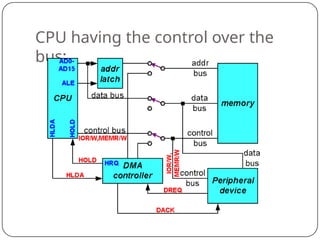
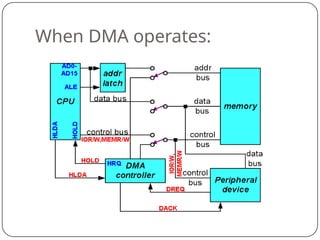
⚫The DMA controller temporarily borrows
the address bus, data bus and control bus
from the microprocessor and transfers the
data directly from the external devices to
Basic DMA Operation:
⚫Two control signals are used
to
request
and
acknowledge a direct memory access
(DMA) transfer in the microprocessor-based
system.
⚫TheHOLD signal as an input(tothe
processor) is used to request a DMA action.
⚫TheHLDA signal as an outputthat
acknowledges the DMA action.
⚫ When the processor recognizes the hold, itstops
its execution and enters hold cycles.
Cont.,
⚫ HOLD input has higher priority than INTR or NMI.
⚫The only microprocessor pin that has a
higher priority than a HOLD is the
RESET pin.
⚫HLDA
becomes
activ
e processorhas
placed
to
indicate its
buses
that
the at
high-
impedance
state.
Basic DMA Definitions:
⚫Direct memory accesses normally occur
between an I/O device and memory without
the use of the microprocessor.
⚫A DMA read transfers data from the
memory to the I/O device.
⚫A DMA write transfers data from an I/O
device to memory.
⚫The system contains separate memory and
I/O control signals.
⚫Hence the Memory & the I/O are
controlled simultaneously
⚫The DMA controller provides memory with its
address, and the controller signal selects the
I/O device during the transfer.
⚫Data transfer speed is determined by speed of
the memory device or a DMA controller.
⚫In many cases, the DMA controller slows the speed
of the system when transfers occur.
⚫The serial PCI (Peripheral Component
Interface) Express bus transfers data at rates
exceeding DMA transfers.
⚫This in modern systems has made DMA is
less important.
The 8237 DMA Controller
⚫The 8237 supplies memory & I/O with
control signals and memory address
information during the DMA transfer.
⚫It is actually a special-purpose
microprocessor whose job is high-speed
data transfer between memory and I/O
CPU having the control over the
bus:
When DMA operates:
⚫8237 is not a discrete componentin
modern microprocessor-based systems.
⚫It appears within many system controller
chip sets
⚫8237 is a four-channel device compatible
with 8086/8088, adequate for small
systems.
⚫Expandable to any number of DMA
channel inputs
⚫8237 is capable of DMA transfers at rates
up to 1.6MB per second.
⚫Each channel is capable of addressing
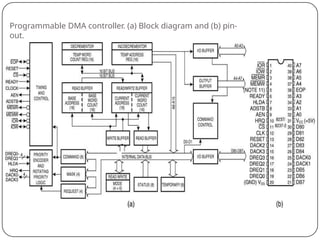
Programmable DMA controller. (a) Block diagram and (b) pin-
out.
8237 Internal Registers
CAR
⚫The current address register holds a 16-
bit memory address used for the DMA
transfer.
⚫Each channel has its own current
address register for this purpose.
⚫When a byte of data is transferred during a
DMA
operation, CAR is either incremented
or
is
decremented depending on how
it programmed.
CWCR
⚫The current word count register
programs a to
transferred
channel for the numberof
bytes during a DMA action.
CR
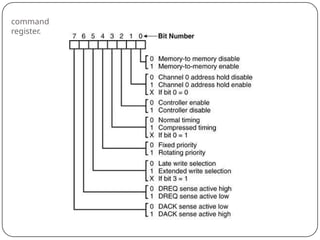
⚫The command register programsthe
operation of the 8237 DMA controller.
⚫The register uses bit position 0 to select
the memory-to-memory DMA transfer
mode.
⚫Memory-to-memory DMA transfers use
DMA channel 0 to hold the source address
⚫DMA channel 1 holds the destination address
command
register.
BA and BWC
⚫The base address (BA) and base word count
(BWC) registers are used when auto-
initialization is selected for a channel.
⚫In auto-initialization mode, these registers
are used to reload the CAR and CWCR
after the DMA action is completed.
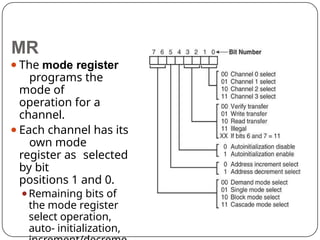
⚫The mode register
programs the
mode of
operation for a
channel.
⚫Each channel has its
own mode
register as selected
by bit
positions 1 and 0.
⚫Remaining bits of
the mode register
select operation,
auto- initialization,
MR
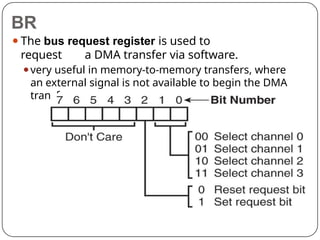
⚫The bus request register is used to
request a DMA transfer via software.
⚫very useful in memory-to-memory transfers, where
an external signal is not available to begin the DMA
transfer
BR
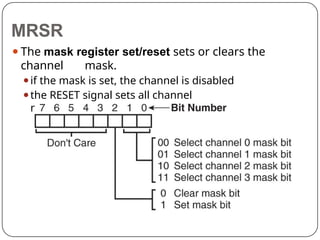
⚫The mask register set/reset sets or clears the
channel mask.
⚫if the mask is set, the channel is disabled
⚫the RESET signal sets all channel
masks to disable them
MRSR
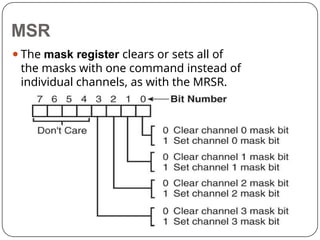
⚫The mask register clears or sets all of
the masks with one command instead of
individual channels, as with the MRSR.
MSR
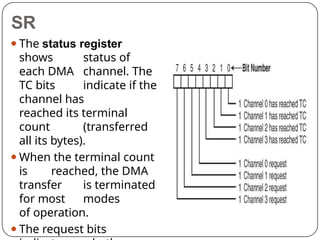
⚫The status register
shows status of
each DMA channel. The
TC bits indicate if the
channel has
reached its terminal
count (transferred
all its bytes).
⚫When the terminal count
is reached, the DMA
transfer is terminated
for most modes
of operation.
⚫The request bits
SR
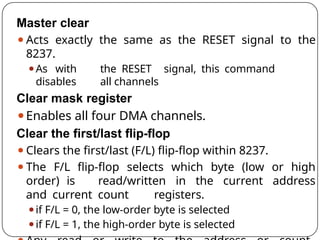
Master clear
⚫Acts exactly the same as the RESET signal to the
8237.
⚫As with the RESET signal, this command
disables all channels
Clear mask register
⚫Enables all four DMA channels.
Clear the first/last flip-flop
⚫Clears the first/last (F/L) flip-flop within 8237.
⚫The F/L flip-flop selects which byte (low or high
order) is read/written in the current address
and current count registers.
⚫if F/L = 0, the low-order byte is selected
⚫if F/L = 1, the high-order byte is selected
⚫Memory-to-
memory
transfer is much
more
powerful than the automatically
repeated MOVSB instruction.
⚫most modern chip sets do not support
the memory-to-memory feature
⚫8237 requires only 2.0 µs per byte, which
is over twice as fast the existing data
transfer.
DMA information of microprocessor.Shows how it performs

  • 1.
  • 2.
    Introduction: ⚫ Direct MemoryAccess (DMA) is a method of allowing data to be moved from one location to another in a computer without intervention from the central processor (CPU). ⚫It is also a fast way of transferring data within (and sometimes between) computer. ⚫The DMA I/O technique provides direct access to the memory while the microprocessor is temporarily disabled. ⚫The DMA controller temporarily borrows the address bus, data bus and control bus from the microprocessor and transfers the data directly from the external devices to
  • 3.
    Basic DMA Operation: ⚫Twocontrol signals are used to request and acknowledge a direct memory access (DMA) transfer in the microprocessor-based system. ⚫TheHOLD signal as an input(tothe processor) is used to request a DMA action. ⚫TheHLDA signal as an outputthat acknowledges the DMA action. ⚫ When the processor recognizes the hold, itstops its execution and enters hold cycles.
  • 4.
    Cont., ⚫ HOLD inputhas higher priority than INTR or NMI. ⚫The only microprocessor pin that has a higher priority than a HOLD is the RESET pin. ⚫HLDA becomes activ e processorhas placed to indicate its buses that the at high- impedance state.
  • 5.
    Basic DMA Definitions: ⚫Directmemory accesses normally occur between an I/O device and memory without the use of the microprocessor. ⚫A DMA read transfers data from the memory to the I/O device. ⚫A DMA write transfers data from an I/O device to memory. ⚫The system contains separate memory and I/O control signals. ⚫Hence the Memory & the I/O are controlled simultaneously
  • 6.
    ⚫The DMA controllerprovides memory with its address, and the controller signal selects the I/O device during the transfer. ⚫Data transfer speed is determined by speed of the memory device or a DMA controller. ⚫In many cases, the DMA controller slows the speed of the system when transfers occur. ⚫The serial PCI (Peripheral Component Interface) Express bus transfers data at rates exceeding DMA transfers. ⚫This in modern systems has made DMA is less important.
  • 7.
    The 8237 DMAController ⚫The 8237 supplies memory & I/O with control signals and memory address information during the DMA transfer. ⚫It is actually a special-purpose microprocessor whose job is high-speed data transfer between memory and I/O
  • 8.
    CPU having thecontrol over the bus:
  • 9.
  • 10.
    ⚫8237 is nota discrete componentin modern microprocessor-based systems. ⚫It appears within many system controller chip sets ⚫8237 is a four-channel device compatible with 8086/8088, adequate for small systems. ⚫Expandable to any number of DMA channel inputs ⚫8237 is capable of DMA transfers at rates up to 1.6MB per second. ⚫Each channel is capable of addressing
  • 11.
    Programmable DMA controller.(a) Block diagram and (b) pin- out.
  • 12.
    8237 Internal Registers CAR ⚫Thecurrent address register holds a 16- bit memory address used for the DMA transfer. ⚫Each channel has its own current address register for this purpose. ⚫When a byte of data is transferred during a DMA operation, CAR is either incremented or is decremented depending on how it programmed.
  • 13.
    CWCR ⚫The current wordcount register programs a to transferred channel for the numberof bytes during a DMA action. CR ⚫The command register programsthe operation of the 8237 DMA controller. ⚫The register uses bit position 0 to select the memory-to-memory DMA transfer mode. ⚫Memory-to-memory DMA transfers use DMA channel 0 to hold the source address ⚫DMA channel 1 holds the destination address
  • 14.
  • 15.
    BA and BWC ⚫Thebase address (BA) and base word count (BWC) registers are used when auto- initialization is selected for a channel. ⚫In auto-initialization mode, these registers are used to reload the CAR and CWCR after the DMA action is completed.
  • 16.
    ⚫The mode register programsthe mode of operation for a channel. ⚫Each channel has its own mode register as selected by bit positions 1 and 0. ⚫Remaining bits of the mode register select operation, auto- initialization, MR
  • 17.
    ⚫The bus requestregister is used to request a DMA transfer via software. ⚫very useful in memory-to-memory transfers, where an external signal is not available to begin the DMA transfer BR
  • 18.
    ⚫The mask registerset/reset sets or clears the channel mask. ⚫if the mask is set, the channel is disabled ⚫the RESET signal sets all channel masks to disable them MRSR
  • 19.
    ⚫The mask registerclears or sets all of the masks with one command instead of individual channels, as with the MRSR. MSR
  • 20.
    ⚫The status register showsstatus of each DMA channel. The TC bits indicate if the channel has reached its terminal count (transferred all its bytes). ⚫When the terminal count is reached, the DMA transfer is terminated for most modes of operation. ⚫The request bits SR
  • 21.
    Master clear ⚫Acts exactlythe same as the RESET signal to the 8237. ⚫As with the RESET signal, this command disables all channels Clear mask register ⚫Enables all four DMA channels. Clear the first/last flip-flop ⚫Clears the first/last (F/L) flip-flop within 8237. ⚫The F/L flip-flop selects which byte (low or high order) is read/written in the current address and current count registers. ⚫if F/L = 0, the low-order byte is selected ⚫if F/L = 1, the high-order byte is selected
  • 22.
    ⚫Memory-to- memory transfer is much more powerfulthan the automatically repeated MOVSB instruction. ⚫most modern chip sets do not support the memory-to-memory feature ⚫8237 requires only 2.0 µs per byte, which is over twice as fast the existing data transfer.