8254 Timer8254 Timer
Features of 8254 Timer
It has 3 independent 16 bit down counters.
Counters can be programmed in 6 different modes.
Counting facility in both BCD and Binary number systems.
It has powerful command called READ BACK COMMAND which allows the
user to check the count value,programmed mode and current mode and
current status of the counter.
Operating frequency range is
For 8253:- upto 2.6 MHz
For 8254:- upto 10 MHz
8254 Functional Description
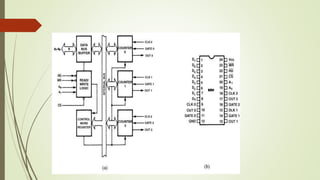
 Figure shows the pin-out of the 8254,
a higher-speed version of the 8253, and a diagram
of one of the three counters.
 Each timer contains:
 a CLK input which provides the basic operating frequency
to the timer
 a gate input pin which controls the timer in some modes
 an output (OUT) connection to obtain the output
of the timer
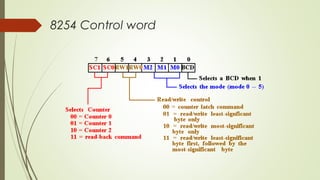
8254 Control word
8254 Programming
 Each counter may be programmed with a count of 1 to FFFFH.
 Minimum count is 1 all modes except 2 and 3 with minimum count of 2.
 Each counter has a program control word used to select the way the
counter operates.
 If two bytes are programmed, then the first byte (LSB) stops the count, and the
second byte (MSB) starts the counter with the new count.
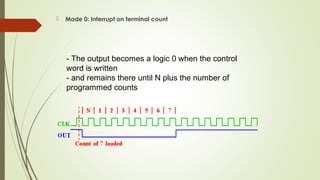
 Mode 0: Interrupt on terminal count
- The output becomes a logic 0 when the control
word is written
- and remains there until N plus the number of
programmed counts
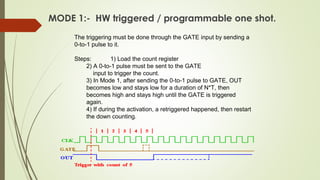
MODE 1:- HW triggered / programmable one shot.
The triggering must be done through the GATE input by sending a
0-to-1 pulse to it.
Steps: 1) Load the count register
2) A 0-to-1 pulse must be sent to the GATE
input to trigger the count.
3) In Mode 1, after sending the 0-to-1 pulse to GATE, OUT
becomes low and stays low for a duration of N*T, then
becomes high and stays high until the GATE is triggered
again.
4) If during the activation, a retriggered happened, then restart
the down counting.
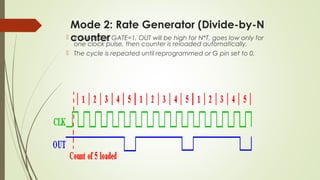
Mode 2: Rate Generator (Divide-by-N
counter In Mode2, if GATE=1, OUT will be high for N*T, goes low only for
one clock pulse, then counter is reloaded automatically,
 The cycle is repeated until reprogrammed or G pin set to 0.
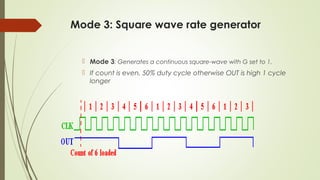
Mode 3: Square wave rate generator
 Mode 3: Generates a continuous square-wave with G set to 1.
 If count is even, 50% duty cycle otherwise OUT is high 1 cycle
longer
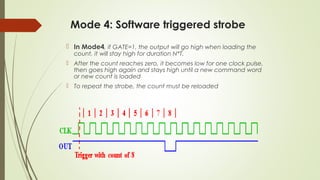
Mode 4: Software triggered strobe
 In Mode4, if GATE=1, the output will go high when loading the
count, it will stay high for duration N*T.
 After the count reaches zero, it becomes low for one clock pulse,
then goes high again and stays high until a new command word
or new count is loaded
 To repeat the strobe, the count must be reloaded
Mode 5: Hardware triggered strobe
 Similar to Mode4, except that the triggering must be
done with the GATE input
 The count starts only when a 0-to-1 pulse is sent to the
GATE input
 If GATE retriggered during the counting, it will restart
the down counting

8254 timer - Microprocessor and interfacing

  • 1.
  • 2.
    Features of 8254Timer It has 3 independent 16 bit down counters. Counters can be programmed in 6 different modes. Counting facility in both BCD and Binary number systems. It has powerful command called READ BACK COMMAND which allows the user to check the count value,programmed mode and current mode and current status of the counter. Operating frequency range is For 8253:- upto 2.6 MHz For 8254:- upto 10 MHz
  • 4.
    8254 Functional Description Figure shows the pin-out of the 8254, a higher-speed version of the 8253, and a diagram of one of the three counters.  Each timer contains:  a CLK input which provides the basic operating frequency to the timer  a gate input pin which controls the timer in some modes  an output (OUT) connection to obtain the output of the timer
  • 5.
  • 6.
    8254 Programming  Eachcounter may be programmed with a count of 1 to FFFFH.  Minimum count is 1 all modes except 2 and 3 with minimum count of 2.  Each counter has a program control word used to select the way the counter operates.  If two bytes are programmed, then the first byte (LSB) stops the count, and the second byte (MSB) starts the counter with the new count.
  • 7.
     Mode 0:Interrupt on terminal count - The output becomes a logic 0 when the control word is written - and remains there until N plus the number of programmed counts
  • 8.
    MODE 1:- HWtriggered / programmable one shot. The triggering must be done through the GATE input by sending a 0-to-1 pulse to it. Steps: 1) Load the count register 2) A 0-to-1 pulse must be sent to the GATE input to trigger the count. 3) In Mode 1, after sending the 0-to-1 pulse to GATE, OUT becomes low and stays low for a duration of N*T, then becomes high and stays high until the GATE is triggered again. 4) If during the activation, a retriggered happened, then restart the down counting.
  • 9.
    Mode 2: RateGenerator (Divide-by-N counter In Mode2, if GATE=1, OUT will be high for N*T, goes low only for one clock pulse, then counter is reloaded automatically,  The cycle is repeated until reprogrammed or G pin set to 0.
  • 10.
    Mode 3: Squarewave rate generator  Mode 3: Generates a continuous square-wave with G set to 1.  If count is even, 50% duty cycle otherwise OUT is high 1 cycle longer
  • 11.
    Mode 4: Softwaretriggered strobe  In Mode4, if GATE=1, the output will go high when loading the count, it will stay high for duration N*T.  After the count reaches zero, it becomes low for one clock pulse, then goes high again and stays high until a new command word or new count is loaded  To repeat the strobe, the count must be reloaded
  • 12.
    Mode 5: Hardwaretriggered strobe  Similar to Mode4, except that the triggering must be done with the GATE input  The count starts only when a 0-to-1 pulse is sent to the GATE input  If GATE retriggered during the counting, it will restart the down counting