CS304PC:Computer Organization
and Architecture (R18 II(I sem))
Department of computer science and engineering (AI/ML)
Session 28
by
Asst.Prof.M.Gokilavani
VITS
3/21/2023 Department of CSE (AI/ML) 1
TEXTBOOK:
• 1. Computer System Architecture – M. Moris Mano,
Third Edition, Pearson/PHI.
REFERENCES:
• Computer Organization – Car Hamacher, Zvonks
Vranesic, Safea Zaky, Vth Edition, McGraw Hill.
• Computer Organization and Architecture – William
Stallings Sixth Edition, Pearson/PHI.
• Structured Computer Organization – Andrew S.
Tanenbaum, 4th Edition, PHI/Pearson.
3/21/2023 Department of CSE (AI/ML) 2
Unit IV
Input-Output Organization: Input-Output
Interface, Asynchronous data transfer, Modes of
transfer, Priority Interrupt Direct memory
Access.
Memory Organization: Memory Hierarchy,
Main memory, Auxiliary memory, Associate
memory, cache memory.
3/21/2023 Department of CSE (AI/ML) 3
Topics covered in session 28
3/21/2023 Department of CSE (AI/ML) 4
•Input-Output Organization
•Input-Output Interface
•Asynchronous data transfer
•Modes of transfer
•Priority Interrupt
•Direct memory Access.
Direct memory Access
• The term DMA stands for direct memory access.
The hardware device used for direct memory
access is called the DMA controller.
• DMA controller is a control unit, part of I/O
device’s interface circuit, which can transfer
blocks of data between I/O devices and main
memory with minimal intervention from the
processor.
3/21/2023 5
Department of CSE (AI/ML)
3/21/2023 Department of CSE (AI/ML) 6
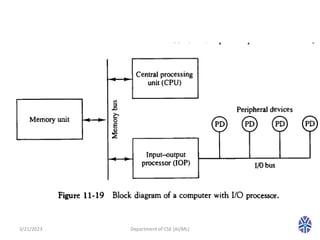
• DMA controller provides an interface between the
bus and the input-output devices.
• Although it transfers data without intervention of
processor, it is controlled by the processor.
• The processor initiates the DMA controller by
sending the starting address, Number of words in
the data block and direction of transfer of data
.i.e. from I/O devices to the memory or from main
memory to I/O devices.
• More than one external device can be connected
to the DMA controller.
3/21/2023 7
Department of CSE (AI/ML)
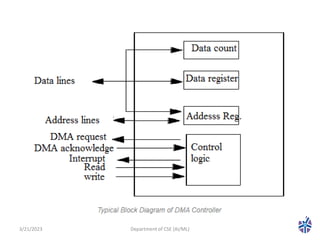
• DMA controller contains an address unit, for
generating addresses and selecting I/O device
for transfer.
• It also contains the control unit and data count
for keeping counts of the number of blocks
transferred and indicating the direction of
transfer of data.
• When the transfer is completed, DMA informs
the processor by raising an interrupt.
• The typical block diagram of the DMA
controller is shown in the figure below.
3/21/2023 8
Department of CSE (AI/ML)
3/21/2023 Department of CSE (AI/ML) 9
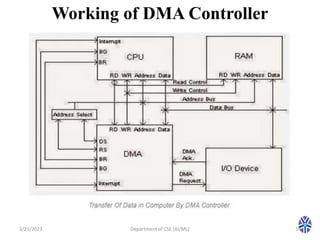
Working of DMA Controller
3/21/2023 Department of CSE (AI/ML) 10
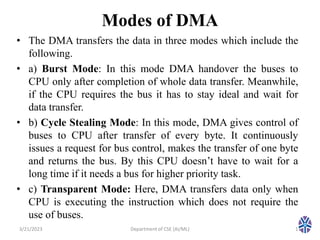
Modes of DMA
• The DMA transfers the data in three modes which include the
following.
• a) Burst Mode: In this mode DMA handover the buses to
CPU only after completion of whole data transfer. Meanwhile,
if the CPU requires the bus it has to stay ideal and wait for
data transfer.
• b) Cycle Stealing Mode: In this mode, DMA gives control of
buses to CPU after transfer of every byte. It continuously
issues a request for bus control, makes the transfer of one byte
and returns the bus. By this CPU doesn’t have to wait for a
long time if it needs a bus for higher priority task.
• c) Transparent Mode: Here, DMA transfers data only when
CPU is executing the instruction which does not require the
use of buses.
3/21/2023 11
Department of CSE (AI/ML)
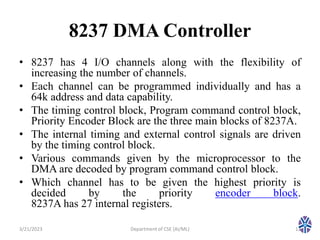
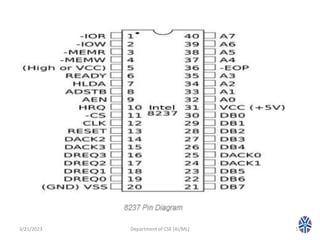
8237 DMA Controller
• 8237 has 4 I/O channels along with the flexibility of
increasing the number of channels.
• Each channel can be programmed individually and has a
64k address and data capability.
• The timing control block, Program command control block,
Priority Encoder Block are the three main blocks of 8237A.
• The internal timing and external control signals are driven
by the timing control block.
• Various commands given by the microprocessor to the
DMA are decoded by program command control block.
• Which channel has to be given the highest priority is
decided by the priority encoder block.
8237A has 27 internal registers.
3/21/2023 12
Department of CSE (AI/ML)
3/21/2023 Department of CSE (AI/ML) 13
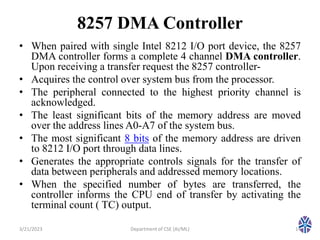
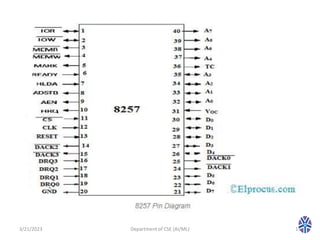
8257 DMA Controller
• When paired with single Intel 8212 I/O port device, the 8257
DMA controller forms a complete 4 channel DMA controller.
Upon receiving a transfer request the 8257 controller-
• Acquires the control over system bus from the processor.
• The peripheral connected to the highest priority channel is
acknowledged.
• The least significant bits of the memory address are moved
over the address lines A0-A7 of the system bus.
• The most significant 8 bits of the memory address are driven
to 8212 I/O port through data lines.
• Generates the appropriate controls signals for the transfer of
data between peripherals and addressed memory locations.
• When the specified number of bytes are transferred, the
controller informs the CPU end of transfer by activating the
terminal count ( TC) output.
3/21/2023 14
Department of CSE (AI/ML)
3/21/2023 Department of CSE (AI/ML) 15
Advantages
• DMA speedups the memory operations by
bypassing the involvement of the CPU.
• The work overload on the CPU decreases.
• For each transfer, only a few numbers of clock
cycles are required
Disadvantages
• Cache coherence problem can be seen when
DMA is used for data transfer.
• Increases the price of the system.
3/21/2023 Department of CSE (AI/ML) 16
Topics to be covered in next session 29
• Memory Organization
3/21/2023 Department of CSE (AI/ML) 17
Thank you!!!

CS304PC:Computer Organization and Architecture Session 28 Direct memory access.pptx

  • 1.
    CS304PC:Computer Organization and Architecture(R18 II(I sem)) Department of computer science and engineering (AI/ML) Session 28 by Asst.Prof.M.Gokilavani VITS 3/21/2023 Department of CSE (AI/ML) 1
  • 2.
    TEXTBOOK: • 1. ComputerSystem Architecture – M. Moris Mano, Third Edition, Pearson/PHI. REFERENCES: • Computer Organization – Car Hamacher, Zvonks Vranesic, Safea Zaky, Vth Edition, McGraw Hill. • Computer Organization and Architecture – William Stallings Sixth Edition, Pearson/PHI. • Structured Computer Organization – Andrew S. Tanenbaum, 4th Edition, PHI/Pearson. 3/21/2023 Department of CSE (AI/ML) 2
  • 3.
    Unit IV Input-Output Organization:Input-Output Interface, Asynchronous data transfer, Modes of transfer, Priority Interrupt Direct memory Access. Memory Organization: Memory Hierarchy, Main memory, Auxiliary memory, Associate memory, cache memory. 3/21/2023 Department of CSE (AI/ML) 3
  • 4.
    Topics covered insession 28 3/21/2023 Department of CSE (AI/ML) 4 •Input-Output Organization •Input-Output Interface •Asynchronous data transfer •Modes of transfer •Priority Interrupt •Direct memory Access.
  • 5.
    Direct memory Access •The term DMA stands for direct memory access. The hardware device used for direct memory access is called the DMA controller. • DMA controller is a control unit, part of I/O device’s interface circuit, which can transfer blocks of data between I/O devices and main memory with minimal intervention from the processor. 3/21/2023 5 Department of CSE (AI/ML)
  • 6.
  • 7.
    • DMA controllerprovides an interface between the bus and the input-output devices. • Although it transfers data without intervention of processor, it is controlled by the processor. • The processor initiates the DMA controller by sending the starting address, Number of words in the data block and direction of transfer of data .i.e. from I/O devices to the memory or from main memory to I/O devices. • More than one external device can be connected to the DMA controller. 3/21/2023 7 Department of CSE (AI/ML)
  • 8.
    • DMA controllercontains an address unit, for generating addresses and selecting I/O device for transfer. • It also contains the control unit and data count for keeping counts of the number of blocks transferred and indicating the direction of transfer of data. • When the transfer is completed, DMA informs the processor by raising an interrupt. • The typical block diagram of the DMA controller is shown in the figure below. 3/21/2023 8 Department of CSE (AI/ML)
  • 9.
  • 10.
    Working of DMAController 3/21/2023 Department of CSE (AI/ML) 10
  • 11.
    Modes of DMA •The DMA transfers the data in three modes which include the following. • a) Burst Mode: In this mode DMA handover the buses to CPU only after completion of whole data transfer. Meanwhile, if the CPU requires the bus it has to stay ideal and wait for data transfer. • b) Cycle Stealing Mode: In this mode, DMA gives control of buses to CPU after transfer of every byte. It continuously issues a request for bus control, makes the transfer of one byte and returns the bus. By this CPU doesn’t have to wait for a long time if it needs a bus for higher priority task. • c) Transparent Mode: Here, DMA transfers data only when CPU is executing the instruction which does not require the use of buses. 3/21/2023 11 Department of CSE (AI/ML)
  • 12.
    8237 DMA Controller •8237 has 4 I/O channels along with the flexibility of increasing the number of channels. • Each channel can be programmed individually and has a 64k address and data capability. • The timing control block, Program command control block, Priority Encoder Block are the three main blocks of 8237A. • The internal timing and external control signals are driven by the timing control block. • Various commands given by the microprocessor to the DMA are decoded by program command control block. • Which channel has to be given the highest priority is decided by the priority encoder block. 8237A has 27 internal registers. 3/21/2023 12 Department of CSE (AI/ML)
  • 13.
  • 14.
    8257 DMA Controller •When paired with single Intel 8212 I/O port device, the 8257 DMA controller forms a complete 4 channel DMA controller. Upon receiving a transfer request the 8257 controller- • Acquires the control over system bus from the processor. • The peripheral connected to the highest priority channel is acknowledged. • The least significant bits of the memory address are moved over the address lines A0-A7 of the system bus. • The most significant 8 bits of the memory address are driven to 8212 I/O port through data lines. • Generates the appropriate controls signals for the transfer of data between peripherals and addressed memory locations. • When the specified number of bytes are transferred, the controller informs the CPU end of transfer by activating the terminal count ( TC) output. 3/21/2023 14 Department of CSE (AI/ML)
  • 15.
  • 16.
    Advantages • DMA speedupsthe memory operations by bypassing the involvement of the CPU. • The work overload on the CPU decreases. • For each transfer, only a few numbers of clock cycles are required Disadvantages • Cache coherence problem can be seen when DMA is used for data transfer. • Increases the price of the system. 3/21/2023 Department of CSE (AI/ML) 16
  • 17.
    Topics to becovered in next session 29 • Memory Organization 3/21/2023 Department of CSE (AI/ML) 17 Thank you!!!