






Financial Management and
Capital Structure
 RUMA KHATUN- B120202087
 REZWAN SADAT- B110202003
 AKIKUN NAHUR- B110202005
 NUSRAT JAHAN- B110202077
 NUSRAT JAHAN PROMA- B110202103
INTRODUCTION
Financial management is an integrated
decision making process, concerned with
acquiring, managing and financing assets to
accomplish overall goals within a business
entity.
Speaking differently, it is concerned with
making decisions relating to investments in
long term assets, working capital, financing
of assets and so on.
Financial Management:
The planning, directing, monitoring,
organizing, coordinating and controlling of
the monetary resources of an organization.
 It is an area of finance dealing with financial
decision business enterprise make and the
tools and analysis used to make this decision.
 financial Management can be defined as:
The management of the finances of a
business organization in order to
achieve financial objectives.
Financial management capacity is a cornerstone of
organizational excellence.
Financial management pervades the whole
organization as management decisions almost always
have financial implications.
The key objectives of
financial management
would be to:
• Create wealth for the
business
• Generate cash
• Provide a sufficient return
on investment bearing in
mind the risks that the
business is taking and the
resources invested.
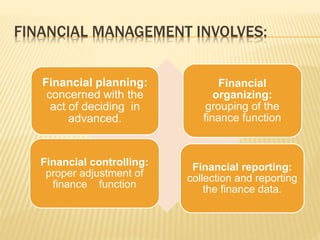
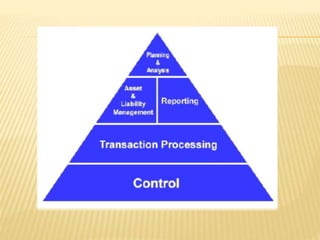
FINANCIAL MANAGEMENT INVOLVES:
Financial planning:
concerned with the
act of deciding in
advanced.
Financial
organizing:
grouping of the
finance function
Financial controlling:
proper adjustment of
finance function
Financial reporting:
collection and reporting
the finance data.
IMPORTANCE OF FINANCIAL MANAGEMENT
Financial management is concerned with procurement and
utilization of funds in a proper way. It is important because of the
following advantages:
1. Helps in obtaining sufficient funds at a minimum cost.
2. Ensures effective utilization of funds.
3. Tries to generate sufficient profits to finance expansion and
modernization of the enterprise and secure stable growth.
4. Ensures safety of funds through creation of reserves,
re-investment of profits, etc
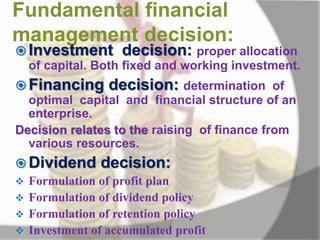
Fundamental financial
management decision:
 Investment decision: proper allocation
of capital. Both fixed and working investment.
 Financing decision: determination of
optimal capital and financial structure of an
enterprise.
Decision relates to the raising of finance from
various resources.
 Dividend decision:
 Formulation of profit plan
 Formulation of dividend policy
 Formulation of retention policy
 Investment of accumulated profit
Investment decision:
 This decision relates to the careful
selection of assets in which funds will be
invested by the firm. It Involves buying,
holding, reducing, replacing, selling &
managing assets.
Financing decisions:
Financing decisions involve the acquisition of funds
needed to support long-term investments.
 While taking this decision, financial management
weighs the advantages and disadvantages of the
different sources of finance.
 The business can either finance from its shareholder
funds which can be subdivided into equity share
capital, preference share capital and the accumulated
profits.
 Borrowings from outsiders include borrowed funds
like debentures and loans from financial institutions.
 This decision relates to the appropriation of profits
earned. The two major alternatives are to retain the
profits earned or to distribute these profits to
shareholders.
While declaring dividend, a large number of
considerations are kept in mind such as:
 Trend of earnings
 Stability in dividends
 The trend of share market prices
 The requirement of funds for future growth
 The cash flow situation
 Restrictions under the Companies Act
 The tax impact on shareholders etc.
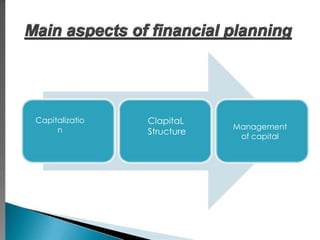
Capitalizatio
n
ClapitaL
Structure
Management
of capital
Form of Capital:
Capital Structure
Definition:
 In finance, capital structure refers to the way a
corporation finances its assets through some
combination of equity, debt, or hybrid securities. A
firm's capital structure is then the composition or
'structure' of its liabilities. For example, a firm that
sells tk20 billion in equity and tk80 billion in debts is
said to be 20% equity-financed and 80% debt-
financed. The firm's ratio of debt to total financing,
80% in this example is referred to as the firm's
leverage. In reality, capital structure may be highly
complex and include dozens of sources. Gearing
Ratio is the proportion of the capital employed of the
firm which come from outside of the business
finance, e.g. by taking a short term loan etc.
Capital structure
Equity Capital: This refers to money put up and owned by
the shareholders (owners). Typically, equity capital
consists of two types:
1.) Contributed capital
2.) Retained earnings.
Debt Capital: The debt capital in a company's capital
structure refers to borrowed money that is at work in the
business.
 Business risk is the risk inherent in the operations of the
firm, prior to the financing decision. Thus, business risk
is the uncertainty inherent in a total risk sense, future
operating income, or earnings before interest and taxes
(EBIT). Business risk is caused by many factors. Two of
the most important are sales variability and operating
leverage.
 Financial risk is the risk added by the use of debt
financing. Debt financing increases the variability of
earnings before taxes (but after interest); thus, along with
business risk, it contributes to the uncertainty of net
income and earnings per share. Business risk plus
financial risk equals total corporate risk.
• EBIT – EPS Analysis
• ROI – ROE Analysis
• Ratio Analysis
• Leverage Analysis
• Cash Flow Analysis
• Comparative Analysis
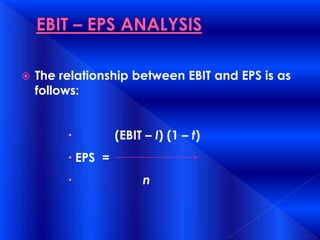
 The relationship between EBIT and EPS is as
follows:
 (EBIT – I) (1 – t)
 EPS =
 n
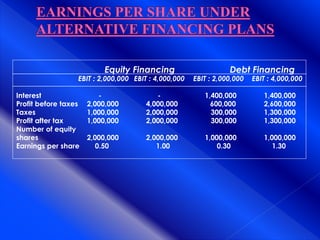
Equity Financing Debt Financing
EBIT : 2,000,000 EBIT : 4,000,000 EBIT : 2,000,000 EBIT : 4,000,000
Interest - - 1,400,000 1,400,000
Profit before taxes 2,000,000 4,000,000 600,000 2,600,000
Taxes 1,000,000 2,000,000 300,000 1,300,000
Profit after tax 1,000,000 2,000,000 300,000 1,300,000
Number of equity
shares 2,000,000 2,000,000 1,000,000 1,000,000
Earnings per share 0.50 1.00 0.30 1.30
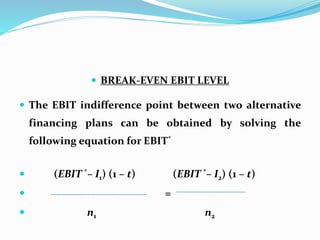
 BREAK-EVEN EBIT LEVEL
 The EBIT indifference point between two alternative
financing plans can be obtained by solving the
following equation for EBIT*
 (EBIT *– I1) (1 – t) (EBIT *– I2) (1 – t)
 =
 n1 n2
ROI – ROE ANALYSIS
 ROE = [ROI + (ROI – r) D/E] (1 – t)
 where ROE = return on equity
 ROI = return on investment
 r = cost of debt
 D/E = debt-equity ratio
 t = tax rate
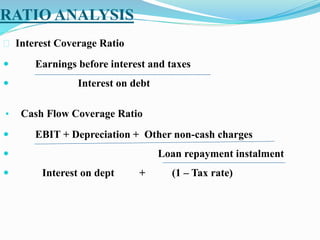
RATIO ANALYSIS
 Interest Coverage Ratio
 Earnings before interest and taxes
 Interest on debt
• Cash Flow Coverage Ratio
 EBIT + Depreciation + Other non-cash charges
 Loan repayment instalment
 Interest on dept + (1 – Tax rate)
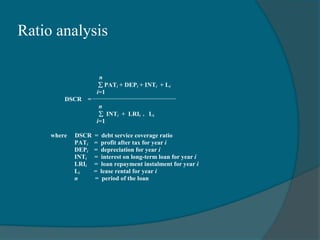
Ratio analysis
n
PATi + DEPi + INTi + Li
i=1
DSCR =
n
 INTi + LRIi + Li
i=1
where DSCR = debt service coverage ratio
PATi = profit after tax for year i
DEPi = depreciation for year i
INTi = interest on long-term loan for year i
LRIi = loan repayment instalment for year i
Li = lease rental for year i
n = period of the loan
 CASH FLOW ANALYSIS
 The key question in assessing the debt capacity of a firm is
whether the probability of default associated with a certain
level of debt is acceptable to the management. The cash flow
analysis establishes the debt capacity by examining the
probability of default.
COMPARATIVE ANALYSIS
A common approach to analysing the capital structure of
a firm is to compare its debt-equity ratio to the average
debt-equity ratio of the industry to which the firm
belongs.
Since the firms in an industry may differ on factors like
operating risk, profitability, and tax status it makes
sense to control for differences in these variables
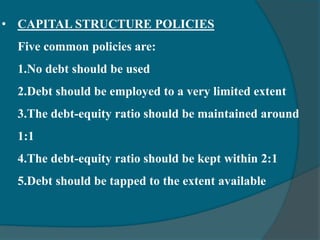
• CAPITAL STRUCTURE POLICIES
Five common policies are:
1.No debt should be used
2.Debt should be employed to a very limited extent
3.The debt-equity ratio should be maintained around
1:1
4.The debt-equity ratio should be kept within 2:1
5.Debt should be tapped to the extent available
Net Income Approach (NI)
Net Operating Income Approach (NOI)
Traditional Approach (TA)
Modigliani and Miller Approach (MM)
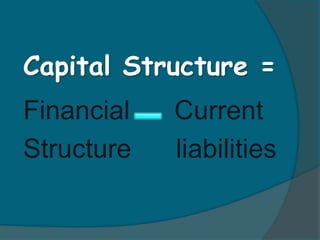
Capital Structure =
Financial Current
Structure liabilities
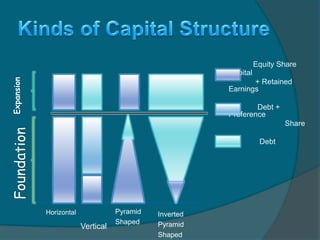
Equity Share
Capital
+ Retained
Earnings
Debt +
Preference
Share
Debt
FoundationExpansion
Horizontal
Vertical
Pyramid
Shaped
Inverted
Pyramid
Shaped
THINK (LOADING………………………..)
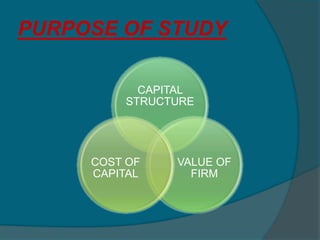
PURPOSE OF STUDY
CAPITAL
STRUCTURE
VALUE OF
FIRM
COST OF
CAPITAL
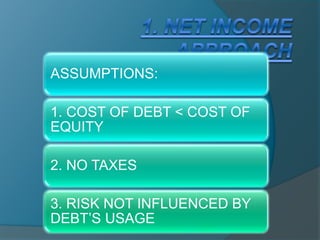
ASSUMPTIONS:
1. COST OF DEBT < COST OF
EQUITY
2. NO TAXES
3. RISK NOT INFLUENCED BY
DEBT’S USAGE
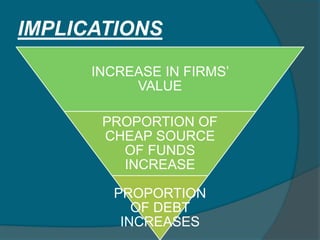
IMPLICATIONS
INCREASE IN FIRMS’
VALUE
PROPORTION OF
CHEAP SOURCE
OF FUNDS
INCREASE
PROPORTION
OF DEBT
INCREASES

Financial management(1)

  • 1.
  • 2.
     RUMA KHATUN-B120202087  REZWAN SADAT- B110202003  AKIKUN NAHUR- B110202005  NUSRAT JAHAN- B110202077  NUSRAT JAHAN PROMA- B110202103
  • 3.
    INTRODUCTION Financial management isan integrated decision making process, concerned with acquiring, managing and financing assets to accomplish overall goals within a business entity. Speaking differently, it is concerned with making decisions relating to investments in long term assets, working capital, financing of assets and so on.
  • 4.
    Financial Management: The planning,directing, monitoring, organizing, coordinating and controlling of the monetary resources of an organization.  It is an area of finance dealing with financial decision business enterprise make and the tools and analysis used to make this decision.  financial Management can be defined as: The management of the finances of a business organization in order to achieve financial objectives.
  • 5.
    Financial management capacityis a cornerstone of organizational excellence. Financial management pervades the whole organization as management decisions almost always have financial implications.
  • 6.
    The key objectivesof financial management would be to: • Create wealth for the business • Generate cash • Provide a sufficient return on investment bearing in mind the risks that the business is taking and the resources invested.
  • 7.
    FINANCIAL MANAGEMENT INVOLVES: Financialplanning: concerned with the act of deciding in advanced. Financial organizing: grouping of the finance function Financial controlling: proper adjustment of finance function Financial reporting: collection and reporting the finance data.
  • 10.
    IMPORTANCE OF FINANCIALMANAGEMENT Financial management is concerned with procurement and utilization of funds in a proper way. It is important because of the following advantages: 1. Helps in obtaining sufficient funds at a minimum cost. 2. Ensures effective utilization of funds. 3. Tries to generate sufficient profits to finance expansion and modernization of the enterprise and secure stable growth. 4. Ensures safety of funds through creation of reserves, re-investment of profits, etc
  • 11.
    Fundamental financial management decision: Investment decision: proper allocation of capital. Both fixed and working investment.  Financing decision: determination of optimal capital and financial structure of an enterprise. Decision relates to the raising of finance from various resources.  Dividend decision:  Formulation of profit plan  Formulation of dividend policy  Formulation of retention policy  Investment of accumulated profit
  • 12.
    Investment decision:  Thisdecision relates to the careful selection of assets in which funds will be invested by the firm. It Involves buying, holding, reducing, replacing, selling & managing assets.
  • 13.
    Financing decisions: Financing decisionsinvolve the acquisition of funds needed to support long-term investments.  While taking this decision, financial management weighs the advantages and disadvantages of the different sources of finance.  The business can either finance from its shareholder funds which can be subdivided into equity share capital, preference share capital and the accumulated profits.  Borrowings from outsiders include borrowed funds like debentures and loans from financial institutions.
  • 14.
     This decisionrelates to the appropriation of profits earned. The two major alternatives are to retain the profits earned or to distribute these profits to shareholders. While declaring dividend, a large number of considerations are kept in mind such as:  Trend of earnings  Stability in dividends  The trend of share market prices  The requirement of funds for future growth  The cash flow situation  Restrictions under the Companies Act  The tax impact on shareholders etc.
  • 15.
  • 16.
  • 17.
    Definition:  In finance,capital structure refers to the way a corporation finances its assets through some combination of equity, debt, or hybrid securities. A firm's capital structure is then the composition or 'structure' of its liabilities. For example, a firm that sells tk20 billion in equity and tk80 billion in debts is said to be 20% equity-financed and 80% debt- financed. The firm's ratio of debt to total financing, 80% in this example is referred to as the firm's leverage. In reality, capital structure may be highly complex and include dozens of sources. Gearing Ratio is the proportion of the capital employed of the firm which come from outside of the business finance, e.g. by taking a short term loan etc.
  • 18.
    Capital structure Equity Capital:This refers to money put up and owned by the shareholders (owners). Typically, equity capital consists of two types: 1.) Contributed capital 2.) Retained earnings. Debt Capital: The debt capital in a company's capital structure refers to borrowed money that is at work in the business.
  • 19.
     Business riskis the risk inherent in the operations of the firm, prior to the financing decision. Thus, business risk is the uncertainty inherent in a total risk sense, future operating income, or earnings before interest and taxes (EBIT). Business risk is caused by many factors. Two of the most important are sales variability and operating leverage.  Financial risk is the risk added by the use of debt financing. Debt financing increases the variability of earnings before taxes (but after interest); thus, along with business risk, it contributes to the uncertainty of net income and earnings per share. Business risk plus financial risk equals total corporate risk.
  • 20.
    • EBIT –EPS Analysis • ROI – ROE Analysis • Ratio Analysis • Leverage Analysis • Cash Flow Analysis • Comparative Analysis
  • 21.
     The relationshipbetween EBIT and EPS is as follows:  (EBIT – I) (1 – t)  EPS =  n
  • 22.
    Equity Financing DebtFinancing EBIT : 2,000,000 EBIT : 4,000,000 EBIT : 2,000,000 EBIT : 4,000,000 Interest - - 1,400,000 1,400,000 Profit before taxes 2,000,000 4,000,000 600,000 2,600,000 Taxes 1,000,000 2,000,000 300,000 1,300,000 Profit after tax 1,000,000 2,000,000 300,000 1,300,000 Number of equity shares 2,000,000 2,000,000 1,000,000 1,000,000 Earnings per share 0.50 1.00 0.30 1.30
  • 23.
     BREAK-EVEN EBITLEVEL  The EBIT indifference point between two alternative financing plans can be obtained by solving the following equation for EBIT*  (EBIT *– I1) (1 – t) (EBIT *– I2) (1 – t)  =  n1 n2
  • 24.
    ROI – ROEANALYSIS  ROE = [ROI + (ROI – r) D/E] (1 – t)  where ROE = return on equity  ROI = return on investment  r = cost of debt  D/E = debt-equity ratio  t = tax rate
  • 25.
    RATIO ANALYSIS  InterestCoverage Ratio  Earnings before interest and taxes  Interest on debt • Cash Flow Coverage Ratio  EBIT + Depreciation + Other non-cash charges  Loan repayment instalment  Interest on dept + (1 – Tax rate)
  • 26.
    Ratio analysis n PATi +DEPi + INTi + Li i=1 DSCR = n  INTi + LRIi + Li i=1 where DSCR = debt service coverage ratio PATi = profit after tax for year i DEPi = depreciation for year i INTi = interest on long-term loan for year i LRIi = loan repayment instalment for year i Li = lease rental for year i n = period of the loan
  • 27.
     CASH FLOWANALYSIS  The key question in assessing the debt capacity of a firm is whether the probability of default associated with a certain level of debt is acceptable to the management. The cash flow analysis establishes the debt capacity by examining the probability of default.
  • 28.
    COMPARATIVE ANALYSIS A commonapproach to analysing the capital structure of a firm is to compare its debt-equity ratio to the average debt-equity ratio of the industry to which the firm belongs. Since the firms in an industry may differ on factors like operating risk, profitability, and tax status it makes sense to control for differences in these variables
  • 29.
    • CAPITAL STRUCTUREPOLICIES Five common policies are: 1.No debt should be used 2.Debt should be employed to a very limited extent 3.The debt-equity ratio should be maintained around 1:1 4.The debt-equity ratio should be kept within 2:1 5.Debt should be tapped to the extent available
  • 30.
    Net Income Approach(NI) Net Operating Income Approach (NOI) Traditional Approach (TA) Modigliani and Miller Approach (MM)
  • 32.
    Capital Structure = FinancialCurrent Structure liabilities
  • 33.
    Equity Share Capital + Retained Earnings Debt+ Preference Share Debt FoundationExpansion Horizontal Vertical Pyramid Shaped Inverted Pyramid Shaped
  • 34.
  • 36.
  • 37.
    ASSUMPTIONS: 1. COST OFDEBT < COST OF EQUITY 2. NO TAXES 3. RISK NOT INFLUENCED BY DEBT’S USAGE
  • 38.
    IMPLICATIONS INCREASE IN FIRMS’ VALUE PROPORTIONOF CHEAP SOURCE OF FUNDS INCREASE PROPORTION OF DEBT INCREASES