STOCK VALUATION Chapter 8
OUTLINE
1. Common & Preferred Stock
A. Rights
B. The Annual Meeting & Voting
C. Dividends
2. Stock Valuation
A. Zero Growth Dividends
B. Constant Growth Dividends
C. Non-constant Growth Dividends
D. Benchmarking
3. The Stock Market
2
COMMON STOCK & PREFERRED
STOCK
3
COMMON STOCK
COMMON STOCK is a unit of ownership in a public corporation;
therefore, STOCKHOLDERS or SHAREHOLDERS are owners of the
firm.
These shares are units of equity without priority for dividends or
a payout during bankruptcy.
COMMON & PREFERRED STOCK 4
COMMON STOCK HOLDERS’ RIGHTS
As owners, stockholders are generally entitled to:
1. Voting rights at the firm’s Annual Meeting
2. Dividends, if they are paid
3. Assets after liabilities are paid in the event of liquidation
(residual claimant)
4. PREEMPTIVE RIGHTS in some cases to share proportionally in
any new stock issuance
COMMON & PREFERRED STOCK 5
THE ANNUAL MEETING & VOTING
Voting for directors happens at a firm’s annual meeting,
where investors gather to cast their votes, ask questions,
and hear management discuss the outlook of the firm.
Let’s look at Google’s parent company, Alphabet.
COMMON & PREFERRED STOCK 6
VOTING RIGHTS
Votes are generally one share, one vote, so larger shareholders can
exert more influence. Some DUAL-CLASS SHARE structures offer
shares with more than one vote per share, possibly to preserve
power for founders.
Voting for Directors:
STRAIGHT VOTING is when a shareholder cannot cast more than one
vote per share per director.
CUMULATIVE VOTING is when a shareholder may cast all their votes for
a director giving smaller shareholders more power.
COMMON & PREFERRED STOCK 7
VOTING RIGHTS- DIRECTOR EXAMPLE
You own 500 shares and there are 4 directors up for election.
With straight voting (the norm), you get can vote up to 500 times
for each director. With cumulative, you could vote up to 500 x 4 =
2000 for one candidate (forfeiting votes for other candidates), or
divide up your vote anyway you’d like.
COMMON & PREFERRED STOCK 8
OTHER VOTE ITEMS
Approving executive compensation (an advisory vote)
Frequency of executive compensation vote
Approving new stock issuance
Auditor approval
COMMON & PREFERRED STOCK 9
VOTING DEFINITIONS AND FEATURES
PROXY: granting the authority to another to vote your
shares if you can’t make it to the meeting (most voting
done this way).
PROXY FIGHT: outside shareholders try to obtain votes
via proxy to vote against management.
DUAL CLASS SHARES: Some firms offer multiple classes,
with voting power concentrated to a certain class.
Alphabet’s Proxy StatementCOMMON & PREFERRED STOCK 10
DIVIDENDS
DIVIDENDS are payments made by a corporation to
shareholders, either in cash or more stock.
1. Not a liability (can’t go bankrupt for not paying)
2. Not a business expense (and thus not tax
deductible)
3. Taxable income to shareholders (even though taxes
already paid at the corporate level)COMMON & PREFERRED STOCK 11
THE DIVIDEND DECISION
Some firms pay dividends; others don’t.
1. Retaining earnings can be used to finance
growth.
2. Dividends are taxable; capital gains aren’t
unless realized.
Why would you hold a stock that doesn’t pay
dividends? COMMON & PREFERRED STOCK 12
PREFERRED STOCK
PREFERRED SHARES are equity shares with dividend
priority over common stock, sometimes without
voting rights, and commonly with CUMULATIVE
DIVIDENDS.
CUMULATIVE DIVIDENDS require that unpaid
dividends be carried forward and paid first to
preferred stock holders before any common share
dividends are paid. Not a liability.
COMMON & PREFERRED STOCK 13
TO SUMMARIZE
Common stock represents ownership in a firm. Rights
include a residual claim to assets and voting ability at
annual meetings. Dividends need not be paid and are not
a liability, even for preferred shares.
COMMON & PREFERRED STOCK 14
STOCK VALUATION
15
COMMON STOCK VALUATION
Valuation for common stock can be challenging for three
reasons:
1. Cash flows for stocks (the dividends) are not
promised like cash flows for bonds (coupons)
2. There is no maturity
3. No easy way to determine the rate of return for
discounting
STOCK VALUATION 16
COMMON STOCK VALUATION EXAMPLE
You are considering buying one share of Nike. You
forecast that you will be able to sell that share for $70 in
one year’s time. Further, Nike is expected to pay a $10
dividend at the end of the year. You think that the
company is relatively risky, so you require a 25% return
on this investment.
What is the value of 1 share of Nike?
STOCK VALUATION 17
COMMON STOCK VALUATION EXAMPLE
With a calculator:
N = 1, FV = 10 + 70, I/Y = 25, CPT PV = -64
Therefore, you should pay no more than $64.
STOCK VALUATION 18
VALUING STOCK CASH FLOWS- 1 PERIOD
We can rewrite the calculation we’ve done as:
P0 is the price now, D1 is the dividend in 1 year, P1 is the price in
1 year, R is the required return.
STOCK VALUATION 19
VALUING STOCK CASH FLOWS- 2
PERIODS
What if we want to sell after 2 years?
Because…
STOCK VALUATION 20
VALUING STOCK CASH FLOWS- 2
PERIODS
And…
STOCK VALUATION 21
VALUING STOCK CASH FLOWS- MANY
PERIODS
Continue to add dividends for each period, pushing back the predicted
stock price so far that it hardly has an impact on P0.
Therefore, the price of a stock today is equal to the present value of all
future dividends.
STOCK VALUATION 22
VALUING STOCK CASH FLOWS- MANY
PERIODS EXAMPLE
What is the value of one share of Adidas, given it pays an annual
dividend of $10 and the required return is 15%? Assume Adidas
will (1) cease to exist in 30 years, (2) 40 years, (3) 100 years
(1) PMT= 10, I/Y = 15%, N = 30, CPT PV = $65.67
(2) PMT= 10, I/Y = 15%, N = 40, CPT PV = $66.42
(3) PMT= 10, I/Y = 15%, N = 100, CPT PV = $66.66
STOCK VALUATION 23
WHAT ABOUT COMPANIES THAT DON’T
PAY DIVIDENDS?
From Ross, Westerfield, and Jordan (11th ed, pg. 241):
“When we say that the value of the stock is equal to the
present value of the future dividends, we don’t rule out the
possibility that some number of those dividends are zero.
They just can’t all be zero.”
STOCK VALUATION 24
SPECIAL CASES OF STOCK VALUATION
We have some special cases where we can directly solve for the
value of the shares (though, unfortunately, these cases are rare
in practice):
1. Dividends are always the same forever (zero growth rate)
2. Dividends grow at a constant rate.
3. Dividends growth is not constant originally, but after some
periods becomes constant.
STOCK VALUATION 25
CASE 1: DIVIDENDS WITH ZERO GROWTH
In this case, the dividends are the same in each period,
effectively making the stock a perpetuity.
which is analogous to…
STOCK VALUATION 26
CASE 1 EXAMPLE
Starrbuxx Koffee has a policy of paying a $10 per share dividend
every year. If this will continue forever, what is the value of a
share assuming you require a return of 20%?
STOCK VALUATION 27
CASE 2: CONSTANT GROWTH
In this case, the dividends are expected to grow at a constant
rate forever.
Using the future value formula, we can find the dividends in each
period:
…and so on.
STOCK VALUATION 28
CASE 2: CONSTANT GROWTH
We can plug in these values of D1 and D2 into:
which simplifies to…
STOCK VALUATION 29
CASE 2: CONSTANT GROWTH
This is called the dividend growth model.
Note that R must be greater than g. The rate of return you
require must be greater than the rate at which the dividends
grow.
STOCK VALUATION 30
CASE 2 EXAMPLE
Amuhzahn Inc. just paid a dividend of $2.30. Management believes the
company is doing well, so they announce they will pay dividends annually,
growing 5% per year indefinitely. Currently, the shares sell at $36. The
required return is 13%. Would you buy these shares?
You would not buy these shares, because $30.19 < $36.
STOCK VALUATION 31
CASE 2 EXAMPLE CONTINUED
Suppose we want to determine what the price for Amuhzahn shares will be
in 5 years.
STOCK VALUATION 32
CASE 3: NONCONSTANT GROWTH
An example of nonconstant growth would be a firm that is paying
no dividends for a period then begins paying at a constant
growth rate.
Here, we first calculate the value of the constant growth portion,
then discount that value to the present.
STOCK VALUATION 33
CASE 3 EXAMPLE
Faysbuk is a newer company that isn’t quite ready to pay dividends.
However, in 5 years, you think the company will be confident enough to
pay a dividend of $0.50 per share to grow at 10% indefinitely. What should
the price of that share be today? The required return is 20%.
Step 1: Constant growth formula:
Step 2: Discount to present:
STOCK VALUATION 34
CASE 3 EXAMPLE (2)
Hahrlee-Dayvidsin Moeturs will pay a dividend of $1, then $2, then $2.50
for the next three years. At that point, dividends will grow at 5% per year.
The required returns is 10%. What is the value of the stock today?
Step 1: Constant growth formula:
Step 2: Discount to present:
STOCK VALUATION 35
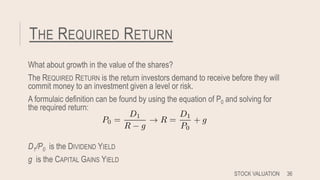
THE REQUIRED RETURN
What about growth in the value of the shares?
The REQUIRED RETURN is the return investors demand to receive before they will
commit money to an investment given a level or risk.
A formulaic definition can be found by using the equation of P0 and solving for
the required return:
D1/P0 is the DIVIDEND YIELD
g is the CAPITAL GAINS YIELD
STOCK VALUATION 36
THE REQUIRED RETURN
Thus, the required return consists of the stock’s dividend
portion and the rate at which the value of the shares are
expected to rise.
STOCK VALUATION 37
USING EPS WHEN NO DIVIDENDS
If the company doesn’t pay dividends, we can also consider
multiplying some BENCHMARK PE RATIO by the EARNINGS PER
SHARE of the company.
STOCK VALUATION 38
BENCHMARK EXAMPLE
Jinrel Elektrik doesn’t pay dividends. It operates in an industry with a
median PE ratio of 29x’s. Last year, its net income was $1,240,000
and there were 500,000 shares outstanding. What is your estimate
price per share for this company?
Therefore, you may want to buy this share if it is selling in the market
for less than $71.92
STOCK VALUATION 39
TO SUMMARIZE
We consider the value of a share to be the present value
of future dividends. Special cases we can calculate
include when dividends stay the same, grow at a constant
rate, or begin growing at a constant rate in the future. The
required return for these calculations includes a dividend
and capital gains portion. Finally, we can use
benchmarking when dividends are not paid.
STOCK VALUATION 40
THE STOCK MARKET
41
BASIC TERMINOLOGY
PRIMARY MARKETS: Where companies sell equity shares
to raise money.
SECONDARY MARKETS: Where shares are traded among
investors.
DEALER: An agent who buys and sells securities from an
inventory.
BROKER: An agent who arranges transactions between
buyers and sellers and does not hold an inventory.THE STOCK MARKET 42
EXAMPLE
To understand what dealers do, think of a campus bookstore:
If they sell you a new book, this is a primary market
transaction.
If you buy a used book, this is a secondary market
transaction, and you pay the store’s ask price.
If you sell a used book to them, this is a secondary
market transaction, and you receive the store’s bid price.
The store makes money by charging more than cost for
new books and on the bid-ask spread for used books.
THE STOCK MARKET 43
STOCK MARKETS: NYSE AND NASDAQ
NYSE
DESIGNATED MARKET MAKERS (dealers) hold certain stocks and
remain at their post auctioning off shares to brokers and
maintaining order.
FLOOR BROKERS get a call from the brokerage company (say
Merrill-Lynch) to buy a certain number of shares of a company on
behalf of a client.
THE STOCK MARKET 44
STOCK MARKETS: NYSE AND NASDAQ
NASDAQ
National Association of Securities Dealers Automated Quotations
System.
Purely electronic market with no physical location.
A dealer market, where bid and ask prices are posted.
THE STOCK MARKET 45
STOCK MARKET INDICES
The Dow Jones Industrial Average and the S&P 500 are popular
examples of stock market indices.
These are groups of popular companies, and the performance of
the stocks in each INDEX can give us an idea of how the stock
market is performing overall.
When the stock market is “up” or “down”, it usually means that
the DJIA or the S&P 500 has gone “up” or “down”.
https://markets.wsj.com/us
THE STOCK MARKET 46
TO SUMMARIZE
The NYSE and NASDAQ are secondary markets where
trading of shares takes place. Dealers have an inventory
of stocks whereas brokers match buyers and sellers.
THE STOCK MARKET 47
TAKEAWAYS
48
TAKEAWAYS
1. Common stock is an ownership interest in a company that
generally comes with voting rights and a residual claim.
2. Dividends don’t need to be paid and are not a liability nor tax
deductible as interest expense is.
3. Preferred stock has dividend priority over common stock.
4. We determine the value of a share by finding the present
value of dividends.
5. The required return has both a dividend yield and capital
gains component.
6. The stock market is a secondary market where owners
exchange shares. TAKEAWAYS 49
END.
50

Ch8

  • 1.
  • 2.
    OUTLINE 1. Common &Preferred Stock A. Rights B. The Annual Meeting & Voting C. Dividends 2. Stock Valuation A. Zero Growth Dividends B. Constant Growth Dividends C. Non-constant Growth Dividends D. Benchmarking 3. The Stock Market 2
  • 3.
    COMMON STOCK &PREFERRED STOCK 3
  • 4.
    COMMON STOCK COMMON STOCKis a unit of ownership in a public corporation; therefore, STOCKHOLDERS or SHAREHOLDERS are owners of the firm. These shares are units of equity without priority for dividends or a payout during bankruptcy. COMMON & PREFERRED STOCK 4
  • 5.
    COMMON STOCK HOLDERS’RIGHTS As owners, stockholders are generally entitled to: 1. Voting rights at the firm’s Annual Meeting 2. Dividends, if they are paid 3. Assets after liabilities are paid in the event of liquidation (residual claimant) 4. PREEMPTIVE RIGHTS in some cases to share proportionally in any new stock issuance COMMON & PREFERRED STOCK 5
  • 6.
    THE ANNUAL MEETING& VOTING Voting for directors happens at a firm’s annual meeting, where investors gather to cast their votes, ask questions, and hear management discuss the outlook of the firm. Let’s look at Google’s parent company, Alphabet. COMMON & PREFERRED STOCK 6
  • 7.
    VOTING RIGHTS Votes aregenerally one share, one vote, so larger shareholders can exert more influence. Some DUAL-CLASS SHARE structures offer shares with more than one vote per share, possibly to preserve power for founders. Voting for Directors: STRAIGHT VOTING is when a shareholder cannot cast more than one vote per share per director. CUMULATIVE VOTING is when a shareholder may cast all their votes for a director giving smaller shareholders more power. COMMON & PREFERRED STOCK 7
  • 8.
    VOTING RIGHTS- DIRECTOREXAMPLE You own 500 shares and there are 4 directors up for election. With straight voting (the norm), you get can vote up to 500 times for each director. With cumulative, you could vote up to 500 x 4 = 2000 for one candidate (forfeiting votes for other candidates), or divide up your vote anyway you’d like. COMMON & PREFERRED STOCK 8
  • 9.
    OTHER VOTE ITEMS Approvingexecutive compensation (an advisory vote) Frequency of executive compensation vote Approving new stock issuance Auditor approval COMMON & PREFERRED STOCK 9
  • 10.
    VOTING DEFINITIONS ANDFEATURES PROXY: granting the authority to another to vote your shares if you can’t make it to the meeting (most voting done this way). PROXY FIGHT: outside shareholders try to obtain votes via proxy to vote against management. DUAL CLASS SHARES: Some firms offer multiple classes, with voting power concentrated to a certain class. Alphabet’s Proxy StatementCOMMON & PREFERRED STOCK 10
  • 11.
    DIVIDENDS DIVIDENDS are paymentsmade by a corporation to shareholders, either in cash or more stock. 1. Not a liability (can’t go bankrupt for not paying) 2. Not a business expense (and thus not tax deductible) 3. Taxable income to shareholders (even though taxes already paid at the corporate level)COMMON & PREFERRED STOCK 11
  • 12.
    THE DIVIDEND DECISION Somefirms pay dividends; others don’t. 1. Retaining earnings can be used to finance growth. 2. Dividends are taxable; capital gains aren’t unless realized. Why would you hold a stock that doesn’t pay dividends? COMMON & PREFERRED STOCK 12
  • 13.
    PREFERRED STOCK PREFERRED SHARESare equity shares with dividend priority over common stock, sometimes without voting rights, and commonly with CUMULATIVE DIVIDENDS. CUMULATIVE DIVIDENDS require that unpaid dividends be carried forward and paid first to preferred stock holders before any common share dividends are paid. Not a liability. COMMON & PREFERRED STOCK 13
  • 14.
    TO SUMMARIZE Common stockrepresents ownership in a firm. Rights include a residual claim to assets and voting ability at annual meetings. Dividends need not be paid and are not a liability, even for preferred shares. COMMON & PREFERRED STOCK 14
  • 15.
  • 16.
    COMMON STOCK VALUATION Valuationfor common stock can be challenging for three reasons: 1. Cash flows for stocks (the dividends) are not promised like cash flows for bonds (coupons) 2. There is no maturity 3. No easy way to determine the rate of return for discounting STOCK VALUATION 16
  • 17.
    COMMON STOCK VALUATIONEXAMPLE You are considering buying one share of Nike. You forecast that you will be able to sell that share for $70 in one year’s time. Further, Nike is expected to pay a $10 dividend at the end of the year. You think that the company is relatively risky, so you require a 25% return on this investment. What is the value of 1 share of Nike? STOCK VALUATION 17
  • 18.
    COMMON STOCK VALUATIONEXAMPLE With a calculator: N = 1, FV = 10 + 70, I/Y = 25, CPT PV = -64 Therefore, you should pay no more than $64. STOCK VALUATION 18
  • 19.
    VALUING STOCK CASHFLOWS- 1 PERIOD We can rewrite the calculation we’ve done as: P0 is the price now, D1 is the dividend in 1 year, P1 is the price in 1 year, R is the required return. STOCK VALUATION 19
  • 20.
    VALUING STOCK CASHFLOWS- 2 PERIODS What if we want to sell after 2 years? Because… STOCK VALUATION 20
  • 21.
    VALUING STOCK CASHFLOWS- 2 PERIODS And… STOCK VALUATION 21
  • 22.
    VALUING STOCK CASHFLOWS- MANY PERIODS Continue to add dividends for each period, pushing back the predicted stock price so far that it hardly has an impact on P0. Therefore, the price of a stock today is equal to the present value of all future dividends. STOCK VALUATION 22
  • 23.
    VALUING STOCK CASHFLOWS- MANY PERIODS EXAMPLE What is the value of one share of Adidas, given it pays an annual dividend of $10 and the required return is 15%? Assume Adidas will (1) cease to exist in 30 years, (2) 40 years, (3) 100 years (1) PMT= 10, I/Y = 15%, N = 30, CPT PV = $65.67 (2) PMT= 10, I/Y = 15%, N = 40, CPT PV = $66.42 (3) PMT= 10, I/Y = 15%, N = 100, CPT PV = $66.66 STOCK VALUATION 23
  • 24.
    WHAT ABOUT COMPANIESTHAT DON’T PAY DIVIDENDS? From Ross, Westerfield, and Jordan (11th ed, pg. 241): “When we say that the value of the stock is equal to the present value of the future dividends, we don’t rule out the possibility that some number of those dividends are zero. They just can’t all be zero.” STOCK VALUATION 24
  • 25.
    SPECIAL CASES OFSTOCK VALUATION We have some special cases where we can directly solve for the value of the shares (though, unfortunately, these cases are rare in practice): 1. Dividends are always the same forever (zero growth rate) 2. Dividends grow at a constant rate. 3. Dividends growth is not constant originally, but after some periods becomes constant. STOCK VALUATION 25
  • 26.
    CASE 1: DIVIDENDSWITH ZERO GROWTH In this case, the dividends are the same in each period, effectively making the stock a perpetuity. which is analogous to… STOCK VALUATION 26
  • 27.
    CASE 1 EXAMPLE StarrbuxxKoffee has a policy of paying a $10 per share dividend every year. If this will continue forever, what is the value of a share assuming you require a return of 20%? STOCK VALUATION 27
  • 28.
    CASE 2: CONSTANTGROWTH In this case, the dividends are expected to grow at a constant rate forever. Using the future value formula, we can find the dividends in each period: …and so on. STOCK VALUATION 28
  • 29.
    CASE 2: CONSTANTGROWTH We can plug in these values of D1 and D2 into: which simplifies to… STOCK VALUATION 29
  • 30.
    CASE 2: CONSTANTGROWTH This is called the dividend growth model. Note that R must be greater than g. The rate of return you require must be greater than the rate at which the dividends grow. STOCK VALUATION 30
  • 31.
    CASE 2 EXAMPLE AmuhzahnInc. just paid a dividend of $2.30. Management believes the company is doing well, so they announce they will pay dividends annually, growing 5% per year indefinitely. Currently, the shares sell at $36. The required return is 13%. Would you buy these shares? You would not buy these shares, because $30.19 < $36. STOCK VALUATION 31
  • 32.
    CASE 2 EXAMPLECONTINUED Suppose we want to determine what the price for Amuhzahn shares will be in 5 years. STOCK VALUATION 32
  • 33.
    CASE 3: NONCONSTANTGROWTH An example of nonconstant growth would be a firm that is paying no dividends for a period then begins paying at a constant growth rate. Here, we first calculate the value of the constant growth portion, then discount that value to the present. STOCK VALUATION 33
  • 34.
    CASE 3 EXAMPLE Faysbukis a newer company that isn’t quite ready to pay dividends. However, in 5 years, you think the company will be confident enough to pay a dividend of $0.50 per share to grow at 10% indefinitely. What should the price of that share be today? The required return is 20%. Step 1: Constant growth formula: Step 2: Discount to present: STOCK VALUATION 34
  • 35.
    CASE 3 EXAMPLE(2) Hahrlee-Dayvidsin Moeturs will pay a dividend of $1, then $2, then $2.50 for the next three years. At that point, dividends will grow at 5% per year. The required returns is 10%. What is the value of the stock today? Step 1: Constant growth formula: Step 2: Discount to present: STOCK VALUATION 35
  • 36.
    THE REQUIRED RETURN Whatabout growth in the value of the shares? The REQUIRED RETURN is the return investors demand to receive before they will commit money to an investment given a level or risk. A formulaic definition can be found by using the equation of P0 and solving for the required return: D1/P0 is the DIVIDEND YIELD g is the CAPITAL GAINS YIELD STOCK VALUATION 36
  • 37.
    THE REQUIRED RETURN Thus,the required return consists of the stock’s dividend portion and the rate at which the value of the shares are expected to rise. STOCK VALUATION 37
  • 38.
    USING EPS WHENNO DIVIDENDS If the company doesn’t pay dividends, we can also consider multiplying some BENCHMARK PE RATIO by the EARNINGS PER SHARE of the company. STOCK VALUATION 38
  • 39.
    BENCHMARK EXAMPLE Jinrel Elektrikdoesn’t pay dividends. It operates in an industry with a median PE ratio of 29x’s. Last year, its net income was $1,240,000 and there were 500,000 shares outstanding. What is your estimate price per share for this company? Therefore, you may want to buy this share if it is selling in the market for less than $71.92 STOCK VALUATION 39
  • 40.
    TO SUMMARIZE We considerthe value of a share to be the present value of future dividends. Special cases we can calculate include when dividends stay the same, grow at a constant rate, or begin growing at a constant rate in the future. The required return for these calculations includes a dividend and capital gains portion. Finally, we can use benchmarking when dividends are not paid. STOCK VALUATION 40
  • 41.
  • 42.
    BASIC TERMINOLOGY PRIMARY MARKETS:Where companies sell equity shares to raise money. SECONDARY MARKETS: Where shares are traded among investors. DEALER: An agent who buys and sells securities from an inventory. BROKER: An agent who arranges transactions between buyers and sellers and does not hold an inventory.THE STOCK MARKET 42
  • 43.
    EXAMPLE To understand whatdealers do, think of a campus bookstore: If they sell you a new book, this is a primary market transaction. If you buy a used book, this is a secondary market transaction, and you pay the store’s ask price. If you sell a used book to them, this is a secondary market transaction, and you receive the store’s bid price. The store makes money by charging more than cost for new books and on the bid-ask spread for used books. THE STOCK MARKET 43
  • 44.
    STOCK MARKETS: NYSEAND NASDAQ NYSE DESIGNATED MARKET MAKERS (dealers) hold certain stocks and remain at their post auctioning off shares to brokers and maintaining order. FLOOR BROKERS get a call from the brokerage company (say Merrill-Lynch) to buy a certain number of shares of a company on behalf of a client. THE STOCK MARKET 44
  • 45.
    STOCK MARKETS: NYSEAND NASDAQ NASDAQ National Association of Securities Dealers Automated Quotations System. Purely electronic market with no physical location. A dealer market, where bid and ask prices are posted. THE STOCK MARKET 45
  • 46.
    STOCK MARKET INDICES TheDow Jones Industrial Average and the S&P 500 are popular examples of stock market indices. These are groups of popular companies, and the performance of the stocks in each INDEX can give us an idea of how the stock market is performing overall. When the stock market is “up” or “down”, it usually means that the DJIA or the S&P 500 has gone “up” or “down”. https://markets.wsj.com/us THE STOCK MARKET 46
  • 47.
    TO SUMMARIZE The NYSEand NASDAQ are secondary markets where trading of shares takes place. Dealers have an inventory of stocks whereas brokers match buyers and sellers. THE STOCK MARKET 47
  • 48.
  • 49.
    TAKEAWAYS 1. Common stockis an ownership interest in a company that generally comes with voting rights and a residual claim. 2. Dividends don’t need to be paid and are not a liability nor tax deductible as interest expense is. 3. Preferred stock has dividend priority over common stock. 4. We determine the value of a share by finding the present value of dividends. 5. The required return has both a dividend yield and capital gains component. 6. The stock market is a secondary market where owners exchange shares. TAKEAWAYS 49
  • 50.