UNIT-4
Dividend Policy
Issues for management
regarding Dividend Policy
n How much dividend should be distributed?
n Should the distribution be as cash
dividends?
n Should cash be passed on shareholders
by buying back stock they hold?
n How stable should be dividend
distribution?
DETERMINANTS OF DIVIDEND
POLICY
Factors
Bonus Shares (Stock Dividend) and
Stock (Share) Splits
Legal, Procedural and Tax Aspects
Solved Problems
FACTORS
1) Dividend payout (D/P) ratio
2) Stability of dividends
3) Legal, contractual and internal constraints
and restrictions
4) Owner’s considerations
5) Capital market considerations
6) Inflation
(1) Dividend Payout (D/P) Ratio
The D/P ratio indicates the percentage share of the
net earnings distributed to the shareholders as
dividends. Given the objective of wealth
maximisation, the D/P ratio should be such as can
maximise the wealth of its owners in the ‘long-run’.
In practice, investors, in general, have a clear cut
preference for dividends because of uncertainty and
imperfect capital markets. Therefore, a low D/P ratio
may cause a decline in share prices, while a high
ratio may lead to a rise in the market price of the
shares.
(2) Stability of Dividends
Stable dividend policy refers to the consistency or lack of variability in the
stream of dividends, that is, a certain minimum amount of dividend is paid
out regularly. Of the three forms of stability of dividend, namely, constant
dividend per share, constant D/P ratio and constant dividend per share plus
extra dividend, the first one is the most appropriate. The investors prefer a
stable dividend policy for a number of reasons, such as, desire for current
income their, informational contents, institutional requirement, and so on.
Constant dividend per share policy is a policy of paying a certain fixed
amount per share as dividend.
Constant/target payout ratio is a policy to pay a constant percentage of net
earnings as dividend to shareholders in each dividend period.
Stable rupee plus extra dividend is a policy based on paying a fixed dividend
to shareholders supplemented by an additional dividend when earnings
warrant it.
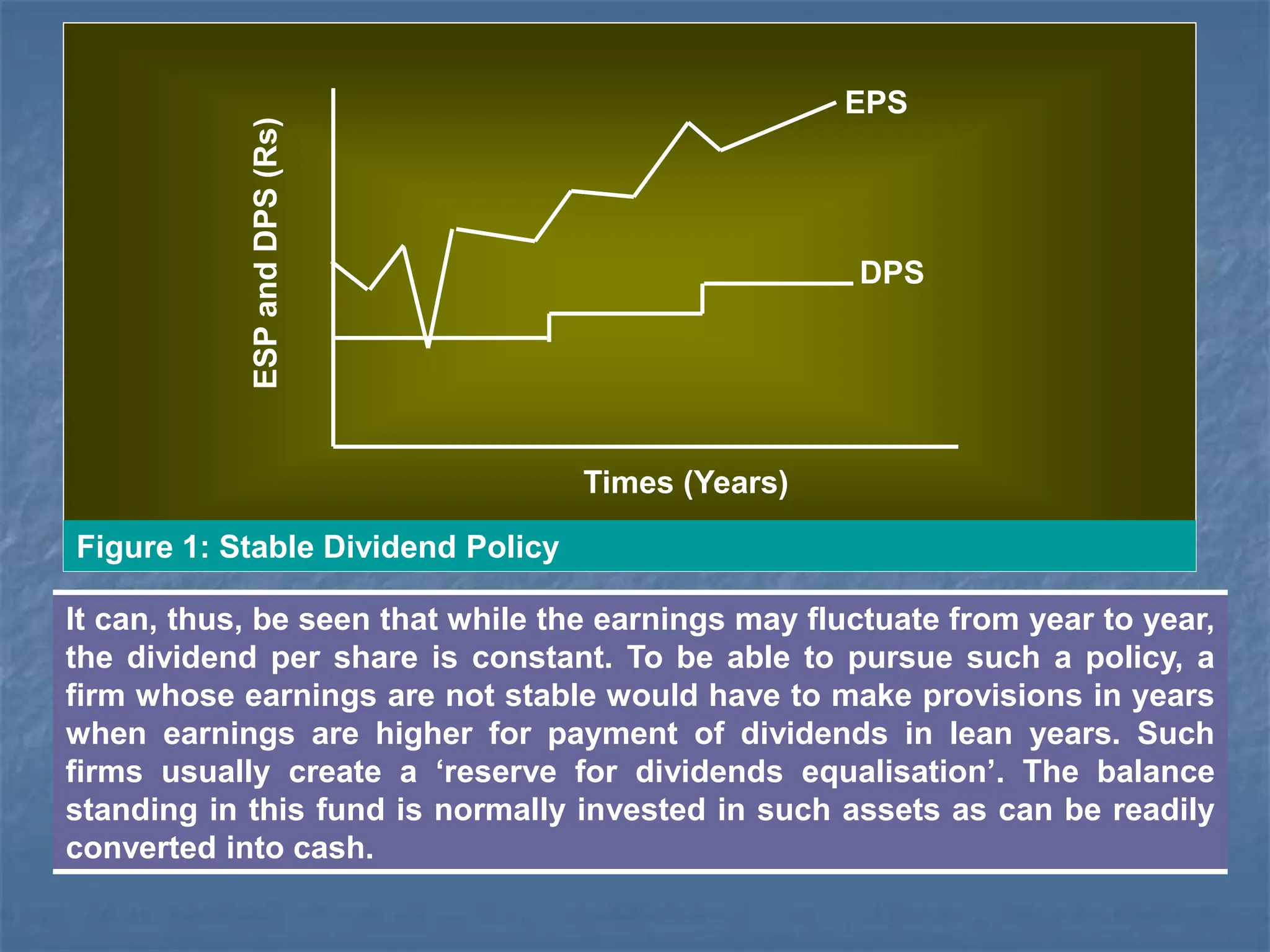
Figure 1: Stable Dividend Policy
DPS
EPS
Times (Years)
ESP
and
DPS
(Rs)
It can, thus, be seen that while the earnings may fluctuate from year to year,
the dividend per share is constant. To be able to pursue such a policy, a
firm whose earnings are not stable would have to make provisions in years
when earnings are higher for payment of dividends in lean years. Such
firms usually create a ‘reserve for dividends equalisation’. The balance
standing in this fund is normally invested in such assets as can be readily
converted into cash.
There are many empirical studies, (e.g. Lintrer) to support the contention that
companies pursue a stable dividend policy.
According to John Lintrer’s study, dividends are ‘sticky’ in the sense that they
are slow to change and lag behind shifts in earnings by one or more periods.
This leads to the pattern of stable dividend per share during the periods of
fluctuating earnings per share and a rising step-function pattern of dividends
per share during increasing earnings per share periods.
Dt – Dt–1 = a0 + c (Dt
* – Dt – 1) (1)
where Dt = Dividend amount under consideration
Dt–1 = Dividend paid in the previous year
a0 = A constant which may have value of zero, but never negative
and generally has a positive value to reflect the greater
reluctance to reduce than to raise dividends
c = Speed of adjustment
Dt
* = Target payout ratio = dividend payout ratio (r) multiplied by profit
after taxes (p) = rp
Dt – Dt–1 = Change in dividend payout (ΔD)
The right hand side of Equation 1 can be rewritten as:
a0 + c (rPt – Dt–1) = a0 + crPt – cDt–1
Adding Dt–1 on both sides of Eq. 1
Dt = a0 + crPt – cDt–1 + Dt–1 = a0 + crPt + Dt–1(1 – c)
Let cr be represented by b1 (short-run propensity to pay dividends) and (1 – c) be represented
by b2 (long-run propensity to pay dividends), we have:
Dt = a0 + b1Pt + b2Dt–1 (2)
Thus, dividends paid by an individual company are a function of a0 (constant), short-run
propensity to pay (b1) and long-run propensity to pay dividends (b2).
Bolten has also formulated a formula based on key variables suggested by Lintner:
where Dt + 1 = dividend amount under consideration,
Dt = prevailing dividend,
Dt /Et = prevailing payout ratio,
P * = target payout ratio,
Et = latest earnings per share, and
a = adjustment cushion.
)
3
(
t
E
t
E
t
D
*
P
a
t
D
1
t
D
















Equation 3 suggests that the increase in dividends would be less than the
increase in earnings owing to the speed of adjustment.
Suppose the target payout ratio of a company is 50 per cent and the present
dividend is Rs 2 per share. The firm would not immediately pay a dividend
of Rs 3 share if the earnings per share rose from Rs 5 per share to Rs 6,
since that would expose the firm to the necessity of reducing the dividend
in the following year, if the earnings per share fell below Rs 6. Rather, the
firm might decide to gradually move toward the 50 per cent target payout by
declaring a Rs 2.50 per share dividend. With Rs 2.50 dividend, the firm’s
earnings per share could drop to Rs 5 in the following year and still be at
the 50 per cent target ratio, avoiding the necessity of reducing the dividend.
Thus,
In summing up, it can be commended that a firm should seek a stable
dividend policy which avoids occasional reductions in dividends. Investors
favourably react to the price of shares of such companies and there is a
price enhancing effect of such a policy.
  50
.
2
Rs
6
Rs
6
Rs
2
Rs
50
.
0
50
.
0
2
Rs
1
t
D 



 







(3) Legal, Contractual, and Internal
Constraints and Restrictions
Legal Requirements Legal stipulations do not
require a dividend declaration but they specify
the conditions under which dividends must be
paid. Such conditions pertain to
a) Capital impairment
b) Net profits
c) Insolvency
(a) Capital Impairment Rules
Legal enactments limit the amount of cash dividends that a firm may pay. A firm
cannot pay dividends out of its paid-up capital, otherwise there would be a
reduction in the capital adversely affecting the security of its lenders. The
rationale of this rule lies in protecting the claims of preference shareholders and
creditors on the firm’s assets by providing a sufficient equity base since the
creditors have originally relied upon such an equity base while extending credit.
(b) Net Profits
The net profits requirement is essentially a corollary of the capital impairment
requirement, in that it restricts the dividend to be paid out of the firm’s current
profits plus past accumulated retained earnings. Alternatively, a firm cannot pay
cash dividends greater than the amount of current profits plus the accumulated
balance of retained earnings.
(c) Insolvency
A firm is said to be insolvent in two situations: first, when its liabilities exceed the
assets; and second, when it is unable to pay its bills. The rationale of the rule is to
protect the creditors by prohibiting the liquidation of near-bankrupt firms through
cash dividend payments to the equity owners.
Contractual Requirements
Important restrictions on the payment of dividend may be accepted by a
company when obtaining external capital either by a loan agreement, a
debenture indenture, a preference share agreement, or a lease contract.
Such restrictions may cause the firm to restrict the payment of cash
dividends until a certain level of earnings has been achieved or limit the
amount of dividends paid to a certain amount or percentage of earnings.
Since the payment of dividend involves a cash outflow, firms are forced
to reinvest the retained earnings within the firm.
Therefore, contractual constraints on dividend payments are quite
common. The payment of cash dividend in violation of a restriction would
amount to default in the case of a loan and the entire principal would
become due and payable. Keeping in view the severity of penalty, the
financial manager must ensure that the amount of dividend is within the
covenants already committed to lenders.
Internal Constraints
Liquid Assets Once the payment of dividend is permissible on legal and
contractual grounds, the next step is to ascertain whether the firm has sufficient
cash funds to pay cash dividends.
Growth Prospects Another set of factors that can influence dividend policy
relates to the firm’s growth prospects. The firm is required to make plans for
financing its expansion programmes.
Financial Requirements Financial requirements of a firm are directly related to
its investment needs. The firm should formulate its dividends policy on the basis
of its foreseeable investment needs
Availability of Funds The dividend policy is also constrained by the availability
of funds and the need for additional investment. In evaluating its financial
position, the firm should consider not only its ability to raise funds but also the
cost involved in it and the promptness with which financing can be obtained.
Earnings Stability The stability of earnings also has a significant bearing on the
dividend decision of a firm. Generally, the more stable the income stream, the
higher is the dividend payout ratio.
Control Dividend policy may also be strongly influenced by the shareholders’ or
the management’s control objectives. That is to say, sometimes management
employs dividend policy as an effective instrument to maintain its position of
command and control.
Owner’s Considerations
Taxes The dividend policy of a firm may be dictated by the income tax
status of its shareholders. If a firm has a large percentage of owners who
are in high tax brackets, its dividend policy should seek to have higher
retentions. Such a policy will provide its owners with income in the form
of capital gains as against dividends. Since capital gains are taxed at a
lower rate than dividends, they are worth more, after taxes, to the
individuals in a high tax bracket.
Opportunities The firm should not retain funds if the rate of return earned
by it would be less than one which could have been earned by the
investors themselves from external investments of funds.
Dilution of Ownership The financial manager should recognise that a
high D/P ratio may result in the dilution of both control and earnings for
the existing equity holders. Dilution in earnings results because low
retentions may necessitate the issue of new equity shares in the future,
causing an increase in the number of equity shares outstanidng and
ultimately lowering earnings per share and their price in the market. By
retaining a high percentage of its earnings, the firm can minimise the
possibility of dilution of earnings.
Capital Market Considerations
Yet another set of factors that can strongly affect dividend policy is the
extent to which the firm has access to the capital markets. In case the firm
has easy access to the capital market, either because it is financially strong
or large in size, it can follow a liberal dividend policy. However, if the firm
has only limited access to capital markets, it is likely to adopt low dividend
payout ratios. Such firms are likely to rely more heavily on retained earnings
as a source of financing their investments.
Inflation
Finally, inflation is another factor which affects the firm’s dividend decision.
With rising prices, funds generated from depreciation may be inadequate to
replace obsolete equipments. These firms have to rely upon retained
earnings as a source of funds to make up the shortfall. This aspect becomes
all the more important if the assets are to be replaced in the near future.
Consequently, their dividend payout tends to be low during periods of
inflation.
DIVIDEND POLICY IN INDIA
The main features of the corporate dividend policy in India are summarised
below
 Most of the corporates have a policy of long-run dividend pay-out ratio.
 Dividend changes follow shift in the long-term sustainable earnings.
 Dividend policy as a residual decision after meeting the desired investment
needs is endorsed by about 50 per cent of the sample corporates. The
corporates which are creating shareholders value (EVA) significantly rescind
dividend increase in the event of growth opportunities available to them.
Large firms are significantly less willing to rescind dividend increases.
 Dividend policy provides a signalling mechanism of the future prospects of
the corporate and, to that exact, affects its market value.
 Investors have different relative risk perceptions of dividend income and
capital gains and are not indifferent between receiving dividend income and
capital gains. Management should be responsive to the shareholders
preferences regarding dividend and the share buy back programme should
not replace the dividend payments of the corporates.
 Dividend payments provide a bonding mechanism so as to encourage
manager to act in the best interest of the shareholders.
 The corporate enterprises in India seem to have a tendency to pay relatively
less dividends. In fact, a fairly large number of them hardly pay any
dividend. The foreign controlled companies seem to follow a policy of larger
distribution of profits relative to the domestic companies. Retained earnings
are a significant source of corporate finance.
 The vast majority of the Indian corporates follows a stable dividend policy in
the sense that they pay either constant dividend per share in the following
year with fluctuating EPS or increased dividend with increase in EPS.
 An overwhelming majority of corporates have a long-run target DIP ratio.
The dividend changes follow shift in long-run sustainable earnings. Their
dividend policy is in agreement with the findings of Lintner’s study on
dividend policy.
 Firms which are creating shareholder value are significantly more willing to
rescind dividend increase in the event of growth opportunities available to
them. The larger firms are significantly less willing to rescind dividend
increase than the small firms.
 Dividend policy provides a signalling mechanism of the future prospects of
the firm and thus affects its market value. The investors are not indifferent
between receiving dividend income and capital gains.
CONTD.
BONUS SHARES (STOCK DIVIDEND) AND
STOCK (SHARE) SPLITS
Apart from cash dividend, a firm can also reward its investors by
paying bonus shares. The bonus shares/share splits do not have
any economic impact on the firm in that its assets, earnings and
investors’ proportionate ownership remain unchanged. As a
result, the number of shares outstanding increases. The increased
number of shares outstanding tends to bring the market price of
shares within more popular range and promote more active
trading in shares. Moreover, bonus/split announcements have
informational content to the investors. It will also enable the
conservation of corporate cash and further enable a firm to raise
additional funds particularly through the issue of convertible
securities.
TABLE 1 Effect of Bonus Shares and Share Splits
(I) Equity portion before the bonus issue:
Equity share capital (30,000 share of Rs 100 each) Rs 30,00,000
Share premium (@ Rs 25 per share) 7,50,000
Retained earnings 62,50,000
Total equity 1,00,00,000
(II) Equity portion after the bonus issue (1 : 2 ratio):
Equity share capital (45,000 shares of Rs 100 each) 45,00,000
Share premium (45,000 shares × Rs 25) 11,25,000
Retained earnings (Rs 62,50,000 – 15,000 shares × Rs 125) 43,75,000
Total equity 1,00,00,000
(III) Equity portion after the share splits (10 : 1 ratio):
Equity share capital (3,00,000 shares of Rs 10 each) 30,00,000
Share premium 7,50,000
Retained earnings 62,50,000
Total equity 1,00,00,000
LEGAL, PROCEDURAL AND TAX ASPECTS
Legal Aspects
The amount of dividend that can be legally distributed is governed by company
law, judicial pronouncements in leading cases, and contractual restrictions. The
important provisions of company law pertaining to dividends are described below.
1) Companies can pay only cash dividends (with the exception of bonus
shares). Apart from cash, dividend may also be remitted by cheque or by
warrant.
2) Dividends can be paid only out of the profits earned during the financial year
after providing for depreciation and after transferring to reserves such
percentage of profits as prescribed by law.
3) Due to inadequacy or absence of profits in any year, dividend may be paid
out of the accumulated profits of previous years.
4) Dividends cannot be declared for past years for which accounts have been
adopted by the shareholders in the annual general meeting.
5) Dividend declared, interim or final, should be deposited in a separate bank
account within 5 days from the date of declaration and dividend will be paid
within 30 days from such a date.
6) Dividend including interim dividend once declared becomes a debt. While the
payment of interim dividend cannot be revoked, the payment of final dividend
can be revoked with the consent of the shareholders.
Procedural Aspects
The important events and dates in the dividend payment procedure are:
1) Board Resoultion: The dividend decision is the prerogative of the board of
directors. Hence, the board of directors should in a formal meeting resolve
to pay the dividend.
2) Shareholder Approval: The resolution of the board of directors to pay the
dividend has to be approved by the shareholders in the annual general
meeting.
3) Record Date: The dividend is payable to shareholders whose names appear
in the register of members as on the record date.
4) Dividend Payment: Once a dividend declaration has been made, dividend
warrant must be posted within 30 days.
5) Unpaid Dividend: if the money transferred to the ‘unpaid dividend account’
in the scheduled bank remains unpaid/unclaimed for a period of 7 years
from the date of such transfer, the company is required to transfer the same
to the ‘Investor.
Tax Aspects
With effect from financial year 2003-4, dividend income from domestic
companies and mutual funds is exempt from tax in the hands of the
shareholders/investors/unit-holders. However, the domestic companies will be
liable to pay dividend distribution tax at the effective rate of 16.995 per cent on
dividends paid after April 1, 2007.
SOLVED PROBLEM 1
X Cement Ltd requires you, as their financial consultant, to advise them with
respect to the dividend policy they have to follow for the current year. The
cement industry has been through a very trying period in the last five years and
the constraints on operations have been removed in the early part of the year.
The company hopes to improve its position in the years to come and has plans
to put up an additional plant in the neighbourhood of the present factory. The
increased profits, due to expansion in capacity, are expected to be 25 per cent
of the additional capital investment after meeting interest charges but before
depreciation on the additional plant installed. The shares of X Cement Ltd are
widely held and there is a large majority of holdings in the hands of middle
class invesotrs whose average holdings do not exceed 500 shares. The
following further data is also made available to you:
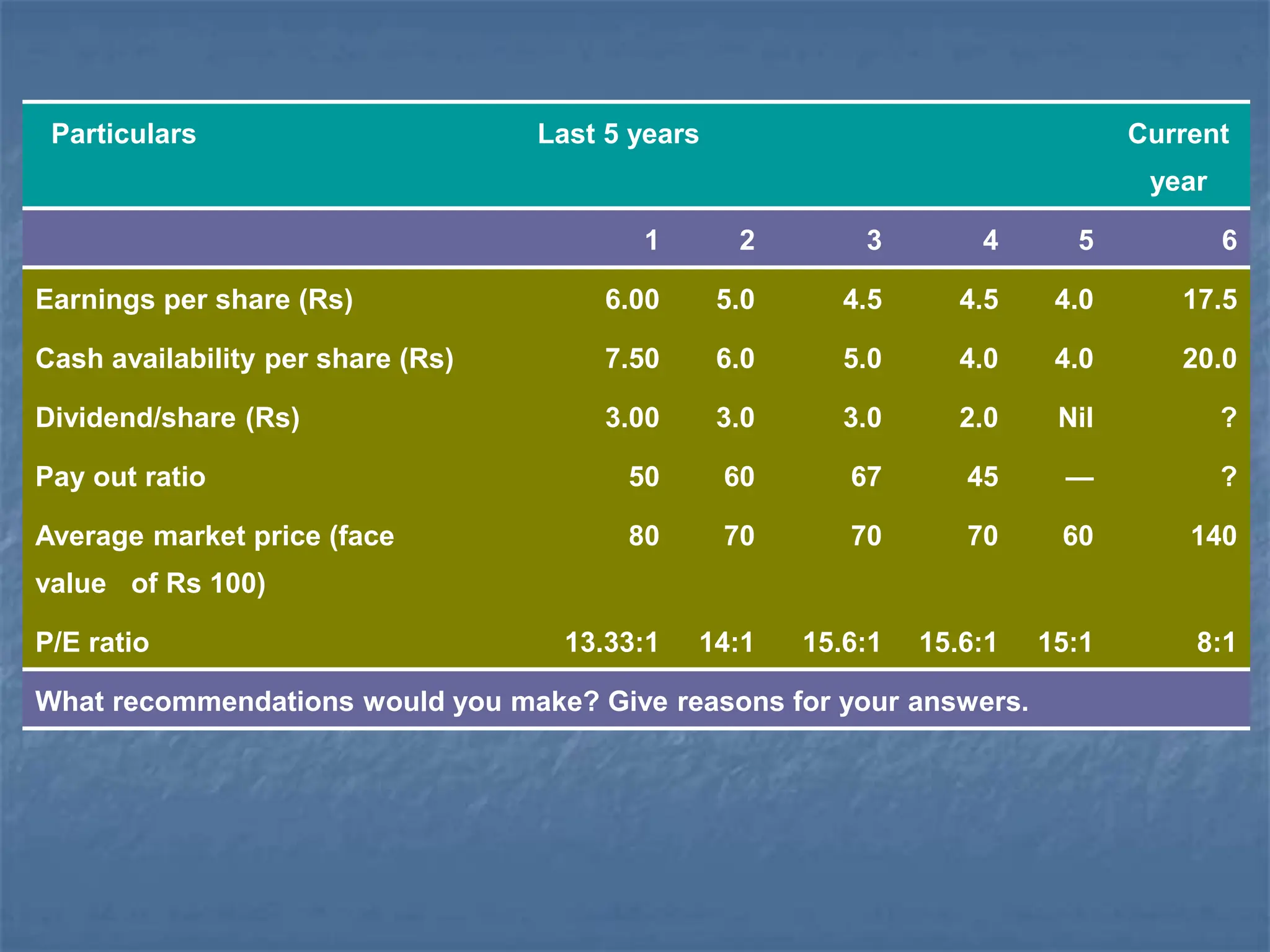
Particulars Last 5 years Current
year
1 2 3 4 5 6
Earnings per share (Rs) 6.00 5.0 4.5 4.5 4.0 17.5
Cash availability per share (Rs) 7.50 6.0 5.0 4.0 4.0 20.0
Dividend/share (Rs) 3.00 3.0 3.0 2.0 Nil ?
Pay out ratio 50 60 67 45 — ?
Average market price (face
value of Rs 100)
80 70 70 70 60 140
P/E ratio 13.33:1 14:1 15.6:1 15.6:1 15:1 8:1
What recommendations would you make? Give reasons for your answers.
Solution
The company appears to be following a stable dividend policy, that is, a
policy of maintaining a stable rupee dividend, decreasing it only when it
appears that earnings have reached a new, permanently low level or vice-
versa in that although the EPS has declined from Rs 6 in Year 1 to Rs 4.50 in
Year 3, no corresponding decrease was effected in the DPS. However, when
the declining trend of earnings continued in subsequent years too, the
dividends had been lowered inasmuch as no dividends were paid in year 5.
Consequently, its share prices fell from Rs 80 in Year 1 to Rs 60 in Year 5.
The decline in market prices is less pronounced in the context of much
distressing profitability and dividend record of the company during the
period as a whole. The rate of return of 6 per cent on equity capital in Year 1
was the maximum. Even this modest amount consistently declined to
eventually a very low figure of 4 per cent by current year; the dividend yield
was still smaller. The only off-setting factor was the stable dividend policy.
Given the improved record of earnings in the current year and the trend which is
likely to continue in future years, coupled with favourable liquidity position, a rise in
dividend is commended for the undermentioned reasons.
(a) The investors would receive dividend income free of tax, especially if this
category of investors includes retired persons who need the current income for
living expenses and do not wish to sell even a small portion of their shares
either because of transaction costs involved or because they are reluctant to
‘eating their own capital’.
(b) The investors must be expecting a substantial rise in dividend in the light of the
current market price of Rs 140 compared to Rs 60 last year. Failure to pay
dividend commensurate to the shareholder’s expectation will have an adverse
effect on share prices.
(c) Cement industry with stable sales and earnings can afford high leverage ratios.
The company is not likely to encounter any major difficulty in raising funds to
finance an additional plant due to bright future prospects.
(d) The payment of dividend resolves uncertainty; investors in general are risk
averters; they prefer current dividends to larger deferred dividends.
The payment was 50 per cent in Year 1; the payment of 60 per cent is recommeded
this year, assuming that target dividend payout ratio is 75 per cent. Moreover, the
company through advertisements should make the investors aware of the growth
prospects and the investment opportunities ahead which would have a positive
effect on share prices.
SOLVED PROBLEM 2
From the following financial statistics of Infosys Ltd for the period 1993-94 to 2001-02 (along with
Sensex), comment on its dividend policy. Are its shares overvalued?
Year MPS Networth
(Rs lakh)
Equity
Dividen
d (Rs
lakh)
EAT
(Rs
Lakh)
EPS NWPS D/P
(%)
DPS Sense
x
1993-94 Rs 343 2,870 117 809 Rs 24.15 Rs 85.67 14.46 Rs 3.49 4,485
1994-95 607 6,247 231 1,332 19.88 93.24 17.34 3.45 4,385
1995-96 458 7,984 363 2,101 28.94 109.97 17.28 5.00 3,259
1996-97 731 11,284 399 3,698 50.94 155.43 10.79 5.50 3,440
1997-98 1,493 17,296 703 6,036 39.53 113.28 11.65 4.60 3,770
1998-99 2,597 57,443 1,211 13,526 84.43 358.57 8.95 7.56 3,286
1999-00* 6,891 83,330 2,976 29,352 91.64 260.16 10.14 9.29 4,543
2000-01 7,173 1,38,964 6,615 62,881 196.32 433.86 10.52 20.65 4,355
2001-02 3,606 2,08,031 13,236 80,796 244.32 629.06 16.38 40.02 3,336
* Company issued bonus shares in the ratio of 1:1.
Solution The Infosys Ltd appears to be following a stable dividend policy. The
dividend per share (DPS) have consistently increased from Rs 3.5 in 1993-94 to Rs
7.56 in 1998-99 and, further, to Rs 40.02 in 2001-02. Though the DPS has shown a
significant increase over the years, the dividends paid are low in relation to the
market price of its share (MPS). The dividend yield (DPS/MPS) is less than one per
cent in most of the years. In 2001-02, when dividends paid were maximum, the
dividend yield was 1.1 per cent only. The dividend payout (D/P) ratios is also a
pointer towards the same, varying in the range of 8.95 per cent (1993-94) and 17.34
per cent (2001-02). The D/P ratios of less than 20 per cent, for a
software/information technology company is below the mark.
The DPS are also not commensurate with the pronounced increase in the EAT as
well as the EPS over the years particularly since 1998-99. For instance, while EPS
was Rs 196.32 and Rs 244.32 in 2001 and 2002 respectively, the corresponding DPS
in these years were Rs 20.65 and Rs 40.02 only. However, Infosys has virtually
doubled the payment of DPS in 2002 over 2001. Given the improved record of
earnings, particularly since 1998-99 and the trend which is likely to continue in
future years in view of increased level of projects from the US, Infosys would be
well advised to pay higher dividend.
All along the period under reference, the market price of its shares seem to be over-
valued as reflected in the market price/book value (net worth) ratio (P/B ratio) as
shown below:
Year MPS NWPS P/B ratio
1993-94 Rs 343 Rs 85.67 4.00
1994-95 607 93.24 6.51
1995-96 458 109.97 4.16
1996-97 731 155.43 4.70
1997-98 1,493 113.28 13.18
1998-99 2,597 358.57 7.24
1999-00 6,891 260.16 26.49
2000-01 7,173 433.86 16.53
2001-02 3,606 629.06 5.73
The P/B ratio indicates that the MPS of Infosys' shares is substantially overvalued.
It was maximum (26.49 times) in 1999-2000. The reason may be higher expected of
growth of software industry by the investors in view of large number of project and
service outsourcing done from India by the USA. However, the MPS is not
warranted by the fundamental factors such as EPS, DPS, NWPS, P/B ratio and so
on.
DIVIDEND AND VALUATION
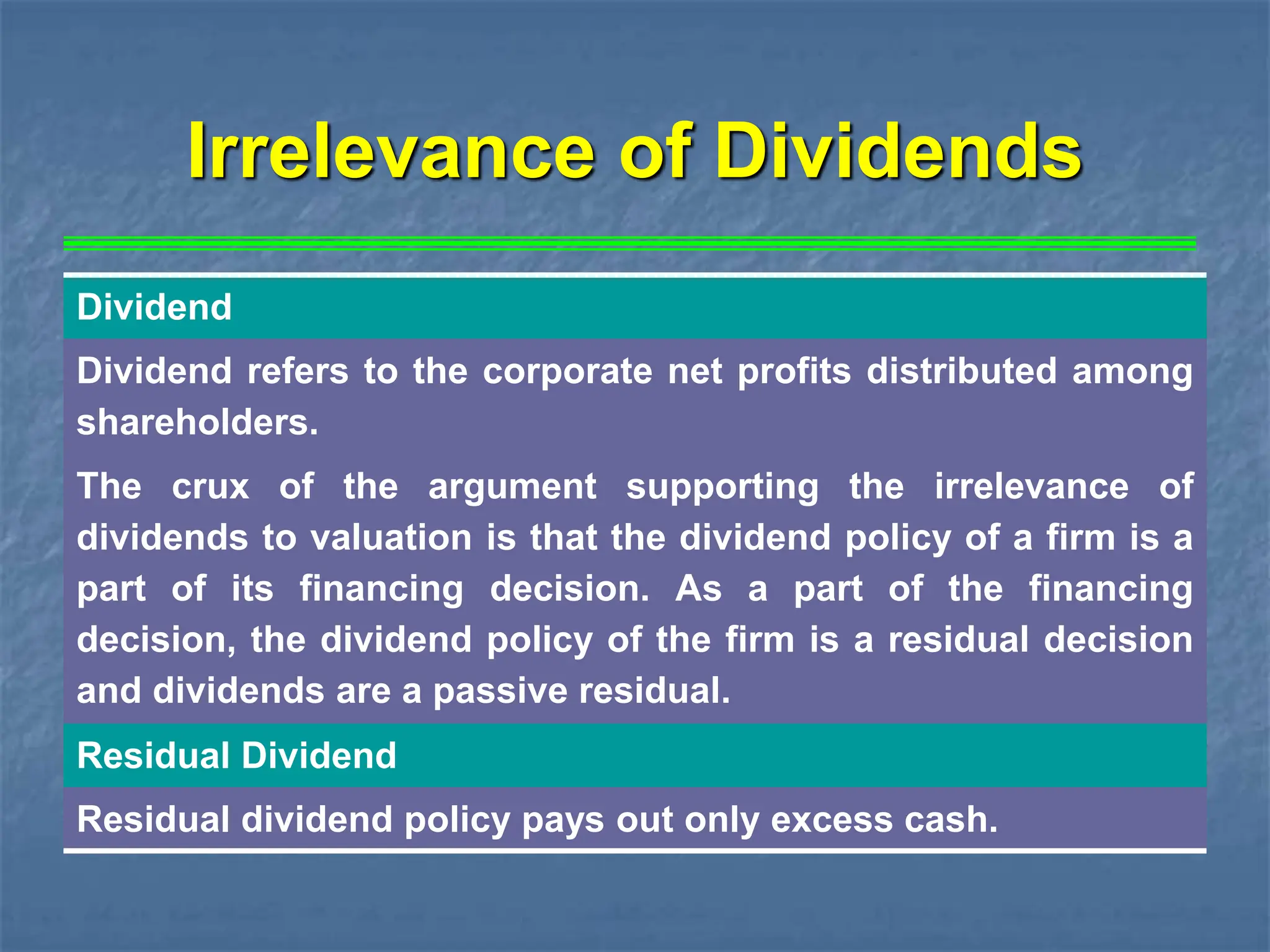
Irrelevance of Dividends
Relevance of Dividends
Solved Problems
Irrelevance of Dividends
Dividend
Dividend refers to the corporate net profits distributed among
shareholders.
The crux of the argument supporting the irrelevance of
dividends to valuation is that the dividend policy of a firm is a
part of its financing decision. As a part of the financing
decision, the dividend policy of the firm is a residual decision
and dividends are a passive residual.
Residual Dividend
Residual dividend policy pays out only excess cash.
Dividends are irrelevant, or are a passive residual, is based
on the assumption that the investors are indifferent between
dividends and capital gains. So long as the firm is able to
earn more than the equity-capitalisation rate (ke), the
investors would be content with the firm retaining the
earnings. In contrast, if the return is less than the ke,
investors would prefer to receive the earnings (i.e. dividends).
Modigliani and Miller (MM)
Hypothesis
The most comprehensive argument in support of the
irrelevance of dividends is provided by the MM
hypothesis. Modigliani and Miller maintain that
dividend policy has no effect on the share price of
the firm and is, therefore, of no consequence.
Dividend Irrelevance
Dividend irrelevance implies that the value of a firm
is unaffected by the distribution of dividends and is
determined solely by the earning power and risk of
its assets.
Assumptions
The MM hypothesis of irrelevance of dividends is based on the
following critical assumptions:
1) Perfect capital markets in which all investors are rational.
There are no taxes. Alternatively, there are no differences in tax
rates applicable to capital gains and dividends.
2) A firm has a given investment policy which does not change.
There is a perfect certainty by every investor as to future
investments and profits of the firm.
Crux of the Argument
The crux of the MM position on the irrelevance of dividend is the arbitrage
argument. The arbitrage process involves a switching and balancing
operation. In other words, arbitrage refers to entering simultaneously into
two transactions which exactly balance or completely offset each other. The
two transactions here are the acts of paying out dividends and raising
external funds–either through the sale of new shares or raising additional
loans–to finance investment programmes.
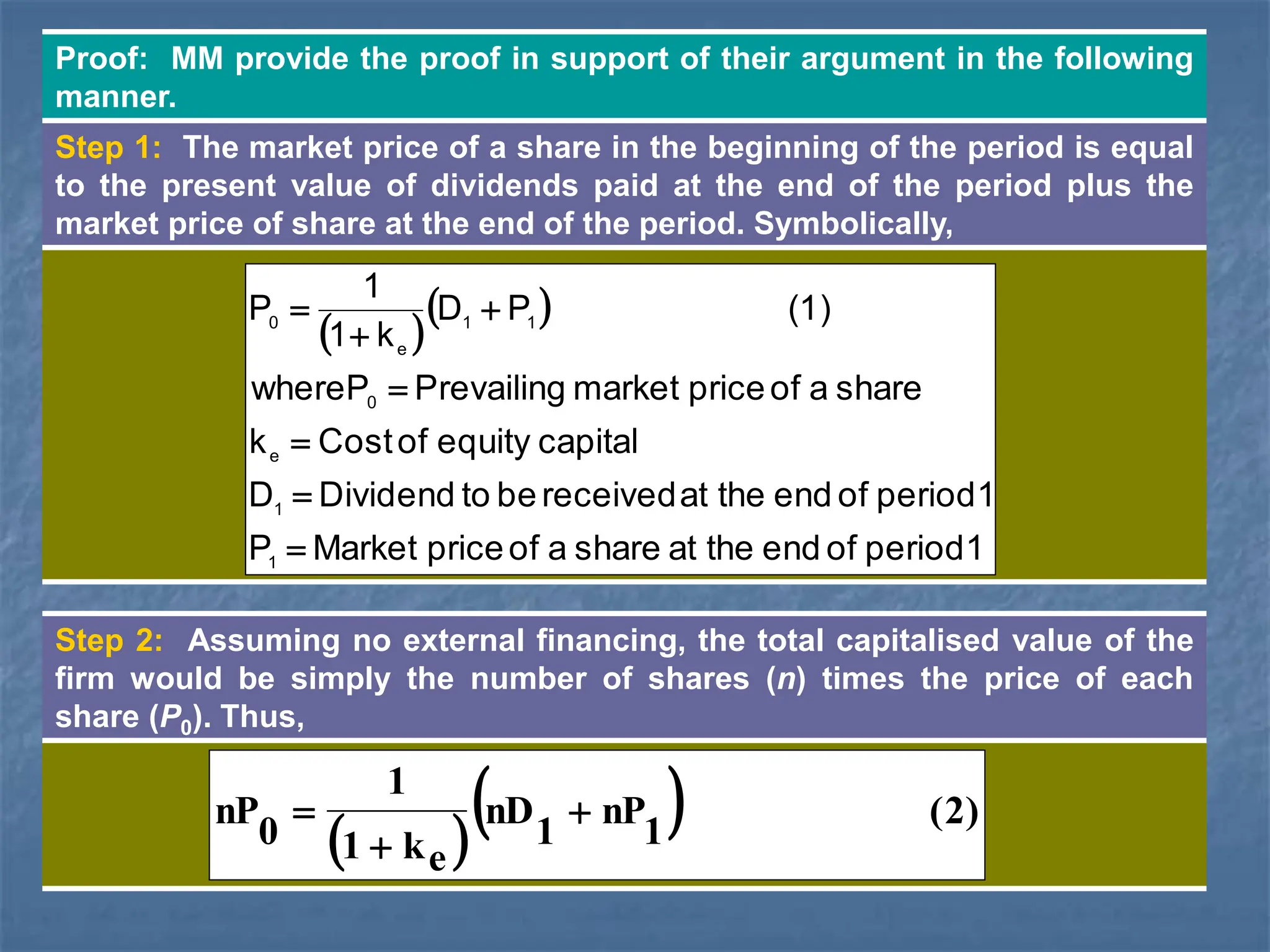
Proof: MM provide the proof in support of their argument in the following
manner.
Step 1: The market price of a share in the beginning of the period is equal
to the present value of dividends paid at the end of the period plus the
market price of share at the end of the period. Symbolically,
 
 
1
period
of
end
the
at
share
a
of
price
Market
P
1
period
of
end
the
at
received
be
to
Dividend
D
capital
equity
of
Cost
k
share
a
of
price
market
Prevailing
whereP
(1)
P
D
k
1
1
P
1
1
e
0
1
1
e
0







Step 2: Assuming no external financing, the total capitalised value of the
firm would be simply the number of shares (n) times the price of each
share (P0). Thus,
 
  )
2
(
1
nP
1
nD
e
k
1
1
0
nP 


Step 3: If the firm’s internal sources of financing its investment
opportunities fall short of the funds required, and Δn is the number of
new shares issued at the end of year 1 at price of P1, Eq. 2 can be written
as:
 
 
 
  )
3
(
nP
P
n
n
nD
k
1
1
nP 1
1
1
e
0 






where n = Number of shares outstanding at the beginning of the period
Δn = Change in the number of shares outstanding during the
period/Additional shares issued
Equation 3 implies that the total value of the firm is the capitalised value of the
dividends to be received during the period plus the value of the number of shares
outstanding at the end of the period, considering new shares, less the value of the
new shares. Thus, in effect, Eq. 3 is equivalent to Eq. 2.
Step 4: If the firm were to finance all investment proposals, the
total amount raised through new shares issued would be given in
Eq. 4.
ΔnP1 = I – (E – nD1)
or ΔnP1 = I – E + nD1 (4)
where ΔnP1 = Amount obtained from the sale of new shares of
finance capital budget.
I = Total amount/requirement of capital budget
E = Earnings of the firm during the period
nD1 = Total dividends paid
(E – nD1) = Retained earnings
According to Equation 4, whatever investment needs (I) are not
financed by retained earnings, must be financed through the sale
of additional equity shares.
Step 5: If we substitute Eq. 4 into Eq. 3 we derive Eq. 5.
 
   
 
 
 
 
 
(6)
e
k
1
E
I
1
P
Δn
n
0
nP
have
then
We
cancels.
1
nD
Therefore,
.
1
nD
negative
and
1
nD
positive
a
is
There
e
k
1
1
nD
E
I
1
P
Δn
n
1
nD
0
nP
have
we
5
eq.
Solving
5)
1
nD
E
I
1
P
Δn
n
1
nD
e
k
1
1
0
nP


















 (
Step 6: Conclusion Since dividends (D) are not found in Eq. 6, Modigliani
and Miller conclude that dividends do not count and that dividend policy
has no effect on the share price.
Example 1
A company belongs to a risk class for which the approximate
capitalisation rate is 10 per cent. It currently has outstanding 25,000
shares selling at Rs 100 each. The firm is contemplating the
declaration of a dividend of Rs 5 per share at the end of the current
financial year. It expects to have a net income of Rs 2,50,000 and
has a proposal for making new investments of Rs 5,00,000. Show
that under the MM assumptions, the payment of dividend does not
affect the value of the firm.
Solution
 
 
 
 
25,00,000
Rs
1.10
27,50,000
Rs
2,50,000
5,00,000
Rs
105
Rs
21
75,000
1
25,000
)
e
k
(1
E
I
1
P
Δn
n
0
nP
firm,
the
of
Value
(iv)
Shares
21
75,000
105
Rs
3,75,000
Rs
Δn
issued,
be
to
shares
additional
of
Number
(iii)
3,75,000
Rs
1,25,000
Rs
-
2,50,000
Rs
-
5,00,000
Rs
1
nD
E
I
1
ΔnP
shares,
new
of
issue
the
from
raised
be
to
required
Amount
(ii)
1
P
105
1
P
5
Rs
110
1
P
5
Rs
1.10
1
100
Rs
1
P
1
D
e
k
1
1
0
P
1,
year
of
end
the
at
share
per
Price
(i)


















































:
Paid
Are
Dividends
When
Firm,
the
of
Price
(a)
 
 
25,00,000
Rs
1.1
27,50,000
Rs
2,50,000
Rs
5,00,000
Rs
110
Rs
11
25,000
1
25,000
firm
the
of
Value
(iv)
shares
11
25,000
110
Rs
2,50,000
Rs
issued,
be
to
shares
additional
of
Number
(iii)
2,50,000
Rs
2,50,000
Rs
-
5,00,000
Rs
1
ΔΔn
shares,
new
of
issue
the
form
raised
be
to
required
Amount
(ii)
1
P
110
or
/1.10
1
P
100
Rs
1,
year
the
of
end
the
at
share
per
Price
(i)









 







Paid
Not
Are
Dividends
When
Firm
the
of
Value
(b)
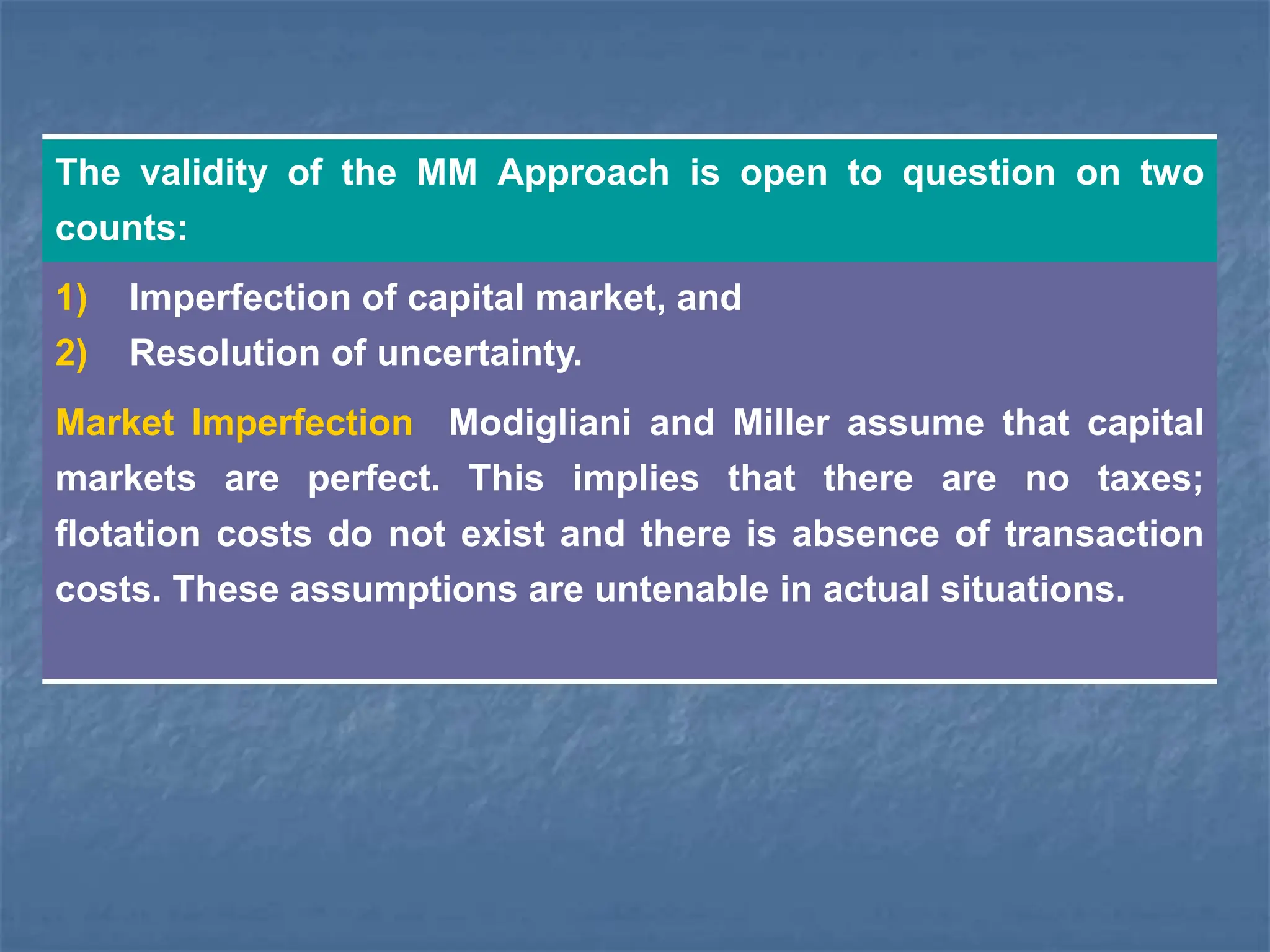
The validity of the MM Approach is open to question on two
counts:
1) Imperfection of capital market, and
2) Resolution of uncertainty.
Market Imperfection Modigliani and Miller assume that capital
markets are perfect. This implies that there are no taxes;
flotation costs do not exist and there is absence of transaction
costs. These assumptions are untenable in actual situations.
Resolution of Uncertainty
(i) near vs distant dividend; (ii) informational content of dividends; (iii)
preference for current income; and (iv) sale of stock at uncertain
price/underpricing.
Near Vs Distant Dividend One aspect of the uncertainty situation is the
payment of dividend now or at a later date. The argument that near dividend
implies resolution of uncertainty is referred to as the ‘bird-in-hand’
argument. Bird-in-hand argument is the belief that current dividend
payments reduce uncertainty and result in higher value of shares of a firm.
Informational Content of Dividends Another aspect of uncertainty, very
closely related to the first (i.e. resolution of uncertainty or the ‘bird-in-hand’
argument) is the ‘informational content of dividend’ argument. Informational
content is the information provided by dividend of a firm with respect to
future earnings which causes owners to bid up or down the price of shares.
Preference for Current Income The third aspect of the uncertainty question
relating to dividends is based on the desire of investors for current income
to meet consumption requirements.
Underpricing implIes sale of shares at price lower than the current market.
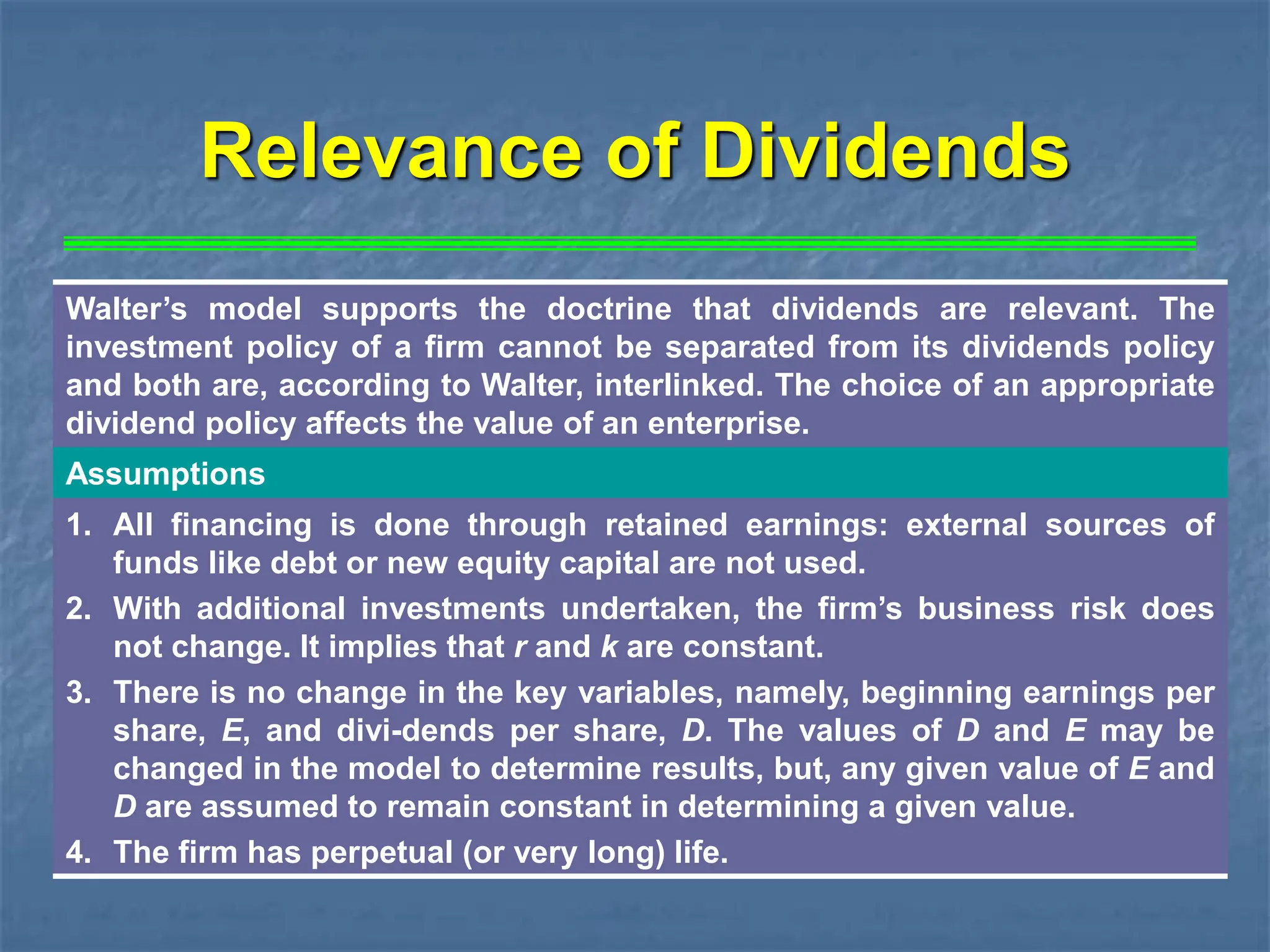
Walter’s model supports the doctrine that dividends are relevant. The
investment policy of a firm cannot be separated from its dividends policy
and both are, according to Walter, interlinked. The choice of an appropriate
dividend policy affects the value of an enterprise.
Assumptions
1. All financing is done through retained earnings: external sources of
funds like debt or new equity capital are not used.
2. With additional investments undertaken, the firm’s business risk does
not change. It implies that r and k are constant.
3. There is no change in the key variables, namely, beginning earnings per
share, E, and divi-dends per share, D. The values of D and E may be
changed in the model to determine results, but, any given value of E and
D are assumed to remain constant in determining a given value.
4. The firm has perpetual (or very long) life.
Relevance of Dividends
D)/E
-
(E
rate
Retention
b
s
investment
firms
on
return
of
rate
Expected
r
where
rb
e
k
D
P
have
we
,
retentions
earnings
reflect
To
earnings
of
rate
growth
Expected
g
capital
equity
of
Cost
e
k
dividend
Initial
D
shares
equity
of
Price
P
where
g
e
k
D
P










)
8
(
)
7
(
 
 
 
investment
firms
the
on
return
of
rate
The
r
share
per
Earnings
E
share
per
Dividend
D
share
a
of
price
market
prevailing
The
whereP
e
k
D
E
e
k
r
D
P
P
D
E
e
k
r
D
e
k
have
we
,
Δ
of
value
the
ng
substituti
,
D
E
e
k
r
P
Δ
since
and
P
ΔP
P
D
e
k
have,
We
P
ΔP
g
(9)
g
P
D
e
k
e
k
determing
for
equation
an
derive
we
7,
equation
the
From

















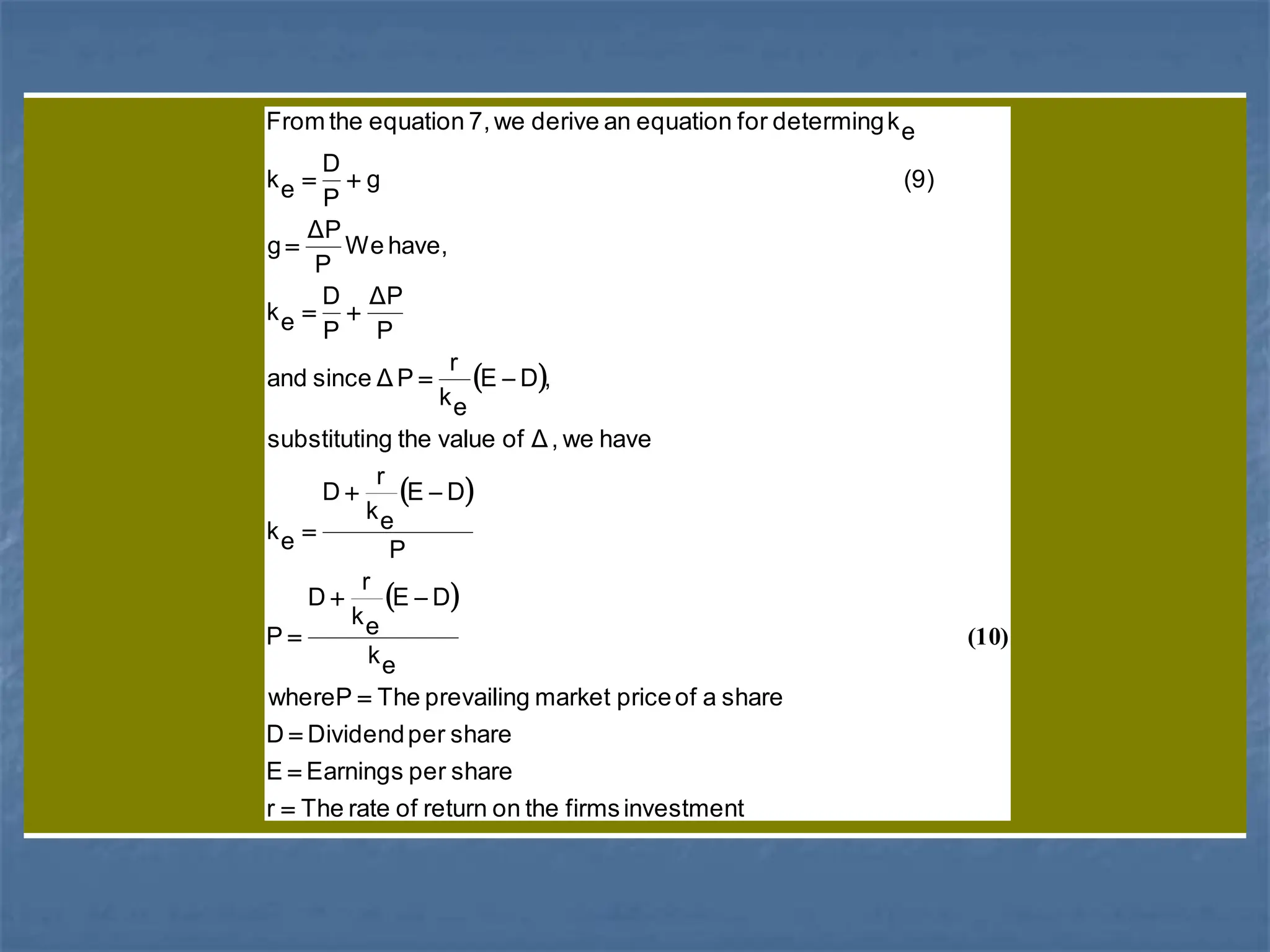
)
10
(
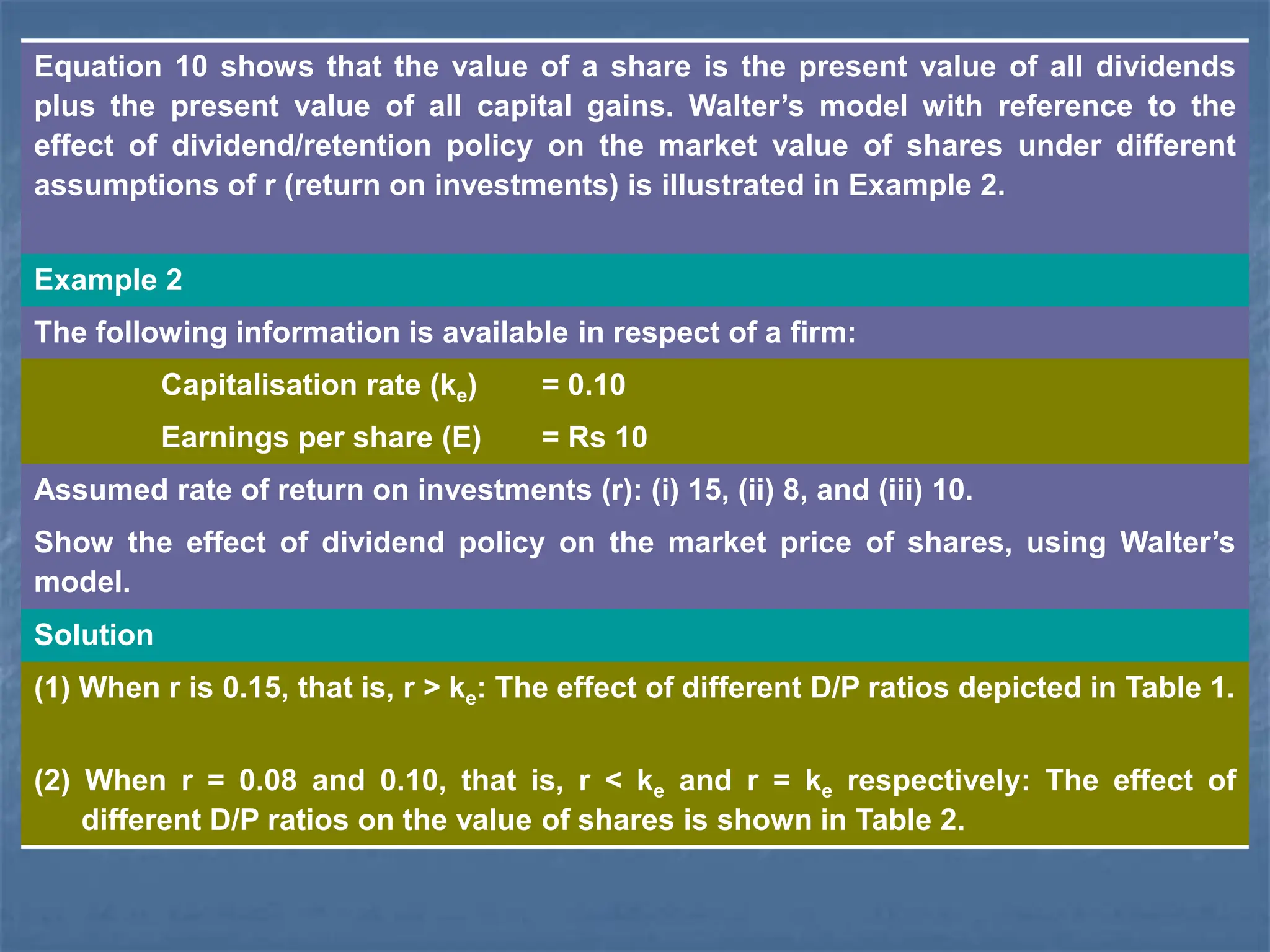
Equation 10 shows that the value of a share is the present value of all dividends
plus the present value of all capital gains. Walter’s model with reference to the
effect of dividend/retention policy on the market value of shares under different
assumptions of r (return on investments) is illustrated in Example 2.
Example 2
The following information is available in respect of a firm:
Capitalisation rate (ke) = 0.10
Earnings per share (E) = Rs 10
Assumed rate of return on investments (r): (i) 15, (ii) 8, and (iii) 10.
Show the effect of dividend policy on the market price of shares, using Walter’s
model.
Solution
(1) When r is 0.15, that is, r > ke: The effect of different D/P ratios depicted in Table 1.
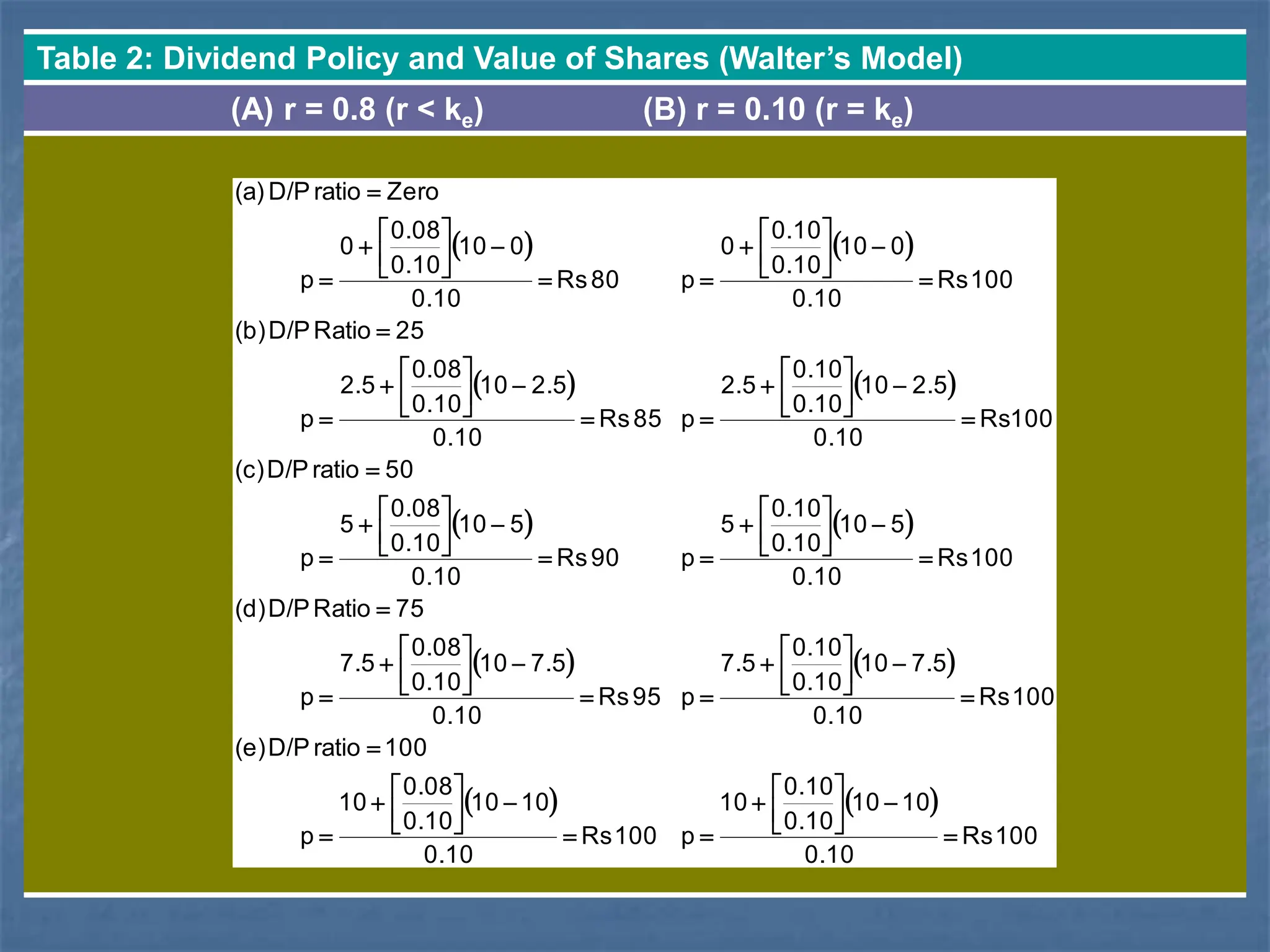
(2) When r = 0.08 and 0.10, that is, r < ke and r = ke respectively: The effect of
different D/P ratios on the value of shares is shown in Table 2.
Table 1 : Dividend Policy and Value of Shares (Walter’s Model)
 
 
 
 
 
100
Rs
0.10
10
10
0.10
0.15
10
p
10)
Rs
share
per
(Dividend
100
ratio
(e)D/P
112.50
Rs
0.10
7.5
10
0.10
0.15
7.5
P
7.5)
Rs
share
per
(Dividend
75
ratio
(d)D/P
125
Rs
0.10
5
10
0.10
0.15
5
P
5)
Rs
share
per
(Dividend
50
ratio
(c)D/P
137.50
Rs
0.10
2.5
10
0.10
0.15
2.5
P
2.5)
Rs
share
per
(Dividend
25
ratio
(b)D/P
Rs150
0.10
0
10
0.10
0.15
0
P
zero)
share
per
(Dividend
0
ratio
(a)D/P




























































Table 2: Dividend Policy and Value of Shares (Walter’s Model)
(A) r = 0.8 (r < ke) (B) r = 0.10 (r = ke)
   
   
   
   
   
100
Rs
0.10
10
10
0.10
0.10
10
p
100
Rs
0.10
10
10
0.10
0.08
10
p
100
ratio
D/P
(e)
100
Rs
0.10
7.5
10
0.10
0.10
7.5
p
95
Rs
0.10
7.5
10
0.10
0.08
7.5
p
75
Ratio
D/P
(d)
100
Rs
0.10
5
10
0.10
0.10
5
p
90
Rs
0.10
5
10
0.10
0.08
5
p
50
ratio
D/P
(c)
100
Rs
0.10
2.5
10
0.10
0.10
2.5
p
85
Rs
0.10
2.5
10
0.10
0.08
2.5
p
25
Ratio
D/P
(b)
100
Rs
0.10
0
10
0.10
0.10
0
p
80
Rs
0.10
0
10
0.10
0.08
0
p
Zero
ratio
D/P
(a)









































































































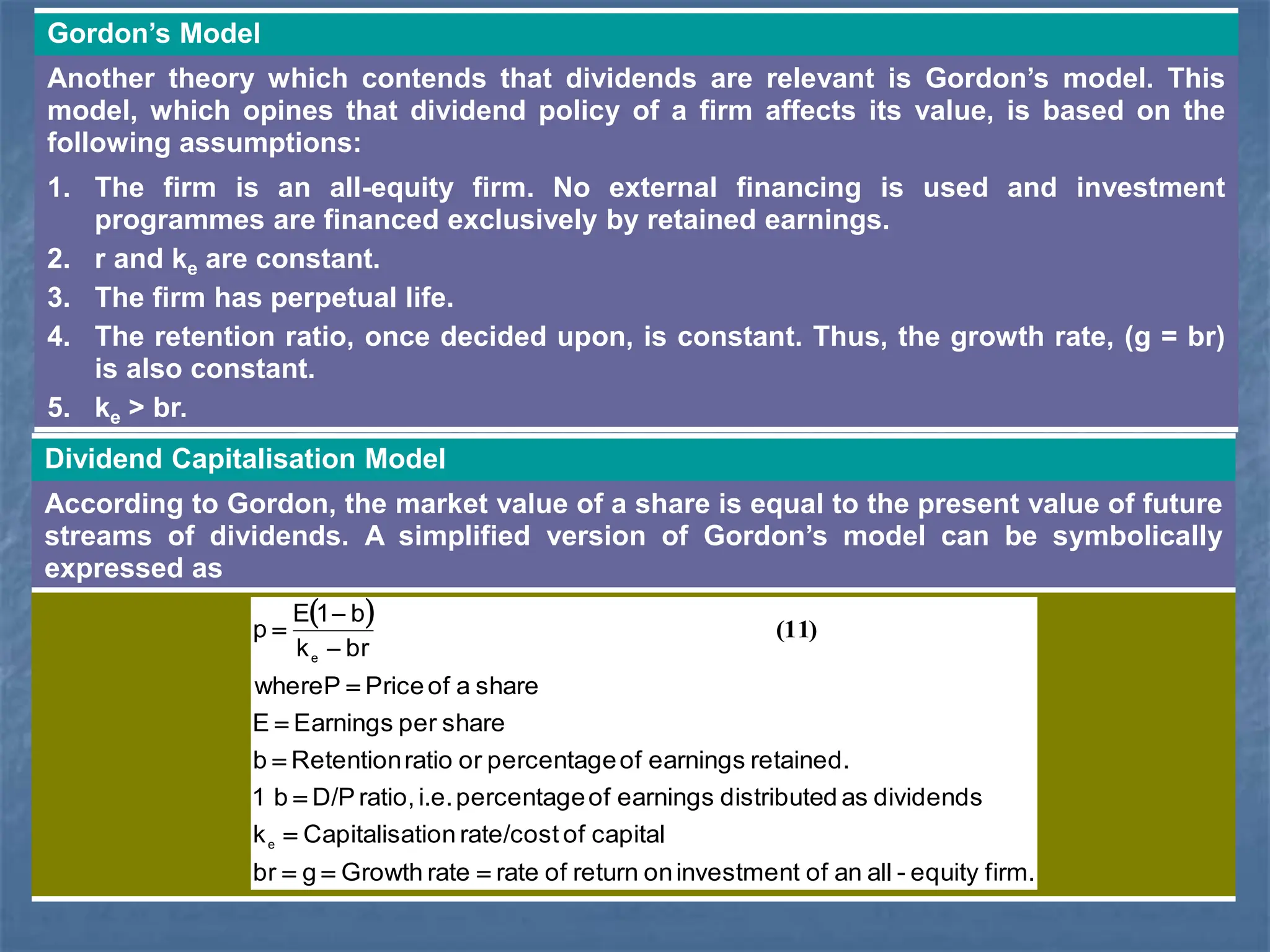
Gordon’s Model
Another theory which contends that dividends are relevant is Gordon’s model. This
model, which opines that dividend policy of a firm affects its value, is based on the
following assumptions:
1. The firm is an all-equity firm. No external financing is used and investment
programmes are financed exclusively by retained earnings.
2. r and ke are constant.
3. The firm has perpetual life.
4. The retention ratio, once decided upon, is constant. Thus, the growth rate, (g = br)
is also constant.
5. ke > br.
Dividend Capitalisation Model
According to Gordon, the market value of a share is equal to the present value of future
streams of dividends. A simplified version of Gordon’s model can be symbolically
expressed as
 
firm.
equity
-
all
an
of
investment
on
return
of
rate
rate
Growth
g
br
capital
of
rate/cost
tion
Capitalisa
k
dividends
as
d
distribute
earnings
of
percentage
i.e.
ratio,
D/P
b
1
retained.
earnings
of
percentage
or
ratio
Retention
b
share
per
Earnings
E
share
a
of
Price
whereP
br
k
b
1
E
p
e
e










 )
11
(
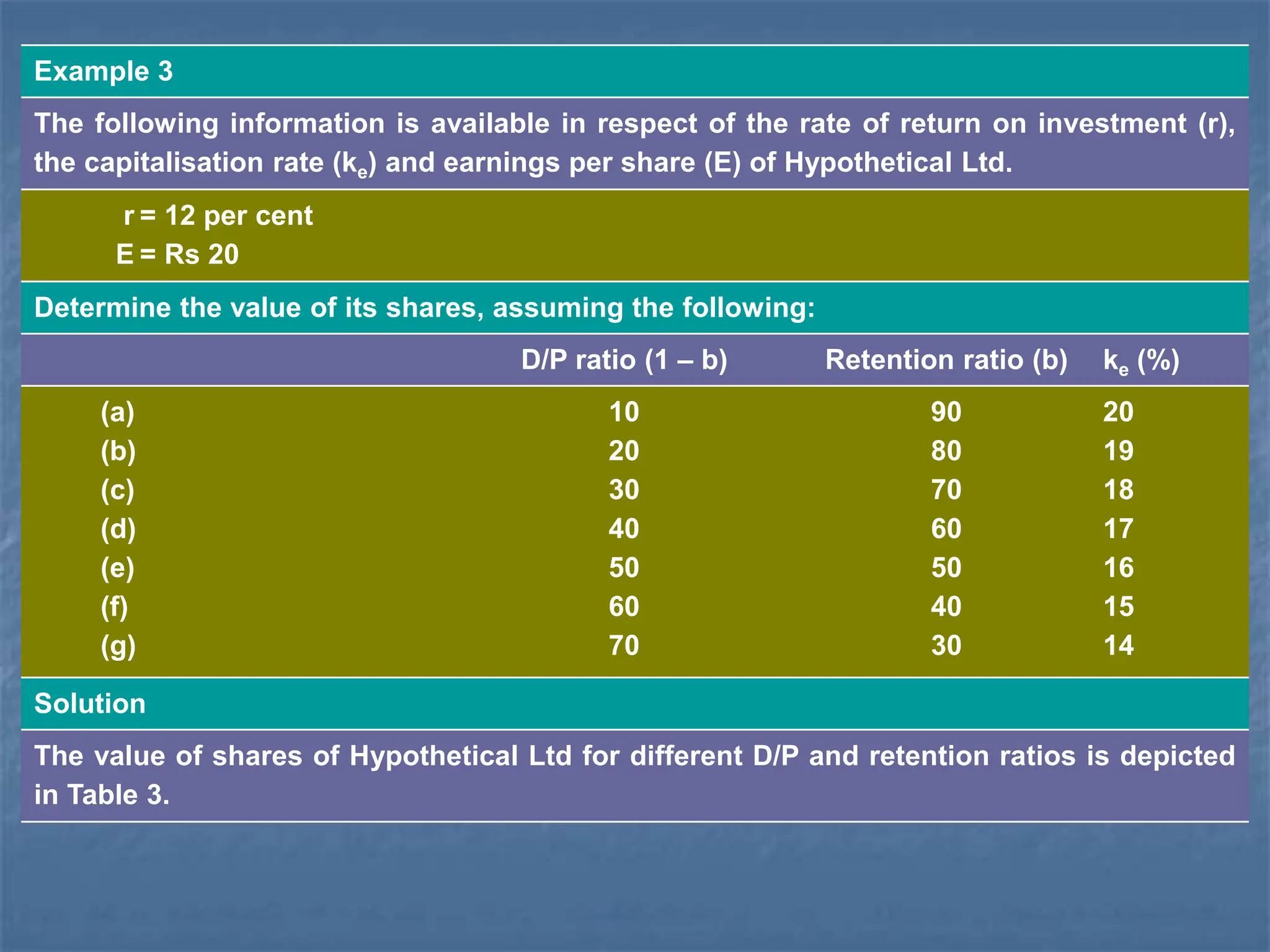
Example 3
The following information is available in respect of the rate of return on investment (r),
the capitalisation rate (ke) and earnings per share (E) of Hypothetical Ltd.
r = 12 per cent
E = Rs 20
Determine the value of its shares, assuming the following:
D/P ratio (1 – b) Retention ratio (b) ke (%)
(a)
(b)
(c)
(d)
(e)
(f)
(g)
10
20
30
40
50
60
70
90
80
70
60
50
40
30
20
19
18
17
16
15
14
Solution
The value of shares of Hypothetical Ltd for different D/P and retention ratios is depicted
in Table 3.
Table 3: Dividend Policy and Value of Shares of Hypothetical Ltd (Gordon’s Model)
 
 
 
 
 
 
  134.62
Rs
0.036
-
0.14
0.3
-
1
20
Rs
P
0.036
0.12
x
0.3
br
30
ratio
Retention
70
ratio
(g)D/P
117.65
Rs
0.048
-
0.15
0.4
-
1
20
Rs
P
0.048
0.12
x
0.4
br
40
ratio
Retention
60
ratio
(f)D/P
100
Rs
0.072
-
0.17
0.5
-
1
20
Rs
P
0.060
0.12
x
0.5
br
50
ratio
Retention
50
ratio
(e)D/P
81.63
Rs
0.072
-
0.17
0.6
-
1
20
Rs
P
0.72
0.12
x
0.6
br
60
ratio
Retention
40
ratio
(d)D/P
62.50
Rs
0.084
-
0.18
0.7
-
1
20
Rs
P
0.084
0.12
x
0.7
br
70
ratio
Retention
30
ratio
(c)D/P
42.55
Rs
0.096
-
0.19
0.8
-
1
20
Rs
P
0.096
0.12
0.8
br
80
ratio
Retention
20
ratio
(b)D/P
21.74
Rs
0.108
0.20
0.9
-
1
20
Rs
P
0.108
0.12
x
0.9
br(g)
90
ratio
Retention
10
ratio
(a)D/P






























Do you like an investor
capital gain or dividend
(Debate)
n State the process on capital gain and
dividend
n State the benefits
n State demerits
n Make a poll on how much student will
prefer from above mentioned terms.
SOLVED PROBLEMS
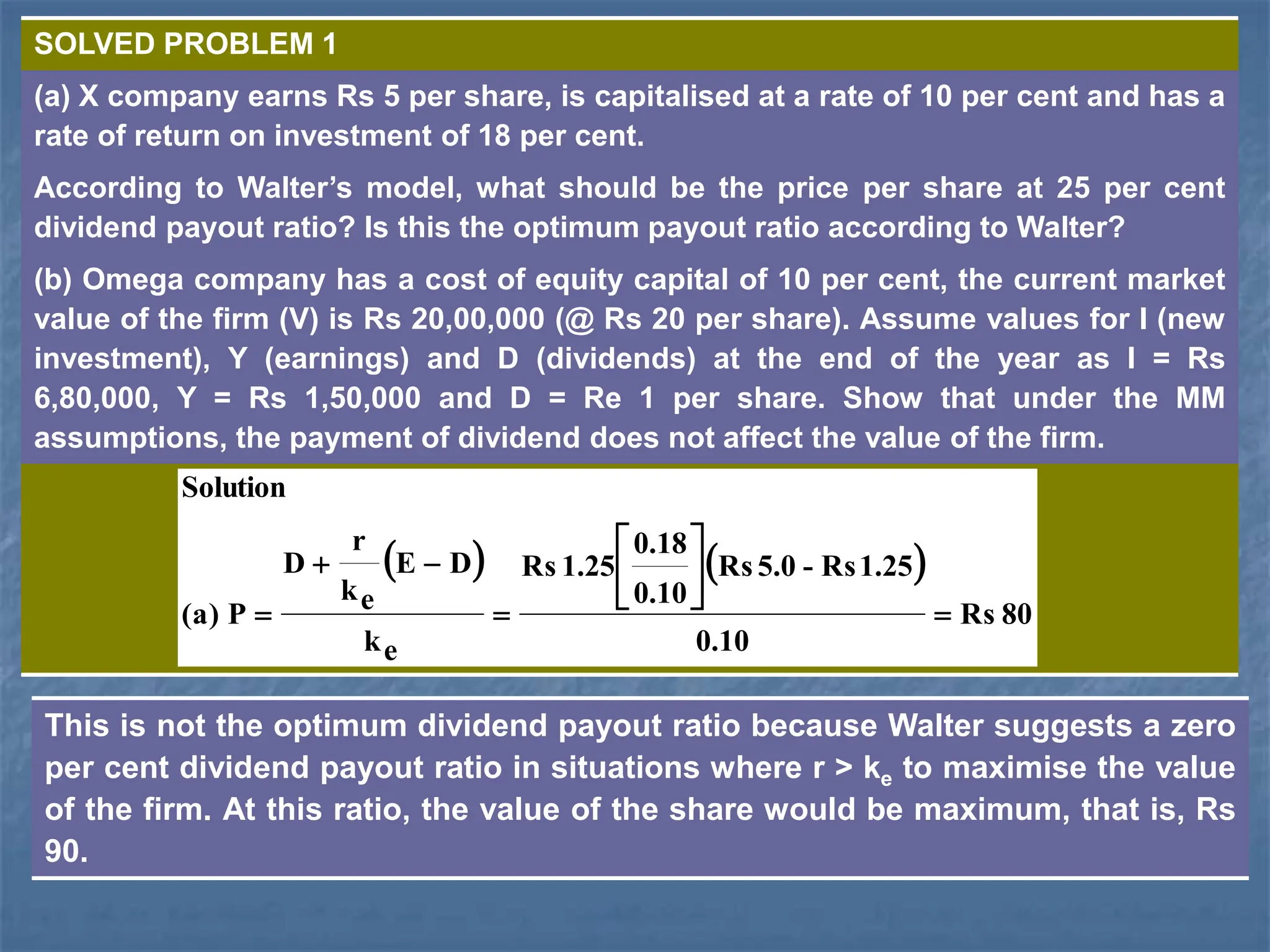
SOLVED PROBLEM 1
(a) X company earns Rs 5 per share, is capitalised at a rate of 10 per cent and has a
rate of return on investment of 18 per cent.
According to Walter’s model, what should be the price per share at 25 per cent
dividend payout ratio? Is this the optimum payout ratio according to Walter?
(b) Omega company has a cost of equity capital of 10 per cent, the current market
value of the firm (V) is Rs 20,00,000 (@ Rs 20 per share). Assume values for I (new
investment), Y (earnings) and D (dividends) at the end of the year as I = Rs
6,80,000, Y = Rs 1,50,000 and D = Re 1 per share. Show that under the MM
assumptions, the payment of dividend does not affect the value of the firm.
   
80
Rs
0.10
1.25
Rs
-
5.0
Rs
0.10
0.18
1.25
Rs
e
k
D
E
e
k
r
D
P
)
a
(
Solution











This is not the optimum dividend payout ratio because Walter suggests a zero
per cent dividend payout ratio in situations where r > ke to maximise the value
of the firm. At this ratio, the value of the share would be maximum, that is, Rs
90.
  
 
 
6,30,000
Rs
1,00,000)
Rs
1,50,000
(Rs
6,80,000
Rs
)
1
nD
-
(Y
I
:
financing
new
for
required
(ii)Amount
1
P
21
Rs
1
P
20
Rs
1
P
21
Rs
1.10
1
Re
1
P
20
Rs
1
D
1
P
e
k
1
1
0
P
:
year
the
of
end
the
at
share
the
of
price
(i)Market
:
s)
assumption
(MM
paid
are
dividends
when
firm,
the
of
(b)Value













10
.
1
1
Re
 
 
  20,00,000
1.10
1,00,000
Rs
1,50,000
Rs
6,80,000
Rs
21
Rs
30,000
1,00,000
1,00,000
Rs
nD1]
-
Y
I
-
1
ΔΔn)
(n
1
[nD
e
k
1
1
:
firm
the
of
(iv)Value
shares
30,000
21
Rs
6,30,000
Rs
:
issued
be
to
shares
of
r
(iii)Numbe














5,30,000
Rs
1,50,000
Rs
-
6,80,000
Rs
)
1
nD
-
(Y
-
I
:
financing
new
for
required
(ii)Amount
1
P
22
Rs
,
1.10
Zero
1
P
20
Rs
:
year
the
of
end
the
at
share
the
of
price
(i)Market
:
paid
not
are
dividends
when
firm
the
of
(c)Value





firm
the
of
value
the
affect
not
does
dividend
paid,
not
are
dividends
when
and
paid
are
dividends
when
situations
the
both
in
20,00,000,
Rs
is
firm
the
of
value
the
Since
20,00,000
Rs
1.10
1,50,000
Rs
6,80,000
Rs
-
22
Rs
22
5,30,000
1,00,000
]
Y
I
-
1
Dn)P
[(n
e
k
1
1
:
firm
the
of
(iv)Value
shares
22
Rs
5,30,000
Rs
issued
be
to
shares
new
of
Number
(iii)















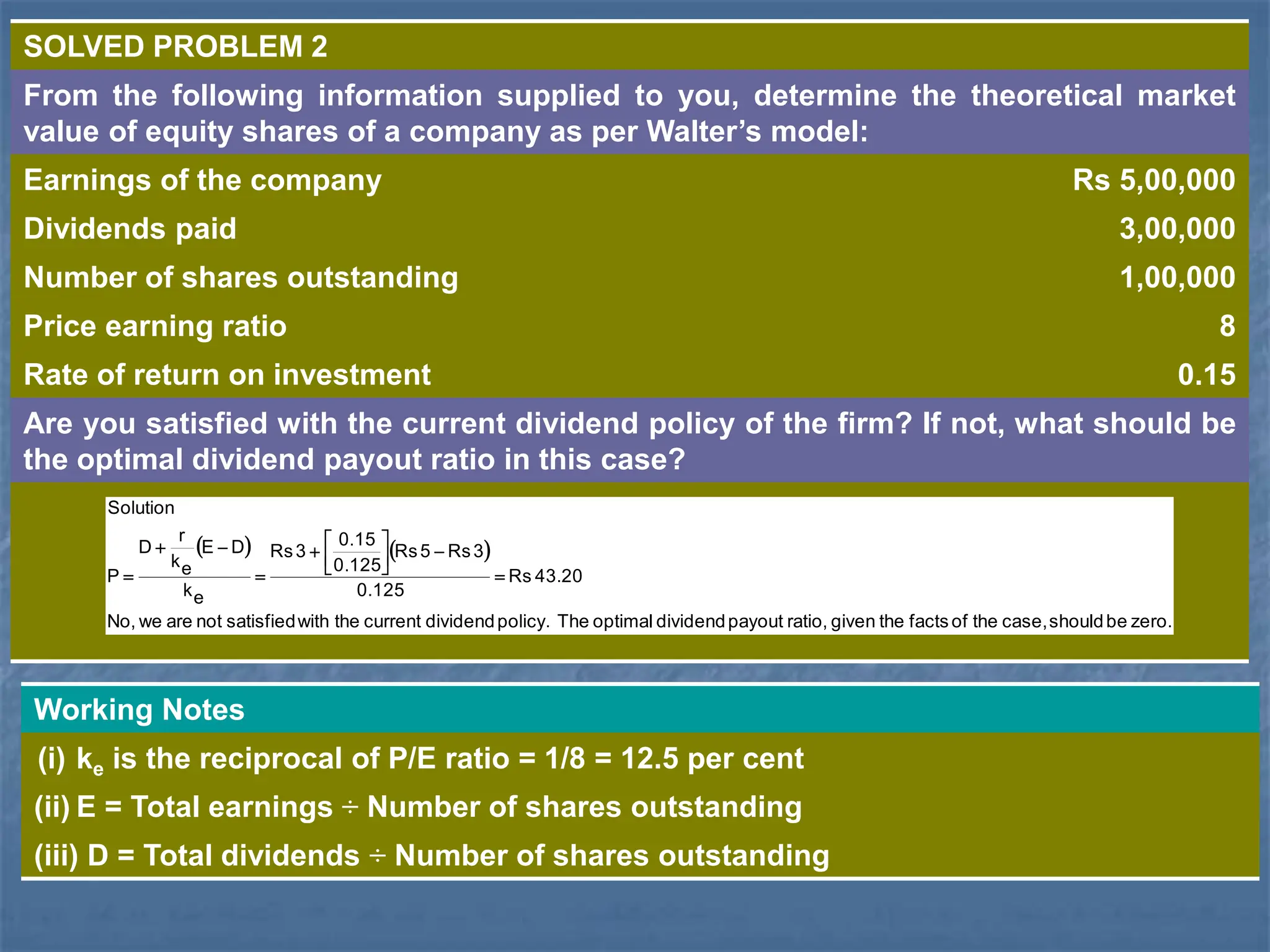
SOLVED PROBLEM 2
From the following information supplied to you, determine the theoretical market
value of equity shares of a company as per Walter’s model:
Earnings of the company Rs 5,00,000
Dividends paid 3,00,000
Number of shares outstanding 1,00,000
Price earning ratio 8
Rate of return on investment 0.15
Are you satisfied with the current dividend policy of the firm? If not, what should be
the optimal dividend payout ratio in this case?
   
zero.
be
should
case,
the
of
facts
the
given
ratio,
payout
dividend
optimal
The
policy.
dividend
current
the
with
satisfied
not
are
we
No,
43.20
Rs
0.125
3
Rs
5
Rs
0.125
0.15
3
Rs
e
k
D
E
e
k
r
D
P
Solution













Working Notes
(i) ke is the reciprocal of P/E ratio = 1/8 = 12.5 per cent
(ii) E = Total earnings ÷ Number of shares outstanding
(iii) D = Total dividends ÷ Number of shares outstanding

DIPK202T_Corporate Finance_Unit 4 PPT.ppt

  • 1.
  • 2.
    Issues for management regardingDividend Policy n How much dividend should be distributed? n Should the distribution be as cash dividends? n Should cash be passed on shareholders by buying back stock they hold? n How stable should be dividend distribution?
  • 3.
    DETERMINANTS OF DIVIDEND POLICY Factors BonusShares (Stock Dividend) and Stock (Share) Splits Legal, Procedural and Tax Aspects Solved Problems
  • 4.
    FACTORS 1) Dividend payout(D/P) ratio 2) Stability of dividends 3) Legal, contractual and internal constraints and restrictions 4) Owner’s considerations 5) Capital market considerations 6) Inflation
  • 5.
    (1) Dividend Payout(D/P) Ratio The D/P ratio indicates the percentage share of the net earnings distributed to the shareholders as dividends. Given the objective of wealth maximisation, the D/P ratio should be such as can maximise the wealth of its owners in the ‘long-run’. In practice, investors, in general, have a clear cut preference for dividends because of uncertainty and imperfect capital markets. Therefore, a low D/P ratio may cause a decline in share prices, while a high ratio may lead to a rise in the market price of the shares.
  • 6.
    (2) Stability ofDividends Stable dividend policy refers to the consistency or lack of variability in the stream of dividends, that is, a certain minimum amount of dividend is paid out regularly. Of the three forms of stability of dividend, namely, constant dividend per share, constant D/P ratio and constant dividend per share plus extra dividend, the first one is the most appropriate. The investors prefer a stable dividend policy for a number of reasons, such as, desire for current income their, informational contents, institutional requirement, and so on. Constant dividend per share policy is a policy of paying a certain fixed amount per share as dividend. Constant/target payout ratio is a policy to pay a constant percentage of net earnings as dividend to shareholders in each dividend period. Stable rupee plus extra dividend is a policy based on paying a fixed dividend to shareholders supplemented by an additional dividend when earnings warrant it.
  • 7.
    Figure 1: StableDividend Policy DPS EPS Times (Years) ESP and DPS (Rs) It can, thus, be seen that while the earnings may fluctuate from year to year, the dividend per share is constant. To be able to pursue such a policy, a firm whose earnings are not stable would have to make provisions in years when earnings are higher for payment of dividends in lean years. Such firms usually create a ‘reserve for dividends equalisation’. The balance standing in this fund is normally invested in such assets as can be readily converted into cash.
  • 8.
    There are manyempirical studies, (e.g. Lintrer) to support the contention that companies pursue a stable dividend policy. According to John Lintrer’s study, dividends are ‘sticky’ in the sense that they are slow to change and lag behind shifts in earnings by one or more periods. This leads to the pattern of stable dividend per share during the periods of fluctuating earnings per share and a rising step-function pattern of dividends per share during increasing earnings per share periods. Dt – Dt–1 = a0 + c (Dt * – Dt – 1) (1) where Dt = Dividend amount under consideration Dt–1 = Dividend paid in the previous year a0 = A constant which may have value of zero, but never negative and generally has a positive value to reflect the greater reluctance to reduce than to raise dividends c = Speed of adjustment Dt * = Target payout ratio = dividend payout ratio (r) multiplied by profit after taxes (p) = rp Dt – Dt–1 = Change in dividend payout (ΔD)
  • 9.
    The right handside of Equation 1 can be rewritten as: a0 + c (rPt – Dt–1) = a0 + crPt – cDt–1 Adding Dt–1 on both sides of Eq. 1 Dt = a0 + crPt – cDt–1 + Dt–1 = a0 + crPt + Dt–1(1 – c) Let cr be represented by b1 (short-run propensity to pay dividends) and (1 – c) be represented by b2 (long-run propensity to pay dividends), we have: Dt = a0 + b1Pt + b2Dt–1 (2) Thus, dividends paid by an individual company are a function of a0 (constant), short-run propensity to pay (b1) and long-run propensity to pay dividends (b2). Bolten has also formulated a formula based on key variables suggested by Lintner: where Dt + 1 = dividend amount under consideration, Dt = prevailing dividend, Dt /Et = prevailing payout ratio, P * = target payout ratio, Et = latest earnings per share, and a = adjustment cushion. ) 3 ( t E t E t D * P a t D 1 t D                
  • 10.
    Equation 3 suggeststhat the increase in dividends would be less than the increase in earnings owing to the speed of adjustment. Suppose the target payout ratio of a company is 50 per cent and the present dividend is Rs 2 per share. The firm would not immediately pay a dividend of Rs 3 share if the earnings per share rose from Rs 5 per share to Rs 6, since that would expose the firm to the necessity of reducing the dividend in the following year, if the earnings per share fell below Rs 6. Rather, the firm might decide to gradually move toward the 50 per cent target payout by declaring a Rs 2.50 per share dividend. With Rs 2.50 dividend, the firm’s earnings per share could drop to Rs 5 in the following year and still be at the 50 per cent target ratio, avoiding the necessity of reducing the dividend. Thus, In summing up, it can be commended that a firm should seek a stable dividend policy which avoids occasional reductions in dividends. Investors favourably react to the price of shares of such companies and there is a price enhancing effect of such a policy.   50 . 2 Rs 6 Rs 6 Rs 2 Rs 50 . 0 50 . 0 2 Rs 1 t D             
  • 11.
    (3) Legal, Contractual,and Internal Constraints and Restrictions Legal Requirements Legal stipulations do not require a dividend declaration but they specify the conditions under which dividends must be paid. Such conditions pertain to a) Capital impairment b) Net profits c) Insolvency
  • 12.
    (a) Capital ImpairmentRules Legal enactments limit the amount of cash dividends that a firm may pay. A firm cannot pay dividends out of its paid-up capital, otherwise there would be a reduction in the capital adversely affecting the security of its lenders. The rationale of this rule lies in protecting the claims of preference shareholders and creditors on the firm’s assets by providing a sufficient equity base since the creditors have originally relied upon such an equity base while extending credit. (b) Net Profits The net profits requirement is essentially a corollary of the capital impairment requirement, in that it restricts the dividend to be paid out of the firm’s current profits plus past accumulated retained earnings. Alternatively, a firm cannot pay cash dividends greater than the amount of current profits plus the accumulated balance of retained earnings. (c) Insolvency A firm is said to be insolvent in two situations: first, when its liabilities exceed the assets; and second, when it is unable to pay its bills. The rationale of the rule is to protect the creditors by prohibiting the liquidation of near-bankrupt firms through cash dividend payments to the equity owners.
  • 13.
    Contractual Requirements Important restrictionson the payment of dividend may be accepted by a company when obtaining external capital either by a loan agreement, a debenture indenture, a preference share agreement, or a lease contract. Such restrictions may cause the firm to restrict the payment of cash dividends until a certain level of earnings has been achieved or limit the amount of dividends paid to a certain amount or percentage of earnings. Since the payment of dividend involves a cash outflow, firms are forced to reinvest the retained earnings within the firm. Therefore, contractual constraints on dividend payments are quite common. The payment of cash dividend in violation of a restriction would amount to default in the case of a loan and the entire principal would become due and payable. Keeping in view the severity of penalty, the financial manager must ensure that the amount of dividend is within the covenants already committed to lenders.
  • 14.
    Internal Constraints Liquid AssetsOnce the payment of dividend is permissible on legal and contractual grounds, the next step is to ascertain whether the firm has sufficient cash funds to pay cash dividends. Growth Prospects Another set of factors that can influence dividend policy relates to the firm’s growth prospects. The firm is required to make plans for financing its expansion programmes. Financial Requirements Financial requirements of a firm are directly related to its investment needs. The firm should formulate its dividends policy on the basis of its foreseeable investment needs Availability of Funds The dividend policy is also constrained by the availability of funds and the need for additional investment. In evaluating its financial position, the firm should consider not only its ability to raise funds but also the cost involved in it and the promptness with which financing can be obtained. Earnings Stability The stability of earnings also has a significant bearing on the dividend decision of a firm. Generally, the more stable the income stream, the higher is the dividend payout ratio. Control Dividend policy may also be strongly influenced by the shareholders’ or the management’s control objectives. That is to say, sometimes management employs dividend policy as an effective instrument to maintain its position of command and control.
  • 15.
    Owner’s Considerations Taxes Thedividend policy of a firm may be dictated by the income tax status of its shareholders. If a firm has a large percentage of owners who are in high tax brackets, its dividend policy should seek to have higher retentions. Such a policy will provide its owners with income in the form of capital gains as against dividends. Since capital gains are taxed at a lower rate than dividends, they are worth more, after taxes, to the individuals in a high tax bracket. Opportunities The firm should not retain funds if the rate of return earned by it would be less than one which could have been earned by the investors themselves from external investments of funds. Dilution of Ownership The financial manager should recognise that a high D/P ratio may result in the dilution of both control and earnings for the existing equity holders. Dilution in earnings results because low retentions may necessitate the issue of new equity shares in the future, causing an increase in the number of equity shares outstanidng and ultimately lowering earnings per share and their price in the market. By retaining a high percentage of its earnings, the firm can minimise the possibility of dilution of earnings.
  • 16.
    Capital Market Considerations Yetanother set of factors that can strongly affect dividend policy is the extent to which the firm has access to the capital markets. In case the firm has easy access to the capital market, either because it is financially strong or large in size, it can follow a liberal dividend policy. However, if the firm has only limited access to capital markets, it is likely to adopt low dividend payout ratios. Such firms are likely to rely more heavily on retained earnings as a source of financing their investments. Inflation Finally, inflation is another factor which affects the firm’s dividend decision. With rising prices, funds generated from depreciation may be inadequate to replace obsolete equipments. These firms have to rely upon retained earnings as a source of funds to make up the shortfall. This aspect becomes all the more important if the assets are to be replaced in the near future. Consequently, their dividend payout tends to be low during periods of inflation.
  • 17.
    DIVIDEND POLICY ININDIA The main features of the corporate dividend policy in India are summarised below  Most of the corporates have a policy of long-run dividend pay-out ratio.  Dividend changes follow shift in the long-term sustainable earnings.  Dividend policy as a residual decision after meeting the desired investment needs is endorsed by about 50 per cent of the sample corporates. The corporates which are creating shareholders value (EVA) significantly rescind dividend increase in the event of growth opportunities available to them. Large firms are significantly less willing to rescind dividend increases.  Dividend policy provides a signalling mechanism of the future prospects of the corporate and, to that exact, affects its market value.  Investors have different relative risk perceptions of dividend income and capital gains and are not indifferent between receiving dividend income and capital gains. Management should be responsive to the shareholders preferences regarding dividend and the share buy back programme should not replace the dividend payments of the corporates.  Dividend payments provide a bonding mechanism so as to encourage manager to act in the best interest of the shareholders.
  • 18.
     The corporateenterprises in India seem to have a tendency to pay relatively less dividends. In fact, a fairly large number of them hardly pay any dividend. The foreign controlled companies seem to follow a policy of larger distribution of profits relative to the domestic companies. Retained earnings are a significant source of corporate finance.  The vast majority of the Indian corporates follows a stable dividend policy in the sense that they pay either constant dividend per share in the following year with fluctuating EPS or increased dividend with increase in EPS.  An overwhelming majority of corporates have a long-run target DIP ratio. The dividend changes follow shift in long-run sustainable earnings. Their dividend policy is in agreement with the findings of Lintner’s study on dividend policy.  Firms which are creating shareholder value are significantly more willing to rescind dividend increase in the event of growth opportunities available to them. The larger firms are significantly less willing to rescind dividend increase than the small firms.  Dividend policy provides a signalling mechanism of the future prospects of the firm and thus affects its market value. The investors are not indifferent between receiving dividend income and capital gains. CONTD.
  • 19.
    BONUS SHARES (STOCKDIVIDEND) AND STOCK (SHARE) SPLITS Apart from cash dividend, a firm can also reward its investors by paying bonus shares. The bonus shares/share splits do not have any economic impact on the firm in that its assets, earnings and investors’ proportionate ownership remain unchanged. As a result, the number of shares outstanding increases. The increased number of shares outstanding tends to bring the market price of shares within more popular range and promote more active trading in shares. Moreover, bonus/split announcements have informational content to the investors. It will also enable the conservation of corporate cash and further enable a firm to raise additional funds particularly through the issue of convertible securities.
  • 20.
    TABLE 1 Effectof Bonus Shares and Share Splits (I) Equity portion before the bonus issue: Equity share capital (30,000 share of Rs 100 each) Rs 30,00,000 Share premium (@ Rs 25 per share) 7,50,000 Retained earnings 62,50,000 Total equity 1,00,00,000 (II) Equity portion after the bonus issue (1 : 2 ratio): Equity share capital (45,000 shares of Rs 100 each) 45,00,000 Share premium (45,000 shares × Rs 25) 11,25,000 Retained earnings (Rs 62,50,000 – 15,000 shares × Rs 125) 43,75,000 Total equity 1,00,00,000 (III) Equity portion after the share splits (10 : 1 ratio): Equity share capital (3,00,000 shares of Rs 10 each) 30,00,000 Share premium 7,50,000 Retained earnings 62,50,000 Total equity 1,00,00,000
  • 21.
    LEGAL, PROCEDURAL ANDTAX ASPECTS Legal Aspects The amount of dividend that can be legally distributed is governed by company law, judicial pronouncements in leading cases, and contractual restrictions. The important provisions of company law pertaining to dividends are described below. 1) Companies can pay only cash dividends (with the exception of bonus shares). Apart from cash, dividend may also be remitted by cheque or by warrant. 2) Dividends can be paid only out of the profits earned during the financial year after providing for depreciation and after transferring to reserves such percentage of profits as prescribed by law. 3) Due to inadequacy or absence of profits in any year, dividend may be paid out of the accumulated profits of previous years. 4) Dividends cannot be declared for past years for which accounts have been adopted by the shareholders in the annual general meeting. 5) Dividend declared, interim or final, should be deposited in a separate bank account within 5 days from the date of declaration and dividend will be paid within 30 days from such a date. 6) Dividend including interim dividend once declared becomes a debt. While the payment of interim dividend cannot be revoked, the payment of final dividend can be revoked with the consent of the shareholders.
  • 22.
    Procedural Aspects The importantevents and dates in the dividend payment procedure are: 1) Board Resoultion: The dividend decision is the prerogative of the board of directors. Hence, the board of directors should in a formal meeting resolve to pay the dividend. 2) Shareholder Approval: The resolution of the board of directors to pay the dividend has to be approved by the shareholders in the annual general meeting. 3) Record Date: The dividend is payable to shareholders whose names appear in the register of members as on the record date. 4) Dividend Payment: Once a dividend declaration has been made, dividend warrant must be posted within 30 days. 5) Unpaid Dividend: if the money transferred to the ‘unpaid dividend account’ in the scheduled bank remains unpaid/unclaimed for a period of 7 years from the date of such transfer, the company is required to transfer the same to the ‘Investor. Tax Aspects With effect from financial year 2003-4, dividend income from domestic companies and mutual funds is exempt from tax in the hands of the shareholders/investors/unit-holders. However, the domestic companies will be liable to pay dividend distribution tax at the effective rate of 16.995 per cent on dividends paid after April 1, 2007.
  • 23.
    SOLVED PROBLEM 1 XCement Ltd requires you, as their financial consultant, to advise them with respect to the dividend policy they have to follow for the current year. The cement industry has been through a very trying period in the last five years and the constraints on operations have been removed in the early part of the year. The company hopes to improve its position in the years to come and has plans to put up an additional plant in the neighbourhood of the present factory. The increased profits, due to expansion in capacity, are expected to be 25 per cent of the additional capital investment after meeting interest charges but before depreciation on the additional plant installed. The shares of X Cement Ltd are widely held and there is a large majority of holdings in the hands of middle class invesotrs whose average holdings do not exceed 500 shares. The following further data is also made available to you:
  • 24.
    Particulars Last 5years Current year 1 2 3 4 5 6 Earnings per share (Rs) 6.00 5.0 4.5 4.5 4.0 17.5 Cash availability per share (Rs) 7.50 6.0 5.0 4.0 4.0 20.0 Dividend/share (Rs) 3.00 3.0 3.0 2.0 Nil ? Pay out ratio 50 60 67 45 — ? Average market price (face value of Rs 100) 80 70 70 70 60 140 P/E ratio 13.33:1 14:1 15.6:1 15.6:1 15:1 8:1 What recommendations would you make? Give reasons for your answers.
  • 25.
    Solution The company appearsto be following a stable dividend policy, that is, a policy of maintaining a stable rupee dividend, decreasing it only when it appears that earnings have reached a new, permanently low level or vice- versa in that although the EPS has declined from Rs 6 in Year 1 to Rs 4.50 in Year 3, no corresponding decrease was effected in the DPS. However, when the declining trend of earnings continued in subsequent years too, the dividends had been lowered inasmuch as no dividends were paid in year 5. Consequently, its share prices fell from Rs 80 in Year 1 to Rs 60 in Year 5. The decline in market prices is less pronounced in the context of much distressing profitability and dividend record of the company during the period as a whole. The rate of return of 6 per cent on equity capital in Year 1 was the maximum. Even this modest amount consistently declined to eventually a very low figure of 4 per cent by current year; the dividend yield was still smaller. The only off-setting factor was the stable dividend policy.
  • 26.
    Given the improvedrecord of earnings in the current year and the trend which is likely to continue in future years, coupled with favourable liquidity position, a rise in dividend is commended for the undermentioned reasons. (a) The investors would receive dividend income free of tax, especially if this category of investors includes retired persons who need the current income for living expenses and do not wish to sell even a small portion of their shares either because of transaction costs involved or because they are reluctant to ‘eating their own capital’. (b) The investors must be expecting a substantial rise in dividend in the light of the current market price of Rs 140 compared to Rs 60 last year. Failure to pay dividend commensurate to the shareholder’s expectation will have an adverse effect on share prices. (c) Cement industry with stable sales and earnings can afford high leverage ratios. The company is not likely to encounter any major difficulty in raising funds to finance an additional plant due to bright future prospects. (d) The payment of dividend resolves uncertainty; investors in general are risk averters; they prefer current dividends to larger deferred dividends. The payment was 50 per cent in Year 1; the payment of 60 per cent is recommeded this year, assuming that target dividend payout ratio is 75 per cent. Moreover, the company through advertisements should make the investors aware of the growth prospects and the investment opportunities ahead which would have a positive effect on share prices.
  • 27.
    SOLVED PROBLEM 2 Fromthe following financial statistics of Infosys Ltd for the period 1993-94 to 2001-02 (along with Sensex), comment on its dividend policy. Are its shares overvalued? Year MPS Networth (Rs lakh) Equity Dividen d (Rs lakh) EAT (Rs Lakh) EPS NWPS D/P (%) DPS Sense x 1993-94 Rs 343 2,870 117 809 Rs 24.15 Rs 85.67 14.46 Rs 3.49 4,485 1994-95 607 6,247 231 1,332 19.88 93.24 17.34 3.45 4,385 1995-96 458 7,984 363 2,101 28.94 109.97 17.28 5.00 3,259 1996-97 731 11,284 399 3,698 50.94 155.43 10.79 5.50 3,440 1997-98 1,493 17,296 703 6,036 39.53 113.28 11.65 4.60 3,770 1998-99 2,597 57,443 1,211 13,526 84.43 358.57 8.95 7.56 3,286 1999-00* 6,891 83,330 2,976 29,352 91.64 260.16 10.14 9.29 4,543 2000-01 7,173 1,38,964 6,615 62,881 196.32 433.86 10.52 20.65 4,355 2001-02 3,606 2,08,031 13,236 80,796 244.32 629.06 16.38 40.02 3,336 * Company issued bonus shares in the ratio of 1:1.
  • 28.
    Solution The InfosysLtd appears to be following a stable dividend policy. The dividend per share (DPS) have consistently increased from Rs 3.5 in 1993-94 to Rs 7.56 in 1998-99 and, further, to Rs 40.02 in 2001-02. Though the DPS has shown a significant increase over the years, the dividends paid are low in relation to the market price of its share (MPS). The dividend yield (DPS/MPS) is less than one per cent in most of the years. In 2001-02, when dividends paid were maximum, the dividend yield was 1.1 per cent only. The dividend payout (D/P) ratios is also a pointer towards the same, varying in the range of 8.95 per cent (1993-94) and 17.34 per cent (2001-02). The D/P ratios of less than 20 per cent, for a software/information technology company is below the mark. The DPS are also not commensurate with the pronounced increase in the EAT as well as the EPS over the years particularly since 1998-99. For instance, while EPS was Rs 196.32 and Rs 244.32 in 2001 and 2002 respectively, the corresponding DPS in these years were Rs 20.65 and Rs 40.02 only. However, Infosys has virtually doubled the payment of DPS in 2002 over 2001. Given the improved record of earnings, particularly since 1998-99 and the trend which is likely to continue in future years in view of increased level of projects from the US, Infosys would be well advised to pay higher dividend. All along the period under reference, the market price of its shares seem to be over- valued as reflected in the market price/book value (net worth) ratio (P/B ratio) as shown below:
  • 29.
    Year MPS NWPSP/B ratio 1993-94 Rs 343 Rs 85.67 4.00 1994-95 607 93.24 6.51 1995-96 458 109.97 4.16 1996-97 731 155.43 4.70 1997-98 1,493 113.28 13.18 1998-99 2,597 358.57 7.24 1999-00 6,891 260.16 26.49 2000-01 7,173 433.86 16.53 2001-02 3,606 629.06 5.73 The P/B ratio indicates that the MPS of Infosys' shares is substantially overvalued. It was maximum (26.49 times) in 1999-2000. The reason may be higher expected of growth of software industry by the investors in view of large number of project and service outsourcing done from India by the USA. However, the MPS is not warranted by the fundamental factors such as EPS, DPS, NWPS, P/B ratio and so on.
  • 30.
    DIVIDEND AND VALUATION Irrelevanceof Dividends Relevance of Dividends Solved Problems
  • 31.
    Irrelevance of Dividends Dividend Dividendrefers to the corporate net profits distributed among shareholders. The crux of the argument supporting the irrelevance of dividends to valuation is that the dividend policy of a firm is a part of its financing decision. As a part of the financing decision, the dividend policy of the firm is a residual decision and dividends are a passive residual. Residual Dividend Residual dividend policy pays out only excess cash.
  • 32.
    Dividends are irrelevant,or are a passive residual, is based on the assumption that the investors are indifferent between dividends and capital gains. So long as the firm is able to earn more than the equity-capitalisation rate (ke), the investors would be content with the firm retaining the earnings. In contrast, if the return is less than the ke, investors would prefer to receive the earnings (i.e. dividends).
  • 33.
    Modigliani and Miller(MM) Hypothesis The most comprehensive argument in support of the irrelevance of dividends is provided by the MM hypothesis. Modigliani and Miller maintain that dividend policy has no effect on the share price of the firm and is, therefore, of no consequence. Dividend Irrelevance Dividend irrelevance implies that the value of a firm is unaffected by the distribution of dividends and is determined solely by the earning power and risk of its assets.
  • 34.
    Assumptions The MM hypothesisof irrelevance of dividends is based on the following critical assumptions: 1) Perfect capital markets in which all investors are rational. There are no taxes. Alternatively, there are no differences in tax rates applicable to capital gains and dividends. 2) A firm has a given investment policy which does not change. There is a perfect certainty by every investor as to future investments and profits of the firm. Crux of the Argument The crux of the MM position on the irrelevance of dividend is the arbitrage argument. The arbitrage process involves a switching and balancing operation. In other words, arbitrage refers to entering simultaneously into two transactions which exactly balance or completely offset each other. The two transactions here are the acts of paying out dividends and raising external funds–either through the sale of new shares or raising additional loans–to finance investment programmes.
  • 35.
    Proof: MM providethe proof in support of their argument in the following manner. Step 1: The market price of a share in the beginning of the period is equal to the present value of dividends paid at the end of the period plus the market price of share at the end of the period. Symbolically,     1 period of end the at share a of price Market P 1 period of end the at received be to Dividend D capital equity of Cost k share a of price market Prevailing whereP (1) P D k 1 1 P 1 1 e 0 1 1 e 0        Step 2: Assuming no external financing, the total capitalised value of the firm would be simply the number of shares (n) times the price of each share (P0). Thus,     ) 2 ( 1 nP 1 nD e k 1 1 0 nP   
  • 36.
    Step 3: Ifthe firm’s internal sources of financing its investment opportunities fall short of the funds required, and Δn is the number of new shares issued at the end of year 1 at price of P1, Eq. 2 can be written as:         ) 3 ( nP P n n nD k 1 1 nP 1 1 1 e 0        where n = Number of shares outstanding at the beginning of the period Δn = Change in the number of shares outstanding during the period/Additional shares issued Equation 3 implies that the total value of the firm is the capitalised value of the dividends to be received during the period plus the value of the number of shares outstanding at the end of the period, considering new shares, less the value of the new shares. Thus, in effect, Eq. 3 is equivalent to Eq. 2.
  • 37.
    Step 4: Ifthe firm were to finance all investment proposals, the total amount raised through new shares issued would be given in Eq. 4. ΔnP1 = I – (E – nD1) or ΔnP1 = I – E + nD1 (4) where ΔnP1 = Amount obtained from the sale of new shares of finance capital budget. I = Total amount/requirement of capital budget E = Earnings of the firm during the period nD1 = Total dividends paid (E – nD1) = Retained earnings According to Equation 4, whatever investment needs (I) are not financed by retained earnings, must be financed through the sale of additional equity shares.
  • 38.
    Step 5: Ifwe substitute Eq. 4 into Eq. 3 we derive Eq. 5.                 (6) e k 1 E I 1 P Δn n 0 nP have then We cancels. 1 nD Therefore, . 1 nD negative and 1 nD positive a is There e k 1 1 nD E I 1 P Δn n 1 nD 0 nP have we 5 eq. Solving 5) 1 nD E I 1 P Δn n 1 nD e k 1 1 0 nP                    ( Step 6: Conclusion Since dividends (D) are not found in Eq. 6, Modigliani and Miller conclude that dividends do not count and that dividend policy has no effect on the share price.
  • 39.
    Example 1 A companybelongs to a risk class for which the approximate capitalisation rate is 10 per cent. It currently has outstanding 25,000 shares selling at Rs 100 each. The firm is contemplating the declaration of a dividend of Rs 5 per share at the end of the current financial year. It expects to have a net income of Rs 2,50,000 and has a proposal for making new investments of Rs 5,00,000. Show that under the MM assumptions, the payment of dividend does not affect the value of the firm. Solution
  • 40.
           25,00,000 Rs 1.10 27,50,000 Rs 2,50,000 5,00,000 Rs 105 Rs 21 75,000 1 25,000 ) e k (1 E I 1 P Δn n 0 nP firm, the of Value (iv) Shares 21 75,000 105 Rs 3,75,000 Rs Δn issued, be to shares additional of Number (iii) 3,75,000 Rs 1,25,000 Rs - 2,50,000 Rs - 5,00,000 Rs 1 nD E I 1 ΔnP shares, new of issue the from raised be to required Amount (ii) 1 P 105 1 P 5 Rs 110 1 P 5 Rs 1.10 1 100 Rs 1 P 1 D e k 1 1 0 P 1, year of end the at share per Price (i)                                                   : Paid Are Dividends When Firm, the of Price (a)
  • 41.
  • 42.
    The validity ofthe MM Approach is open to question on two counts: 1) Imperfection of capital market, and 2) Resolution of uncertainty. Market Imperfection Modigliani and Miller assume that capital markets are perfect. This implies that there are no taxes; flotation costs do not exist and there is absence of transaction costs. These assumptions are untenable in actual situations.
  • 43.
    Resolution of Uncertainty (i)near vs distant dividend; (ii) informational content of dividends; (iii) preference for current income; and (iv) sale of stock at uncertain price/underpricing. Near Vs Distant Dividend One aspect of the uncertainty situation is the payment of dividend now or at a later date. The argument that near dividend implies resolution of uncertainty is referred to as the ‘bird-in-hand’ argument. Bird-in-hand argument is the belief that current dividend payments reduce uncertainty and result in higher value of shares of a firm. Informational Content of Dividends Another aspect of uncertainty, very closely related to the first (i.e. resolution of uncertainty or the ‘bird-in-hand’ argument) is the ‘informational content of dividend’ argument. Informational content is the information provided by dividend of a firm with respect to future earnings which causes owners to bid up or down the price of shares. Preference for Current Income The third aspect of the uncertainty question relating to dividends is based on the desire of investors for current income to meet consumption requirements. Underpricing implIes sale of shares at price lower than the current market.
  • 44.
    Walter’s model supportsthe doctrine that dividends are relevant. The investment policy of a firm cannot be separated from its dividends policy and both are, according to Walter, interlinked. The choice of an appropriate dividend policy affects the value of an enterprise. Assumptions 1. All financing is done through retained earnings: external sources of funds like debt or new equity capital are not used. 2. With additional investments undertaken, the firm’s business risk does not change. It implies that r and k are constant. 3. There is no change in the key variables, namely, beginning earnings per share, E, and divi-dends per share, D. The values of D and E may be changed in the model to determine results, but, any given value of E and D are assumed to remain constant in determining a given value. 4. The firm has perpetual (or very long) life. Relevance of Dividends
  • 45.

  • 46.
         investment firms the on return of rate The r share per Earnings E share per Dividend D share a of price market prevailing The whereP e k D E e k r D P P D E e k r D e k have we , Δ of value the ng substituti , D E e k r P Δ since and P ΔP P D e k have, We P ΔP g (9) g P D e k e k determing for equation an derive we 7, equation the From                  ) 10 (
  • 47.
    Equation 10 showsthat the value of a share is the present value of all dividends plus the present value of all capital gains. Walter’s model with reference to the effect of dividend/retention policy on the market value of shares under different assumptions of r (return on investments) is illustrated in Example 2. Example 2 The following information is available in respect of a firm: Capitalisation rate (ke) = 0.10 Earnings per share (E) = Rs 10 Assumed rate of return on investments (r): (i) 15, (ii) 8, and (iii) 10. Show the effect of dividend policy on the market price of shares, using Walter’s model. Solution (1) When r is 0.15, that is, r > ke: The effect of different D/P ratios depicted in Table 1. (2) When r = 0.08 and 0.10, that is, r < ke and r = ke respectively: The effect of different D/P ratios on the value of shares is shown in Table 2.
  • 48.
    Table 1 :Dividend Policy and Value of Shares (Walter’s Model)           100 Rs 0.10 10 10 0.10 0.15 10 p 10) Rs share per (Dividend 100 ratio (e)D/P 112.50 Rs 0.10 7.5 10 0.10 0.15 7.5 P 7.5) Rs share per (Dividend 75 ratio (d)D/P 125 Rs 0.10 5 10 0.10 0.15 5 P 5) Rs share per (Dividend 50 ratio (c)D/P 137.50 Rs 0.10 2.5 10 0.10 0.15 2.5 P 2.5) Rs share per (Dividend 25 ratio (b)D/P Rs150 0.10 0 10 0.10 0.15 0 P zero) share per (Dividend 0 ratio (a)D/P                                                            
  • 49.
    Table 2: DividendPolicy and Value of Shares (Walter’s Model) (A) r = 0.8 (r < ke) (B) r = 0.10 (r = ke)                     100 Rs 0.10 10 10 0.10 0.10 10 p 100 Rs 0.10 10 10 0.10 0.08 10 p 100 ratio D/P (e) 100 Rs 0.10 7.5 10 0.10 0.10 7.5 p 95 Rs 0.10 7.5 10 0.10 0.08 7.5 p 75 Ratio D/P (d) 100 Rs 0.10 5 10 0.10 0.10 5 p 90 Rs 0.10 5 10 0.10 0.08 5 p 50 ratio D/P (c) 100 Rs 0.10 2.5 10 0.10 0.10 2.5 p 85 Rs 0.10 2.5 10 0.10 0.08 2.5 p 25 Ratio D/P (b) 100 Rs 0.10 0 10 0.10 0.10 0 p 80 Rs 0.10 0 10 0.10 0.08 0 p Zero ratio D/P (a)                                                                                                         
  • 50.
    Gordon’s Model Another theorywhich contends that dividends are relevant is Gordon’s model. This model, which opines that dividend policy of a firm affects its value, is based on the following assumptions: 1. The firm is an all-equity firm. No external financing is used and investment programmes are financed exclusively by retained earnings. 2. r and ke are constant. 3. The firm has perpetual life. 4. The retention ratio, once decided upon, is constant. Thus, the growth rate, (g = br) is also constant. 5. ke > br. Dividend Capitalisation Model According to Gordon, the market value of a share is equal to the present value of future streams of dividends. A simplified version of Gordon’s model can be symbolically expressed as   firm. equity - all an of investment on return of rate rate Growth g br capital of rate/cost tion Capitalisa k dividends as d distribute earnings of percentage i.e. ratio, D/P b 1 retained. earnings of percentage or ratio Retention b share per Earnings E share a of Price whereP br k b 1 E p e e            ) 11 (
  • 51.
    Example 3 The followinginformation is available in respect of the rate of return on investment (r), the capitalisation rate (ke) and earnings per share (E) of Hypothetical Ltd. r = 12 per cent E = Rs 20 Determine the value of its shares, assuming the following: D/P ratio (1 – b) Retention ratio (b) ke (%) (a) (b) (c) (d) (e) (f) (g) 10 20 30 40 50 60 70 90 80 70 60 50 40 30 20 19 18 17 16 15 14 Solution The value of shares of Hypothetical Ltd for different D/P and retention ratios is depicted in Table 3.
  • 52.
    Table 3: DividendPolicy and Value of Shares of Hypothetical Ltd (Gordon’s Model)               134.62 Rs 0.036 - 0.14 0.3 - 1 20 Rs P 0.036 0.12 x 0.3 br 30 ratio Retention 70 ratio (g)D/P 117.65 Rs 0.048 - 0.15 0.4 - 1 20 Rs P 0.048 0.12 x 0.4 br 40 ratio Retention 60 ratio (f)D/P 100 Rs 0.072 - 0.17 0.5 - 1 20 Rs P 0.060 0.12 x 0.5 br 50 ratio Retention 50 ratio (e)D/P 81.63 Rs 0.072 - 0.17 0.6 - 1 20 Rs P 0.72 0.12 x 0.6 br 60 ratio Retention 40 ratio (d)D/P 62.50 Rs 0.084 - 0.18 0.7 - 1 20 Rs P 0.084 0.12 x 0.7 br 70 ratio Retention 30 ratio (c)D/P 42.55 Rs 0.096 - 0.19 0.8 - 1 20 Rs P 0.096 0.12 0.8 br 80 ratio Retention 20 ratio (b)D/P 21.74 Rs 0.108 0.20 0.9 - 1 20 Rs P 0.108 0.12 x 0.9 br(g) 90 ratio Retention 10 ratio (a)D/P                              
  • 53.
    Do you likean investor capital gain or dividend (Debate) n State the process on capital gain and dividend n State the benefits n State demerits n Make a poll on how much student will prefer from above mentioned terms.
  • 54.
  • 55.
    SOLVED PROBLEM 1 (a)X company earns Rs 5 per share, is capitalised at a rate of 10 per cent and has a rate of return on investment of 18 per cent. According to Walter’s model, what should be the price per share at 25 per cent dividend payout ratio? Is this the optimum payout ratio according to Walter? (b) Omega company has a cost of equity capital of 10 per cent, the current market value of the firm (V) is Rs 20,00,000 (@ Rs 20 per share). Assume values for I (new investment), Y (earnings) and D (dividends) at the end of the year as I = Rs 6,80,000, Y = Rs 1,50,000 and D = Re 1 per share. Show that under the MM assumptions, the payment of dividend does not affect the value of the firm.     80 Rs 0.10 1.25 Rs - 5.0 Rs 0.10 0.18 1.25 Rs e k D E e k r D P ) a ( Solution            This is not the optimum dividend payout ratio because Walter suggests a zero per cent dividend payout ratio in situations where r > ke to maximise the value of the firm. At this ratio, the value of the share would be maximum, that is, Rs 90.
  • 56.
          6,30,000 Rs 1,00,000) Rs 1,50,000 (Rs 6,80,000 Rs ) 1 nD - (Y I : financing new for required (ii)Amount 1 P 21 Rs 1 P 20 Rs 1 P 21 Rs 1.10 1 Re 1 P 20 Rs 1 D 1 P e k 1 1 0 P : year the of end the at share the of price (i)Market : s) assumption (MM paid are dividends when firm, the of (b)Value              10 . 1 1 Re       20,00,000 1.10 1,00,000 Rs 1,50,000 Rs 6,80,000 Rs 21 Rs 30,000 1,00,000 1,00,000 Rs nD1] - Y I - 1 ΔΔn) (n 1 [nD e k 1 1 : firm the of (iv)Value shares 30,000 21 Rs 6,30,000 Rs : issued be to shares of r (iii)Numbe              
  • 57.
  • 58.
    SOLVED PROBLEM 2 Fromthe following information supplied to you, determine the theoretical market value of equity shares of a company as per Walter’s model: Earnings of the company Rs 5,00,000 Dividends paid 3,00,000 Number of shares outstanding 1,00,000 Price earning ratio 8 Rate of return on investment 0.15 Are you satisfied with the current dividend policy of the firm? If not, what should be the optimal dividend payout ratio in this case?     zero. be should case, the of facts the given ratio, payout dividend optimal The policy. dividend current the with satisfied not are we No, 43.20 Rs 0.125 3 Rs 5 Rs 0.125 0.15 3 Rs e k D E e k r D P Solution              Working Notes (i) ke is the reciprocal of P/E ratio = 1/8 = 12.5 per cent (ii) E = Total earnings ÷ Number of shares outstanding (iii) D = Total dividends ÷ Number of shares outstanding