Dividend Decisions
Shabareesh Reddy-117
Manoj Rokade-120
Sadhana Shastri-136
Sanket Sawant-127
Sambhav Shah-129
1
MEANING
 The term dividend refers to that part of profits of a company which is
distributed by the company among its shareholders.
 It is the reward of the shareholders for investments made by them in the
shares of the company.
2
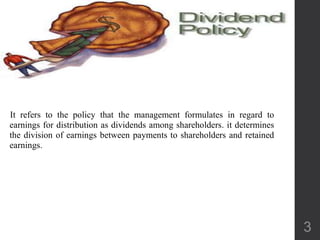
It refers to the policy that the management formulates in regard to
earnings for distribution as dividends among shareholders. it determines
the division of earnings between payments to shareholders and retained
earnings.
3
Double Tax
• If the company decides to pay out dividends, the earnings are taxed twice by
the government because of the transfer of the money from the company to the
shareholders. The first taxation occurs at the company's year-end when it
must pay taxes on its earnings. The second taxation occurs when the
shareholders receive the dividends, which come from the company's after-tax
earnings.
• The shareholders pay taxes first as owners of a company that brings in
earnings and then again as individuals, who must pay income taxes on their
own personal dividend earnings.
4
SIGNIFICANCE OF DIVIDEND
POLICY
 The firm has to balance between the growth of the company and the
distribution to the shareholders.
 It has a critical influence on the value of the firm.
 It has to also to strike a balance between the long term financing decision
(company distributing dividend in the absence of any investment
opportunity) and the wealth maximization.
 The market price gets affected if dividends paid are less.
 Retained earnings helps the firm to concentrate on the growth, expansion
and modernisation of the firm.
 To sum up, it to a large extent affects the financial structure, flow of funds,
corporate liquidity, stock prices, growth of the company and investor’s
satisfaction.
5
6
SIGNIFICANCE OF STABILITY OF
DIVIDEND
• Confidence among shareholders.
• Investors desire for current income.
• Institutional investor’s requirement.
• Stability in market prices of shares.
• Raising additional finances.
• Spreading of ownership of outstanding shares.
• Reduces the chances of loss of control.
• Market for debentures and preference shares.
7
FORMS OF DIVIDEND
• SCRIP DIVIDEND- An unusual type of dividend involving the
distribution of promissory notes that call for some type of payment at a
future date.
• BOND DIVIDEND- A type of liability dividend paid in the dividend
payer's bonds.
• PROPERTY DIVIDEND- A stockholder dividend paid in a form other
than cash, scrip, or the firm's own stock.
• CASH DIVIDEND- A dividend paid in cash to a company’s
shareholders, normally out of the its current earnings or accumulated
profits.
• BONUS SHARE OR STOCK DIVIDENDS- A dividend payment made
in the form of additional shares, rather than a cash payout.
• OPTIONAL DIVIDEND- Dividend which the shareholders can choose
to take as either cash or stock.
8
9
Dividend Theories
Relevance Theories
(i.e. which consider dividend
decision to be relevant as it
affects the value of the firm)
Walter’s
Model
Gordon’s
Model
Irrelevance Theories
(i.e. which consider dividend
decision to be irrelevant as it
does not affects the value of the
firm)
Modigliani and
Miller’s Model
Traditional
Approach
10
RELEVANCE
THEORIES
11
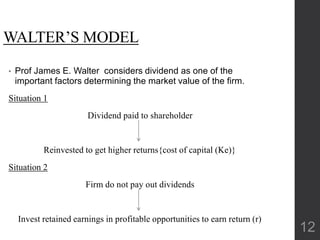
WALTER’S MODEL
• Prof James E. Walter considers dividend as one of the
important factors determining the market value of the firm.
Situation 1
Dividend paid to shareholder
Reinvested to get higher returns{cost of capital (Ke)}
Situation 2
Firm do not pay out dividends
Invest retained earnings in profitable opportunities to earn return (r)
12
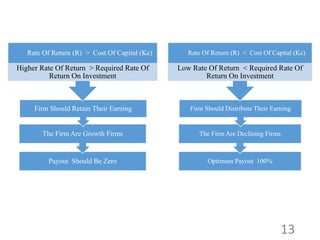
13
Payout Should Be Zero
The Firm Are Growth Firms
Firm Should Retain Their Earning
Rate Of Return (R) > Cost Of Capital (Ke)
Higher Rate Of Return > Required Rate Of
Return On Investment
Optimum Payout 100%
The Firm Are Declining Firms
Firm Should Distribute Their Earning
Rate Of Return (R) < Cost Of Capital (Ke)
Low Rate Of Return < Required Rate Of
Return On Investment
14
No Optimum Dividend Payout
The Firm Are Normal Firms
Firm Can Distribute Their Earning Or Can Retain
Their Earning
Rate Of Return (R) = Cost Of Capital (Ke)
Rate Of Return = Required Rate Of Return On Investment
ASSUMPTIONS OF WALTER’S
MODEL
 Retained earning are only source of financing investment in
firm
 The cost of capital (Ke), and rate of return on investment (r ),
are constant.
 Firms life is endless
 Give or not to give out dividend depends on the opportunities to
invest retain earning.
15
FORMULA OF WALTER’S MODEL
Where,
P = Current Market Price of equity share
E = Earning per share
D = Dividend per share
(E-D) = Retained earning per share
r = Rate of Return on firm’s investment or Internal Rate of Return
k = Cost of Equity Capital
16
P
D + r (E-D)
k
k
=
CRITICISMS OF WALTER’S
MODEL
• Only Retained Earnings And No External Financing.
• R Is Constant.
• K Is Constant.
GORDON’S MODEL
18
•Myron Gordon consider dividends are relevant and the dividend decision of
the company affects its value.
Investors are risk averse
Future capital gain to be more risky
Discount the future capital gain at a higher rate(ke>g)
ASSUMPTIONS OF GORDON’S MODEL
 The product of retention ratio and rate of return gives us growth
of firm(b X r=g)
 Cost of capital is greater then growth rate (k>br=g)
19
FORMULA OF GORDON’S
MODEL
Where,
P = Price
E = Earning per Share
b = Retention Ratio
k = Cost of Capital
br = g = Growth Rate
20
P =
E (1 – b)
K - br
IRRELEVANCE
THEORIES
21
MODIGLIANI & MILLER’S
IRRELEVANCE MODEL
Value of Firm (i.e. Wealth of Shareholders)
Firm’s Earnings
Firm’s Investment Policy and not on dividend policy
Depends on
Depends on
22
M-M’s ASSUMPTIONS
 Perfect capital market
 No taxes
 No floating cost
 Firm has a fixed investment policy.
 No risk or uncertainity
23
M-M’s Argument
• If a company retains earnings instead of giving it out as dividends,
the shareholder enjoy capital appreciation equal to the amount of
earnings retained.
• If it distributes earnings by the way of dividends instead of retaining
it, shareholder enjoys dividends equal in value to the amount by
which his capital would have appreciated had the company chosen to
retain its earning.
• Hence, the division of earnings between dividends and retained
earnings is IRRELEVANT from the point of view of shareholders.
24
CRITICISM OF M-M
MODEL
 TAX DIFFERENTIAL
 FLOATION COST
 TRANSACTION COST
 DISCOUNT RATE
25
Dividend Summary of Reliance Ind.
Announcement
Date
Effective
Date
Dividend Type Dividend (%)
17-04-15 08-05-15 Final 100.00
21-04-14 16-05-14 Final 95.00
16-04-13 10-05-13 Final 90.00
20-04-12 31-05-12 Final 85.00
21-04-11 05-05-11 Final 80.00
26-04-10 10-05-10 Final 70.00
26
27
REFERENCES
 http://www.articlesbase.com/college-and-university-articles/dividend-decision-
5852765.html
 http://www.efinancemanagement.com/dividend-decisions/walters-theory-on-
dividend-policy
 http://www.moneycontrol.com/company-facts/relianceindustries/dividends/RI
 http://economictimes.indiatimes.com/reliance-capital-
ltd/infocompanydividends/companyid-13189.cms
28
29

dividend decision.

  • 1.
    Dividend Decisions Shabareesh Reddy-117 ManojRokade-120 Sadhana Shastri-136 Sanket Sawant-127 Sambhav Shah-129 1
  • 2.
    MEANING  The termdividend refers to that part of profits of a company which is distributed by the company among its shareholders.  It is the reward of the shareholders for investments made by them in the shares of the company. 2
  • 3.
    It refers tothe policy that the management formulates in regard to earnings for distribution as dividends among shareholders. it determines the division of earnings between payments to shareholders and retained earnings. 3
  • 4.
    Double Tax • Ifthe company decides to pay out dividends, the earnings are taxed twice by the government because of the transfer of the money from the company to the shareholders. The first taxation occurs at the company's year-end when it must pay taxes on its earnings. The second taxation occurs when the shareholders receive the dividends, which come from the company's after-tax earnings. • The shareholders pay taxes first as owners of a company that brings in earnings and then again as individuals, who must pay income taxes on their own personal dividend earnings. 4
  • 5.
    SIGNIFICANCE OF DIVIDEND POLICY The firm has to balance between the growth of the company and the distribution to the shareholders.  It has a critical influence on the value of the firm.  It has to also to strike a balance between the long term financing decision (company distributing dividend in the absence of any investment opportunity) and the wealth maximization.  The market price gets affected if dividends paid are less.  Retained earnings helps the firm to concentrate on the growth, expansion and modernisation of the firm.  To sum up, it to a large extent affects the financial structure, flow of funds, corporate liquidity, stock prices, growth of the company and investor’s satisfaction. 5
  • 6.
  • 7.
    SIGNIFICANCE OF STABILITYOF DIVIDEND • Confidence among shareholders. • Investors desire for current income. • Institutional investor’s requirement. • Stability in market prices of shares. • Raising additional finances. • Spreading of ownership of outstanding shares. • Reduces the chances of loss of control. • Market for debentures and preference shares. 7
  • 8.
    FORMS OF DIVIDEND •SCRIP DIVIDEND- An unusual type of dividend involving the distribution of promissory notes that call for some type of payment at a future date. • BOND DIVIDEND- A type of liability dividend paid in the dividend payer's bonds. • PROPERTY DIVIDEND- A stockholder dividend paid in a form other than cash, scrip, or the firm's own stock. • CASH DIVIDEND- A dividend paid in cash to a company’s shareholders, normally out of the its current earnings or accumulated profits. • BONUS SHARE OR STOCK DIVIDENDS- A dividend payment made in the form of additional shares, rather than a cash payout. • OPTIONAL DIVIDEND- Dividend which the shareholders can choose to take as either cash or stock. 8
  • 9.
  • 10.
    Dividend Theories Relevance Theories (i.e.which consider dividend decision to be relevant as it affects the value of the firm) Walter’s Model Gordon’s Model Irrelevance Theories (i.e. which consider dividend decision to be irrelevant as it does not affects the value of the firm) Modigliani and Miller’s Model Traditional Approach 10
  • 11.
  • 12.
    WALTER’S MODEL • ProfJames E. Walter considers dividend as one of the important factors determining the market value of the firm. Situation 1 Dividend paid to shareholder Reinvested to get higher returns{cost of capital (Ke)} Situation 2 Firm do not pay out dividends Invest retained earnings in profitable opportunities to earn return (r) 12
  • 13.
    13 Payout Should BeZero The Firm Are Growth Firms Firm Should Retain Their Earning Rate Of Return (R) > Cost Of Capital (Ke) Higher Rate Of Return > Required Rate Of Return On Investment Optimum Payout 100% The Firm Are Declining Firms Firm Should Distribute Their Earning Rate Of Return (R) < Cost Of Capital (Ke) Low Rate Of Return < Required Rate Of Return On Investment
  • 14.
    14 No Optimum DividendPayout The Firm Are Normal Firms Firm Can Distribute Their Earning Or Can Retain Their Earning Rate Of Return (R) = Cost Of Capital (Ke) Rate Of Return = Required Rate Of Return On Investment
  • 15.
    ASSUMPTIONS OF WALTER’S MODEL Retained earning are only source of financing investment in firm  The cost of capital (Ke), and rate of return on investment (r ), are constant.  Firms life is endless  Give or not to give out dividend depends on the opportunities to invest retain earning. 15
  • 16.
    FORMULA OF WALTER’SMODEL Where, P = Current Market Price of equity share E = Earning per share D = Dividend per share (E-D) = Retained earning per share r = Rate of Return on firm’s investment or Internal Rate of Return k = Cost of Equity Capital 16 P D + r (E-D) k k =
  • 17.
    CRITICISMS OF WALTER’S MODEL •Only Retained Earnings And No External Financing. • R Is Constant. • K Is Constant.
  • 18.
    GORDON’S MODEL 18 •Myron Gordonconsider dividends are relevant and the dividend decision of the company affects its value. Investors are risk averse Future capital gain to be more risky Discount the future capital gain at a higher rate(ke>g)
  • 19.
    ASSUMPTIONS OF GORDON’SMODEL  The product of retention ratio and rate of return gives us growth of firm(b X r=g)  Cost of capital is greater then growth rate (k>br=g) 19
  • 20.
    FORMULA OF GORDON’S MODEL Where, P= Price E = Earning per Share b = Retention Ratio k = Cost of Capital br = g = Growth Rate 20 P = E (1 – b) K - br
  • 21.
  • 22.
    MODIGLIANI & MILLER’S IRRELEVANCEMODEL Value of Firm (i.e. Wealth of Shareholders) Firm’s Earnings Firm’s Investment Policy and not on dividend policy Depends on Depends on 22
  • 23.
    M-M’s ASSUMPTIONS  Perfectcapital market  No taxes  No floating cost  Firm has a fixed investment policy.  No risk or uncertainity 23
  • 24.
    M-M’s Argument • Ifa company retains earnings instead of giving it out as dividends, the shareholder enjoy capital appreciation equal to the amount of earnings retained. • If it distributes earnings by the way of dividends instead of retaining it, shareholder enjoys dividends equal in value to the amount by which his capital would have appreciated had the company chosen to retain its earning. • Hence, the division of earnings between dividends and retained earnings is IRRELEVANT from the point of view of shareholders. 24
  • 25.
    CRITICISM OF M-M MODEL TAX DIFFERENTIAL  FLOATION COST  TRANSACTION COST  DISCOUNT RATE 25
  • 26.
    Dividend Summary ofReliance Ind. Announcement Date Effective Date Dividend Type Dividend (%) 17-04-15 08-05-15 Final 100.00 21-04-14 16-05-14 Final 95.00 16-04-13 10-05-13 Final 90.00 20-04-12 31-05-12 Final 85.00 21-04-11 05-05-11 Final 80.00 26-04-10 10-05-10 Final 70.00 26
  • 27.
  • 28.
    REFERENCES  http://www.articlesbase.com/college-and-university-articles/dividend-decision- 5852765.html  http://www.efinancemanagement.com/dividend-decisions/walters-theory-on- dividend-policy http://www.moneycontrol.com/company-facts/relianceindustries/dividends/RI  http://economictimes.indiatimes.com/reliance-capital- ltd/infocompanydividends/companyid-13189.cms 28
  • 29.