FINANCIAL MANAGEMENT

MBA SEM 2
GROUP NO :- 1(A2)
PRIYANKA BACHKANIWALA-4
RAKSHIT BHAVSAR-13
KOSHA DOSHI-24
AANCHAL JAIN-37
SONAM LALWANI-51
TOPIC : DIVIDEND POLICY


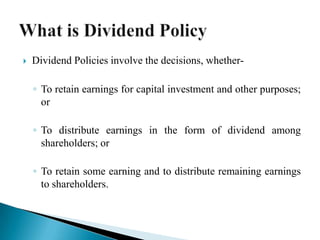
Dividend Policies involve the decisions, whether◦ To retain earnings for capital investment and other purposes;
or
◦ To distribute earnings in the form of dividend among
shareholders; or
◦ To retain some earning and to distribute remaining earnings
to shareholders.
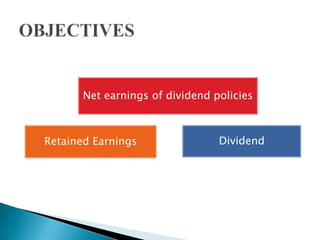
Net earnings of dividend policies

Retained Earnings

Dividend


To consider the net earnings of the firm as a source of long
term funds



To pay dividend distribution tax on the distributed dividend



To reduce internal funds available to finance profitable
investment opportunities which constraints growth or
requires the firms to find other costly sources of financing



To view dividend decision merely as a residual decision


The payment of dividends may significantly affect the market
price of a share



In oder to maximize wealth under uncertainty, the firm must
pay enough dividends to satisfy the investors



Their wealth will be maximized if firm’s retain earnings rather
than distributing them


The typical dividend policy of most firm is to retain between
1/3 to half of the net earnings and distribute the remaining
amount to share holders.



Companies in india specify dividends in term of a dividend
rate which is percentage of the paid up capital per share.


What are the firm’s financial needs given its growth plan and
investment opportunities



Who are the shareholders of the firm? What are the
preferences regarding dividend payment



What are the firms’ risk-business and financial



Should the firm pay stable dividend policy



How should thw firm pay dividends-cash dividends or bonus
share or share buyback


1) Firm’s investment opportunities and financial needs



2) Shareholder’s Expectations



3) Constraints on Paying Dividend


Firm should tailor their dividends policy to their long-term
investment opportunities to have maximum flexibility and
avoid financial frictions and cost of raising external funds.



When they don’t have any specific investment opportunities
they invest in short term securities yielding nominal returns.


Shareholders’ preference for dividends or capital gains may
depend on dividends and capital gains.



The ownership concentration in a firm may define the
shareholders’ expectations.



Closely held company where shareholders are small and
homogeneous and management usually knows the
expectations of shareholders.


Where in widely held company, number of shareholders are very
large. So, they have diverse desire regarding dividends and capital
gains.



Small shareholders are not frequent purchasers of the shares. They
have small numbers of shares in few companies with the
expectations of dividend income.
Retired and old persons will purchase shares from their regular
income so that they choose regular and liberal dividends paying
company.





Wealthy investors are much concerned about with the dividend
policy followed by a company. They have definite way of
investment policy to maximize their wealth and minimize taxes



Institutional investors purchase large blocks of shares to hold them
for relatively long periods of time.








Legal restrictions
Liquidity
Financial Conditions
Access to Capital Market
Restrictions in Loan Agreement
Inflation
Control


LEGAL RESTRICTIONS




Evolve within legal framework
The directors are not legally compelled to declare dividend



LIQUIDITY



Payment of dividend means cash outflow.
There might be adequate earning but insufficient cash to pay
Cash position and overall liquidity > ability to pay dividend
Two conditions of firm :- Mature firm & growing firm






FINANCIAL CONDITION AND BORROWING CAPACITY



It is depends on its use of borrowings and interest charges
payable .
Higher degree of FL makes company vulnerable to change in
earnings, there more base is on equity.
Steady growing firm cash flows and less investment
opportunities , might follow high dividend policy inspite of
having debt
Growing firm to pay dividend borrow funds. This might not be
sound. It reduces financial flexibility.








ACCESS TO CAPITAL MARKET



Company if insufficient with cash can also pay dividend
through raising debt and equity in capital market.
Good goodwill in market would easily raise fund
If the company has an easy acces to market it provides
flexibility to the management in paying dividend as well as
meeting corporate obligations.
Soundness of the company cash position determines it access
to capital market.
Thus, Ability to raise fund in capital market > ability to pay
dividend even if its not liquid.









RESTRICTION IN LOAN AGREEMENT



Terms and conditions of lender can also restrict the dividend
policy in order to safeguard their interest they would be
receiving in future, who has lower profitability and liquidity.
If higher is the debt , or If liquidity is low prohibition can be
there.
When the restriction put, the company is forced to retain
earnings and have low payout.







INFLATION



Accounting is based on historical cost, Thus


CONTROL



The management control over the company can also influence
dividend policy. Large dividend affects cash position. As a
result, the company will issue new shares to raise fund to
finance its investment. The power of existing will be diluted if
they don’t buy additional shares issued.



Under these conditions, the payment of dividend may be
retained to finance the firm investment oportunities.


Stability of dividends is considered a desirable policy by the
management of most companies in practice. Many surveys have
shown that shareholders also seem generally to favor this policy and
value stable dividends higher than the fluctuating ones.



Stability of dividends also means regularity in paying some
dividend annually , even though the amount of dividend may
fluctuate over the years ,and may not be related with earnings.



There are a number of companies, which have records of paying
dividend for a long, unbroken period. More precisely, stability of
dividends refers to the amounts paid out regularly.


Constant dividend per share or dividend rate



Constant payout



Constant dividend per share plus extra dividend


A number of companies follow in India follow the policy of
paying a fixed rate on paid-up capital as dividend
year, irrespective of the fluctuations in the earnings.



When the company reaches new levels of earnings and
expects to maintain them, the dividend rate may be increased.



It is easy to follow this policy when earnings are stable.
However if the earning patterns of a company shows wide
fluctuations, it than becomes difficult to maintain such a
policy.


In practice, when a company retains earnings in good years for
this purpose, it earmarks this surplus as dividend equalization
reserve.



These funds are invested in current assets like tradeable
(marketable) securities, so that they may easily be converted
into cash at the time of paying dividends in bad years.



A constant dividend per share policy puts ordinary
shareholders at par with preference shareholders irrespective
of the firm’s investment opportunities or the preferences of
shareholders.


The ratio of dividend to earnings is known as payout ratio.



Some companies may follow a policy of constant payout ratio
i.e. paying a fixed percentage of net earnings every year .



With this policy the amount of dividend will fluctuate in direct
proportion to earnings.



If a company adopts a 40 % payout ratio, then 40% of every
rupee of net earnings will be paid out.


This policy is related to a company’s ability to pay dividends.
If the company incurs losses, no dividends shall be paid
regardless of the desires of shareholders.



At any given payout ratio, the amount of dividends and the
additions to retained earnings increase with increasing
earnings and decrease with decreasing earnings.



This policy does not put any pressure on a company’s liquidity
since dividends are distributed only when the company has
profits.


For companies with fluctuating earnings, the policy to pay a
minimum dividend per share with a step-up feature is
desirable .The small amount of dividend per share is fixed to
reduce the possibility of ever missing a dividend payment.



By paying extra dividend( a number of companies in India pay
an interim dividend followed by a regular, final dividend) in
periods of prosperity, an attempt is made to prevent investors
from expecting that the dividend represents an increase in the
established dividend amount.


This type of policy enables a company to pay constant amount
of dividend regularly without a default and allows a great deal
of flexibility for supplementing the income of shareholders
only when the company’s earnings are higher than the
usual, without committing itself to make larger payments as a
part of the future fixed dividend.



Certain shareholders like this policy because of the certain
cash flow in the form of regular dividend and the option of
earning extra dividend occasionally.


Resolution of Investors



Investor’s desire for current income



Institutional investor’s requirements



Raising additional finances


The greatest danger in adopting a stable dividend policy is
that once it is established , it cannot be changed without
seriously affecting the investors attitude and the financial
standing of the company



Missing of dividend payment in a year will effect on investors
more than the failure to pay a dividend with unstable dividend
policy


A cut in dividend = A cut in salary



The companies with stable dividend policy create a ‘clientele’
that depends on dividend income to meet their living and
operating expenses.



When a company fails to pay a dividend , it does not have a
depressing effect on investors as a failure to pay a regular
dividend does.


He found out that firms generally think in
terms of proportion of earnings to be made
out investment requirements are not
considered for modifying the patterns of
dividend behaviour. Thus firms generally
have target payout ratios in view while
determining change in dividend per share.
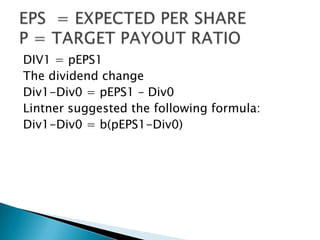
DIV1 = pEPS1
The dividend change
Div1-Div0 = pEPS1 – Div0
Lintner suggested the following formula:
Div1-Div0 = b(pEPS1-Div0)













Companies mostly pay dividends in cash.
A company should have enough cash while declaring dividend in
its absences arrangement should be made to borrow fund.
Same way, when the company follows a stable dividend policy, it
should prepare a cash budget for the coming period to indicate the
necessary funds, which would be needed to meet the regular
dividend payments of the company.
It is relatively difficult to make cash planning in anticipation of
dividend needs when an unstable policy is followed.
The cash account and the reserve account of a company will be
reduced when the cash dividend is paid.
Thus, both the total asset and the net worth of the company are
reduced when the cash dividend is distributed.
The market price of the shares drops in most cases by the amount
of the cash dividend distributed.









Bonus shares is the distribution of shares free of cost to the existing
company.
In India, bonus shares are issued in addition to the cash dividend
and not in lieu of cash dividend. Hence companies in India may
supplement cash dividend by bonus issues.
The bonus shares are distributed proportionately to the existing
shareholder. Hence there is no dilution of ownership.
The declaration of bonus shares will increase the paid up share
capital and reduce the reserve and surplus of the company.
The total net worth (paid up capital + surplus) is not affected by the
bonus issue.
In fact, a bonus issue represents a recapitalization of reserve and
surplus.
It is merely an accounting transfer from reserves and surplus to
paid-up capital.
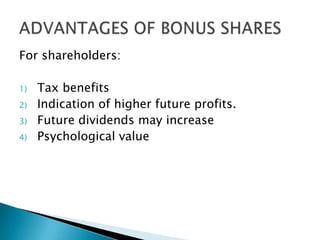
For shareholders:
1)
2)
3)

4)

Tax benefits
Indication of higher future profits.
Future dividends may increase
Psychological value

1)
2)
3)

For company:
Conservation of cash
Only means to pay dividends under financial
difficulty and contractual restrictions.
More attractive share price
1)

Shareholders wealth remains unaffected

2)

Costly to administer

3)

Problem of adjusting Earning Per Share and Price Earning
Ratio.


When the prices of shares fall, the company may want to
reduce the number of its share outstanding to increase the
market price.



The reduction of the number of outstanding shares by
increasing per share par value is known as a reverse split.


A share split is a method to increase the number of outstanding
shares through a proportional reduction in the par value of the
share and thus shareholders total funds remain unaltered.






The buy buck of shares is the repurchase of its own shares by
a company.
Until recently the buy buck of shares by companies in India
was prohibited under section 77 of the Indian Companies Act
1999.
As a result, a company in India can now buy buck its own
shares.
1)

2)

3)

4)
5)

A company buying back its shares will not issue fresh
capital, except bonus issue, for the next 12 months.
The company will state the amount to be used for the
buyback of shares and seek price approval of shareholders.
The buyback of shares can be affected only by utilizing the
free reserves, viz., reserves not specifically earmarked for
some purpose.
The company will not borrow funds to buy back shares.
The shares bought under the buyback schemes will be
extinguished and they cannot be reissued.

1)

2)

There are two methods of the shares buyback in India.
A company can buy its shares through authorized brokers on
the open markets. The reason for the buy buck was that the
company wanted to signal to the shareholders that it would
reward its shareholders by returning surplus cash to them.
The company can make a tender offer, which will specify the
purchase price, the total amount and the period within which
shares will be bought back.








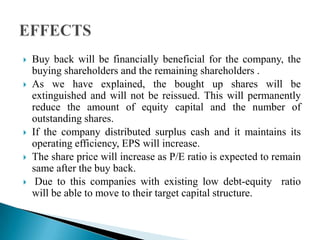
Buy back will be financially beneficial for the company, the
buying shareholders and the remaining shareholders .
As we have explained, the bought up shares will be
extinguished and will not be reissued. This will permanently
reduce the amount of equity capital and the number of
outstanding shares.
If the company distributed surplus cash and it maintains its
operating efficiency, EPS will increase.
The share price will increase as P/E ratio is expected to remain
same after the buy back.
Due to this companies with existing low debt-equity ratio
will be able to move to their target capital structure.
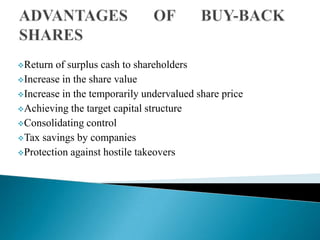
Return

of surplus cash to shareholders
Increase in the share value
Increase in the temporarily undervalued share price
Achieving the target capital structure
Consolidating control
Tax savings by companies
Protection against hostile takeovers
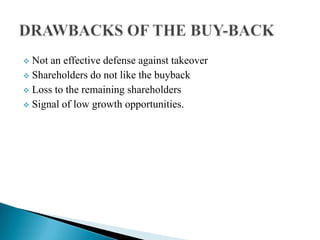
Not an effective defense against takeover
 Shareholders do not like the buyback
 Loss to the remaining shareholders
 Signal of low growth opportunities.


Dividend policies-financial mgt

  • 1.
    FINANCIAL MANAGEMENT MBA SEM2 GROUP NO :- 1(A2) PRIYANKA BACHKANIWALA-4 RAKSHIT BHAVSAR-13 KOSHA DOSHI-24 AANCHAL JAIN-37 SONAM LALWANI-51 TOPIC : DIVIDEND POLICY
  • 3.
     Dividend Policies involvethe decisions, whether◦ To retain earnings for capital investment and other purposes; or ◦ To distribute earnings in the form of dividend among shareholders; or ◦ To retain some earning and to distribute remaining earnings to shareholders.
  • 4.
    Net earnings ofdividend policies Retained Earnings Dividend
  • 5.
     To consider thenet earnings of the firm as a source of long term funds  To pay dividend distribution tax on the distributed dividend  To reduce internal funds available to finance profitable investment opportunities which constraints growth or requires the firms to find other costly sources of financing  To view dividend decision merely as a residual decision
  • 6.
     The payment ofdividends may significantly affect the market price of a share  In oder to maximize wealth under uncertainty, the firm must pay enough dividends to satisfy the investors  Their wealth will be maximized if firm’s retain earnings rather than distributing them
  • 8.
     The typical dividendpolicy of most firm is to retain between 1/3 to half of the net earnings and distribute the remaining amount to share holders.  Companies in india specify dividends in term of a dividend rate which is percentage of the paid up capital per share.
  • 9.
     What are thefirm’s financial needs given its growth plan and investment opportunities  Who are the shareholders of the firm? What are the preferences regarding dividend payment  What are the firms’ risk-business and financial  Should the firm pay stable dividend policy  How should thw firm pay dividends-cash dividends or bonus share or share buyback
  • 10.
     1) Firm’s investmentopportunities and financial needs  2) Shareholder’s Expectations  3) Constraints on Paying Dividend
  • 11.
     Firm should tailortheir dividends policy to their long-term investment opportunities to have maximum flexibility and avoid financial frictions and cost of raising external funds.  When they don’t have any specific investment opportunities they invest in short term securities yielding nominal returns.
  • 12.
     Shareholders’ preference fordividends or capital gains may depend on dividends and capital gains.  The ownership concentration in a firm may define the shareholders’ expectations.  Closely held company where shareholders are small and homogeneous and management usually knows the expectations of shareholders.
  • 13.
     Where in widelyheld company, number of shareholders are very large. So, they have diverse desire regarding dividends and capital gains.  Small shareholders are not frequent purchasers of the shares. They have small numbers of shares in few companies with the expectations of dividend income. Retired and old persons will purchase shares from their regular income so that they choose regular and liberal dividends paying company.   Wealthy investors are much concerned about with the dividend policy followed by a company. They have definite way of investment policy to maximize their wealth and minimize taxes  Institutional investors purchase large blocks of shares to hold them for relatively long periods of time.
  • 14.
           Legal restrictions Liquidity Financial Conditions Accessto Capital Market Restrictions in Loan Agreement Inflation Control
  • 15.
     LEGAL RESTRICTIONS   Evolve withinlegal framework The directors are not legally compelled to declare dividend  LIQUIDITY  Payment of dividend means cash outflow. There might be adequate earning but insufficient cash to pay Cash position and overall liquidity > ability to pay dividend Two conditions of firm :- Mature firm & growing firm   
  • 16.
     FINANCIAL CONDITION ANDBORROWING CAPACITY  It is depends on its use of borrowings and interest charges payable . Higher degree of FL makes company vulnerable to change in earnings, there more base is on equity. Steady growing firm cash flows and less investment opportunities , might follow high dividend policy inspite of having debt Growing firm to pay dividend borrow funds. This might not be sound. It reduces financial flexibility.   
  • 17.
     ACCESS TO CAPITALMARKET  Company if insufficient with cash can also pay dividend through raising debt and equity in capital market. Good goodwill in market would easily raise fund If the company has an easy acces to market it provides flexibility to the management in paying dividend as well as meeting corporate obligations. Soundness of the company cash position determines it access to capital market. Thus, Ability to raise fund in capital market > ability to pay dividend even if its not liquid.    
  • 18.
     RESTRICTION IN LOANAGREEMENT  Terms and conditions of lender can also restrict the dividend policy in order to safeguard their interest they would be receiving in future, who has lower profitability and liquidity. If higher is the debt , or If liquidity is low prohibition can be there. When the restriction put, the company is forced to retain earnings and have low payout.    INFLATION  Accounting is based on historical cost, Thus
  • 19.
     CONTROL  The management controlover the company can also influence dividend policy. Large dividend affects cash position. As a result, the company will issue new shares to raise fund to finance its investment. The power of existing will be diluted if they don’t buy additional shares issued.  Under these conditions, the payment of dividend may be retained to finance the firm investment oportunities.
  • 20.
     Stability of dividendsis considered a desirable policy by the management of most companies in practice. Many surveys have shown that shareholders also seem generally to favor this policy and value stable dividends higher than the fluctuating ones.  Stability of dividends also means regularity in paying some dividend annually , even though the amount of dividend may fluctuate over the years ,and may not be related with earnings.  There are a number of companies, which have records of paying dividend for a long, unbroken period. More precisely, stability of dividends refers to the amounts paid out regularly.
  • 21.
     Constant dividend pershare or dividend rate  Constant payout  Constant dividend per share plus extra dividend
  • 22.
     A number ofcompanies follow in India follow the policy of paying a fixed rate on paid-up capital as dividend year, irrespective of the fluctuations in the earnings.  When the company reaches new levels of earnings and expects to maintain them, the dividend rate may be increased.  It is easy to follow this policy when earnings are stable. However if the earning patterns of a company shows wide fluctuations, it than becomes difficult to maintain such a policy.
  • 23.
     In practice, whena company retains earnings in good years for this purpose, it earmarks this surplus as dividend equalization reserve.  These funds are invested in current assets like tradeable (marketable) securities, so that they may easily be converted into cash at the time of paying dividends in bad years.  A constant dividend per share policy puts ordinary shareholders at par with preference shareholders irrespective of the firm’s investment opportunities or the preferences of shareholders.
  • 24.
     The ratio ofdividend to earnings is known as payout ratio.  Some companies may follow a policy of constant payout ratio i.e. paying a fixed percentage of net earnings every year .  With this policy the amount of dividend will fluctuate in direct proportion to earnings.  If a company adopts a 40 % payout ratio, then 40% of every rupee of net earnings will be paid out.
  • 25.
     This policy isrelated to a company’s ability to pay dividends. If the company incurs losses, no dividends shall be paid regardless of the desires of shareholders.  At any given payout ratio, the amount of dividends and the additions to retained earnings increase with increasing earnings and decrease with decreasing earnings.  This policy does not put any pressure on a company’s liquidity since dividends are distributed only when the company has profits.
  • 26.
     For companies withfluctuating earnings, the policy to pay a minimum dividend per share with a step-up feature is desirable .The small amount of dividend per share is fixed to reduce the possibility of ever missing a dividend payment.  By paying extra dividend( a number of companies in India pay an interim dividend followed by a regular, final dividend) in periods of prosperity, an attempt is made to prevent investors from expecting that the dividend represents an increase in the established dividend amount.
  • 27.
     This type ofpolicy enables a company to pay constant amount of dividend regularly without a default and allows a great deal of flexibility for supplementing the income of shareholders only when the company’s earnings are higher than the usual, without committing itself to make larger payments as a part of the future fixed dividend.  Certain shareholders like this policy because of the certain cash flow in the form of regular dividend and the option of earning extra dividend occasionally.
  • 28.
     Resolution of Investors  Investor’sdesire for current income  Institutional investor’s requirements  Raising additional finances
  • 29.
     The greatest dangerin adopting a stable dividend policy is that once it is established , it cannot be changed without seriously affecting the investors attitude and the financial standing of the company  Missing of dividend payment in a year will effect on investors more than the failure to pay a dividend with unstable dividend policy
  • 30.
     A cut individend = A cut in salary  The companies with stable dividend policy create a ‘clientele’ that depends on dividend income to meet their living and operating expenses.  When a company fails to pay a dividend , it does not have a depressing effect on investors as a failure to pay a regular dividend does.
  • 31.
     He found outthat firms generally think in terms of proportion of earnings to be made out investment requirements are not considered for modifying the patterns of dividend behaviour. Thus firms generally have target payout ratios in view while determining change in dividend per share.
  • 32.
    DIV1 = pEPS1 Thedividend change Div1-Div0 = pEPS1 – Div0 Lintner suggested the following formula: Div1-Div0 = b(pEPS1-Div0)
  • 34.
           Companies mostly paydividends in cash. A company should have enough cash while declaring dividend in its absences arrangement should be made to borrow fund. Same way, when the company follows a stable dividend policy, it should prepare a cash budget for the coming period to indicate the necessary funds, which would be needed to meet the regular dividend payments of the company. It is relatively difficult to make cash planning in anticipation of dividend needs when an unstable policy is followed. The cash account and the reserve account of a company will be reduced when the cash dividend is paid. Thus, both the total asset and the net worth of the company are reduced when the cash dividend is distributed. The market price of the shares drops in most cases by the amount of the cash dividend distributed.
  • 35.
           Bonus shares isthe distribution of shares free of cost to the existing company. In India, bonus shares are issued in addition to the cash dividend and not in lieu of cash dividend. Hence companies in India may supplement cash dividend by bonus issues. The bonus shares are distributed proportionately to the existing shareholder. Hence there is no dilution of ownership. The declaration of bonus shares will increase the paid up share capital and reduce the reserve and surplus of the company. The total net worth (paid up capital + surplus) is not affected by the bonus issue. In fact, a bonus issue represents a recapitalization of reserve and surplus. It is merely an accounting transfer from reserves and surplus to paid-up capital.
  • 36.
    For shareholders: 1) 2) 3) 4) Tax benefits Indicationof higher future profits. Future dividends may increase Psychological value
  • 37.
     1) 2) 3) For company: Conservation ofcash Only means to pay dividends under financial difficulty and contractual restrictions. More attractive share price
  • 38.
    1) Shareholders wealth remainsunaffected 2) Costly to administer 3) Problem of adjusting Earning Per Share and Price Earning Ratio.
  • 39.
     When the pricesof shares fall, the company may want to reduce the number of its share outstanding to increase the market price.  The reduction of the number of outstanding shares by increasing per share par value is known as a reverse split.
  • 40.
     A share splitis a method to increase the number of outstanding shares through a proportional reduction in the par value of the share and thus shareholders total funds remain unaltered.
  • 41.
       The buy buckof shares is the repurchase of its own shares by a company. Until recently the buy buck of shares by companies in India was prohibited under section 77 of the Indian Companies Act 1999. As a result, a company in India can now buy buck its own shares.
  • 42.
    1) 2) 3) 4) 5) A company buyingback its shares will not issue fresh capital, except bonus issue, for the next 12 months. The company will state the amount to be used for the buyback of shares and seek price approval of shareholders. The buyback of shares can be affected only by utilizing the free reserves, viz., reserves not specifically earmarked for some purpose. The company will not borrow funds to buy back shares. The shares bought under the buyback schemes will be extinguished and they cannot be reissued.
  • 43.
     1) 2) There are twomethods of the shares buyback in India. A company can buy its shares through authorized brokers on the open markets. The reason for the buy buck was that the company wanted to signal to the shareholders that it would reward its shareholders by returning surplus cash to them. The company can make a tender offer, which will specify the purchase price, the total amount and the period within which shares will be bought back.
  • 44.
         Buy back willbe financially beneficial for the company, the buying shareholders and the remaining shareholders . As we have explained, the bought up shares will be extinguished and will not be reissued. This will permanently reduce the amount of equity capital and the number of outstanding shares. If the company distributed surplus cash and it maintains its operating efficiency, EPS will increase. The share price will increase as P/E ratio is expected to remain same after the buy back. Due to this companies with existing low debt-equity ratio will be able to move to their target capital structure.
  • 45.
    Return of surplus cashto shareholders Increase in the share value Increase in the temporarily undervalued share price Achieving the target capital structure Consolidating control Tax savings by companies Protection against hostile takeovers
  • 46.
    Not an effectivedefense against takeover  Shareholders do not like the buyback  Loss to the remaining shareholders  Signal of low growth opportunities. 

Editor's Notes