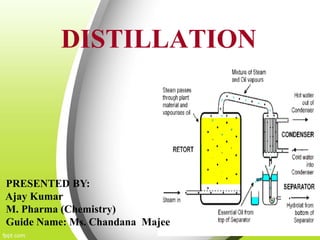
DISTILLATION
PRESENTED BY:
Ajay Kumar
M. Pharma (Chemistry)
Guide Name: Ms. Chandana Majee
LIST OF CONTENT…..
• DEFINATION OF DISTILLATION
• APPLICATIONS
• RAOULT’S LAW
• TYPES OF DISTILLATION PROCESS
• STEAM DISTILLATION
• STEAM DISTILLATION SET-UP
• AZEOTROPIC DISTILLATION
• REFRENCE
DEFINITION
• “Distillation is an unit operation which involves in
separation of a vaporizable component from a
multicomponent system and subsequent condensation
of vapours.”
• “Distillation is defined as the separation of the
components of a liquid mixture by a process
involving vaporization and subsequent condensation
at another place.”
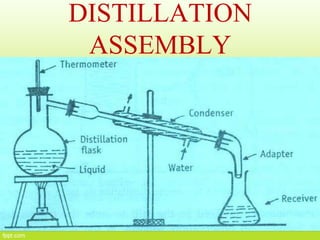
DISTILLATION
ASSEMBLY
APPLICATIONS
• Separation of volatile oils- cloves(Eugenol comprises 72-90%,
Vanilin, acetyl eugenol).
• Separation of drugs obtained from plant and animal sources-
Vit. A from fish liver oil.
• Purification of organic solvents-absolute alcohol (100%).
• Purification of drugs obtained from chemical process.
• Manufacture of official preparations -sprit of nitrous ether,
sprit of ammonia, D.water and water for inj.
• Quality control methods- Alcohol content in elixir(4-40%).
• Refining of petroleum products- Petroleum ether 60,80.
• Recovery of solvents- synthesis
RAOULT’S
LAW
• It express a quantitative relationship between the concentration
and vapour pressure
• It states that partial vapour pressure of each volatile
constituent is equal to vapour pressure of the pure constituent
multiplied by its mole fraction in the solution at a given
temperature.
RAOULT’S
LAW……..
• Suppose Homogeneous mixture of liquid A and B
Partial vapour pressure of component A in Mixture
= PA = P°A*XA
Mole fraction of A in solution = XA
Vapour pressure of A in pure state = P°A
Partial vapour pressure of component B in Mixture
PB = P°B *XB
Mole fraction of B in solution = XB
Vapour pressure of A in pure state = P°B
• Total Vapour pressure of Mixture
PT = PA + PB
PT= P°A*XA + P°B*XB
TYPES OF DISTILLATION
PROCESS
• FLASH DISTILLATION
• SIMPLE DISTILLATION
• FACTIONAL DISTILLATION
• AZETROPIC AND EXTRACTIVE DISTILLATION
• STEAM DISTILLATION
• DISTILLATION UNDER REDUCED PRESSURE
• MOLECULAR DISTILLATION
STEAM DISTILLATION
• Steam distillation is method of distillation carried out with aid
of steam.
• It is used to separate
- High boiling substances from non-volatile impurities –
Separate immiscible liquids
• PRINCIPLE:
• A mixture of immiscible liquids begins to boil when sum of
their vapour pressure is equal to atmospheric pressure.
• In case of mixture of water and turpentine, mixture boils below
the boiling point of pure water, though the turpentine boils at a
much higher temperature than that of water.
STEAM DISTILLATION
SET-UP
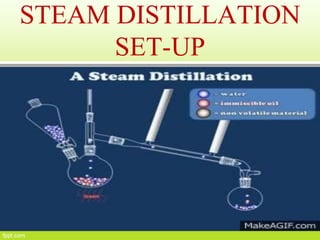
WORKING:
• Metallic steam can fitted with cork having two holes.
• Safety tube inserted up to bottom through one hole to maintain
pressure in side stem can, more over when steam comes out
from safety tube indicates that can is empty.
• Through other hole band tube is passed and other end of this
tube is connected to flask containing nonaqueous liquid in
which tube is dipped.
• Flask and condenser is connected with delivery tube.
• Condenser is connected to receiver with help of adopter.
APPLICATION
• Used to separate immiscible liquids
Eg- Water + Toluene
• Extraction at much lower temperature to protect from decomposition
without loss of aroma
• To extract volatile oils like clove, anise and eucalyptus oils.
• Purification of essential oils like almond oil.
• Camphor is distilled by this method.
• Aromatic water are prepared.
• Limitation:
• Not suitable when two immiscible liquids reacts with each other.
AZEOTROPIC
DISTILLATION
• Azeotropic distillation refers to processes whereby a new component
(called the entrainer) is added to the original feed mixture to form (or
nearly form) an azeotrope with one (or more) of the feed components.
• The azeotrope is then removed as either the distillate or the bottoms.
• Usually refers to the specific technique of adding another component to
generate a new, lower-boiling azeotrope that is heterogeneous (e.g.
producing two, immiscible liquid phases), such as the example below with
the addition of benzene to water and ethanol.
• Azeotropic distillation also refers to those processes in which a new
component is added to an original feed mixture to break an azeotrope that
otherwise would be formed by the feed components.
AZEOTROPIC
DISTILLATION
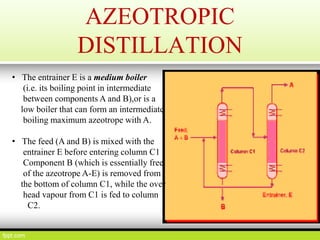
• The entrainer E is a medium boiler
(i.e. its boiling point in intermediate
between components A and B),or is a
low boiler that can form an intermediate
boiling maximum azeotrope with A.
• The feed (A and B) is mixed with the
entrainer E before entering column C1
Component B (which is essentially free
of the azeotrope A-E) is removed from
the bottom of column C1, while the over
head vapour from C1 is fed to column
C2.
APPLICATION
• Azeotropic distillation is provided by us to many of our customers is to
break an azeotrope in distillation.
• It is usually denotes the specific technique of adding new constituent to
produce a novel, lower-boiling azeotrope that is heterogeneous.
• We construct the unit with the specification provided by the customers.
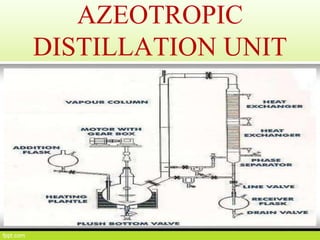
AZEOTROPIC
DISTILLATION UNIT
REFRENCE
• Text book of Pharmaceutical Engineering By
C.V.S Subrahmanyam, J.Thimma Setty ,5th
edition ,Page No293-336.
• Slideshare.
Distillation

Distillation

  • 1.
    DISTILLATION PRESENTED BY: Ajay Kumar M.Pharma (Chemistry) Guide Name: Ms. Chandana Majee
  • 2.
    LIST OF CONTENT….. •DEFINATION OF DISTILLATION • APPLICATIONS • RAOULT’S LAW • TYPES OF DISTILLATION PROCESS • STEAM DISTILLATION • STEAM DISTILLATION SET-UP • AZEOTROPIC DISTILLATION • AZEOTROPIC DISTILLATION • REFRENCE
  • 3.
    DEFINITION • “Distillation isan unit operation which involves in separation of a vaporizable component from a multicomponent system and subsequent condensation of vapours.” • “Distillation is defined as the separation of the components of a liquid mixture by a process involving vaporization and subsequent condensation at another place.”
  • 4.
  • 5.
    APPLICATIONS • Separation ofvolatile oils- cloves(Eugenol comprises 72-90%, Vanilin, acetyl eugenol). • Separation of drugs obtained from plant and animal sources- Vit. A from fish liver oil. • Purification of organic solvents-absolute alcohol (100%). • Purification of drugs obtained from chemical process. • Manufacture of official preparations -sprit of nitrous ether, sprit of ammonia, D.water and water for inj. • Quality control methods- Alcohol content in elixir(4-40%). • Refining of petroleum products- Petroleum ether 60,80. • Recovery of solvents- synthesis
  • 6.
    RAOULT’S LAW • It expressa quantitative relationship between the concentration and vapour pressure • It states that partial vapour pressure of each volatile constituent is equal to vapour pressure of the pure constituent multiplied by its mole fraction in the solution at a given temperature.
  • 7.
    RAOULT’S LAW…….. • Suppose Homogeneousmixture of liquid A and B Partial vapour pressure of component A in Mixture = PA = P°A*XA Mole fraction of A in solution = XA Vapour pressure of A in pure state = P°A Partial vapour pressure of component B in Mixture PB = P°B *XB Mole fraction of B in solution = XB Vapour pressure of A in pure state = P°B • Total Vapour pressure of Mixture PT = PA + PB PT= P°A*XA + P°B*XB
  • 8.
    TYPES OF DISTILLATION PROCESS •FLASH DISTILLATION • SIMPLE DISTILLATION • FACTIONAL DISTILLATION • AZETROPIC AND EXTRACTIVE DISTILLATION • STEAM DISTILLATION • DISTILLATION UNDER REDUCED PRESSURE • MOLECULAR DISTILLATION
  • 9.
    STEAM DISTILLATION • Steamdistillation is method of distillation carried out with aid of steam. • It is used to separate - High boiling substances from non-volatile impurities – Separate immiscible liquids • PRINCIPLE: • A mixture of immiscible liquids begins to boil when sum of their vapour pressure is equal to atmospheric pressure. • In case of mixture of water and turpentine, mixture boils below the boiling point of pure water, though the turpentine boils at a much higher temperature than that of water.
  • 10.
  • 11.
    WORKING: • Metallic steamcan fitted with cork having two holes. • Safety tube inserted up to bottom through one hole to maintain pressure in side stem can, more over when steam comes out from safety tube indicates that can is empty. • Through other hole band tube is passed and other end of this tube is connected to flask containing nonaqueous liquid in which tube is dipped. • Flask and condenser is connected with delivery tube. • Condenser is connected to receiver with help of adopter.
  • 12.
    APPLICATION • Used toseparate immiscible liquids Eg- Water + Toluene • Extraction at much lower temperature to protect from decomposition without loss of aroma • To extract volatile oils like clove, anise and eucalyptus oils. • Purification of essential oils like almond oil. • Camphor is distilled by this method. • Aromatic water are prepared. • Limitation: • Not suitable when two immiscible liquids reacts with each other.
  • 13.
    AZEOTROPIC DISTILLATION • Azeotropic distillationrefers to processes whereby a new component (called the entrainer) is added to the original feed mixture to form (or nearly form) an azeotrope with one (or more) of the feed components. • The azeotrope is then removed as either the distillate or the bottoms. • Usually refers to the specific technique of adding another component to generate a new, lower-boiling azeotrope that is heterogeneous (e.g. producing two, immiscible liquid phases), such as the example below with the addition of benzene to water and ethanol. • Azeotropic distillation also refers to those processes in which a new component is added to an original feed mixture to break an azeotrope that otherwise would be formed by the feed components.
  • 14.
    AZEOTROPIC DISTILLATION • The entrainerE is a medium boiler (i.e. its boiling point in intermediate between components A and B),or is a low boiler that can form an intermediate boiling maximum azeotrope with A. • The feed (A and B) is mixed with the entrainer E before entering column C1 Component B (which is essentially free of the azeotrope A-E) is removed from the bottom of column C1, while the over head vapour from C1 is fed to column C2.
  • 15.
    APPLICATION • Azeotropic distillationis provided by us to many of our customers is to break an azeotrope in distillation. • It is usually denotes the specific technique of adding new constituent to produce a novel, lower-boiling azeotrope that is heterogeneous. • We construct the unit with the specification provided by the customers.
  • 16.
  • 17.
    REFRENCE • Text bookof Pharmaceutical Engineering By C.V.S Subrahmanyam, J.Thimma Setty ,5th edition ,Page No293-336. • Slideshare.