DISTILLATION & ITS TYPES
BY:- PRAJWAL DESAI
UNDER THE GUIDANCE OF PROF. S.T. PATIL
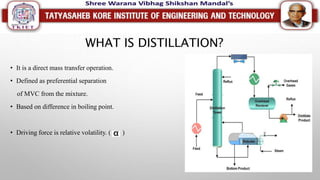
WHAT IS DISTILLATION?
• It is a direct mass transfer operation.
• Defined as preferential separation
of MVC from the mixture.
• Based on difference in boiling point.
• Driving force is relative volatility. ( )
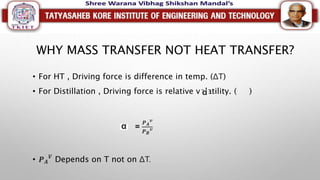
WHY MASS TRANSFER NOT HEAT TRANSFER?
• For HT , Driving force is difference in temp. (ΔT)
• For Distillation , Driving force is relative volatility. ( )
=
𝑷𝑨
𝒗
𝑷𝑩
𝒗
• 𝑷𝑨
𝑽
Depends on T not on ΔT.
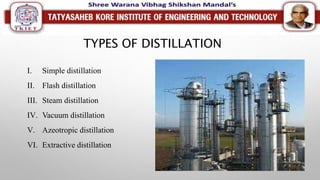
TYPES OF DISTILLATION
I. Simple distillation
II. Flash distillation
III. Steam distillation
IV. Vacuum distillation
V. Azeotropic distillation
VI. Extractive distillation
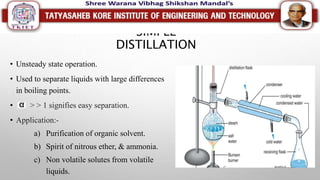
SIMPLE
DISTILLATION
• Unsteady state operation.
• Used to separate liquids with large differences
in boiling points.
• > > 1 signifies easy separation.
• Application:-
a) Purification of organic solvent.
b) Spirit of nitrous ether, & ammonia.
c) Non volatile solutes from volatile
liquids.
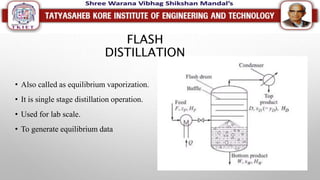
FLASH
DISTILLATION
• Also called as equilibrium vaporization.
• It is single stage distillation operation.
• Used for lab scale.
• To generate equilibrium data
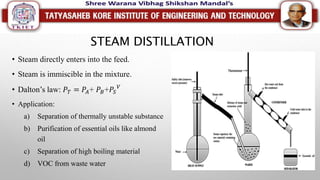
STEAM DISTILLATION
• Steam directly enters into the feed.
• Steam is immiscible in the mixture.
• Dalton’s law: 𝑃𝑇 = 𝑃𝐴+ 𝑃𝐵+𝑃𝑆
𝑉
• Application:
a) Separation of thermally unstable substance
b) Purification of essential oils like almond
oil
c) Separation of high boiling material
d) VOC from waste water
VACUUM
DISTILLATION
• Distillation under reduced
pressure. Using steam ejector or
vacuum pump.
• Used for difficult separation.
• Removal of azeotrope.
• Application:-
a) Separation of heat sensitive
materials. Enzymes & vitamins.
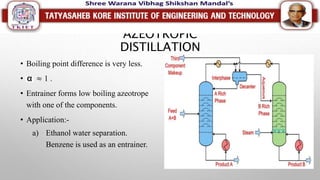
AZEOTROPIC
DISTILLATION
• Boiling point difference is very less.
• ≈ 1 .
• Entrainer forms low boiling azeotrope
with one of the components.
• Application:-
a) Ethanol water separation.
Benzene is used as an entrainer.
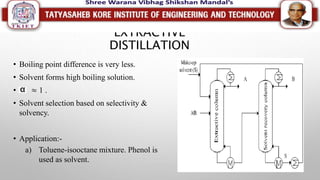
EXTRACTIVE
DISTILLATION
• Boiling point difference is very less.
• Solvent forms high boiling solution.
• ≈ 1 .
• Solvent selection based on selectivity &
solvency.
• Application:-
a) Toluene-isooctane mixture. Phenol is
used as solvent.
Prajwal Desai Distillation.pptx

Prajwal Desai Distillation.pptx

  • 1.
    DISTILLATION & ITSTYPES BY:- PRAJWAL DESAI UNDER THE GUIDANCE OF PROF. S.T. PATIL
  • 2.
    WHAT IS DISTILLATION? •It is a direct mass transfer operation. • Defined as preferential separation of MVC from the mixture. • Based on difference in boiling point. • Driving force is relative volatility. ( )
  • 3.
    WHY MASS TRANSFERNOT HEAT TRANSFER? • For HT , Driving force is difference in temp. (ΔT) • For Distillation , Driving force is relative volatility. ( ) = 𝑷𝑨 𝒗 𝑷𝑩 𝒗 • 𝑷𝑨 𝑽 Depends on T not on ΔT.
  • 4.
    TYPES OF DISTILLATION I.Simple distillation II. Flash distillation III. Steam distillation IV. Vacuum distillation V. Azeotropic distillation VI. Extractive distillation
  • 5.
    SIMPLE DISTILLATION • Unsteady stateoperation. • Used to separate liquids with large differences in boiling points. • > > 1 signifies easy separation. • Application:- a) Purification of organic solvent. b) Spirit of nitrous ether, & ammonia. c) Non volatile solutes from volatile liquids.
  • 6.
    FLASH DISTILLATION • Also calledas equilibrium vaporization. • It is single stage distillation operation. • Used for lab scale. • To generate equilibrium data
  • 7.
    STEAM DISTILLATION • Steamdirectly enters into the feed. • Steam is immiscible in the mixture. • Dalton’s law: 𝑃𝑇 = 𝑃𝐴+ 𝑃𝐵+𝑃𝑆 𝑉 • Application: a) Separation of thermally unstable substance b) Purification of essential oils like almond oil c) Separation of high boiling material d) VOC from waste water
  • 8.
    VACUUM DISTILLATION • Distillation underreduced pressure. Using steam ejector or vacuum pump. • Used for difficult separation. • Removal of azeotrope. • Application:- a) Separation of heat sensitive materials. Enzymes & vitamins.
  • 9.
    AZEOTROPIC DISTILLATION • Boiling pointdifference is very less. • ≈ 1 . • Entrainer forms low boiling azeotrope with one of the components. • Application:- a) Ethanol water separation. Benzene is used as an entrainer.
  • 10.
    EXTRACTIVE DISTILLATION • Boiling pointdifference is very less. • Solvent forms high boiling solution. • ≈ 1 . • Solvent selection based on selectivity & solvency. • Application:- a) Toluene-isooctane mixture. Phenol is used as solvent.