DISTILLATION
V.JAGAN MOHAN RAO M.S.Pharm., MED.CHEM
NIPER-KOLKATA
Asst.Professor, MIPER-KURNOOL
EMAIL- jaganvana6@gmail.com
DEFINITION
 “Distillation is an unit operation which involves separation
of a vaporizable component from a multi-component system
and subsequent condensation of vapours.”
 “Distillation is a process of separating the component
substances from a liquid mixture by selective evaporation
and condensation.”
 “Distillation is defined as the separation of the components
of a liquid mixture by a process involving vaporization and
subsequent condensation at another place.”
APPLICATIONS:
 Separation of volatile oils- cloves(Eugenol comprises 72-
90%, Vanilin, acetyl eugenol).
 Separation of drugs obtained from plant and animal
sources- Vit. A from fish liveroil.
 Purification of organic solvents-absolute alcohol (100%).
 Purification of drugs obtained from chemical process.
 Manufacture of official preparations -sprit of nitrous ether,
sprit of ammonia, D.water and water for inj.
 Quality control methods -Alcohol content in elixir(4-40%).
 Refining of petroleum products- Petroleum ether 60,80.
 Recovery of solvents- synthesis.
TERMINOLOGY
 Binary Mixture
When two liquids mixed together, they may be miscible
with each other in all proportion, such miscible liquid are
known as binary mixtures of liquid.
Example:
- Ethanol + Water
- Acetone + Water
- Benzene + Carbon tetrachloride
TERMINOLOGY
 Ideal Solution (Perfect solution)
Ideal solution is defined as the one in which there is no
change in the properties of components other than dilution,
when they mixed to form a solution.
Property of ideal solution
 Total volume of solution is equal to sum of volumes of
each component
 No heat absorbed and No heat evolved
 No Chemical reaction in-between
 Final volume of solution represents additive property of
individual components
 Follow Raoult’s low
TERMINOLOGY
 Real Solution
Most system shows varying degree of deviation from
raoult’s law, depending on nature of liquids and
temperature. These solution are known as real solution.
Property of Real solution
 Heat may absorbed or evolved
 Chemical reaction occurs in-between
 Final volume of solution represents additive property of
individual components
 Don’t Follow Raoult’s low
Example
 Carbon tetra-chloride + Cyclohexane
 Choroform + Acetone
TERMINOLOGY
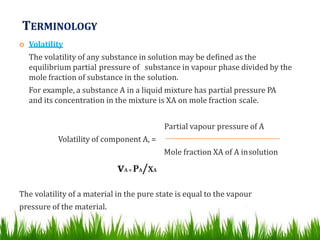
 Volatility
The volatility of any substance in solution may be defined as the
equilibrium partial pressure of substance in vapour phase divided by the
mole fraction of substance in the solution.
For example, a substance A in a liquid mixture has partial pressure PA
and its concentration in the mixture is XA on mole fraction scale.
Partial vapour pressure of A
Volatility of component A, =
Mole fraction XA of A insolution
vA = PA/XA
The volatility of a material in the pure state is equal to the vapour
pressure of the material.
TERMINOLOGY
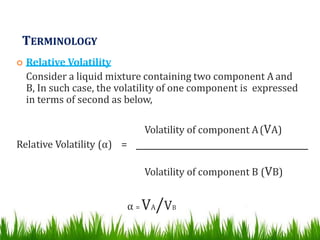
 Relative Volatility
Consider a liquid mixture containing two component A and
B, In such case, the volatility of one component is expressed
in terms of second as below,
Volatility of component A(VA)
Relative Volatility (α) =
Volatility of component B (VB)
α = VA/VB
TERMINOLOGY
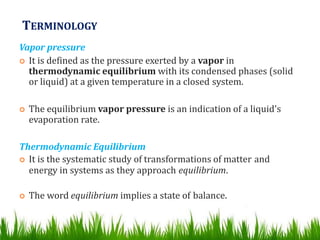
Vapor pressure
 It is defined as the pressure exerted by a vapor in
thermodynamic equilibrium with its condensed phases (solid
or liquid) at a given temperature in a closed system.
 The equilibrium vapor pressure is an indication of a liquid's
evaporation rate.
Thermodynamic Equilibrium
 It is the systematic study of transformations of matter and
energy in systems as they approach equilibrium.
 The word equilibrium implies a state of balance.
TERMINOLOGY
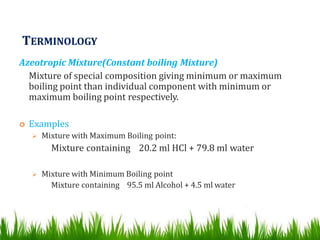
Azeotropic Mixture(Constant boiling Mixture)
Mixture of special composition giving minimum or maximum
boiling point than individual component with minimum or
maximum boiling point respectively.
 Examples
 Mixture with Maximum Boiling point:
Mixture containing 20.2 ml HCl + 79.8 ml water
 Mixture with Minimum Boiling point
Mixture containing 95.5 ml Alcohol + 4.5 ml water
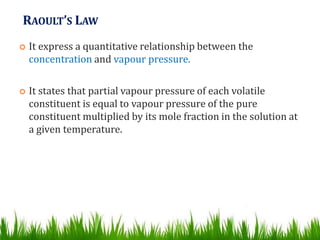
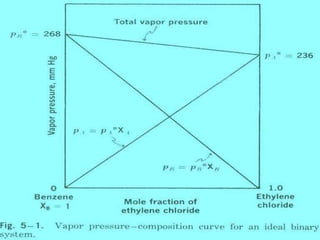
RAOULT’S LAW
 It express a quantitative relationship between the
concentration and vapour pressure.
 It states that partial vapour pressure of each volatile
constituent is equal to vapour pressure of the pure
constituent multiplied by its mole fraction in the solution at
a given temperature.
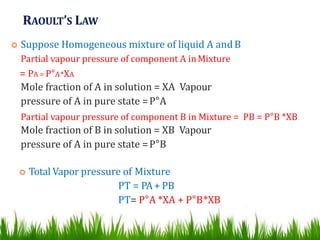
 Suppose Homogeneous mixture of liquid A andB
Partial vapour pressure of component A inMixture
= PA = P°A*XA
Mole fraction of A in solution = XA Vapour
pressure of A in pure state =P°A
Partial vapour pressure of component B in Mixture = PB = P°B *XB
Mole fraction of B in solution = XB Vapour
pressure of A in pure state =P°B
 Total Vapor pressure of Mixture
PT = PA+ PB
PT= P°A *XA + P°B*XB
RAOULT’S LAW
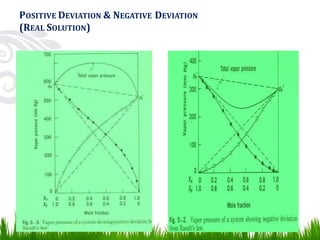
POSITIVE DEVIATION & NEGATIVE DEVIATION
(REAL SOLUTION)
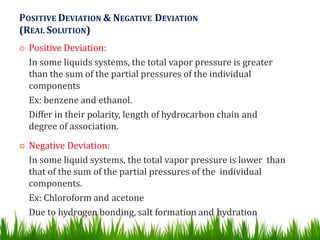
 Positive Deviation:
In some liquids systems, the total vapor pressure is greater
than the sum of the partial pressures of the individual
components
Ex: benzene and ethanol.
Differ in their polarity, length of hydrocarbon chain and
degree of association.
 Negative Deviation:
In some liquid systems, the total vapor pressure is lower than
that of the sum of the partial pressures of the individual
components.
Ex: Chloroform and acetone
Due to hydrogen bonding, salt formation and hydration
POSITIVE DEVIATION & NEGATIVE DEVIATION
(REAL SOLUTION)
16
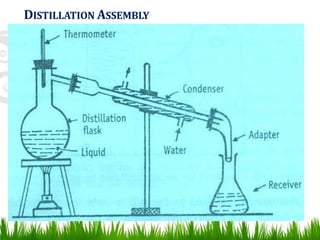
DISTILLATION ASSEMBLY
GENERAL EQUIPMENT FOR DISTILLATION:
STILL :
 It is a vaporizing chamber and used to place the material
to be distilled.
 The still is heated by a suitable means for vaporization of
the volatile constituents.
 On laboratory scale round bottom flasks made of glass
are used so that the progress of the distillation can be
noticed.
 A condenser is attached to the still using appropriate
joints. A trap is inserted between distillation flask and
condenser.
GENERAL EQUIPMENT FOR DISTILLATION:
CONDENSER :
 Used to condense the vapor.
It is kept cold by circulating water/air through jacket.
Types:
 Single-surface condensers
- Straight Tube
- Bulb type
- Spiral
- Coiled type
 Double-surface condensers
 Multi-tubular condensers
The condenser is connected to a receiver through a suitable
adapter.
GENERAL EQUIPMENT FOR DISTILLATION:
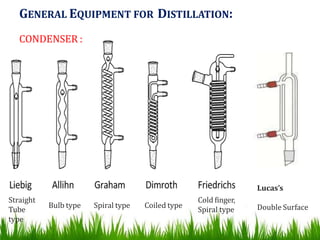
CONDENSER :
Bulb type
Straight
Tube
type
Spiral type Coiled type
Cold finger,
Spiral type
Lucas’s
Double Surface
19
GENERAL EQUIPMENT FOR DISTILLATION:
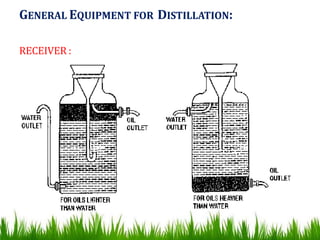
RECEIVER :
 It is used to collect the distillate.
 It may be a simple flask.
 It immersed in ice-bath to minimize loss of volatile
matter.
 Florentine receivers are used for the separation of
oil and water.
Types of Florentine receivers :
 Type-I :- for separation of oil heavier than water.
 Type-II :- for separation of oil lighter than water.
GENERAL EQUIPMENT FOR DISTILLATION:
RECEIVER :
CLASSIFICATION OF DISTILLATION METHODS
 Simple Distillation (Differential distillation)
 Flash Distillation (Equilibrium distillation)
 Vacuum distillation (distillation under reduced pressure)
 Molecular Distillation (Evaporation distillation or short path distillation)
 Fractional Distillation (Rectification)
 Azeotropic and extractive Distillation
 Steam Distillation
 Destructive Distillation
 Compression Distillation
1. SIMPLE DISTILLATION
 Simple distillation is a process of converting a single
constituent from a liquid (or mixture) into its vapour,
transferring the vapour to another place and recovering the
liquid by condensing the vapour, usually by allowing it to
come in contact with a cold surface.
 This process is known differential distillation, as
distillation is based on the differences in volatilities and
vapour pressures of the components in the mixture.
Principle:
 Liquid boils when its vapour pressure is equal to atmospheric
pressure. Simple distillation is conducted at its boiling point.
 The higher the relative volatility of a liquid, the better is the
separation by simple distillation. Heat is supplied to the liquid so
that it boils. The resulting vapour is transferred to a different place
and condensed.
CONSTRUCTION:
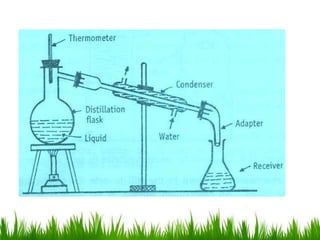
 It consists of a distillation flask with a side arm sloping
downwards.
 Condenser is fitted into the side arm by means of a cork.
 The condenser is usually water condenser, i.e., jacketed
for circulation of water.
 The condenser is connected to a receiver flask using an adapter
with ground glass joints.
On a laboratory scale, the whole apparatus is made of glass. 24
WORKING:
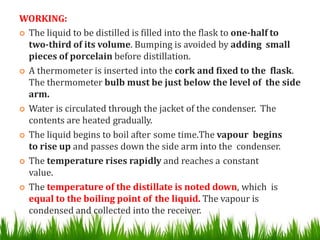
 The liquid to be distilled is filled into the flask to one-half to
two-third of its volume. Bumping is avoided by adding small
pieces of porcelain before distillation.
 A thermometer is inserted into the cork and fixed to the flask.
The thermometer bulb must be just below the level of the side
arm.
 Water is circulated through the jacket of the condenser. The
contents are heated gradually.
 The liquid begins to boil after some time.The vapour begins
to rise up and passes down the side arm into the condenser.
 The temperature rises rapidly and reaches a constant
value.
 The temperature of the distillate is noted down, which is
equal to the boiling point of the liquid. The vapour is
condensed and collected into the receiver.
 The flame is adjusted so that the distillate is collected at
the rate of one to two drops per second. Distillation should
be continued until a small volume of liquid remains in
the flask.
Applications:
 For the preparation of distilled water and water for injection.
 Volatile and aromatic waters are prepared.
 Organic solvents are purified.
 A few official compounds are prepared by distillation.
Examples are spirit of nitrous ether and aromatic spirit of
ammonia.
 Non-volatile solids are separated from volatile liquids.
2. FLASH DISTILLATION
 Flash distillation is defined as a process in which the
entire liquid mixture is suddenly vaporized (flash) by
passing the feed from a high pressure zone to a low
pressure zone.
 Flash distillation is also known as equilibrium distillation,
i.e., separation is attempted when the liquid and vapour
phases are in equilibrium. This method is frequently
carried out as a continuous process and does not involve
rectification.
Principle:
 When a hot liquid mixture is allowed to enter from a high-
pressure zone into a low-pressure zone, the entire liquid
mixture is suddenly vaporised.
 This process is known as flash vaporisation. During
this process the chamber gets cooled. The individual
vapour phase molecules of high boiling fraction get
condensed, while low boiling fraction remains as
vapour.
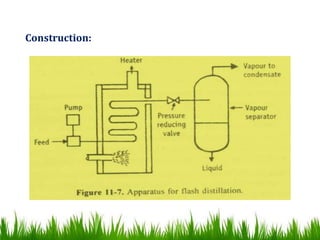
Construction:
Working:
 The feed is pumped through a heater at a certain pressure.
 The liquid gets heated, which enters the vapour-liquid separator
through a pressure-reducing valve.
 Due to the drop in pressure, the hot liquid flashes, which
further enhances the vaporisation process.
 The sudden vaporization induces cooling. The individual vapour
phase molecules of high boiling fraction get condensed, while low
boiling fraction remains as vapour.
 The mixture is allowed for a sufficient time, so that vapour and
liquid portions separate and achieve equilibrium.
 The vapour is separated through a pipe from above and liquid is
collected from the bottom of the separator.
 By continuously feeding into the still, it is possible to obtain
continuous flash distillation.
 The operating conditions can be adjusted in such a way that the
amount of feed exactly equals the amount of material
removed.
 Therefore, vapour and liquid concentrations at any point
remain constant in the unit.
Uses:
 Flash distillation is used for separating components, which boil
at widely different temperatures. It is widely used in
petroleum industry for refining crude oil.
Advantages:
 Flash distillation is a continuous process.
Disadvantages:
 It is not effective in separating components of comparable
volatility.
 It is not an efficient distillation when nearly pure components
are required, because the condensed vapour and residual liquid
are far from pure.
3. VACUUM DISTILLATION
 The distillation process in which the liquid is distilled at a
temperature lower than its boiling point by the application
of vacuum. Vacuum pumps, suction pumps, etc. are used
to reduce the pressure on the liquid surface. Distillation
under the reduced pressure is based on the principle of the
simple distillation with some modifications.
3. VACUUM DISTILLATION
Principle:
 Liquid boils when vapour pressure is equal to the atmospheric
pressure, i.e., pressure on its surface. If the external pressure is reduced
by applying vacuum, the boiling point of liquid is lowered.
 Therefore, the liquid boils at a lower temperature. This principle is
illustrated using an example of water.
 Water boils at an 100°C at an atmospheric pressure is 101.3I kPa
(760 mm Hg). At 40°C, the vapour pressure of water is
approximately 9.33 kPa (70 mm Hg). Hence, the external pressure
is reduced to 9.33 kPa (70 mm Hg) where water boils at 40°C. The
net result is the increase in rate of mass transfer into vapour.
3. VACUUM DISTILLATION
The important factor in evaporation is:
Mass of vapour formed ά = vapour pressure of evaporating liquid
external pressure
According to this formula, water is allowed to evaporate at
40°C and 9.33 kPa (70 mm Hg) pressure, the mass of
vapour formed in unit time is approximately 11 times, i.e.
760/70 for water.
3. VACUUM DISTILLATION
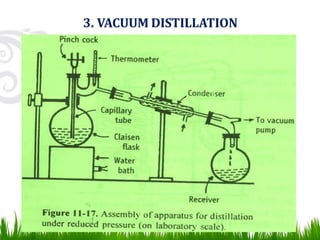
Assembling of apparatus:
 It consists of a double-neck distillation flask known as Claisen flask .
 Thick walled glass apparatus with interchangeable standard glass joints are used for vacuum
distillation.
 In one of the necks of the Claisen flask, a thermometer is fitted. The second neck prevents splashing of
the violently agitated liquid.
 Bumping occurs readily during vacuum distillation. Placing a fine capillary tube in the second neck
of the flask can prevent bumping.
 The capillary tube is dipped in the boiling liquid, so that a stream of air bubbles is drawn out.
 Water bath or oil bath is used for heating.
 The Claisen flask is connected to a receiver through a condenser.
 Vacuum pump is attached through an adapter to the receiver. A small pressure gauge (manometer)
should be inserted between the pump and the receiver.
3. VACUUM DISTILLATION
• Applications:
• Preventing degradation of active constituents (≈ 55◦C)
• Enzymes - malt extract, pancreatin
• Vitamins - thiamine, ascorbic acid
Glycosides - anthraquinones
Alkaloids - hyocyamine to atropine
• Disadvantages:
• In vacuum distillation, persistent foaming occurs. This may be
overcome by adding capryl alcohol to the liquid or by inserting a
fine air capillary tube in the second neck of the Claisen flask.
• The stream of air is drawn in and breaks the rising foam. The
above method is not suitable for the preparation of semisolid or
solid extracts by distillation under vacuum.
4. MOLECULAR DISTILLATION
 It is defined as a distillation process in which each
molecule in the vapour phase travels mean free path
and gets condensed individually without
intermolecular collisions on application of vacuum.
Molecular distillation is based on the principle of the
simple distillation with some modifications. This is also
called Evaporation distillation or Short path
distillation.
4. MOLECULAR DISTILLATION
Principle:
 The substances to be distilled have very low vapour pressures. examples
are viscous liquids, oils, greases, waxy materials and high molecular
weight substances.
 These boil at very high temperature. In order to decrease the boiling point
of the liquids, high vacuum must be applied.
 The pressure exerted by vapors above the liquid is much lower. At very
low pressure, the distance between the evaporating surface and the
condenser is approximately equal to the mean free path of the vapour
molecules.
 Molecules leaving the surface of the liquid are more likely hit the
condenser surface nearby. each molecule is condensed individually the
distillate is subsequently collected.
41
4. MOLECULAR DISTILLATION
Applications:
Molecular distillation is used for the purification and separation of chemicals
of low vapour pressure.
1. Purification of chemicals such as tricresyl phosphate, dibutyl phthalate and
dimethyl phthalate.
2. More frequently used in the refining of fixed oils.
3. Vitamin A is separated from fish liver oil. Vitamin's is concentrated bythis
method from fish liver oils and other vegetable oils.
4. Free fatty acids are distilled at 100°C.
5. Steroids can be obtained between 100°C and 200°C,
6. Triglycerides can be obtained from 200°C onwards.
Proteins and gums will remain as nonvolatile residues. Thus, the above
mixture can be separated by molecular distillation.
4. MOLECULAR DISTILLATION
Theory:
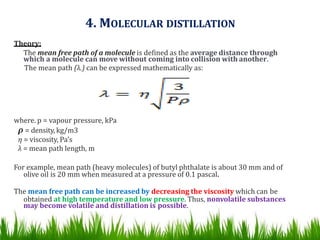
The mean free path of a molecule is defined as the average distance through
which a molecule can move without coming into collision with another.
The mean path (λ.) can be expressed mathematically as:
where. p = vapour pressure, kPa
ρ = density, kg/m3
η = viscosity, Pa's
λ = mean path length, m
For example, mean path (heavy molecules) of butyl phthalate is about 30 mm and of
olive oil is 20 mm when measured at a pressure of 0.1 pascal.
The mean free path can be increased by decreasing the viscosity which can be
obtained at high temperature and low pressure. Thus, nonvolatile substances
may become volatile and distillation is possible.
4. MOLECULAR DISTILLATION
Requirements for design the equipment:
• The evaporating surface must be close to the condensing surface.
This ensures the molecules to come in contact with the condenser
as soon as they leave the evaporating surface. For this reason, this
process is also known as short pathdistillation.
• The molecular collisions should be minimized because they change
the direction of the path of molecules. In other words, intermolecular
distances should be fairly high. It can be achieved under very high
vacuum, usually of the order of 0.1 to
1.0 pascals.
• The liquid surface area must be as large as possible as so that the
vapour is evolved from the surface only, but not by boiling. Thus
this process is also called evaporation distillation.
4. MOLECULAR DISTILLATION
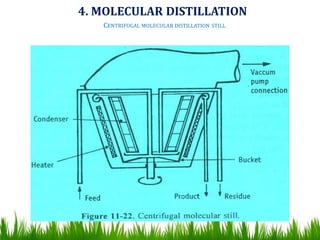
CENTRIFUGAL MOLECULAR DISTILLATION STILL
Principle:
 In this method, liquid feed is introduced into a vessel, which is
rotated at very high speed (centrifugal action).
 On account of heating, vaporisation occurs from a film of liquid on
the sides of the vessel.
 The vapour (molecules) travels a short distance and gets
condensed on the adjacent condenser.
 Each molecule is condensed individually. The distillate is
subsequently collected. 46
4. MOLECULAR DISTILLATION
CENTRIFUGAL MOLECULAR DISTILLATION STILL
Construction:
 It consists of a bucket-shaped vessel having a diameter of about 1 to
1.5 m.
 It is rotated at high speed using a motor.
 Radiant heaters are provided externally to heat the fluid in the
bucket.
 Condensers are arranged very close to the evaporatingsurface.
 Vacuum pump is connected to the entire vessel at thetop.
 Provisions are made for introducing the feed into the centre of the
bucket, for receiving the product and residue forre-circulation.
4. MOLECULAR DISTILLATION
CENTRIFUGAL MOLECULAR DISTILLATION STILL
.
Working:
 Vacuum is applied at the centre of the vessel.
 The bucket shaped vessel is allowed to rotate at high speed.
 The feed is introduced from the centre of the vessel.
 Due to centrifugal action of the rotating bucket, liquid moves outward over the
surface of the vessel and forms a film.
 Since, the radiant heaters heat the surface, the liquid evaporates directly from
the film.
 The vapour (molecules) travels its mean tree path and strikes the condenser.
 The condensate is collected into another vessel.
 The residue is collected from the bottom of the vessel and is recirculated through
the feed port for further distillation
48
4. MOLECULAR DISTILLATION
CENTRIFUGAL MOLECULAR DISTILLATION STILL
49
4. MOLECULAR DISTILLATION
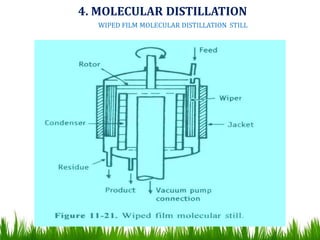
WIPED FILM MOLECULAR DISTILLATION STILL
Construction:
 The vessel has a diameter of 1 m.
 The walls of the vessel are provided with suitable means of heating
(jacket).
 Wipers are provided adjacent to the vessel wall. Wipers are
connected to a rotating head through arotor.
 The condensers are arranged very close to the wall (evaporating
surface).
 Vacuum pump is connected to a large diameter pipe at the
centre of the vessel.
 Provisions are made for collecting the distillate and the undistilled
liquid residue at the bottom. 50
4. MOLECULAR DISTILLATION
WIPED FILM MOLECULAR DISTILLATION STILL
Working:
 The vessel is heated by suitable means.
 Vacuum is applied at the centre of the vessel and wipers are allowed to rotate.
 The feed is entered through the inlet of the vessel. As the liquid flows down the walls, it is spread to
form a film by PTFE (polytetrafluoroethylene) wipers, which are moving at a rate of 3 m per
second.
 The velocity of the film is 1.5 m per second.
 Since the surface is already heated, the liquid film evaporates directly.
 The vapour (molecules) travels its mean free path and strikes the condenser.
 The condensate is collected into a vessel.
 The residue (undistilled or mean free path not travelled) is collected from the bottom of the vessel and
re-circulated through the feed port for further distillation. Capacity is about 1000 L / hour.
4. MOLECULAR DISTILLATION
WIPED FILM MOLECULAR DISTILLATION STILL
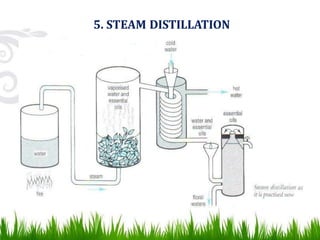
5. STEAM DISTILLATION
 Steam distillation is method of distillation carried out
with aid of steam.
 It is used to separate
High boiling substances from non-volatile impurities
Separate immiscible liquids
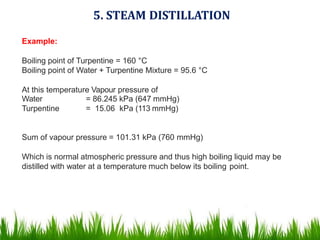
5. STEAM DISTILLATION
Example:
Boiling point of Turpentine = 160 °C
Boiling point of Water + Turpentine Mixture = 95.6 °C
At this temperature Vapour pressure of
Water
Turpentine
= 86.245 kPa (647 mmHg)
= 15.06 kPa (113 mmHg)
Sum of vapour pressure = 101.31 kPa (760 mmHg)
Which is normal atmospheric pressure and thus high boiling liquid may be
distilled with water at a temperature much below its boiling point.
5. STEAM DISTILLATION
Principle:
A mixture of immiscible liquids begins to boil when sum of their vapour
pressure is equal to atmospheric pressure.
In case of mixture of water and turpentine, mixture boils below the boiling
point of pure water, though the turpentine boils at a much higher temperature
than that of water.
5. STEAM DISTILLATION
Application:
 Used to separate immiscible liquids. Ex- Water + Toluene
Extraction at much lower temperature to protect from
decomposition without loss of aroma
 Toextract volatile oils like clove, anise and eucalyptus oils.
 Purification of essential oils like almond oil.
 Camphor is distilled by this method.
 Aromatic water are prepared.
Limitation:
Not suitable when two immiscible liquids reacts with eachother.
5. STEAM DISTILLATION
Construction & Working:
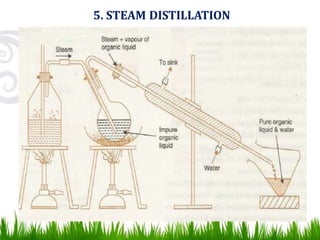
 Metallic steam can fitted with cork having two holes.
 Safety tube inserted up to bottom through one hole to maintain pressure
in side stem can, more over when steam comes out from safety tube
indicates that can is empty.
 Through other hole band tube is passed and other end of this tube is
connected to flask containing non-aqueous liquid in which tube is dipped.
 Flask and condenser is connected with delivery tube.
 Condenser is connected to receiver with help of adopter.
 Provision are made to heat both steam can and flask separately.
6. DESTRUCTIVE DISTILLATION (DRY DISTILLATION)
 Distillatilate is decomposition product of constituents of the
organic matter burnet in absence of air.
 Not used in lab practices but very useful in industrial process
to obtain valuable product from wood, coal and animal matter.
 It involve the heating of dry organic matter in suitable vessel in
absence of air, until all volatile substances are driven off.
 The distillate is the decomposition product of constituents.
 Wood distillation industry and coal carbonation industry
provides many useful fuel material with this method
Compression distillationmethod was developed to meet the need
of navy and army for fresh water from sea-water.
Product obtained is quite pure and pyrogen-free, there for it meets
the requirement of pharmaceutical industry.
It is economical from the standpoint of consumption of fuel and
water.
7. COMPRESSION DISTILLATION
61
7. COMPRESSION DISTILLATION
 The feed water is heated in an evaporator for boiling.
 The vapour produced in tubes is separated from entrained distill and
in separator.
 The vapour is than conveyed to compressor, which compresses it and
raises its temperature to about 118 c.
 It than flows to the steam chest where it is condensed on the outer
surface of tube.
 During condensation, heat is released which is allowed for
heating of fresh feed in the tube.
 The vapour condensed and drained off as distillate.
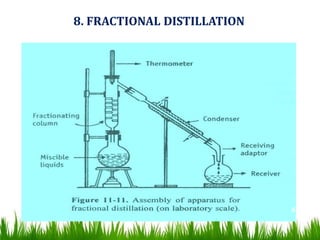
8. FRACTIONAL DISTILLATION
63
8. FRACTIONAL DISTILLATION
 This method is also known as rectification, because a part of
the vapour is condensed and returned as a liquid.
 This method is used to separate miscible volatile liquids, whose
boiling points are close, by means of a fractionating column.
 Fractional distillation is a process in which vaporisation of liquid
mixture gives rise to a mixture of constituents from which the desired
one is separated in pure form.
Principle:
 When a liquid mixture is distilled, the partial condensation ofthe
vapour is allowed to occur in a fractionatingcolumn.
In the column, ascending vapour from the still is allowed tocome in
contact with the condensing vapour returning to thestill.
This results is enrichment of the vapour with the morevolatile
component.
 By condensing the vapour and reheating the liquid repeatedly,
equilibrium between liquid and vapour is set up at each stage,which
ultimately results in the separation of a more volatilecomponent.
8. FRACTIONAL DISTILLATION
Applications:
Fractional distillation is used for the separation of volatile miscible liquids with
near boiling point such as
•Acetone and water
•Chloroform and benzene
Disadvantage:
Fractional distillation cannot be used to separate miscible liquids, which form
PURE azeotropic mixtures.
8. FRACTIONAL DISTILLATION
Fractionating columns
 In fractional distillation, special type of still-heads are required so that
condensation and re-vaporisation are affected continuously.
 These are known as fractionating columns.
 A fractionating column is essentially a long vertical tube in which the
vapour passes upward and partially condensed. The condensate flows down the
column and is returned eventually to the flask.
The columns are constructed so as to offer the following advantages
simultaneously.
(1) It offers a large cooling surface for the vapour to condense.
(2) An obstruction to the ascending vapour allows easy condensation.
8. FRACTIONAL DISTILLATION
Fractionating columns Types
A] Packed columns and
B] Plate columns
8. FRACTIONAL DISTILLATION
Fractionating columns Types
A] Packed columns
8. FRACTIONAL DISTILLATION
Fractionating columns Types
A] Packed columns
Some form of packing is used in the column to affect the necessary
liquid/vapour contact. The packing may consistof single turn
helices (spirals) of wire or glass, glass rings, cylindrical glass beads,
stainless steel ringsetc.
Construction: Packed column consists of a tower containing a packing
that becomes wetted with a film of liquid, which is brought into
contact with the vapour in the interveningspaces.
(a)A long fractionating column is necessary when theboiling points
of the constituents are lying fairly closetogether.
(b)A short fractionating column is necessary when theboiling
point of the constituents differconsiderably.
Applications: Packing must be uniform so as to obtain proper
channels. If packing is irregular, mass transfer becomes less
effective.
8. FRACTIONAL DISTILLATION
Fractionating columns Types
B] Plate columns
8. FRACTIONAL DISTILLATION
Fractionating columns Types
B] Plate columns (Bubble cap)
8. FRACTIONAL DISTILLATION
Fractionating columns Types
B] Plate columns
Many forms of plates are used in the distillation using different columns. It can be divided into
two types, which are commonly used in pharmacy.
(a) Bubble cap plates
(b) Turbo grid plates
Bubble cap column is used in large distillation plants and is describedbelow.
Construction: The column consistsof a number of plates mounted one above the other. Caps are
present on each plate, which allow the vapour to escape by bubbling through the liquid.
Working: Ascending vapour from the still passes through the bubble-caps on plate A and the rising
vapour will be richer in the more volatile component. This vapour passes through the liquid on
plate B and partially condensed. The heat of condensation partially vaporizes the liquid. The
process of condensation and vaporisation will be repeated at plate C and so on all the way up
the column. Each bubble-cap plate has the same effect as a separate still.
8. FRACTIONAL DISTILLATION
Fractionating columns Types
B] Plate columns (Bubble cap)
Advantages:
The bubble cap plate is effective over a wide range ofvapour- liquid
proportions. There is excellent contact as the vapour bubbles
through the liquid.
Disadvantages:
(I) A layer of liquid on each plate results inconsiderable hold-up
of liquid over the entire column.
(2)The need to force the vapour out of the caps, throughthe liquid, led
to a large pressure drop through thecolumn.
(3) The column does not drain when it is not inuse.
(4)The structure is complicated making constructionand
maintenance expensive.
Theory:
Fractional distillation is suitable for a system when the boiling point of the
mixture is always intermediate between those of pure components.
 There is neither a maximum nor a minimum in the composition curves.
These systems are known as zeotropic mixtures.
 Examples
Benzene and toluene
Carbon tetrachloride and cyclohexane
8. FRACTIONAL DISTILLATION
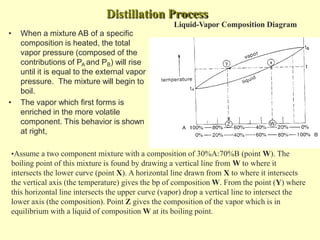
Distillation Process
Liquid-Vapor Composition Diagram
• When a mixture AB of a specific
composition is heated, the total
vapor pressure (composed of the
contributions of PA and PB) will rise
until it is equal to the external vapor
pressure. The mixture will begin to
boil.
• The vapor which first forms is
enriched in the more volatile
component. This behavior is shown
at right,
•Assume a two component mixture with a composition of 30%A:70%B (point W). The
boiling point of this mixture is found by drawing a vertical line from W to where it
intersects the lower curve (point X). A horizontal line drawn from X to where it intersects
the vertical axis (the temperature) gives the bp of composition W. From the point (Y) where
this horizontal line intersects the upper curve (vapor) drop a vertical line to intersect the
lower axis (the composition). Point Z gives the composition of the vapor which is in
equilibrium with a liquid of composition W at its boiling point.
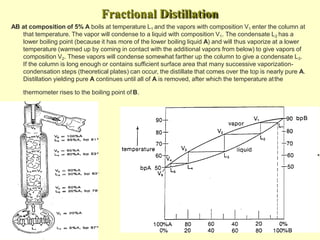
Fractional Distillation
AB at composition of 5% A boils at temperature L1 and the vapors with composition V1 enter the column at
that temperature. The vapor will condense to a liquid with composition V1. The condensate L2 has a
lower boiling point (because it has more of the lower boiling liquid A) and will thus vaporize at a lower
temperature (warmed up by coming in contact with the additional vapors from below) to give vapors of
composition V2. These vapors will condense somewhat farther up the column to give a condensate L3.
If the column is long enough or contains sufficient surface area that many successive vaporization-
condensation steps (theoretical plates) can occur, the distillate that comes over the top is nearly pure A.
Distillation yielding pure A continues until all of A is removed, after which the temperature atthe
thermometer rises to the boiling point of B.
AZEOTROPIC AND EXTRACTIVE DISTILLATION
Azeotropic distillation:
In which azeoptorpic mixture is broken by the addition of third
substance, which forms a new azeotrope with one of the components.
Extractive distillation:
The third substance added to the azeoptorpic mixture is relatively
nonvolatile liquid compared to the components to be separated.
Azeotropic distillation:
Azeotropic Mixture(Constant boiling Mixture)
Mixture of special composition giving minimum or
maximum boiling point than individual component with
minimum or maximum boiling point respectively.
distillation

distillation

  • 1.
    DISTILLATION V.JAGAN MOHAN RAOM.S.Pharm., MED.CHEM NIPER-KOLKATA Asst.Professor, MIPER-KURNOOL EMAIL- jaganvana6@gmail.com
  • 2.
    DEFINITION  “Distillation isan unit operation which involves separation of a vaporizable component from a multi-component system and subsequent condensation of vapours.”  “Distillation is a process of separating the component substances from a liquid mixture by selective evaporation and condensation.”  “Distillation is defined as the separation of the components of a liquid mixture by a process involving vaporization and subsequent condensation at another place.”
  • 3.
    APPLICATIONS:  Separation ofvolatile oils- cloves(Eugenol comprises 72- 90%, Vanilin, acetyl eugenol).  Separation of drugs obtained from plant and animal sources- Vit. A from fish liveroil.  Purification of organic solvents-absolute alcohol (100%).  Purification of drugs obtained from chemical process.  Manufacture of official preparations -sprit of nitrous ether, sprit of ammonia, D.water and water for inj.  Quality control methods -Alcohol content in elixir(4-40%).  Refining of petroleum products- Petroleum ether 60,80.  Recovery of solvents- synthesis.
  • 4.
    TERMINOLOGY  Binary Mixture Whentwo liquids mixed together, they may be miscible with each other in all proportion, such miscible liquid are known as binary mixtures of liquid. Example: - Ethanol + Water - Acetone + Water - Benzene + Carbon tetrachloride
  • 5.
    TERMINOLOGY  Ideal Solution(Perfect solution) Ideal solution is defined as the one in which there is no change in the properties of components other than dilution, when they mixed to form a solution. Property of ideal solution  Total volume of solution is equal to sum of volumes of each component  No heat absorbed and No heat evolved  No Chemical reaction in-between  Final volume of solution represents additive property of individual components  Follow Raoult’s low
  • 6.
    TERMINOLOGY  Real Solution Mostsystem shows varying degree of deviation from raoult’s law, depending on nature of liquids and temperature. These solution are known as real solution. Property of Real solution  Heat may absorbed or evolved  Chemical reaction occurs in-between  Final volume of solution represents additive property of individual components  Don’t Follow Raoult’s low Example  Carbon tetra-chloride + Cyclohexane  Choroform + Acetone
  • 7.
    TERMINOLOGY  Volatility The volatilityof any substance in solution may be defined as the equilibrium partial pressure of substance in vapour phase divided by the mole fraction of substance in the solution. For example, a substance A in a liquid mixture has partial pressure PA and its concentration in the mixture is XA on mole fraction scale. Partial vapour pressure of A Volatility of component A, = Mole fraction XA of A insolution vA = PA/XA The volatility of a material in the pure state is equal to the vapour pressure of the material.
  • 8.
    TERMINOLOGY  Relative Volatility Considera liquid mixture containing two component A and B, In such case, the volatility of one component is expressed in terms of second as below, Volatility of component A(VA) Relative Volatility (α) = Volatility of component B (VB) α = VA/VB
  • 9.
    TERMINOLOGY Vapor pressure  Itis defined as the pressure exerted by a vapor in thermodynamic equilibrium with its condensed phases (solid or liquid) at a given temperature in a closed system.  The equilibrium vapor pressure is an indication of a liquid's evaporation rate. Thermodynamic Equilibrium  It is the systematic study of transformations of matter and energy in systems as they approach equilibrium.  The word equilibrium implies a state of balance.
  • 10.
    TERMINOLOGY Azeotropic Mixture(Constant boilingMixture) Mixture of special composition giving minimum or maximum boiling point than individual component with minimum or maximum boiling point respectively.  Examples  Mixture with Maximum Boiling point: Mixture containing 20.2 ml HCl + 79.8 ml water  Mixture with Minimum Boiling point Mixture containing 95.5 ml Alcohol + 4.5 ml water
  • 11.
    RAOULT’S LAW  Itexpress a quantitative relationship between the concentration and vapour pressure.  It states that partial vapour pressure of each volatile constituent is equal to vapour pressure of the pure constituent multiplied by its mole fraction in the solution at a given temperature.
  • 12.
     Suppose Homogeneousmixture of liquid A andB Partial vapour pressure of component A inMixture = PA = P°A*XA Mole fraction of A in solution = XA Vapour pressure of A in pure state =P°A Partial vapour pressure of component B in Mixture = PB = P°B *XB Mole fraction of B in solution = XB Vapour pressure of A in pure state =P°B  Total Vapor pressure of Mixture PT = PA+ PB PT= P°A *XA + P°B*XB RAOULT’S LAW
  • 14.
    POSITIVE DEVIATION &NEGATIVE DEVIATION (REAL SOLUTION)  Positive Deviation: In some liquids systems, the total vapor pressure is greater than the sum of the partial pressures of the individual components Ex: benzene and ethanol. Differ in their polarity, length of hydrocarbon chain and degree of association.  Negative Deviation: In some liquid systems, the total vapor pressure is lower than that of the sum of the partial pressures of the individual components. Ex: Chloroform and acetone Due to hydrogen bonding, salt formation and hydration
  • 15.
    POSITIVE DEVIATION &NEGATIVE DEVIATION (REAL SOLUTION)
  • 16.
  • 17.
    GENERAL EQUIPMENT FORDISTILLATION: STILL :  It is a vaporizing chamber and used to place the material to be distilled.  The still is heated by a suitable means for vaporization of the volatile constituents.  On laboratory scale round bottom flasks made of glass are used so that the progress of the distillation can be noticed.  A condenser is attached to the still using appropriate joints. A trap is inserted between distillation flask and condenser.
  • 18.
    GENERAL EQUIPMENT FORDISTILLATION: CONDENSER :  Used to condense the vapor. It is kept cold by circulating water/air through jacket. Types:  Single-surface condensers - Straight Tube - Bulb type - Spiral - Coiled type  Double-surface condensers  Multi-tubular condensers The condenser is connected to a receiver through a suitable adapter.
  • 19.
    GENERAL EQUIPMENT FORDISTILLATION: CONDENSER : Bulb type Straight Tube type Spiral type Coiled type Cold finger, Spiral type Lucas’s Double Surface 19
  • 20.
    GENERAL EQUIPMENT FORDISTILLATION: RECEIVER :  It is used to collect the distillate.  It may be a simple flask.  It immersed in ice-bath to minimize loss of volatile matter.  Florentine receivers are used for the separation of oil and water. Types of Florentine receivers :  Type-I :- for separation of oil heavier than water.  Type-II :- for separation of oil lighter than water.
  • 21.
    GENERAL EQUIPMENT FORDISTILLATION: RECEIVER :
  • 22.
    CLASSIFICATION OF DISTILLATIONMETHODS  Simple Distillation (Differential distillation)  Flash Distillation (Equilibrium distillation)  Vacuum distillation (distillation under reduced pressure)  Molecular Distillation (Evaporation distillation or short path distillation)  Fractional Distillation (Rectification)  Azeotropic and extractive Distillation  Steam Distillation  Destructive Distillation  Compression Distillation
  • 23.
    1. SIMPLE DISTILLATION Simple distillation is a process of converting a single constituent from a liquid (or mixture) into its vapour, transferring the vapour to another place and recovering the liquid by condensing the vapour, usually by allowing it to come in contact with a cold surface.  This process is known differential distillation, as distillation is based on the differences in volatilities and vapour pressures of the components in the mixture.
  • 24.
    Principle:  Liquid boilswhen its vapour pressure is equal to atmospheric pressure. Simple distillation is conducted at its boiling point.  The higher the relative volatility of a liquid, the better is the separation by simple distillation. Heat is supplied to the liquid so that it boils. The resulting vapour is transferred to a different place and condensed. CONSTRUCTION:  It consists of a distillation flask with a side arm sloping downwards.  Condenser is fitted into the side arm by means of a cork.  The condenser is usually water condenser, i.e., jacketed for circulation of water.  The condenser is connected to a receiver flask using an adapter with ground glass joints. On a laboratory scale, the whole apparatus is made of glass. 24
  • 26.
    WORKING:  The liquidto be distilled is filled into the flask to one-half to two-third of its volume. Bumping is avoided by adding small pieces of porcelain before distillation.  A thermometer is inserted into the cork and fixed to the flask. The thermometer bulb must be just below the level of the side arm.  Water is circulated through the jacket of the condenser. The contents are heated gradually.  The liquid begins to boil after some time.The vapour begins to rise up and passes down the side arm into the condenser.  The temperature rises rapidly and reaches a constant value.  The temperature of the distillate is noted down, which is equal to the boiling point of the liquid. The vapour is condensed and collected into the receiver.
  • 27.
     The flameis adjusted so that the distillate is collected at the rate of one to two drops per second. Distillation should be continued until a small volume of liquid remains in the flask. Applications:  For the preparation of distilled water and water for injection.  Volatile and aromatic waters are prepared.  Organic solvents are purified.  A few official compounds are prepared by distillation. Examples are spirit of nitrous ether and aromatic spirit of ammonia.  Non-volatile solids are separated from volatile liquids.
  • 28.
    2. FLASH DISTILLATION Flash distillation is defined as a process in which the entire liquid mixture is suddenly vaporized (flash) by passing the feed from a high pressure zone to a low pressure zone.  Flash distillation is also known as equilibrium distillation, i.e., separation is attempted when the liquid and vapour phases are in equilibrium. This method is frequently carried out as a continuous process and does not involve rectification.
  • 29.
    Principle:  When ahot liquid mixture is allowed to enter from a high- pressure zone into a low-pressure zone, the entire liquid mixture is suddenly vaporised.  This process is known as flash vaporisation. During this process the chamber gets cooled. The individual vapour phase molecules of high boiling fraction get condensed, while low boiling fraction remains as vapour.
  • 30.
  • 31.
    Working:  The feedis pumped through a heater at a certain pressure.  The liquid gets heated, which enters the vapour-liquid separator through a pressure-reducing valve.  Due to the drop in pressure, the hot liquid flashes, which further enhances the vaporisation process.  The sudden vaporization induces cooling. The individual vapour phase molecules of high boiling fraction get condensed, while low boiling fraction remains as vapour.
  • 32.
     The mixtureis allowed for a sufficient time, so that vapour and liquid portions separate and achieve equilibrium.  The vapour is separated through a pipe from above and liquid is collected from the bottom of the separator.  By continuously feeding into the still, it is possible to obtain continuous flash distillation.  The operating conditions can be adjusted in such a way that the amount of feed exactly equals the amount of material removed.  Therefore, vapour and liquid concentrations at any point remain constant in the unit.
  • 33.
    Uses:  Flash distillationis used for separating components, which boil at widely different temperatures. It is widely used in petroleum industry for refining crude oil. Advantages:  Flash distillation is a continuous process. Disadvantages:  It is not effective in separating components of comparable volatility.  It is not an efficient distillation when nearly pure components are required, because the condensed vapour and residual liquid are far from pure.
  • 34.
  • 35.
    3. VACUUM DISTILLATION The distillation process in which the liquid is distilled at a temperature lower than its boiling point by the application of vacuum. Vacuum pumps, suction pumps, etc. are used to reduce the pressure on the liquid surface. Distillation under the reduced pressure is based on the principle of the simple distillation with some modifications.
  • 36.
    3. VACUUM DISTILLATION Principle: Liquid boils when vapour pressure is equal to the atmospheric pressure, i.e., pressure on its surface. If the external pressure is reduced by applying vacuum, the boiling point of liquid is lowered.  Therefore, the liquid boils at a lower temperature. This principle is illustrated using an example of water.  Water boils at an 100°C at an atmospheric pressure is 101.3I kPa (760 mm Hg). At 40°C, the vapour pressure of water is approximately 9.33 kPa (70 mm Hg). Hence, the external pressure is reduced to 9.33 kPa (70 mm Hg) where water boils at 40°C. The net result is the increase in rate of mass transfer into vapour.
  • 37.
    3. VACUUM DISTILLATION Theimportant factor in evaporation is: Mass of vapour formed ά = vapour pressure of evaporating liquid external pressure According to this formula, water is allowed to evaporate at 40°C and 9.33 kPa (70 mm Hg) pressure, the mass of vapour formed in unit time is approximately 11 times, i.e. 760/70 for water.
  • 38.
    3. VACUUM DISTILLATION Assemblingof apparatus:  It consists of a double-neck distillation flask known as Claisen flask .  Thick walled glass apparatus with interchangeable standard glass joints are used for vacuum distillation.  In one of the necks of the Claisen flask, a thermometer is fitted. The second neck prevents splashing of the violently agitated liquid.  Bumping occurs readily during vacuum distillation. Placing a fine capillary tube in the second neck of the flask can prevent bumping.  The capillary tube is dipped in the boiling liquid, so that a stream of air bubbles is drawn out.  Water bath or oil bath is used for heating.  The Claisen flask is connected to a receiver through a condenser.  Vacuum pump is attached through an adapter to the receiver. A small pressure gauge (manometer) should be inserted between the pump and the receiver.
  • 39.
    3. VACUUM DISTILLATION •Applications: • Preventing degradation of active constituents (≈ 55◦C) • Enzymes - malt extract, pancreatin • Vitamins - thiamine, ascorbic acid Glycosides - anthraquinones Alkaloids - hyocyamine to atropine • Disadvantages: • In vacuum distillation, persistent foaming occurs. This may be overcome by adding capryl alcohol to the liquid or by inserting a fine air capillary tube in the second neck of the Claisen flask. • The stream of air is drawn in and breaks the rising foam. The above method is not suitable for the preparation of semisolid or solid extracts by distillation under vacuum.
  • 40.
    4. MOLECULAR DISTILLATION It is defined as a distillation process in which each molecule in the vapour phase travels mean free path and gets condensed individually without intermolecular collisions on application of vacuum. Molecular distillation is based on the principle of the simple distillation with some modifications. This is also called Evaporation distillation or Short path distillation.
  • 41.
    4. MOLECULAR DISTILLATION Principle: The substances to be distilled have very low vapour pressures. examples are viscous liquids, oils, greases, waxy materials and high molecular weight substances.  These boil at very high temperature. In order to decrease the boiling point of the liquids, high vacuum must be applied.  The pressure exerted by vapors above the liquid is much lower. At very low pressure, the distance between the evaporating surface and the condenser is approximately equal to the mean free path of the vapour molecules.  Molecules leaving the surface of the liquid are more likely hit the condenser surface nearby. each molecule is condensed individually the distillate is subsequently collected. 41
  • 42.
    4. MOLECULAR DISTILLATION Applications: Moleculardistillation is used for the purification and separation of chemicals of low vapour pressure. 1. Purification of chemicals such as tricresyl phosphate, dibutyl phthalate and dimethyl phthalate. 2. More frequently used in the refining of fixed oils. 3. Vitamin A is separated from fish liver oil. Vitamin's is concentrated bythis method from fish liver oils and other vegetable oils. 4. Free fatty acids are distilled at 100°C. 5. Steroids can be obtained between 100°C and 200°C, 6. Triglycerides can be obtained from 200°C onwards. Proteins and gums will remain as nonvolatile residues. Thus, the above mixture can be separated by molecular distillation.
  • 43.
    4. MOLECULAR DISTILLATION Theory: Themean free path of a molecule is defined as the average distance through which a molecule can move without coming into collision with another. The mean path (λ.) can be expressed mathematically as: where. p = vapour pressure, kPa ρ = density, kg/m3 η = viscosity, Pa's λ = mean path length, m For example, mean path (heavy molecules) of butyl phthalate is about 30 mm and of olive oil is 20 mm when measured at a pressure of 0.1 pascal. The mean free path can be increased by decreasing the viscosity which can be obtained at high temperature and low pressure. Thus, nonvolatile substances may become volatile and distillation is possible.
  • 44.
    4. MOLECULAR DISTILLATION Requirementsfor design the equipment: • The evaporating surface must be close to the condensing surface. This ensures the molecules to come in contact with the condenser as soon as they leave the evaporating surface. For this reason, this process is also known as short pathdistillation. • The molecular collisions should be minimized because they change the direction of the path of molecules. In other words, intermolecular distances should be fairly high. It can be achieved under very high vacuum, usually of the order of 0.1 to 1.0 pascals. • The liquid surface area must be as large as possible as so that the vapour is evolved from the surface only, but not by boiling. Thus this process is also called evaporation distillation.
  • 45.
    4. MOLECULAR DISTILLATION CENTRIFUGALMOLECULAR DISTILLATION STILL
  • 46.
    Principle:  In thismethod, liquid feed is introduced into a vessel, which is rotated at very high speed (centrifugal action).  On account of heating, vaporisation occurs from a film of liquid on the sides of the vessel.  The vapour (molecules) travels a short distance and gets condensed on the adjacent condenser.  Each molecule is condensed individually. The distillate is subsequently collected. 46 4. MOLECULAR DISTILLATION CENTRIFUGAL MOLECULAR DISTILLATION STILL
  • 47.
    Construction:  It consistsof a bucket-shaped vessel having a diameter of about 1 to 1.5 m.  It is rotated at high speed using a motor.  Radiant heaters are provided externally to heat the fluid in the bucket.  Condensers are arranged very close to the evaporatingsurface.  Vacuum pump is connected to the entire vessel at thetop.  Provisions are made for introducing the feed into the centre of the bucket, for receiving the product and residue forre-circulation. 4. MOLECULAR DISTILLATION CENTRIFUGAL MOLECULAR DISTILLATION STILL
  • 48.
    . Working:  Vacuum isapplied at the centre of the vessel.  The bucket shaped vessel is allowed to rotate at high speed.  The feed is introduced from the centre of the vessel.  Due to centrifugal action of the rotating bucket, liquid moves outward over the surface of the vessel and forms a film.  Since, the radiant heaters heat the surface, the liquid evaporates directly from the film.  The vapour (molecules) travels its mean tree path and strikes the condenser.  The condensate is collected into another vessel.  The residue is collected from the bottom of the vessel and is recirculated through the feed port for further distillation 48 4. MOLECULAR DISTILLATION CENTRIFUGAL MOLECULAR DISTILLATION STILL
  • 49.
    49 4. MOLECULAR DISTILLATION WIPEDFILM MOLECULAR DISTILLATION STILL
  • 50.
    Construction:  The vesselhas a diameter of 1 m.  The walls of the vessel are provided with suitable means of heating (jacket).  Wipers are provided adjacent to the vessel wall. Wipers are connected to a rotating head through arotor.  The condensers are arranged very close to the wall (evaporating surface).  Vacuum pump is connected to a large diameter pipe at the centre of the vessel.  Provisions are made for collecting the distillate and the undistilled liquid residue at the bottom. 50 4. MOLECULAR DISTILLATION WIPED FILM MOLECULAR DISTILLATION STILL
  • 51.
    Working:  The vesselis heated by suitable means.  Vacuum is applied at the centre of the vessel and wipers are allowed to rotate.  The feed is entered through the inlet of the vessel. As the liquid flows down the walls, it is spread to form a film by PTFE (polytetrafluoroethylene) wipers, which are moving at a rate of 3 m per second.  The velocity of the film is 1.5 m per second.  Since the surface is already heated, the liquid film evaporates directly.  The vapour (molecules) travels its mean free path and strikes the condenser.  The condensate is collected into a vessel.  The residue (undistilled or mean free path not travelled) is collected from the bottom of the vessel and re-circulated through the feed port for further distillation. Capacity is about 1000 L / hour. 4. MOLECULAR DISTILLATION WIPED FILM MOLECULAR DISTILLATION STILL
  • 52.
  • 53.
  • 54.
    5. STEAM DISTILLATION Steam distillation is method of distillation carried out with aid of steam.  It is used to separate High boiling substances from non-volatile impurities Separate immiscible liquids
  • 55.
    5. STEAM DISTILLATION Example: Boilingpoint of Turpentine = 160 °C Boiling point of Water + Turpentine Mixture = 95.6 °C At this temperature Vapour pressure of Water Turpentine = 86.245 kPa (647 mmHg) = 15.06 kPa (113 mmHg) Sum of vapour pressure = 101.31 kPa (760 mmHg) Which is normal atmospheric pressure and thus high boiling liquid may be distilled with water at a temperature much below its boiling point.
  • 56.
    5. STEAM DISTILLATION Principle: Amixture of immiscible liquids begins to boil when sum of their vapour pressure is equal to atmospheric pressure. In case of mixture of water and turpentine, mixture boils below the boiling point of pure water, though the turpentine boils at a much higher temperature than that of water.
  • 57.
    5. STEAM DISTILLATION Application: Used to separate immiscible liquids. Ex- Water + Toluene Extraction at much lower temperature to protect from decomposition without loss of aroma  Toextract volatile oils like clove, anise and eucalyptus oils.  Purification of essential oils like almond oil.  Camphor is distilled by this method.  Aromatic water are prepared. Limitation: Not suitable when two immiscible liquids reacts with eachother.
  • 58.
    5. STEAM DISTILLATION Construction& Working:  Metallic steam can fitted with cork having two holes.  Safety tube inserted up to bottom through one hole to maintain pressure in side stem can, more over when steam comes out from safety tube indicates that can is empty.  Through other hole band tube is passed and other end of this tube is connected to flask containing non-aqueous liquid in which tube is dipped.  Flask and condenser is connected with delivery tube.  Condenser is connected to receiver with help of adopter.  Provision are made to heat both steam can and flask separately.
  • 59.
    6. DESTRUCTIVE DISTILLATION(DRY DISTILLATION)  Distillatilate is decomposition product of constituents of the organic matter burnet in absence of air.  Not used in lab practices but very useful in industrial process to obtain valuable product from wood, coal and animal matter.  It involve the heating of dry organic matter in suitable vessel in absence of air, until all volatile substances are driven off.  The distillate is the decomposition product of constituents.  Wood distillation industry and coal carbonation industry provides many useful fuel material with this method
  • 60.
    Compression distillationmethod wasdeveloped to meet the need of navy and army for fresh water from sea-water. Product obtained is quite pure and pyrogen-free, there for it meets the requirement of pharmaceutical industry. It is economical from the standpoint of consumption of fuel and water. 7. COMPRESSION DISTILLATION 61
  • 61.
    7. COMPRESSION DISTILLATION The feed water is heated in an evaporator for boiling.  The vapour produced in tubes is separated from entrained distill and in separator.  The vapour is than conveyed to compressor, which compresses it and raises its temperature to about 118 c.  It than flows to the steam chest where it is condensed on the outer surface of tube.  During condensation, heat is released which is allowed for heating of fresh feed in the tube.  The vapour condensed and drained off as distillate.
  • 62.
  • 63.
    8. FRACTIONAL DISTILLATION This method is also known as rectification, because a part of the vapour is condensed and returned as a liquid.  This method is used to separate miscible volatile liquids, whose boiling points are close, by means of a fractionating column.  Fractional distillation is a process in which vaporisation of liquid mixture gives rise to a mixture of constituents from which the desired one is separated in pure form.
  • 65.
    Principle:  When aliquid mixture is distilled, the partial condensation ofthe vapour is allowed to occur in a fractionatingcolumn. In the column, ascending vapour from the still is allowed tocome in contact with the condensing vapour returning to thestill. This results is enrichment of the vapour with the morevolatile component.  By condensing the vapour and reheating the liquid repeatedly, equilibrium between liquid and vapour is set up at each stage,which ultimately results in the separation of a more volatilecomponent. 8. FRACTIONAL DISTILLATION
  • 66.
    Applications: Fractional distillation isused for the separation of volatile miscible liquids with near boiling point such as •Acetone and water •Chloroform and benzene Disadvantage: Fractional distillation cannot be used to separate miscible liquids, which form PURE azeotropic mixtures. 8. FRACTIONAL DISTILLATION
  • 67.
    Fractionating columns  Infractional distillation, special type of still-heads are required so that condensation and re-vaporisation are affected continuously.  These are known as fractionating columns.  A fractionating column is essentially a long vertical tube in which the vapour passes upward and partially condensed. The condensate flows down the column and is returned eventually to the flask. The columns are constructed so as to offer the following advantages simultaneously. (1) It offers a large cooling surface for the vapour to condense. (2) An obstruction to the ascending vapour allows easy condensation. 8. FRACTIONAL DISTILLATION
  • 68.
    Fractionating columns Types A]Packed columns and B] Plate columns 8. FRACTIONAL DISTILLATION
  • 69.
    Fractionating columns Types A]Packed columns 8. FRACTIONAL DISTILLATION
  • 70.
    Fractionating columns Types A]Packed columns Some form of packing is used in the column to affect the necessary liquid/vapour contact. The packing may consistof single turn helices (spirals) of wire or glass, glass rings, cylindrical glass beads, stainless steel ringsetc. Construction: Packed column consists of a tower containing a packing that becomes wetted with a film of liquid, which is brought into contact with the vapour in the interveningspaces. (a)A long fractionating column is necessary when theboiling points of the constituents are lying fairly closetogether. (b)A short fractionating column is necessary when theboiling point of the constituents differconsiderably. Applications: Packing must be uniform so as to obtain proper channels. If packing is irregular, mass transfer becomes less effective. 8. FRACTIONAL DISTILLATION
  • 71.
    Fractionating columns Types B]Plate columns 8. FRACTIONAL DISTILLATION
  • 72.
    Fractionating columns Types B]Plate columns (Bubble cap) 8. FRACTIONAL DISTILLATION
  • 73.
    Fractionating columns Types B]Plate columns Many forms of plates are used in the distillation using different columns. It can be divided into two types, which are commonly used in pharmacy. (a) Bubble cap plates (b) Turbo grid plates Bubble cap column is used in large distillation plants and is describedbelow. Construction: The column consistsof a number of plates mounted one above the other. Caps are present on each plate, which allow the vapour to escape by bubbling through the liquid. Working: Ascending vapour from the still passes through the bubble-caps on plate A and the rising vapour will be richer in the more volatile component. This vapour passes through the liquid on plate B and partially condensed. The heat of condensation partially vaporizes the liquid. The process of condensation and vaporisation will be repeated at plate C and so on all the way up the column. Each bubble-cap plate has the same effect as a separate still. 8. FRACTIONAL DISTILLATION
  • 74.
    Fractionating columns Types B]Plate columns (Bubble cap) Advantages: The bubble cap plate is effective over a wide range ofvapour- liquid proportions. There is excellent contact as the vapour bubbles through the liquid. Disadvantages: (I) A layer of liquid on each plate results inconsiderable hold-up of liquid over the entire column. (2)The need to force the vapour out of the caps, throughthe liquid, led to a large pressure drop through thecolumn. (3) The column does not drain when it is not inuse. (4)The structure is complicated making constructionand maintenance expensive.
  • 75.
    Theory: Fractional distillation issuitable for a system when the boiling point of the mixture is always intermediate between those of pure components.  There is neither a maximum nor a minimum in the composition curves. These systems are known as zeotropic mixtures.  Examples Benzene and toluene Carbon tetrachloride and cyclohexane 8. FRACTIONAL DISTILLATION
  • 76.
    Distillation Process Liquid-Vapor CompositionDiagram • When a mixture AB of a specific composition is heated, the total vapor pressure (composed of the contributions of PA and PB) will rise until it is equal to the external vapor pressure. The mixture will begin to boil. • The vapor which first forms is enriched in the more volatile component. This behavior is shown at right, •Assume a two component mixture with a composition of 30%A:70%B (point W). The boiling point of this mixture is found by drawing a vertical line from W to where it intersects the lower curve (point X). A horizontal line drawn from X to where it intersects the vertical axis (the temperature) gives the bp of composition W. From the point (Y) where this horizontal line intersects the upper curve (vapor) drop a vertical line to intersect the lower axis (the composition). Point Z gives the composition of the vapor which is in equilibrium with a liquid of composition W at its boiling point.
  • 77.
    Fractional Distillation AB atcomposition of 5% A boils at temperature L1 and the vapors with composition V1 enter the column at that temperature. The vapor will condense to a liquid with composition V1. The condensate L2 has a lower boiling point (because it has more of the lower boiling liquid A) and will thus vaporize at a lower temperature (warmed up by coming in contact with the additional vapors from below) to give vapors of composition V2. These vapors will condense somewhat farther up the column to give a condensate L3. If the column is long enough or contains sufficient surface area that many successive vaporization- condensation steps (theoretical plates) can occur, the distillate that comes over the top is nearly pure A. Distillation yielding pure A continues until all of A is removed, after which the temperature atthe thermometer rises to the boiling point of B.
  • 78.
    AZEOTROPIC AND EXTRACTIVEDISTILLATION Azeotropic distillation: In which azeoptorpic mixture is broken by the addition of third substance, which forms a new azeotrope with one of the components. Extractive distillation: The third substance added to the azeoptorpic mixture is relatively nonvolatile liquid compared to the components to be separated. Azeotropic distillation: Azeotropic Mixture(Constant boiling Mixture) Mixture of special composition giving minimum or maximum boiling point than individual component with minimum or maximum boiling point respectively.