Azeotropic distillation
Presented by: Sawalkar Manisha Ratnakar
M. Pharmacy (pharmaceutical chemistry)
School of Pharmacy,
S.R.T.M.University, Nanded.
Guided by: Dr.S.pekamwar
WHATISAZEOTROPE?
• “ An azeotrope (a constant boiling mixture) - is a mixture of two or
more liquids whose proportions cannot be separated by simple
distillation.
• An azeotrope is formed when the liquid and vapour compositions are
the same.
• When an azeotrope is boiled, the vapour has the same
proportions of combining as the unboiled mixture.
• The name comes from the Greek words for ‘boiling without
changing’.
• When the azeotropic composition has been reached,
distillation cannot separate the two liquids.
WHATIS AZEOTROPE?
• Azeotropes can form only when a mixture deviates
from Raoult's law.
• Separation by conventional distillation is not
possible
• Dewpoint and bubble point are the same at the
azeotrope.
Minimum BoilingAzeotropes
 Each azeotrope has a characteristic boiling point. The
boiling point of an azeotrope is less than the boiling
point temperatures of any of its is a Minimum boiling
azeotrope.
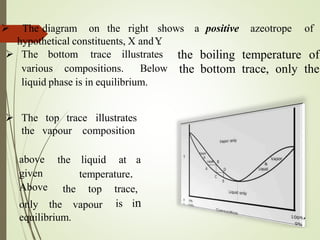
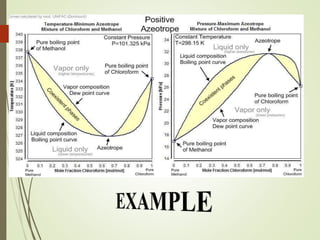
 The diagram on the right shows a positive azeotrope of
hypothetical constituents, X andY
.
 The bottom trace illustrates the boiling temperature of
the bottom trace, only the
various compositions. Below
liquid phase is in equilibrium.
 The top trace illustrates
the vapour composition
the liquid at a
temperature.
the top trace,
is in
above
given
Above
only the vapour
equilibrium.
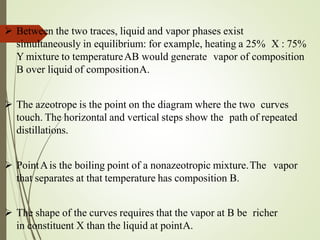
 Between the two traces, liquid and vapor phases exist
simultaneously in equilibrium: for example, heating a 25% X : 75%
Y mixture to temperatureAB would generate vapor of composition
B over liquid of compositionA.
 The azeotrope is the point on the diagram where the two curves
touch. The horizontal and vertical steps show the path of repeated
distillations.
 PointAis the boiling point of a nonazeotropic mixture.The vapor
that separates at that temperature has composition B.
 The shape of the curves requires that the vapor at B be richer
in constituent X than the liquid at pointA.
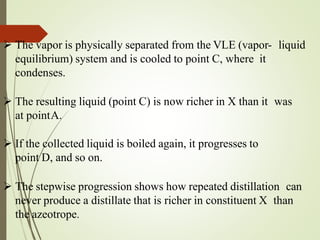
 The vapor is physically separated from the VLE (vapor- liquid
equilibrium) system and is cooled to point C, where it
condenses.
 The resulting liquid (point C) is now richer in X than it was
at pointA.
 If the collected liquid is boiled again, it progresses to
point D, and so on.
 The stepwise progression shows how repeated distillation can
never produce a distillate that is richer in constituent X than
the azeotrope.
Minimum boiling azeotropes examples
• separation of isobutanol and water
• separation of benzene and cyclohexane
• main application is to separate ethanol and
water( dehydration of ethanol)
Entrainers- How do they work?
• An entrainer is an agent, which affects volality of
one of the azeotrope combinings more than
another
• If one of the combinings is more volatile, so it
can be separated by distillation
The use of entrainers in the azeotropic distillation of alcohol
• The water+ethanol azeotrope can be separated
by adding the entrainer nenzene or cyclohexane.
• When cyclohexane is added, it engages all of the
water from the azeotrope, and then boiled,
azeotrope vapouring and leaving the desired
ethanol free of water
• Benzene has toxic effects,that is why
cyclohexane has replaced it
Maximum BoilingAzeotropes
 Each azeotrope has a characteristic boiling point. The
boiling point of an azeotrope is more than the boiling
point temperatures of any of its constituents is a
Maximum boiling azeotrope.
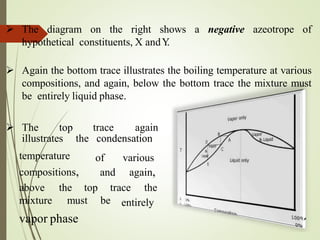
 The diagram on the right shows a negative azeotrope of
hypothetical constituents, X andY
.
 Again the bottom trace illustrates the boiling temperature at various
compositions, and again, below the bottom trace the mixture must
be entirely liquid phase.
 The top trace again
illustrates the condensation
temperature
compositions,
of various
and again,
trace the
above the top
mixture must be entirely
vapor phase
wit
 The point, A, shown here is a boiling point
composition chosen very near to the azeotrope.
 The vapor is collected at the same temperature at point B.
That vapor is cooled, condensed, and collected at point C.
 Because this example is a negative azeotrope rather than a
positive one, the distillate is farther from the azeotrope than
the original liquid mixture at pointAwas.
 So the distillate is poorer in constituent X and richer in
constituent Y than the original mixture
 Because this process has removed a greater fraction of Y from the
liquid than it had originally, the residue must be poorer in Y and
richer in X after distillation than before.
 If the point, A had been chosen to the right of the azeotrope rather
than to the left, the distillate at point C would be farther to the right
than A, which is to say that the distillate would be richer in X and
poorer in Y than the original mixture.
 So in this case too, the distillate moves away from the
and the residue moves toward it.
azeotrope
 This is characteristic of negative azeotropes.
Maximum boiling azeotropes examples
 nitric acid (68%) / water, boils at 120.2 °C at 1 atm
(negative azeotrope)
 perchloric acid (71.6%) / water, boils at 203 °C (negative
azeotrope)
 hydrofluoric acid (35.6%) / water, boils at 111.35 °C
(negative azeotrope)
An example of a negative azeotrope is
hydrochloric acid at
 a concentration of 20.2% and 79.8% water (by
mass).
EXAMPLES
• ethanol (96%) / water, boils at 78.1 °C
• sulfuric acid (98.3%) / water, boils at 338 °C
• acetone / methanol / chloroform form an intermediate
boiling (saddle) azeotrope
• diethyl ether (33%) / halothane (66%) a mixture once
commonly used in anaesthesia.
• benzene / hexafluorobenzene forms a double binary
azeotrope
AZEOTROPIC DISTILLATION
 The technique of addition of another component to form a
new low boiling point azeotropic solution such as benzene can
be added to the solution of ethanol and water in azeotropic
distillation.
 The azeotropic distillation unit consists of a container to feed
the azeotrope, decanter and steamer.
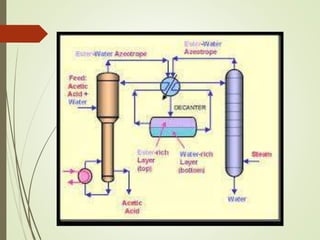
 For example; the mixture of acetic acid and water can be
separate out with the addition of an ester like n- butyl acetate.
 Remember the boiling point of acetic acid is 118.10C and
water is 1000C.
 Addition of ester whose boiling point is 1250C forms a
minimum- boiling azeotrope with water with boiling point
90.20C.
AZEOTROPIC DISTILLATION
 Hence azeotropic mixture will be distilled over as vapor and
leave acetic acid at bottoms.
 The overhead vapor is condensed and collected in a
decanter.
 Here it forms two insoluble layers in which the top layer
contains pure butyl acetate with water, and a bottom layer
contains pure water saturated with butyl acetate.
 The top layer is returned to the distillation column and
bottom layer is sent to another column for the recovery of
the ester by steam stripping.
How Azeotropic Distillation Works
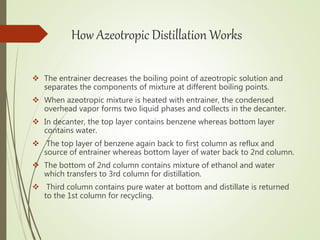
 The entrainer decreases the boiling point of azeotropic solution and
separates the components of mixture at different boiling points.
 When azeotropic mixture is heated with entrainer, the condensed
overhead vapor forms two liquid phases and collects in the decanter.
 In decanter, the top layer contains benzene whereas bottom layer
contains water.
 The top layer of benzene again back to first column as reflux and
source of entrainer whereas bottom layer of water back to 2nd column.
 The bottom of 2nd column contains mixture of ethanol and water
which transfers to 3rd column for distillation.
 Third column contains pure water at bottom and distillate is returned
to the 1st column for recycling.
Applications of azeotropes
• The use of specially chosen azeotropes is proposed as
standards when testing gas chromatographs, detectors,
columns and sample introduction systems. These
azeotropic mixtures permit us to minimize the errors due
to composition changes during sampling and sample
introduction systems (intended for gases or liquids). The
potentialities and advantages of such applications are
illustrated using the azeotropic mixture of benzene and
cyclohexane as an example.
.
Applications of azeotropes
• These azeotropic mixtures permit us to minimize the
errors due to composition changes during sampling and
sample introduction systems (intended for gases or
liquids). The potentialities and advantages of
such applications are illustrated using
the azeotropic mixture of benzene and cyclohexane as
an example.
References:
• www.google.com
• www.wikipedia.org
• Atkin’s Elements of physical chemistry
• Pharmaceutical engineering by CVS
subramanyam
THANK YOU

Azeotropic distillation

  • 1.
    Azeotropic distillation Presented by:Sawalkar Manisha Ratnakar M. Pharmacy (pharmaceutical chemistry) School of Pharmacy, S.R.T.M.University, Nanded. Guided by: Dr.S.pekamwar
  • 2.
    WHATISAZEOTROPE? • “ Anazeotrope (a constant boiling mixture) - is a mixture of two or more liquids whose proportions cannot be separated by simple distillation. • An azeotrope is formed when the liquid and vapour compositions are the same. • When an azeotrope is boiled, the vapour has the same proportions of combining as the unboiled mixture. • The name comes from the Greek words for ‘boiling without changing’. • When the azeotropic composition has been reached, distillation cannot separate the two liquids.
  • 3.
    WHATIS AZEOTROPE? • Azeotropescan form only when a mixture deviates from Raoult's law. • Separation by conventional distillation is not possible • Dewpoint and bubble point are the same at the azeotrope.
  • 4.
    Minimum BoilingAzeotropes  Eachazeotrope has a characteristic boiling point. The boiling point of an azeotrope is less than the boiling point temperatures of any of its is a Minimum boiling azeotrope.
  • 5.
     The diagramon the right shows a positive azeotrope of hypothetical constituents, X andY .  The bottom trace illustrates the boiling temperature of the bottom trace, only the various compositions. Below liquid phase is in equilibrium.  The top trace illustrates the vapour composition the liquid at a temperature. the top trace, is in above given Above only the vapour equilibrium.
  • 6.
     Between thetwo traces, liquid and vapor phases exist simultaneously in equilibrium: for example, heating a 25% X : 75% Y mixture to temperatureAB would generate vapor of composition B over liquid of compositionA.  The azeotrope is the point on the diagram where the two curves touch. The horizontal and vertical steps show the path of repeated distillations.  PointAis the boiling point of a nonazeotropic mixture.The vapor that separates at that temperature has composition B.  The shape of the curves requires that the vapor at B be richer in constituent X than the liquid at pointA.
  • 7.
     The vaporis physically separated from the VLE (vapor- liquid equilibrium) system and is cooled to point C, where it condenses.  The resulting liquid (point C) is now richer in X than it was at pointA.  If the collected liquid is boiled again, it progresses to point D, and so on.  The stepwise progression shows how repeated distillation can never produce a distillate that is richer in constituent X than the azeotrope.
  • 9.
    Minimum boiling azeotropesexamples • separation of isobutanol and water • separation of benzene and cyclohexane • main application is to separate ethanol and water( dehydration of ethanol)
  • 10.
    Entrainers- How dothey work? • An entrainer is an agent, which affects volality of one of the azeotrope combinings more than another • If one of the combinings is more volatile, so it can be separated by distillation
  • 11.
    The use ofentrainers in the azeotropic distillation of alcohol • The water+ethanol azeotrope can be separated by adding the entrainer nenzene or cyclohexane. • When cyclohexane is added, it engages all of the water from the azeotrope, and then boiled, azeotrope vapouring and leaving the desired ethanol free of water • Benzene has toxic effects,that is why cyclohexane has replaced it
  • 12.
    Maximum BoilingAzeotropes  Eachazeotrope has a characteristic boiling point. The boiling point of an azeotrope is more than the boiling point temperatures of any of its constituents is a Maximum boiling azeotrope.
  • 13.
     The diagramon the right shows a negative azeotrope of hypothetical constituents, X andY .  Again the bottom trace illustrates the boiling temperature at various compositions, and again, below the bottom trace the mixture must be entirely liquid phase.  The top trace again illustrates the condensation temperature compositions, of various and again, trace the above the top mixture must be entirely vapor phase
  • 14.
    wit  The point,A, shown here is a boiling point composition chosen very near to the azeotrope.  The vapor is collected at the same temperature at point B. That vapor is cooled, condensed, and collected at point C.  Because this example is a negative azeotrope rather than a positive one, the distillate is farther from the azeotrope than the original liquid mixture at pointAwas.  So the distillate is poorer in constituent X and richer in constituent Y than the original mixture
  • 15.
     Because thisprocess has removed a greater fraction of Y from the liquid than it had originally, the residue must be poorer in Y and richer in X after distillation than before.  If the point, A had been chosen to the right of the azeotrope rather than to the left, the distillate at point C would be farther to the right than A, which is to say that the distillate would be richer in X and poorer in Y than the original mixture.  So in this case too, the distillate moves away from the and the residue moves toward it. azeotrope  This is characteristic of negative azeotropes.
  • 17.
    Maximum boiling azeotropesexamples  nitric acid (68%) / water, boils at 120.2 °C at 1 atm (negative azeotrope)  perchloric acid (71.6%) / water, boils at 203 °C (negative azeotrope)  hydrofluoric acid (35.6%) / water, boils at 111.35 °C (negative azeotrope) An example of a negative azeotrope is hydrochloric acid at  a concentration of 20.2% and 79.8% water (by mass).
  • 18.
    EXAMPLES • ethanol (96%)/ water, boils at 78.1 °C • sulfuric acid (98.3%) / water, boils at 338 °C • acetone / methanol / chloroform form an intermediate boiling (saddle) azeotrope • diethyl ether (33%) / halothane (66%) a mixture once commonly used in anaesthesia. • benzene / hexafluorobenzene forms a double binary azeotrope
  • 19.
    AZEOTROPIC DISTILLATION  Thetechnique of addition of another component to form a new low boiling point azeotropic solution such as benzene can be added to the solution of ethanol and water in azeotropic distillation.  The azeotropic distillation unit consists of a container to feed the azeotrope, decanter and steamer.  For example; the mixture of acetic acid and water can be separate out with the addition of an ester like n- butyl acetate.  Remember the boiling point of acetic acid is 118.10C and water is 1000C.  Addition of ester whose boiling point is 1250C forms a minimum- boiling azeotrope with water with boiling point 90.20C.
  • 20.
    AZEOTROPIC DISTILLATION  Henceazeotropic mixture will be distilled over as vapor and leave acetic acid at bottoms.  The overhead vapor is condensed and collected in a decanter.  Here it forms two insoluble layers in which the top layer contains pure butyl acetate with water, and a bottom layer contains pure water saturated with butyl acetate.  The top layer is returned to the distillation column and bottom layer is sent to another column for the recovery of the ester by steam stripping.
  • 21.
    How Azeotropic DistillationWorks  The entrainer decreases the boiling point of azeotropic solution and separates the components of mixture at different boiling points.  When azeotropic mixture is heated with entrainer, the condensed overhead vapor forms two liquid phases and collects in the decanter.  In decanter, the top layer contains benzene whereas bottom layer contains water.  The top layer of benzene again back to first column as reflux and source of entrainer whereas bottom layer of water back to 2nd column.  The bottom of 2nd column contains mixture of ethanol and water which transfers to 3rd column for distillation.  Third column contains pure water at bottom and distillate is returned to the 1st column for recycling.
  • 23.
    Applications of azeotropes •The use of specially chosen azeotropes is proposed as standards when testing gas chromatographs, detectors, columns and sample introduction systems. These azeotropic mixtures permit us to minimize the errors due to composition changes during sampling and sample introduction systems (intended for gases or liquids). The potentialities and advantages of such applications are illustrated using the azeotropic mixture of benzene and cyclohexane as an example. .
  • 24.
    Applications of azeotropes •These azeotropic mixtures permit us to minimize the errors due to composition changes during sampling and sample introduction systems (intended for gases or liquids). The potentialities and advantages of such applications are illustrated using the azeotropic mixture of benzene and cyclohexane as an example.
  • 25.
    References: • www.google.com • www.wikipedia.org •Atkin’s Elements of physical chemistry • Pharmaceutical engineering by CVS subramanyam
  • 26.