DISTILLATION
BY ANITHA.V
INTRODUCTION
•Distillation can be defined as
the process of saeparation of the
constituents of a mixture By
vaporization and further
recovering the liquid another
place by condensation.
The feed liquid in distillation apparatus
which is to be distilled is called distill and
white liquid collected by condensation is
called condensate or distillate.
Distillationis used to separate volatile oil
or components from non volatile
components or to separate a mixture of
liquids with different boiling points.
Distillation is also used to purify liquid
mixture.
• Distillation differs from evaporation and
drying.
In distillation condensation vapour is
required to product while in evaporation
the concentrated liquid residue is final
product and in drying, dried solid residue
is used as product
APPLICATION
•Separation of volatile oil. Example: cloves(
Eugenol)
Separation of drugs obtained from plant
and animal source. Example: Vitamin A
from fish liver oil.
Purification of organic solvent Example:
Alcohol.
Quality control methods. Example: Alcohol
containing elixir.
•Recovery of solvent. Example: Synthesis.
•Distillation method is used for preparation
of distilled water
•Azeotropic distillation is used to get
absolute alcohol.
•In petroleum industry, using a flash
distillation method, the crude oil is
separated into different fraction
•Distillation method is used to estimate
CLASSIFICATION OF
DISTILLATION:
•Simple distillation ( Differential distillation).
•Flash distillation ( Equilibrium distillation).
• Vacuum distillation(Distillation under
reduced pressure).
• Molecular distillation(Vaporation
distillation or short bath distillation ).
• Fractional distillation.
• Azeotropic and extractive distillation.
• Steam distillation
BINARY MIXTURE
•When two liquids mixed together, they maybe
visible with each other in all portions, such
miscible liquids are known as “ Binary mixture
“.
•Example:
•Ethanol + water
•Acetone + water
RAOULT‘LAW:
•It is expressed as a quantitative
relationship between the concentration
and vapour pressure.
•It state’s that portion vapour pressure of
each component is equal to vapour
pressure of the pure component by mole
fraction in the solution at the given
temperature.
Mole fraction A in solution =XA.
Vapour pressure of A in pure state=P0A
Partial vapour pressure of component B in
mixture =PB=P0B.
Total vapour pressure of mixture,
PT= PA +PB
PT=P0A.XA+P0B.XB
SIMPLE
DISTILLATION
•Simple distillation is the process of
converting a single constituent from a
liquid into its vapour, transferring the
liquid by condensing the vapour usually
by allowing it to come in contact with the
cold surface.
PRINCIPLE:
•The liquid boils when it’s vapour pressure
is equal to atmospheric pressure.
•Simple distillation is conducted at its
boiling point.
•The higher the relative volatility of a
liquid, the better is the separation by
simple distillation.
CONSTRUCTION:
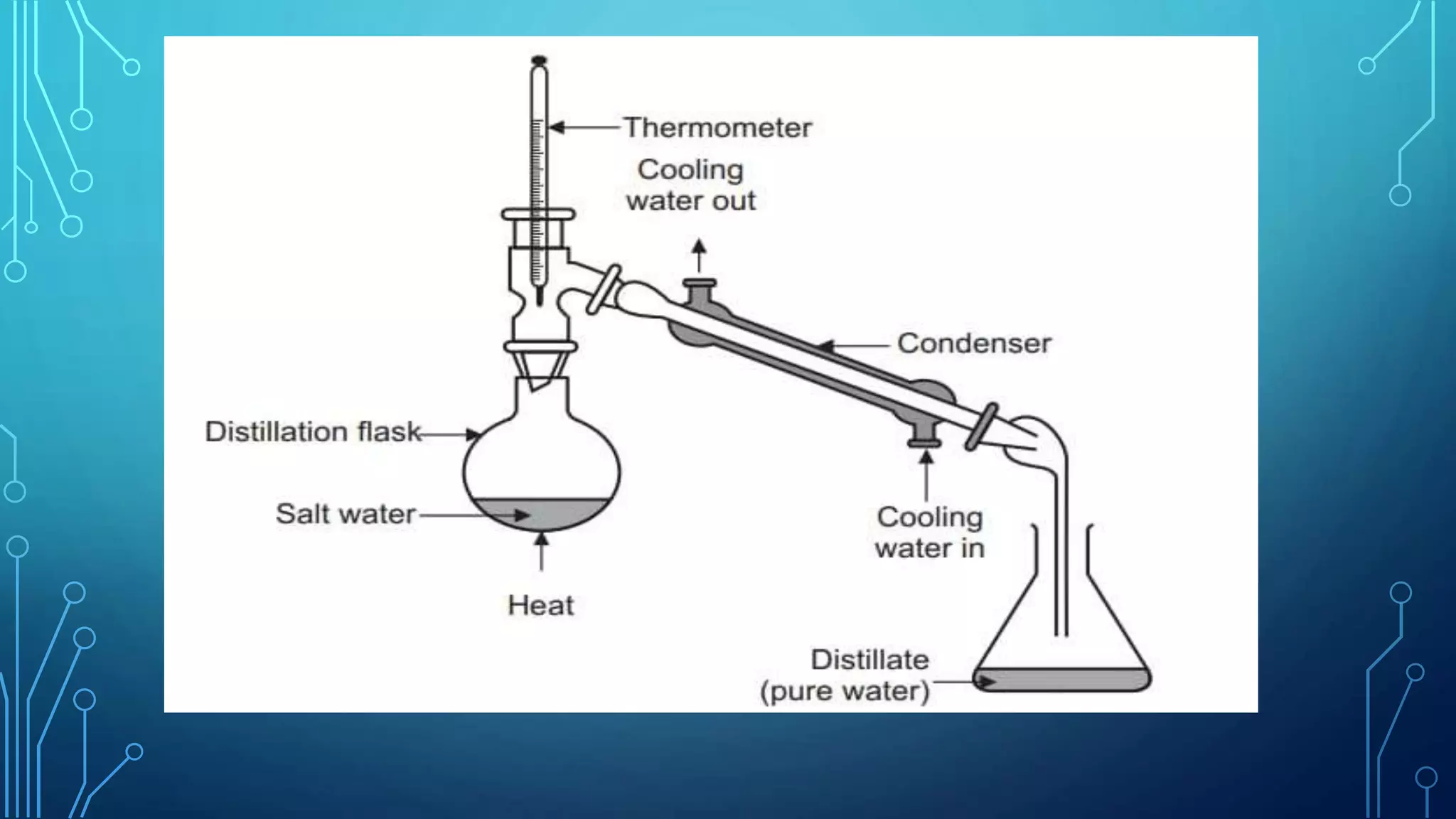
•It consist of a distillation flask with a side on
sloping downwards.
•Condenser is fitted into the side on by means
of cork.
•The condenser is usually water condenser
jacketed for circulation of water. The
condenser is connected to a receiver flask
using an adaptor with ground glass joints.
WORKING:
•The liquid to be distilled is filled into the flask
to one half to two third of its volume.
•Pumping is avoided by adding small pieces of
porcelain before distillation.A thermometer is
inserted into the jacket on the flask.water is
circulated to the jacket on the Condenser the
vapour beings to riseup and passes down the
side on into the condenser. The vapour is
condensed and collected into the receiver.
APPLICATIONS:
•For the preparation of distilled water and water
for injection.
•Volatile and aromatic water are prepared.
•Organic solvents are purified.
•It is used in preparing pharmaceutical spirits.
•It is used to separate non_ volatile compounds
from volatile ones.
ADVANTAGE:
•It is simple, cheap, easy and economic
method.
•It requires less energy.
•This process requires single run and thus is
comparatively faster.
•DISADVANTAGE:
Not suitable for mixtures containing
FRACTIONAL
DISTILLATION
• Fractional distillation is a process in which vaporization 0f liquid
mixture gives rise to a mixture of constituents from which the
desired one is separated in pure form.
• This method is also known as rectification.
• In simple distillation, condensate is collected directly into the
receiver, while in fractional distillation condensation takes place in
the fractionating column, so that part of the condensing vapour
returns to the still.
PRINCIPLE:
•When a liquid mixture is distilled, partial
condensation of the vapour is allowed to occur in
a fractionating column.
•In the column, ascending vapours from the still
are allowed to come in contact with the
condensing vapour returning to the still. This
result is enrichment of the vapour with more
volatile components. By condensing the vapour
and reheating the liquid repeatedly, equilibrium
CONSTRUCTION:
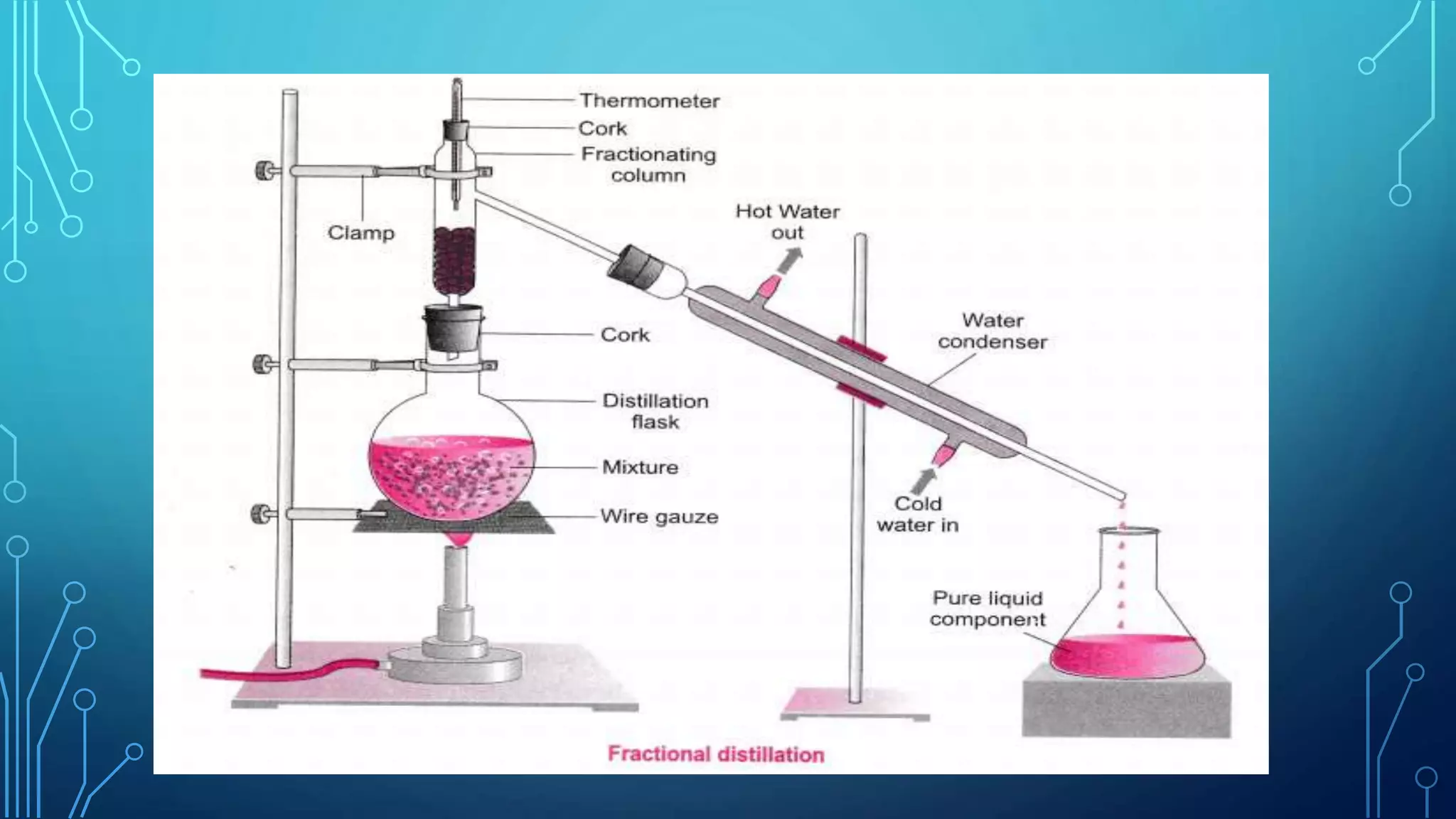
•The equipment used for fractional distillation
consist of special type of still heads known as
fractionating column
•In still heads condensation and vaporization are
affected continuously.
•Fractionating column is an essentialluck a long
vertical tube in which the vapour moves upward
and partially get condensed.The condensate
flows down the column and is returned to the
WORKING:
•It is a large scale made to supply the heat to
the bottom of column, at the top of column a
condenser is attached, the fractional column
has a large area.
•The flow condition is low the top of the
column is cooler than the bottom, so that the
liquid steam becomes to the vapour steam
because cooling effect.
APPLICATIONS:
•It is used in separating volatile liquids.
•Fractional distillation has been used
traditionally in the separation of mixtures and
purification of solvents, chemicals and other
naturally occurring material.
•Fractional distillation is suitable for a system
when the boiling point of the mixture is
ADVANTAGE:
•Fractional distillation gives good solvent recovery.
•It is easy to use and operate.
•It helps to produce much needed fuel.
•DISADVANTAGE:
•High capital cost.Not flexible.
•Not easy to sterilize. It is not economical for small
volume production. Not preferable for processing of
temperature sensitive product.
VACUUM
DISTILLATION
•In this distillation occur at a temperature
below ist is boiling point by vacuum.
•Vacuum distillation is preferred when liquid
have high boiling point at atmospheric or
solution containing thermolabile substances .
•Vacuum pumps or suction pumps are used to
reduce pressure on the liquid surface.
PRINCIPLE:
•The liquid boils when it’s vapour pressure is
equal to the atmospheric pressure.
•The liquids which are can be distilled at a
much lower temperature then thEurope
boiling point.
•If the pressure is reduced to the surface of
the liquid.
PRINCIPLE AND
CONSTRUCTION:
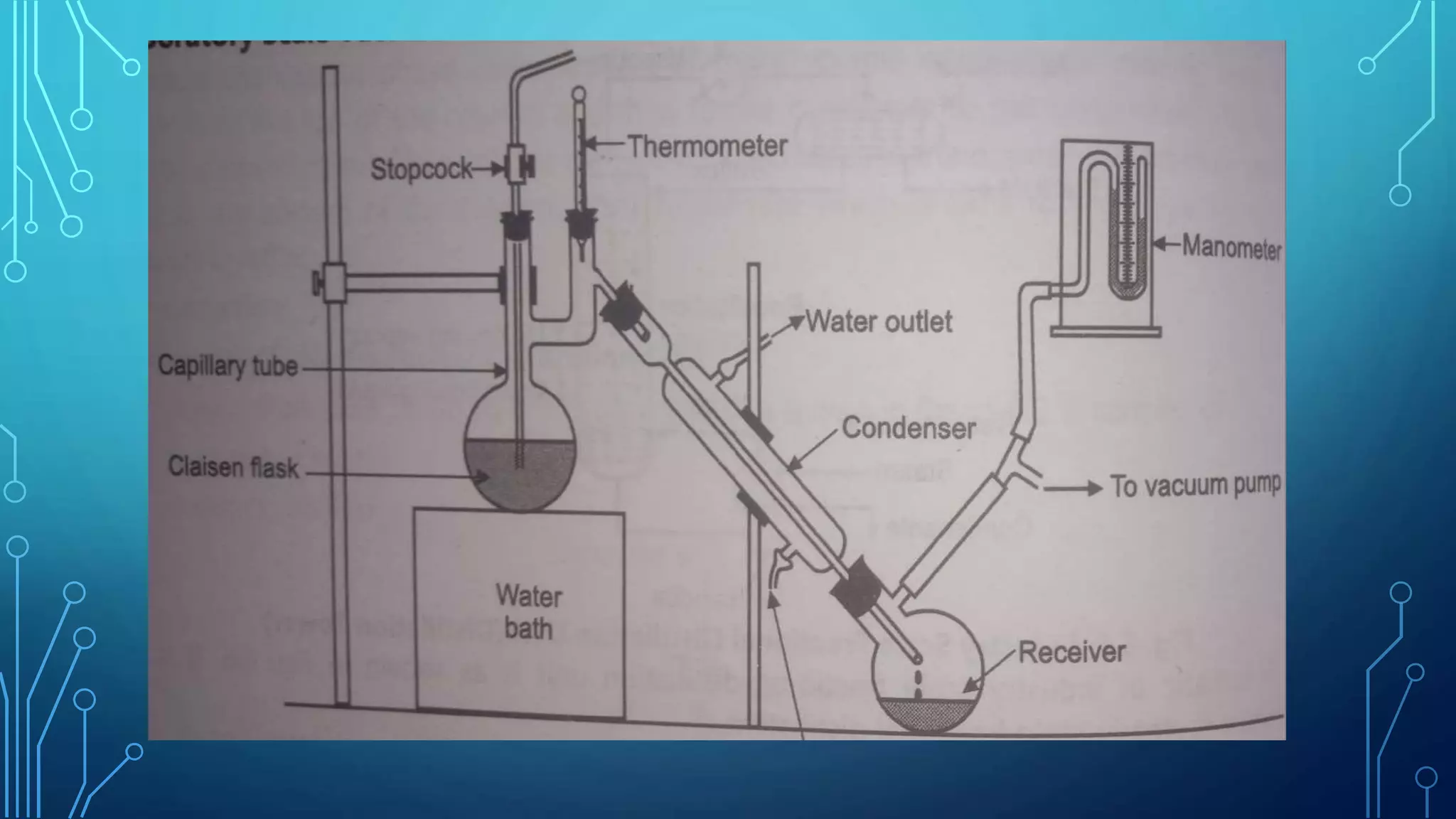
•The liquid to be distilled is put into flask up
to one half to two third of its volume.
•A porcelain pieces is add to prevent
pumping.
•The clause flask also have provision of
capillary tube.
•A thermometer is also inserted in the flask
Watergate is used as heating medium.
•Due to rising temperature liquid get
converted into vapours due to vacuum.
•These vapours passed through condenser
collect the condensate in the receiver.
•The receiver is attached to a vacuum pump
to reduce pressure.
•The pressure is measured with the help of a
manometer.
APPLICATION:
•It reduces the number of stages needed in
distillation
•The product output per day is very high.
•Columns can be operated at lower temperature.
•It requires lower temperature at lower pressure.
•It increases the relative volatility of the key
components in many applications lower pressure
increases relative volatilities in many systems.
ADVANTAGE:
•Vacuum distillation is also used in the separation
of sensitive organic chemicals and recovery of
organic s
•solvents.
•DISADVANTAGE:
•High energy cost of vacuum pumps.
•Pressure and energy losses due to any leaks or
STEAM
DISTILLATION
•In steam distillation impure compounds are
distilled with the help of steam.
•This method is applicable to solids as well as
liquids.
•For purification by steam distillation an
impure compound should not decompose at
the steam temperature, should have a high
vapour pressure at 373 k , should be
insoluble in water and the impurities present
PRINCIPLE:
•The mixture of impossible liquid being to be
boiling when the sum of vapour pressure is
equal to atmosphere pressure P1 present the
vapour pressure of the water and P2
representative the vapour pressure of the
organic liquid in steam distillation the liquid
boils at a temperature at which,
CONSTRUCTION:
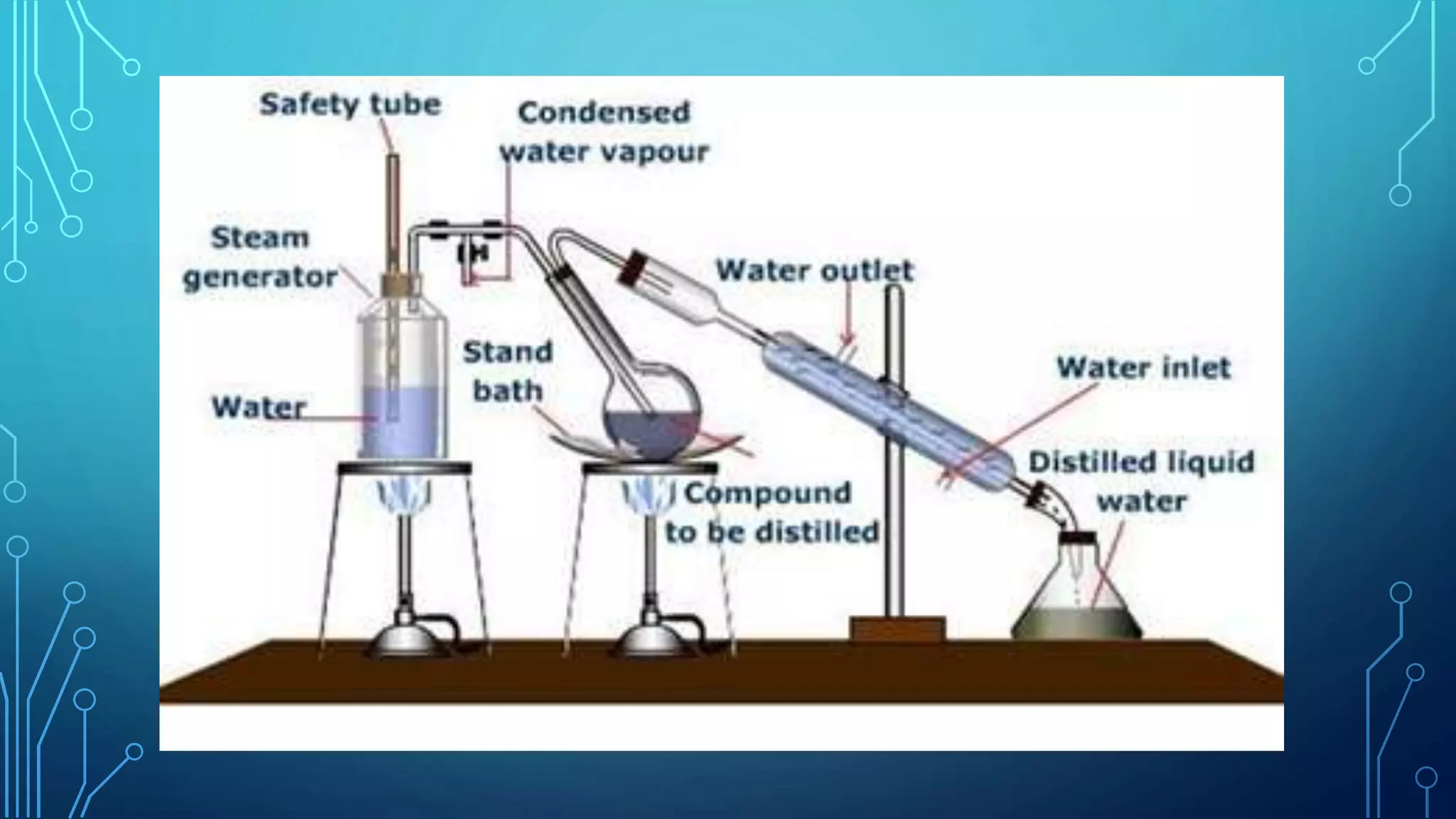
•It is contain steam can with two hole through
the one hole the safety tube passes to relieve
pressure .
•If high pressure is generated through one
hole bent tube is passed whose other end is
attached to the flask having an aqueous
liquid.
•There is also provision to heat steam can and
WORKING:
•Steam can be filled with water.
•The non aqueous liquid is placed into flask and a
small quantity of water is added.
•The flask is heated gently now steam is bubbled
through contents in the flask.
•The vapours of compound mix up with steam
and escape into the condenser the condensate
thus into mixtures of water and non aqueous
liquid which can be separate.
APPLICATION:
•Steam distillation is used to extract essential oils
from aromatic plants to flavours liqueurs.
•It is used for extraction of peppermint and
spearmint oils.
•It is used in synthesis of complex organic
compounds.
•Organic oil and eucalyptus oil are obtained at
ADVANTAGE:
•The amount of steam and the quality of the
steam can be controlled.
•It is the standard method of extracting flavour
and fragrance.
•Most widely used process for the extraction of
essential oils on a large scale.
DISADVANTAGE:
•Need trained operator in order to operate the
equipment.
•The process has a hidden cost of maintaining
and repairing equipment.
•There is much higher capital requirement and
with low priced oils the payback period can be
over 10 years.
FIASH
DISTILLATION
•Flash distillation also called “ Equilibrium
distillation “, is a single stage separation
technique.
•Simple flash separations are very common in
industry particularly petroleum refining.
•Even when some other method of separation is
to be used it is not uncommon to use a”
PRINCIPLE:
•When a hot liquid mixture is heated to enter from
a high pressure zone to low pressure zone.
•The entire liquid mixture is suddenly vaporized.
•This process is known as “flash vapourization”.
•During this process the chamber gets cooled.
•The individual vapour phase molecules of high
boiling fraction get condensed while low boiling
fraction remain as vapour.
CONSTRUCTION AND
WORKING:
•It consist of a pump which is used to force feed
into heating chamber.
•As a result feed get heated.
•The other end of pipe is attached to the vapour
separator through pressure reducing valve.
•Due to pressure drop hot liquid flashes, the sudden
vapourization causes cooling. After some time
vapour and liquid phase separate and achieve
•The apparatus also has a provision of
vapour outlet at top and liquid outlet at
the bottom.
•The liquid is collected from bottom of the
separator.
•At the end of the process the vapour will
be in equilibrium with liquid.
APPLICATION:
•It is used in petroleum industry for refining crude
oil.
•Desalination of ocean water by multi stage flash
distillation.
• It can also used for separation of Beltane from
octane.
•Flash distillation is a continuous process.
•The equipment is smaller than the multi stage
flash distillation.
DISADVANTAGE:
•It is not effective in separating components of
comparable volatility.
•It is not suitable for two component systems.
•It is not efficient distillation when nearly pure
components are required, because the
condensed vapour and residual liquid contain
both components to some extent.
THE END
THANK
YOU

Distillation ppt.pptx

  • 1.
  • 2.
    INTRODUCTION •Distillation can bedefined as the process of saeparation of the constituents of a mixture By vaporization and further recovering the liquid another place by condensation.
  • 3.
    The feed liquidin distillation apparatus which is to be distilled is called distill and white liquid collected by condensation is called condensate or distillate. Distillationis used to separate volatile oil or components from non volatile components or to separate a mixture of liquids with different boiling points.
  • 4.
    Distillation is alsoused to purify liquid mixture. • Distillation differs from evaporation and drying. In distillation condensation vapour is required to product while in evaporation the concentrated liquid residue is final product and in drying, dried solid residue is used as product
  • 6.
    APPLICATION •Separation of volatileoil. Example: cloves( Eugenol) Separation of drugs obtained from plant and animal source. Example: Vitamin A from fish liver oil. Purification of organic solvent Example: Alcohol. Quality control methods. Example: Alcohol containing elixir.
  • 7.
    •Recovery of solvent.Example: Synthesis. •Distillation method is used for preparation of distilled water •Azeotropic distillation is used to get absolute alcohol. •In petroleum industry, using a flash distillation method, the crude oil is separated into different fraction •Distillation method is used to estimate
  • 8.
    CLASSIFICATION OF DISTILLATION: •Simple distillation( Differential distillation). •Flash distillation ( Equilibrium distillation). • Vacuum distillation(Distillation under reduced pressure). • Molecular distillation(Vaporation distillation or short bath distillation ). • Fractional distillation. • Azeotropic and extractive distillation. • Steam distillation
  • 9.
    BINARY MIXTURE •When twoliquids mixed together, they maybe visible with each other in all portions, such miscible liquids are known as “ Binary mixture “. •Example: •Ethanol + water •Acetone + water
  • 10.
    RAOULT‘LAW: •It is expressedas a quantitative relationship between the concentration and vapour pressure. •It state’s that portion vapour pressure of each component is equal to vapour pressure of the pure component by mole fraction in the solution at the given temperature.
  • 11.
    Mole fraction Ain solution =XA. Vapour pressure of A in pure state=P0A Partial vapour pressure of component B in mixture =PB=P0B. Total vapour pressure of mixture, PT= PA +PB PT=P0A.XA+P0B.XB
  • 13.
    SIMPLE DISTILLATION •Simple distillation isthe process of converting a single constituent from a liquid into its vapour, transferring the liquid by condensing the vapour usually by allowing it to come in contact with the cold surface.
  • 14.
    PRINCIPLE: •The liquid boilswhen it’s vapour pressure is equal to atmospheric pressure. •Simple distillation is conducted at its boiling point. •The higher the relative volatility of a liquid, the better is the separation by simple distillation.
  • 15.
    CONSTRUCTION: •It consist ofa distillation flask with a side on sloping downwards. •Condenser is fitted into the side on by means of cork. •The condenser is usually water condenser jacketed for circulation of water. The condenser is connected to a receiver flask using an adaptor with ground glass joints.
  • 16.
    WORKING: •The liquid tobe distilled is filled into the flask to one half to two third of its volume. •Pumping is avoided by adding small pieces of porcelain before distillation.A thermometer is inserted into the jacket on the flask.water is circulated to the jacket on the Condenser the vapour beings to riseup and passes down the side on into the condenser. The vapour is condensed and collected into the receiver.
  • 17.
    APPLICATIONS: •For the preparationof distilled water and water for injection. •Volatile and aromatic water are prepared. •Organic solvents are purified. •It is used in preparing pharmaceutical spirits. •It is used to separate non_ volatile compounds from volatile ones.
  • 18.
    ADVANTAGE: •It is simple,cheap, easy and economic method. •It requires less energy. •This process requires single run and thus is comparatively faster. •DISADVANTAGE: Not suitable for mixtures containing
  • 20.
    FRACTIONAL DISTILLATION • Fractional distillationis a process in which vaporization 0f liquid mixture gives rise to a mixture of constituents from which the desired one is separated in pure form. • This method is also known as rectification. • In simple distillation, condensate is collected directly into the receiver, while in fractional distillation condensation takes place in the fractionating column, so that part of the condensing vapour returns to the still.
  • 21.
    PRINCIPLE: •When a liquidmixture is distilled, partial condensation of the vapour is allowed to occur in a fractionating column. •In the column, ascending vapours from the still are allowed to come in contact with the condensing vapour returning to the still. This result is enrichment of the vapour with more volatile components. By condensing the vapour and reheating the liquid repeatedly, equilibrium
  • 22.
    CONSTRUCTION: •The equipment usedfor fractional distillation consist of special type of still heads known as fractionating column •In still heads condensation and vaporization are affected continuously. •Fractionating column is an essentialluck a long vertical tube in which the vapour moves upward and partially get condensed.The condensate flows down the column and is returned to the
  • 23.
    WORKING: •It is alarge scale made to supply the heat to the bottom of column, at the top of column a condenser is attached, the fractional column has a large area. •The flow condition is low the top of the column is cooler than the bottom, so that the liquid steam becomes to the vapour steam because cooling effect.
  • 24.
    APPLICATIONS: •It is usedin separating volatile liquids. •Fractional distillation has been used traditionally in the separation of mixtures and purification of solvents, chemicals and other naturally occurring material. •Fractional distillation is suitable for a system when the boiling point of the mixture is
  • 25.
    ADVANTAGE: •Fractional distillation givesgood solvent recovery. •It is easy to use and operate. •It helps to produce much needed fuel. •DISADVANTAGE: •High capital cost.Not flexible. •Not easy to sterilize. It is not economical for small volume production. Not preferable for processing of temperature sensitive product.
  • 27.
    VACUUM DISTILLATION •In this distillationoccur at a temperature below ist is boiling point by vacuum. •Vacuum distillation is preferred when liquid have high boiling point at atmospheric or solution containing thermolabile substances . •Vacuum pumps or suction pumps are used to reduce pressure on the liquid surface.
  • 28.
    PRINCIPLE: •The liquid boilswhen it’s vapour pressure is equal to the atmospheric pressure. •The liquids which are can be distilled at a much lower temperature then thEurope boiling point. •If the pressure is reduced to the surface of the liquid.
  • 29.
    PRINCIPLE AND CONSTRUCTION: •The liquidto be distilled is put into flask up to one half to two third of its volume. •A porcelain pieces is add to prevent pumping. •The clause flask also have provision of capillary tube. •A thermometer is also inserted in the flask Watergate is used as heating medium.
  • 30.
    •Due to risingtemperature liquid get converted into vapours due to vacuum. •These vapours passed through condenser collect the condensate in the receiver. •The receiver is attached to a vacuum pump to reduce pressure. •The pressure is measured with the help of a manometer.
  • 31.
    APPLICATION: •It reduces thenumber of stages needed in distillation •The product output per day is very high. •Columns can be operated at lower temperature. •It requires lower temperature at lower pressure. •It increases the relative volatility of the key components in many applications lower pressure increases relative volatilities in many systems.
  • 32.
    ADVANTAGE: •Vacuum distillation isalso used in the separation of sensitive organic chemicals and recovery of organic s •solvents. •DISADVANTAGE: •High energy cost of vacuum pumps. •Pressure and energy losses due to any leaks or
  • 34.
    STEAM DISTILLATION •In steam distillationimpure compounds are distilled with the help of steam. •This method is applicable to solids as well as liquids. •For purification by steam distillation an impure compound should not decompose at the steam temperature, should have a high vapour pressure at 373 k , should be insoluble in water and the impurities present
  • 35.
    PRINCIPLE: •The mixture ofimpossible liquid being to be boiling when the sum of vapour pressure is equal to atmosphere pressure P1 present the vapour pressure of the water and P2 representative the vapour pressure of the organic liquid in steam distillation the liquid boils at a temperature at which,
  • 36.
    CONSTRUCTION: •It is containsteam can with two hole through the one hole the safety tube passes to relieve pressure . •If high pressure is generated through one hole bent tube is passed whose other end is attached to the flask having an aqueous liquid. •There is also provision to heat steam can and
  • 37.
    WORKING: •Steam can befilled with water. •The non aqueous liquid is placed into flask and a small quantity of water is added. •The flask is heated gently now steam is bubbled through contents in the flask. •The vapours of compound mix up with steam and escape into the condenser the condensate thus into mixtures of water and non aqueous liquid which can be separate.
  • 39.
    APPLICATION: •Steam distillation isused to extract essential oils from aromatic plants to flavours liqueurs. •It is used for extraction of peppermint and spearmint oils. •It is used in synthesis of complex organic compounds. •Organic oil and eucalyptus oil are obtained at
  • 40.
    ADVANTAGE: •The amount ofsteam and the quality of the steam can be controlled. •It is the standard method of extracting flavour and fragrance. •Most widely used process for the extraction of essential oils on a large scale.
  • 41.
    DISADVANTAGE: •Need trained operatorin order to operate the equipment. •The process has a hidden cost of maintaining and repairing equipment. •There is much higher capital requirement and with low priced oils the payback period can be over 10 years.
  • 42.
    FIASH DISTILLATION •Flash distillation alsocalled “ Equilibrium distillation “, is a single stage separation technique. •Simple flash separations are very common in industry particularly petroleum refining. •Even when some other method of separation is to be used it is not uncommon to use a”
  • 43.
    PRINCIPLE: •When a hotliquid mixture is heated to enter from a high pressure zone to low pressure zone. •The entire liquid mixture is suddenly vaporized. •This process is known as “flash vapourization”. •During this process the chamber gets cooled. •The individual vapour phase molecules of high boiling fraction get condensed while low boiling fraction remain as vapour.
  • 44.
    CONSTRUCTION AND WORKING: •It consistof a pump which is used to force feed into heating chamber. •As a result feed get heated. •The other end of pipe is attached to the vapour separator through pressure reducing valve. •Due to pressure drop hot liquid flashes, the sudden vapourization causes cooling. After some time vapour and liquid phase separate and achieve
  • 45.
    •The apparatus alsohas a provision of vapour outlet at top and liquid outlet at the bottom. •The liquid is collected from bottom of the separator. •At the end of the process the vapour will be in equilibrium with liquid.
  • 46.
    APPLICATION: •It is usedin petroleum industry for refining crude oil. •Desalination of ocean water by multi stage flash distillation. • It can also used for separation of Beltane from octane. •Flash distillation is a continuous process. •The equipment is smaller than the multi stage flash distillation.
  • 47.
    DISADVANTAGE: •It is noteffective in separating components of comparable volatility. •It is not suitable for two component systems. •It is not efficient distillation when nearly pure components are required, because the condensed vapour and residual liquid contain both components to some extent.
  • 49.
  • 50.