SEMINAR ON DISTILLATION
PRESENTED BY
Borade Nikita Jagannath
Roll No : 02
M. Pharm ( sem – II )
( Pharmaceutical Chemistry )
GUIDANCE BY
Prof. Dr. R.L. Sawant
M.Pharm Ph.D
Dept. Pharmaceutical Chemistry
DR. VITHALRAO VIKHE PATIL FOUNDATION’S
COLLEGE OF PHARMACY, VILAD GHAT,
AHMEDNAGAR (2022-2023)
1
 DISTILLATION
• The separation of the components of a liquid mixture by a process involving
vaporization and subsequent condensation at another place is termed as distillation.
• Distillation process involve two steps :
1. Converting a liquid into vapor phase.
2. Transferring the vapor to another place and recovering the liquid by condensation.
• Feed liquid distilland.
• Condensed liquid distillate or condensate.
 APPLICATIONS
• Separation of volatile oils
• Purification of organic solvent
• Manufacturing of official preparation
• Refining of petroleum products
• Recovery of petroleum products
• Recovery of solvent
• Quality control methods
• Separation of drugs obtained from plants and animal source
• Purification of drugs obtained from chemical reaction.
 THEORY
• Distillation is a process of separating and purifying the components in a liquid
mixture. Distillation method depends on the relative volatilities of the compunents
present in the mixture.
• When two liquids are mixed together they may be missible with each other in all
proportion. Such liquid are known as binary mixtures of liquid.
• Example : ethyl alcohol and water.
Ideal solution
Ideal solution is defined as the one in which there is no change in the properties of
the component other than dilution , when they are mixed to form a solution.
 RAOULT’S LAW
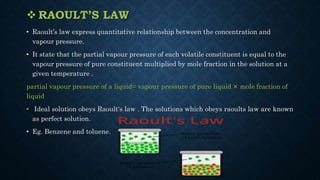
• Raoult’s law express quantitative relationship between the concentration and
vapour pressure.
• It state that the partial vapour pressure of each volatile constituent is equal to the
vapour pressure of pure constituent multiplied by mole fraction in the solution at a
given temperature .
partial vapour pressure of a liquid= vapour pressure of pure liquid × mole fraction of
liquid
• Ideal solution obeys Raoult's law . The solutions which obeys raoults law are known
as perfect solution.
• Eg. Benzene and toluene.
 DALTON’S LAW
• It is a law of partial vapour pressure.
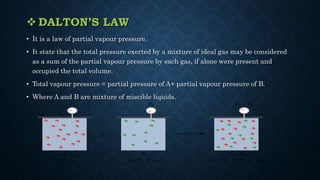
• It state that the total pressure exerted by a mixture of ideal gas may be considered
as a sum of the partial vapour pressure by each gas, if alone were present and
occupied the total volume.
• Total vapour pressure = partial pressure of A+ partial vapour pressure of B.
• Where A and B are mixture of miscible liquids.
 REAL SOLUTIONS
• Most of the liquids shows varying degree of deviation on the nature of liquids and
the temperature. These solutions are known as real solution.
• True Solution is a homogeneous mixture of two or more substances in which
substance dissolved (solute) in solvent has the particle size of less than 10-9 m or 1
nm. Simple solution of sugar in water is an example of true solution.
• They can be separated again using special filtration methods, such as reverse
osmosis or nanofiltration.
Properties of real solution.
• The real solution is clear
• The substance is so finely distributed in the solvent that the particles are not visible
• Real solutions pass through porous filter material without leaving any residue
behind.
Classification of distillation methods
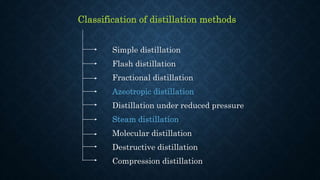
Simple distillation
Flash distillation
Fractional distillation
Azeotropic distillation
Distillation under reduced pressure
Steam distillation
Molecular distillation
Destructive distillation
Compression distillation
 AZEOTROPIC DISTILLATION
• Azeotrope: it is a mixture of two or more components in fluidic states whose
proportions cannot be altered or changed by simple distillation.
• Azeotropic distillation is a distillation method in which azeotropic mixture is broken by
the addition of a third substance, which forms a new azeotrope with one of the
component.
• The relative volatility of the liquid mixture can be changed by adding a third substance.
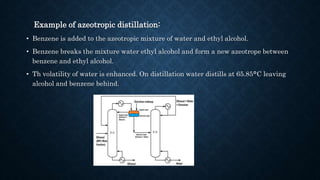
Example of azeotropic distillation:
• Benzene is added to the azeotropic mixture of water and ethyl alcohol.
• Benzene breaks the mixture water ethyl alcohol and form a new azeotrope between
benzene and ethyl alcohol.
• Th volatility of water is enhanced. On distillation water distills at 65.85°C leaving
alcohol and benzene behind.
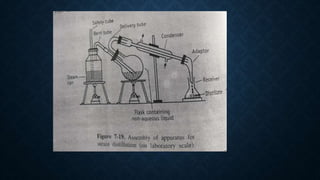
 STEAM DISTILLATION
• Steam distillation is a method of distillation carried with the ais of steam and is
used for the separation of high boiling substance from non-volatile impurities.
Principle :
• A mixture of immiscible liquids begins to boil when the sum of theirs vapour
pressure is equal to atmospheric pressure. In case of water and turpentine, mixture
boils below the boiling point of pure water, though the turpentine boils at much
higher temperature than that of water.
 APPLICATION
• Separation of immiscible liquids.
• Extraction of volatile oil.
• Purification of liquid with high boiling point.
• Distillation of camphor.
• Preparation of aromatic waters.
 ADVANTAGES
• Volatile oil can be separated at a lowered temperature in steam distillation, without
any decomposition and loss of aroma.
• If a substance has a low volatility, it can be easily distilled provide its molecular
weight is considerably higher than water.
DISADVANTAGES
• Not suitable when immiscible liquid and water react with each other.
 REFERENCE
• C.V.S. SUBRAHMANYAM; J.T.SETTY; S.SURESH; V.K DEVI ‘
PHARMACEUTICAL ENGINEERING’ UNIT OPERATION II , PUBLISHED BY
VALLABH PRAKASHAN, PG.NO 220,221 & 225-227
•THANK YOU……………

distillation.pptx

  • 1.
    SEMINAR ON DISTILLATION PRESENTEDBY Borade Nikita Jagannath Roll No : 02 M. Pharm ( sem – II ) ( Pharmaceutical Chemistry ) GUIDANCE BY Prof. Dr. R.L. Sawant M.Pharm Ph.D Dept. Pharmaceutical Chemistry DR. VITHALRAO VIKHE PATIL FOUNDATION’S COLLEGE OF PHARMACY, VILAD GHAT, AHMEDNAGAR (2022-2023) 1
  • 2.
     DISTILLATION • Theseparation of the components of a liquid mixture by a process involving vaporization and subsequent condensation at another place is termed as distillation. • Distillation process involve two steps : 1. Converting a liquid into vapor phase. 2. Transferring the vapor to another place and recovering the liquid by condensation. • Feed liquid distilland. • Condensed liquid distillate or condensate.
  • 3.
     APPLICATIONS • Separationof volatile oils • Purification of organic solvent • Manufacturing of official preparation • Refining of petroleum products • Recovery of petroleum products • Recovery of solvent • Quality control methods • Separation of drugs obtained from plants and animal source • Purification of drugs obtained from chemical reaction.
  • 4.
     THEORY • Distillationis a process of separating and purifying the components in a liquid mixture. Distillation method depends on the relative volatilities of the compunents present in the mixture. • When two liquids are mixed together they may be missible with each other in all proportion. Such liquid are known as binary mixtures of liquid. • Example : ethyl alcohol and water. Ideal solution Ideal solution is defined as the one in which there is no change in the properties of the component other than dilution , when they are mixed to form a solution.
  • 5.
     RAOULT’S LAW •Raoult’s law express quantitative relationship between the concentration and vapour pressure. • It state that the partial vapour pressure of each volatile constituent is equal to the vapour pressure of pure constituent multiplied by mole fraction in the solution at a given temperature . partial vapour pressure of a liquid= vapour pressure of pure liquid × mole fraction of liquid • Ideal solution obeys Raoult's law . The solutions which obeys raoults law are known as perfect solution. • Eg. Benzene and toluene.
  • 6.
     DALTON’S LAW •It is a law of partial vapour pressure. • It state that the total pressure exerted by a mixture of ideal gas may be considered as a sum of the partial vapour pressure by each gas, if alone were present and occupied the total volume. • Total vapour pressure = partial pressure of A+ partial vapour pressure of B. • Where A and B are mixture of miscible liquids.
  • 7.
     REAL SOLUTIONS •Most of the liquids shows varying degree of deviation on the nature of liquids and the temperature. These solutions are known as real solution. • True Solution is a homogeneous mixture of two or more substances in which substance dissolved (solute) in solvent has the particle size of less than 10-9 m or 1 nm. Simple solution of sugar in water is an example of true solution. • They can be separated again using special filtration methods, such as reverse osmosis or nanofiltration. Properties of real solution. • The real solution is clear • The substance is so finely distributed in the solvent that the particles are not visible • Real solutions pass through porous filter material without leaving any residue behind.
  • 8.
    Classification of distillationmethods Simple distillation Flash distillation Fractional distillation Azeotropic distillation Distillation under reduced pressure Steam distillation Molecular distillation Destructive distillation Compression distillation
  • 9.
     AZEOTROPIC DISTILLATION •Azeotrope: it is a mixture of two or more components in fluidic states whose proportions cannot be altered or changed by simple distillation. • Azeotropic distillation is a distillation method in which azeotropic mixture is broken by the addition of a third substance, which forms a new azeotrope with one of the component. • The relative volatility of the liquid mixture can be changed by adding a third substance.
  • 10.
    Example of azeotropicdistillation: • Benzene is added to the azeotropic mixture of water and ethyl alcohol. • Benzene breaks the mixture water ethyl alcohol and form a new azeotrope between benzene and ethyl alcohol. • Th volatility of water is enhanced. On distillation water distills at 65.85°C leaving alcohol and benzene behind.
  • 11.
     STEAM DISTILLATION •Steam distillation is a method of distillation carried with the ais of steam and is used for the separation of high boiling substance from non-volatile impurities. Principle : • A mixture of immiscible liquids begins to boil when the sum of theirs vapour pressure is equal to atmospheric pressure. In case of water and turpentine, mixture boils below the boiling point of pure water, though the turpentine boils at much higher temperature than that of water.
  • 12.
     APPLICATION • Separationof immiscible liquids. • Extraction of volatile oil. • Purification of liquid with high boiling point. • Distillation of camphor. • Preparation of aromatic waters.
  • 13.
     ADVANTAGES • Volatileoil can be separated at a lowered temperature in steam distillation, without any decomposition and loss of aroma. • If a substance has a low volatility, it can be easily distilled provide its molecular weight is considerably higher than water. DISADVANTAGES • Not suitable when immiscible liquid and water react with each other.
  • 16.
     REFERENCE • C.V.S.SUBRAHMANYAM; J.T.SETTY; S.SURESH; V.K DEVI ‘ PHARMACEUTICAL ENGINEERING’ UNIT OPERATION II , PUBLISHED BY VALLABH PRAKASHAN, PG.NO 220,221 & 225-227
  • 17.