Communicable
Disease
Physical Health
Starter
1. Where is the first place you should usually
start when reading a food label?
2. List two things you can do to avoid portion
distortion
3. List two of the problems we talked about
with fad diets
4. T/F: We should make sure that we are
getting plenty of calorie dense foods in our
diet
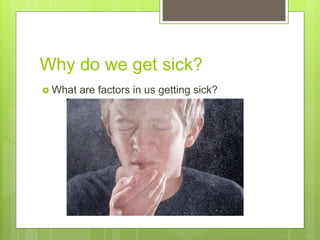
Why do we get sick?
๏‚› What are factors in us getting sick?
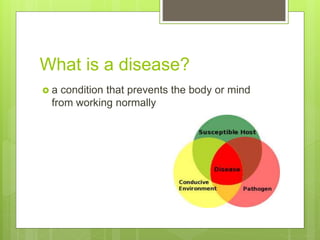
What is a disease?
๏‚› a condition that prevents the body or mind
from working normally
How many are there?
๏‚› Not sure of exact number possible but A
LOT!!!
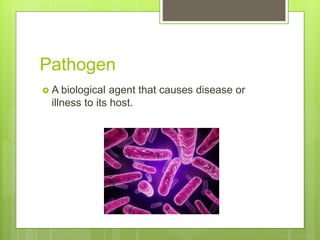
Pathogen
๏‚› A biological agent that causes disease or
illness to its host.
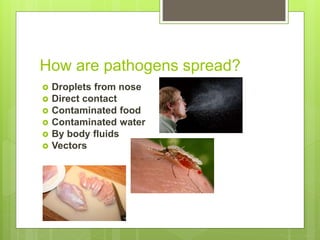
How are pathogens spread?
๏‚› Droplets from nose
๏‚› Direct contact
๏‚› Contaminated food
๏‚› Contaminated water
๏‚› By body fluids
๏‚› Vectors
Communicable Disease
๏‚› a disease that can be communicated from
one person to another
๏‚› Examples
๏‚› HIV/AIDS
๏‚› H1N1
๏‚› STD
๏‚› Measles
๏‚› Flu
๏‚› Rabies
Poster Board Activity
๏‚› What is it your disease?
๏‚› How is it transmitted?
๏‚› How does someone know they have it
(symptoms)?
๏‚› How can it be prevented?
๏‚› Any treatments?
๏‚› 1 interesting fact or statistic
๏‚› * Each person must present at least 1 thing!*
What effect do they have?
๏‚› Economic effect = billions of dollars a year in
treatment, sick leave, etc.
๏‚› Social effect = some are untreatable/incurable
๏ƒ  you have them for LIFE
๏‚› Physical effect = varies depending on the
disease
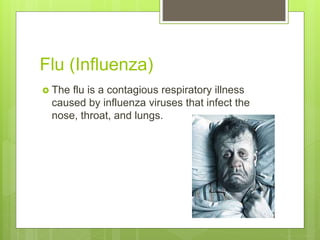
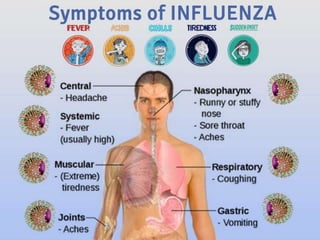
Flu (Influenza)
๏‚› The flu is a contagious respiratory illness
caused by influenza viruses that infect the
nose, throat, and lungs.
How the Flu Spreads
๏‚› Most experts believe that flu viruses spread
mainly by droplets made when people with
flu cough, sneeze or talk. These droplets can
land in the mouths or noses of people who
are nearby. Less often, a person might also
get flu by touching a surface or object that
has flu virus on it and then touching their
own mouth, eyes or possibly their nose.
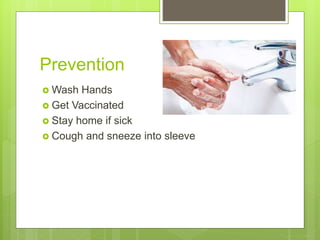
Prevention
๏‚› Wash Hands
๏‚› Get Vaccinated
๏‚› Stay home if sick
๏‚› Cough and sneeze into sleeve
HIV and AIDS (in the US)
๏‚› Number of new AIDS cases: 33,015 (2010)
๏‚› Number of deaths: 8,369
๏‚› How is it transmitted?
๏‚› Contact with: blood, semen, vaginal fluid, breast
milk, sharing needles.
Prevention
๏‚› One sexual Partner โ€“ EVER!
๏‚› No sharing needles
๏‚› GET TESTED!!!!
Tuberculosis
๏‚› Tuberculosis (TB) is caused by a bacterium
called Mycobacterium tuberculosis. The
bacteria usually attack the lungs, but TB
bacteria can attack any part of the body such
as the kidney, spine, and brain. If not treated
properly, TB disease can be fatal.
How is it spread?
๏‚› TB is spread through the air from one person
to another. The TB bacteria are put into the air
when a person with TB disease of the lungs or
throat coughs, sneezes, speaks, or sings.
People nearby may breathe in these bacteria
and become infected.
TB is NOT spread by
๏‚› shaking someoneโ€™s hand
๏‚› sharing food or drink
๏‚› touching bed linens or toilet seats
๏‚› sharing toothbrushes
๏‚› kissing
Symptoms
๏‚› a bad cough that lasts 3 weeks or longer
๏‚› pain in the chest
๏‚› coughing up blood or sputum
๏‚› weakness or fatigue
๏‚› weight loss
๏‚› no appetite
๏‚› chills
๏‚› fever
๏‚› sweating at night
Who is at risk?
๏‚› Has HIV infection;
๏‚› Has been recently infected with TB bacteria
(in the last 2 years);
๏‚› Has other health problems, like diabetes, that
make it hard for the body to fight bacteria;
๏‚› Abuses alcohol or uses illegal drugs
๏‚› Was not treated correctly for TB infection in
the past
Measles
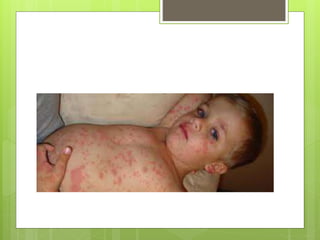
๏‚› A childhood infection caused by a virus
๏‚› Once quite common, measles can now almost always
be prevented with a vaccine.
๏‚› Signs and symptoms of measles include cough, runny
nose, inflamed eyes, sore throat, fever and a red,
blotchy skin rash.
๏‚› While death rates have been falling worldwide as
more children receive the measles vaccine, the
disease still kills more than 100,000 people a year,
most under the age of 5.
Hepatitis
๏‚› Hepatitis A. This type wonโ€™t lead to long-term infection and
usually doesnโ€™t cause any complications. Your liver heals in
about 2 months. You can prevent it with a vaccine
๏‚› Hepatitis B. Most people recover from this type in 6 months.
Sometimes though, it causes a long-term infection that could
lead to liver damage. Once youโ€™ve got the disease, you can
spread the virus even if you donโ€™t feel sick. You wont catch it if
you get a vaccine.
๏‚› Hepatitis C. Many people with this type don't have any
symptoms. About 80% of those with the disease get a long-
term infection. It can sometimes lead to cirrhosis, a scarring of
the liver. There's no vaccine to prevent it.
Hepatitis
๏‚› People may become ill decades after initial infection,
viral hepatitis is sometimes referred to as a โ€˜silent
epidemic.โ€™
๏‚› Responsible for more than one million deaths
annually, mostly in low- and middle- income
countries.
๏‚› Hepatitis B virus alone infects an estimated one in
three people worldwide.
๏‚› Hepatitis B and C cause roughly 80% of liver
cancers, and are an important cause of cirrhosis
(scarring) of the liver.
๏‚› Prevention: Hep B = Vaccine, Hep C = Screening
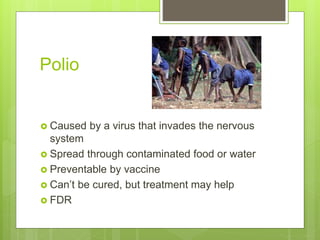
Polio
๏‚› Caused by a virus that invades the nervous
system
๏‚› Spread through contaminated food or water
๏‚› Preventable by vaccine
๏‚› Canโ€™t be cured, but treatment may help
๏‚› FDR
What can I do?
1. Handle & Prepare Food Safely
2. Wash Hands Often
3. Clean & Disinfect Commonly Used Surfaces
4. Cough & Sneeze Into Your Sleeve
5. Don't Share Personal Items
6. Get Vaccinated
7. Avoid Touching Wild Animals
8. Stay Home When Sick

Diseases

  • 1.
  • 2.
    Starter 1. Where isthe first place you should usually start when reading a food label? 2. List two things you can do to avoid portion distortion 3. List two of the problems we talked about with fad diets 4. T/F: We should make sure that we are getting plenty of calorie dense foods in our diet
  • 3.
    Why do weget sick? ๏‚› What are factors in us getting sick?
  • 4.
    What is adisease? ๏‚› a condition that prevents the body or mind from working normally
  • 5.
    How many arethere? ๏‚› Not sure of exact number possible but A LOT!!!
  • 6.
    Pathogen ๏‚› A biologicalagent that causes disease or illness to its host.
  • 7.
    How are pathogensspread? ๏‚› Droplets from nose ๏‚› Direct contact ๏‚› Contaminated food ๏‚› Contaminated water ๏‚› By body fluids ๏‚› Vectors
  • 8.
    Communicable Disease ๏‚› adisease that can be communicated from one person to another ๏‚› Examples ๏‚› HIV/AIDS ๏‚› H1N1 ๏‚› STD ๏‚› Measles ๏‚› Flu ๏‚› Rabies
  • 9.
    Poster Board Activity ๏‚›What is it your disease? ๏‚› How is it transmitted? ๏‚› How does someone know they have it (symptoms)? ๏‚› How can it be prevented? ๏‚› Any treatments? ๏‚› 1 interesting fact or statistic ๏‚› * Each person must present at least 1 thing!*
  • 10.
    What effect dothey have? ๏‚› Economic effect = billions of dollars a year in treatment, sick leave, etc. ๏‚› Social effect = some are untreatable/incurable ๏ƒ  you have them for LIFE ๏‚› Physical effect = varies depending on the disease
  • 11.
    Flu (Influenza) ๏‚› Theflu is a contagious respiratory illness caused by influenza viruses that infect the nose, throat, and lungs.
  • 13.
    How the FluSpreads ๏‚› Most experts believe that flu viruses spread mainly by droplets made when people with flu cough, sneeze or talk. These droplets can land in the mouths or noses of people who are nearby. Less often, a person might also get flu by touching a surface or object that has flu virus on it and then touching their own mouth, eyes or possibly their nose.
  • 15.
    Prevention ๏‚› Wash Hands ๏‚›Get Vaccinated ๏‚› Stay home if sick ๏‚› Cough and sneeze into sleeve
  • 16.
    HIV and AIDS(in the US) ๏‚› Number of new AIDS cases: 33,015 (2010) ๏‚› Number of deaths: 8,369 ๏‚› How is it transmitted? ๏‚› Contact with: blood, semen, vaginal fluid, breast milk, sharing needles.
  • 17.
    Prevention ๏‚› One sexualPartner โ€“ EVER! ๏‚› No sharing needles ๏‚› GET TESTED!!!!
  • 18.
    Tuberculosis ๏‚› Tuberculosis (TB)is caused by a bacterium called Mycobacterium tuberculosis. The bacteria usually attack the lungs, but TB bacteria can attack any part of the body such as the kidney, spine, and brain. If not treated properly, TB disease can be fatal.
  • 19.
    How is itspread? ๏‚› TB is spread through the air from one person to another. The TB bacteria are put into the air when a person with TB disease of the lungs or throat coughs, sneezes, speaks, or sings. People nearby may breathe in these bacteria and become infected.
  • 20.
    TB is NOTspread by ๏‚› shaking someoneโ€™s hand ๏‚› sharing food or drink ๏‚› touching bed linens or toilet seats ๏‚› sharing toothbrushes ๏‚› kissing
  • 21.
    Symptoms ๏‚› a badcough that lasts 3 weeks or longer ๏‚› pain in the chest ๏‚› coughing up blood or sputum ๏‚› weakness or fatigue ๏‚› weight loss ๏‚› no appetite ๏‚› chills ๏‚› fever ๏‚› sweating at night
  • 22.
    Who is atrisk? ๏‚› Has HIV infection; ๏‚› Has been recently infected with TB bacteria (in the last 2 years); ๏‚› Has other health problems, like diabetes, that make it hard for the body to fight bacteria; ๏‚› Abuses alcohol or uses illegal drugs ๏‚› Was not treated correctly for TB infection in the past
  • 23.
    Measles ๏‚› A childhoodinfection caused by a virus ๏‚› Once quite common, measles can now almost always be prevented with a vaccine. ๏‚› Signs and symptoms of measles include cough, runny nose, inflamed eyes, sore throat, fever and a red, blotchy skin rash. ๏‚› While death rates have been falling worldwide as more children receive the measles vaccine, the disease still kills more than 100,000 people a year, most under the age of 5.
  • 25.
    Hepatitis ๏‚› Hepatitis A.This type wonโ€™t lead to long-term infection and usually doesnโ€™t cause any complications. Your liver heals in about 2 months. You can prevent it with a vaccine ๏‚› Hepatitis B. Most people recover from this type in 6 months. Sometimes though, it causes a long-term infection that could lead to liver damage. Once youโ€™ve got the disease, you can spread the virus even if you donโ€™t feel sick. You wont catch it if you get a vaccine. ๏‚› Hepatitis C. Many people with this type don't have any symptoms. About 80% of those with the disease get a long- term infection. It can sometimes lead to cirrhosis, a scarring of the liver. There's no vaccine to prevent it.
  • 26.
    Hepatitis ๏‚› People maybecome ill decades after initial infection, viral hepatitis is sometimes referred to as a โ€˜silent epidemic.โ€™ ๏‚› Responsible for more than one million deaths annually, mostly in low- and middle- income countries. ๏‚› Hepatitis B virus alone infects an estimated one in three people worldwide. ๏‚› Hepatitis B and C cause roughly 80% of liver cancers, and are an important cause of cirrhosis (scarring) of the liver. ๏‚› Prevention: Hep B = Vaccine, Hep C = Screening
  • 27.
    Polio ๏‚› Caused bya virus that invades the nervous system ๏‚› Spread through contaminated food or water ๏‚› Preventable by vaccine ๏‚› Canโ€™t be cured, but treatment may help ๏‚› FDR
  • 28.
    What can Ido? 1. Handle & Prepare Food Safely 2. Wash Hands Often 3. Clean & Disinfect Commonly Used Surfaces 4. Cough & Sneeze Into Your Sleeve 5. Don't Share Personal Items
  • 29.
    6. Get Vaccinated 7.Avoid Touching Wild Animals 8. Stay Home When Sick