Unit 8 Diseases and Disorders Infectious diseases, STD’s, HIV and AIDS, Noninfectious Diseases and Disabilities
Ever had the common cold? Did you know that……… The common cold is an infectious disease  An  infectious disease  is a disease caused by organisms that enter and multiply in  YOUR  body.
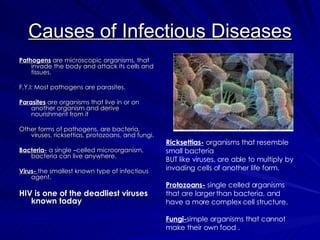
Causes of Infectious Diseases Pathogens  are microscopic organisms, that invade the body and attack its cells and tissues. F.Y.I: Most pathogens are parasites. Parasites  are organisms that live in or on another organism and derive nourishment from it Other forms of pathogens, are bacteria, viruses, ricksettias, protozoans, and fungi. Bacteria-  a single –celled microorganism, bacteria can live anywhere. Virus-   the smallest known type of infectious agent. HIV is one of the deadliest viruses known today Ricksettias-  organisms that resemble small bacteria  BUT like viruses, are able to multiply by invading cells of another life form. Protozoans-  single celled organisms that are larger than bacteria, and have a more complex cell structure. Fungi- simple organisms that cannot make their own food .
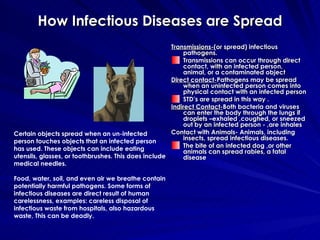
How Infectious Diseases are Spread Transmissions- (or spread) infectious pathogens. Transmissions can occur through direct contact, with an infected person, animal, or a contaminated object Direct contact- Pathogens may be spread when an uninfected person comes into physical contact with an infected person STD’s are spread in this way . Indirect Contact- Both bacteria and viruses can enter the body through the lungs if droplets –exhaled ,coughed, or sneezed out by an infected person - ,are inhales Contact with Animals- Animals, including insects, spread infectious diseases. The bite of an infected dog ,or other animals can spread rabies, a fatal disease Certain objects spread when an un-infected person touches objects that an infected person has used. These objects can include eating utensils, glasses, or toothbrushes. This does include medical needles. Food, water, soil, and even air we breathe contain potentially harmful pathogens. Some forms of infectious diseases are direct result of human carelessness, examples: careless disposal of infectious waste from hospitals, also hazardous waste, This can be deadly.
How your body defends against infectious diseases Immunity-  is the body’s natural defenses against infection. Physical Barriers-   Your body’s first line of defense against invading pathogens consists of physical barriers, the main being your skin. Mucous membranes-   The soft, skinlike lining of many parts of the body- in your mouth, nose, and bronchial tubes produce a sticky substance called  mucus  that trap pathogens. Phagocytosis -  The process by which phagocytes engulf and destroy pathogens. Neutrophils-  the chief type of phagocyte involved in the process of phagocytosis. Antibodies -  Proteins that destroy or neutralize invading pathogens.
More Diseases Mononucleosis   is a viral infection common among young people.  -  Symptoms include: Chills, fever, sore throat, fatigue and swollen lymph nodes Hepatitis   is an inflammation of the liver. Toxic hepatitis maybe caused my certain drugs, chemicals, or poisons.  - Hepatitis A  is a result of eating food or drinking water that has been contaminated with the virus from an infected persons feces. - Hepatitis B  is found in all bodily fluids of an infected person, especially blood. It is spread mainly by contaminated blood transfusions, and blood products. -Hepatitis C  like hepatitis B is spread through infected blood Hepatitis C can cause liver cancer.
Preventing Infectious Diseases Active immunity- this immunity, your body develops to protect you from diseases Passive Immunity-  temporary immunity that an infant acquires from their mother.  Vaccinations   are   active immunizations involve the introduction into the body of the vaccine. Vaccines provide immunity by causing the body to produce the anti-bodies against the pathogens.
Common infectious diseases   Pneumonia - A serious inflammation of the lungs. Many people die each year from pneumonia. Secondary infections need  antibiotic Tuberculosis (TB)-  a highly contagious bacterial infection that most often effects the lungs. Strep throat-  a bacterial infection of the throat. Immunization- a program whereby communities or other large population are systematically immune to a disease. Rubella- also known as German measles. A viral disease with similar symptoms causing only a minor infection in children
Sexually transmitted diseases a.k.a STD’s are spread from person to person, primarily by means of sexual contact.  Although the rate of transmission of STD’s  has been declining, the problem remain an epidemic in this country. The only sure way to avoid contracting or spreading and STD is by abstaining from sexual activity and other high-risk behaviors. -------------------------------------------------------------------------------------------------------- Sexually Transmitted Diseases-  infectious disease spread from person to person through sexual contact.  Epidemic-  an outbreak of an infectious disease that affects a large population. Preventing STD’s
Sex is not always good Having more than one sexual partner rather than committing to a single long term relationship. Engaging in unprotected sex . Selecting partners at higher risk,  such as those with a history of multiple sex partners or intravenous  drug use. An additional risk for teen females is that they lack an immunity to some of the pathogens that cause STD’s. Some STD’s can cause sterility, the inability to reproduce, and Some STD’s can even be incurable. The primary means of transmission of STD’s is sexual activity.
Common STD’s and their Treatments Chlamydia-  is an infection caused by bacterium that affects the vagina in females and the urethra in males. Nongonococcal urethritis-  an infection caused by several different kinds of bacteria-like organisms that infect the urethra in males and the cervix in females. In males the symptoms include pain and burning during urination and unusual discharge from the penis. In females the symptoms include pain in the pelvic region and the same unusual discharge except from the vagina Gonorrhea-  caused by bacteria that affect the general mucus membrane, primarily in the lining of the urethra of the male and in the cervix and vagina  of the female.
Continued…. Trichomoniasis-   a vaginal infection that can lead to the urethra and bladder infection. Vaginitis-  a common inflammation of the female genitals. Genital Warts-  pink or reddish warts with cauliflower-like tops that appear on the genitals  Genital Herpes- blister-like sores in the genital area  Syphilis-  an STD that attacks many parts of the body and is caused by a small bacterium call a spirochete Having an STD is not like having a cold. It will not simoly go away if a person waits long enough. The individual must take action to have the disease treated.
HIV and AIDS AIDS is a disorder that interferes with the body’s ability to fight of infections Viruses are the simplest form of life. HIV  plays a central role in the AIDS epidemic. The human immune-deficiency virus (HIV) is transmitted mainly through semen, sections from the females vagina, blood, breast milk, and sharing needles, and transfusions HIV must enter a persons blood stream in order to infect the person. HIV has been found in body fluids such as blood semen and vaginal secretions of infected persons
HIV Infections Acquired Immune Deficiency Syndrome a.k.a AIDS  -  and HIV infection combined with severe immune deficiency. It is also the final stage of HIV. Human Immunodeficiency Virus a.k.a HIV-  a virus that attacks the body’s immune system. Intravenous (IV) drugs-  drugs that are infected in to the veins
Health Concepts  A number of tests are used to detect the presence of HIV anti-bodies IDs interferes with the normal functioning of the immune system, making patients prey to a host of AIDS- opportunistic illnesses that seldom appear in people with healthy immune systems. AIDS education can help stem the AIDS pandemic  Choosing abstinence from high-risk behaviors is 100% effective way to limit the spread of HIV infections  HIV-reactive-  “positive” that is infected with HIV ELISA-  a test that screens for the presence of HIV anti-bodies in the blood
Continued….. Confirmatory test-  a highly accurate test used to confirm the results of a reactive ELISA Asymptomatic stage –  a period of months or years which the virus is present in the blood but there are no symptoms or signs of disease AIDS opportunistic illnesses-  infections and other diseases caused by organisms that do not usually produce illness in healthy people with un impaired immune systems
Lifestyle Diseases Many cardiovascular diseases relate to a persons habits and lifestyles Adopting positive habits now, while you are young can help set you on the road to good health for life. Cardiovascular diseases (CVD’s)-  medical disorders that affect the heart and blood vessels  Hypertension-  high blood pressure   Arteriolosclerosis-  hardening of the arteries   Angina pectoris-  pain and tightness in the chest caused by the lack of oxygen to the heart Fibrillation- the rapid ineffective beating of the heart one of two chamber called ventricles  Congestive heart failure-  slow gradual weakening of the heart mussel from over-work Stroke-  an interruption of the flow of blood to any part of the brain.
Cancer Risk factors for cancer include hereditary, environment and life style There are seven warning signs of cancer  The earlier cancer is diagnosed the greater the range of treatment options that are available  _______________________________________________________________ Cancers-   uncontrolled abnormal cells growths Tumors- masses of tissue, but not all tumors are cancers  Benign (non-cancers)-  characterized by abnormal cells, but they’re growth is less aggressive than that of cancerous ones Malignant-  cancerous  Metastasis- spread of cancer from the point where it originated to the other parts of the body Carcinogen -  a cancerous substance in the environment Melanoma- often deadly skin type cancer
EXAMPLES Lung cancer Oral cancer Cancer of the colon and rectum Reproductive cancer Lukemia  Chemotherapy-  the use of anti-cancer medication in the treatment of cancer Biopsy-  a laboratory analysis of a section of tissue taken from a site where abnormal cell growth is suspected.
Other non-infectious diseases Knowing the differences between type 1 and type 2 diabetes is essential to treatment of the diseases Arthritis can affect people of any age  Treatment programs to ease the discomfort  of Arthritis are available _______________________________________________________________ Diabetes- a chronic disease that affects the way body cells convert food into energy  Insulin-  a hormone that is produced in the pancreas and then helps the body convert glucose to energy. Impaired glucose tolerance- (IGT)-  A condition in which blood sugar levels are higher than normal but not high enough to be classified as diabetes .  Arthritis-  at least 100 different conditions that cause aching, pain, a swelling in joints and connective tissue throughout the body. Rheumatoid arthritis-  a destructive and disabling inflammation of the joints  Osteoarthritis- a disease that effects primarily the weight bearing joints of the knee and hips causing aches and soreness especially when moving.
Physical and Mental challenges Depending on its nature and severity, a disability can interfere with an individuals performance of tasks that non-disabled people may take for granted Understanding the realities of physical and mental challenges is important for all people. _______________________________________________________________ Disability-  any physical or mental impairment that limits normal activities, including, seeing, hearing, walking or speaking Profound Deafness-  a hearing loss so severe that a person affected cannot benefit from mechanical amplification such as a hearing aid. Mental retardation-  below average intellectual ability present from birth or early childhood and associated with difficulties in learning and social adaptation Americans with Disabilities Act-  this is a law prohibiting discrimination people with physical or mental disabilities in the work place, transportation, public accommodation, and telecommunications

Unit 8 Health Book

  • 1.
    Unit 8 Diseasesand Disorders Infectious diseases, STD’s, HIV and AIDS, Noninfectious Diseases and Disabilities
  • 2.
    Ever had thecommon cold? Did you know that……… The common cold is an infectious disease An infectious disease is a disease caused by organisms that enter and multiply in YOUR body.
  • 3.
    Causes of InfectiousDiseases Pathogens are microscopic organisms, that invade the body and attack its cells and tissues. F.Y.I: Most pathogens are parasites. Parasites are organisms that live in or on another organism and derive nourishment from it Other forms of pathogens, are bacteria, viruses, ricksettias, protozoans, and fungi. Bacteria- a single –celled microorganism, bacteria can live anywhere. Virus- the smallest known type of infectious agent. HIV is one of the deadliest viruses known today Ricksettias- organisms that resemble small bacteria BUT like viruses, are able to multiply by invading cells of another life form. Protozoans- single celled organisms that are larger than bacteria, and have a more complex cell structure. Fungi- simple organisms that cannot make their own food .
  • 4.
    How Infectious Diseasesare Spread Transmissions- (or spread) infectious pathogens. Transmissions can occur through direct contact, with an infected person, animal, or a contaminated object Direct contact- Pathogens may be spread when an uninfected person comes into physical contact with an infected person STD’s are spread in this way . Indirect Contact- Both bacteria and viruses can enter the body through the lungs if droplets –exhaled ,coughed, or sneezed out by an infected person - ,are inhales Contact with Animals- Animals, including insects, spread infectious diseases. The bite of an infected dog ,or other animals can spread rabies, a fatal disease Certain objects spread when an un-infected person touches objects that an infected person has used. These objects can include eating utensils, glasses, or toothbrushes. This does include medical needles. Food, water, soil, and even air we breathe contain potentially harmful pathogens. Some forms of infectious diseases are direct result of human carelessness, examples: careless disposal of infectious waste from hospitals, also hazardous waste, This can be deadly.
  • 5.
    How your bodydefends against infectious diseases Immunity- is the body’s natural defenses against infection. Physical Barriers- Your body’s first line of defense against invading pathogens consists of physical barriers, the main being your skin. Mucous membranes- The soft, skinlike lining of many parts of the body- in your mouth, nose, and bronchial tubes produce a sticky substance called mucus that trap pathogens. Phagocytosis - The process by which phagocytes engulf and destroy pathogens. Neutrophils- the chief type of phagocyte involved in the process of phagocytosis. Antibodies - Proteins that destroy or neutralize invading pathogens.
  • 6.
    More Diseases Mononucleosis is a viral infection common among young people. - Symptoms include: Chills, fever, sore throat, fatigue and swollen lymph nodes Hepatitis is an inflammation of the liver. Toxic hepatitis maybe caused my certain drugs, chemicals, or poisons. - Hepatitis A is a result of eating food or drinking water that has been contaminated with the virus from an infected persons feces. - Hepatitis B is found in all bodily fluids of an infected person, especially blood. It is spread mainly by contaminated blood transfusions, and blood products. -Hepatitis C like hepatitis B is spread through infected blood Hepatitis C can cause liver cancer.
  • 7.
    Preventing Infectious DiseasesActive immunity- this immunity, your body develops to protect you from diseases Passive Immunity- temporary immunity that an infant acquires from their mother. Vaccinations are active immunizations involve the introduction into the body of the vaccine. Vaccines provide immunity by causing the body to produce the anti-bodies against the pathogens.
  • 8.
    Common infectious diseases Pneumonia - A serious inflammation of the lungs. Many people die each year from pneumonia. Secondary infections need antibiotic Tuberculosis (TB)- a highly contagious bacterial infection that most often effects the lungs. Strep throat- a bacterial infection of the throat. Immunization- a program whereby communities or other large population are systematically immune to a disease. Rubella- also known as German measles. A viral disease with similar symptoms causing only a minor infection in children
  • 9.
    Sexually transmitted diseasesa.k.a STD’s are spread from person to person, primarily by means of sexual contact. Although the rate of transmission of STD’s has been declining, the problem remain an epidemic in this country. The only sure way to avoid contracting or spreading and STD is by abstaining from sexual activity and other high-risk behaviors. -------------------------------------------------------------------------------------------------------- Sexually Transmitted Diseases- infectious disease spread from person to person through sexual contact. Epidemic- an outbreak of an infectious disease that affects a large population. Preventing STD’s
  • 10.
    Sex is notalways good Having more than one sexual partner rather than committing to a single long term relationship. Engaging in unprotected sex . Selecting partners at higher risk, such as those with a history of multiple sex partners or intravenous drug use. An additional risk for teen females is that they lack an immunity to some of the pathogens that cause STD’s. Some STD’s can cause sterility, the inability to reproduce, and Some STD’s can even be incurable. The primary means of transmission of STD’s is sexual activity.
  • 11.
    Common STD’s andtheir Treatments Chlamydia- is an infection caused by bacterium that affects the vagina in females and the urethra in males. Nongonococcal urethritis- an infection caused by several different kinds of bacteria-like organisms that infect the urethra in males and the cervix in females. In males the symptoms include pain and burning during urination and unusual discharge from the penis. In females the symptoms include pain in the pelvic region and the same unusual discharge except from the vagina Gonorrhea- caused by bacteria that affect the general mucus membrane, primarily in the lining of the urethra of the male and in the cervix and vagina of the female.
  • 12.
    Continued…. Trichomoniasis- a vaginal infection that can lead to the urethra and bladder infection. Vaginitis- a common inflammation of the female genitals. Genital Warts- pink or reddish warts with cauliflower-like tops that appear on the genitals Genital Herpes- blister-like sores in the genital area Syphilis- an STD that attacks many parts of the body and is caused by a small bacterium call a spirochete Having an STD is not like having a cold. It will not simoly go away if a person waits long enough. The individual must take action to have the disease treated.
  • 13.
    HIV and AIDSAIDS is a disorder that interferes with the body’s ability to fight of infections Viruses are the simplest form of life. HIV plays a central role in the AIDS epidemic. The human immune-deficiency virus (HIV) is transmitted mainly through semen, sections from the females vagina, blood, breast milk, and sharing needles, and transfusions HIV must enter a persons blood stream in order to infect the person. HIV has been found in body fluids such as blood semen and vaginal secretions of infected persons
  • 14.
    HIV Infections AcquiredImmune Deficiency Syndrome a.k.a AIDS - and HIV infection combined with severe immune deficiency. It is also the final stage of HIV. Human Immunodeficiency Virus a.k.a HIV- a virus that attacks the body’s immune system. Intravenous (IV) drugs- drugs that are infected in to the veins
  • 15.
    Health Concepts A number of tests are used to detect the presence of HIV anti-bodies IDs interferes with the normal functioning of the immune system, making patients prey to a host of AIDS- opportunistic illnesses that seldom appear in people with healthy immune systems. AIDS education can help stem the AIDS pandemic Choosing abstinence from high-risk behaviors is 100% effective way to limit the spread of HIV infections HIV-reactive- “positive” that is infected with HIV ELISA- a test that screens for the presence of HIV anti-bodies in the blood
  • 16.
    Continued….. Confirmatory test- a highly accurate test used to confirm the results of a reactive ELISA Asymptomatic stage – a period of months or years which the virus is present in the blood but there are no symptoms or signs of disease AIDS opportunistic illnesses- infections and other diseases caused by organisms that do not usually produce illness in healthy people with un impaired immune systems
  • 17.
    Lifestyle Diseases Manycardiovascular diseases relate to a persons habits and lifestyles Adopting positive habits now, while you are young can help set you on the road to good health for life. Cardiovascular diseases (CVD’s)- medical disorders that affect the heart and blood vessels Hypertension- high blood pressure Arteriolosclerosis- hardening of the arteries Angina pectoris- pain and tightness in the chest caused by the lack of oxygen to the heart Fibrillation- the rapid ineffective beating of the heart one of two chamber called ventricles Congestive heart failure- slow gradual weakening of the heart mussel from over-work Stroke- an interruption of the flow of blood to any part of the brain.
  • 18.
    Cancer Risk factorsfor cancer include hereditary, environment and life style There are seven warning signs of cancer The earlier cancer is diagnosed the greater the range of treatment options that are available _______________________________________________________________ Cancers- uncontrolled abnormal cells growths Tumors- masses of tissue, but not all tumors are cancers Benign (non-cancers)- characterized by abnormal cells, but they’re growth is less aggressive than that of cancerous ones Malignant- cancerous Metastasis- spread of cancer from the point where it originated to the other parts of the body Carcinogen - a cancerous substance in the environment Melanoma- often deadly skin type cancer
  • 19.
    EXAMPLES Lung cancerOral cancer Cancer of the colon and rectum Reproductive cancer Lukemia Chemotherapy- the use of anti-cancer medication in the treatment of cancer Biopsy- a laboratory analysis of a section of tissue taken from a site where abnormal cell growth is suspected.
  • 20.
    Other non-infectious diseasesKnowing the differences between type 1 and type 2 diabetes is essential to treatment of the diseases Arthritis can affect people of any age Treatment programs to ease the discomfort of Arthritis are available _______________________________________________________________ Diabetes- a chronic disease that affects the way body cells convert food into energy Insulin- a hormone that is produced in the pancreas and then helps the body convert glucose to energy. Impaired glucose tolerance- (IGT)- A condition in which blood sugar levels are higher than normal but not high enough to be classified as diabetes . Arthritis- at least 100 different conditions that cause aching, pain, a swelling in joints and connective tissue throughout the body. Rheumatoid arthritis- a destructive and disabling inflammation of the joints Osteoarthritis- a disease that effects primarily the weight bearing joints of the knee and hips causing aches and soreness especially when moving.
  • 21.
    Physical and Mentalchallenges Depending on its nature and severity, a disability can interfere with an individuals performance of tasks that non-disabled people may take for granted Understanding the realities of physical and mental challenges is important for all people. _______________________________________________________________ Disability- any physical or mental impairment that limits normal activities, including, seeing, hearing, walking or speaking Profound Deafness- a hearing loss so severe that a person affected cannot benefit from mechanical amplification such as a hearing aid. Mental retardation- below average intellectual ability present from birth or early childhood and associated with difficulties in learning and social adaptation Americans with Disabilities Act- this is a law prohibiting discrimination people with physical or mental disabilities in the work place, transportation, public accommodation, and telecommunications