Physical Health Unit
Starter
 What are 4 things you like about who
you are as a person/your personality?
(ex: funny, kind, thoughtful, etc.)
 What are 4 things you like about your
physical appearance?
 In your opinion, how does the media
affect the ways that we view and think
about our bodies?
Is it really a big deal?
 1 in 150 females suffers from Anorexia
Nervosa
 Recent studies on college campuses show
that almost 20% of college females have
Bulimia Nervosa
 In regards to gender, 1 in 10 cases of these
disorders involve males. This means that
hundreds of thousands of males are
affected, but fewer are diagnosed
Warning Signs of Eating
Disorders
 Calorie restriction, binge eating, or
secretive eating
 Extreme preoccupation with food
 Distorted body image (claiming to feel
fat when they are emaciated)
 Abuse of laxatives, diuretics, diet pills
etc.
 Excessive/Extreme amounts of exercise
Anorexia Nervosa
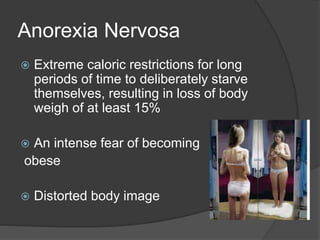
 Extreme caloric restrictions for long
periods of time to deliberately starve
themselves, resulting in loss of body
weigh of at least 15%
 An intense fear of becoming
obese
 Distorted body image
Bulimia Nervosa
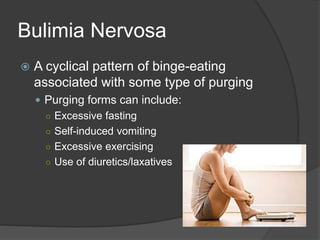
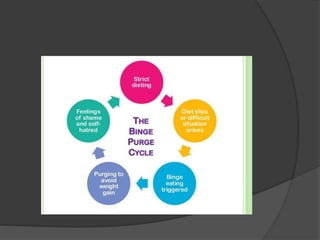
 A cyclical pattern of binge-eating
associated with some type of purging
 Purging forms can include:
○ Excessive fasting
○ Self-induced vomiting
○ Excessive exercising
○ Use of diuretics/laxatives
Negative Physical Effects
 Tooth decay, loss of enamel, and gum disease
 Weakening of the heart due to malnourishment
and arrhythmias
 Possible renal (kidney) impairment and
swelling in the cheeks and face
 Stomach ruptures
 Urinary infections
 Osteoporosis
 Menstrual irregularities
 Lowered resistance to infection
 Dizziness and muscular weakness
How do we really see
ourselves?
The “Media Effect”
Group Discussion
 Pictures/Commercials
 What are they trying to “sell” and how do
they sell it?
 What is the real message they’re giving?
 What does the media do to depict unrealistic
and unattainable goals?
Paradigm
 A framework containing the basic
assumptions, ways of thinking, and
methodology that are commonly
accepted by members of a community.
 Ex: We face the doors in an elevator
Challenging Paradigms
 Who are the real heroes?
Body Image…What is it?
 What you believe about your own
appearance (including your memories,
assumptions, and generalizations).
 How you feel about your body, including
your height, shape, and weight.
 How you sense and control your body as
you move. How you feel in your body, not
just about you
Negative Body Image
 A distorted perception of your shape--you
perceive parts of your body unlike they really
are.
 You are convinced that only other people are
attractive and that your body size or shape is a
sign of personal failure.
 You feel ashamed, self-conscious, and
anxious about your body.
 You feel uncomfortable and awkward in your
body.
Positive Body Image
 A clear, true perception of your shape--you see the
various parts of your body as they really are.
 You celebrate and appreciate your natural body
shape and you understand that a person’s physical
appearance says very little about their character and
value as a person.
 You feel proud and accepting of your unique body
and refuse to spend an unreasonable amount of time
worrying about food, weight, and calories.
 You feel comfortable and confident in your body.
Affirmations

Body image and eating disorders

  • 1.
  • 2.
    Starter  What are4 things you like about who you are as a person/your personality? (ex: funny, kind, thoughtful, etc.)  What are 4 things you like about your physical appearance?  In your opinion, how does the media affect the ways that we view and think about our bodies?
  • 3.
    Is it reallya big deal?  1 in 150 females suffers from Anorexia Nervosa  Recent studies on college campuses show that almost 20% of college females have Bulimia Nervosa  In regards to gender, 1 in 10 cases of these disorders involve males. This means that hundreds of thousands of males are affected, but fewer are diagnosed
  • 4.
    Warning Signs ofEating Disorders  Calorie restriction, binge eating, or secretive eating  Extreme preoccupation with food  Distorted body image (claiming to feel fat when they are emaciated)  Abuse of laxatives, diuretics, diet pills etc.  Excessive/Extreme amounts of exercise
  • 5.
    Anorexia Nervosa  Extremecaloric restrictions for long periods of time to deliberately starve themselves, resulting in loss of body weigh of at least 15%  An intense fear of becoming obese  Distorted body image
  • 6.
    Bulimia Nervosa  Acyclical pattern of binge-eating associated with some type of purging  Purging forms can include: ○ Excessive fasting ○ Self-induced vomiting ○ Excessive exercising ○ Use of diuretics/laxatives
  • 8.
    Negative Physical Effects Tooth decay, loss of enamel, and gum disease  Weakening of the heart due to malnourishment and arrhythmias  Possible renal (kidney) impairment and swelling in the cheeks and face  Stomach ruptures  Urinary infections  Osteoporosis  Menstrual irregularities  Lowered resistance to infection  Dizziness and muscular weakness
  • 9.
    How do wereally see ourselves?
  • 10.
  • 11.
    Group Discussion  Pictures/Commercials What are they trying to “sell” and how do they sell it?  What is the real message they’re giving?  What does the media do to depict unrealistic and unattainable goals?
  • 12.
    Paradigm  A frameworkcontaining the basic assumptions, ways of thinking, and methodology that are commonly accepted by members of a community.  Ex: We face the doors in an elevator
  • 13.
    Challenging Paradigms  Whoare the real heroes?
  • 14.
    Body Image…What isit?  What you believe about your own appearance (including your memories, assumptions, and generalizations).  How you feel about your body, including your height, shape, and weight.  How you sense and control your body as you move. How you feel in your body, not just about you
  • 15.
    Negative Body Image A distorted perception of your shape--you perceive parts of your body unlike they really are.  You are convinced that only other people are attractive and that your body size or shape is a sign of personal failure.  You feel ashamed, self-conscious, and anxious about your body.  You feel uncomfortable and awkward in your body.
  • 16.
    Positive Body Image A clear, true perception of your shape--you see the various parts of your body as they really are.  You celebrate and appreciate your natural body shape and you understand that a person’s physical appearance says very little about their character and value as a person.  You feel proud and accepting of your unique body and refuse to spend an unreasonable amount of time worrying about food, weight, and calories.  You feel comfortable and confident in your body.
  • 17.