Communicable
Diseases
Introduction
Diseases that can be transmitted or transferred from
one person to another , either directly or indirectly
These are caused by infectious agents that can be
transmitted to other people from an infected person,
animal or a source in the environment
These are of 2 types:
(I ) Contagious diseases: Infection is transmitted by
direct contact with infected persons or object.
(ii) Infectious diseases: Infection is transmitted
through some media like food, water or air etc.
General
characteristics
• A communicable disease is any disease that passes
between people or animals
• Incubation period: Every infectious disease has
incubation period . This period starts from the time the
germs enter the body and lasts with the appearance of
symptoms . During this time germs establish and
multiply in the body and do not show any ill effect .
Some diseases have only a few hours time and some
may have one month
• Definite symptoms: for instance – fever , headache ,
skin rashes , sore throat , shivering etc
• Definite duration – every disease has a definite
duration
• The attack of some diseases is rarely repeated
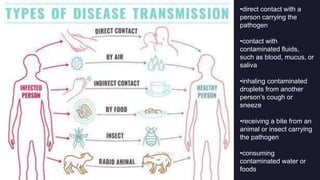
•direct contact with a
person carrying the
pathogen
•contact with
contaminated fluids,
such as blood, mucus, or
saliva
•inhaling contaminated
droplets from another
person’s cough or
sneeze
•receiving a bite from an
animal or insect carrying
the pathogen
•consuming
contaminated water or
foods
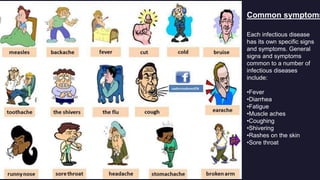
Common symptoms
Each infectious disease
has its own specific signs
and symptoms. General
signs and symptoms
common to a number of
infectious diseases
include:
•Fever
•Diarrhea
•Fatigue
•Muscle aches
•Coughing
•Shivering
•Rashes on the skin
•Sore throat
HEPATITIS (A,B and C)
o Inflammatory condition of the liver
o commonly caused by a viral infection, but there are other possible
causes of hepatitis, include autoimmune hepatitis ie. that occurs when
your body makes antibodies against your liver tissue. and hepatitis
that occurs as a secondary result of medications, drugs, toxins, and
alcohol
o Hepatitis C is the most common blood borne virus in the USA. It is
considered to be the most serious of the hepatitis viruses. Once
exposed, the majority of people (60-85%) go on to develop chronic
hepatitis C.
o Both hepatitis B and C infections can cause short- and long-term
effects. However, hepatitis C is more likely to turn into a chronic
condition than hepatitis B
o A person can transmit hepatitis B through bodily fluids, while the
transmission of hepatitis C usually only occurs through blood-to-blood
contact.
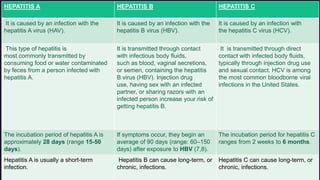
HEPATITIS A HEPATITIS B HEPATITIS C
It is caused by an infection with the
hepatitis A virus (HAV).
It is caused by an infection with the
hepatitis B virus (HBV).
It is caused by an infection with
the hepatitis C virus (HCV).
This type of hepatitis is
most commonly transmitted by
consuming food or water contaminated
by feces from a person infected with
hepatitis A.
It is transmitted through contact
with infectious body fluids,
such as blood, vaginal secretions,
or semen, containing the hepatitis
B virus (HBV). Injection drug
use, having sex with an infected
partner, or sharing razors with an
infected person increase your risk of
getting hepatitis B.
It is transmitted through direct
contact with infected body fluids,
typically through injection drug use
and sexual contact. HCV is among
the most common bloodborne viral
infections in the United States.
The incubation period of hepatitis A is
approximately 28 days (range 15-50
days).
If symptoms occur, they begin an
average of 90 days (range: 60–150
days) after exposure to HBV (7,8).
The incubation period for hepatitis C
ranges from 2 weeks to 6 months.
Hepatitis A is usually a short-term
infection.
Hepatitis B can cause long-term, or
chronic, infections.
Hepatitis C can cause long-term, or
chronic, infections.
Prevention of spread of hepatitis:
• Practicing good hygiene and avoid local water , ice ,
raw or undercooked shellfish and oysters and raw
fruits and vegetables when underdeveloped areas.
• not sharing drug needle , not sharing razors , not
using someone else’s toothbrush , not touching
spilled blood
• contracted through sexual intercourse and intimate
sexual contact. Practicing safe sex by using condoms
and dental dams can help decrease the risk of
infection. You can find many options available for
purchase online
• Vaccines : The use of vaccines is an important key to
preventing hepatitis. Vaccinations are available to
prevent the development of hepatitis A and B. Experts
are currently developing vaccines against hepatitis C.
A vaccination for hepatitis E exists in China, but it isn’t
available in the United States.
Symptoms include:
•fatigue
•flu-like symptoms
•dark urine
•pale stool
•abdominal pain
•loss of appetite
•unexplained weight loss
•yellow skin and eyes, which may be signs
of jaundice
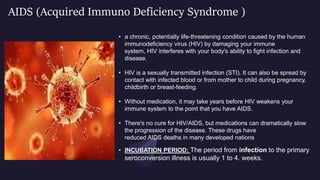
AIDS (Acquired Immuno Deficiency Syndrome )
• a chronic, potentially life-threatening condition caused by the human
immunodeficiency virus (HIV) by damaging your immune
system, HIV interferes with your body's ability to fight infection and
disease.
• HIV is a sexually transmitted infection (STI). It can also be spread by
contact with infected blood or from mother to child during pregnancy,
childbirth or breast-feeding.
• Without medication, it may take years before HIV weakens your
immune system to the point that you have AIDS.
• There's no cure for HIV/AIDS, but medications can dramatically slow
the progression of the disease. These drugs have
reduced AIDS deaths in many developed nations.
• INCUBATION PERIOD: The period from infection to the primary
seroconversion illness is usually 1 to 4. weeks.
oUse use treatment as prevention (TasP)
oUse post-exposure prophylaxis (PEP) if
you've been exposed to HIV
oUse a new condom every time you have
sex.
oConsider preexposure prophylaxis
(PrEP).
oTell your sexual partners if you
have HIV.
oUse a clean needle. If you're pregnant,
get medical care right away.
oConsider male circumcision.
•Headache
•Fever
•Muscle aches and joint pain
•Rash
•Sore throat and painful mouth sores
•Swollen lymph glands, mainly on the
neck
•Diarrhea
•Weight loss
•Cough
•Night sweats
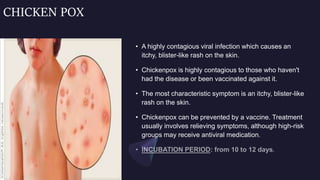
CHICKEN POX
• A highly contagious viral infection which causes an
itchy, blister-like rash on the skin.
• Chickenpox is highly contagious to those who haven't
had the disease or been vaccinated against it.
• The most characteristic symptom is an itchy, blister-like
rash on the skin.
• Chickenpox can be prevented by a vaccine. Treatment
usually involves relieving symptoms, although high-risk
groups may receive antiviral medication.
• The chickenpox (varicella) vaccine is the best way to prevent
chickenpox .The chickenpox vaccine (Varivax) is recommended
• young children receive two doses of the varicella vaccine — the
first between ages 12 and 15 months and the second between
ages 4 and 6 years — as part of the routine childhood vaccination
schedule.
• The vaccine can be combined with the measles, mumps and
rubella vaccine, but for some children between the ages of 12 and
23 months, the combination may increase the risk of fever and
seizure from the vaccine.
• Unvaccinated older children. : Children age 13 or older who
haven't been vaccinated should also receive two catch-up doses of
the vaccine, given at least four weeks apart.
• Unvaccinated adults who've never had chickenpox and are at
high risk of exposure.
• The chickenpox vaccine isn't approved for: Pregnant women ,
People who have weakened immune systems, such as those who
are infected with HIV, or people who are taking immune-
suppressing medications ,People who are allergic to gelatin or the
antibiotic neomycin
The itchy blister rash caused by chickenpox infection
appears 10 to 21 days after exposure to the virus and
usually lasts about five to 10 days. Other signs and
symptoms, which may appear one to two days before the
rash, include:
•Fever
•Loss of appetite
•Headache
•Tiredness and a general feeling of being unwell (malaise)
Once the chickenpox rash appears, it goes through three
phases:
•Raised pink or red bumps (papules), which break out over
several days
•Small fluid-filled blisters (vesicles), which form in about
one day and then break and leak
•Crusts and scabs, which cover the broken blisters and
take several more days to heal
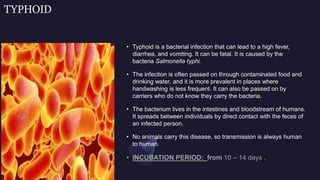
TYPHOID
• Typhoid is a bacterial infection that can lead to a high fever,
diarrhea, and vomiting. It can be fatal. It is caused by the
bacteria Salmonella typhi.
• The infection is often passed on through contaminated food and
drinking water, and it is more prevalent in places where
handwashing is less frequent. It can also be passed on by
carriers who do not know they carry the bacteria.
• The bacterium lives in the intestines and bloodstream of humans.
It spreads between individuals by direct contact with the feces of
an infected person.
• No animals carry this disease, so transmission is always human
to human.
• Before traveling to a high-risk area, getting
vaccinated against typhoid fever is recommended.
• This can be achieved by oral medication or a one-off
injection:
• Oral: a live, attenuated vaccine. Consists of 4 tablets,
one to be taken every second day, the last of which is
taken 1 week before travel .Shot, an inactivated
vaccine, administered 2 weeks before travel.
• Disinfect the toilet
• Prevent against fly breeding
• Boil milk and protect milk from contamination
• Proper supervision of sanitation
The two major symptoms of typhoid are fever and
rash. Typhoid fever is particularly high, gradually
increasing over several days up to 104 degrees
Fahrenheit, or 39 to 40 degrees Celsius.
The rash, which does not affect every patient,
consists of rose-colored spots, particularly on the
neck and abdomen.
Other symptoms can include:
•weakness
•abdominal pain
•constipation
•headaches
Thank you

Communicable diseases

  • 1.
  • 3.
    Introduction Diseases that canbe transmitted or transferred from one person to another , either directly or indirectly These are caused by infectious agents that can be transmitted to other people from an infected person, animal or a source in the environment These are of 2 types: (I ) Contagious diseases: Infection is transmitted by direct contact with infected persons or object. (ii) Infectious diseases: Infection is transmitted through some media like food, water or air etc.
  • 4.
    General characteristics • A communicabledisease is any disease that passes between people or animals • Incubation period: Every infectious disease has incubation period . This period starts from the time the germs enter the body and lasts with the appearance of symptoms . During this time germs establish and multiply in the body and do not show any ill effect . Some diseases have only a few hours time and some may have one month • Definite symptoms: for instance – fever , headache , skin rashes , sore throat , shivering etc • Definite duration – every disease has a definite duration • The attack of some diseases is rarely repeated
  • 5.
    •direct contact witha person carrying the pathogen •contact with contaminated fluids, such as blood, mucus, or saliva •inhaling contaminated droplets from another person’s cough or sneeze •receiving a bite from an animal or insect carrying the pathogen •consuming contaminated water or foods
  • 6.
    Common symptoms Each infectiousdisease has its own specific signs and symptoms. General signs and symptoms common to a number of infectious diseases include: •Fever •Diarrhea •Fatigue •Muscle aches •Coughing •Shivering •Rashes on the skin •Sore throat
  • 7.
    HEPATITIS (A,B andC) o Inflammatory condition of the liver o commonly caused by a viral infection, but there are other possible causes of hepatitis, include autoimmune hepatitis ie. that occurs when your body makes antibodies against your liver tissue. and hepatitis that occurs as a secondary result of medications, drugs, toxins, and alcohol o Hepatitis C is the most common blood borne virus in the USA. It is considered to be the most serious of the hepatitis viruses. Once exposed, the majority of people (60-85%) go on to develop chronic hepatitis C. o Both hepatitis B and C infections can cause short- and long-term effects. However, hepatitis C is more likely to turn into a chronic condition than hepatitis B o A person can transmit hepatitis B through bodily fluids, while the transmission of hepatitis C usually only occurs through blood-to-blood contact.
  • 8.
    HEPATITIS A HEPATITISB HEPATITIS C It is caused by an infection with the hepatitis A virus (HAV). It is caused by an infection with the hepatitis B virus (HBV). It is caused by an infection with the hepatitis C virus (HCV). This type of hepatitis is most commonly transmitted by consuming food or water contaminated by feces from a person infected with hepatitis A. It is transmitted through contact with infectious body fluids, such as blood, vaginal secretions, or semen, containing the hepatitis B virus (HBV). Injection drug use, having sex with an infected partner, or sharing razors with an infected person increase your risk of getting hepatitis B. It is transmitted through direct contact with infected body fluids, typically through injection drug use and sexual contact. HCV is among the most common bloodborne viral infections in the United States. The incubation period of hepatitis A is approximately 28 days (range 15-50 days). If symptoms occur, they begin an average of 90 days (range: 60–150 days) after exposure to HBV (7,8). The incubation period for hepatitis C ranges from 2 weeks to 6 months. Hepatitis A is usually a short-term infection. Hepatitis B can cause long-term, or chronic, infections. Hepatitis C can cause long-term, or chronic, infections.
  • 9.
    Prevention of spreadof hepatitis: • Practicing good hygiene and avoid local water , ice , raw or undercooked shellfish and oysters and raw fruits and vegetables when underdeveloped areas. • not sharing drug needle , not sharing razors , not using someone else’s toothbrush , not touching spilled blood • contracted through sexual intercourse and intimate sexual contact. Practicing safe sex by using condoms and dental dams can help decrease the risk of infection. You can find many options available for purchase online • Vaccines : The use of vaccines is an important key to preventing hepatitis. Vaccinations are available to prevent the development of hepatitis A and B. Experts are currently developing vaccines against hepatitis C. A vaccination for hepatitis E exists in China, but it isn’t available in the United States. Symptoms include: •fatigue •flu-like symptoms •dark urine •pale stool •abdominal pain •loss of appetite •unexplained weight loss •yellow skin and eyes, which may be signs of jaundice
  • 10.
    AIDS (Acquired ImmunoDeficiency Syndrome ) • a chronic, potentially life-threatening condition caused by the human immunodeficiency virus (HIV) by damaging your immune system, HIV interferes with your body's ability to fight infection and disease. • HIV is a sexually transmitted infection (STI). It can also be spread by contact with infected blood or from mother to child during pregnancy, childbirth or breast-feeding. • Without medication, it may take years before HIV weakens your immune system to the point that you have AIDS. • There's no cure for HIV/AIDS, but medications can dramatically slow the progression of the disease. These drugs have reduced AIDS deaths in many developed nations. • INCUBATION PERIOD: The period from infection to the primary seroconversion illness is usually 1 to 4. weeks.
  • 11.
    oUse use treatmentas prevention (TasP) oUse post-exposure prophylaxis (PEP) if you've been exposed to HIV oUse a new condom every time you have sex. oConsider preexposure prophylaxis (PrEP). oTell your sexual partners if you have HIV. oUse a clean needle. If you're pregnant, get medical care right away. oConsider male circumcision. •Headache •Fever •Muscle aches and joint pain •Rash •Sore throat and painful mouth sores •Swollen lymph glands, mainly on the neck •Diarrhea •Weight loss •Cough •Night sweats
  • 12.
    CHICKEN POX • Ahighly contagious viral infection which causes an itchy, blister-like rash on the skin. • Chickenpox is highly contagious to those who haven't had the disease or been vaccinated against it. • The most characteristic symptom is an itchy, blister-like rash on the skin. • Chickenpox can be prevented by a vaccine. Treatment usually involves relieving symptoms, although high-risk groups may receive antiviral medication.
  • 13.
    • The chickenpox(varicella) vaccine is the best way to prevent chickenpox .The chickenpox vaccine (Varivax) is recommended • young children receive two doses of the varicella vaccine — the first between ages 12 and 15 months and the second between ages 4 and 6 years — as part of the routine childhood vaccination schedule. • The vaccine can be combined with the measles, mumps and rubella vaccine, but for some children between the ages of 12 and 23 months, the combination may increase the risk of fever and seizure from the vaccine. • Unvaccinated older children. : Children age 13 or older who haven't been vaccinated should also receive two catch-up doses of the vaccine, given at least four weeks apart. • Unvaccinated adults who've never had chickenpox and are at high risk of exposure. • The chickenpox vaccine isn't approved for: Pregnant women , People who have weakened immune systems, such as those who are infected with HIV, or people who are taking immune- suppressing medications ,People who are allergic to gelatin or the antibiotic neomycin The itchy blister rash caused by chickenpox infection appears 10 to 21 days after exposure to the virus and usually lasts about five to 10 days. Other signs and symptoms, which may appear one to two days before the rash, include: •Fever •Loss of appetite •Headache •Tiredness and a general feeling of being unwell (malaise) Once the chickenpox rash appears, it goes through three phases: •Raised pink or red bumps (papules), which break out over several days •Small fluid-filled blisters (vesicles), which form in about one day and then break and leak •Crusts and scabs, which cover the broken blisters and take several more days to heal
  • 14.
    TYPHOID • Typhoid isa bacterial infection that can lead to a high fever, diarrhea, and vomiting. It can be fatal. It is caused by the bacteria Salmonella typhi. • The infection is often passed on through contaminated food and drinking water, and it is more prevalent in places where handwashing is less frequent. It can also be passed on by carriers who do not know they carry the bacteria. • The bacterium lives in the intestines and bloodstream of humans. It spreads between individuals by direct contact with the feces of an infected person. • No animals carry this disease, so transmission is always human to human.
  • 15.
    • Before travelingto a high-risk area, getting vaccinated against typhoid fever is recommended. • This can be achieved by oral medication or a one-off injection: • Oral: a live, attenuated vaccine. Consists of 4 tablets, one to be taken every second day, the last of which is taken 1 week before travel .Shot, an inactivated vaccine, administered 2 weeks before travel. • Disinfect the toilet • Prevent against fly breeding • Boil milk and protect milk from contamination • Proper supervision of sanitation The two major symptoms of typhoid are fever and rash. Typhoid fever is particularly high, gradually increasing over several days up to 104 degrees Fahrenheit, or 39 to 40 degrees Celsius. The rash, which does not affect every patient, consists of rose-colored spots, particularly on the neck and abdomen. Other symptoms can include: •weakness •abdominal pain •constipation •headaches
  • 16.