Us:- Waled Amen Moh Head department, Community Health Nursing UMST Communicable Diseases
Introduction Communicable Diseases are the major causes of morbidity and mortality. Main causes of morbidity and mortality in emergencies are diarrheal diseases, acute respiratory infections, measles and in areas where it is endemic malaria.
Introduction Other communicable diseases that have also in the past caused epidemics amongst population affected by emergencies are meningococcal disease, tuberculosis and typhus. Malnutrition and trauma are additional causes of illness and death amongst populations affected by communicable diseases.
Definitions Communicable Disease  is one that can transmitted from one person to another and is caused by an infectious agent that is transmitted from a source or reservoir to a susceptible host. Infectious diseases  is one that caused by infectious agent.
Outbreak o occurrence of new cases of a disease clearly in excess of the baseline frequency of the disease in a defined community over a given time period o point source outbreak: an outbreak due to exposure of a group of people to a noxious influence that is common to the individuals in the group •  the exposure is brief and essentially simultaneous, resultant cases all develop within 1 incubation period of the disease o propagated outbreak: an outbreak where there are multiple exposures over a period of time, from host to host (directly or indirectly), resulting in cases that are not within 1 incubation period
Epidemic occurrence, in a community or region, of a group of illnesses of a similar nature in excess of normal expectancy Endemic habitual presence of a disease or agent within a geographic area based on the usual prevalence of a given disease within such an area Pandemic an epidemic which is worldwide in distribution Host person/animal that affords subsistence to an infectious agent under natural conditions Carrier person/animal that harbors a specific infectious agent in the absence of discernible clinical disease and serves as a potential source of infection
Fomite o contaminated substance (not necessarily a reservoir) serving as an intermediate means of transport for an infectious agent Reservoir o anything (living or inert) in which an infectious agent lives and multiplies in such a manner that it can be transmitted to a susceptible host Vector o invertebrate animal capable of transmitting an infectious agent to vertebrates Virulence o ability of an infectious agent to cause severe or fatal infections
IMMUNITY o active •  altered organism or its product induces a host to produce antibodies (e.g. natural measles infection or live vaccine) o passive •  protective antibodies produced by another host which are introduced into susceptible persons (e.g. natural transplacental IgG from mother to infant) o inherent •  endogenous production of antibody o herd •  expression used to describe immunity of a group or community •  resistance of a group to an infectious agent based on the immunity of many individuals in the group •  implies transmission interruption when < 100% of group is immune due to separation of few susceptibles
Transmission of Infectious Agents   Transmission refers to any mechanism by which an infectious agent is spread from a source or reservoir to a person. Reservoir. Mode of infection. Susceptible host.
Six Factors furthering process Agent Reservoir Portal of exit Mode of transmission Portal of entry Susceptible host
Man 1=Case :-case can be prevented and controlled by 1-Identification:- --presentation:- This involves signs and symptoms of this disease. --Lab finding :- Diagnostic test, or physical examination --complications That may arise due to this disease.  Reservoir
Case 2-Treatment 3-Isolation:-  this needs to determine communicability period 4 -Health education:- About  -S&S of complication -treatment Man
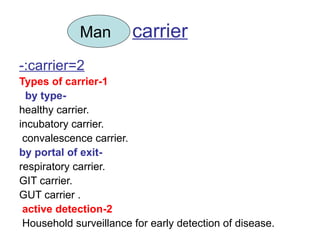
carrier 2=carrier:- 1-Types of carrier -by type  .healthy carrier .incubatory carrier .convalescence carrier  -by portal of exit .respiratory carrier .GIT carrier . GUT carrier 2-active detection   .Household surveillance for early detection of disease  Man
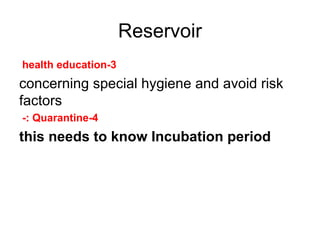
Reservoir 3-health education  concerning special hygiene and avoid risk factors 4-Quarantine :-  this needs to know Incubation period
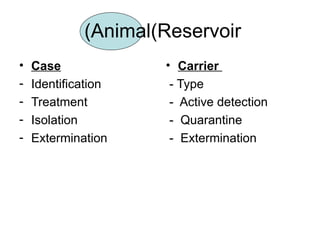
Animal(Reservoir)  Case Identification Treatment Isolation Extermination Carrier  - Type  -  Active detection -  Quarantine -  Extermination
Soil  (Reservoir)  Disinfection
Mode of transmission   - Direct :-- Direct contact  Vertical transmission  Droplet infection Animal bite transmission Contact with soil
Indirect Air-borne  Vehicle borne Vector-borne transmission Fomite –borne  Hand –borne
Susceptible host   Man   1- the at risk individual Systemic diseases Surgical patients Immunocompromised individuals Genetic based Organ transplant Chemotherapy Radiotherapy HIV infection
2-health education :- about vaccination and preventive measures 3-immunization :- if available.  4-prophylaxis :- 5-special protective measures :- 6-legislation :-
Susceptible host Animals 1- the at risk 2-prophylaxis  3-special protective measures
Emerging Infectious Diseases Emerging infectious diseases are diseases that have appeared for the first time or that have occurred before appeared in populations where they have not previously been reported.
Reemerging Infectious Diseases Reemerging infectious diseases are familiar diseases caused by well-understood organisms that were once under control or declining but now are resistant to common drugs or gaining new footholds in the population and increasing in incidence.
Fundamental principles of Control of Communicable Diseases   Rapid Assessment Prevention Surveillance Outbreak Control Disease Management
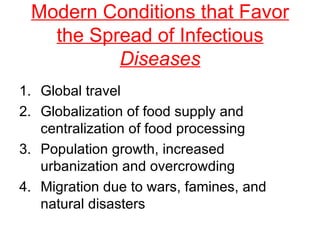
Modern Conditions that Favor the Spread of Infectious  Diseases Global travel Globalization of food supply and centralization of food processing Population growth, increased urbanization and overcrowding Migration due to wars, famines, and natural disasters
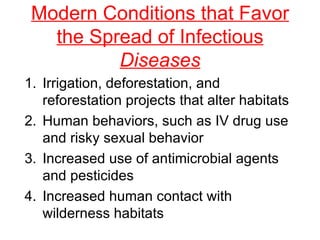
Modern Conditions that Favor the Spread of Infectious  Diseases Irrigation, deforestation, and reforestation projects that alter habitats Human behaviors, such as IV drug use and risky sexual behavior Increased use of antimicrobial agents and pesticides Increased human contact with wilderness habitats
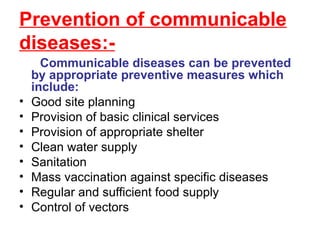
Prevention of communicable diseases:- Communicable diseases can be prevented by appropriate preventive measures which include: Good site planning Provision of basic clinical services Provision of appropriate shelter Clean water supply Sanitation Mass vaccination against specific diseases Regular and sufficient food supply Control of vectors
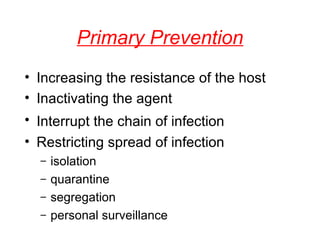
Primary Prevention Increasing the resistance of the host Inactivating the agent Interrupt the chain of infection   Restricting spread of infection  isolation  quarantine  segregation  personal surveillance
Secondary Prevention Activities targeted at detecting disease at earliest possible time to: begin treatment  stop progression  protect others in the community Examples of activities: case finding,  health screening, health education
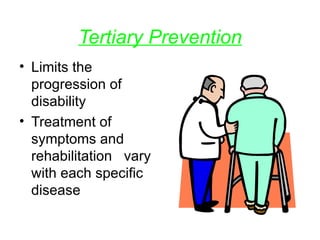
Tertiary Prevention Limits the progression of disability Treatment of symptoms and rehabilitation  vary with each specific disease
Surveillance Surveillance is the ongoing systematic collection,analysis and interpretation of data in order to plan, implement and evaluate public health intervention. Surveillance system should be simple,  flexible, acceptable.
Outbreak Control An outbreak is occurrence of a number of cases of a disease that is unusually large or unexpected for a given place and time . Outbreaks and epidemics refer to the one and same thing. Outbreaks in emergency situations can spread rapidly giving rise to high morbidity and mortality rates. Aim should be to detect and control the outbreak as early as possible.
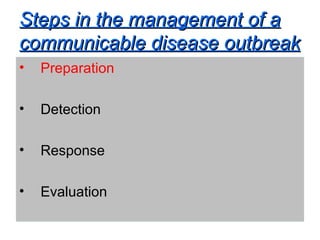
Steps in the management of a communicable disease outbreak Preparation Detection Response Evaluation
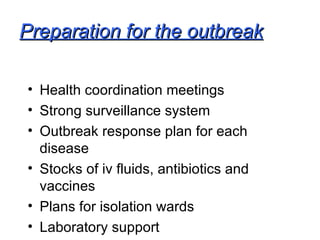
Preparation for the outbreak Health coordination meetings Strong surveillance system Outbreak response plan for each disease Stocks of iv fluids, antibiotics and vaccines Plans for isolation wards Laboratory support
Steps in the management of a communicable disease outbreak Preparation Detection Response Evaluation
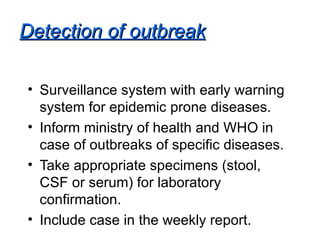
Detection of outbreak Surveillance system with early warning system for epidemic prone diseases. Inform ministry of health and WHO in case of outbreaks of specific diseases. Take appropriate specimens (stool, CSF or serum) for laboratory confirmation. Include case in the weekly report.
Steps in the management of a communicable disease outbreak Preparation Detection Response Evaluation
Response to the outbreak Confirm the outbreak Activate the outbreak control team Investigate the outbreak Control the outbreak
Steps in the management of a communicable disease outbreak Preparation Detection Response Evaluation
Evaluation  Assess appropriateness and effectiveness of containment measures. Assess timelines of outbreak detection and response. Change public health policy if indicated. Write and disseminate outbreak report.
Global Disease Eradication Efforts Methods to accomplish the goal of eradication of  diseases include: immunization and vaccination drug therapy community training health education national disease surveillance efforts
examples 7 diseases have been targeted for eradication in early 21st century: polio measles leprosy river blindness Chagas’ disease guinea worm disease lymphatic filariasis
Nurses’ Role   Community health nurses play an important role with regarded to all population at risk for communicable disease  Nurses concerned with communicable disease control  must  Recognize who at risk  Where the reservoirs and source of infectious disease agents are located  What environmental factors promote the spread
What comprise the characteristic of vulnerability of community member and groups-particularly those subject to intervention  Community health nurses  must  work collaboratively with other public health professional to establish immunization and educational programs , to improve community infection control policies , and to develop abroad range of services to population at risk

Communicable disease

  • 1.
    Us:- Waled AmenMoh Head department, Community Health Nursing UMST Communicable Diseases
  • 2.
    Introduction Communicable Diseasesare the major causes of morbidity and mortality. Main causes of morbidity and mortality in emergencies are diarrheal diseases, acute respiratory infections, measles and in areas where it is endemic malaria.
  • 3.
    Introduction Other communicablediseases that have also in the past caused epidemics amongst population affected by emergencies are meningococcal disease, tuberculosis and typhus. Malnutrition and trauma are additional causes of illness and death amongst populations affected by communicable diseases.
  • 4.
    Definitions Communicable Disease is one that can transmitted from one person to another and is caused by an infectious agent that is transmitted from a source or reservoir to a susceptible host. Infectious diseases is one that caused by infectious agent.
  • 5.
    Outbreak o occurrenceof new cases of a disease clearly in excess of the baseline frequency of the disease in a defined community over a given time period o point source outbreak: an outbreak due to exposure of a group of people to a noxious influence that is common to the individuals in the group • the exposure is brief and essentially simultaneous, resultant cases all develop within 1 incubation period of the disease o propagated outbreak: an outbreak where there are multiple exposures over a period of time, from host to host (directly or indirectly), resulting in cases that are not within 1 incubation period
  • 6.
    Epidemic occurrence, ina community or region, of a group of illnesses of a similar nature in excess of normal expectancy Endemic habitual presence of a disease or agent within a geographic area based on the usual prevalence of a given disease within such an area Pandemic an epidemic which is worldwide in distribution Host person/animal that affords subsistence to an infectious agent under natural conditions Carrier person/animal that harbors a specific infectious agent in the absence of discernible clinical disease and serves as a potential source of infection
  • 7.
    Fomite o contaminatedsubstance (not necessarily a reservoir) serving as an intermediate means of transport for an infectious agent Reservoir o anything (living or inert) in which an infectious agent lives and multiplies in such a manner that it can be transmitted to a susceptible host Vector o invertebrate animal capable of transmitting an infectious agent to vertebrates Virulence o ability of an infectious agent to cause severe or fatal infections
  • 8.
    IMMUNITY o active• altered organism or its product induces a host to produce antibodies (e.g. natural measles infection or live vaccine) o passive • protective antibodies produced by another host which are introduced into susceptible persons (e.g. natural transplacental IgG from mother to infant) o inherent • endogenous production of antibody o herd • expression used to describe immunity of a group or community • resistance of a group to an infectious agent based on the immunity of many individuals in the group • implies transmission interruption when < 100% of group is immune due to separation of few susceptibles
  • 9.
    Transmission of InfectiousAgents Transmission refers to any mechanism by which an infectious agent is spread from a source or reservoir to a person. Reservoir. Mode of infection. Susceptible host.
  • 10.
    Six Factors furtheringprocess Agent Reservoir Portal of exit Mode of transmission Portal of entry Susceptible host
  • 11.
    Man 1=Case :-casecan be prevented and controlled by 1-Identification:- --presentation:- This involves signs and symptoms of this disease. --Lab finding :- Diagnostic test, or physical examination --complications That may arise due to this disease. Reservoir
  • 12.
    Case 2-Treatment 3-Isolation:- this needs to determine communicability period 4 -Health education:- About -S&S of complication -treatment Man
  • 13.
    carrier 2=carrier:- 1-Typesof carrier -by type .healthy carrier .incubatory carrier .convalescence carrier -by portal of exit .respiratory carrier .GIT carrier . GUT carrier 2-active detection .Household surveillance for early detection of disease Man
  • 14.
    Reservoir 3-health education concerning special hygiene and avoid risk factors 4-Quarantine :- this needs to know Incubation period
  • 15.
    Animal(Reservoir) CaseIdentification Treatment Isolation Extermination Carrier - Type - Active detection - Quarantine - Extermination
  • 16.
    Soil (Reservoir) Disinfection
  • 17.
    Mode of transmission - Direct :-- Direct contact Vertical transmission Droplet infection Animal bite transmission Contact with soil
  • 18.
    Indirect Air-borne Vehicle borne Vector-borne transmission Fomite –borne Hand –borne
  • 19.
    Susceptible host Man 1- the at risk individual Systemic diseases Surgical patients Immunocompromised individuals Genetic based Organ transplant Chemotherapy Radiotherapy HIV infection
  • 20.
    2-health education :-about vaccination and preventive measures 3-immunization :- if available. 4-prophylaxis :- 5-special protective measures :- 6-legislation :-
  • 21.
    Susceptible host Animals1- the at risk 2-prophylaxis 3-special protective measures
  • 22.
    Emerging Infectious DiseasesEmerging infectious diseases are diseases that have appeared for the first time or that have occurred before appeared in populations where they have not previously been reported.
  • 23.
    Reemerging Infectious DiseasesReemerging infectious diseases are familiar diseases caused by well-understood organisms that were once under control or declining but now are resistant to common drugs or gaining new footholds in the population and increasing in incidence.
  • 24.
    Fundamental principles ofControl of Communicable Diseases Rapid Assessment Prevention Surveillance Outbreak Control Disease Management
  • 25.
    Modern Conditions thatFavor the Spread of Infectious Diseases Global travel Globalization of food supply and centralization of food processing Population growth, increased urbanization and overcrowding Migration due to wars, famines, and natural disasters
  • 26.
    Modern Conditions thatFavor the Spread of Infectious Diseases Irrigation, deforestation, and reforestation projects that alter habitats Human behaviors, such as IV drug use and risky sexual behavior Increased use of antimicrobial agents and pesticides Increased human contact with wilderness habitats
  • 27.
    Prevention of communicablediseases:- Communicable diseases can be prevented by appropriate preventive measures which include: Good site planning Provision of basic clinical services Provision of appropriate shelter Clean water supply Sanitation Mass vaccination against specific diseases Regular and sufficient food supply Control of vectors
  • 28.
    Primary Prevention Increasingthe resistance of the host Inactivating the agent Interrupt the chain of infection Restricting spread of infection isolation quarantine segregation personal surveillance
  • 29.
    Secondary Prevention Activitiestargeted at detecting disease at earliest possible time to: begin treatment stop progression protect others in the community Examples of activities: case finding, health screening, health education
  • 30.
    Tertiary Prevention Limitsthe progression of disability Treatment of symptoms and rehabilitation vary with each specific disease
  • 31.
    Surveillance Surveillance isthe ongoing systematic collection,analysis and interpretation of data in order to plan, implement and evaluate public health intervention. Surveillance system should be simple, flexible, acceptable.
  • 32.
    Outbreak Control Anoutbreak is occurrence of a number of cases of a disease that is unusually large or unexpected for a given place and time . Outbreaks and epidemics refer to the one and same thing. Outbreaks in emergency situations can spread rapidly giving rise to high morbidity and mortality rates. Aim should be to detect and control the outbreak as early as possible.
  • 33.
    Steps in themanagement of a communicable disease outbreak Preparation Detection Response Evaluation
  • 34.
    Preparation for theoutbreak Health coordination meetings Strong surveillance system Outbreak response plan for each disease Stocks of iv fluids, antibiotics and vaccines Plans for isolation wards Laboratory support
  • 35.
    Steps in themanagement of a communicable disease outbreak Preparation Detection Response Evaluation
  • 36.
    Detection of outbreakSurveillance system with early warning system for epidemic prone diseases. Inform ministry of health and WHO in case of outbreaks of specific diseases. Take appropriate specimens (stool, CSF or serum) for laboratory confirmation. Include case in the weekly report.
  • 37.
    Steps in themanagement of a communicable disease outbreak Preparation Detection Response Evaluation
  • 38.
    Response to theoutbreak Confirm the outbreak Activate the outbreak control team Investigate the outbreak Control the outbreak
  • 39.
    Steps in themanagement of a communicable disease outbreak Preparation Detection Response Evaluation
  • 40.
    Evaluation Assessappropriateness and effectiveness of containment measures. Assess timelines of outbreak detection and response. Change public health policy if indicated. Write and disseminate outbreak report.
  • 41.
    Global Disease EradicationEfforts Methods to accomplish the goal of eradication of diseases include: immunization and vaccination drug therapy community training health education national disease surveillance efforts
  • 42.
    examples 7 diseaseshave been targeted for eradication in early 21st century: polio measles leprosy river blindness Chagas’ disease guinea worm disease lymphatic filariasis
  • 43.
    Nurses’ Role Community health nurses play an important role with regarded to all population at risk for communicable disease Nurses concerned with communicable disease control must Recognize who at risk Where the reservoirs and source of infectious disease agents are located What environmental factors promote the spread
  • 44.
    What comprise thecharacteristic of vulnerability of community member and groups-particularly those subject to intervention Community health nurses must work collaboratively with other public health professional to establish immunization and educational programs , to improve community infection control policies , and to develop abroad range of services to population at risk

Editor's Notes

  • #5 The source or reservoir can be a person ,animal , insect, or inanimate material