DISEASES: What it is and what it's not.
Disease It is a term for an abnormal condition that impairs the normal functioning of the body.
Disease causes… Discomfort, Dysfunction, Distress and Death. Disabilities, Disorders, Syndromes, Infections and other unusual variations of structure and functions.
Types of Diseases: COMMUNICABLE/CONTAGIOUS These are infectious disease capable of passing from one person to another.
NON-COMMUNICABLE DISEASE Are those diseases which are not infectious which may result from genetics or lifestyle.
MORBIDITY vs. MORTALITY Morbidity- refers to the degree of severity of a disease. Mortality- is the quality or condition of being mortal; the term is usually used to determine the measure of the number of deaths.
Conditions Contributing to Disease
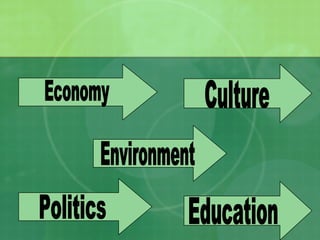
Economy Culture Environment Politics Education
ECONOMY Poverty usually is a source of illness because of deprivation of medical attention for its high cost.
CULTURE Cultural or traditional beliefs hinders medical attention. Consulting from questionable medical practices by quack doctors, faith healers and other fake healers holds back proper medical procedures.
ENVIRONMENT Potential causes of death and illness depends on the interaction between the environment and individual.
Politics has great effect on illness and death of an individual or the whole community. Government officials have a big responsibility regarding programs like hospitals, health care and health centers.
Possibly, education or information has the biggest effect on death and illness.
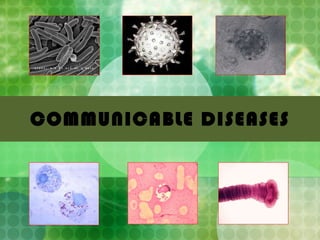
COMMUNICABLE DISEASES
Communicable/Infectious diseases These are illnesses sourced from pathogens which spread from lining thing to another.  Pathogens  can enter the body through direct or indirect contact causing illnesses like influenza.
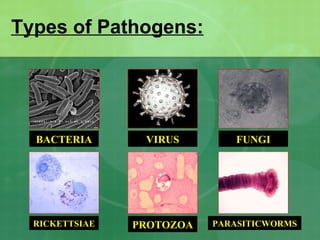
It is a biological agent that causes diseases or illness to its host. These are organisms, frequently microorganisms, or components of these organisms which include various species of bacteria, viruses and protozoa.
Types of Pathogens: BACTERIA RICKETTSIAE PROTOZOA PARASITICWORMS FUNGI VIRUS
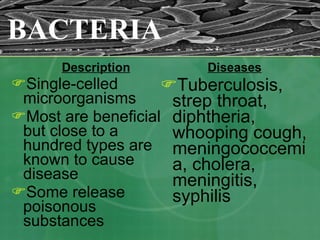
Description Single-celled microorganisms Most are beneficial but close to a hundred types are known to cause disease Some release poisonous substances Diseases Tuberculosis, strep throat, diphtheria, whooping cough, meningococcemia, cholera, meningitis, syphilis BACTERIA
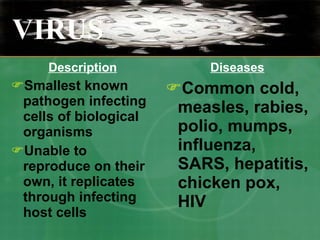
Description Smallest known pathogen infecting cells of biological organisms Unable to reproduce on their own, it replicates through infecting host cells Diseases Common cold, measles, rabies, polio, mumps, influenza, SARS, hepatitis, chicken pox, HIV VIRUS
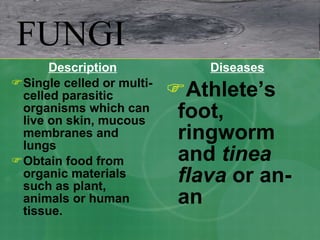
Description Single celled or multi-celled parasitic organisms which can live on skin, mucous membranes and lungs Obtain food from organic materials such as plant, animals or human tissue. Diseases Athlete’s foot, ringworm and  tinea flava  or an-an FUNGI
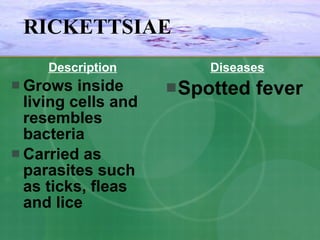
Description Grows inside living cells and resembles bacteria Carried as parasites such as ticks, fleas and lice Diseases Spotted fever RICKETTSIAE
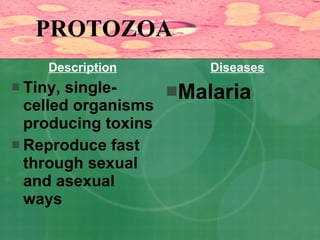
Description Tiny, single-celled organisms producing toxins Reproduce fast through sexual and asexual ways Diseases Malaria PROTOZOA
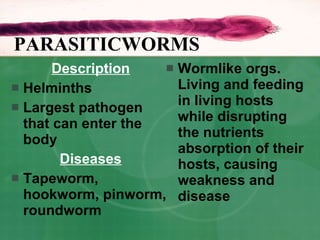
Description Helminths Largest pathogen that can enter the body Diseases Tapeworm, hookworm, pinworm, roundworm Wormlike orgs. Living and feeding in living hosts while disrupting the nutrients absorption of their hosts, causing weakness and disease PARASITICWORMS
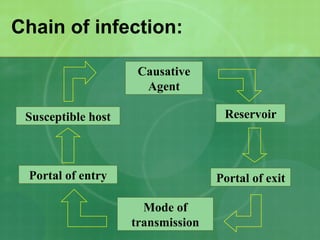
Chain of infection: Causative Agent Reservoir Portal of exit Mode of transmission Portal of entry Susceptible host
Causative Agent  (Infectious Agent) It is a microbial organism with the ability to cause disease. Example:  Bacteria, Virus, Fungi and Parasites.
Reservoir It is a place where microorganisms can thrive and reproduce. Microorganisms can thrive in  human beings, animals and inanimate objects such as water, table tops and door knobs.
Portal of Exit or Mode of Exit It is a place of exit providing a way for a microorganism to leave the reservoir. Principal portals of exit are:  Digestive system, urinary system, respiratory system, reproductive system and the blood.
Mode of Transmission It is a method of transfer by which the microorganism  moves or is carried from one place to another  or  from reservoir to a susceptible host.
Portal of Entry It may be any opening allowing the microorganism to enter the host. It is within the same system of portals of exit.
Susceptible Host It is an individual who cannot resist a microorganism invading the body, multiplying and resulting infection. HOST- a person susceptible to disease, lacking physical resistance to overcome the invasion of the pathogenic organism.
COMMON COMMUNICABLE DISEASES
COLD - most common infectious disease INFLUENZA - viral infection
PNEUMONIA -  infection in the lungs by viruses, bacteria and other pathogens.( chest pain)
Chicken Pox Small red spots that become blisters/ scabs 13- 17 days Early stage of rupture of blisters
MEASLES Long lasting cough in the morning Slight fever in the afternoon Sweating at night Chest and back pain Pale Skin Hoarse voice
STREP THROAT Sore throat, fever, nausea, vomiting high fever and muscle ache
MUMPS Spreads through saliva Parotid salivary glands Fever, swelling and pain
BODY DEFENSES First Line of Defense SKIN TINY HAIR MUCOUS MEMBRANE
Second Line of Defense White Blood Cells inflammation
Third Line of Defense Antibodies Active immunity Passive immunity
These are illnesses caused by pathogens that are easily passed on from one to another. These are not caused by pathogens and cant be transferred from one person to another. It is the resistance to disease through the activities of our immune system Quiz #3
1. It is a place where microorganisms can thrive and reproduce. 2. A person susceptible to disease, lacking physical resistance to overcome the invasion of the pathogenic organism.
3 .  It is a method of transfer by which the microorganism  moves from reservoir to a susceptible host. 4.  It may be any opening allowing the microorganism to enter the host.
5.   It is a microbial organism with the ability to cause disease. 6.  It is a place where microorganisms can thrive and reproduce. 7. It is the transmission of a pathogenic agent through the various links.
Write the process how the character got sick. By way of illustration, write the six elements of chain of infection.
Alice is a student in a prestigious school in the city. With air conditioned rooms conducive for learning, students were given comfort. One of her classmates who happen to be her seatmate is suffering
from colds and sneezes every now and then. Alice could not do away with it since they stay in one classroom. After few days, symptoms of common colds were also seen in her.

Communicable diseases

  • 1.
    DISEASES: What itis and what it's not.
  • 2.
    Disease It isa term for an abnormal condition that impairs the normal functioning of the body.
  • 3.
    Disease causes… Discomfort,Dysfunction, Distress and Death. Disabilities, Disorders, Syndromes, Infections and other unusual variations of structure and functions.
  • 4.
    Types of Diseases:COMMUNICABLE/CONTAGIOUS These are infectious disease capable of passing from one person to another.
  • 5.
    NON-COMMUNICABLE DISEASE Arethose diseases which are not infectious which may result from genetics or lifestyle.
  • 6.
    MORBIDITY vs. MORTALITYMorbidity- refers to the degree of severity of a disease. Mortality- is the quality or condition of being mortal; the term is usually used to determine the measure of the number of deaths.
  • 7.
  • 8.
    Economy Culture EnvironmentPolitics Education
  • 9.
    ECONOMY Poverty usuallyis a source of illness because of deprivation of medical attention for its high cost.
  • 10.
    CULTURE Cultural ortraditional beliefs hinders medical attention. Consulting from questionable medical practices by quack doctors, faith healers and other fake healers holds back proper medical procedures.
  • 11.
    ENVIRONMENT Potential causesof death and illness depends on the interaction between the environment and individual.
  • 12.
    Politics has greateffect on illness and death of an individual or the whole community. Government officials have a big responsibility regarding programs like hospitals, health care and health centers.
  • 13.
    Possibly, education orinformation has the biggest effect on death and illness.
  • 14.
  • 15.
    Communicable/Infectious diseases Theseare illnesses sourced from pathogens which spread from lining thing to another. Pathogens can enter the body through direct or indirect contact causing illnesses like influenza.
  • 16.
    It is abiological agent that causes diseases or illness to its host. These are organisms, frequently microorganisms, or components of these organisms which include various species of bacteria, viruses and protozoa.
  • 17.
    Types of Pathogens:BACTERIA RICKETTSIAE PROTOZOA PARASITICWORMS FUNGI VIRUS
  • 18.
    Description Single-celled microorganismsMost are beneficial but close to a hundred types are known to cause disease Some release poisonous substances Diseases Tuberculosis, strep throat, diphtheria, whooping cough, meningococcemia, cholera, meningitis, syphilis BACTERIA
  • 19.
    Description Smallest knownpathogen infecting cells of biological organisms Unable to reproduce on their own, it replicates through infecting host cells Diseases Common cold, measles, rabies, polio, mumps, influenza, SARS, hepatitis, chicken pox, HIV VIRUS
  • 20.
    Description Single celledor multi-celled parasitic organisms which can live on skin, mucous membranes and lungs Obtain food from organic materials such as plant, animals or human tissue. Diseases Athlete’s foot, ringworm and tinea flava or an-an FUNGI
  • 21.
    Description Grows insideliving cells and resembles bacteria Carried as parasites such as ticks, fleas and lice Diseases Spotted fever RICKETTSIAE
  • 22.
    Description Tiny, single-celledorganisms producing toxins Reproduce fast through sexual and asexual ways Diseases Malaria PROTOZOA
  • 23.
    Description Helminths Largestpathogen that can enter the body Diseases Tapeworm, hookworm, pinworm, roundworm Wormlike orgs. Living and feeding in living hosts while disrupting the nutrients absorption of their hosts, causing weakness and disease PARASITICWORMS
  • 24.
    Chain of infection:Causative Agent Reservoir Portal of exit Mode of transmission Portal of entry Susceptible host
  • 25.
    Causative Agent (Infectious Agent) It is a microbial organism with the ability to cause disease. Example: Bacteria, Virus, Fungi and Parasites.
  • 26.
    Reservoir It isa place where microorganisms can thrive and reproduce. Microorganisms can thrive in human beings, animals and inanimate objects such as water, table tops and door knobs.
  • 27.
    Portal of Exitor Mode of Exit It is a place of exit providing a way for a microorganism to leave the reservoir. Principal portals of exit are: Digestive system, urinary system, respiratory system, reproductive system and the blood.
  • 28.
    Mode of TransmissionIt is a method of transfer by which the microorganism moves or is carried from one place to another or from reservoir to a susceptible host.
  • 29.
    Portal of EntryIt may be any opening allowing the microorganism to enter the host. It is within the same system of portals of exit.
  • 30.
    Susceptible Host Itis an individual who cannot resist a microorganism invading the body, multiplying and resulting infection. HOST- a person susceptible to disease, lacking physical resistance to overcome the invasion of the pathogenic organism.
  • 31.
  • 32.
    COLD - mostcommon infectious disease INFLUENZA - viral infection
  • 33.
    PNEUMONIA - infection in the lungs by viruses, bacteria and other pathogens.( chest pain)
  • 34.
    Chicken Pox Smallred spots that become blisters/ scabs 13- 17 days Early stage of rupture of blisters
  • 35.
    MEASLES Long lastingcough in the morning Slight fever in the afternoon Sweating at night Chest and back pain Pale Skin Hoarse voice
  • 36.
    STREP THROAT Sorethroat, fever, nausea, vomiting high fever and muscle ache
  • 37.
    MUMPS Spreads throughsaliva Parotid salivary glands Fever, swelling and pain
  • 38.
    BODY DEFENSES FirstLine of Defense SKIN TINY HAIR MUCOUS MEMBRANE
  • 39.
    Second Line ofDefense White Blood Cells inflammation
  • 40.
    Third Line ofDefense Antibodies Active immunity Passive immunity
  • 41.
    These are illnessescaused by pathogens that are easily passed on from one to another. These are not caused by pathogens and cant be transferred from one person to another. It is the resistance to disease through the activities of our immune system Quiz #3
  • 42.
    1. It isa place where microorganisms can thrive and reproduce. 2. A person susceptible to disease, lacking physical resistance to overcome the invasion of the pathogenic organism.
  • 43.
    3 . It is a method of transfer by which the microorganism moves from reservoir to a susceptible host. 4. It may be any opening allowing the microorganism to enter the host.
  • 44.
    5. It is a microbial organism with the ability to cause disease. 6. It is a place where microorganisms can thrive and reproduce. 7. It is the transmission of a pathogenic agent through the various links.
  • 45.
    Write the processhow the character got sick. By way of illustration, write the six elements of chain of infection.
  • 46.
    Alice is astudent in a prestigious school in the city. With air conditioned rooms conducive for learning, students were given comfort. One of her classmates who happen to be her seatmate is suffering
  • 47.
    from colds andsneezes every now and then. Alice could not do away with it since they stay in one classroom. After few days, symptoms of common colds were also seen in her.