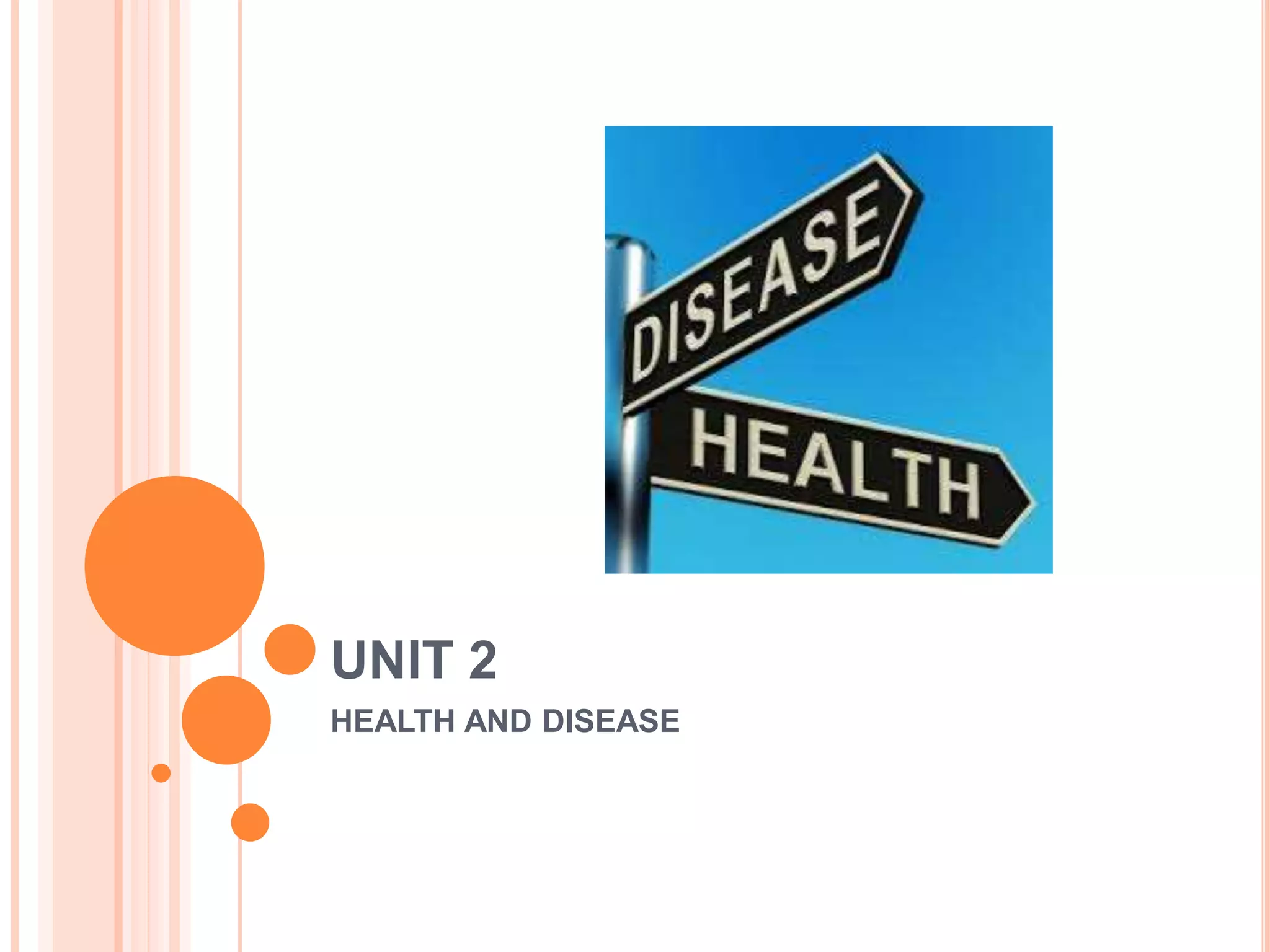
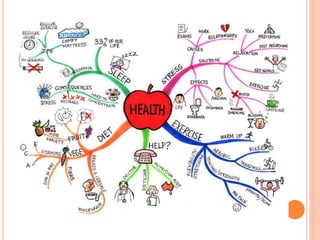
UNIT 2 
HEALTH AND DISEASE
TOPICS: (WHAT TO LEARN ) 
 1. THE WHO DEFINITION OF HEALTH 
 2. THE DETERMINANTS OF HEALTH 
 3. TYPES OF DISEASES 
 4. DEFINITION OF INFECTIOUS DISEASE 
 5. WAYS OF TRANSMISSION OF INFECTIOUS 
DISEASES 
 6. EXTERNAL DEFENCES 
 7. INTERNAL DEFENCES 
 8. PERIOD OF INFECTIOUS DISEASE 
 9. DEFINITION OF INFECTION 
 10. THE TREATMENT AND PREVENTION OF 
ILLNESS
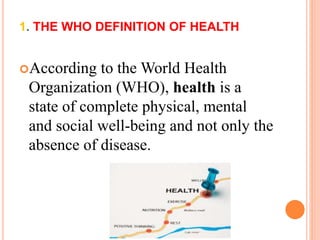
1. THE WHO DEFINITION OF HEALTH 
According to the World Health 
Organization (WHO), health is a 
state of complete physical, mental 
and social well-being and not only the 
absence of disease.
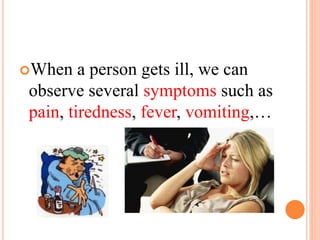
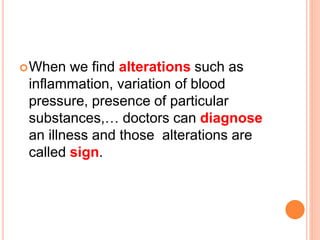
When a person gets ill, we can 
observe several symptoms such as 
pain, tiredness, fever, vomiting,…
When we find alterations such as 
inflammation, variation of blood 
pressure, presence of particular 
substances,… doctors can diagnose 
an illness and those alterations are 
called sign.
2. 
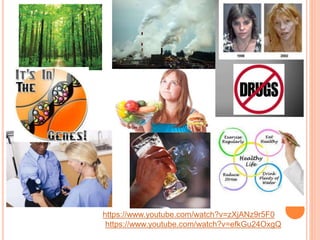
 Whether people are healthy or not, is determined 
by their circumstances such as: 
- The environment: far away from biologic 
elements(microorganism), physic elements 
(radiation and noise) and chemical elements 
(pollutans). 
- Acquisition of healthy habits and ways of living, 
such as doing sports, no smoking, no drinking 
alcoholic drinks, balanced eating,… 
- Genetics factors that include inheritance of 
characteristics and age. 
- Health services, access and use of services that 
prevent and treat diseases.
https://www.youtube.com/watch?v=zXjANz9r5F0 
https://www.youtube.com/watch?v=efkGu24OxgQ
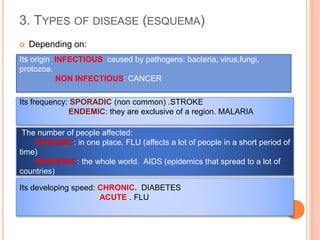
3. TYPES OF DISEASE (ESQUEMA) 
 Depending on: 
Its origin: INFECTIOUS caused by pathogens: bacteria, virus,fungi, 
protozoa. 
NON INFECTIOUS: CANCER 
Its frequency: SPORADIC (non common) .STROKE 
ENDEMIC: they are exclusive of a region. MALARIA 
The number of people affected: 
EPIDEMIC: in one place. FLU (affects a lot of people in a short period of 
time) 
PANDEMIC: the whole world. AIDS (epidemics that spread to a lot of 
countries) 
Its developing speed: CHRONIC. DIABETES 
ACUTE . FLU
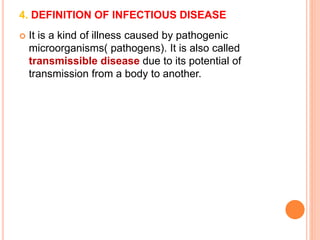
4. DEFINITION OF INFECTIOUS DISEASE 
 It is a kind of illness caused by pathogenic 
microorganisms( pathogens). It is also called 
transmissible disease due to its potential of 
transmission from a body to another.
Pathogens and disease 
Today you will be learning about what pathogens are 
and how they can spread
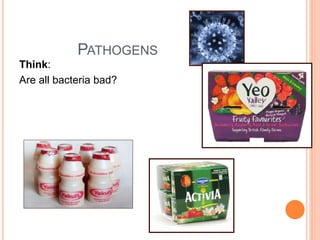
PATHOGENS 
Think: 
Are all bacteria bad?
4. DEFINITION OF INFECTIOUS DISEASE 
 It is a kind of illness caused by pathogenic 
microorganisms( pathogens). It is also called 
transmissible disease due to its potential of 
transmission from a body to another. 
 Types of pathogens: 
BACTERIA: cause disease through their own or production of toxins. 
Examples: TUBERCULOSIS, SALMONELLA, TETANUS 
PROTOZOA: cause MALARIA, DYSENTERY 
VIRUS: They aren´t living things. Examples: HIV, FLU; VARICELLA 
FUNGI: cause mycosis. ATHLETE´S FOOT
Diseases caused by pathogens 
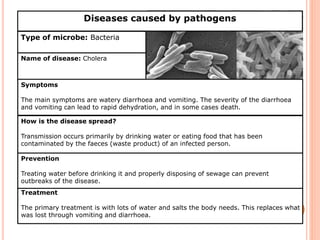
Type of microbe: Bacteria 
Name of disease: Cholera 
Symptoms 
The main symptoms are watery diarrhoea and vomiting. The severity of the diarrhoea 
and vomiting can lead to rapid dehydration, and in some cases death. 
How is the disease spread? 
Transmission occurs primarily by drinking water or eating food that has been 
contaminated by the faeces (waste product) of an infected person. 
Prevention 
Treating water before drinking it and properly disposing of sewage can prevent 
outbreaks of the disease. 
Treatment 
The primary treatment is with lots of water and salts the body needs. This replaces what 
was lost through vomiting and diarrhoea.
Diseases caused by pathogens 
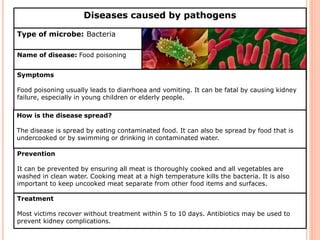
Type of microbe: Bacteria 
Name of disease: Food poisoning 
Symptoms 
Food poisoning usually leads to diarrhoea and vomiting. It can be fatal by causing kidney 
failure, especially in young children or elderly people. 
How is the disease spread? 
The disease is spread by eating contaminated food. It can also be spread by food that is 
undercooked or by swimming or drinking in contaminated water. 
Prevention 
It can be prevented by ensuring all meat is thoroughly cooked and all vegetables are 
washed in clean water. Cooking meat at a high temperature kills the bacteria. It is also 
important to keep uncooked meat separate from other food items and surfaces. 
Treatment 
Most victims recover without treatment within 5 to 10 days. Antibiotics may be used to 
prevent kidney complications.
Diseases caused by pathogens 
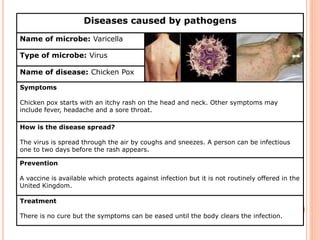
Name of microbe: Varicella 
Type of microbe: Virus 
Name of disease: Chicken Pox 
Symptoms 
Chicken pox starts with an itchy rash on the head and neck. Other symptoms may 
include fever, headache and a sore throat. 
How is the disease spread? 
The virus is spread through the air by coughs and sneezes. A person can be infectious 
one to two days before the rash appears. 
Prevention 
A vaccine is available which protects against infection but it is not routinely offered in the 
United Kingdom. 
Treatment 
There is no cure but the symptoms can be eased until the body clears the infection.
Diseases caused by pathogens 
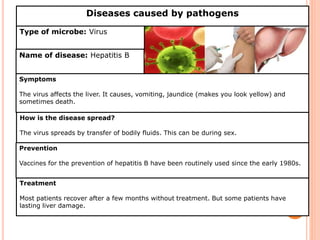
Type of microbe: Virus 
Name of disease: Hepatitis B 
Symptoms 
The virus affects the liver. It causes, vomiting, jaundice (makes you look yellow) and 
sometimes death. 
How is the disease spread? 
The virus spreads by transfer of bodily fluids. This can be during sex. 
Prevention 
Vaccines for the prevention of hepatitis B have been routinely used since the early 1980s. 
Treatment 
Most patients recover after a few months without treatment. But some patients have 
lasting liver damage.
Diseases caused by pathogens 
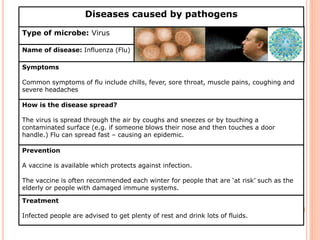
Type of microbe: Virus 
Name of disease: Influenza (Flu) 
Symptoms 
Common symptoms of flu include chills, fever, sore throat, muscle pains, coughing and 
severe headaches 
How is the disease spread? 
The virus is spread through the air by coughs and sneezes or by touching a 
contaminated surface (e.g. if someone blows their nose and then touches a door 
handle.) Flu can spread fast – causing an epidemic. 
Prevention 
A vaccine is available which protects against infection. 
The vaccine is often recommended each winter for people that are ‘at risk’ such as the 
elderly or people with damaged immune systems. 
Treatment 
Infected people are advised to get plenty of rest and drink lots of fluids.
Diseases caused by pathogens 
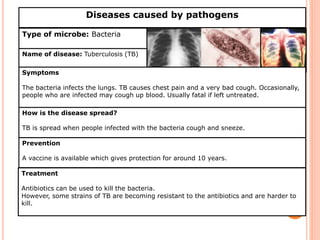
Type of microbe: Bacteria 
Name of disease: Tuberculosis (TB) 
Symptoms 
The bacteria infects the lungs. TB causes chest pain and a very bad cough. Occasionally, 
people who are infected may cough up blood. Usually fatal if left untreated. 
How is the disease spread? 
TB is spread when people infected with the bacteria cough and sneeze. 
Prevention 
A vaccine is available which gives protection for around 10 years. 
Treatment 
Antibiotics can be used to kill the bacteria. 
However, some strains of TB are becoming resistant to the antibiotics and are harder to 
kill.
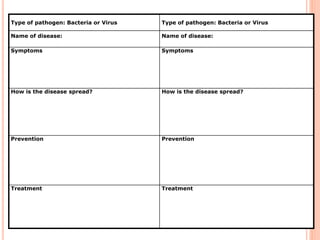
Type of pathogen: Bacteria or Virus Type of pathogen: Bacteria or Virus 
Name of disease: Name of disease: 
Symptoms Symptoms 
How is the disease spread? How is the disease spread? 
Prevention Prevention 
Treatment Treatment
5. WAYS OF TRANSMISSION OF INFECTIOSUS DISEASES 
 Transmission is the passing of a disease from an infected 
individual to an uninfected individual. 
 Pathogens may be transmitted by several ways: 
I. Direct physical contact. Touching an infected person, 
including sexual contact such as MEASLES (sarampión) and 
sexually transmitted diseases (STDs). 
II. Indirect contact. Through objects or droplets released by 
coughing or sneezing like flu (influenza). 
III. Fecal- oral transmission. Usually from a contaminated food 
or water, such as cholera or salmonella. 
IV By air. Pathogen can be on dust particles or floating in the air, 
such as tuberculosis. 
V. Vector borne transmission. Carried by insects or other 
animals, such as malaria or black death.
6. EXTERNAL DEFENCES 
Stop diseases getting into our bodies (and foreign 
particles) : 
 STRUCTURAL : skin and mucosa (internal and 
external covering) : Digestive and respiratory 
cavities. 
 BIOCHEMICAL: saliva, tears, gastric acid. 
 MECHANICAL: they drag pathogens. Cilia and 
mucus. 
 ECOLOGICAL: non pathogenic microorganisms 
compete with pathogenic microorganisms.
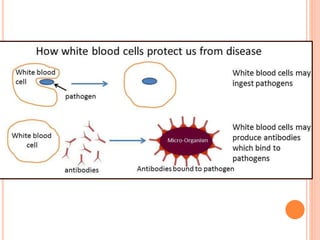
7. INTERNAL DEFENCES 
 NON SPECIFIC: PHAGOCYTE 
They are white blood cells. Carry out phagocytosis, 
ingestion of harmful foreign particles. 
 SPECIFIC: LYMPHOCYTE 
They are white blood cells. There are two types: 
B Cells: produce antibodies 
T Cells: kill specific pathogens through lisis.
8. PERIODS OF INFECTIOUS DISEASE 
 Period of incubation : 
- It´s the interval occurring between the start of the infection and the 
appearance of symptoms. 
- The patient does not know it yet. 
- The length of this periods depends on the pathogen characteristics. 
 Period of illness: 
- It´s the beginning of appearance of symptoms. 
- The patient is starting to get sick. 
 Period of convalescence(recovery) 
- The pathogens have been eliminated 
- The body repairs the damage caused by the infection
9. INFECTION 
 It is the colonisation of the body by microorganisms which cause 
a disease. 
 There are a lot of different kinds of infections: 
a. Opportunistic infection: when a pathogen which live in one 
part of the body normally passes to a different part of the body 
causing a disease.(example AIDS) 
b. Local infection: it is limited to a small area of the body. 
(example pharyngitis). 
c. Systemic infection: it starts by a local infection then it 
spreads for all over the body (example tetanus). 
d. Latent infection. It´s inactive though continuing to infect 
(Herpesvirus). 
e. Chronic infection. It is an infection that develops slowly and 
lasts a long time (example Hepatitis C).
10. THE TREATMENT AND 
PREVENTION OF ILLNESS 
 It´s health care through three levels: 
- Primary Health Care with PHC primary health 
care physicians. 
- Specialised doctors: they are specialists in organs 
such as cardiologist, neurologist. 
- Hospitalization: in Hospital where we carry out 
medical test and operations.
Unit 2 health and disease

Unit 2 health and disease

  • 1.
    UNIT 2 HEALTHAND DISEASE
  • 2.
    TOPICS: (WHAT TOLEARN )  1. THE WHO DEFINITION OF HEALTH  2. THE DETERMINANTS OF HEALTH  3. TYPES OF DISEASES  4. DEFINITION OF INFECTIOUS DISEASE  5. WAYS OF TRANSMISSION OF INFECTIOUS DISEASES  6. EXTERNAL DEFENCES  7. INTERNAL DEFENCES  8. PERIOD OF INFECTIOUS DISEASE  9. DEFINITION OF INFECTION  10. THE TREATMENT AND PREVENTION OF ILLNESS
  • 3.
    1. THE WHODEFINITION OF HEALTH According to the World Health Organization (WHO), health is a state of complete physical, mental and social well-being and not only the absence of disease.
  • 4.
    When a persongets ill, we can observe several symptoms such as pain, tiredness, fever, vomiting,…
  • 5.
    When we findalterations such as inflammation, variation of blood pressure, presence of particular substances,… doctors can diagnose an illness and those alterations are called sign.
  • 6.
    2.  Whetherpeople are healthy or not, is determined by their circumstances such as: - The environment: far away from biologic elements(microorganism), physic elements (radiation and noise) and chemical elements (pollutans). - Acquisition of healthy habits and ways of living, such as doing sports, no smoking, no drinking alcoholic drinks, balanced eating,… - Genetics factors that include inheritance of characteristics and age. - Health services, access and use of services that prevent and treat diseases.
  • 7.
  • 8.
    3. TYPES OFDISEASE (ESQUEMA)  Depending on: Its origin: INFECTIOUS caused by pathogens: bacteria, virus,fungi, protozoa. NON INFECTIOUS: CANCER Its frequency: SPORADIC (non common) .STROKE ENDEMIC: they are exclusive of a region. MALARIA The number of people affected: EPIDEMIC: in one place. FLU (affects a lot of people in a short period of time) PANDEMIC: the whole world. AIDS (epidemics that spread to a lot of countries) Its developing speed: CHRONIC. DIABETES ACUTE . FLU
  • 9.
    4. DEFINITION OFINFECTIOUS DISEASE  It is a kind of illness caused by pathogenic microorganisms( pathogens). It is also called transmissible disease due to its potential of transmission from a body to another.
  • 10.
    Pathogens and disease Today you will be learning about what pathogens are and how they can spread
  • 11.
    PATHOGENS Think: Areall bacteria bad?
  • 12.
    4. DEFINITION OFINFECTIOUS DISEASE  It is a kind of illness caused by pathogenic microorganisms( pathogens). It is also called transmissible disease due to its potential of transmission from a body to another.  Types of pathogens: BACTERIA: cause disease through their own or production of toxins. Examples: TUBERCULOSIS, SALMONELLA, TETANUS PROTOZOA: cause MALARIA, DYSENTERY VIRUS: They aren´t living things. Examples: HIV, FLU; VARICELLA FUNGI: cause mycosis. ATHLETE´S FOOT
  • 13.
    Diseases caused bypathogens Type of microbe: Bacteria Name of disease: Cholera Symptoms The main symptoms are watery diarrhoea and vomiting. The severity of the diarrhoea and vomiting can lead to rapid dehydration, and in some cases death. How is the disease spread? Transmission occurs primarily by drinking water or eating food that has been contaminated by the faeces (waste product) of an infected person. Prevention Treating water before drinking it and properly disposing of sewage can prevent outbreaks of the disease. Treatment The primary treatment is with lots of water and salts the body needs. This replaces what was lost through vomiting and diarrhoea.
  • 14.
    Diseases caused bypathogens Type of microbe: Bacteria Name of disease: Food poisoning Symptoms Food poisoning usually leads to diarrhoea and vomiting. It can be fatal by causing kidney failure, especially in young children or elderly people. How is the disease spread? The disease is spread by eating contaminated food. It can also be spread by food that is undercooked or by swimming or drinking in contaminated water. Prevention It can be prevented by ensuring all meat is thoroughly cooked and all vegetables are washed in clean water. Cooking meat at a high temperature kills the bacteria. It is also important to keep uncooked meat separate from other food items and surfaces. Treatment Most victims recover without treatment within 5 to 10 days. Antibiotics may be used to prevent kidney complications.
  • 15.
    Diseases caused bypathogens Name of microbe: Varicella Type of microbe: Virus Name of disease: Chicken Pox Symptoms Chicken pox starts with an itchy rash on the head and neck. Other symptoms may include fever, headache and a sore throat. How is the disease spread? The virus is spread through the air by coughs and sneezes. A person can be infectious one to two days before the rash appears. Prevention A vaccine is available which protects against infection but it is not routinely offered in the United Kingdom. Treatment There is no cure but the symptoms can be eased until the body clears the infection.
  • 16.
    Diseases caused bypathogens Type of microbe: Virus Name of disease: Hepatitis B Symptoms The virus affects the liver. It causes, vomiting, jaundice (makes you look yellow) and sometimes death. How is the disease spread? The virus spreads by transfer of bodily fluids. This can be during sex. Prevention Vaccines for the prevention of hepatitis B have been routinely used since the early 1980s. Treatment Most patients recover after a few months without treatment. But some patients have lasting liver damage.
  • 17.
    Diseases caused bypathogens Type of microbe: Virus Name of disease: Influenza (Flu) Symptoms Common symptoms of flu include chills, fever, sore throat, muscle pains, coughing and severe headaches How is the disease spread? The virus is spread through the air by coughs and sneezes or by touching a contaminated surface (e.g. if someone blows their nose and then touches a door handle.) Flu can spread fast – causing an epidemic. Prevention A vaccine is available which protects against infection. The vaccine is often recommended each winter for people that are ‘at risk’ such as the elderly or people with damaged immune systems. Treatment Infected people are advised to get plenty of rest and drink lots of fluids.
  • 18.
    Diseases caused bypathogens Type of microbe: Bacteria Name of disease: Tuberculosis (TB) Symptoms The bacteria infects the lungs. TB causes chest pain and a very bad cough. Occasionally, people who are infected may cough up blood. Usually fatal if left untreated. How is the disease spread? TB is spread when people infected with the bacteria cough and sneeze. Prevention A vaccine is available which gives protection for around 10 years. Treatment Antibiotics can be used to kill the bacteria. However, some strains of TB are becoming resistant to the antibiotics and are harder to kill.
  • 19.
    Type of pathogen:Bacteria or Virus Type of pathogen: Bacteria or Virus Name of disease: Name of disease: Symptoms Symptoms How is the disease spread? How is the disease spread? Prevention Prevention Treatment Treatment
  • 20.
    5. WAYS OFTRANSMISSION OF INFECTIOSUS DISEASES  Transmission is the passing of a disease from an infected individual to an uninfected individual.  Pathogens may be transmitted by several ways: I. Direct physical contact. Touching an infected person, including sexual contact such as MEASLES (sarampión) and sexually transmitted diseases (STDs). II. Indirect contact. Through objects or droplets released by coughing or sneezing like flu (influenza). III. Fecal- oral transmission. Usually from a contaminated food or water, such as cholera or salmonella. IV By air. Pathogen can be on dust particles or floating in the air, such as tuberculosis. V. Vector borne transmission. Carried by insects or other animals, such as malaria or black death.
  • 21.
    6. EXTERNAL DEFENCES Stop diseases getting into our bodies (and foreign particles) :  STRUCTURAL : skin and mucosa (internal and external covering) : Digestive and respiratory cavities.  BIOCHEMICAL: saliva, tears, gastric acid.  MECHANICAL: they drag pathogens. Cilia and mucus.  ECOLOGICAL: non pathogenic microorganisms compete with pathogenic microorganisms.
  • 22.
    7. INTERNAL DEFENCES  NON SPECIFIC: PHAGOCYTE They are white blood cells. Carry out phagocytosis, ingestion of harmful foreign particles.  SPECIFIC: LYMPHOCYTE They are white blood cells. There are two types: B Cells: produce antibodies T Cells: kill specific pathogens through lisis.
  • 24.
    8. PERIODS OFINFECTIOUS DISEASE  Period of incubation : - It´s the interval occurring between the start of the infection and the appearance of symptoms. - The patient does not know it yet. - The length of this periods depends on the pathogen characteristics.  Period of illness: - It´s the beginning of appearance of symptoms. - The patient is starting to get sick.  Period of convalescence(recovery) - The pathogens have been eliminated - The body repairs the damage caused by the infection
  • 25.
    9. INFECTION It is the colonisation of the body by microorganisms which cause a disease.  There are a lot of different kinds of infections: a. Opportunistic infection: when a pathogen which live in one part of the body normally passes to a different part of the body causing a disease.(example AIDS) b. Local infection: it is limited to a small area of the body. (example pharyngitis). c. Systemic infection: it starts by a local infection then it spreads for all over the body (example tetanus). d. Latent infection. It´s inactive though continuing to infect (Herpesvirus). e. Chronic infection. It is an infection that develops slowly and lasts a long time (example Hepatitis C).
  • 26.
    10. THE TREATMENTAND PREVENTION OF ILLNESS  It´s health care through three levels: - Primary Health Care with PHC primary health care physicians. - Specialised doctors: they are specialists in organs such as cardiologist, neurologist. - Hospitalization: in Hospital where we carry out medical test and operations.